
 100% FREE ACCESS
12th Standard Syllabus & Materials
12th Standard
TN 12th Computer Applications மின்னணு தரவு பரிமாற்றம் Sample Question Papers Study Material - QB365 Set A
NEW12th Standard
TN 12th Computer Applications மின் - வணிக பாதுகாப்பு அமைப்புகள் Sample Question Papers Study Material - QB365 Set A
NEW12th Standard
TN 12th Computer Applications மின்னணு செலுத்தல் முறைகள் Sample Question Papers Study Material - QB365 Set A
NEW12th Standard
TN 12th Computer Applications மின் - வணிகம் Sample Question Papers Study Material - QB365 Set A
NEW12th Standard
TN 12th Computer Applications திறந்த மூல கருத்துருக்கள் Sample Question Papers Study Material - QB365 Set A
NEW12th Standard
TN 12th Computer Applications வலையமைப்பு வடமிடல் Sample Question Papers Study Material - QB365 Set A

Published on: 01/09/2022
QB365 provides a detailed and simple solution for every Possible Book Back Questions in Class 12 Maths Subject - Inverse Trigonometric Functions, English Medium. It will help Students to get more practice questions, Students can Practice these question papers in addition to score best marks.
Download Tamil Nadu 12th Standard Maths question papers, model tests, one-mark questions, important questions, and public exam papers in PDF format. Free study materials and answer keys for TN State Board students.
Questions + Answers key
Take MCQ Maths Test1.
Find the principal value of cot-1 \((\sqrt 3)\)
2.
Find cos-1\((cos(\frac{7\pi}{6}))\)
3.
Find cos-1\((cos(-\frac{\pi}{3}))\)
4.
Find the value of \({ sin }^{ -1 }\left( sin\left( \frac { 2\pi }{ 3 } \right) \right) \)
5.
Find the principal value of sec−1(−2).
6.
Find the value of \(cos\left[ \frac { 1 }{ 2 } { cos }^{ -1 }\left( \frac { 1 }{ 8 } \right) \right] \)
7.
Find the principal value of \({sin }^{ -1 }\left( sin\left( \frac { 5\pi }{ 6 } \right) \right) \)
8.
Find the principal value of \({sin }^{ -1 }\left( sin\left( -\frac { \pi }{ 3 } \right) \right) \)
9.
Find the value, if it exists. If not, give the reason for non-existence.
sin-1 [sin5]
10.
Find the value, if it exists. If not, give the reason for non-existence
\({ tan }^{ -1 }\left( sin\left( -\frac { 5\pi }{ 2 } \right) \right) \)
11.
Find the principal value of cosec-1\((-\sqrt{2})\)
12.
Find the principal value of cot-1 \((\sqrt{3})\)
13.
Find the value of tan(tan-1(-0.2021)).
14.
Find the value of tan (tan−1(1947))
15.
Find the value of \(\tan^{-1}(tan(-\frac{\pi}{6}))\)
16.
Find the domain of the following functions
\(\frac{1}{2}tan^{-1}(1-x^2)-\frac{\pi}{4}\)
17.
Find the value of \({ sin }^{ -1 }\left( sin\left( \frac { 5\pi }{ 4 } \right) \right) \)
18.
Find the period and amplitude of y = 4sin(−2x)
19.
Find the period and amplitude of
y = -sin\((\frac{1}{3}x)\)
20.
Find the value, if it exists. If not, give the reason for non-existence.
sin-1(cos\(\pi\))
21.
Find the value of
\(sin\left[ \frac { \pi }{ 3 } -{ sin }^{ -1 }\left( -\frac { 1 }{ 2 } \right) \right] \)
22.
Find the value of \({ tan }^{ -1 }\left( \sqrt { 3 } \right) -{ sec }^{ -1 }(-2)\)
23.
Find the principal value of
sec-1\((\frac{2}{\sqrt3})\)
24.
Find the value of sec−1\(\left( -\frac { 2\sqrt { 3 } }{ 3 } \right) \)
25.
Find the principal value of cosec−1(−1)
26.
Find the value of
\(tan(tan^{-1}(\frac{7\pi}{4}))\)
27.
Find the value of
\(tan^{-1}(tan\frac{5\pi}{4})\)
28.
Find the domain of the following functions :
\(tan^{-1}(\sqrt{9-x^{2}})\)
29.
Find the principal value of tan−1(\(\sqrt3\))
30.
Find the principal value of cos-1\((\frac{1}{2})\).
31.
Is cos-1(-x) = \(\pi\)-cos−1(x) true? Justify your answer.
32.
State the reason for cos-1\([cos(-\frac{\pi}{6})]\neq \frac{\pi}{6}.\)
33.
Find cos-1 \((-\frac{1}{\sqrt2})\)
34.
Find the principal value of cos−1\(\left( \frac { \sqrt { 3 } }{ 2 } \right) \)
35.
For what value of x does sinx = sin−1x?
36.
Sketch the graph of y = sin\((\frac{1}{3}x)\) for 0\(\le x <6\pi\).
37.
Find the period and amplitude of y = sin 7x
38.
Find the principal value of
\({ Sin }^{ -1 }\left( \frac { 1 }{ \sqrt { 2 } } \right) \)
39.
Find the principal value of sin-1(2), if it exists.
40.
Find the principal value of sin-1\(\left( -\frac { 1 }{ 2 } \right) \)(in radians and degrees).
41.
Prove that 2tan-1\(\frac{1}{2}+tan^{-1}\frac{1}{7}=tan^{-1}\frac{31}{17}\)
42.
Find the domain of
g(x) = sin−1x + cos−1x
43.
Find the value of \({ cos }^{ -1 }\left( cos\frac { \pi }{ 7 } cos\frac { \pi }{ 17 } -sin\frac { \pi }{ 7 } sin\frac { \pi }{ 17 } \right) .\)
44.
Find the value of
\({ cos }^{ -1 }\left( \frac { 1 }{ 2 } \right) +{ sin }^{ -1 }(-1)\)
45.
Find all values of x such that
-5\(\pi\le x \le 5\pi\) and cos x =1
46.
Solve tan-1 2x + tan-1 3x = \(\frac{\pi}{4}\), if 6x2 < 1
47.
Show that \(cot(sin^{ -1 }x)=\frac { \sqrt { 1-x^{ 2 } } }{ x } -1\le x\le 1\)and x \(\neq \) 0
48.
Solve sin-1 x > cos-1x
49.
Prove that tan-1\(\frac{1}{2}+tan^{-1}\frac{1}{3}=\frac{\pi}{4}\)
50.
Prove that tan \(\left( { sin }^{ -1 }x \right) =\frac { x }{ \sqrt { 1-{ x }^{ 2 } } } for|x|<1\)
51.
Prove that \(\frac{\pi}{2}\le sin^{-1}x+2 cos^{-1} x\le\frac{3\pi}{2}\)
52.
If cot-1\(\frac{1}{7}=\theta\), find the value of cos \(\theta\).
53.
For what value of x, the inequality \(\frac { \pi }{ 2 } <{ cos }^{ -1 }(3x-1)<\pi \) holds?
54.
Find the value of
\(2{ cos }^{ -1 }\left( \frac { 1 }{ 2 } \right) +{ sin }^{ -1 }\left( \frac { 1 }{ 2 } \right) \)
55.
Find all values of x such that -6\(\pi\le x \le 6\pi\) and cos x = 0
56.
Solve \(tan^{ -1 }\left( \frac { x-1 }{ x-2 } \right) +tan^{ -1 }\left( \frac { x+1 }{ x+2 } \right) =\frac { \pi }{ 4 } \)
57.
Solve tan-1\(\left( \frac { 1-x }{ 1+x } \right) =\frac { 1 }{ 2 } { tan }^{ -1 }\) x for x > 0
1.
\(
\cot ^{-1}(\sqrt{3})
\)
\(\cot ^{-1}(\sqrt{3}) =\theta
\)
\(\sqrt{3} =\cot \theta
\)
\(\cot \frac{\pi}{6} =\cot \theta
\)
\(\theta =\frac{\pi}{6}
\)
2.
It is known that cos-1 x : [-1, 1]\(\rightarrow\)[0, \(\pi\)] is given by
cos−1x = y if and only if x = cos y for -1\(\le x\le1\ and\ 0\le y \le\pi\)
Thus, we have
cos-1\((cos(-\frac{7\pi}{6}))\) = \(\frac{5\pi}{6}\), since cos\((\frac{7x}{6})=cos(\pi+\frac{\pi}{6})=-\frac{\sqrt3}{2}=cos(\frac{5\pi}{6})\in[0, \pi].\)
3.
It is known that cos-1 x : [-1, 1]\(\rightarrow\)[0, \(\pi\)] is given by
cos−1x = y if and only if x = cos y for -1\(\le x\le1\ and\ 0\le y \le\pi\)
Thus, we have
cos-1\((cos(-\frac{\pi}{3}))\) = cos-1\((cos(-\frac{\pi}{3}))\) = \(\frac{\pi}{3}\), since -\(\frac{\pi}{3}\)\(\notin \) [0, \(\pi\)], but \(\frac{\pi}{3}\in[0, \pi]\)
4.
\({ sin }^{ -1 }\left( sin\left( \frac { 2\pi }{ 3 } \right) \right) \)
= \({ sin }^{ -1 }\left( sin\left( \pi -\frac { \pi }{ 3 } \right) \right) \) \(\left[ \because \frac { 2\pi }{ 3 } \notin \left[ \frac { -\pi }{ 2 } ,\frac { \pi }{ 2 } \right] \right] \)which is the principal domain of sine function
= \({ sin }^{ -1 }\left( sin\left( \frac { \pi }{ 3 } \right) \right) \) = \(\frac { \pi }{ 3 }\) \(\left[ \because sin\left( \pi -\theta \right) =sin\theta \right] \)
5.
Let y = sec-1 (-2). Then, sec y = -2
By the definition, the range of the principal value branch of y = sec−1x is [0, \(\pi\)]\{\({{\frac{\pi}{2}}}\)}
Let us find y in [0, \(\pi\)] - {\({{\frac{\pi}{2}}}\)} such that sec y = -2
But, sec y = −2 \(\Rightarrow\) cos y = -\(\frac{1}{2}\)
Now, cos y = -\(\frac { 1 }{ 2 } =-cos\frac { \pi }{ 3 } =cos\left( \pi -\frac { \pi }{ 3 } \right) =cos\frac { 2\pi }{ 3 } \). Therefore, y = \(\frac{2\pi}{3}\)
since \(\frac{2\pi}{3}\in[0,\pi]\)\{\({{\frac{\pi}{2}}}\)}, the principal value of sec-1(-2) is \(\frac{2\pi}{3}\)
6.
Consider cos\(\left[ \frac { 1 }{ 2 } { cos }^{ -1 }\left( \frac { 1 }{ 8 } \right) \right]\).
Let \( { cos }^{ -1 }\left( \frac { 1 }{ 8 } \right) =\theta .\)
Then \( cos\theta =\frac { 1 }{ 8 } and\quad \theta \in \left[ 0,\pi \right] \)
Now, cos\(\theta=\frac{1}{8}\) implies 2 cos2 \(\frac{\theta}{2}-1=\frac{1}{8}\).
Thus, cos\((\frac{\theta}{2})\) is positive
Thus, \(cos\left[ \frac { 1 }{ 2 } { cos }^{ -1 }\left( \frac { 1 }{ 8 } \right) \right] =cos\left( \frac { \theta }{ 2 } \right) =\frac { 3 }{ 4 } \)
7.
We know that sin-1: [-1, 1] \(\rightarrow \left[ -\frac { \pi }{ 2 } ,\frac { \pi }{ 2 } \right] \)is given by
sin−1x = y if and only if x = sin y for −1\(\le x\le \) and -\(\frac { \pi }{ 2 } \le y \le \frac { \pi }{ 2 } \). Thus
\({ sin }^{ -1 }\left( sin\left( \frac { 5\pi }{ 6 } \right) \right) \)= \({ sin }^{ -1 }\left( sin\left( \frac { \pi }{ 6 } \right) \right) \) = \({ sin }^{ -1 }\left( sin\frac { \pi }{ 6 } \right) \), since \(\frac{\pi}{6}\)\(\in \left[ -\frac { \pi }{ 2 } ,\frac { \pi }{ 2 } \right] \)
8.
We know that sin-1: [-1, 1] \(\rightarrow \left[ -\frac { \pi }{ 2 } ,\frac { \pi }{ 2 } \right] \)is given by
sin−1x = y if and only if x = sin y for −1\(\le x\le \) and -\(\frac { \pi }{ 2 } \le y \le \frac { \pi }{ 2 } \). Thus,
\({ sin }^{ -1 }\left( sin\left( -\frac { \pi }{ 3 } \right) \right) \) = -\(\frac{\pi}{3}\), since -\(\frac{\pi}{3}\) \(\in \left[ -\frac { \pi }{ 2 } ,\frac { \pi }{ 2 } \right] \)
9.
sin-1 [sin5]
We know that \({ sin }^{ -1 }\left( sin5 \right) =0\quad if\quad \theta \varepsilon \left[ \frac { -\pi }{ 2 } ,\frac { \pi }{ e } \right] \)
Consiideerning the approximation \(\frac { \pi }{ 2 } =\frac { 11 }{ 7 } \)
\(5=5\times \frac { 11 }{ 7 } \times \frac { 7 }{ 11 } =5\times \frac { \pi }{ 2 } \times \frac { 7 }{ 11 } =\frac { 35\pi }{ 22 } \notin \left[ -\frac { \pi }{ 2 } ,\frac { \pi }{ 2 } \right] \)
But \(5-2\pi =5-2\times \frac { 22 }{ 7 } =5-\frac { 44 }{ 7 } =\frac { 35z44 }{ 7 } \)
= \(\frac { -11 }{ 7 } \varepsilon \left( -\frac { \pi }{ 2 } ,\frac { \pi }{ 2 } \right) \)
\(5-2\pi \notin \left[ -\frac { \pi }{ 2 } ,\frac { \pi }{ 2 } \right] \)
\({ sin }^{ -1 }\left( sin5 \right) ={ sin }^{ -1 }\left( sin(5-2\pi ) \right) \)
= \(5-2\pi \quad \)
10.
\({ tan }^{ -1 }\left( sin\left( -\frac { 5\pi }{ 2 } \right) \right) \)
\({ tan }^{ -1 }\left( sin\left( \frac { -5\pi }{ 2 } \right) \right) =x\)
\(\Rightarrow { tan }^{ -1 }\left( -1 \right) =x\)
\(\Rightarrow -1=tanx\)
\(\Rightarrow tan\ x=-1=-tan{ \frac { \pi }{ 4 } }\)
\(\Rightarrow tan\ x=tan\left( \frac { -\pi }{ 4 } \right) \)
\(\Rightarrow x=\frac { -\pi }{ 4 } \)\(\left[ \because \frac { -\pi }{ 4 } \epsilon \left[ \frac { -\pi }{ 2 } ,\frac { \pi }{ 2 } \right] \right] \)
\(\therefore \ tan^-1\left( sin\left( \frac { -5\pi }{ 2 } \right) \right) =-\frac { \pi }{ 4 } \)
11.
cosec-1\((-\sqrt{2})\)
\(\Rightarrow -\sqrt { 2 } =cosex\theta \)
\(\Rightarrow sin\theta =\frac { -1 }{ \sqrt { 2 } } \)
\(\Rightarrow sin\theta =-sin\frac { \pi }{ 4 } \)
\(\Rightarrow sin\theta =sin\left( \frac { -\pi }{ 4 } \right) \)
\(\Rightarrow sin\theta =sin\left( \frac { -\pi }{ 4 } \right) \)
\(\Rightarrow \theta =-\frac { \pi }{ 4 } \)
\(\therefore\) \(\theta cosec^{ -1 }\left( -\sqrt { 2 } \right) =-\frac { \pi }{ 4 } \)
12.
cot-1 \((\sqrt{3})\)
Let \({ cot }^{ -1 }\left( \sqrt { 3 } \right) \)
\(\Rightarrow \sqrt { 3 } =cot\theta \)
\(\Rightarrow tan\theta =\frac { 1 }{ \sqrt { 3 } } \)
\(\Rightarrow tan\theta =tan\frac { \pi }{ 6 } \)
\(\Rightarrow \theta =\frac { \pi }{ 6 } \)
13.
tan(tan-1(0.2021))
= -0.2021[\(\because \) tan (tan-1x) = x for any real number]
14.
tan(tan-1(1947))
= 1947
15.
\(\tan^{-1}(tan(-\frac{\pi}{6}))\)
= \(-\frac { \pi }{ 6 } \)
Since \(-\frac { \pi }{ 6 } \epsilon \left( \frac { -\pi }{ 2 } ,\frac { \pi }{ 2 } \right) \)
16.
Let \(g(x)=\frac { 1 }{ 2 } { tan }^{ -1 }\left( 1-{ x }^{ 2 } \right) -\frac { \pi }{ 4 } \)
By the definition of tan-1 x, it is a function with
the entire real line \(\left( -\infty ,\infty \right) \) as its domain.
\(\therefore \) Domain of \(g(x)=\frac { 1 }{ 2 } { tan }^{ -1 }\left( 1-{ x }^{ 2 } \right) -\frac { \pi }{ 4 } \)is R
\(\therefore \) Domain of g(x) is R.
17.
\({ sin }^{ -1 }\left( sin\left( \frac { 5\pi }{ 4 } \right) \right) \)
= \({ sin }^{ -1 }\left( sin\left( \pi +\frac { \pi }{ 4 } \right) \right) \) \(\because \frac { 5\pi }{ 4 } \notin \left[ \frac { -\pi }{ 2 } ,\frac { \pi }{ 2 } \right] \)
= \({ sin }^{ -1 }\left( sin\left( -\frac { \pi }{ 4 } \right) \right) \)
= \( \frac {- \pi }{ 4 } \epsilon \left[ \frac { -\pi }{ 2 } ,\frac { \pi }{ 2 } \right] \)
18.
y = 4 sin (-2x)
The amplitude of sin x is 1
\(\Rightarrow\) amplitude of sin (-2x) is 1
\(\therefore\) Amplitude 4 sin(-2x) is 4 \(\times\) 1 = 4.
The period of sin \((-2x)is2x=2\pi \Rightarrow =\frac { 2\pi }{ 2 } =\pi \)
19.
\(y=-sin\left( { \frac { 1 }{ 3 } x } \right) \)
The amplitude sin x is 1
\(\Rightarrow \) amplitude of \(-sin\left( \frac { 1 }{ 3 } x \right) \) is also 1.
The period of \(-sin\left( \frac { 1 }{ 3 } x \right) \) is \(\frac { 1 }{ 3 } x=2\pi \Rightarrow x=6\pi \)
20.
\({ sin }^{ -1 }\left( cos\pi \right) =x\)
Let \(\Rightarrow { sin }^{ -1 }\left( -1 \right) \left( cos\pi \right) =x\)
\(\Rightarrow -1=sinx\)
\(\Rightarrow sinx=-sin\frac { \pi }{ 2 } \)
\(\Rightarrow sinx=sin\left( \frac { -\pi }{ 2 } \right) \)
\(\Rightarrow x=\frac { -\pi }{ 2 } \)
\(\therefore { sin }^{ -1 }(cos\pi )=-\frac { \pi }{ 2 } \)
21.
\(sin\left[ \frac { \pi }{ 3 } -si{ n }^{ -1 }\left( -\frac { 1 }{ 2 } \right) \right] =sin\left[ \frac { \pi }{ 3 } -\left( -\frac { \pi }{ 6 } \right) \right] =sin\left( \frac { \pi }{ 2 } \right) =1\)
22.
\({ tan }^{ -1 }\left( \sqrt { 3 } \right) -{ sec }^{ -1 }(-2)\)
Let \({ tan }^{ 1 }\left( \sqrt { 3 } \right) =x\Rightarrow \sqrt { 3 } =tanx\)
\(\Rightarrow tanx=tan\frac { \pi }{ 3 } \)
\(\Rightarrow x=\frac { \pi }{ 3 } \)
Let sec-1(-2) = y
\(\Rightarrow -2=sec\ y\Rightarrow cos\ y=\frac { -1 }{ 2 } \Rightarrow cos\ y=-cos\left( \frac { \pi }{ 3 } \right) \)
\(\Rightarrow cos\ y=cos\left( \pi -\frac { \pi }{ 3 } \right) \)
\(\Rightarrow cos\ y=cos\left( \frac { 2\pi }{ 3 } \right) \Rightarrow y=3\frac { 2\pi }{ 3 } \)
\(\therefore { tan }^{ -1 }\left( \sqrt { 3 } \right) -{ sec }^{ -1 }\left( -2 \right) \)
= \(\frac { \pi }{ 3 } -\frac { 2\pi }{ 3 } \)
= \(\frac { \pi -2\pi }{ 3 } =-\frac { \pi }{ 3 } \)
\(\therefore\) \({ tan }^{ -1 }\left( \sqrt { 3 } \right) -{ sec }^{ -1 }(-2)\)= \(-\frac { \pi }{ 3 } \)
23.
sec-1\((\frac{2}{\sqrt3})\)
Let \({ sec }^{ -1 }\left( { \frac { 2 }{ \sqrt { 3 } } } \right) \)
\(\Rightarrow \frac { 2 }{ \sqrt { 3 } } =sec\theta \Rightarrow cos\theta =\frac { \sqrt { 3 } }{ 2 } \)
\(\Rightarrow cos\theta =cos\left( \frac { \pi }{ 6 } \right) \)
\(\Rightarrow \theta =\frac { \pi }{ 6 } \)
\(\therefore { sec }^{ -1 }\left( \frac { 2 }{ \sqrt { 3 } } \right) =\frac { \pi }{ 6 } \)
24.
Let sec-1\(\left( -\frac { 2\sqrt { 3 } }{ 3 } \right) =\theta \).
Then, sec\(\theta\) = \(-\frac{2}{\sqrt3}\) where \(\theta\in[0,\pi]\)\{\(\frac{\pi}{2}\)}.
Thus, cos \(\theta =-\frac{\sqrt{3}}{2}\).
Now, \(cos\frac { 5\pi }{ 6 } =cos\left( \pi -\frac { \pi }{ 6 } \right) =-cos\left( \frac { \pi }{ 6 } \right) =-\frac { \sqrt { 3 } }{ 2 } .\)
Hence, Sec-1 \(\left( -\frac { 2\sqrt { 3 } }{ 3 } \right) =\frac { 5\pi }{ 6 } \)
25.
Let cosec−1(−1) = y. Then, cosec y = −1
Since the range of principal value branch of y = cosec-1x is\(\left[ -\frac { \pi }{ 2 } ,\frac { \pi }{ 2 } \right] \)\{0} and
cosec \((-\frac{\pi}{2})=-1,\)
We have y = \(-\frac{\pi}{2}\).
Note that \(-\frac{\pi}{2}\in\left[ -\frac { \pi }{ 2 } ,\frac { \pi }{ 2 } \right] \)\{0}.
Thus, the principal value of cosec−1(−1) is −\(\frac{\pi}{2}\)
26.
\(tan(tan^{-1}(\frac{7\pi}{4}))\)
= \(tan(tan^{-1}(\frac{7\pi}{4}))\)
= \(\frac { 7\pi }{ 4 } \)[\(\therefore\) [tan (tan-1(x)- x for any real number]
27.
\(tan^{-1}(tan\frac{5\pi}{4})\)
= \({ tan }^{ -1 }\left( tan\left( \pi +\frac { \pi }{ 4 } \right) \right) \)
= \({ tan }^{ -1 }\left( tan\frac { \pi }{ 4 } \right) \) \(\left[ \because tan\left( \pi +\theta =tan\theta \right) \right] \)
= \(\frac { \pi }{ 4 } \varepsilon \left( \frac { -\pi }{ 2 } ,\frac { \pi }{ 2 } \right) \)
28.
Let \(f(x)={ tan }^{ -1 }\sqrt { 9-{ x }^{ 2 } } \)
\(\sqrt { 9-{ x }^{ 2 } } \varepsilon R\) but \(\sqrt { 9-{ x }^{ 2 } } \varepsilon R\)
\(\therefore \ 9-{ x }^{ 2 }\ge 0\)
\(\Rightarrow { x }^{ 2 }-9\ge 0\)
\(\Rightarrow (x+3)(x-3)\le 0\)
\(\Rightarrow \) Domain is [-3, 3]
29.
Let tan−1(\(\sqrt3\)) = y
Then, tan y =\(\sqrt3\)
Thus, y = \(\frac{\pi}{3}\)
Since \(\in(-\frac{\pi}{2},\frac{\pi}{2})\)
Thus the principal value of tan−1(\(\sqrt3\)) = \(\frac{\pi}{3}\)
30.
Let \(x={ cos }^{ -1 }\left( \frac { 1 }{ 2 } \right) \)
\(\Rightarrow cosx=\frac { 1 }{ 2 } \)
\(\Rightarrow cosx=\frac { 1 }{ 2 } \) \(\left[ \because \frac { \pi }{ 3 } \varepsilon \left[ 0,\pi \right] \right] \)
\(\Rightarrow x=\frac { \pi }{ 3 } \)
\(\therefore \) The principal value of \(cos^{ -1 }\left( \frac { 1 }{ 2 } \right) \) is \(\frac { \pi }{ 3 } \)
31.
cos-1(-x) = \(\pi\)-cos−1(x)
Let cos-1(-x) = \(\theta \) ..(1)
\(\Rightarrow -x=cos\theta \)
\(\Rightarrow x=-cos\theta =cos\theta =cos\left( \pi -\theta \right) \)
\(\Rightarrow \pi -\theta ={ cos }^{ -1 }\left( x \right) \)
\(\Rightarrow \theta =\pi -{ cos }^{ -1 }x\) ...(2)
From (1) & (2) \({ cos }^{ -1 }\left( -x \right) =\pi -{ cos }^{ -1 }\left( x \right) \)
\({ cos }^{ -1 }\left( -x \right) =\pi -{ cos }^{ -1 }\left( x \right) \) is true.
32.
cos-1\([cos(-\frac{\pi}{6})]\neq \frac{\pi}{6}.\)
Since \(\frac { -\pi }{ 6 } \notin \left[ 0,\pi \right] \) which is the principal domain of cosine function. [\(\therefore \) cos -\(\theta\) = cos \(\theta\)]
33.
It is known that cos-1 x : [-1, 1]\(\rightarrow\)[0, \(\pi\)] is given by
cos−1x = y if and only if x = cos y for -1\(\le x\le1 and 0\le y \le\pi\)
Thus, we have
cos-1 \((-\frac{1}{\sqrt2})\) = \(\frac{3\pi}{4}\), since \(\frac{3\pi}{4}\)\(\in[0,\pi]\)cos\(\frac{3\pi}{4}\) = cos\((\pi=\frac{\pi}{4})=-cos \frac{\pi}{4}=-\frac{1}{\sqrt2}\)
34.
Let cos−1\(\left( \frac { \sqrt { 3 } }{ 2 } \right) \) = y. Then, cos y = \( \frac { \sqrt { 3 } }{ 2 } \)
The range of the principal values of y = cos−1x is [0, \(\pi\)].
So, let us find y in [0, \(\pi\)] such that cos y =\( \frac { \sqrt { 3 } }{ 2 } \)
But, cos\(\frac{\pi}{6}=\frac{\sqrt3}{2} and \frac{\pi}{6}\in[0,\pi]\). Therefore, y = \(\frac{\pi}{6}\)
Thus, the principal value of cos-1 \(\left( \frac { \sqrt { 3 } }{ 2 } \right) is\frac { \pi }{ 6 } \)
35.
Let y = sin-1x
When y = 0, 0 = sin-1Ix
\(\Rightarrow\) sin(0) = sin (sin-1)(x))
\(\Rightarrow\)sin 0 = x
\(\Rightarrow\)x = 0
Hence, solution to (1) is x = 0. Also, graph of sin x and sin-1x intersect at origin (0, 0).
36.
| x | 0 | \(\frac {3 \pi }{ 2 } \) | \(3\pi \) | \(\frac { 9\pi }{ 2 } \) | \(6\pi \) |
| y | 0 | 1 | 0 | -1 | 0 |
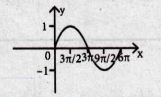
37.
The amplitude of sin x is 1 [Max of sin x curve is 1]
\(\Rightarrow \) amplitude of sin 7x is also 1
If p is the period of the function,
then f(x+p) = f(x)
Since the period of sine function is \(2\pi \)
The period of sin is \(\frac { 2\pi }{ 7 } \)
amplitude = 1
38.
We know that sin-1: [-1, 1] \(\rightarrow \left[ -\frac { \pi }{ 2 } ,\frac { \pi }{ 2 } \right] \)is given by
sin−1x = y if and only if x = sin y for −1\(\le x\le \) and -\(\frac { \pi }{ 2 } \le y \le \frac { \pi }{ 2 } \). Thus,
\({ Sin }^{ -1 }\left( \frac { 1 }{ \sqrt { 2 } } \right) \)= \(\frac{\pi}{4}\), Since \(\frac{\pi}{4}\)\(\in \left[ -\frac { \pi }{ 2 } ,\frac { \pi }{ 2 } \right] \)and sin \(\frac { \pi }{ 4 } =\frac { 1 }{ \sqrt { 2 } } \)
39.
Since the domain of y = sin-1 is −[11], and 2\(\notin \)[-1, 1], sin−1(2) does not exist.
40.
Let sin-1 \(\left( -\frac { 1 }{ 2 } \right) \) = y. Then sin y = -\(\frac{1}{2}\)
The range of the principal value of sin-1x is \(\left[ -\frac { \pi }{ 2 } ,\frac { \pi }{ 2 } \right] \) and hence, Let us find y \(\in \left[ -\frac { \pi }{ 2 } ,\frac { \pi }{ 2 } \right] \) Such that sin y = -\(\frac{1}{2}\). Clearly, y = -\(\frac{\pi}{6}\)
Thus, the principal value of sin-1\(\left( -\frac { 1 }{ 2 } \right) \) is -\(\frac{\pi}{6}\). This corresponds to -30o.
41.
We know that 2tan-1 x = tan-1\((\frac{2x}{1-x^{2}}, -1
So, \(2{ tan }^{ -1 }\frac { 1 }{ 2 } ={ tan }^{ -1 }\frac { 2\left( \frac { 1 }{ 2 } \right) }{ 1-\left( \frac { 1 }{ 2 } \right) ^{ 2 } } ={ tan }^{ -1 }\left( \frac { 4 }{ 3 } \right) \)
Hence, \(2{ tan }^{ -1 }\frac { 1 }{ 2 } +{ tan }^{ -1 }\frac { 1 }{ 7 } ={ tan }^{ -1 }\frac { 4 }{ 3 } +{ tan }^{ -1 }\frac { 1 }{ 7 } ={ tan }^{ -1 }\left( \frac { \frac { 4 }{ 3 } +\frac { 1 }{ 7 } }{ 1-\left( \frac { 4 }{ 3 } \right) \left( \frac { 1 }{ 7 } \right) } \right) ={ tan }^{ -1 }\left( \frac { 31 }{ 17 } \right) \)
42.
Given g(x) = sin-1 x + cos-1x
From the definition of sin-1x.
\(-1\le x\le 1\) ...(1)
Also from the definition of cos-1x
\(-1\le x\le 1\) .........(2)
\(\therefore \) From (1) & (2),
Domain ofg(x) = [-1, 1] U [-1, 1]
= [-1, 1]
Hence the domain of g(x) is [-1, 1].
43.
\({ cos }^{ -1 }\left( cos\frac { \pi }{ 7 } cos\frac { \pi }{ 17 } -sin\frac { \pi }{ 17 } sin\frac { \pi }{ 17 } \right) .\)
\({ cos }^{ -1 }\left( cos\left( \frac { \pi }{ 7 } +\frac { \pi }{ 17 } \right) \right) \)
\(\left[ \therefore cosA\ cosB-sinA\ sinB=cos(A+B) \right] \)
= \({ cos }^{ -1 }\left( cos\left( \frac { 24\pi }{ 119 } \right) \right) \) \(\left[ \therefore \frac { 24\pi }{ 119 } \varepsilon \left[ 0,\pi \right] \right] \)
= \(\frac { 24\pi }{ 119 } \)
44.
\({ cos }^{ -1 }\left( \frac { 1 }{ 2 } \right) +{ sin }^{ -1 }(-1)\)
Let \({ cos }^{ -1 }\left( \frac { 1 }{ 2 } \right) =x\) and -1 = sin y
\(\Rightarrow cosx=\frac { 1 }{ 2 } =cos\frac { \pi }{ 3 } \)
\(x=\frac { \pi }{ 3 } \)
\(siny=-1=-sin\left( \frac { -\pi }{ 2 } \right) \)
= \(-sin\left( \frac { -\pi }{ 2 } \right) \)
\(\left[ \because sin\left( -\theta \right) =-sin\ \theta\ and\ \frac { \pi }{ 2 } \varepsilon \left[ \frac { -\pi }{ 2 } ,\frac { \pi }{ 2 } \right] \right] \)
\(\Rightarrow y=\frac { -\pi }{ 2 } \)
\(\therefore { cos }^{ -1 }\left( \frac { 1 }{ 2 } \right) +{ sin }^{ -1 }\left( -1 \right) =x+y\)
= \(\frac { \pi }{ 3 } -\frac { \pi }{ 2 } =\frac { 2\pi -3\pi }{ 6 } =-\frac { \pi }{ 6 } \)
\(\therefore { cos }^{ -1 }\left( \frac { 1 }{ 2 } \right) +{ sin }^{ -1 }(-1)=-\frac {\pi }{ 6 } \)
45.
\(-5\pi \le x\le 5\pi \) and cos x = -1
cos x = -1
\(cosx=cos\pi \) \([\because cos\theta =cos\alpha \Rightarrow 2n\pi +\alpha ,n\varepsilon Z]\)
\(x=2n\pi +\pi ,n\varepsilon Z\quad \)
= \((2n+1)\pi ,n\varepsilon Z\)
\(\Rightarrow But-5\pi \le x\le 5\pi \)
Putting,\(=0,\pm 1,\pm 2\) and -3 we get
\(\Rightarrow x=-5\pi ,-3\pi ,-\pi ,3\pi ,5\pi \)
\(x=(2n+1)\ {\pi},n=0,\pm 1,\pm 2 \) and -3
46.
Now, tan-1 2x + tan-1 3x = \({ tan }^{ -1 }\left( \frac { 2x+3x }{ 1-6x^{ 2 } } \right) \), since 6x2 < 1.
So, \(tan^{ -1 }\left( \frac { 5x }{ 1-6x^{ 2 } } \right) =\frac { \pi }{ 4 } \), Which implies \(\frac { 5x }{ 1-6x^{ 2 } } =tan\frac { \pi }{ 4 } \) = 1
Thus, 1-6x2 = 5x , which gives 6x2+5x−1 = 0
Hence, x = \(\frac{1}{6},-1\). But x = -1 does not satisfy 6x2 < 1.
Observe that x = −1 makes the left side of the equation negative whereas the right side is a positive number.
Thus, x = −1 is not a solution.
Hence, x = \(\frac{1}{6}\) is the only solution of the equation.
47.
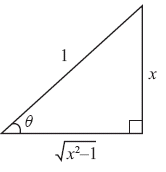
Let sin−1= \(\theta\). Then, x = sin\(\theta\) and x \(\neq\) 0, we get \(\theta \in\left[\frac{-\pi}{2}, 0\right) \cup\left(0, \frac{\pi}{2}\right]\)
Hence, \(\cos \theta \geq 0 \text { and } \)\(\cos \theta=\sqrt{1-\sin ^{2} \theta}=\)\( \sqrt { 1-x^{ 2 } } \)
Thus, \(cot(sin^{ -1 }x)=cot\theta =\frac { \sqrt { 1-x^{ 2 } } }{ x } ,|x|\le1\ and\ x\neq0\)
48.
Given that sin-1x > cos-1x. Note that -1\(\le x\le\)
Adding both sides by sin-1x, we get
sin-1 x + sin-1 x > x cos-1 x + sin-1x, Which resucess to 2 sin-1 x > \(\frac{\pi}{2}\)
As sine function increases in the interval \(\left[ -\frac { \pi }{ 2 }, \frac { \pi }{ 2 } \right] \), we have x > sin\(\frac{\pi}{4} or x> \frac{1}{\sqrt2}\)
Thus, the solution set is the interval \(\left[ \frac { 1 }{ \sqrt { 2 } } ,1 \right] \)
49.
We know that tan-1 x + tan-1 y = tan-1\(\frac{x+y}{1-xy}\), xy < 1
Thus, tan−1\(\frac{1}{2}+tan^{-1}\frac{1}{3}={ tan }^{ -1 }\frac { \frac { 1 }{ 2 } +\frac { 1 }{ 3 } }{ 1-\left( \frac { 1 }{ 2 } \right) \left( \frac { 1 }{ 3 } \right) } ={ tan }^{ -1 }(1)=\frac { \pi }{ 4 } \)
50.
Let sin−1 x = \(\theta\).
Then, x = sin \(\theta\) and-1\(\le x\le1\)
Now, tan(sin-1 x) = tan \(\theta\) = \(\frac{sin\theta}{cos\theta}=\frac{sin\theta}{\sqrt{1-sin^{2}\theta}}=\frac{x}{\sqrt{1-x2}},|x|<1\)
51.
sin-1x + 2cos-1x = sin-1x + cos-1x = \(\frac{\pi}{2}\) + cos-1x
We know that 0\(\le\)cos-1x\(\le\pi\)
Thus, \(\frac{\pi}{2}+0\le cos^{-1}x\)x+\(\frac{\pi}{2}\le\pi+\frac{\pi}{2}\)
Thus, \(\frac{\pi}{2}\le sin^-{1}x+2cos^{-1}x\le \frac{3\pi}{2}\)
52.
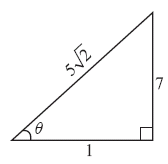
By definition, cot-1x\(\in(0,\pi)\)
Therefore, cot-1\((\frac{1}{7})\) = \(\theta\) implies \(\theta \in(0,\pi)\)
But cot-1\((\frac{1}{7})\) = \(\theta\) implies cot \(\theta\) = \(\frac{1}{7}\) and hence tan \(\theta\) = 7 and \(\theta\) is acute.
Using tan \(\theta\) = \(\frac{7}{1}\), We construct a right triangle as shown .
Then, we have, cos \(\theta\) = \(\frac{1}{5\sqrt2}\).
53.
Given \(\frac { \pi }{ 2 } <{ cos }^{ -1 }(3x-1)<\pi \)
\((cos2\frac { \pi }{ 2 } <3x-1\))
\(\Rightarrow 0<3x-1<-1\)
\(0+1<3x<-1+1\)
\(1<3x<0\)
54.
\(2{ cos }^{ -1 }\left( \frac { 1 }{ 2 } \right) +{ sin }^{ -1 }\left( \frac { 1 }{ 2 } \right) \)
Let \({ cos }^{ -1 }\left( \frac { 1 }{ 2 } \right) =x\) and\({ sin }^{ -1 }\left( \frac { 1 }{ 2 } \right) \)
\(\Rightarrow cosx=\frac { 1 }{ 2 } \)
\(\Rightarrow cosx=cos\frac { \pi }{ 3 } \) \(\left[ \therefore \frac { \pi }{ 3 } \varepsilon \left[ 0,\pi \right] \right] \)
\(\Rightarrow x=\frac { \pi }{ 3 } \)
[\(\therefore\) Principal domain of sin is \(\therefore \left[ \frac { -\pi }{ 2 } ,\frac { \pi }{ 2 } \right] \) and principal domain of cos is\(\left[ 0,\pi \right] \)
\(siny=\frac { 1 }{ 2 } \)
\(siny=sin\frac { \pi }{ 6 } \) \(\left[ \because \frac { \pi }{ 6 } \varepsilon \left[ \frac { -\pi }{ 2 } ,\frac { \pi }{ 2 } \right] \right] \)
\(\Rightarrow x=\frac { \pi }{ 3 } \) and \(y=\frac { \pi }{ 6 } \)
\(\therefore \quad 2{ cos }^{ -1 }\left( \frac { 1 }{ 2 } \right) +{ sin }^{ -1 }\left( \frac { 1 }{ 2 } \right) \)
= \(2\left( \frac { \pi }{ 3 } \right) +\frac { \pi }{ 6 } =\frac { 2\pi }{ 3 } +\frac { \pi }{ 6 } \)
= \(\frac { 4\pi +\pi }{ 6 } =\frac { 5\pi }{ 6 } \)
55.
cos x = 0
\(\Rightarrow x=\left( 2n+1 \right) \frac { \pi }{ 2 } ,n\varepsilon Z\)
But \(-6\pi \le x\le 6\pi \)
\(\therefore \) n can take values from
\(x=(2n+1)\frac { \pi }{ 2 } ,n=0\pm 1,\pm 2,...\pm 5\), -6
56.
Now, \(tan^{ -1 }\left( \frac { x-1 }{ x-2 } \right) +tan^{ -1 }\left( \frac { x+1 }{ x+2 } \right) =tan^{ -1 }\left[ \frac { \frac { x-1 }{ x-2 } +\frac { x+1 }{ x+2 } }{ 1-\frac { x-1 }{ x-2 } \left( \frac { x+1 }{ x+2 } \right) } \right] =\frac { \pi }{ 4 } \)
Thus, \(\frac { \frac { x-1 }{ x-2 } +\frac { x+1 }{ x+2 } }{ 1-\frac { x-1 }{ x-2 } \left( \frac { x+1 }{ x+2 } \right) } \) = 1, which on simplification gives 2x2−4 = −3
Thus, x2 = \(\frac{1}{2}\)gives x = \(\pm \frac { 1 }{ \sqrt { 2 } } \)
57.
tan-1 \(\left( \frac { 1-x }{ 1+x } \right) =\frac { 1 }{ 2 } { tan }^{ -1 }\)x gives tan-1 1-tan-1 x = \(\frac{1}{2}\)tan-1x.
Therefore, \(\frac{\pi}{4}=\frac{3}{2}tan^{-1}\)x, which in turn reduces to tan−1 = \(\frac{\pi}{6}\)
Thus, x = tan\(\frac{\pi}{6}=\frac{1}{\sqrt3}\)

12th Standard Syllabus & Materials
12th Standard
TN 12th Computer Applications களப்பெயர் முறைமை (DNS) Sample Question Papers Study Material - QB365 Set A
NEW12th Standard
TN 12th Computer Applications வலையமைப்பு எடுத்துக்காட்டுகள் மற்றும் நெறிமுறைகள் Sample Question Papers Study Material - QB365 Set A
NEW12th Standard
TN 12th Computer Applications கணினி வலையமைப்பு ஓர் அறிமுகம் Sample Question Papers Study Material - QB365 Set A
NEW12th Standard
TN 12th Computer Applications PHP-உடன் MySQL-ஐ இணைத்தல் Sample Question Papers Study Material - QB365 Set A



Tamilnadu Stateboard 12th Standard Subjects
Maths

Chemistry

Physics

Biology

Computer Science

Business Maths and Statistics

Economics

Commerce

Accountancy

History

Computer Applications
Biology
Computer Technology
Computer Applications
Computer Science
Business Maths and Statistics
Commerce
Economics
Maths
Chemistry
Physics
Computer Technology
History
Accountancy

Tamil

English

French
Tamilnadu Stateboard Standards

