
 100% FREE ACCESS
12th Standard Syllabus & Materials
12th Standard
TN 12th Maths Applications of Matrices and Determinants Sample Question Papers Study Material - QB365 Set A
NEW12th Standard
TN 12th Computer Applications மின்னணு தரவு பரிமாற்றம் Sample Question Papers Study Material - QB365 Set A
NEW12th Standard
TN 12th Computer Applications மின் - வணிக பாதுகாப்பு அமைப்புகள் Sample Question Papers Study Material - QB365 Set A
NEW12th Standard
TN 12th Computer Applications மின்னணு செலுத்தல் முறைகள் Sample Question Papers Study Material - QB365 Set A
NEW12th Standard
TN 12th Computer Applications மின் - வணிகம் Sample Question Papers Study Material - QB365 Set A
NEW12th Standard
TN 12th Computer Applications திறந்த மூல கருத்துருக்கள் Sample Question Papers Study Material - QB365 Set A

Published on: 02/09/2022
QB365 provides a detailed and simple solution for every Possible Book Back Questions in Class 12 Maths Subject - Application of Differential Calculus, English Medium. It will help Students to get more practice questions, Students can Practice these question papers in addition to score best marks.
Download Tamil Nadu 12th Standard Maths question papers, model tests, one-mark questions, important questions, and public exam papers in PDF format. Free study materials and answer keys for TN State Board students.
Questions + Answers key
Take MCQ Maths Test1.
Find the intervals of monotonicity and hence find the local extrema for the function f(x) = x2 − 4x + 4
2.
Explain why Lagrange’s mean value theorem is not applicable to the following functions in the respective intervals
f(x) = |3x + 1|, x ∈ |-1, 3|
3.
Explain why Lagrange’s mean value theorem is not applicable to the following functions in the respective intervals:
f(x) = \(\frac { x+1 }{ x } \), x ∈ [-1, 2]
4.
Explain why Rolle’s theorem is not applicable to the following functions in the respective intervals.
\(f(x)=x-2logx, x\in [2,7]\)
5.
Explain why Rolle’s theorem is not applicable to the following functions in the respective intervals.
\(f(x)=tan x,x \in [0, \pi]\)
6.
Explain why Rolle’s theorem is not applicable to the following functions in the respective intervals.
\(f(x)=|\frac{1}{x}|, x\in [-1,1]\)
7.
Find the slope of the tangent to the curves at the respective given points.
x = a cos3 t, y = b sin3 t at t = \(\frac { \pi }{ 2 } \)
8.
Find the slope of the tangent to the following curves at the respective given points
y = x4 + 2x2 − x at x = 1
9.
The temperature T in celsius in a long rod of length 10 m, insulated at both ends, is a function of length x given by T = x(10 − x). Prove that the rate of change of temperature at the midpoint of the rod is zero.
10.
Suppose that c is a critical point at which f '(c) = 0, that f ′(x) exists in a neighborhood of c , and that f ''(c) exists. Then f has a relative maximum value at c if f ''(c) < 0 and a relative minimum value at c if f ''(c) > 0 . If f ''(c) = 0 , the test is not informative.
11.
(i) If f ′′(c) exists and f ′′(c) changes sign when passing through x = c, then the point (c, f (c)) is a point of inflection of the graph of f .
(ii) If f ′′(c) exists at the point of inflection, then f ''(c) = 0 .
12.
(i) If f ''(x) > 0 on an open interval I , then f (x) is concave up on I .
(ii) If f ''(x) < 0 on an open interval I , then f (x) is concave down on I .
13.
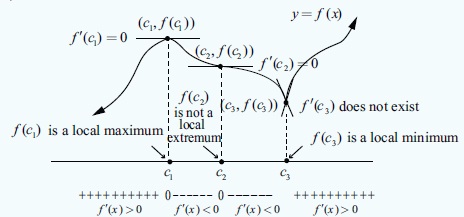
Let (c, f (c)) be a critical point of function f (x) that is continuous on an open interval I containing c . If f(x) is differentiable on the interval, except possibly at c , then f (c) can be classified as follows: (when moving across the interval I from left to right)
(i) If f ′(x) changes from negative to positive at c, then f (x) has a local minimum f (c) .
(ii) If f ′(x) changes from positive to negative at c, then f (x) has a local maximum f (c) .
(iii) If f ′(x) is positive on both sides of c or negative on both sides of c , then f (c) is neither a local minimum nor a local maximum.
14.
If f (x) has a relative extremum at x = c then c is a critical number. Invariably there will be critical numbers of the function obtained as solutions of the equation f'(x) = 0 or as values of x at which f′(x) does not exist.
15.
If f ( x) is continuous on a closed interval [a,b] , then f has both an absolute maximum and an absolute minimum on [a,b] .
16.
If the function f (x) is differentiable in an open interval (a,b) then we say,
(1) if
\(\frac{d}{d x}(f(x)) \geq 0, \forall x \in(a, b)\) then f (x) is increasing in the interval (a,b) ,
(2) if
\(\frac{d}{d x}(f(x))>0, \forall x \in(a, b)\) then f (x) is strictly increasing in the interval (a,b) .
The proof of the above can be observed from Theorem 7.3.
(3) f (x) is decreasing in the interval (a,b) if
\(\frac{d}{d x}(f(x)) \leq 0, \forall x \in(a, b)\)
(4) f (x) is strictly decreasing in the interval (a,b) if
\(\frac{d}{d x}(f(x))<0, \forall x \in(a, b)\)
17.
Let \(\lim _{x \rightarrow \alpha} g(x)\) exist and let it be L and let f (x) be a continuous function at x = L . Then, \(\lim _{x \rightarrow \alpha} f(g(x))=f\left(\lim _{x \rightarrow \alpha} g(x)\right)\)
18.
(a) Taylor’s Series
Let f (x) be a function infinitely differentiable at x = a . Then f (x) can be expanded as a series, in an interval (x − a, x + a), of the form
\(f(x)=\sum_{n=0}^{\infty} \frac{f^{(n)}(a)}{n !}(x-a)^{n}=f(a)+\frac{f^{\prime}(a)}{1 !}(x-a)+\cdots+\frac{f^{(n)}(a)}{n !}(x-a)^{n}+\cdots\)
(b) Maclaurin’s series
If a = 0, the expansion takes the form
\(f(x)=\sum_{n=0}^{\infty} \frac{f^{(n)}(0)}{n !} x^{n}=f(0)+\frac{f^{\prime}(0)}{1 !} x+\cdots+\frac{f^{(n)}(0)}{n !} x^{n}+\cdots\)
19.
If f (x) is continuous in closed interval [a,b] and differentiable in open interval (a,b) and if f'(x) > 0, x ∈ (a,b) , then for, x1, x2 ∈ [ a, b ], such that x1 < x2 we have, f (x1) < f (x2 )
20.
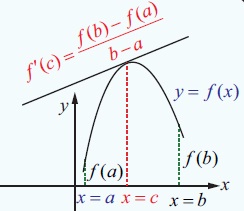
Let f (x) be continuous in a closed interval [a,b] and differentiable in the open interval (a,b) (where f (a), f (b) are not necessarily equal). Then there exist at least one point c∈ (a,b) such that,
\(f^{\prime}(c)=\frac{f(b)-f(a)}{b-a}\)
21.
Let f (x) be continuous on a closed interval [a,b] and differentiable on the open interval (a,b) If f (a) = f (b) , then there is at least one point c∈(a,b) where f '(c) = 0.
22.
If f is continuous on a closed interval [a,b] , and c is any number between f (a) and f (b) inclusive, then there is at least one number x in the closed interval [a,b] , such that f (x) = c .
23.
Find the asymptotes of the curve \(f(x)=\frac { { 2x }^{ 2 }-8 }{ { x }^{ 2 }-16 } \)
24.
Prove that the function f(x) = x − sin x is increasing on the real line. Also discuss for the existence of local extrema.
25.
Find the absolute extrema of the function f (x) = 3cos x on the closed interval \([0,2\pi]\)
26.
Find the absolute maximum and absolute minimum values of the function f (x) = 2x3 + 3x2 −12x on [−3, 2]
27.
Find the local extrema for the following function using second derivative test:
f(x) = x2 e-2x
28.
Evaluate the following limit, if necessary use l ’Hôpital Rule
\(\underset { x\rightarrow { 1 }^{ + } }{ lim } \left( \frac { 2 }{ { x }^{ 2 }-1 } -\frac { x }{ x-1 } \right) \)
29.
Evaluate the following limit, if necessary use l ’Hôpital Rule
\(\underset { x\rightarrow 0 }{ lim } \left( \frac { 1 }{ sinx } -\frac { 1 }{ x } \right) \)
30.
Evaluate the following limit, if necessary use l ’Hôpital Rule
\(\underset { x\rightarrow \infty }{ lim } { e }^{ -x }\sqrt { x } \)
31.
Evaluate the following limit, if necessary use l ’Hôpital Rule
\(\underset { x\rightarrow \frac { { \pi }^{ - } }{ 2 } }{ lim } \frac { secx }{ tanx } \)
32.
Evaluate the following limit, if necessary use l ’Hôpital Rule
\(\underset { x\rightarrow \infty }{ lim } \frac { x }{ logx } \)
33.
Evaluate the following limit, if necessary use l ’Hôpital Rule
\(\underset { x\rightarrow \infty }{ lim } \frac { { 2x }^{ 2 }-3 }{ { x }^{ 2 }-5x+3 } \)
34.
Evaluate the following limit, if necessary use l ’Hôpital Rule
\(\underset { x\rightarrow 0 }{ lim } \frac { 1-cosx }{ { x }^{ 2 } } \)
35.
Evaluate: \(\underset{x\rightarrow 0^{+}}{lim}(\frac{1}{x}-\frac{1}{e^{x}-1})\).
36.
Evaluate : \(\underset{x\rightarrow 1^{-}}{lim}(\frac{log(1-x)}{cot(\pi x)})\).
37.
Expand the polynomial f (x) = x2 - 3x + 2 in powers of x - 1
38.
Write the Maclaurin series expansion of the following function
log(1 - x); -1 ≤ x < 1
39.
Write the Maclaurin series expansion of the following function
cos x
40.
Write the Maclaurin series expansion of the following function
sin x
41.
Write the Maclaurin series expansion of the following function
ex
42.
Using the Rolle’s theorem, determine the values of x at which the tangent is parallel to the x -axis for the following functions:
\(f(x)=\sqrt{x}-\frac{x}{3}, x\in [0,9]\)
43.
Using the Rolle’s theorem, determine the values of x at which the tangent is parallel to the x -axis for the following functions:
\(f(x)=\frac{x^{2}-2x}{x+2}, x\in [-1,6]\)
44.
Using the Rolle’s theorem, determine the values of x at which the tangent is parallel to the x -axis for the following functions:
f(x) = x2 − x, x ∈ [0, 1]
45.
A thermometer was taken from a freezer and placed in a boiling water. It took 22 seconds for the thermometer to raise from −10°C to 100°C. Show that the rate of change of temperature at some time t is 5°C per second.
46.
Prove, using mean value theorem, that \(|sin \alpha-sin\beta|\le |\alpha-\beta|, \alpha, \beta \in R\)
47.
Suppose f(x) is a differentiable function for all x with f'(x) ≤ 29 and f(2) = 17. What is the maximum value of f(7)?
48.
A truck travels on a toll road with a speed limit of 80 km/hr. The truck completes a 164 km journey in 2 hours. At the end of the toll road the trucker is issued with a speed violation ticket. Justify this using the Mean Value Theorem.
49.
Prove that there is a zero of the polynomial \(2x^{3}-9x^{2}-11x+12\) in the interval (2, 7) given that 2 and 7 are the zeros of the polynomial \(x^{4}-6x^{3}-11x^{2}+24x+28\)
50.
Without actually solving show that the equation x4+2x3-2 = 0 has only one real root in the interval (0, 1).
51.
Compute the value of 'c' satisfied by Rolle’s theorem for the function \(f(x)=log(\frac{x^{2}+6}{5x})\) in the interval [2, 3]
52.
Find the values in the interval \((\frac{1}{2},2)\) satisfied by the Rolle's theorem for the function \(f(x)=x+\frac{1}{x}, x\in[\frac{1}{2},2]\)
53.
Compute the value of 'c' satisfied by the Rolle’s theorem for the function f (x) = x2 (1 - x)2, x ∈ [0,1]
54.
Find the tangent and normal to the following curves at the given points on the curve
x = cos t, y = 2sin t2 at t = \(\frac { \pi }{ 3 } \)
55.
Find the tangent and normal to the following curves at the given points on the curve
y = x sin x at \(\left( \frac { \pi }{ 2 } ,\frac { \pi }{ 2 } \right) \)
56.
Find the tangent and normal to the following curves at the given points on the curve
y = x4 + 2ex at (0, 2)
57.
Find the tangent and normal to the following curves at the given points on the curve
y = x2 − x4 at (1, 0)
58.
Find the point on the curve y = x2 − 5x + 4 at which the tangent is parallel to the line 3x + y = 7.
59.
Find the equations of tangent and normal to the curve y = x2 + 3x − 2 at the point (1, 2)
60.
A particle moves along a straight line in such a way that after t seconds its distance from the origin is s = 2t2 + 3t metres.
61.
A particle moves so that the distance moved is according to the law s(t) = \(s(t)=\frac{t^{3}}{3}-t^{2}+3\). At what time the velocity and acceleration are zero.
62.
A person learnt 100 words for an English test. The number of words the person remembers in t days after learning is given by W(t) = 100 × (1− 0.1t)2, 0 ≤ t ≤ 10. What is the rate at which the person forgets the words 2 days after learning?
63.
Find the local maximum and minimum of the function x2 y2 on the line x + y = 10
64.
We have a 12 square unit piece of thin material and want to make an open box by cutting small squares from the corners of our material and folding the sides up. The question is, which cut produces the box of maximum volume?
65.
Find the intervals of monotonicity and local extrema of the function \(f(x)=\frac{1}{1+x^{2}}\)
66.
Find the intervals of monotonicity and local extrema of the function f(x) = x log x + 3x.
67.
Determine the intervals of concavity of the curve y = 3+ sin x .
68.
Discuss the monotonicity and local extrema of the function \(f(x)=log(1+x)-\frac{x}{1+x},x>-1\) and hence find the domain where, \(log(1+x)>\frac{x}{1+x}\)
69.
If an initial amount A0 of money is invested at an interest rate r compounded n times a year, the value of the investment after t years is \(A={ A }_{ 0 }{ \left( 1+\frac { r }{ n } \right) }^{ nt }\). If the interest is compounded continuously, (that is as n ➝∞), show that the amount after t years is A = Aoert.
70.
Find the local extrema for the following function using second derivative test:
f(x) = x logx
71.
Find the local extrema for the following function using second derivative test:
f(x) = -3x5 +5x3
72.
Evaluate the following limit, if necessary use l’Hôpital Rule
\(\underset { x\rightarrow { { 0 }^{ + } } }{ lim } (cos{ x })^{ \frac { 1 }{ { x }^{ 2 } } }\)
73.
Evaluate the following limit, if necessary use l ’Hôpital Rule
\(\underset { x\rightarrow { \frac { \pi }{ 2 } } }{ lim } { \left( sinx \right) }^{ tanx }\)
74.
Evaluate the following limit, if necessary use l ’Hôpital Rule
\(\underset { x\rightarrow \infty }{ lim } \ { \left( 1+\frac { 1 }{ x } \right) }^{ x }\)
75.
Evaluate: \(\underset{x \rightarrow1}{lim} \ x^{\frac{1}{1-x}}\)
76.
Evaluate: \( (\underset{x\rightarrow \infty}{lim}(1+2x)^{\frac{1}{2log\ x}}\)
77.
Using the l’Hôpital Rule prove that, \(\underset{x\rightarrow 0^{+}}{lim}(1+x)^{\frac{1}{x}}=e\)
78.
Write the Maclaurin series expansion of the following function:
cos2 x
79.
Write the Maclaurin series expansion of the following function
tan-1(x); -1 ≤ x ≤ 1
80.
Find intervals of concavity and points of inflexion for the following function:
\(f(x)=\frac { 1 }{ 2 } \left( { e }^{ x }-{ e }^{ -x } \right) \)
81.
Find intervals of concavity and points of inflexion for the following function:
f(x) = sin x + cos x, 0 < x < 2
82.
Find intervals of concavity and points of inflexion for the following functions
f(x) = x(x - 4)3
83.
The price of a product is related to the number of units available (supply) by the equation Px + 3P −16x = 234, where P is the price of the product per unit in Rupees(Rs) and x is the number of units. Find the rate at which the price is changing with respect to time when 90 units are available and the supply is increasing at a rate of 15 units/week.
1.
We have,
f(x) = (x-2)2, then
\(f'(x)=2(x-2)=0 \) gives x = 2.
The intervals of monotonicity are \((-\infty,2)\) and \((2,\infty)\)
Since \(f'(x)<0, \forall x \in (-\infty,2)\) for \((-\infty,2)\) the f(x) is strictly decreasing on \((2,\infty)\)
As \(f'(x)>0, \) for \(x \in(2, \infty)\) the function f(x) is strictly increasing on \((2,\infty)\)
Becasue f'(x) changes its sign from negative to positive when passing through x = 2 for the function f(x) it has a local minimum at x = 2
The local minimum value is f(2) = 0.
2.
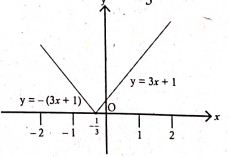
f(x) = |3x + 1|, x ∈ |-1, 3|
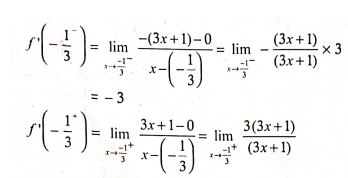
Since \(LHL \neq RHL, f'(-\frac{1}{3})\) does not exist.
Hence, Lagrange's mean value theorem is not applicable.
3.
f(x) = \(\frac { x+1 }{ x } \), x ∈ [-1, 2]
f(0) = undefined
Lagrange's mean value theorem is not applicable since f (x) is not continuous at x = 0
4.
Given \(f(x)=x-2logx, x\in [2,7]\)
(i) f(x) is continuous in [2, 7]
(ii) f(x) is differentiable in (2, 7)
f(2) = 2 - 2 log 2
= 2 - log 22 = 2 - log 4
f (7) = 7 - 2 log 7
= 7 - log 72 = 7 - log 49
Since f(2) ≠ f (7), Rolle's theorem is not applicable.
5.
Given f(x) = tan x, x ∈ [0, π]
Rolle's theorem is not applicable since tan x is not continuous at x = \(\frac{\pi}{2}\) [∵ tan \(\frac{\pi}{2}\) = ∞]
6.
Given \(f(x)=|\frac{1}{x}|, x\in [-1,1]\)
Rolle's theorem is not applicable since \(f(x)=(\frac{1}{x})\) is not continuous at x = 0 in [-1, 1] and not differentiable in (-1, 1)
7.
Given x = a cos3 t; y = b sin3 t
\(\frac { dx }{ dt } =-3a \ { cos }^{ 2 } \ t \ sin \ t\)
\(\frac { dy }{ dt } =3b \ { sin }^{ 2 } \ t \ cot \ t\)
\(\therefore \frac { dy }{ dx } =\frac { \frac { dy }{ dt } }{ \frac { dx }{ dt } } \)
\(\frac { 3b{ sin }^{ 2 }tcost }{ 3a{ cos }^{ 2 }tsint } =\frac { -b }{ a } \) tan t
Slope of the tangent at t = \(\frac { \pi }{ 2 } \) is
\({ m=\left( \frac { dy }{ dx } \right) }_{ t=\frac { \pi }{ 2 } }\)
\(\frac { -b }{ a } tan\frac { \pi }{ 2 } =\frac { -b }{ a } \times \infty =\infty \)
\(\therefore m=\infty \)
8.
Given y = x4 + 2x2 - x
\(\frac { dy }{ dx } \) = 4x3 + 4x - 1
Slope of the tangent at x = 1 is
m = \(\left( \frac { dy }{ dx } \right) \)(x = 1)
= 4(1)3+ 4 (1) - 1
= 4+4-1 = 7
∴ m = 7
9.
We are given that, T = 10x − x2
Hence, the rate of change at any distance from one end is given by \(\frac{dT}{dx}=10-2x \)
The mid point of the rod is at x = 5
Substituting x = 5, we get \(\frac{dT}{dx}=0\)
10.
11.
12.
13.
14.
15.
16.
17.
18.
The series expansion of f (x) , in powers of (x − a) , be given by
\(f(x)=A_{0}+\sum_{n=1}^{\infty} A_{n}(x-a)^{n}\)
Substituting x = a gives A0 = f(a). Differentiation of (7) given
\(f^{\prime}(x)=1 ! A \mid+\sum_{n=2}^{\infty} n A_{n}(x-a)^{n-1}\)
Substituting x = a gives A1 = f'(a). Differentiation of (8) given
\(f^{\prime \prime}(x)=2 ! A_{2}+\sum_{n=3}^{\infty} n(n-1) A_{n}(x-a)^{n-2}\)
Substituting x = a given \(A_{2}=\frac{f^{\prime \prime}(a)}{2 !}\) Differentiation of (9) gives
\(f^{\prime \prime \prime}(x)=3 ! A_{3}+\sum_{n=4}^{\infty} n(n-1)(n-2) A_{n}(x-a)^{n-3}\)
Differentiation of (10) (k − 3) times gives
\(f^{(k)}(x)=k ! A_{k}+\sum_{n=k+1}^{\infty} n(n-1) \ldots(n-k+1) A_{n}(x-a)^{n-k}\)
Substituting x = a gives \(A_{k}=\frac{f^{(k)}(a)}{k !}\) which completes the proof of the theorem.
In order to expand a function around a point say x = a , equivalently in powers of (x − a) we need to differentiate the given function as many times as the required powers and evaluate at x = a. This will give the value for the coefficients of the required powers of (x − a).
19.
By the mean value theorem, there exists \(c \in\left(x_{1}, x_{2}\right) \subset(a, b)\) such that,
\(\frac{f\left(x_{2}\right)-f\left(x_{1}\right)}{x_{2}-x_{1}}=f^{\prime}(c)\)
Since \(f^{\prime}(c)>0, \text { and } x_{2}-x_{1}>0 \text { we have } f\left(x_{2}\right)-f\left(x_{1}\right)>0\)
We conclude that, whenever \(x_{1}
20.
21.
22.
23.
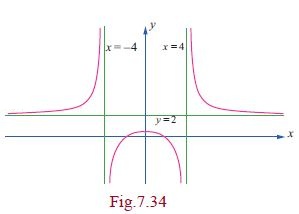
As \(\underset { x\rightarrow -{ 4 }^{ + } }{ lim } \frac { { 2x }^{ 2 }-8 }{ { x }^{ 2 }-16 } =-\infty \ and\ \underset { x\rightarrow { 4 }^{ + } }{ lim } \frac { { 2x }^{ 2 }-8 }{ { x }^{ 2 }-16 } =\infty \)
Therefore x = −4 and x = 4 are vertical asymptotes
As \(\underset { x\rightarrow \infty }{ lim } \frac { { 2x }^{ 2 }-8 }{ { x }^{ 2 }-16 } =\underset { x\rightarrow \infty }{ lim } \frac { 2-\frac { 8 }{ { x }^{ 2 } } }{ 1-\frac { 16 }{ { x }^{ 2 } } } =2\) and \(\underset { x\rightarrow -\infty }{ lim } \frac { { 2x }^{ 2 }-8 }{ { x }^{ 2 }-16 } =\underset { x\rightarrow -\infty }{ lim } \frac { 2-\frac { 8 }{ { x }^{ 2 } } }{ 1-\frac { 16 }{ { x }^{ 2 } } } =2\)
Therefore, y = 2 is a horizontal asymptote.
This can also be obtained by synthetic division
24.
Since \(f'(x)=1-cosx\ge0\) and zero at the points \(x=2n\pi, n\in Z\) and hence the function is increasing on the real line.
Since there is no sign change in f′(x) when passing through \(x=2n\pi, n\in Z\) by the first derivative test there is no local extrema.
25.
Differentiating the given function, we get \(f'(x)= -3 sin\ x\)
Thus, \(f'(x)=0 \Rightarrow sinx\)\( =0 \Rightarrow x=\pi \in (0,2\pi)\).
Evaluating f(x) -at the endpoints \(x=0,2\pi\) and at critical number \(x=\pi\)
we get \(f(0)=3, f(2\pi)=3 \) and \(f(\pi)=-3\)
From these values, the absolute maximum is 3 which occurs at \(x=0,2\pi\) and the absolute minimum is −3 which occurs at \(x=\pi\)
26.
Differentiating the given function, we get
f'(x) = 6x2 + 6x -12
= 6(x2 + x - 2)
f'(x) = 6(x + 2)(x + 1)
Thus, f'(x) = 0 \(\Rightarrow\) x = -2, 1 \(\in\) (-3, 2).
Therefore, the critical numbers are, x = -2, 1. Evaluating f(x) at the endpoints x = -3, 2 and at critical numbers x = -2,1 we get f(-3) = 9, f(2) = 4, f(-2) = 20 and f(1) = -7.
From these values, the absolute maximum is 20 which occurs at, x = -2 and the absolute minimum is −7 which occurs at x = 1
27.
f(x) = x2e-2x
f(x) = x2 e-2x
f'(x) = x2 (-2) e-2x + e-2x(2x)
f''(x) = 2xe-2x (1 -x)
f'(x) = 0
⇒ 2x e-2x(1 - x) = 0
⇒ x = 0,1
∴ The critical numbers are x = 0, 1
f"(x) = [x e-2x (-1) + x (-2)e-2x(1-x)+1e-2x(1-x)]
= 2e-2x(-x-2x+2x2+ 1-x)
= 2e-2x(2x2- 4x + 1)
f"(0) = 2(1)(1) = 2 > 0
f"(1) = 2e-2 (2 - 4 + 1)
= 2e-2 (-1)
= \(-{ 2e }^{ 2 }=\frac { -2 }{ { e }^{ 2 } } <0\)
Since f"(0) > 0, there is a local minimum at x = 0.
ஃ(0) = 02 e0 = 0
Since f"(1) < 0, there is a local maximum at x = 1.
\(\therefore f(1)={ 1 }^{ 2 }e^{ -2(1) }={ e }^{ -2 }=\frac { 1 }{ { e }^{ 2 } } \)
28.
\(\underset { x\rightarrow { 1 }^{ + } }{ lim } \left( \frac { 2 }{ { x }^{ 2 }-1 } -\frac { x }{ x-1 } \right) =\underset { x\rightarrow { 1 }^{ + } }{ lim } \left( \frac { 2-x(x+1) }{ { x }^{ 2 }-1 } \right) \)
\(\underset { x\rightarrow { 1 }^{ + } }{ lim } \left( \frac { 2-{ x }^{ 2 }-x }{ { x }^{ 2 }-1 } \right) =\frac { 0 }{ 0 } \)
Form which is indeterminate,
Applying L' Hopital rule we get,
\(\underset { x\rightarrow { 1 }^{ + } }{ lim } \left( \frac { 2-{ x }^{ 2 }-x }{ { x }^{ 2 }-1 } \right) =\frac { 0 }{ 0 } =\frac { -2-1 }{ 2(1) } =\frac { -3 }{ 2 } \)
29.
\(\underset { x\rightarrow 0 }{ lim } \left( \frac { 1 }{ sinx } -\frac { 1 }{ x } \right) =\underset { x\rightarrow 0 }{ lim } \left( \frac { x-sinx }{ xsinx } \right) =\frac { 0 }{ 0 } \) form
Which is indeterminate Applying L' Hopital rule we get,
\(0+\frac { sinx }{ -xsinx+cosx } +cosx=\frac { 0 }{ 2 } =0\)
\(\underset { x\rightarrow { 1 }^{ + } }{ lim } \frac { 1-cosx }{ xcosx+sinx } =\frac { 1-cos0 }{ 0+sin0 } =\frac { 1-1 }{ 0 } =\frac { 0 }{ 0 } \)form
30.
\(\underset { x\rightarrow \infty }{ lim } { e }^{ -x }\sqrt { x } =\underset { x\rightarrow \infty }{ lim } \frac { { \sqrt { x } } }{ { e }^{ x } } =\frac { \infty }{ \infty } \)
Which is in indeterminate form. Applying L' Hopital rule we get,
\(\underset { x\rightarrow \infty }{ lim } \frac { \frac { 1 }{ 2 } { x }^{ \frac { 1 }{ 2 } -1 } }{ { e }^{ x } } =\frac { 1 }{ 2 } \underset { x\rightarrow \infty }{ lim } \frac { { x }^{ \frac { 1 }{ 2 } -1 } }{ { e }^{ x } } =\frac { 1 }{ 2 } \underset { x\rightarrow \infty }{ lim } \frac { { e }^{ -x } }{ \sqrt { x } } \)
\(\frac { 1 }{ 2 } \underset { x\rightarrow \infty }{ lim } e^{ -x }\sqrt { \frac { 1 }{ x } } =\frac { 1 }{ 2 } { e }^{ -\infty }(0)=0\) [When x ➝ ∞, \(\frac1x\) ➝ 0 e-∞ = 0]
31.
\(\underset { x\rightarrow \frac { { \pi }^{ - } }{ 2 } }{ lim } \frac { secx }{ tanx } =\underset { x\rightarrow \frac { { \pi }^{ - } }{ 2 } }{ lim } \frac { \frac { 1 }{ \frac { cosx }{ sinx } } }{ \frac { sinx }{ cosx } } =\underset { x\rightarrow \frac { { \pi }^{ - } }{ 2 } }{ lim } \frac { 1 }{ sinx } \)
\(=\frac { 1 }{ sin\frac { \pi }{ 2 } } =\frac { 1 }{ 1 } =1\)
32.
\(\underset { x\rightarrow \infty }{ lim } \frac { x }{ logx } =\frac { \infty }{ \infty } \)
Which is in indeterminate form
∴ By L' Hopital rule we get,
\(\underset { x\rightarrow \infty }{ lim } \frac { \frac { 1 }{ 1 } }{ x } =\underset { x\rightarrow \infty }{ lim } x=\infty \)
33.
\(\underset { x\rightarrow \infty }{ lim } \frac { { 2x }^{ 2 }-3 }{ { x }^{ 2 }-5x+3 } =\frac { 2-\frac { 3 }{ { x }^{ 2 } } }{ 1+\frac { 5 }{ x } +\frac { 3 }{ { x }^{ 2 } } } \)
[Dividing the numerator and denominator by x2]
= \(\frac { 2-0 }{ 1-0+0 } =\frac { 2 }{ 1 } =2\)
34.
\(\underset { x\rightarrow 0 }{ lim } \frac { 1-cosx }{ { x }^{ 2 } } =\frac { 1-cos0 }{ 0 } =\frac { 1-1 }{ 0 } =\frac { 0 }{ 0 } \)
Indeterminate form, Applying L' Hopital rule we get,
\(\underset { x\rightarrow 0 }{ lim } \frac { sinx }{ 2x } =\frac { 1 }{ 2 } \underset { x\rightarrow 0 }{ lim } \frac { sinx }{ x } \)\(\left[ \because \underset { x\rightarrow 0 }{ lim } \frac { sinx }{ x } =1 \right] \)
\(=\frac { 1 }{ 2 } \times 1\)
= \(\frac12\)
35.
This is an indeterminate of the form \(\infty, -\infty\). To evaluate this limit we first simplify and bring it in the form \((\frac{0}{0})\) and applying the l’Hôpital Rule, we get
\(\frac{x\rightarrow 0^{+}}{lim}(\frac{1}{x}-\frac{1}{e^{x}-1})=\underset{x\rightarrow 0^{+}}{lim}(\frac{e^{x}-x-1}{x(e^{x}-1)})\) \((\frac{0}{0})\)
Now, \(\underset{x\rightarrow 0^{+}}{lim} (\frac{e^{x}-x-1}{x(e^{x}-1)})=\underset{x\rightarrow 0^{+}}{lim}(\frac{e^{x}-1}{xe^{x}+e^{x}-1})\) \((\frac{0}{0})\)
\(=\underset{x\rightarrow 0^{+}}{lim}(\frac{e^{x}}{xe^{x}+2e^{x}})=\frac{1}{2}\)
36.
This is an indeterminate form \(\frac{\infty}{\infty}\) and hence we use the l’Hôpital’s Rule to evaluate.
\(\underset{x\rightarrow 1^{-}}{lim}(\frac{log(1-x)}{cot(\pi x)})=\underset{x\rightarrow1^{-}}{lim}(\frac{-\frac{1}{1-x}}{-\pi cosec^{2}(\pi x)})\) \((\frac{\infty}{\infty})\)
On Simplication,
\(=\underset{x\rightarrow-1}{lim}(\frac{sin^{2}(\pi x)}{\pi (1-x)})\) \((\frac{0}{0})\)
again applying the l’Hôpital Rule
\(= \underset{x\rightarrow 1^{-}}{lim}(\frac{2\pi sin(\pi x). cos(\pi x)}{-\pi})\)
=\(\underset{x\rightarrow -1}{lim}(-2 sin(\pi x).cos (\pi x))\)
= 0.
37.
f(x) = x2 - 3x + 2
fI(x) = 2x - 3
fII(x) = 2
⇒ f(1) = 0
fI(1) = 2 - 3 = -1
fII(1) = 2
Taylor's series forf(x) at x = 1 is
f(x) = \(f(1)+\frac { { f }^{ 1 }(1) }{ 1! } (x-1)+\frac { { f }^{ II }(1) }{ 2! } ({ x-1) }^{ 2 }\)
= \(0-\frac { 1 }{ 1! } { (x-1) }+\frac { 2 }{ 2! } { (x-1) }^{ 2 }\)
f(x) = -(x-1)+(x-1)2
38.
| Function and its derivatives | log (1-x) cos x and its derivatives | Value at x = 0 |
| f(x) | log (1-x) | log 1 = 0 |
| fI(x) | \(\frac{-1}{1-x}\) = -1(1 - x)-1 | \(\frac{-1}{1}\) = -1 |
| fIl(x) | -1(1-x)-2 | -1 |
| fIIl(x) | -2(1-x)-3 | -2 |
| fIV(x) | -6 (1 - x)-4 | -6 |
| fV(x) | -24 (1 - x)-5 | -24 |
Meclaurin's expansion
\(f(x)=f(0)+\frac { { f }^{ 1 }(0) }{ 1! } x+\frac { { f }^{ II }(0) }{ 2! } { x }^{ 2 }+\frac { { f }^{ III }(0) }{ 3! } { x }^{ 3 }+\).................
log(1-x) = \(0-\frac { 1 }{ 1! } x-\frac { { x }^{ 2 } }{ 2! }- \frac { 2 }{ 3! } { x }^{ 3 }-\frac { { 6x }^{ 4 } }{ 4! } +.....\)
= \(-x-\frac { { x }^{ 2 } }{ 2 } +\frac { { x }^{ 3 } }{ 3 } +\frac { { x }^{ 4 } }{ 4 } \)+ .....
log(1 - x) = \(-\left( x+\frac { { x }^{ 2 } }{ 2 } +\frac { { x }^{ 3 } }{ 3 } +\frac { { x }^{ 4 } }{ 4 } +.... \right) \)
39.
| Function and its derivatives | cos x and its derivatives | Value at x = 0 |
| f(x) | cos x | cos 0 = 1 |
| fI(x) | - sin x | - sin 0 = 0 |
| fII(x) | - cos x | - cos 0 = -1 |
| fIII(x) | sin x | sin 0 = 1 |
| fIV(x) | cos x | cos 0 = 1 |
| fV(x) | - sin x | - sin 0 = 0 |
| fVI(x) | -cos x | - cos 0 = -1 |
\(f(x)=f(0)+\frac { { f }^{ 1 }(0) }{ 1! } x+\frac { { f }^{ II }(0) }{ 2! } { x }^{ 2 }+\frac { { f }^{ III }(0) }{ 3! } { x }^{ 3 }\) + .........
cos x = 1 + 0 - \(\frac { { x }^{ 2 } }{ 2! } +0+\frac { { x }^{ 4 } }{ 4! } +0+\frac { { x }^{ 6 } }{ 6! } +...\)
cos x = 1 - \(\frac { { x }^{ 2 } }{ 2! } +\frac { { x }^{ 4 } }{ 4! } +\frac { { x }^{ 6 } }{ 6! } \)
40.
Let f(x) = sin x ⇒ f(0) = sin 0 = 0
fI(x) = cos x ⇒ fI(0) = cos 0 = 1
fIl(x) = - sin x ⇒ fII(0) = -sin 0 = 0
fIlI(x) = - cos x ⇒ fIII(0) = -cos 0 = 0
fIV(x) = + sin x ⇒ fIV(0) = sin 0 = 0
fV(x) = cos x ⇒ fv(0) = cos 0 = 0
fVI(x) = - sin x ⇒ fvI(0) = - sin 0 = 0
fVII(x) = - cos x ⇒ fvII(0) = - cos 0 = 0
∴ Maclaurins' series expansion
\(f(x)=f(0)+\frac { { f }^{ 1 }(0) }{ 1! } x+\frac { { f }^{ II }(0) }{ 2! } { x }^{ 2 }+\frac { { f }^{ III }(0) }{ 3! } { x }^{ 3 }+\frac { { f }^{ IV }(0) }{ 4! } { x }^{ 4 }+.....\)
\(\therefore sinx=0+\frac { 1 }{ 1! } x+0-\frac { 1 }{ 3! } { x }^{ 3 }+0-\frac { 1 }{ 5! } { x }^{ 5 }+0-\frac { 1 }{ 7! } { x }^{ 7 }+........\)
\(x-\frac { { x }^{ 3 } }{ 3! } -\frac { { x }^{ 5 } }{ 5! } -\frac { { x }^{ 7 } }{ 7! } +...\)
41.
| Function and its distribution | ex and its derivatives | Value at x=0 |
| f(x) | ex | e0 = 1 |
| f1(x) | ex | e0 = 1 |
| f11(x) | ex | e0 = 1 |
\(f(x)=f(0)+\frac { { f }^{ 1 }(0) }{ 1! } x+\frac { { f }^{ II }(0) }{ 2! } { x }^{ 2 }+........\)
∴ Maclaurins' series expansion of
\({ e }^{ x }=1+\frac { 1 }{ 1! } x+\frac { 1 }{ 2! } { x }^{ 2 }+...\)
42.
a) f(x) is continuous in [0, 9]
b) f(x) is differentiable in (0, 9)
c) f(0) = 0
\(f(9)=\sqrt { 9 } -\frac { 9 }{ 3 } =3-3=0\)
∴ f(0) = f(9)
∴ By Rolle's theorem, there exists C ∈ [0, 9] such that f'(c) = 0
⇒ \({ \frac { 1 }{ 2 } c }^{ \frac { 1 }{ 2 } -1 }-\frac { 1 }{ 3 } =0\)
⇒ \({ \frac { 1 }{ 2 } c }^{ \frac { 1 }{ 2 } -1 }=\frac { 1 }{ 3 } \)
⇒ \(\frac { 1 }{ 2\sqrt { c } } =\frac { 1 }{ 3 } \)
⇒ \(\frac { 1 }{ \sqrt { c } } =\frac { 2 }{ 3 } \)
⇒ \(\sqrt { c } =\frac { 2 }{ 3 } \)
Squaring both sides, c = \(\frac94\) ∈ [0, 9]
43.
Given \(f(x)=\frac{x^{2}-2x}{x+2}, x\in [-1,6]\)
a) f(x) is continuous in [-1, 6]
b) f(x) is differentiable in (-1,6)
c) \(f(-1)=\frac { ({ 1) }^{ 2 }-2(-1) }{ -1+2 } =\frac { 1+2 }{ 1 } =3\)
\(f(6)=\frac { { 6 }^{ 2 }-2(6) }{ 6+2 } \)
\(=\frac { 36-12 }{ 8 } =\frac { 24 }{ 8 } =3\)
∴ (-1) = f(6)
By Rolle's theorem, there exists c ∈ [-1, 6] such that
f'(c) = 0
⇒ \(\frac { (c+2)(2c-2)-({ c }^{ 2 }-2c)(1) }{ (c+{ 2 })^{ 2 } } \) = 0 [By Quotient Rule]
⇒ 2c2 + 4c - 2c - 4 - c2 + 2c = 0
⇒ c2+4c-4 = 0
⇒ \(c=\frac { -4\pm \sqrt { { 4 }^{ 2 }-4(1)(-4) } }{ 2(1) } \) [∵ x = \( {-b \pm \sqrt{b^2-4ac} \over 2a}\)]
⇒ \(\frac { -4+\sqrt { 16+16 } }{ 2(1) } =\frac { -4\pm \sqrt { 2\times 16 } }{ 2 } \)
\(=\frac{-4 \pm 4 \sqrt{2}}{2}=+\not 2 \frac{(-2 \pm 2 \sqrt{2})}{\not 2}\)
\(c=-2\pm \sqrt { 2 } \)
\(c=-2+\sqrt { 2 } \) ∈ [-1, 6]
[∵ \(-2+\sqrt { 2 } \) ∉ [-1, 6]]
44.
Given f(x) = x2 − x, x ∈ [0, 1]
(i) f(x) is continuous in [0, 1]
(ii) f(x) is differentiable in (0, 1)
(iii) f(0) = 02 - 0 = 0
f(1) = 12-1 = 1-1 = 0
∴ f(0) = f(1)
By Rolle's theorem, there exists C ∈ [0, 1] such that
f'(c) = 0
⇒ 2c - 1 = 0
⇒ 2c = 1
⇒ c = \(\frac12\) ∈ [0, 1]
45.
Let f (t) be the temperature at time t. By the mean value theorem, we have
\(f'(c)=\frac{f(b)-f(a)}{b-a}\)
= \(\frac{100-(-10)}{22}\)
= \(\frac{110}{22}\)
= 5°C per second.
Hence the instantaneous rate of change of temperature at some time t should be 5°C per second.
46.
Let f (x) = sin x which is a differentiable function in any open interval. Consider an interval \([\alpha, \beta]\). Applying the mean value theorem there exists \(c \in (\alpha, \beta)\) such that,
\(\frac{sin \beta - sin \alpha}{\beta-\alpha}=f'(c)=cos(c)\)
Therefore, \(\frac{sin \beta - sin \alpha}{\beta-\alpha}=|cos(c)|\le1\)
Hence, \(|sin\alpha-sin\beta|\le |\alpha-\beta|\)
Remark
If we take \(\beta=0\) in the above problem, we ge \(|sin \alpha|\le |\alpha|\)
47.
By the mean value theorem we have, there exists 'c'∈(2, 7) such that,
\(\frac { f(7)-f(2) }{ 7-2 } \) = f'(c) ≤ 29
Hence, f(7) ≤ 5× 29 +17 = 162
Therefore, the maximum value of f (7) is 162.
48.
Let f (t) be the distance travelled by the trucker in 't' hours. This is a continuous function in [0, 2] and differentiable in (0, 2). Now, f (0) = 0 and f (2) =164. By an application of the Mean Value Theorem, there exists a time c such that, \(f'(c)=\frac{164-0}{2-0}=82>80\)
Therefore at some point of time, during the travel in 2 hours the trucker must have travelled with a speed more than 80 km which justifies the issuance of a speed violation ticket.
49.
P(x) = \(x^{4}-6x^{3}-11x^{2}+24x+28\), \(\alpha\) = 2, \(\beta\) = 7
and observing \(\frac{P'(x)}{2}=2x^{3}-9x^{2}-11x+12=Qx\), (say).
This implies that there is a zero of the polynomial Q(x) in the interval (2, 7)
For verification,
Q(2) = 16 - 36 - 22 +12 = 28 - 58 = -30 < 0
Q(7) = 686 - 441 - 77 +12 = 698 - 518 = 180 > 0
From this we may see that there is a zero of the polynomial Q(x) in the interval (2, 7)
50.
Let f (x) = x4 + 2x3-2
Then f (x) is continuous in [0, 1] and differentiable in (0, 1)
Now, f'(x) = 4x3+6x2
If f'(x) = 0, then
2x2(2x+3) = 0
Therefore, \(x=0, -\frac{3}{2}\) but \(0,-\frac{3}{2} \notin (0,1)\).
Thus, \(f'(x)>0, \forall x\in (0,1)\).
Hence by the Rolle’s theorem there do not exist \(a,b \in(0,1)\) such that, f(a) = 0 = f(b). Therefore the equation f(x ) = 0 cannot have two roots in the interval (0, 1) . But, f (0, 2) = −2 < 0 and f (1) = 1 > 0 tells us the curve y f = (x) crosses the x -axis between 0 and 1 only once by the Intermediate value theorem. Therefore the equation x4 + 2x3 − 2 = 0 has only one real root in the interval (0, 1) .
51.
Observe that, f (2) = 0 = f (3) and f (x) is continuous in the interval [2, 3] and differentiable in (2, 3). Now,
\(f'(x)=\frac{x^{2}-6}{x(x^{2}+6)} \)
Therefore, \(f'{(c)}=0\) gives
\(\frac{c^{2}-6}{c(c^{2}+6)}=0\)
which implies \( c=\pm\sqrt{6}\)
Now c = \(\pm\sqrt{6} \in (2,3).\)
Observe that \(-\sqrt{6}\notin (2,3)\) and hence \(c=\pm\sqrt{6}\) satisfies the Rolle’s theorem.
Rolle’s theorem can also be used to compute the number of roots of an algebraic equation in an interval without actually solving the equation.
52.
We have, f (x) is continuous in \([\frac{1}{2},2 ]\) and differentiable in \((\frac{1}{2},2 )\) with \(f(\frac{1}{2})=\frac{5}{2}=f(2) \).
By the Rolle’s theorem there must exist a \(c \in (\frac{1}{2},2 )\) such that, \(f'(c)=1-\frac{1}{c^{2}}=0 \Rightarrow c^{2}=1 \) gives \(\Rightarrow c=\pm1, \) As \(1\in(\frac{1}{2},2)\) we choose c = 1.
53.
Observe that, f(0) = 0 = f (1), is continuous in the interval [0,1] and is differentiable in (0,1). Now,
\(f'{x}=2x(1-x)(1-2x)\).
Therefore, \(f'(c)=0 \) gives c = 0, 1 and \(\frac{1}{2}\)
which \(\Rightarrow c= \frac{1}{2}\in (0,1)\).
54.
Equation of the given curve is x = cos t; y = 2 sin2 t
\(\frac { dx }{ dt } \) = - sin t;
\(\frac { dy}{ dt } \) = 4 sin t cos t
\(\therefore \frac { dy }{ dx } =\frac { \frac { dy }{ dt } }{ \frac { dx }{ dt } } \) = \(\frac{4 \ sin \ t \ cos \ t}{-sin \ t}\)
= 4 cost
∴ Slope = m = \(\left( \frac { dy }{ dx } \right) \)t = \(\frac { \pi }{ 3 } \)
= -4 cos \(\frac { \pi }{ 3 } \) = -4 \(\left( \frac { 1 }{ 2 } \right) \)
Equation of the tangent is y - y1 = m (x - x1)
When t = \(\frac { \pi }{ 3 } \), x cos \(\frac { \pi }{ 3 } \) = \(\frac12\)
when t = \(\frac { \pi }{ 3 } \), y = 2 \({ \left( sin\ \frac { \pi }{ 3 } \right) }^{ 2 }\)
= 2 \({ \left( \frac { \sqrt { 3 } }{ 2 } \right) }^{ 2 }\) = 2 \(\frac34\) = \(\frac32\)
∴ Equating of the tangent is y - \(\frac32\) = -2 (x-\(\frac12\))
\(\Rightarrow \frac{2 y-3}{\not 2}=\frac{1}{2}\left(\frac{2 x-1}{\not 2}\right)\)
⇒ 2y - 3 = -4x + 2
⇒ 4x + 2y = 5
Equating of the normal is y - y1 = \(\frac{-1}{m}\) (x-x1)
⇒ y - \(\frac32\) = \(\frac12\)(x - \(\frac12\))
\(\Rightarrow \frac{2 y-3}{\not 2}=\frac{1}{2}\left(\frac{2 x-1}{\not 2}\right)\)
⇒ 4y-6 = 2x-1
⇒ 2x - 4y +5 = 0
55.
Equation of the given curve is y = x sin x
∴ slope = m = \(\left( \frac { dy }{ dx } \right) \)\(\left( \frac { \pi }{ 2 } ,\frac { \pi }{ 2 } \right) \)
= \(\frac { \pi }{ 2 } cos\frac { \pi }{ 2 } +sin\frac { \pi }{ 2 } \)
= \(\frac { \pi }{ 2 } \) (0) + 1 = 1
∴ Equating of the tangent is y - y1 = m (x - x1)
⇒ y - \(\frac { \pi }{ 2 } \) = 1 \(\left( x-\frac { \pi }{ 2 } \right) \)
\(\Rightarrow \frac{2 y-\pi}{\not 2}=\frac{2 x-\pi}{\not 2}\)
Equating of the normal is y - y1 = \(\frac{-1}{m}\) (x - x1)
\(\Rightarrow \frac{2 y-\pi}{\not 2}=\frac{2 x-\pi}{\not 2}\)
⇒ 2x + 2y = 2π
⇒ x + y- π = 0
56.
Equating of the given curve is y = x4+ 2ex
\(\frac { dy }{ dx } \) = x4+ 2ex
m = \(\frac { dy }{ dx } \)(0, 2)
= 4(0) + 2e0 = 2(1) = 2
∴ Equating of the tangent is y - y1 = m (x - x1)
⇒ y - 2 = 2 (x - 0)
⇒ y-2 =2x
⇒ 2x - y = -2
Equating of the normal is y -y1 = \(\frac{-1}{m}\) (x-x1)
⇒ y - 2 = -\(\frac12\) (x - 0)
⇒ 2y - 4 = -x
⇒ x + 2y - 4 = 0
57.
Given y = x2 - x4
\(\frac { dy }{ dx } \) = 2x-4x3
m = \(\frac { dy }{ dx } \)(1, 0) = 2(1) - 4 (1)3
= 2 - 4 = - 2
Equating of the tangent is y - y1 = m (x - x1)
⇒ y - 0 = - 2 (x - 1)
⇒ y = -2x+2
⇒ 2x+y = 2
Equating of the normal is y - y1 = \(\frac{1}{m}\)(x - x1)
⇒ y- 0 = \(\frac12\) (x - 1)
⇒ 2y = x - 1
⇒ x- 2y = 1
58.
Given curve is y = x2 − 5x + 4 and the line is 3x + y = 7
Slope of the tangent to the curve
\({ m }_{ 1 }=\frac { dx }{ dt } \) = 2x - 5
Slope of the line = \({ m }_{ 2}=\frac { dx }{ dt } \) = -3
\(\left[ \because m=\frac { co-efficient \ of \ x }{ co-efficient \ of \ y } \right] \)
Since the tangent of the curve and the lines are parallel, their slopes are equal.
∴ m1 = m2
⇒ 2x - 5 = -3
⇒ 2x = 2
⇒ x = 1
Substituting x = 1 in y = x2 - 5x + 4 we get
y = 12-5(1)+4 = 0
∴ The required point is (1, 0).
59.
We have, \(\frac{dy}{dx}=2x+3\). Hence at (1, 2), \((\frac{dy}{dx})=5\)
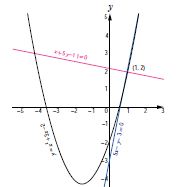
Therefore, the required equation of tangent is.
\((y-2)=5(x-1)\Rightarrow 5x-y-3=0\)
The slope of the normal at the point (1, 2) is -\(\frac{1}{5}\).
therefore, the required equation of normal is
\((y-2)=-\frac{1}{5}(x-1)\Rightarrow x+5y-11=0\)
60.
61.
Distance moved in time 't' is s = \(\frac{t^{3}}{3}-t^{2}+3\)
Velocity at time 't ' is V = \(\frac{ds}{dt}=t^{2}-2t\)
Acceleration at time 't ' is a(t) = \(\frac{dV}{dt}=2t-2\)
Therefore, the velocity is zero when t2 − 2t = 0, that is t = 0, 2. The acceleration is zero when 2t − 2 = 0 . That is at time at time t = 1
62.
We have,
\(\frac{d}{dt}W(t)=-20\times(1-0.1t)\)
Therefore at t = 2, \(\frac{d}{dt}W(t)=-16\)
That is, the person forgets at the rate of 16 words after 2 days of studying.
63.
Let the given function be written as f (x) = x2 ( 10− x)2 . Now
f(x) = x2(100 - 20x + x2) = x4-20x3+100x2
Therefore, f'(x) = 4x3- 60x3 + 200x = 4x(x2-15x+50)
f'(x) = 4x(x2-15x + 50) = 0 ⇒ x = 0, 5, 10
and f"(x) = 12x2-120x + 200
The stationary points of f(x) are x = 0, 5, 10 at these points the values of f′′(x) are respectively 200, −100 and 200. At x = 0, it has local minimum and its value is f(0) = 0. At x = 5, it has local maximum and its value is f(5) = 625. At x = 10, it has local minimum and its value is f(10) = 0.
64.
Let x = length of the cut on each side of the little squares.
V = the volume of the folded box.
The length of the base after two cuts along each edge of size x is 12 − 2x. The depth of the box after folding is x, so the volume is V = x \(\times\) (12 - 2x)2 Note that,
when x = 0 or 6, the volume is zero and hence there cannot be a box. Therefore the problem is to maximize, V = x \(\times\) (12 - 2x)2, x ∈ (0, 6)
\(\frac { dV }{ dx } ={ (12-2x) }^{ 2 }-4x(12-2x)\)
= (12 − 2x)(12 − 6x).
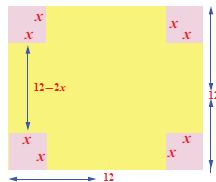
\(\frac { dV }{ dx } \) = 0 gives the stationary points x = 2, 6. Since 6 ∉ (0, 6) the only stationary point is at x = 2∈(0, 6). Further, \(\frac { dV }{ dx } \)- changes its sign from postive to negative when passing through x = 2 .
Therefore at x = 2 the volume V is local maximum. The local maximum volume value is V = 128 units. Hence the maximum cut can only be 2 units.
65.
The given function is defined and is differentiable at all \(x\in (-\infty, \infty) \). As
\(f(x)=\frac{1}{1+x^{2}}\).
We have \(f'(x)=-\frac{2x}{(1+x^{2})^{2}}\)
The stationary points are given by \(-\frac{2x}{(1+x^{2})^{2}}=0\) that is x = 0
Hence the intervals of monotonicity are \((-\infty,0)\) and \((0,\infty)\)
On the interval \((-\infty,0)\) the function strictly increases because f'(x) > 0 in that interval.
The function f(x) strictly decreases in the interval \((0,\infty)\) because f'(x) < 0 in that interval.
Since f′(x) changes from positive to negative when passing through x = 0, the first derivative test tells us there is local maximum at x = 0 and the local maximum value is f (0) = 1.
66.
The given function is defined and is differentiable at all \(x \in(0, \infty)\)
f(x) = x log x + 3x.
Therefore f'(x) = log x+1+3 = 4 + log x.
The stationary points are given by 4 + log x = 0
That is x = e-4
Hence the intervals of monotonicity are (0, e-4) and \((e^{-4}, \infty)\)
At \(x=e^{-5}\in(0,e^{-4})\), f'(e-5) = -1<0 and hence in the interval (0, e-4) -the function is strictly decreasing.
At \(x=e^{-3}\in(0,e^{-4})\), f'(e-3) = 1>0 and hence strictly increasing in the interval \((e^{-4}, \infty)\).
Since f′(x) changes from negative to positive when passing through x = e−4, the first derivative test tells us there is a local minimum at x = e-4 and it is f(e-4) = -e-4.
67.
The given function is a periodic function with period 2π and hence there will be stationary points and points of inflections in each period interval. We have,
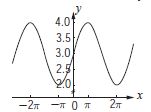
\(\frac { dy }{ dx } =cosx\) and \(\frac { { d }^{ 2 }y }{ { dx }^{ 2 } } =sinx\)
Now,\( \frac { { d }^{ 2 }y }{ { dx }^{ 2 } } =-sinx=0\Rightarrow x=n\pi \)
We now consider an interval, (-π, π ) by splitting into two sub intervals \(\left( -\pi ,0 \right) \) and \(\left( 0,\pi \right) \)
In the interval \(\left( -\pi ,0 \right) ,\frac { { d }^{ 2 }y }{ { dx }^{ 2 } } >0\) and hence the function is concave upward
In the interval \(\left( -\pi ,0 \right) ,\frac { { d }^{ 2 }y }{ { dx }^{ 2 } } <0\) and hence the function is concave downward. Therefore (0,3) is a point of inflection. The general intervals need to be considered to discuss the concavity of the curve are \(\left( n\pi ,\left( n+1 \right) \pi \right) \), where n is any integer which can be discussed as before to conclude that \(\left( n\pi ,3 \right) \) are also points of inflection.
68.
We have,
\(f(x)=log(1+x)-\frac{x}{1+x}\)
Therefore, \(f'(x)=\frac{1}{1+x}-\frac{1}{(1+x)^{2}}\)
= \(\frac{x}{(1+x)^{2}}\).
Hence, f′(x) is \(\begin{cases} <0 \ when-1
Therefore f (x) is strictly increasing for x > 0 and strictly decreasing for x < 0. Since f′(x) changes from negative to positive when passing through x = 0, the first derivative test tells us there is a local minimum at x = 0 which is f (0) = 0. Further, for x > 0, f(x) > f (0) = 0 gives
\(log(1+x)-\frac{x}{1+x}>0 \Rightarrow log(1+x)>\frac{x}{1+x}\).
69.
The amount after t years \((A)=\underset { x\rightarrow { \infty } }{ lim } { A }_{ 0 }{ \left( 1+\frac { r }{ n } \right) }^{ nt }\)
This is an indeterminate of the form 1∞.
Let g(x) = \({ \left( 1+\frac { r }{ n } \right) }^{ nt }\)
Taking logarithm we get,
log (g(x) = \(log{ \left( 1+\frac { r }{ n } \right) }^{ nt }\)
= \(\frac { log{ \left( 1+\frac { r }{ n } \right) } }{ \frac { 1 }{ nt } } \)
\(\therefore \underset { x\rightarrow { \infty } }{ lim } log(g(x)=\underset { x\rightarrow { \infty } }{ lim } \frac { log{ \left( 1+\frac { r }{ n } \right) } }{ \frac { 1 }{ nt } } \left( \frac { 0 }{ 0 } from \right) \)
\(=\underset { x\rightarrow { \infty } }{ lim } \frac { \frac { 1 }{ 1+\frac { r }{ n } } \left( \frac { -r }{ { n }^{ 2 } } \right) }{ -\frac { 1 }{ { n }^{ 2 }t } } \) [By L' Hôpital rule]
\(=\underset { x\rightarrow { \infty } }{ lim } \frac { 1 }{ 1+\frac { r }{ n } } \left( \frac { -r }{ { n }^{ 2 } } \right) \left( -\frac { { n }^{ 2 }t }{ 1 } \right) \)
= \(\underset { x\rightarrow { \infty } }{ lim } \frac { 1 }{ 1+\frac { r }{ n } } (rt)\)
= \(\left( \frac { 1 }{ 1+0 } \right) (rt)={ A }_{ 0 }rt\)
But \(\underset { x\rightarrow { \infty } }{ lim } log(g(x))=log(\underset { x\rightarrow { \infty } }{ lim } g(x))\)
\(\therefore log(\underset { x\rightarrow { \infty } }{ lim } g(x))=rt\)
\(\Rightarrow { e }^{ log(\underset { x\rightarrow { \infty } }{ lim } g(x)) }=rt\)
\(\Rightarrow \underset { x\rightarrow { \infty } }{ lim } g(x)={ e }^{ rt }\)
\(\Rightarrow \underset { x\rightarrow { \infty } }{ lim } { A }_{ 0 }{ \left( 1+\frac { r }{ n } \right) }^{ nt }={ A }_{ 0 }.{ e }^{ rt }\)
\(\Rightarrow A={ A }_{ 0 }.({ e }^{ rt })\)
Hence Proved.
70.
f(x) = x log x
\(f'\left( x \right) =x.\frac { 1 }{ x } +logx(1)\)
= 1 + log x
f''(x) = 0
⇒ 1 + logx = 0
⇒ logx = 1
\(\Rightarrow x={ e }^{ -1 }=\frac { 1 }{ e } \)
ஃ The critical numbers is \(\frac { 1 }{ e } \)
\(f''(x)=\frac { 1 }{ x } \)
\(f''\left( \frac { 1 }{ e } \right) =\frac { 1 }{ \frac { 1 }{ e } } =e>0\)
Since \(f''\left( \frac { 1 }{ e } \right) >0\) there is a local minimum at \(x=\frac { 1 }{ e } \)
\(f''\left( \frac { 1 }{ e } \right) =\frac { 1 }{ e } log\frac { 1 }{ e } \)
= \(\frac { 1 }{ e } log\frac { 1 }{ e } \)
= \(\frac { -1 }{ e } { log }_{ e }e=\frac { -1 }{ e } (1)=\frac { -1 }{ e } \)
ஃ Local minimum is \(-\frac { 1 }{ e } \) which occurs at \(x=\frac { 1 }{ e } \)
71.
f'(x) = -3.x5 + 5x3
f'(x) = -3x5 + 5x
f'(x) = - 15x4 + 15x2
f''(x) = 0
⇒ - 15x4 + 15x2 = 0
⇒ - 15x2 (1 - x2) = 0
⇒ x2 = 0, 1-x2 = 0
⇒ x = 0, x = 1, x = -1
ஃ The critical numbers are 0, 1,-1.
f"(x) - 60x3 + 30 x
f"(0) = 0
f"(1) - 60(1)3 + 30 (1)
-60 + 30 = -30
- 60(-1)3 + 30 (-1)
60- 30 = -30
Since f"(-1) < 0, it has a local maximum at
x = 1.
ஃ f(1) = -3(-1)5 + 5(-1)3
= -3 + 5 = 2
Since f"(-1) > 0, it has a local maximum at
x = -1.
ஃ f(-1) -3(1)5 + 5(1)3
3 - 5 = -2
∴ Local maximum is 2 which occurs at,
x = 1 and local minimum is -2 which occurs at
x = -1.
72.
This is an indeterminate of the form 1∞
Let g(x) = \((cos{ x })^{ \frac { 1 }{ { x }^{ 2 } } }\)
Taking logarithm, we get
log g(x) = log \((cos{ x })^{ \frac { 1 }{ { x }^{ 2 } } }\)
= \(\frac { log(cosx) }{ { x }^{ 2 } } \)
Now, \(\underset { x\rightarrow { { 0 }^{ + } } }{ lim } \frac { log(cosx) }{ { x }^{ 2 } } =\left( \frac { 0 }{ 0 } form \right) \)
= \(\frac { \underset { x\rightarrow { { 0 }^{ + } } }{ lim } \frac { 1 }{ cosx } (-sinx) }{ 2x } \)
= \(\underset { x\rightarrow { { 0 }^{ + } } }{ lim } -\frac { tanx }{ 2x } \)
= \(\frac { -1 }{ 2 } \underset { x\rightarrow { { 0 }^{ + } } }{ lim } \frac { tanx }{ x } =\frac { -1 }{ 2 } (1)\) \(\left[ \because \underset { x\rightarrow { { 0 }^{ + } } }{ lim } \frac { tanx }{ x } =1 \right] \)
= \(-\frac { 1 }{ 2 } \)
But \(\underset { x\rightarrow { { 0 }^{ + } } }{ lim } log(g(x)=log{ e }^{ (\underset { x\rightarrow { { 0 }^{ + } } }{ lim } g(x)) }\)
∴ \(log\left( \underset { x\rightarrow { { 0 }^{ + } } }{ lim } g(x) \right) =-\frac { 1 }{ 2 } \)
\({ e }^{ log }\left( \underset { x\rightarrow { { 0 }^{ + } } }{ lim } g(x) \right) ={ e }^{ -\frac { 1 }{ 2 } }\)
\({ e }^{ log }\left( \underset { x\rightarrow { { 0 }^{ + } } }{ lim } g(x) \right) ={ e }^{ -\frac { 1 }{ 2 } }=\frac {1}{\sqrt e}\)
73.
This is an indeterminate of the from 1∞
Let g(x) = (sin x)tan x
Taking logarithm, we get
log (g(x)) = log (sin x)tan x
= tan x log (sin x)
Now, \(\underset { x\rightarrow { \frac { \pi }{ 2 } } }{ lim } log(g(x))\) = \(\underset { x\rightarrow { \frac { \pi }{ 2 } } }{ lim } \frac { log(sinx) }{ cotx } =\left( \frac { 0 }{ 0 } form \right) \)
= \(\frac { \underset { x\rightarrow { \frac { \pi }{ 2 } } }{ lim } \frac { 1 }{ sinx } \times cosx }{ -{ cosec }^{ 2 }x } \) [By L' Hôpital Rule]
= \(\underset { x\rightarrow { \frac { \pi }{ 2 } } }{ lim } -\frac { cosx }{ sinx\frac { 1 }{ { sin }^{ 2 }x } } \)
= \(\underset { x\rightarrow { \frac { \pi }{ 2 } } }{ lim } cos \ x \ sin \ x=0\)
But \(\underset { x\rightarrow { \frac { \pi }{ 2 } } }{ lim } log(g(x))=log(\underset { x\rightarrow { \frac { \pi }{ 2 } } }{ lim } g(x))\)
\(\therefore log\left( \underset { x\rightarrow { \frac { \pi }{ 2 } } }{ lim } g(x) \right) =log \ 0=1\)
\(\Rightarrow { e }^{ log }\left( \underset { x\rightarrow { \frac { \pi }{ 2 } } }{ lim } g(x) \right) ={ e }^{ 1 }\)
\(\Rightarrow \underset { x\rightarrow { \frac { \pi }{ 2 } } }{ lim } g(x)=e\Rightarrow \underset { x\rightarrow { \frac { \pi }{ 2 } } }{ lim } { (sinx) }^{ tanx }=e^o=1\)
74.
This an indeterminate of the form 1∞
Let \(g(x)={ \left( 1+\frac { 1 }{ x } \right) }^{ x }\)
Taking logarithm, we get,
\(log(g(x))=log{ \left( 1+\frac { 1 }{ x } \right) }^{ x }\)
\(=xlog{ \left( 1+\frac { 1 }{ x } \right) }\)
\(=\frac { { \left( 1+\frac { 1 }{ x } \right) } }{ \frac { 1 }{ x } } \)
\(\therefore \underset { x\rightarrow \infty }{ lim } log(g(x))=\underset { x\rightarrow \infty }{ lim } \frac { { \left( 1+\frac { 1 }{ x } \right) } }{ \frac { 1 }{ x } } =\left( \frac { 0 }{ 0 } form \right) \)
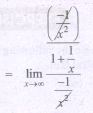
\(=\underset { x\rightarrow \infty }{ lim } \frac { { 1 } }{ \left( 1+\frac { 1 }{ x } \right) } =1\)
But \(\underset { x\rightarrow \infty }{ lim } log(g(x))=log\underset { x\rightarrow \infty }{ lim } g(x)\)
\(\therefore log(\underset { x\rightarrow \infty }{ lim } g(x))=1\)
\({ e }^{ log }(\underset { x\rightarrow \infty }{ lim } g(x))={ e }^{ 1 }=e\Rightarrow (\underset { x\rightarrow \infty }{ lim } g(x))=e\)
\(\Rightarrow \underset { x\rightarrow \infty }{ lim } { \left( 1+\frac { 1 }{ x } \right) }^{ x }=e\)
75.
Let \(g(x)=x^{\frac{1}{1-x}}\). This is an indeterminate of the form \(1^{\infty}\). Taking the logarithm,
\(log \ g(x)=\frac{logx}{1-x}\).
Therefore, \(\underset{x \rightarrow1}{lim \ }log \ g(x) =\underset{x\rightarrow 1}{lim}(\frac{log \ x}{1-x})(\frac{0}{0})\)
An application of l’Hôpital rule,
\(\underset{x \rightarrow1}{lim} \ (\frac{\frac{1}{x}}{-1})=-1\)
But, \(\underset{x\rightarrow 1}{lim}\) log g(x) = log (\(\underset{x\rightarrow 1}{lim}\) g(x)).
Hence on exponentiating, we get
\(\underset{x \rightarrow1}{lim}\quad x^{\frac{1}{1-x}}=e^{-1}=\frac{1}{e}\).
76.
This is an indeterminate of the form \(\infty^{0}\).
Let \(g(x)=(1+2x)^{\frac{1}{2log \ x}}\)
Taking the logarithm, we get
log g(x) = \(\frac{log(1+2x)}{2log \ x}\)
\(\underset{x\rightarrow \infty}{lim}log \ g(x)=\underset{x\rightarrow \infty}{lim}(\frac{log(1+2x)}{2log \ x})\) \((\frac{\infty}{\infty})\)
\(=\underset{x\rightarrow \infty}{lim}(\frac{\frac{2}{1+2x}}{\frac{2}{x}})\) (by l’Hôpital Rule)
= \(\underset{x\rightarrow \infty}{lim}(\frac{x}{1+2x})\) \((\frac{\infty}{\infty})\)
= \(\underset{x\rightarrow \infty}{lim}(\frac{1}{2})=\frac{1}{2}\) but,
\(\underset{x\rightarrow \infty}{lim}log \ g(x)=log (\underset{x\rightarrow \infty}{lim}g(x))\).
Hence by exponentiating, we get the required limit as \(\sqrt{e}\)
77.
This is an indeterminate of the form \(1^{\infty}\).
Let \(g(x)=(1+x)^{\frac{1}{x}}\). Taking the logarithm, we get
\(log \ g(x)=\frac{log(1+x)}{x}\)
\(\underset{x\rightarrow 0^{+}}{lim} log (g(x))=\underset{x\rightarrow 0^{+}}{lim}(\frac{log(1+x)}{x})\) \((\frac{0}{0})\)
=\(\underset{x\rightarrow0^{+}}{lim}(\frac{\frac{1}{1+x}}{1})\) (by 1’Hôpital Rule)
= 1.
But, \(\underset{x\rightarrow0^{+}}{lim}log g(x)=log(\underset{x\rightarrow 0^{+}}{lim} g(x))\)
Therefore, log\((\underset{x\rightarrow 0^{+}}{lim} g(x))=1\).
Hence by exponentiating, we get, \(\underset{x\rightarrow 0^{+}}{lim}g(x)=e.\)
78.
Let (x) = cos2 x
fI(x) = 2cos x (- sin x)
= - sin 2x ⇒ fl(0) = 0
fIl(x) = - 2 cos 2x ⇒ fIl(0) = -2
fIII(x) = + 4 sin 2 x ⇒ fIII(0) = 0
fIV(x) = 8 cos 2 x ⇒ fIV(0) = 8
fV(x) = -16 sin 2x ⇒ fV(0) = 0
fVI(x) = - 32 cos 2x ⇒ fVI(0) = -32
∴ Maclaurin's series
\(f(x)=f(0)+\frac { { f }^{ 1 }(0) }{ 1! } x+\frac { { f }^{ II }(0) }{ 2! } { x }^{ 2 }+\frac { { f }^{ III }(0) }{ 3! } { x }^{ 3 }+\) .......
∴ cos x = 1 - \(\frac { 2{ x }^{ 2 } }{ 2! } +\frac { 8{ x }^{ 4 } }{ 4! } +\frac { { 32x }^{ 6 } }{ 6! } \) + ...
= 1 - \(\frac { 2{ x }^{ 2 } }{ 2! } +\frac { { 2 }^{ 3 }{ x }^{ 4 } }{ 4! } +\frac { { { 2 }^{ 5 }x }^{ 6 } }{ 6! } \)+ ...
79.
Let f(x) = tan-1(x)
⇒ f(0) = tan-1(0) = 0
\({ f }^{ -1 }(x)=\frac { 1 }{ 1+{ x }^{ 2 } } ={ (1+{ x }^{ 2 }) }^{ -1 }\)
⇒ fI(0) = 1
fII(x) = -1(1 + x)-2 (2x)
= -2x(1 + x2)-2
⇒ fII(0) = 0
= -2[-4x2(1 + x2)-3 + (1 + x2)-2]
fIII(x) = -2[x(-2)(1+x2)-3 (2x) + (1 + x2)-2]
⇒ fIII(0) = 2
fIV(x) = -2[-4x2(-3) (1 + x2)-4 (2x) + (1 + x2)-3(-8x) + (1 + x2)-3(-2)(2x)]
⇒ fIIl(0) = 2
= - 2 [24x3 (1 + x2)-4-8x (1+ x2)3 -4x (1 + x2)3]
= - 2 [24x3 (1 + x2)-4-12x (1+ x2)3]
fIV(x) = 24[2x3 (1 + x2)-4 - x (1 + x2)-3]
⇒ fIl(0) = 0
fV(x) = - 24 [2x3 (-4)(1 +x2)-5(2x) + (1+ x2)-4(6x2 -x (- 3)(1 + x2)-4(2x) - (1 + x2)3]
= - 24 [16x4 (1 + x2)-5+ 6x2 (1+ x2)-4- (1 + x2)3]
= - 24 [16x4 (1 + x2)-5+12x2 (1+ x2)-4- (1 + x2)3]
⇒ fV(0) = 24
⇒ f(0) = tan-1 (0) = 0
⇒ fI(0) = 1
⇒ fII(0) = 0
⇒ fIII(0) = -2
⇒ fIV(0) = 0
⇒ fV(0) = 24
Maclaurin's series
\(f(x)=f(0)+\frac { { f }^{ 1 }(0) }{ 1! } x+\frac { { f }^{ II }(0) }{ 2! } { x }^{ 2 }+\frac { { f }^{ III }(0) }{ 3! } { x }^{ 3 }+\frac { { f }^{ IV }(0) }{ 4! } { x }^{ 4 }+..\)
= \(0+\frac { 1 }{ 1! } x+0\frac { 2 }{ 3! } { x }^{ 3 }+0+\frac { 24 }{ 5! } { x }^{ 5 }+\)...
= x - \(\frac { { x }^{ 3 } }{ 3 } +\frac { { x }^{ 5 } }{ 5 } +\).......
80.
f (x) is defined and differentiable for all x∈(-∞, ∞)
\(f'\left( x \right) =\frac { 1 }{ 2 } \left( { e }^{ x }+{ e }^{ -x } \right) \)
\(f''(x)=\frac { 1 }{ 2 } \left( { e }^{ x }-{ e }^{ -x } \right) \)
f"(x) = 0
\(\Rightarrow \frac { 1 }{ 2 } \left( { e }^{ x }-{ e }^{ -x } \right) =0\Rightarrow { e }^{ x }-{ e }^{ -x }=0\)
\(\Rightarrow { e }^{ x }={ e }^{ -x }\Rightarrow { e }^{ x }=\frac { 1 }{ { e }^{ x } } \)
\(\Rightarrow { e }^{ 2x }=1\Rightarrow { e }^{ 2x }={ e }^{ 0 }\)
\(\Rightarrow 2x=0\Rightarrow x=0\)
The possible intervals are (-∞,0) and (0,∞)
| Intervel | (-∞, 0) | (0, ∞) |
| Sign of f"(x) | Say x = -1 \(\cfrac { 1 }{ 2 } \left( { e }^{ -1 }-{ e }^{ 1 } \right) =-ve\) |
Say x = 1 \(\cfrac { 1 }{ 2 } \left( { e }^{ -1 }-{ e }^{ 1 } \right) =+ve\) |
| Concavity | Concave down | Concave up |
ஃ f(x) is concave up in (0, ∞) and concave down in (∞, 0).
Since f"(x) changes its position from negative to positive, when it passes through x = 0 the points of inflection is (0,1(0))
\(f(0)=\frac { 1 }{ 2 } \left( { e }^{ o }-{ e }^{ o } \right) =\frac { 1 }{ 2 } \left( 1-1 \right) =0\)
ஃ (0, 0) is the point of inflection.
81.
Givenf(x) = sin x + cos x, 0
f"(x) = sin x - cos x
\(\therefore\) f"(x) = 0
\(\Rightarrow\) sin x - cos X = 0
\(\Rightarrow\) -sin x = cosx
\(\Rightarrow\) sin (-x) = cos x
\(\Rightarrow\) \(x=\frac { 3\pi }{ 4 } ,\frac { 7\pi }{ 4 } ,2\pi \)
ஃ The possible intervals are \(\left( 0,\frac { 3\pi }{ 4 } \right) \left( \frac { 3\pi }{ 4 } ,\frac { 7\pi }{ 4 } \right) \left( \frac { 7\pi }{ 4 } ,2\pi \right) \)
| Interval | \(\left( 0,\frac { 3\pi }{ 4 } \right) \) | \(\left( \frac { 3\pi }{ 4 } ,\frac { 7\pi }{ 4 } \right) \) | \(\left( \frac { 7\pi }{ 4 } ,2\pi \right) \) |
| Say x = -1 \(f''\left( x \right) =-\frac { 1 }{ \sqrt { 2 } } -\frac { 1 }{ \sqrt { 2 } } =-\frac { 2 }{ \sqrt { 2 } } \) |
Say x = π f''(x) = -sinπ-cosπ = 0-(1) = 1 +ve |
Say x = 320° f" (x) = - sin 320 - cos 320 = -sin (270 + 60) - cos (270 + 60) = cos 60 - sin 60 = \(\frac { 1 }{ 2 } -\frac { \sqrt { 3 } }{ 2 } \) -ve |
|
| Concavity | Concave down | Concave up | Concave down |
ஃf (x) is concave upward in \(\left( \frac { 3\pi }{ 4 } ,\frac { 7\pi }{ 4 } \right) \) and concave downward in \(\left( 0,\frac { 3\pi }{ 4 } \right) \left( \frac { 7\pi }{ 4 } ,2\pi \right) \)
Since f" (x) changes its sign from negative to positive at \(\frac { 3\pi }{ 4 } \) and positive at \(\frac { 7\pi }{ 4 } \) f(x) has point of inflection at \(\left( \frac { 3\pi }{ 4 } ,f\left( \frac { 3\pi }{ 4 } \right) \right) \) and
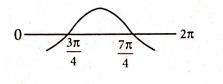
\(\left( \frac { 7\pi }{ 4 } ,f\left( \frac { 7\pi }{ 4 } \right) \right) \)
\(\therefore f\left( \frac { 3\pi }{ 4 } \right) =sin\frac { 3\pi }{ 4 } -cos\frac { \pi }{ 4 } \)
= \(sin\left( \pi -\frac { \pi }{ 4 } \right) +cos\left( \frac { \pi }{ 4 } \right) \)
= \(\frac { 1 }{ \sqrt { 2 } } -\frac { 1 }{ \sqrt { 2 } } =0\)
ஃ The points of inflection are \(\left( \frac { 3\pi }{ 4 } ,0 \right) \) and \(\left( \frac { 7\pi }{ 4 } ,0 \right) \)
82.
Given f(x) = x (x - 4)3
f'(x) = x .3(x - 4)2 + (x - 4)3(1)
= 3x (x - 4)2 + (x - 4)3
= (x - 4)2 + (3x +x- 4)3
= (x - 4)2 + (4x - 4)
= 4 (x-1) (x-4)2
f"(x) = 4 [(x - 1)2 (x - 4) +(x - 4)2 (1)]
= 4[2(x-4)(x-1)+(x - 4)2]
= 4(x- 4)[2x - 2 +x - 4)]
= 4(x - 4)(3x - 6)
= 12 (x - 4)(x- 2)
f"(x) = 0
⇒ 12 (x - 4)(x- 2) = 0
⇒ x = 2, 4
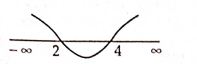
The possible intervals are (-∞, 2) (2, 4) and (4, ∞)
| Interval | (-∞, 2) | (2, 4) | (4, ∞) |
| Sign of f"(x) | Say x= 0 12(-4)(-2) = +ve |
Say x = 3 12(-1 )(1) = -ve |
Say x = 5 12(1)(3) = +ve |
| Concavity | Concave up | Concave down | Concave up |
ஃThe curve is concave upward on (-∞, 2) (4, ∞) and concave downward on (2, 4).
As f"(x) changes its sign when it passes through x = 2 and x = 4, the points of inflection are (2, f(2)) and (4,f(4)).
f(2) = 2(2 - 4)3
= 2(-2)3 = 2(-8) = -16
f(4) = 4 (4 - 4)3 = 0
\(\therefore\) (2, -16) and (4, 0) are the points of inflection
83.
We have, \(P=\frac{234+16x}{x+3}\)
Therefore, \(\frac{dP}{dt}= - \frac{186}{(x+3)^{2}}\times \frac{dx}{dt}\).
Substituting \(x=90, \frac{dx}{dt}=15\) we get\(\frac{dP}{dt}= -\frac{186}{93^{2}}\times 15= -\frac{10}{31}\approx -0.32\) repee/ week.
That is the price is changing, in fact decreasing at the rate of Rs. 0.32 per unit.

12th Standard Syllabus & Materials
12th Standard
TN 12th Computer Applications வலையமைப்பு வடமிடல் Sample Question Papers Study Material - QB365 Set A
NEW12th Standard
TN 12th Computer Applications களப்பெயர் முறைமை (DNS) Sample Question Papers Study Material - QB365 Set A
NEW12th Standard
TN 12th Computer Applications வலையமைப்பு எடுத்துக்காட்டுகள் மற்றும் நெறிமுறைகள் Sample Question Papers Study Material - QB365 Set A
NEW12th Standard
TN 12th Computer Applications கணினி வலையமைப்பு ஓர் அறிமுகம் Sample Question Papers Study Material - QB365 Set A



Tamilnadu Stateboard 12th Standard Subjects
Maths

Chemistry

Physics

Biology

Computer Science

Business Maths and Statistics

Economics

Commerce

Accountancy

History

Computer Applications
Biology
Computer Technology
Computer Applications
Computer Science
Business Maths and Statistics
Commerce
Economics
Maths
Chemistry
Physics
Computer Technology
History
Accountancy

Tamil

English

French
Tamilnadu Stateboard Standards

