
 100% FREE ACCESS
12th Standard Syllabus & Materials
12th Standard
TN 12th Maths Applications of Matrices and Determinants Sample Question Papers Study Material - QB365 Set A
NEW12th Standard
TN 12th Computer Applications மின்னணு தரவு பரிமாற்றம் Sample Question Papers Study Material - QB365 Set A
NEW12th Standard
TN 12th Computer Applications மின் - வணிக பாதுகாப்பு அமைப்புகள் Sample Question Papers Study Material - QB365 Set A
NEW12th Standard
TN 12th Computer Applications மின்னணு செலுத்தல் முறைகள் Sample Question Papers Study Material - QB365 Set A
NEW12th Standard
TN 12th Computer Applications மின் - வணிகம் Sample Question Papers Study Material - QB365 Set A
NEW12th Standard
TN 12th Computer Applications திறந்த மூல கருத்துருக்கள் Sample Question Papers Study Material - QB365 Set A

Published on: 02/09/2022
QB365 provides a detailed and simple solution for every Possible Book Back Questions in Class 12 Maths Subject - Applications of Integration, English Medium. It will help Students to get more practice questions, Students can Practice these question papers in addition to score best marks.
Download Tamil Nadu 12th Standard Maths question papers, model tests, one-mark questions, important questions, and public exam papers in PDF format. Free study materials and answer keys for TN State Board students.
Questions + Answers key
Take MCQ Maths Test1.
Find, by integration, the volume of the solid generated by revolving about y-axis the region bounded between the curve y =\(\frac{3}{4} \sqrt {x^2 -16}, x\ge4\) the y-axis, and the lines y = 1 and y = 6.
2.
Find the volume of the solid formed by revolving the region bounded by the ellipse \(\frac { { x }^{ 2 } }{ { a }^{ 2 } } +\frac { { y }^{ 2 } }{ { b }^{ 2 } } =1\), a>b about the major axis.
3.
Find the volume of a right-circular cone of base radius r and height h.
4.
Using integration, find the area of the region which is bounded by x-axis, the tangent and normal to the circle x2 + y2 = 4 drawn at (1, \(\sqrt 3\))
5.
Using integration find the area of the region bounded by triangle ABC, whose vertices A, B, and C are (−1, 1), (3, 2), and (0, 5) respectively
6.
Find the area of the region bounded between the parabolas y2 = 4x and x2 = 4y.
7.
Find the area of the region bounded by x−axis, the curve y = |cos x|, the lines x = 0 and x = \(\pi\).
8.
Find the area of the region bounded by the y-axis and the parabola x = 5 − 4y − y2.
9.
If \(\int _{ 0 }^{ \infty }{ { e }^{ -a{ x }^{ 2 } }{ x }^{ 3 }dx=32,\alpha >0,\ find\ \alpha } \)
10.
Evaluate the following:
\(\int _{ 0 }^{ \frac { \pi }{ 2 } }{ \frac { { e }^{ -tanx } }{ { cos }^{ 6 }x } } dx\)
11.
Prove that \(\int _{ 0 }^{ \infty }{ { e }^{ -x }{ x }^{ n }dx=n! } \) where n is a positive integer.
12.
Evaluate \(\int _{ 0 }^{ 2a }{ { x }^{ 2 }\sqrt { 2ax-{ x }^{ 2 } } } dx\)
13.
Evaluate the following integrals using properties of integration:
\(\int _{ 0 }^{ { sin }^{ 2 }x }{ { sin }^{ -1 }\sqrt { t } dt+\int _{ 0 }^{ { cos }^{ 2 }x }{ { cos }^{ -1 }\sqrt { t } dt } } \)
14.
Evaluate the following integrals using properties of integration:
\(\int _{ 0 }^{ 1 }{ |5x-3|dx } \)
15.
Evaluate the following integrals using properties of integration:
\(\int _{ 0 }^{ 2\pi }{ { sin }^{ 4 }{ x\ cos }^{ 3 }xdx } \)
16.
Evaluate the following integrals using properties of integration:
\(\int _{ -\frac { \pi }{ 2 } }^{ \frac { \pi }{ 2 } }{ ({ x }^{ 5 }+xcos\ x+{ tan }^{ 3 }x+1)dx } \)
17.
Prove that \(\int ^\frac {\pi}{4}_{0} \frac{dx}{a^2 sin^2 x+b^2 cos^2 x}\) = \(\frac{1}{ab} tan^{-1} (\frac{a}{b})\) where a, b > 0
18.
Prove that \(\int^{\frac{\pi}{4}}_{0} \frac {sin 2x dx}{ sin ^4x +cos ^4 x}\) = \(\frac{\pi}{4}\)
19.
Evaluate: \(\int _{ 0 }^{ 1.5 }{ [{ x }^{ 2 }]dx } \) where [x] is the greatest integer function
20.
Evaluate: \(\int _{ 0 }^{ \frac { \pi }{ 2 } }{ (\sqrt { tan\ x } +\sqrt { cot\ x } )dx } \)
21.
Evaluate: \(\int _{ 0 }^{ \frac { 1 }{ \sqrt { 2 } } }{ \frac { { sin }^{ -1 }x }{ { (1-{ x }^{ 2 }) }^{ \frac { 3 }{ 2 } } } dx } \)
22.
Evaluate: \(\int _{ 0 }^{ \frac { \pi }{ 2 } }{ \frac { cos\theta }{ (1+sin\theta )(2+sin\theta ) } } d\theta \)
23.
Evaluate the following integrals as the limits of sums.
\(\int _{ 1 }^{ 2 }{( 4x^2-1)dx } \)
24.
Evaluate the following integrals as the limits of sums.
\(\int _{ 0 }^{ 1 }{ (5x+4)dx } \)
25.
Evaluate\(\int _{ 1 }^{ 4 }{ ({ 2x }^{ 2 }+3) } \) dx, as the limit of a sum
26.
Find an approximate value of \(\int _{ 1 }^{ 1.5 }{ { (2-x)dx } } \) by applying the mid-point rule with the partition {1.1, 1.2, 1.3, 1.4, 1.5}.
27.
Find an approximate value of \(\int _{ 1 }^{ 1.5 }{ x^2dx } \) by applying the right-end rule with the partition {1.1, 1.2, 1.3, 1.4, 1.5}.
28.
Find an approximate value of \(\int _{ 1 }^{ 1.5 }{ xdx } \) by applying the left-end rule with the partition {1.1, 1.2, 1.3, 1.4, 1.5}.
29.
If f (x) be a continuous function defined on a closed interval [a,b] and F(x) is an anti-derivative of f (x), then,
\(\int_{a}^{b} f(x) d x=F(b)-F(a)\)
30.
If f (x) be a continuous function defined on a closed interval [a,b] and\(F(x)=\int_{a}^{x} f(u) d u, \quad a
31.
Find, by integration, the volume of the solid generated by revolving about y-axis the region bounded between the parabola x = y2 +1, the y-axis, and the lines y = 1 and y = −1.
32.
Find the volume of a sphere of radius a.
33.
Evaluate \(\int _{ 0 }^{ \infty }{ \frac { { x }^{ n } }{ { x }^{ x } } } dx\), where n is positive integer \(\ge\)2
34.
Evaluate the following
\(\int _{ 0 }^{ 1 }{ { x }^{ 2 }{ (1-x) }^{ 3 }dx } \)
35.
Evaluate the following
\(\int _{ 0 }^{ 2\pi }{ { sin }^{ 7 } } \frac { x }{ 4 } dx\)
36.
Evaluate the following
\(\int _{ 0 }^{ \pi /6 }{ { sin}^{ 5}3x\ dx } \)
37.
Evaluate the following
\(\int _{ 0 }^{ \pi /4 }{ { sin}^{ 6}2x\ dx } \)
38.
Evaluate \(\int _{ 0 }^{ 1 }{ { x }^{ 5 }{ (1-{ x }^{ 2 }) }^{ 5 }dx } \)
39.
Evaluate the following \(\int _{ 0 }^{ \frac { \pi }{ \sqrt { 2 } } }{ \frac { dx }{ 5+4{ sin }^{ 2 }x } } \)
40.
Evaluate the following:
\(\int _{ 0 }^{ \frac { \pi }{ 2 } }{ { x }^{ 2 }cos2x\ dx } \)
41.
Evaluate the following:
\(\int _{ 0 }^{ \frac { 1 }{ 2 } }{ \frac { { e }^{ { a\ sin }^{ -1x } }{ sin }^{ -1 }x }{ \sqrt { 1-{ x }^{ 2 } } } dx } \)
42.
Evaluate the following:
\(\int _{ 0 }^{ 1 }{ \frac { sin(3{ tan }^{ -1 }x){ tan }^{ -1 }x }{ 1+{ x }^{ 2 } } } dx\)
43.
Evaluate the following:
\(\int _{ 0 }^{ 1 }{ { x }^{ 3 }{ e }^{ -2x }dx } \)
44.
Evaluate: \(\\ \\ \int _{ -1 }^{ 1 }{ { e }^{ -\lambda x }(1-{ x }^{ 2 }) } dx\)
45.
Evaluate: \(\int _{ 0 }^{ 2\pi }{ { x }^{ 2 }sin\ nx\ dx } \) where n is a positive integer.
46.
Evaluate \(\\ \int _{ 0 }^{ 1 }{ { e }^{ -2x }(1+x-{ 2x }^{ 3 })dx } \)
47.
Evaluate \(\int _{ 0 }^{ x }{ { x }^{ 2 } } \)cos nx dx, where n is a positive integer.
48.
Evaluate the following integrals using properties of integration:
\(\int _{ 0 }^{ 2\pi }{ xlog\left( \frac { 3+cos\ x }{ 3-cos\ x } \right) } dx\)
49.
Evaluate the following integrals using properties of integration:
\(\int _{ -\frac { \pi }{ 4 } }^{ \frac { \pi }{ 4 } }{ { sin }^{ 2 }xdx } \)
50.
Evaluate the following integrals using properties of integration:
\(\int _{ -5 }^{ 5 }{ xcos } \left( \frac { { e }^{ x }-1 }{ { e }^{ x }+1 } \right) dx\)
51.
Evaluate the following definite integrals:
\(\int _{ 0 }^{ 1 }{ \frac { 1-{ x }^{ 2 } }{ { (1+{ x }^{ 2 }) }^{ 2 } } } dx\)
52.
Evaluate the following definite integrals:
\(\int _{ 0 }^{ \frac { \pi }{ 2 } }{ \sqrt { cos\theta } } { sin }^{ 3 }\theta d\theta \)
53.
Evaluate the following definite integrals:
\(\int _{ 0 }^{ \frac { \pi }{ 2 } }{ { e }^{ x }\left( \frac { 1+sinx }{ 1+cosx } \right) dx } \)
54.
Evaluate the following definite integrals:
\(\int _{ 0 }^{ 1 }{ \sqrt { \frac { 1-x }{ 1+x } } } dx\)
55.
If f (x) = f (a + x), then \(\int _{ 0 }^{ 2a }{ f(x)dx=2\int _{ 0 }^{ a }{ f(x)dx } } \)
56.
Evaluate :\(\int _{ 0 }^{ 1 }{ \frac { 2x+7 }{ { 5x }^{ 2 }+9 } } dx\)
57.
Evaluate: \(\int _{ 0 }^{ 3 }{ (3{ x }^{ 2 }-4x+5) } dx\)
58.
Find the area of the region bounded by the line 6x + 5y = 30, x − axis and the lines x = −1 and x = 3.
59.
Evaluate the following:
\(\int _{ 0 }^{ \infty }{ { x }^{ 5 }{ e }^{ -3x }dx } \)
60.
Show that \(\int ^\frac{2\pi}{0}_{0}\) g(cos x)dx = 2 \(\int ^{\pi}_{0}\) g(cosx)dx where g(cos x) is a function of cos x
61.
Show that \(\int _{ 0 }^{ \pi }{ g(sinx)dx=2 } \int _{ 0 }^{ \frac { \pi }{ 2 } }{ g(sinx)dx, } \) where g(sin x) is a function of sin x.
1.
We note that \(y=\frac { 3 }{ 4 } \sqrt { { x }^{ 2 }-16 } \Rightarrow \frac { { x }^{ 2 } }{ 16 } -\frac { { y }^{ 2 } }{ 9 } =1\). So, the given curve is a portion of the hyperbola \(\frac { { x }^{ 2 } }{ 16 } -\frac { { y }^{ 2 } }{ 9 } =1\) between the lines y = 1 and y = 6 and it lies above the x-axis.
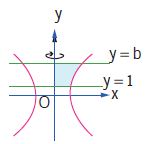
The region to be revolved is sketched.
Since revolution is made about y-axis, we write the equation of the portion of the hyperbola as \(x=\frac { 4 }{ 3 } \sqrt { 9+{ y }^{ 2 } } .\)
So, the volume of the solid generated is given by
\(V=\pi \int _{ 1 }^{ 6 }{ { x }^{ 2 }dy=\pi \int _{ 1 }^{ 6 }{ { \left( \frac { 4 }{ 3 } \sqrt { 9+{ y }^{ 2 } } \right) }^{ 2 } } } dy=\pi \left( \frac { 16 }{ 9 } \right) \int _{ 1 }^{ 16 }{ \left( 9+{ y }^{ 2 } \right) dy } \)
\(=\pi \left( \frac { 16 }{ 9 } \right) { \left( 9y+\frac { { y }^{ 3 } }{ 3 } \right) }_{ 1 }^{ 6 }=\pi \left( \frac { 16 }{ 9 } \right) \left[ (54+72)-(9+\frac { 1 }{ 3 } ) \right] =\frac { 5600 }{ 27 } \pi \)
2.
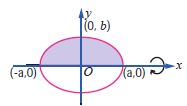
The ellipse is symmetric about both the axes. The major axis lies along x-axis. The region to be revolved is sketched
Hence, the required volume is given by
\(V=\pi \int _{ -a }^{ a }{ { y }^{ 2 }dx } =\pi \int _{ -a }^{ a }{ \frac { { b }^{ 2 } }{ { a }^{ 2 } } \left( { a }^{ 2 }-{ x }^{ 2 } \right) dx } \)
\(=\frac { 2\pi { b }^{ 2 } }{ { a }^{ 2 } } \int _{ 0 }^{ a }{ ({ a }^{ 2 }-{ x }^{ 2 })dx } \) since the integrand is an even function
\(=\frac { { 2\pi b }^{ 2 } }{ { a }^{ 2 } } { \left( { a }^{ 2 }x-\frac { { x }^{ 3 } }{ 3 } \right) }_{ 0 }^{ a }=\frac { 2\pi { b }^{ 2 } }{ 3 } ={ \left( { a }^{ 2 }-\frac { { a }^{ 3 } }{ 3 } \right) }_{ 0 }^{ a }=\frac { 2\pi { b }^{ 2 } }{ 3 } \left( \frac { { 2a }^{ 3 } }{ 3 } \right) =\frac { 4\pi { ab }^{ 2 } }{ 3 } \)
3.
Consider the triangular region in the first quadrant which is bounded by the line y = \(\frac{r}{h}\)x. x-axis, the lines x = 0 and x = h. revolving the region about the x-axis, we get a cone of base radius r and height h.
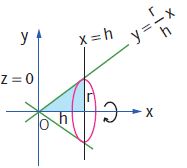
Hence, the volume of the cone is given by
\(\\ \\ V=\pi \int _{ 0 }^{ h }{ { y }^{ 2 }dx=\pi \int _{ 0 }^{ h }{ { \left( \frac { r }{ h } x \right) }^{ 2 } } dx=\pi { \left( \frac { r }{ h } \right) }^{ 2 } } { \left[ \frac { { x }^{ 3 } }{ 3 } \right] }_{ 0 }^{ h }=\frac { \pi { r }^{ 2 }h }{ 3 } \)
4.
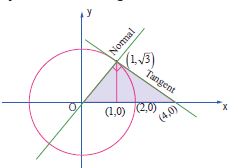
We recall that the equation of the tangent to the circle x2 + y2 = a2 at (x1, y1) is xx1+yy1 = a2. So, the equation of the tangent to the circle x2 + y2 + = 4 at (1, \(\sqrt 3\)) is x+y\(\sqrt 3\) = 4; that is y = -\(\frac{1}{\sqrt 3}\)( x - 4). The tangent meets the x-axis at the point (4,0). The slope of the tangent is-\(\frac{1}{\sqrt 3}\). So the slope of the normal is \(\sqrt 3\) and hence equation of the normal is y-\(\sqrt 3\) =\(\sqrt 3\)(x-1); that is y = \(\sqrt 3\) x and it passes through the origin. The area to be found is shaded in the adjoining figure. It can be found by two methods.
5.
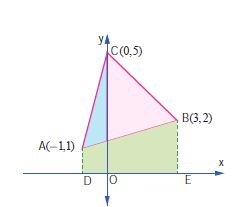
Equation of AB is \(\frac { y-1 }{ 2-1 } =\frac { x+1 }{ 3+1 } or\quad y=\frac { 1 }{ 4 } (x+5)\)
Equation of BC is \(\frac { y-5 }{ 2-5 } =\frac { x-0 }{ 3-0 } or\quad y=-x+5\)
Equation of AC is \(\frac { y-1 }{ 5-1 } =\frac { x+1 }{ 0+1 } or\quad y=4x+5\)
\(\therefore\) Area of \(\Delta\)ABC = Area DACO+ Area of OCBE − Area of DABE
\(=\int _{ -1 }^{ 0 }{ (4x+5)dx+\int _{ 0 }^{ 3 }{ (-x+5)dx-\frac { 1 }{ 4 } \int _{ -1 }^{ 3 }{ (x+5)dx } } } \)
\(\\ \\ \\ ={ \left[ \frac { { 4x }^{ 2 } }{ 2 } +5x \right] }_{ -1 }^{ 0 }+{ \left[ -\frac { { x }^{ 2 } }{ 2 } +5x \right] }_{ 0 }^{ 3 }-\frac { 1 }{ 4 } { \left[ \frac { { x }^{ 2 } }{ 2 } +5x \right] }_{ -1 }^{ 3 }\)
\(=0-(+2-5)+\left( -\frac { 9 }{ 2 } +15 \right) -0-\frac { 1 }{ 4 } \left[ \frac { 9 }{ 2 } +15 \right] +\frac { 1 }{ 4 } \left[ \frac { 1 }{ 2 } -5 \right] =\frac { 15 }{ 2 } \)
6.
First, we get the points of intersection of the parabolas. For this, we solve y2 x = 4 and x2 y = 4 simultaneously Eliminating y between them, we get x4 = 64x and so x = 0 and x = 4. Then the points of intersection are (0, 0) and (4, 4). The required region is sketched.
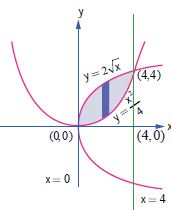
Viewing in the direction of y -axis, the equation of the upper boundary is y = 2\(\sqrt x\) for 0\(\le x \le\) 4 and the equation of the lower boundary is \(y =\frac {x^2}{4}\)for \(0 \leq x \leq 4\). So, the required area \(\Delta\) is
\(A=\int_{0}^{4}\left(y_{U}-Y_{L}\right) d x=\int_{0}^{4}\left(2 \sqrt{x}-\frac{x^{2}}{4}\right) d x=\left[2\left(\frac{2 x^{3 / 2}}{3}\right)-\frac{x^{3}}{12}\right]_{0}^{4}=\left[2\left(\frac{2 \times 8}{3}\right)-\frac{64}{12}\right]-0=\frac{16}{3}\)
7.
The given curve is \(y=\begin{cases} cosx,0\le x\le \frac { \pi }{ 2 } \\ -cosx,\frac { \pi }{ 2 } \le x\le \pi \end{cases}\)
It lies above the x − axis. The required area is sketched. So, the required area is given by
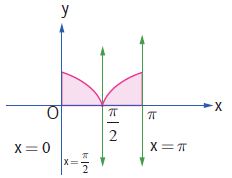
\(A=\int _{ 0 }^{ \pi }{ ydx=\int _{ 0 }^{ \frac { \pi }{ 2 } }{ cosxdx } +\int _{ \frac { \pi }{ 2 } }^{ \pi }{ (-cosx)dx } ={ [sin\quad x] }_{ 0 }^{ \frac { \pi }{ 2 } }-{ [sin\quad x] }_{ \frac { \pi }{ 2 } }^{ \pi } } \)
= [1-0]-[0-1] = 2
8.
The equation of the parabola is ( y + 2)2 = −(x−9). The parabola crosses the y- axis at (0, −5) and (0, 1). The vertex is at (9, −2) and the axis of the parabola is y = −2. The required area is sketched
Viewing in the positive direction of x-axis, and making horizontal strips, the required area A is given by
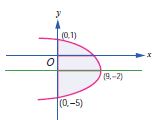
\(A=\int _{ -5 }^{ 1 }{ xdy } =\int _{ -5 }^{ 1 }{ (5-4y-{ y }^{ 2 })dy={ \left[ 5y-2{ y }^{ 2 }-\frac { { y }^{ 3 } }{ 3 } \right] }_{ -5 }^{ 1 }=\frac { 8 }{ 3 } -\left( -\frac { 100 }{ 3 } \right) =36 } \)
9.
Given \(\int _{ 0 }^{ \infty }{ { e }^{ -a{ x }^{ 2 } }{ x }^{ 3 }dx=32,\alpha >0} \)
| x | 0 | \(\infty\) |
| t | 0 | \(\infty\) |
\(\Rightarrow \int _{ 0 }^{ \infty }{ { e }^{ { -\alpha x }^{ 2 } } } .{ x }^{ 2 }.dx=32\)
\(put\ t= { x }^{ 2 }\)
\(\Rightarrow dt=2x\ dx\)
\(\\ \Rightarrow \frac { dt }{ 2 } = xdx\)
\( \int _{ 0 }^{ \infty }{ { e }^{ -\alpha t }\frac{dt}{2}} \frac { 1 }{ 2 } \int _{ 0 }^{ \infty }{ { e }^{ -\alpha t }.tdt } \)
\( \frac { 1 }{ 2 } \times\frac{1} { \alpha}^{ 2 } \) ...... (1)
Given \(\int^x_0e^{-ax^2}x^3 dx = 32\)
By (1),
\(\Rightarrow \frac { 1! }{ { \alpha }^{ 2 } } =32\times 2\left[ \because \int _{ 0 }^{ \infty }{ { e }^{ -ax }{ x }^{ n }dx=\frac { n! }{ { a }^{ n+1 } } } \right] \)
\(\frac{1}{2}\times \frac{1}{\alpha^2}= 32 \Rightarrow \frac {1}{\alpha ^2}= 64\\ \alpha ^2 = \frac{1}{64}\)
\(\Rightarrow \alpha =\frac { 1 }{ 8 } \)
10.
\(=\int _{ 0 }^{ \pi /2 }{ { e }^{ -tan\quad x }{ sec }^{ 6 }xdx\ \left[ \because sec\ x=\frac { 1 }{ cos\quad x } \right] } \)
\(Put\quad t=tan\quad x\Rightarrow dt={ sec }^{ 2 }xdx\)
\(=\int _{ 0 }^{ \pi /2 }{ { e }^{ -tanx }{ sec }^{ 4x }{ sec }^{ 2x }dx } \)
\(=\int _{ 0 }^{ \pi /2 }{ { e }^{ -tanx }{ (1+{ tan }^{ 2 }) }^{ 2 } } { sec }^{ 2 }xdx\)
\(put\quad t=tanx\Rightarrow dt={ sec }^{ 2 }xdx\)
| x | 0 | \(\frac{\pi}{2}\) |
| t | 0 | \(\infty\) |
\(=\int _{ 0 }^{ \infty }{ { e }^{ -t }{ (1+{ t }^{ 2 }) }^{ 2 } } dt\)
\(=\int _{ 0 }^{ \infty }{ { e }^{ -t }(1+{ t }^{ 4 }+{ 2t }^{ 2 })dt } \)
\(=\int _{ 0 }^{ \infty }{ { e }^{ -t }(1)dt+\int _{ 0 }^{ \infty }{ { e }^{ -t }{ t }^{ 4 }dt+2 } } \int _{ 0 }^{ \infty }{ { e }^{ -t }{ t }^{ 2 }dt } \)
\(=0!+4!+2(2!)\left[ \because \int _{ 0 }^{ \infty }{ { e }^{ -x }{ x }^{ n }dx=n! } \right] \)
\(=1+4\times 3\times 2\times 1+2\times 2=1+24+4\)
\(\therefore I=29\)
11.
Applying integration by parts, we get
\(\int _{ 0 }^{ \infty }{ { e }^{ -x }{ x }^{ n } } dx={ \left[ { x }^{ n }(-{ e }^{ -x }) \right] }_{ 0 }^{ \infty }-\int _{ 0 }^{ \infty }{ (-{ e }^{ -x }) } ({ nx }^{ n-1 })dx=n\int _{ 0 }^{ \infty }{ { e }^{ -x }{ x }^{ n-1 }dx } \)
\(Let\quad { I }_{ n }=\int _{ 0 }^{ \infty }{ { e }^{ -x }{ x }^{ n }dx.\ Then,\ { I }_{ n }={ nI }_{ n-1 } } \)
So, we get In= n(n−1) In−2.
Proceeding in this way, we get ultimately,
In = n(n-1)(n-2)...(2)(1)I0.
But, \({ I }_{ 0 }=\int _{ 0 }^{ \infty }{ { e }^{ -x }{ x }^{ 0 }dx } ={ \left( -{ e }^{ -x } \right) }_{ 0 }^{ \infty }=0+1=1.\) So, we get n = n(n-1)(n-2)(2)(1) = n!
Hence, we get
\(\int _{ 0 }^{ \infty }{ { e }^{ -x }{ x }^{ n }dx=n! } \), where n is a nonnegative integer.
12.
Put x = 2a cos2\(\theta\).
Then, dx = -4a cos \(\theta\) sin \(\theta\)d\(\theta\)
when x = 0, 2a cos2\(\theta\) = 0 and so \(\theta\) = \(\frac{\pi}{2}\)
When x = 2a, 2a cos2\(\theta\) = 2a and so \(\theta\) = 0
Hence, we get
\(I=\int _{ 0 }^{ 2a }{ { x }^{ 2 }\sqrt { 2ax-{ x }^{ 2 } } dx } \)
\(\int _{ \frac { \pi }{ 2 } }^{ 0 }{ { 4a }^{ 2 }{ cos }^{ 2 }\theta \sqrt { { 4a }^{ 2 }{ cos }^{ 2 }\theta -4{ a }^{ 2 }{ cos }^{ 4 }\theta } } (-4a\ cos\theta sin\ \theta )d\theta \)
\(=\int _{ 0 }^{ \frac { \pi }{ 2 } }{ { 4a }^{ 2 }{ cos }^{ 2 }\theta\ 2a\ cos\ \theta sin\ \theta (4a\ cos\ \theta sin\theta )d\theta } \)
\(=32{ a }^{ 4 }\int _{ 0 }^{ \frac { \pi }{ 2 } }{ { cos }^{ 4 }\theta { sin }^{ 2 }\theta d\theta } \)
\(=32{ a }^{ 4 }\times \frac { 1 }{ 6 } \times \frac { 3 }{ 4 } \times \frac { 1 }{ 2 } \times \frac { \pi }{ 2 } =\pi { a }^{ 4 }\)
13.
\(put\sqrt { t } =z\Rightarrow \frac { 1 }{ 2\sqrt { t } } dt=dz\)
\(\Rightarrow \frac { 1 }{ 2z } dt=dz\Rightarrow dt=2zdz\)
| t | 0 | sin2x |
| z | 0 | sin x |
| t | 0 | cos2x |
| z | 0 | cos x |
\(\therefore I=\int _{ 0 }^{ sin\quad x }{ 2z{ sin }^{ -1 }zdz } +\int _{ 0 }^{ cosx }{ 2z{ cos }^{ -1 }zdz } ...(1)\)
= I1+ I2
\(=2\int _{ 0 }^{ x }{ \theta sin\theta cos\theta d\theta +2\int _{ \frac { \pi }{ 2 } }^{ x }{ \theta cos\theta (-sin\theta )d\theta } } \)
\(=\int _{ 0 }^{ x }{ \theta 2sin\theta cos\theta d\theta -\int _{ \frac { \pi }{ 2 } }^{ x }{ \theta 1sin\theta cos\theta d\theta } } \)
\(=\int _{ 0 }^{ x }{ \theta sin2\theta d\theta -\int _{ \frac { \pi }{ 2 } }^{ x }{ \theta sin2\theta d\theta } } \)
\([\because sin2\theta =sin\theta cos\theta ]\)
\(=\int _{ 0 }^{ x }{ \theta sin2\theta d\theta \int _{ x }^{ \frac { \pi }{ 2 } }{ \theta sin2\theta d\theta } =\int _{ 0 }^{ \frac { \pi }{ 2 } }{ \theta sin2\theta d\theta } } \)
\(\left[ \because \int _{ a }^{ c }{ f(x)dx+\int _{ c }^{ b }{ f(x)dx=\int _{ a }^{ b }{ f(x)dx } } } \right] \)
\(={ \left[ -\frac { \theta cos2\theta }{ 2 } \right] }_{ 0 }^{ \frac { \pi }{ 2 } }+\int _{ 0 }^{ \frac { \pi }{ 2 } }{ \frac { cos2\theta }{ 2 } d\theta } \)
\(={ \left[ -\frac { \theta cos2\theta }{ 2 } +\frac { sin2\theta }{ 4 } \right] }_{ 0 }^{ \frac { \pi }{ 2 } }\)
\(=\frac { -\frac { \pi }{ 2 } cos\pi }{ 2 } +\frac { sin\pi }{ 4 } -(0+0)\)
\(=\frac { -\frac { \pi }{ 2 } (-1) }{ 2 } +\frac { 0 }{ 4 } =\frac { \pi }{ 4 } \)
14.
\(=\int _{ 0 }^{ \frac { 3 }{ 5 } }{ -(5x-3)dx+\int _{ \frac { 3 }{ 5 } }^{ 1 }{ -(5x-3)dx } } \)
\(={ { \left[ 3x-\frac { { 5x }^{ 2 } }{ 2 } \right] }_{ 0 }^{ \frac { 3 }{ 5 } }+\left[ \frac { { 5x }^{ 2 } }{ 2 } -3x \right] }_{ 3 }^{ 1 }\)
\(=\frac { 9 }{ 5 } -\frac { 5 }{ 2 } \left( \frac { 9 }{ 25 } \right) -0+\frac { 5 }{ 2 } -3-\frac { 5 }{ 2 } \left( \frac { 9 }{ 25 } \right) +\frac { 9 }{ 5 } \)
\(=\frac { 9 }{ 5 } -\frac { 9 }{ 10 } +\frac { 5 }{ 2 } -3-\frac { 9 }{ 10 } +\frac { 9 }{ 5 } \)
\(=\frac { 18-9+25-30-9+18 }{ 10 } =\frac { 13 }{ 10 } \)
15.
Let \(I=\int _{ 0 }^{ 2\pi }{ { sin }^{ 4 }x{ cos }^{ 3 }xdx } \quad ...(1)\)
By the property \(\left[ \because \int _{ 0 }^{ a }{ f(x)dx=\int _{ 0 }^{ a }{ f(a-x)dx } } \right] \)
we get
\(I=\int _{ 0 }^{ 2\pi }{ { \left[ sin(2\pi -x) \right] }^{ 4 } } { \left[ cos(2\pi -x) \right] }^{ 3 }dx\)
\(=\int _{ 0 }^{ 2\pi }{ { [-sin\quad x] }^{ 4 }{ [-cos\quad x] }^{ 3 }dx } \)
\(=-\int _{ 0 }^{ 2\pi }{ { sin }^{ 4 }x{ cos }^{ 3 }xdx\quad ..(2) } \)
\(\therefore (1)+(2)\Rightarrow \)
\(2I=\int _{ 0 }^{ 2\pi }{ { sin }^{ 4 }x{ cos }^{ 3 }xdx } \)
\(-\int _{ 0 }^{ 2\pi }{ { sin }^{ 4 }x{ cos }^{ 3 }xdx=0 } \)
\(\Rightarrow I=0\)
16.
\(=\int _{ -\frac { \pi }{ 2 } }^{ \frac { \pi }{ 2 } }{ { x }^{ 5 }dx } +\int _{ -\frac { \pi }{ 2 } }^{ \frac { \pi }{ 2 } }{ xcosx\quad dx+ } \int _{ -\frac { \pi }{ 2 } }^{ \frac { \pi }{ 2 } }{ { tan }^{ 3 }xdx+ } \int _{ -\frac { \pi }{ 2 } }^{ \frac { \pi }{ 2 } }{ dx } \)
\(=0+0+0+{ [x] }_{ -\frac { \pi }{ 2 } }^{ \frac { \pi }{ 2 } }\)
\(=\frac { \pi }{ 2 } -\left( -\frac { \pi }{ 2 } \right) \)
\(=\frac { \pi }{ 2 } +\frac { \pi }{ 2 } \)
\(=\pi \)
\(\\ \\ \\ \\ \\ \because \int { { x }^{ 5 } } dx\) is an odd function \(\int { { x } } \) cos xdx is an odd function \(\int { { tan }^{ 3 } } \)xdx is an odd function
17.
Put I = \(\int _{ 0 }^{ \frac { \pi }{ 4 } } \frac { dx }{ a^{ 2 }sin^{ 2 }x+b^{ 2 }cos^{ 2 }x } =\int _{ 0 }^{ \frac { \pi }{ 4 } } \frac { sec^{ 2 }xdx }{ a^{ 2 }tan^{ 2 }x+b^{ 2 } } \)
Put u = tan x
Then du = sec2 x dx
When x = 0 , we have u = tan 0 = 0
When x = \(\frac{\pi}{4}\), we have u = tan\(\frac{\pi}{4}\) = 1
\(\therefore I=\int _{ 0 }^{ 1 } \frac { du }{ a^{ 2 }u^{ 2 }+b^{ 2 } } =\frac { 1 }{ a^{ 2 } } \int _{ 0 }^{ 1 } \frac { du }{ u^{ 2 }+\left( \frac { b }{ a } \right) ^{ 2 } } =\frac { 1 }{ a^{ 2 } } { \left[ \frac { a }{ b } tan^{ -1 }(\frac { au }{ b } ) \right] }_{ 0 }^{ 1 }=\frac { 1 }{ ab } tan^{ -1 }\left( \frac { a }{ b } \right) \)
We derive some more properties of definite integrals
18.
\(\int _{ 0 }^{ \frac { \pi }{ 4 } } \frac { sin2xdx }{ sin^{ 4 }x+cos^{ 4 }x } =\int _{ 0 }^{ \frac { \pi }{ 4 } } \frac { sin2xdx }{ (sin^{ 2 }x+cos^{ 2 }x)-2sin^{ 2 }xcos^{ 2 }x } \)
\(\int _{ 0 }^{ \frac { \pi }{ 4 } } \frac { sin2xdx }{ (1-\frac { 1 }{ 2 } (2sinxcosx)^{ 2 } } =\int _{ 0 }^{ \frac { \pi }{ 4 } } \frac { 2sin2xdx }{ 2-sin^{ 2 }2x } =\int _{ 0 }^{ \frac { \pi }{ 4 } } \frac { 2sin2xdx }{ 1+cos^{ 2 }2x } \)
Put u = cos 2x, Then, du = −2sin 2x dx
When x = 0 , we have u = cos 0 = 1. When x = \(\frac{\pi}{4}\) we have u = cos\(\frac{\pi}{4}\) = 0
∴ I = \(\int^{0}_{1} \frac {-du}{1+u^2}\) = \(\int^{0}_{1} \frac {du}{1+u^2}\) = [tan-1 u\(]^1_0\) = \(\frac{\pi}{4}\)
19.
We know that the greatest integer function [x] is the largest integer less than or equal to x. In other words, it is defined by [x] = n, if n \(\le\) x \(\le\) (n +1) , where n is an integer.
So, we get \(\begin{cases} \begin{matrix} 0 & if & 0\le x\le 1 \end{matrix} \\ \begin{matrix} 1 & if & 1\le x<\sqrt { 2 } \end{matrix} \\ \begin{matrix} 2 & if & \sqrt { 2 } \le x\le 1.5 \end{matrix} \end{cases}\)
We note that the above function is not continuous on [0,1.5]
But, it is continuous in each of the sub-intervals [0, 1] , [1, \(\sqrt2\)] and [\(\sqrt2\), 1.5]; that is, it is piece-wise continuous on [0, 1.5].
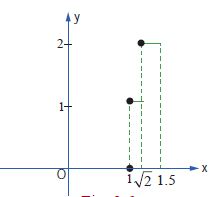
\(\int _{ 0 }^{ 1.5 }{ \left[ { x }^{ 2 } \right] dx=\int _{ 0 }^{ 1 }{ [{ x }^{ 2 }] } dx+\int _{ 1 }^{ \sqrt { 2 } }{ [{ x }^{ 2 }]dx+ } } \int _{ \sqrt { 2 } }^{ 1.5 }{ \left[ { x }^{ 2 } \right] } dx=\int _{ 1 }^{ \sqrt { 2 } }{ 1dx } +\int _{ \sqrt { 2 } }^{ 1.5 }{ 2dx } \)
\(={ 0+(x) }_{ 1 }^{ \sqrt { 2 } }+{ (2x) }_{ \sqrt { 2 } }^{ 1.5 }=(\sqrt { 2 } -1)+(3-2\sqrt { 2 } )=2-\sqrt { 2 } \)
20.
Let I = \(\int _{ 0 }^{ \frac { \pi }{ 2 } }{ (\sqrt { tan\ x } +\sqrt { cot\ x } )dx } \) Then we get
\(I=\int _{ 0 }^{ \frac { \pi }{ 2 } }{ \left( \sqrt { \frac { sinx }{ cosx } } +\sqrt { \frac { cosx }{ sinx } } \right) dx } =\int _{ 0 }^{ \frac { \pi }{ 2 } }{ \frac { sinx+cosx }{ \sqrt { sinxcosx } } dx } =\sqrt { 2 } \int _{ 0 }^{ \frac { \pi }{ 2 } }{ \frac { sinx+cosx }{ \sqrt { 2sinxcosx } } dx } \)
\(=\sqrt { 2 } \int _{ 0 }^{ \frac { \pi }{2 } }{ \frac { (sinx+cosx)dx }{ \sqrt { 1-sinx-cosx{ ) }^{ 2 } } } } \)
Put u = sin x − cos x
Then, du = (cos x + sin x)dx .
When x = 0, u = −1
When x =\(\frac{\pi}{2}\), u = 1
\(\therefore I=\sqrt { 2 } \int _{ -1 }^{ 1 }{ \frac { du }{ \sqrt { 1-{ u }^{ 2 } } } =\sqrt { 2 } { [{ sin }^{ -1 }u] }_{ -1 }^{ 1 }=\sqrt { 2 } \left[ { sin }^{ -1 }(1)-{ sin }^{ -1 }(-1)) \right] } =\pi \sqrt { 2 } \)
21.
Let I = \(\int _{ 0 }^{ \frac { 1 }{ \sqrt { 2 } } }{ \frac { { sin }^{ -1 }x }{ { (1-{ x }^{ 2 }) }^{ \frac { 3 }{ 2 } } } dx } \)
Put u = sin-1 x. Then, x = sin u and so, du =\(\frac { 1 }{ \sqrt { 1-{ x }^{ 2 } } } dx\)
When x = 0, u = 0
When \(x=\frac { 1 }{ \sqrt { 2 } } ,u=\frac { \pi }{ 4 } .\)
\(\therefore I=\int _{ 0 }^{ \frac { \pi }{ 4 } }{ \frac { u }{ { cos }^{ 2 }u } } du=\int _{ 0 }^{ \frac { \pi }{ 4 } }{ u{ sec }^{ 2 }udu={ [utanu] }_{ 0 }^{ \frac { \pi }{ 4 } } } -\int _{ 0 }^{ \frac { \pi }{ 4 } }{ tan\quad udu={ [utanu] }_{ 0 }^{ \frac { \pi }{ 4 } }+{ \left[ logcosu \right] }_{ 0 }^{ \frac { \pi }{ 4 } } } \)
\(=\frac { \pi }{ 4 } +log\frac { 1 }{ \sqrt { 2 } } =\frac { \pi }{ 4 } -\frac { 1 }{ 2 } log2\)
22.
Let I = \(\int _{ 0 }^{ \frac { \pi }{ 2 } }{ \frac { cos\theta }{ (1+sin\theta )(2+sin\theta ) } } d\theta \)
Put u = 1 + sin\(\theta\)
Then, du = cos\(\theta\) d\(\theta\)
When \(\theta\) = 0, u = 1
When \(\theta =\frac{\pi}{2}, u=2\)
\(\therefore I=\int _{ 1 }^{ 2 }{ \frac { du }{ u(1+u) } } =\int _{ 1 }^{ 2 }{ \frac { (1+u)-u }{ u(1+u) } du } =\int _{ 1 }^{ 2 }{ \left( \frac { 1 }{ u } -\frac { 1 }{ 1+u } \right) du=[logu-log(1+u)]_{ 1 }^{ 2 } } \)
\(=(log2-log3)-(log1-log2)=2log2-log3=log\frac { 4 }{ 3 } .\)
23.
Here a = 1, b = 2,f(x) = 4x2-1
\(\therefore f(a+(b-a)\frac { r }{ n } )=f(1+1(\frac { r }{ n } ))\)
\(=f\left( 1+\frac { r }{ n } \right) \)
\(=4{ \left( 1+\frac { r }{ n } \right) }^{ 2 }-1=4\left( 1+\frac { { r }^{ 2 } }{ { n }^{ 2 } } +\frac { 2r }{ n } \right) -1\)
\(=4+\frac { { 4r }^{ 2 } }{ { n }^{ 2 } } +\frac { 8r }{ n } -1=3+\frac { { 4r }^{ 2 } }{ { n }^{ 2 } } +\frac { 8r }{ n } \)
\(\int _{ a }^{ b }{ f(x)dx= } \underset { n\rightarrow \infty }{ lim } \frac { b-a }{ n } \sum _{ r=1 }^{ n }{ f } \left( a+(b-a)\frac { r }{ n } \right) \)
\(\therefore \int _{ 1 }^{ 2 }{ ({ 4x }^{ 2 }-1)dx } =\underset { n\rightarrow \infty }{ lim } \frac { 1 }{ n } \sum _{ r=1 }^{ n }{ \left( 3+\frac { { 4r }^{ 2 } }{ { n }^{ 2 } } +\frac { 8r }{ n } \right) } \)
\(=\underset { n\rightarrow \infty }{ lim } \left[ \frac { 1 }{ n } \sum _{ r=1 }^{ n }{ 3+\frac { 1 }{ n } } \sum _{ r=1 }^{ n }{ \frac { { 4r }^{ 2 } }{ { n }^{ 2 } } } +\frac { 1 }{ n } \sum _{ r=1 }^{ n }{ \frac { 8r }{ n } } \right] \)
\(=\left[ \underset { n\rightarrow \infty }{ lim } \frac { 1 }{ n } .3n+\frac { 1 }{ n } \frac { 4 }{ { n }^{ 2 } } ({ 1 }^{ 2 }+{ 2 }^{ 2 }+...+{ n }^{ 2 })+\frac { 1 }{ n } .\frac { 8 }{ n } (1+2+3....+n) \right] \)\(=\underset { n\rightarrow \infty }{ lim } \left[ 3+\frac { 4 }{ { n }^{ 3 } } \frac { n(n+1)(2+1) }{ 6 } +\frac { 8 }{ { n }^{ 2 } } \frac { n(n+1) }{ 2 } \right] \)
\(\left[ \because \sum { r } =\frac { n(n+1) }{ 2 } \sum { { r }^{ 2 }=\frac { n(n+1)(2n+1) }{ 6 } } \right] \)
\(=\underset { n\rightarrow \infty }{ lim } \left[ 3+\frac { 4 }{ { n }^{ 3 } } \frac { { n }^{ 3 }(1+\frac { 1 }{ n } )(2+\frac { 1 }{ n } ) }{ 6 } +\frac { 8 }{ { n }^{ 2 } } \frac { { n }^{ 2 }(1+\frac { 1 }{ n } ) }{ 2 } \right] \)
\(=[3+\frac { 2 }{ 3 } (1+0)(2+0)+4(1+0)]\)
\([\because when\quad n\rightarrow \infty ,1/n\rightarrow 0]\)
\(=3+\frac { 4 }{ 3 } +4=\frac { 9+4+12 }{ 3 } =\frac { 25 }{ 3 } \)
\(\therefore \int _{ 1 }^{ 2 }{ (4{ x }^{ 2 }-1)dx=\frac { 25 }{ 3 } } \)
24.
Here a = 0, b = 1,f (x) = 5x + 4
\(\therefore f(a+(b-a)\frac { r }{ n } )=f\left( 0+1(\frac { r }{ n } ) \right) =f(\frac { r }{ n } )=5(\frac { r }{ n } )+4\)
\(\int _{ a }^{ b }{ f(x)dx } =\underset { n\rightarrow \infty }{ lim } \frac { b-a }{ n } \sum _{ r=1 }^{ n }{ f(a+(b-a)\frac { r }{ n } } \)
\(\therefore \int _{ 0 }^{ 1 }{ (5x+4)dx } =\underset { n\rightarrow \infty }{ lim } \frac { 1 }{ n } \sum _{ r=1 }^{ n }{ \left( \frac { 5r }{ n } +4 \right) } \)
\(=\underset { n\rightarrow \infty }{ lim } \left[ \frac { 1 }{ n } \sum _{ r=1 }^{ n }{ \frac { 5r }{ n } +\frac { 1 }{ n } \sum _{ r=1 }^{ n }{ 4 } } \right] \)
\(=\underset { n\rightarrow \infty }{ lim } \left[ \frac { 1 }{ n } .\frac { 5 }{ n } .(1+2+3+...+n)+\frac { 1 }{ n } .4n \right] \)
\(=\underset { n\rightarrow \infty }{ lim } \left[ \frac { 5 }{ { n }^{ 2 } } \frac { n(n+1) }{ 2 } +4 \right] \)
\([\because \sum { r=\frac { n(n+1) }{ 2 } ;\sum { { r }^{ 2 }=\frac { n(n+1)(2n+1) }{ 6 } } } ]\)
\(=\underset { n\rightarrow \infty }{ lim } \frac { 5 }{ { n }^{ 2 } } { n }^{ 2 }\frac { (1+\frac { 1 }{ n } ) }{ 2 } +4\)
\(=\frac { 5 }{ 2 } (1+0)+4=\frac { 5 }{ 2 } +4\)
\([wehen\quad n\rightarrow \infty ,1/n\quad \rightarrow 0]\)
\(=\frac { 5+8 }{ 2 } =\frac { 13 }{ 2 } \)
\(\therefore \int _{ 0 }^{ 1 }{ (5x+4)dx } =\frac { 13 }{ 2 } \)
25.
We use the formula
\(\int _{ a }^{ b }{ f(x)dx } =\underset { n\rightarrow \infty }{ lim } \frac { b-a }{ n } \sum _{ r=1 }^{ n }{ f } \left( a+(b-a)\frac { r }{ n } \right) \)
Here f(x) = 2x2+3, a = 1 and b = 4
So, we get
\(f\left( a+(b-a)\frac { r }{ n } \right) =f\left( 1+(4-1)\frac { r }{ n } \right) =f\left( 1+\frac { 3r }{ n } \right) =2{ \left( 1+\frac { 3r }{ n } \right) }^{ 2 }+3=5+\frac { { 18r }^{ 2 } }{ { n }^{ 2 } } +\frac { 12r }{ n } \)Hence, we get
\(\int _{ 1 }^{ 4 }{ ({ 2x }^{ 2 }+3) } dx=\underset { n\rightarrow \infty }{ lim } \frac { 3 }{ n } \sum _{ r=1 }^{ n }{ \left( 5+\frac { { 18r }^{ 2 } }{ { n }^{ 2 } } +\frac { 12r }{ n } \right) } =\underset { n\rightarrow \infty }{ lim } \left[ \frac { 15 }{ n } \sum _{ r=1 }^{ n }{ 1+\frac { 54 }{ { n }^{ 3 } } \sum _{ r=1 }^{ n }{ { r }^{ 2 } } +\frac { 36 }{ { n }^{ 2 } } \sum _{ r=1 }^{ n }{ r } } \right] \)
\(=\underset { n\rightarrow \infty }{ lim } \left[ \frac { 15 }{ n } n+\frac { 54 }{ { n }^{ 3 } } ({ 1 }^{ 2 }+{ 2 }^{ 2 }+...+{ n }^{ 2 })+\frac { 36 }{ { n }^{ 2 } } (1+2+..+n) \right] \)
\(=\underset { n\rightarrow \infty }{ lim } \left[ 15+\frac { 54 }{ { n }^{ 3 } } \frac { n(n+1)(2n+1) }{ 6 } +\frac { 36 }{ { n }^{ 2 } } \frac { n(n+1) }{ 2 } \right] \)
\(=\underset { n\rightarrow \infty }{ lim } \left[ 15+9\left( 1+\frac { 1 }{ n } \right) \left( 2+\frac { 1 }{ n } \right) +18\left( 1+\frac { 1 }{ n } \right) \right] \)
= 15+9(1+ 0)(2 + 0) +18(1+ 0) = 51.
26.
Here a = 1, b = 1.5, n = 5 and f(x) = 2-x
So, the width of each subinterval is
\(h=\Delta x=\frac { b-a }{ n } =\frac { 1.5-1 }{ 5 } =\frac { 0.5 }{ 5 } =0.1\)
The partition of the interval is given by
x0 = 1
x1 = 1.1
x2 = 1.2
x3 = 1.3
x4 = 1.4
x5 = 1.5
Mid-point rule for Riemann sum with equal widh \(\Delta x\) is
\(S=\left[ f\left( \frac { { x }_{ 0 }+{ x }_{ 1 } }{ 2 } \right) +f\left( \frac { { x }_{ 1 }+{ x }_{ 2 } }{ 2 } \right) +f\left( \frac { { x }_{ 2 }+{ x }_{ 3 } }{ 2 } \right) +f\left( \frac { { x }_{ 3 }+{ x }_{ 4 } }{ 2 } \right) +f\left( \frac { { x }_{ 4 }+{ x }_{ 5 } }{ 2 } \right) \right] \Delta x\)
\(=\left[ f\left( \frac { 1+1.1 }{ 2 } \right) +f\left( \frac { 1.1+1.2 }{ 2 } \right) +f\left( \frac { 1.2+1.3 }{ 2 } \right) +f\left( \frac { 1.3+1.4 }{ 2 } \right) +f\left( \frac { 1.4+1.5 }{ 2 } \right) \right] 0.1\)
= [f(1.05)+f(1.15)+f(1.25)+f(1.35)+f(1.45)](0.1)
= 0.95+0.85+0.75+0.65+0.55) \(\times\)(0.1)
= (2-1.05)+(2-1.15)+(2-1.25)+(2-1.35)+(2-1.45)\(\times\)(0.1)
= 3.75\(\times\)0.1 = 0.375
27.
Here a = 1, b = 1.5, n = 5, f(x) = x2
So, the width of each subinterval is
\(h=\Delta x=\frac { b-a }{ n } =\frac { 1.5-1 }{ 5 } =\frac { 0.5 }{ 5 } =0.1\)
The right end rule for Riemann sum with equal width \(\Delta\)x
x1 = 1.1
x2 = 1.2
x3 = 1.3
x4 = 1.4
x5 = 1.5
The right - end rule for Riemann sum with equal width Ax is
S = [fx1)+f(x2)+f(x3)+......+f(xn)]\(\Delta\)x
S = [f(1.1)+f(1.2)+f(1.3)+f(1.4)+f(1.5)](0.1)
= (1.21+1.44+1.69+1.96+2.25) \(\times\)(0.1)
= (8.55)\(\times\)(0.1)
= 0.855
28.
To find \(\int _{ 1 }^{ 1.5 }{ xdx } \) in {1.1, 1.2, 1.3, 1.4, 1.5}.
Here a = 1,
b = 1.5, n = 5, f(x) = x
\(\therefore h=\Delta x=\frac { b-a }{ n } =\frac { 1.5-1 }{ 5 } =\frac { 0.5 }{ 5 } =0.1\)
The partition of the interval is given by
x0 = 1
x1 = x0 + h = 1 + 0.1 = 1.1
x2 = x1 + h = 1.1 + 0.1 = 1.2
x3 = x2 + h = 1.2 + 0.1 = 1.3
x4 = x3 + h = 1.3 + 0.1 = 1.4
x5 = x4 + h = 1.4 + 0.1 = 1.5
The left end rule for Riemann sum with equal width \(\Delta\)x is
\(\int _{ a }^{ b }{ xdx } =[f({ x }_{ 0 })+f({ x }_{ 1 })+...+f({ x }_{ (n-1 })]\Delta x\)
S = [f(1) + f(1.1) + f(1.2) + f(1.3) + f(1.4)](0.1)
= (1 + 1.1 + 1.2 + 1.3 + 1.4) (0.1)
= 6 \(\times\) 0.1
S = 0.6
29.
30.
31.
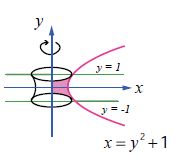
The parabola x = y2 +1 is y2 x = −1. It is symmetrical about x-axis and has the vertex at (1, 0) and focus at \(\left( \frac { 5 }{ 4 } ,0 \right) \). The region for revolution is shaded. Hence, the required volume is given by
\(V=\pi \int _{ -1 }^{ 1 }{ { x }^{ 2 }dy } \)
\(=\pi \int _{ -1 }^{ 1 }{ { ({ y }^{ 2 }+1) }^{ 2 }dy } \)
\(=2\pi \int _{ 0 }^{ 1 }{ \left( { y }^{ 4 }+{ 1y }^{ 2 }+1 \right) dy } \), since the integrand is an even function
\(=2\pi { \left( \frac { { y }^{ 5 } }{ 5 } +2\frac { { y }^{ 3 } }{ 3 } +y \right) }_{ 0 }^{ 1 }=2\pi \left( \frac { 1 }{ 5 } +\frac { 2 }{ 3 } +1 \right) \pi \)
32.
By revolving the upper semicircular region enclosed between the circle x2 + y2 = a2 and the x-axis, we get a sphere of radius a.
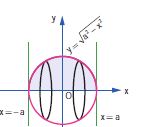
The boundaries of the region are y = \(\\ \\ \\ \\ \\ \\ \\ \sqrt { { a }^{ 2 }-{ x }^{ 2 } } \) x-axis, the lines x = −a and x = a. Hence, the volume of the sphere is given by
\(v=\pi \int _{ -a }^{ a }{ { y }^{ 2 }dx=\pi } \int _{ -a }^{ a }{ \left( { a }^{ 2 }-{ x }^{ 2 } \right) } dx\)
\(=2\pi \int _{ 0 }^{ a }{ ({ a }^{ 2 }-{ x }^{ 2 })dx } \) since the integrand (a2-x2) is an even function
\(=2\pi { \left( { a }^{ 2 }x-\frac { { x }^{ 3 } }{ 3 } \right) }_{ 0 }^{ a }=2\pi \left( { a }^{ 3 }-\frac { { a }^{ 3 } }{ 3 } \right) =\frac { 4 }{ 3 } { \pi a }^{ 3 }\)
33.
Using the formula \(n={ e }^{ { log }_{ e }n },\) we get
\(I=\int _{ 0 }^{ \infty }{ \frac { { x }^{ n } }{ { n }^{ x } } } dx=\int _{ 0 }^{ \infty }{ { n }^{ -x }{ x }^{ n }dx=\int _{ 0 }^{ \infty }{ { n }^{ -x }{ x }^{ n } } dx=\int _{ 0 }^{ \infty }{ { ({ e }^{ log\quad n }) }^{ -x }{ x }^{ n }dx=\int _{ 0 }^{ \infty }{ { e }^{ -xlog\quad n }{ x }^{ n }dx } } } \)
Using the substitution u = x log n, we get dx \(\frac { du }{ log\ n } \)
When x = 0,
we get u = 0
When x = \(\infty\), we get u = \(\infty\)
\(\therefore I=\int _{ 0 }^{ \infty }{ { e }^{ -u }{ \left( \frac { u }{ log\quad n } \right) }^{ n }\frac { du }{ log\quad n } } \)
\(=\frac { 1 }{ { (log\quad n) }^{ n+1 } } \int _{ 0 }^{ \infty }{ { e }^{ -u }{ u }^{ (n+1)-1 }du=\frac { Γ(n+1) }{ { (log\quad n) }^{ n+1 } } =\frac { n! }{ { (log) }^{ n+1 } } } \)
34.
\(I=\int _{ 0 }^{ 1 }{ { x }^{ 2 } } { (1-x) }^{ 3 }dx\)
We know \(\int _{ 0 }^{ 1 }{ { x }^{ m }{ (1-x) }^{ n }dx=\frac { m!\times n! }{ (m+n+1)! } } \)
\(\therefore I=\frac { 2!\times 3! }{ (2+3+1)! } =\frac { 2\times 3\times 2\times 1 }{ 6\times 5\times 4\times 3\times 2\times 1 } \)
\(I=\frac { 1 }{ 60 } \)
35.
\(Let\quad t=\frac { x }{ 4 } \Rightarrow dt=\frac { dx }{ 4 } \Rightarrow dx=4dt\)
Here n = 7, which is odd
\(\therefore I=4\int _{ 0 }^{ \pi /2 }{ { sin }^{ 7 }tdt } \)
| x | 0 | 2\(\pi\) |
| t | 0 | \(\frac{\pi}{2}\) |
\(=4\times \frac { 6 }{ 7 } \times \frac { 4 }{ 5 } \times \frac { 2 }{ 3 } \times 1\)
\(I=\frac { 64 }{ 35 } \)
36.
\(Let\quad t=3x\\\Rightarrow dt=3dx\\\Rightarrow \frac { dt }{ 3 } =dx\)
Here n = 6, which is even
\(\therefore I=\frac { 1 }{ 3 } \int _{ 0 }^{ \frac { \pi }{ 2 } }{ { sin }^{ 5 }t\quad dt=\frac { 1 }{ 3 } \times \frac { 4 }{ 5 } \times \frac { 2 }{ 3 } \times 1 } \)
| x | 0 | \(\frac{\pi}{6}\) |
| t | 0 | \(\frac{\pi}{2}\) |
\(=\frac { 8 }{ 45 } \)
37.
\(Let\quad t=2x\Rightarrow dt=2dx\Rightarrow \frac { dt }{ 2 } =dx\)
\(\therefore I=\frac { 1 }{ 2 } \int _{ 0 }^{ \frac { \pi }{ 2 } }{ { sin }^{ 6 }t\quad dt=\frac { 1 }{ 2 } { I }_{ 6 } } \)
| x | 0 | \(\frac{\pi}{4}\) |
| t | 0 | \(\frac{\pi}{t}\) |
\([\int _{ 0 }^{ \pi /2 }{ { sin }^{ n }xdx=\frac { n-1 }{ n } { I }_{ n-2 }, } n\ge 2]\)
\(\\ =\frac { 1 }{ 2 } \times \frac { 5 }{ 6 } \times \frac { 3 }{ 4 } \times \frac { 1 }{ 2 } \times \frac { \pi }{ 2 } =\frac { 5\pi }{ 64 } \)
38.
Put x = sin \(\theta\). Then, dx = cos \(\theta\) d \(\theta\)
when x = 0, sin \(\theta\) = 0 and so \(\theta\) = 0. When x = 1, sin \(\theta\) = 1 and so \(\theta =\frac{\pi}{2}\)
Hence, we get
\(I=\int _{ 0 }^{ \frac { \pi }{ 2 } }{ { sin }^{ 5 }\theta { (1-{ sin }^{ 2 }\theta ) }^{ 5 }cos\theta d\theta } \)
\(=\int _{ 0 }^{ \frac { \pi }{ 2 } }{ { sin }^{ 5 }\theta { cos }^{ 11 }\theta d\theta =\frac { 10 }{ 16 } \times \frac { 8 }{ 14 } \times \frac { 6 }{ 12 } \times \frac { 4 }{ 10 } \times \frac { 2 }{ 8 } \times \frac { 1 }{ 6 } =\frac { 1 }{ 336 } } \)
By applying the reduction formula III iteratively, we get the following results (stated without proof):
\(\int _{ 0 }^{ 1 }{ { x }^{ m }{ (1-x) }^{ n }dx } =\frac { m!\times n! }{ (m+n+1)! } \), where m and n are positive integers
39.
Dividing the numerator and denominator by cos2x we get,
\(I=\int _{ 0 }^{ \frac { \pi }{ 2 } }{ \frac { \frac { 1 }{ { cos }^{ 2 } } dx }{ \frac { 5 }{ { cos }^{ 2 }x } +\frac { 4{ sin }^{ 2 }x }{ { cos }^{ 2 }x } } } \)
\(=\int _{ 0 }^{ \frac { \pi }{ 2 } }{ \frac { { sec }^{ 2 }x }{ 5{ sec }^{ 2 }x+4{ tan }^{ 2 }x } dx } \)
\(\\ =\int _{ 0 }^{ \frac { \pi }{ 2 } }{ \frac { { sec }^{ 2 }xdx }{ 5(1+{ tan }^{ 2 }x)+4{ tan }^{ 2 }x } } \)
\(=\int _{ 0 }^{ \frac { \pi }{ 2 } }{ \frac { { sec }^{ 2 }x }{ 5+5{ tan }^{ 2 }x+4{ tan }^{ 2 }x } } dx\)
\(=\int _{ 0 }^{ \frac { \pi }{ 2 } }{ \frac { { sec }^{ 2 }x }{ 5+9{ tan }^{ 2 }x } dx\quad put\quad u=tan\quad x } \)
| x | 0 | \(\frac{\pi}{2}\) |
| u | 0 | \(\infty\) |
\(\Rightarrow du={ sec }^{ 2 }x,dx\)
\(\therefore I=\int _{ 0 }^{ \infty }{ \frac { du }{ 5+9{ u }^{ 2 } } =\frac { 1 }{ 9 } \int _{ 0 }^{ \infty }{ \frac { du }{ \frac { 5 }{ 9 } +{ u }^{ 2 } } =\frac { 1 }{ 9 } \int _{ 0 }^{ \infty }{ \frac { du }{ { \left( \frac { \sqrt { 5 } }{ 3 } \right) }^{ 2 }+{ u }^{ 2 } } } } } \)
\(=\frac { 1 }{ 9 } \frac { \pi }{ 2\left( \frac { \sqrt { 5 } }{ 3 } \right) } \left[ \because \int _{ 0 }^{ \infty }{ \frac { dx }{ { a }^{ 2 }+{ x }^{ 2 } } } =\frac { \pi }{ 2a } \right] \)
\(=\frac { \pi }{ 2.3\sqrt { 5 } } =\frac { \pi }{ 6\sqrt { 5 } } \times \frac { \sqrt { 5 } }{ \sqrt { 5 } } =\frac { \pi }{ 6\sqrt 5 } \)
40.
\(Let\ u={ x }^{ 2 }\ v=cos 2x\ dx\)
\(u'=2x\quad { v }_{ 1 }=\frac { sin2x }{ 2 } \)
\(u"=2\quad { v }_{ 2 }=-\frac { cos2x }{ 4 } \)
\(\\ { v }_{ 3 }=-\frac { sinx }{ 8 } \)
Bernoulli's' formula:
\(\int { uvdx } =u{ v }_{ 1 }-u'{ v }_{ 2 }+u''{ v }_{ 3 }\)
\(\therefore \int _{ 0 }^{ \pi /2 }{ { x }^{ 2 }cos2x\quad dx={ \left[ \frac { { x }^{ 2 }sin2x }{ 2 } +\frac { 2xcos2x }{ 4 } -\frac { 2sin2x }{ 8 } \right] }_{ 0 }^{ \frac { \pi }{ 2 } } } \)
\(=\left[ \frac { { \pi }^{ 2 } }{ 8 } sin\pi +\frac { 2\pi }{ 8 } cos\pi -\frac { sin\pi }{ 8 } \right] -[0+0-0]\)
\(=\frac {- 2\pi }{ 8 } (-1)=\frac { \pi }{ 4 }\quad [\because sin\pi =0,cos\pi =-1]\)
41.
\(put\ t={ sin }^{ -1 }x\Rightarrow dt=\frac { dx }{ \sqrt { 1-{ x }^{ 2 } } } \)
\(\therefore \int _{ 0 }^{ \frac { \pi }{ 4 } }{ { e }^{ at }t\quad dt=\int _{ 0 }^{ \frac { \pi }{ 4 } }{ t } { e }^{ at }dt } \)
\( u=t\ \ v={ e }^{ at }dt\)
\(u'=1\quad { v }_{ 1 }= e ^t\)
\(u'' = 0 \ \ { v }_{ 2 }=e^t\)
\(\int { uvdx } ={ uv }_{ 1 }-u'{ v }_{ 2 }\)
\(\int _{ 0 }^{ \frac { \pi }{ 4 } }{ t{ e }^{ at }dt } ={ \left[ t\frac { { e }^{ at } }{ a } -1\frac { { e }^{ at } }{ { a }^{ 2 } } \right] }_{ 0 }^{ \frac { \pi }{ 4 } }\)
\(dt = \frac{1}{\sqrt 1-x^2}dx\)
I = \(\int ^\frac{\pi}{4}_0 e^t t \ dt\)
\([t e^t-t]^{\frac{\pi}{4}}_0\)
\(=\frac { { e }^{ \frac { \pi }{ 4 } } }{ { a }^{ 2 } } \left( \frac { a\pi }{ 4 } -1 \right) -\frac { { e }^{ 0 } }{ { a }^{ 2 } } (-1)\)
\(=1+ e ^ \frac { \pi }{ 4 } (\frac { \pi }{ 4 }-1) \)
42.
Let \(\int _{ 0 }^{ 1 }{ \frac { sin(3{ tan }^{ -1 }x){ tan }^{ -1 }x }{ 1+{ x }^{ 2 } } } dx\)
\(put\quad { tan }^{ -1 }x=t\Rightarrow \frac { 1 }{ 1+{ x }^{ 2 } } dx=dt\)
\(\Rightarrow \int _{ 0 }^{ \frac { \pi }{ 4 } }{ t\quad sin(3t)dt } =\int _{ 0 }^{ \frac { \pi }{ 4 } }{ tsin3t } dt\)
| x | 0 | 1 |
| t | 0 | \(\frac{\pi}{4}\) |
\(Let\ u=t\ \ v=sin3tdt\)
\(u'=1\ \ { v }_{ 1 }=\frac { -cos3t }{ 3 } \)
\(u'' = 0 \quad { v }_{ 2 }=\frac { -sin3t }{ 9 } \)
Bernoulli's formula:
\(\int { uvdx } =u{ v }_{ 1 }-u'{ v }_{ 2 }\)
\(\int _{ 0 }^{ \frac { \pi }{ 4 } }{ tsin3tdt={ \left[ t\left( \frac { -cos3t }{ 3 } \right) -1\left( \frac { -sin3t }{ 9 } \right) \right] }_{ 0 }^{ \frac { \pi }{ 4 } } } \)
\(=\frac { -1 }{ 9 } { [3tcos3t-sin3t] }_{ 0 }^{ \frac { \pi }{ 4 } }\)
\(=\frac { -1 }{ 9 } \left[ \left( 3\frac { \pi }{ 4 } cos\frac { 3\pi }{ 4 } -sin\frac { 3\pi }{ 4 } \right) -(0-0) \right] \)
\(=\frac { -1 }{ 9 } \left[ \frac { 3\pi }{ 4 } \left( -\frac { 1 }{ \sqrt { 2 } } \right) -\frac { 1 }{ \sqrt { 2 } } \right] \)
\(=\frac { -1 }{ 9 } \left[ \frac { -3\pi -4 }{ 4\sqrt { 2 } } \right] =\frac { 3\pi }{ 36\sqrt { 2 } } +\frac { 4 }{ 36\sqrt { 2 } } \)
\(=\frac { \pi }{ 12\sqrt { 2 } } +\frac { 1 }{ 9\sqrt { 9 } } =\frac { 1 }{ \sqrt { 9 } } \left[ \frac { \pi }{ 12 } +\frac { 1 }{ 9 } \right] \)
43.
Let \(u={ x }^{ 3 }\quad dv={ e }^{ -2x }\)
\(u_1=3{ x }^{ 2 }{ v }_{ 1 }=\frac { { e }^{ -2x } }{ -2 } \)
\(u_2=6x\quad { v }_{ 2 }=\frac { { e }^{ -2x } }{ 4 } \)
\(u_3=6\quad { v }_{ 3 }=\frac { { e }^{ -2x } }{ -8 } \)
\(u_4 = 0 \quad \ { v }_{ 4 }=\frac { { e }^{ -2x } }{ 16 } \)
Bernoulli's' formula:
\(\int { uvdx } ={ uv }_{ 1 }-u'{ v }_{ 2 }+u"{ v }_{ 3 }-u"'{ v }_{ 4 }+...\)
\(\therefore \int _{ 0 }^{ 1 }{ { x }^{ 3 }{ e }^{ -2x }dx={ \left[ { x }^{ 3 }\left( \frac { { e }^{ -2x } }{ -2 } \right) -3{ x }^{ 2 }\left( \frac { { e }^{ -2x } }{ 4 } \right) +6x\left( \frac { { e }^{ -2x } }{ -8 } \right) -6\left( \frac { { e }^{ -2x } }{ 16 } \right) \right] }_{ 0 }^{ 1 } } \)
\(={ \left[ { e }^{ -2x }\left( \frac { -{ x }^{ 3 } }{ 2 } -\frac { -3{ x }^{ 2 } }{ 4 } -\frac { 3x }{ 4 } -\frac { 3 }{ 8 } \right) \right] }_{ 0 }^{ 1 }\)
\(=\left[ { e }^{ -2 }\left( -\frac { 1 }{ 2 } -\frac { 3 }{ 4 } -\frac { 3 }{ 4 } -\frac { 3 }{ 8 } \right) -{ e }^{ -0 }\left( \frac { -3 }{ 8 } \right) \right] \)
\(={ e }^{ -2 }\left( \frac { -4-12-3 }{ 8 } \right) +\frac { 3 }{ 8 } \)
\(={ e }^{ -2 }\left( \frac { -19 }{ 8 } \right) +\frac { 3 }{ 8 } =\frac { 3 }{ 8 } -\frac { 19 }{ 8 } { e }^{ -2 }\)
44.
Taking u = 1−x2 and v = e−\(\lambda\)x, and applying the Bernoulli’s formula, we get
\(I=\int _{ -1 }^{ 1 }{ { e }^{ -\lambda x } } (1-{ x }^{ 2 })dx={ \left[ (1-{ x }^{ 2 })\left( \frac { { e }^{ -\lambda x } }{ -\lambda } \right) -(-2x)\left( \frac { { e }^{ -\lambda x } }{ { \lambda }^{ 2 } } \right) +(-2)\left( \frac { { e }^{ -\lambda x } }{ -{ \lambda }^{ 3 } } \right) \right] }_{ -1 }^{ 1 }\)
\(=2\left( \frac { { e }^{ -\lambda } }{ { \lambda }^{ 2 } } \right) +2\left( \frac { { e }^{ -\lambda } }{ { \lambda }^{ 3 } } \right) +2\left( \frac { { e }^{ \lambda } }{ { \lambda }^{ 2 } } \right) -2\left( \frac { { e }^{ \lambda } }{ { \lambda }^{ 3 } } \right) \)
\(=\frac { 2 }{ { \lambda }^{ 2 } } ({ e }^{ \lambda }+{ e }^{ -\lambda })-\frac { 2 }{ { \lambda }^{ 3 } } ({ e }^{ \lambda }-{ e }^{ -\lambda })\)
45.
Taking u = x2 and v = sin nx, and applying the Bernoulli’s formula, we get
\(I=\int _{ 0 }^{ 2\pi }{ { x }^{ 2 } } sin\quad nx\quad dx={ \left[ \left( { x }^{ 2 } \right) \left( -\frac { cos\quad nx }{ n } \right) -(2x)\left( -\frac { sin\quad nx }{ { n }^{ 2 } } \right) +(2)\left( \frac { cos\quad nx }{ { n }^{ 3 } } \right) \right] }_{ 0 }^{ 2x }\)
\(=\left[ (4{ \pi }^{ 2 })\left( -\frac { 1 }{ n } \right) -0+(2)\left( \frac { 1 }{ { n }^{ 3 } } \right) \right] -\left[ 0-0+(2)\left( \frac { 1 }{ { n }^{ 3 } } \right) \right] \) since cos 2n\(\pi\) = 1 and sin 2n \(\pi\) = 0
\(=-\frac { 4{ \pi }^{ 2 } }{ n } +\frac { 2 }{ { n }^{ 3 } } -\frac { 2 }{ { n }^{ 3 } } =\frac { { 4\pi }^{ 2 } }{ n } \)
46.
Taking u = 1 + x − 2x3 and v = e-2x, and applying the Bernoulli’s formula, we get
I = \(\\ \int _{ 0 }^{ 1 }{ { e }^{ -2x }(1+x-{ 2x }^{ 3 })dx } \)
\(={ \left[ (1+x-{ 2x }^{ 3 })\left( \frac { { e }^{ -2x } }{ -2 } \right) -(1-6{ x }^{ 2 })\left( \frac { { e }^{ -2x } }{ -4 } \right) +(-12x)\left( \frac { { e }^{ -2x } }{ -8 } \right) -(-12)\left( \frac { { e }^{ -2x } }{ 16 } \right) \right] }_{ 0 }^{ 1 }\)
\(={ \left[ \frac { { e }^{ -2x } }{ 16 } (16{ x }^{ 3 }+24{ x }^{ 2 }+16x) \right] }_{ 0 }^{ 1 }\)
\(\\ =\frac { 7 }{ 2{ e }^{ 2 } } \)
47.
Taking u = x2 and v = cos nx, and applying the Bernoulli’s formula, we get
\(I=\int _{ 0 }^{ \pi }{ { x }^{ 2 }cos\quad nxdx } ={ \left[ ({ x }^{ 2 })\left( \frac { sin\quad nx }{ n } \right) -(2x)\left( -\frac { cos\ nx }{ { n }^{ 2 } } \right) +(2)\left( -\frac { sin\quad nx }{ { n }^{ 3 } } \right) \right] }_{ 0 }^{ \pi }\)
\(=\frac { 2\pi { (-1) }^{ n } }{ { n }^{ 2 } } \), since cos n\(\pi\) = (-1)n and sin n\(\pi\) = 0
48.
Let \(I=\int _{ 0 }^{ \pi }{ xlog\left( \frac { 3+cos\quad x }{ 3-cos\quad x } \right) \left( \frac { 3-cos\quad x }{ 3+cos\quad x } \right) dx } \quad ...(1)\)
\(I=\int _{ 0 }^{ 2\pi }{ (2\pi -x)log\left( \frac { 3+cos(2\pi -x) }{ 3-cos(2\pi -x) } \right) } dx\)
\(\left[ \because \int _{ 0 }^{ a }{ f(x)dx=\int _{ 0 }^{ a }{ (a-x)dx } } \right] \)
\(=\int _{ 0 }^{ 2\pi }{ 2\pi log\left( \frac { 3+cos\quad x }{ 3-cos\quad x } \right) dx } \)
\(-\int _{ 0 }^{ 2\pi }{ xlog\left( \frac { 3+cos\quad x }{ 3-cos\quad x } \right) dx } \)
\(\left[ \because cos(2\pi -x)=cos\quad x \right] \)
\(I=2\pi \int _{ 0 }^{ 2\pi }{ log\left( \frac { 3+cos\quad x }{ 3-cos\quad x } \right) dx-I } [using(1)]\)
\(\\ 2I=2\pi \int _{ 0 }^{ 2\pi }{ log\left( \frac { 3+cos\quad x }{ 3-cos\quad x } \right) dx } \quad \quad ...(2)\)
\(\left[ \because \int _{ 0 }^{ a }{ f(x)dx=2\int _{ 0 }^{ \frac { a }{ 2 } }{ f(x)dx\quad if(a-x)=f(x) } } \right] \)
I = 2 pi integral limit 0 to pi
\(\left[ log3+\frac { x }{ 3-x } \right] dx\)
\(\Rightarrow I=2\pi \int _{ 0 }^{ \pi }{ log\left( \frac { 3+cos(\pi -x) }{ 3-cos(\pi -x) } \right) dx } \)
\(\Rightarrow I=2\pi \int _{ 0 }^{ \pi }{ log\left( \frac { 3-cos\quad x }{ 3+cos\quad x } \right) dx...(3) } \)
\([\because cos(\pi -x)=cosx]\)
Adding (2) and (3) we get,
\(2I=\int _{ 0 }^{ \pi }{ log\left( \frac { 3+cos\quad x }{ 3-cos\quad x } \right) \left( \frac { 3-cos\quad x }{ 3+cos\quad x } \right) dx } \)
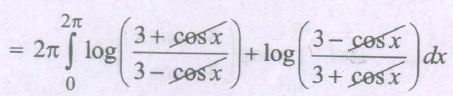
\(\Rightarrow 2\pi \int _{ 0 }^{ 2\pi }{ 0dx=0 } \)
\(\Rightarrow 2I=0\Rightarrow I=0\)
\(\therefore \int _{ 0 }^{ 2\pi }{ xlog\left( \frac { 3+cos\ x }{ 3-cos\ x } \right) dx=0 } \)
49.
Let \(f(x)={ sin }^{ 2 }x\)
\(f(-x)={ (sin(-x)) }^{ 2 }={ sin }^{ 2 }x=f(x)\)
\(\therefore \int _{ -\frac { \pi }{ 4 } }^{ \frac { \pi }{ 4 } }{ { sin }^{ 2 }xdx } =2\int _{ 0 }^{ \frac { \pi }{ 4 } }{ { sin }^{ 2 }xdx } \)
\(cos\ 2x=1-2{ sin }^{ 2 }x\)
\(2{ sin }^{ 2 }x=1-cos2\)
\({ sin }^{ 2 }x=\frac { 1-cos\quad 2x }{ 2 } \)
\(=2\int _{ 0 }^{ \frac { \pi }{ 4 } }{ \left( \frac { 1-cos2x }{ 2 } \right) dx } \)
\(=\frac { 2 }{ 2 } { \left[ x-\frac { sin2x }{ 2 } \right] }_{ 0 }^{ \frac { \pi }{ 4 } }\)
\(=\frac { \pi }{ 4 } -\frac { sin\frac { \pi }{ 4 } }{ 2 } -0+\frac { sin0 }{ 2 } \)
\(\\ =\frac { \pi }{ 4 } -\frac { 1 }{ 2 } =\frac { \pi -2 }{ 4 } \)
50.
Let \(f(x)=xcos\left( \frac { { e }^{ x }-1 }{ { e }^{ x }+1 } \right) \)
\(f(-x)=-x\quad cos\left( \frac { { e }^{ x }-1 }{ { e }^{ x }+1 } \right) \)
\(=-x\quad cos\left( \frac { { e }^{ \frac { 1 }{ x } }-1 }{ { e }^{ \frac { 1 }{ x } }+1 } \right) \)
\(=-x\quad cos\left( \frac { 1-{ e }^{ x } }{ 1+{ e }^{ x } } \right) \)
\(=-x\quad cos\left( -\left( \frac { { e }^{ x }-1 }{ { e }^{ x }+1 } \right) \right) \)
\(=-xcos\left( \frac { { e }^{ x }-1 }{ { e }^{ x }+1 } \right) \)
\([\because cos(-\theta )=cos\theta ]\)
= -f(x)
\(\therefore\) f(x) is an odd function
\(\therefore \int _{ -5 }^{ 5 }{ xcos\left( \frac { { e }^{ x }-1 }{ { e }^{ x }+1 } \right) } dx=0\)
51.
I = \(\int _{ 0 }^{ 1 }{ \frac { 1-{ x }^{ 2 } }{ { (1+{ x }^{ 2 }) }^{ 2 } } } dx\)
[Dividing the numerator and denominator by x]
\(I=\int _{ 0 }^{ 1 }{ \frac { \frac { 1 }{ { x }^{ 2 } } -\frac { { x }^{ 2 } }{ { x }^{ 2 } } }{ 0\left( \frac { 1 }{ x } +\frac { { x }^{ 2 } }{ { x }^{ 2 } } \right) } } dx=\int _{ 0 }^{ 1 }{ \frac { { x }^{ \frac { 1 }{ 2 } -1 } }{ { (\frac { 1 }{ x } +x) }^{ 2 } } } dx\)
\(put\ x+\frac { 1 }{ x } =t\Rightarrow (1-\frac { 1 }{ { x }^{ 2 } } )dx=dt\)
\(\Rightarrow \left( \frac { 1 }{ { x }^{ 2 } } -1 \right) dx=-dt\)
| x | 0 | 1 |
| t | \(\infty\) | 2 |
\(\therefore I=\int _{ \infty }^{ 2 }{ -\frac { dt }{ { t }^{ 2 } } } =\int _{ 2 }^{ \infty }{ \frac { dt }{ { t }^{ 2 } } } \)
\(=\int _{ 2 }^{ \infty }{ { t }^{ -2 }dt } ={ \left[ \frac { { t }^{ -1 } }{ -1 } \right] }_{ 2 }^{ \infty }={ \left[ -\frac { 1 }{ t } \right] }_{ 2 }^{ \infty }\)
\(=-\frac { 1 }{ \infty } +\frac { 1 }{ 2 } =0+\frac { 1 }{ 2 } \)
\(=\frac { 1 }{ 2 } \therefore \int _{ 0 }^{ 1 }{ \frac { 1-{ x }^{ 2 } }{ { (1+{ x }^{ 2 }) }^{ 2 } } dx=\frac { 1 }{ 2 } } \)
52.
\(=\int _{ 0 }^{ \frac { \pi }{ 2 } }{ { cos }^{ \frac { 1 }{ 2 } }\theta (1-{ cos }^{ 2 }) } sin\ \theta\ d\theta \)
\(=\int _{ 0 }^{ \frac { \pi }{ 2 } }{ \left( { cos }^{ \frac { 1 }{ 2 } }\theta -{ cos }^{ \frac { 5 }{ 2 } }\theta \right) } sin\theta\ d\theta \)
\(Put\ cos\theta =t\)
\(\\ \Rightarrow -sin\theta\ d\theta =dt\)
\(\Rightarrow sin\theta\ d\theta =-dt\)
| \(\theta\) | 0 | \(\frac{\pi}{2}\) |
| t | 1 | 0 |
\(=-\int _{ 1 }^{ 0 }{ ({ t }^{ \frac { 1 }{ 2 } }-{ t }^{ \frac { 5 }{ 2 } }) } dt=\int _{ 0 }^{ 1 }{ ({ t }^{ \frac { 1 }{ 2 } }-{ t }^{ \frac { 5 }{ 2 } }) } dt\)
\(={ \left[ \frac { { t }^{ \frac { 3 }{ 2 } } }{ \frac { 3 }{ 2 } } -\frac { { t }^{ \frac { 7 }{ 2 } } }{ \frac { 7 }{ 2 } } \right] }_{ 0 }^{ 1 }=\left[ \frac { 2 }{ 3 } (1)-\frac { 2 }{ 7 } (1)-0 \right] \)
\(=\frac { 2 }{ 3 } -\frac { 2 }{ 7 } =\frac { 14-6 }{ 21 } =\frac { 8 }{ 21 } \)
53.
\(Let\int _{ 0 }^{ \frac { \pi }{ 2 } }{ { e }^{ x }\left( \frac { sinx }{ 1+cosx } \right) dx } \)
\(\int _{ 0 }^{ \frac { \pi }{ 2 } }{ { e }^{ x }\left( \frac { 1+sinx }{ { cos }^{ 2 }\frac { x }{ 2 } } \right) dx } \)
\(\left[ \because cosx=2{ cos }^{ 2 }x-1\Rightarrow 1+cos2x=2{ cos }^{ 2 }x \right] \)
\(=\frac { 1 }{ 2 } \int _{ 0 }^{ \frac { \pi }{ 2 } }{ { e }^{ x }\left( \frac { 1 }{ { cos }^{ 2 }\frac { x }{ 2 } } +\frac { sinx }{ { cos }^{ 2 }\frac { x }{ 2 } } \right) dx } \)
\(=\frac { 1 }{ 2 } \int _{ 0 }^{ \frac { \pi }{ 2 } }{ { e }^{ x }\left( { sec }^{ 2 }\frac { x }{ 2 } +\frac { 2sin\frac { x }{ 2 } cos\frac { x }{ 2 } }{ { cos }^{ 2 }\frac { x }{ 2 } } \right) dx } \)
\(\\ [\because sin2x=2sinx\quad cosx]\)
\(=\frac { 1 }{ 2 } \int _{ 0 }^{ \frac { \pi }{ 2 } }{ { e }^{ x }\left( { sec }^{ 2 }\frac { x }{ 2 } 2tan\frac { x }{ 2 } \right) dx } \)
\(=\frac { 1 }{ 2 } \int _{ 0 }^{ \frac { \pi }{ 2 } }{ { e }^{ x }(f'(x)+f(x)dx } \)
Where \(f(x)=2tan\frac { x }{ 2 } \)
\(=\frac { 1 }{ 2 } .{ e }^{ x }.f(x)={ \left[ \left( \frac { 1 }{ 2 } { e }^{ x }.2tan\frac { x }{ 2 } \right) \right] }_{ 0 }^{ \frac { \pi }{ 2 } }\)
\(={ \left[ { e }^{ x }tan\frac { x }{ 2 } \right] }_{ 0 }^{ \frac { \pi }{ 2 } }\)
\(={ e }^{ \frac { \pi }{ 2 } }tan\frac { \pi }{ 4 } -{ e }^{ 0 }tan0={ e }^{ \frac { \pi }{ 2 } }(1)\)
\(\therefore I={ e }^{ \frac { \pi }{ 2 } }\)
54.
I \(=\int _{ 0 }^{ 1 }{ \sqrt { \frac { (1-x)(1-x) }{ (1+x)(1-x) } } } dx\)
\(=\int _{ 0 }^{ 1 }{ \sqrt { \frac { (1-x) 2}{ (1-x)^2 } } } dx\)
\(=\int _{ 0 }^{ 1 }{ \frac { 1-x }{ \sqrt { 1-{ x }^{ 2 } } } } dx\)
Put x = sin u, dx = cosu.du, 0u = sin-1(x)
For x = 0, u = 0 and x = 1, u = \(\frac{\pi}{2}\)
\(=\int _{ 0 }^{ 1 }{ \frac { 1-sin\ u }{ \sqrt { 1-{ sin }^{ 2 }u } } } \times cos u.du\)
\(=\int _{ 0 }^{ 1 } \frac { 1-sin\ u }{cos u} \times cos u.du\)
= \( [u+cos u]^\frac{\pi }{2}_0\)= (\(\frac{\pi}{2}\)+0)-(0+1) = \(\frac{\pi}{2}\) -1
\(=\frac { \pi }{ 2 } -0-1=\frac { \pi }{ 2 } -1\)
55.
We write \(\int _{ 0 }^{ 2a }{ f(x)dx\int _{ 0 }^{ a }{ f(x)dx } } +\int _{ 0 }^{ 2a }{ f(x)dx } \) ....(1)
Consider \(\int _{ 0 }^{ 2a }{ f(x)dx } \)
Substituting x = a + u, we have dx = du ; when x = a, u = 0 and when x = 2a,u = a.
\(\therefore \int _{ 0 }^{ 2a }{ f(x)dx=\int _{ 0 }^{ a }{ f(a+u)du } =\int _{ 0 }^{ a }{ d(u)du } } \), since f(x) = f(a+x)
\(\\ \\ \\ =\int _{ 0 }^{ a }{ f(x)dx } \) ..(2)
Substituting (2) in (1), we get
\(\int _{ 0 }^{ 2a }{ f(x)dx } =2\int _{ 0 }^{ a }{ f(x)dx } \)
56.
\(\int _{ 0 }^{ 1 }{ \frac { 2x+7 }{ { 5x }^{ 2 }+9 } dx } =\int _{ 0 }^{ 1 }{ \frac { 2x }{ { 5x }^{ 2 }+9 } } +7\int _{ 0 }^{ 1 }{ \frac { dx }{ (5{ x }^{ 2 })+{ 3 }^{ 2 } } =\frac { 1 }{ 5 } } log{ [{ 5x }^{ 2 }+9] }_{ 0 }^{ 1 }+\frac { 7 }{ 5 } \int _{ 0 }^{ 1 }{ \frac { dx }{ { x }^{ 2 }{ \left( \frac { 3 }{ \sqrt { 5 } } \right) }^{ 2 } } } \)
\(=\frac { 1 }{ 5 } [log14-log9]+\frac { 7 }{ 5 } \times \frac { \sqrt { 5 } }{ 3 } { \left[ { tan }^{ -1 }\frac { x }{ \left[ \frac { 3 }{ \sqrt { 5 } } \right] } \right] }_{ 0 }^{ 1 }=\frac { 1 }{ 5 } log\frac { 14 }{ 9 } +\frac { 7 }{ 3\sqrt { 5 } } { tan }^{ -1 }\frac { \sqrt { 5 } }{ 3 } \)
57.
\(\int _{ 0 }^{ 3 }{ (3{ x }^{ 2 }-4x+5) } dx=\int _{ 0 }^{ 3 }{ 3{ x }^{ 2 } } dx-\int _{ 0 }^{ 3 }{ 4x } dx+\int _{ 0 }^{ 3 }{ 5 } dx\)
\(=3\int _{ 0 }^{ 3 }{ { x }^{ 2 } } dx-4\int _{ 0 }^{ 3 }{ c } dx+5\int _{ 0 }^{ 3 }{ dx } \)
\(=3{ \left[ \frac { { x }^{ 3 } }{ 3 } \right] }_{ 0 }^{ 3 }-4{ \left[ \frac { { x }^{ 2 } }{ 2 } \right] }_{ 0 }^{ 3 }+5{ \left[ x \right] }_{ 0 }^{ 3 }\)
= (27 − 0) − 2(9 − 0) + 5(3− 0)
= 27 −18 +15 = 24.
58.
The region is sketched. It lies above the x − axis. Hence, the required area is given by
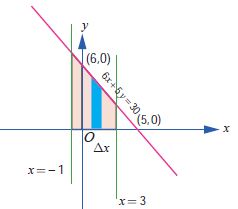
\(A=\int _{ -1 }^{ 3 }{ ydx } =\int _{ -1 }^{ 3 }{ \left( \frac { 30-6x }{ 5 } \right) dx={ \left( \frac { 30x-3{ x }^{ 2 } }{ 5 } \right) }_{ -1 }^{ 3 } } \)
\(=\left( \frac { 90-27 }{ 5 } \right) -\left( \frac { -30-3 }{ 5 } \right) =\frac { 96 }{ 5 } \)
59.
\( \because \int _{ 0 }^{ \infty }{ { x }^{ n }{ e }^{ -ax }dx}=\frac { n! }{ { a }^{ n+1 } } \)
\(n=5,\quad a=3 \)
\(=\frac { 5! }{ { 3 }^{ 6 } } \)
60.
Take 2a = 2\(\pi\) and f(x) = g(cosx)
Then, f (2a−x) = f(2\(\pi\)-x) = g(cos(2\(\pi\)-x)) = g(cos x) = f(x)
\(\therefore \int _{ 0 }^{ 2a }{ f(x)dx=2 } \int _{ 0 }^{ a }{ f(x)dx } \)
\(\therefore \int _{ 0 }^{ 2\pi }{ g(cosx)dx=2\int _{ 0 }^{ \pi }{ g(cosx)dx } } \)
61.
We know that \(\int _{ 0 }^{ 2a }{ f(x)dx } =2\int _{ 0 }^{ a }{ f(x) } dx\quad if(2a-x)=f(x)\)
Take 2a = \(\pi\) and f(x) = g(sinx)
Then, f(2a-x) = g(sin(\(\pi\)-x)) = g(sinx) = f(x).
\(\therefore \int _{ 0 }^{ 2a }{ f(x)dx } =2\int _{ 0 }^{ a }{ f(x)dx } \)
\(\int _{ 0 }^{ \pi }{ g(sinx)dx } =2\int _{ 0 }^{ \frac { \pi }{ 2 } }{ g(sinx)dx } \)

12th Standard Syllabus & Materials
12th Standard
TN 12th Computer Applications வலையமைப்பு வடமிடல் Sample Question Papers Study Material - QB365 Set A
NEW12th Standard
TN 12th Computer Applications களப்பெயர் முறைமை (DNS) Sample Question Papers Study Material - QB365 Set A
NEW12th Standard
TN 12th Computer Applications வலையமைப்பு எடுத்துக்காட்டுகள் மற்றும் நெறிமுறைகள் Sample Question Papers Study Material - QB365 Set A
NEW12th Standard
TN 12th Computer Applications கணினி வலையமைப்பு ஓர் அறிமுகம் Sample Question Papers Study Material - QB365 Set A



Tamilnadu Stateboard 12th Standard Subjects
Maths

Chemistry

Physics

Biology

Computer Science

Business Maths and Statistics

Economics

Commerce

Accountancy

History

Computer Applications
Biology
Computer Technology
Computer Applications
Computer Science
Business Maths and Statistics
Commerce
Economics
Maths
Chemistry
Physics
Computer Technology
History
Accountancy

Tamil

English

French
Tamilnadu Stateboard Standards

