
 100% FREE ACCESS
12th Standard Syllabus & Materials
12th Standard
TN 12th Computer Applications மின்னணு தரவு பரிமாற்றம் Sample Question Papers Study Material - QB365 Set A
NEW12th Standard
TN 12th Computer Applications மின் - வணிக பாதுகாப்பு அமைப்புகள் Sample Question Papers Study Material - QB365 Set A
NEW12th Standard
TN 12th Computer Applications மின்னணு செலுத்தல் முறைகள் Sample Question Papers Study Material - QB365 Set A
NEW12th Standard
TN 12th Computer Applications மின் - வணிகம் Sample Question Papers Study Material - QB365 Set A
NEW12th Standard
TN 12th Computer Applications திறந்த மூல கருத்துருக்கள் Sample Question Papers Study Material - QB365 Set A
NEW12th Standard
TN 12th Computer Applications வலையமைப்பு வடமிடல் Sample Question Papers Study Material - QB365 Set A

Published on: 02/09/2022
QB365 provides a detailed and simple solution for every Possible Book Back Questions in Class 12 Maths Subject - Two Dimensional Analytical Geometry-II, English Medium. It will help Students to get more practice questions, Students can Practice these question papers in addition to score best marks.
Download Tamil Nadu 12th Standard Maths question papers, model tests, one-mark questions, important questions, and public exam papers in PDF format. Free study materials and answer keys for TN State Board students.
Questions + Answers key
Take MCQ Maths Test1.
Find the equation of the ellipse in each of the cases given below:
length of latus rectum 8, eccentricity = \(\frac { 3 }{ 5 } \), centre (0, 0) and major axis on x -axis.
2.
Find the equation of the ellipse in each of the cases given below:
foci (0, ±4) and end points of major axis are (0, ±5).
3.
Find the equation of the ellipse in each of the cases given below:
foci (±3, 0), e = \(\frac { 1 }{ 2 } \)
4.
Three normals can be drawn to a parabola y2 = 4ax from a given point, one of which is always real.
5.
The sum of the focal distances of any point on the ellipse is equal to length of the major axis
6.
From any point outside the circle x2 + y2 = a2 two tangents can be drawn
7.
The position of a point P(x1 , y 1) with respect to a given circle x2 + y2 + 2gx + 2 fy + c = 0 in the plane containing the circle is outside or on or inside the circle according as
\(x_{1}^{2}+y_{1}^{2}+2 g x_{1}+2 f y_{1}+c \text { is } \begin{cases}>0 & \text { or } \\ =0 & \text { or } \\ <0 & \end{cases}\)
8.
The equation of a circle with (x1, y1 ) and (x2, y2 ) as extremities of one of the diameters of the circle is (x − x1)(x − x2 ) + ( y − y1 )( y − y2) = 0
9.
The circle passing through the points of intersection (real or imaginary) of the line lx+my+n = 0 and the circle x2 + y2 +2gx+2 fy+c =0 is the circle of the form
x2 + y2 + 2gx + 2 fy + c +\(\lambda\) (lx + my + n) = 0 \(\lambda \in \mathbb{R}^{1}\)
10.
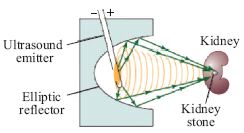
The equation of the ellipse is \(\frac { { \left( x-11 \right) }^{ 2 } }{ 484 } +\frac { { y }^{ 2 } }{ 64 } =1\). ( x and y are measured in centimeters) where to the nearest centimeter, should the patient’s kidney stone be placed so that the reflected sound hits the kidney stone?
11.
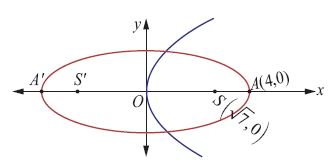
An equation of the elliptical part of an optical lens system is \(\frac { { x }^{ 2 } }{ 16 } +\frac { { y }^{ 2 } }{ 9 } \) = 1. The parabolic part of the system has a focus in common with the right focus of the ellipse. The vertex of the parabola is at the origin and the parabola opens to the right. Determine the equation of the parabola.
12.
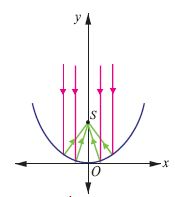
The equation y = \(\frac { 1 }{ 32 } \)x2 models cross sections of parabolic mirrors that are used for solar energy. There is a heating tube located at the focus of each parabola; how high is this tube located above the vertex of the parabola?
13.
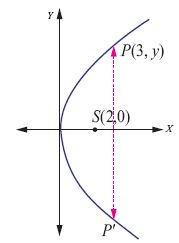
The parabolic communication antenna has a focus at 2m distance from the vertex of the antenna. Find the width of the antenna 3m from the vertex.
14.
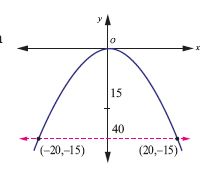
A concrete bridge is designed as a parabolic arch. The road over bridge is 40 m long and the maximum height of the arch is 15 m. Write the equation of the parabolic arch.
15.
Find the equation of the ellipse in each of the cases given below:
length of latus rectum 4, distance between foci 4 \( \sqrt{ 2}\) , centre (0, 0) and major axis as y - axis.
16.
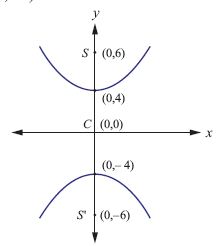
Find the equation of the hyperbola with vertices (0, ±4) and foci(0, ±6).
17.
Find the equations of the tangent and normal to the circle x2 + y2 = 25 at P(-3, 4).
18.
A line 3x+4y+10 = 0 cuts a chord of length 6 units on a circle with centre of the circle (2,1). Find the equation of the circle in general form.
19.
Find the equations of the tangent and normal to hyperbola 12x2−9y2 = 108 at \(\theta =\frac { \pi }{ 3 } \) (Hint: use parametric form)
20.
Find the length of Latus rectum of the ellipse \(\frac { { x }^{ 2 } }{ { a }^{ 2 } } +\frac { { y }^{ 2 } }{ { b }^{ 2 } } =1\)
1.
Length of latus rectrum = 8, e = \(\frac35\) and major axis on x-axis
Given \(\frac { { 2b }^{ 2 } }{ a } =8,e=\frac { 3 }{ 5 } \)
b2 = 4a
b2 = a2(1- e2)
\(4a={ a }^{ 2 }\left( 1-\frac { 9 }{ 25 } \right) \)
\(4=a\left( \frac { 25-9 }{ 25 } \right) \)
100 = a(16)
a = \(\frac { 100 }{ 16 } =\frac { 25 }{ 4 } \Rightarrow { a }^{ 2 }=\frac { 625 }{ 16 } \)
\({ b }^{ 2 }=4\times \frac { 25 }{ 4 } =25\)
Since major axis is on x-axis, equation of the ellipse is
⇒ \(\frac { { \left( x-0 \right) }^{ 2 } }{ { a }^{ 2 } } +\frac { { \left( y-0 \right) }^{ 2 } }{ { b }^{ 2 } } =1\)
⇒ \(\frac { { x }^{ 2 } }{ \frac { 625 }{ 16 } } +\frac { { y }^{ 2 } }{ 25 } =1\)
⇒ \(\frac { 16{ x }^{ 2 } }{ 625 } +\frac { { y }^{ 2 } }{ 25 } =1\)
2.
Foci (0, ±4) and end points of major axis
are (0, ±5)
Since foci are (0, ±be) ⇒ be = 4
End points of major axis are (0, ±5)
⇒ b = 5
∴ 5(e) = 4
⇒ e = \(\frac { 4 }{ 5 } \)
Also, a2 = b2(1 - e2)
a2 = 25\(\left( 1-\frac { 16 }{ 25 } \right) =25\left( \frac { 25-16 }{ 25 } \right) \)
⇒ a2 = 9
Equation of the ellipse is \(\frac { { x }^{ 2 } }{ a ^2 }+\frac { { y }^{ 2 } }{ b^2 } =1\)
⇒ \(\frac { { x }^{ 2 } }{ 9 } +\frac { { y }^{ 2 } }{ 25 } =1\)
.JPG)
3.
foci (±3, 0), e = \(\frac { 1 }{ 2 } \)
Since foci are (±ae, 0)
⇒ ae = 3
⇒ a \(\frac { 1 }{ 2 } \) = 3
⇒ a = 6
Centre is (0, 0)
and b2 = a2 (1 - e2)
⇒ b2 = 36\(\left( 1-\frac { 1 }{ 4 } \right) \)
⇒ \({ b }^{ 2 }=36\left( \frac { 3 }{ 4 } \right) \)
⇒ b2 = 27
∴ Equation of the ellipse is \(\frac { { x }^{ 2 } }{ 36 } +\frac { { y }^{ 2 } }{ 27 } =1\)
\(\frac { { x }^{ 2 } }{ 36 } +\frac { { y }^{ 2 } }{ 27 } =1\)
.JPG)
4.
y2 = 4ax is the given parabola. Let (\(\alpha\), \(\beta\)) be the given point.
Equation of the normal in parametric form is
y = –tx + 2at + at3 ...(1)
If m is the slope of the normal then m = −t
Therefore the equation (1) becomes y = mx - 2am- am3
Let it passes through (\(\alpha\), \(\beta\)), then
b = ma - 2am- am3
am3 + (2a −\(\alpha\))m+ \(\beta\) = 0
which being a cubic equation in m, has three values of m. Consequently three normals, in general, can be drawn from a point to the parabola, since complex roots of real equation, always occur in conjugate pairs and (1) being an odd degree equation, it has atleast one real root. Hence atleast one normal to the parabola is real.
5.
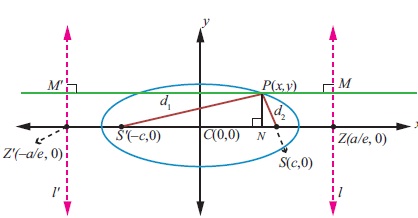
Let P(x, y) be a point on the ellipse \(\frac{x^{2}}{a^{2}}+\frac{y^{2}}{b^{2}}=1\)
Draw MM′ through P, perpendicular to directrices l and l′
Draw PN ⊥ to x -axis
By definition SP = ePM
= eNZ
= e[CZ -CN]
\(=e\left[\frac{a}{2}-x\right]=a-e x\) ....(1)
and SP′ = ePM′
= e[CN +CZ']
\(=e\left[x+\frac{a}{e}\right]=e x+a\) ....(2)
Hence, SP + S'P = a − ex + a + ex = 2a
6.
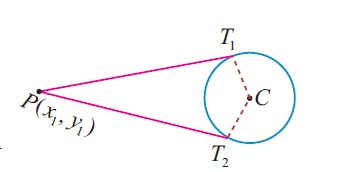
Let P(x1, y1) be a point outside the circle. The equation of the tangent is
\(y=m x \pm a \sqrt{1+m^{2}}\) It passes through (x1, y1 ). Therefore
\( y_{1} =m x_{1} \pm a \sqrt{1+m^{2}} \)
\(y_{1}-m x_{1} =a \sqrt{1+m^{2}} . \) Squaring both sides, we get
\( \left(y_{1}-m x_{1}\right)^{2} =a^{2}\left(1+m^{2}\right) \)
\(y_{1}^{2}+m^{2} x_{1}^{2}-2 m x_{1} y_{1}-a^{2}-a^{2} m^{2} =0 \)
\(m^{2}\left(x_{1}^{2}-a^{2}\right)-2 m x_{1} y_{1}+\left(y_{1}^{2}-a^{2}\right) =0\)
This quadratic equation in m gives two values for m
These values give two tangents to the circle x2 + y2 = a2 .
7.
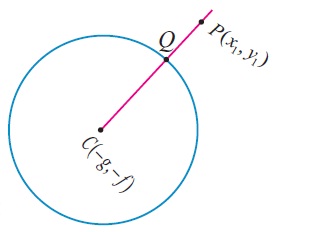
Equation of the circle is x2 + y2 + 2gx + 2 fy + c = 0 with centre C (-g, - f ) and radius \(r=\sqrt{g^{2}+f^{2}-c}\)
Let P(x1, y1) be a point in the plane. Join CP and let it meet the circle at Q. Then the point P is outside, on or within the circle according as
\(|C P| \text { is } \begin{cases}>|C Q| & \text { or, } \\ =|C Q| & \text { or, } \\ <|C Q| . & \end{cases}\)
\(\Rightarrow \quad C P^{2} \text { is } \begin{cases}>r^{2} & \text { or, } \\ =r^{2} & \text { or } \quad\{C Q=r\}, \\ <r^{2} .\end{cases}\)
\(\Rightarrow\left(x_{1}+g\right)^{2}+\left(y_{1}+f\right)^{2} \text { is } \begin{cases}>g^{2}+f^{2}-c & \text { or, } \\ =g^{2}+f^{2}-c & \text { or, } \\ <g^{2}+f^{2}-c\end{cases}\)
\(\Rightarrow \quad x_{1}^{2}+y_{1}^{2}+2 g x_{1}+2 f y_{1}+c \text { is } \begin{cases}>0 & \text { or, } \\ =0 & \text { or, } \\ <0 & \end{cases}\)
8.
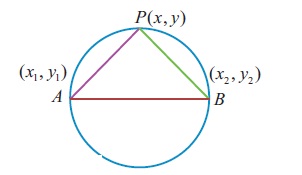
Let A (x1, y1) and B (x2, y2) be the two extremities of the diameter AB and P(x, y) be any point on the circle. Then \(\angle A P B=\frac{\pi}{2}\) (angle in a semi-circle).
Therefore, the product of slopes of AP and PB is equal to -1.
That is, \(\left(\frac{\left(y-y_{1}\right)}{\left(x-x_{1}\right)}\right)\left(\frac{\left(y-y_{2}\right)}{\left(x-x_{2}\right)}\right)=-1\) yielding the equation of the required circle as (x − x 1)(x − x2 ) + ( y − y1 )( y − y2 ) = 0
9.
Let the circle be S : x2 + y2 +2gx+2 fy+c = 0 , … (1)
and the line be L : lx+my+n = 0 . … (2)
Consider S +\(\lambda\) L = 0 . That is x2 + y2 + 2gx + 2 fy + c +\(\lambda\) (lx + my + n) = 0 ....(3)
Grouping the terms of x, y and constants, we get \(x^{2}+y^{2}+x(2 g+\lambda l)+y(2 f+\lambda m)+c+\lambda n=0\) which is a second degree equation in x and y with coefficients of x2 and y2 equal and there is no xy term.
If (\(\alpha\), \(\beta\) ) is a point of intersection of S and L satisfying equation (1) and (2), then it satisfies equation (3).
Hence S + \(\lambda\)L = 0 represents the required circle.
10.
The equation of the ellipse is \(\frac { { \left( x-11 \right) }^{ 2 } }{ 484 } +\frac { { y }^{ 2 } }{ 64 } =1\). The origin of the sound wave and the kidney stone of patient should be at the foci in order to crush the stones.
a2 = 484 and b2 = 64
c2 = a2 -b2
= 484-64
= 420
c \(\simeq \) 20.5
Therefore the patient’s kidney stone should be placed 20.5 cm from the centre of the ellipse.
11.
In the given ellipse a2 = 16, b2 = 9
then c2 = a2 - b2
c2 = 16 - 9
= 7
c = ±\(\sqrt { 7 } \)
Therefore the foci are F(\(\sqrt { 7 } \), 0) F1(-\(\sqrt { 7 } \), 0). The focus of the parabola is (\(\sqrt { 7 } \), 0) \(\Rightarrow \) a = \(\sqrt { 7 } \)
Equation of the parabola is y2 = 4\(\sqrt { 7 } \) x.
12.
Equation of the parabola is y = \(\frac { 1 }{ 32 } \)x2
That is x2 = 32y ; the vertex is (0, 0)
= 4 (8)y
\(\Rightarrow a=8\)
So the heating tube needs to be placed at focus (0, a)
Hence the heating tube needs to be placed 8 units above the vertex of the parabola.
13.
Let the parabola be y2 = 4ax
Since focus is 2m from the vertex a = 2
Equation of the parabola is y2 = 8x
Let P be a point on the parabola whose x -coordinate is 3m from the
vertex P (3, y)
y2 = 8 × 3
y =\(\sqrt { 8\times 3 } \)
= \(2\sqrt { 6 } \)
The width of the antenna 3m from the vertex is 4\(\sqrt { 6 } \) m.
14.
From the graph the vertex is at (0, 0) and the parabola is open down
Equation of the parabola is x2 = -4ay
(-20, -15) and (20, -15) lie on the parabola
202 = -4a(-15)
\(4a=\frac { 400 }{ 15 } \)
x2 =\(\frac { -80 }{ 3 } \) x y
Therefore equation is 3x2 = -80y
15.
Length of latus rectum = 4,
distance between foci = 4\(\sqrt { 2 } \) major axis is y-axis
Given \(\frac { { 2b }^{ 2 } }{ a } =4\) and distance between foci = 2ae = 4\(\sqrt { 2 } \)
⇒ ae = \(2\sqrt { 2 } \)
⇒a2e2 = 8 ....(1)
\(\frac { { 2b }^{ 2 } }{ a } =4\Rightarrow { b }^{ 2 }=2a\) ...(2)
We know b2 = a2(1 - e2)
b2 = a2 - a2e2
2a = a2 - 8
[using (1) and (2)]
a2 - 2a - 8 = 0
On factorising we get
(a - 4)(a + 2) = 0
a = 4 or-2
a = 4
⇒ [∴ a = -2 is not possible]
⇒ ae = 16
∴ From (2), b2 = 2(4) = 8
Hence, the equation of the ellipse is
\(\frac { { x }^{ 2 } }{ 8 } +\frac { { y }^{ 2 } }{ 16 } =1\) [∵ Major axis is y -axis]
.JPG)
16.
From figure the midpoint of line joining foci is the centre C(0, 0).
Transverse axis is y-axis
AA′ = 2a \(\Rightarrow \) 2a = 8,
SS′ = 2c = 12, c = 6
a = 4
b2 = c2−a2 = 36−16 = 20
Hence the equation of the required hyperbola is \(\frac { { y }^{ 2 } }{ 16 }- \frac { { x }^{ 2 } }{ 20 } =1\)
17.
Equation of tangent to the circle at P(x1, y1 ) is xx1 yy1 = a2
That is, x(−3) + y(4) = 25
−3x + 4y = 25
Equation of normal is xy1 - yx1 = 0
That is, 4x + 3y = 0
18.
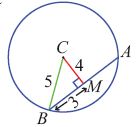
C(2, 1) is the centre and 3x + 4y + 10 = 0 cuts a chord AB on the circle. Let M be the midpoint of AB,
then AM = BM = 3. Now BMC is a right triangle.
So, we have CM = \(\frac { \left| 3\left( 2 \right) +4\left( 1 \right) +10 \right| }{ \sqrt { { 3 }^{ 2 }+{ 4 }^{ 2 } } } =4\)
By Pythagoras theorem BC2 = BM2 + MC2 = 32 + 42 = 25
BC = 5 = radius
Equation of the required circle is
(x−2)2+(y−1) = 52
x2+y2−4x−2y−20 = 0 .
19.
Equation of the hyperbola is 12x2- 9y2 = 108
\(\div 108\) we get, \(\frac { { 12x }^{ 2 } }{ 108 } -\frac { 9{ y }^{ 2 } }{ 108 } =1\)
⇒ \(\frac { { x }^{ 2 } }{ 9 } -\frac { { y }^{ 2 } }{ 12 } =1\)
∴ a2 = 9, b2 = 12
Parametric equation of tangent to the hyperbola is \(\frac { x \ sec\ \theta }{ a } -\frac { y \ tan \ \theta }{ b } =1\)
When \(\theta =\frac { \pi }{ 3 } \), the equation is
\(\frac { xsec\frac { \pi }{ 3 } }{ 3 } -\frac { ytan\frac { \pi }{ 3 } }{ 2\sqrt { 3 } } =1\)
.JPG)
⇒ \(\frac { 4x-3y }{ 6 } =1\) ⇒ 4x - 3y - 6 = 0 is the required equation of tangent.
Parametric equation of normal to the hyperbola is
\(\frac { ax }{ sec\theta } +\frac { by }{ tan\theta } ={ a }^{ 2 }+{ b }^{ 2 }\)
At \(\theta =\frac { \pi }{ 3 } ,\frac { 3x }{ sec\frac { \pi }{ 3 } } +\frac { 2\sqrt { 3 } }{ tan\frac { \pi }{ 3 } } =9+12\)
\(\Rightarrow \frac{3 x}{2}+\frac{2 \sqrt{\not 3} y}{\sqrt{\not 3}}=21\)
⇒ \(\frac { 3x }{ 2 } \) + 2y = 21 ⇒ 3x + 4y = 42
⇒ 3x + 4y - 42 = 0 is the required equation of normal.
20.
The Latus rectum LL′ of an ellipse \(\frac { { x }^{ 2 } }{ { a }^{ 2 } } +\frac { { y }^{ 2 } }{ { b }^{ 2 } } =1\) passes through S(ae, 0)
Hence L is (ae, y1 )
Therefore, \(\frac { { a }^{ 2 }{ e }^{ 2 } }{ { a }^{ 2 } } +\frac { { y_1 }^{ 2 } }{ { b }^{ 2 } } \) = 1
\(\frac { { y _1}^{ 2 } }{ { b }^{ 2 } } \) = 1-e2
y12 = b2(1-e2)
= b2\(\left( \frac { { b }^{ 2 } }{ { a }^{ 2 } } \right) \)\(\left( since,{ e }^{ 2 }=1-\frac { { b }^{ 2 } }{ { a }^{ 2 } } \right) \ \)
y1 = \(\pm\frac { { b }^{ 2 } }{ { a } } \)
That is the end points of Latus rectum L and L′ are \(\left( ae,\frac { { b }^{ 2 } }{ { a } } \right) and\ \left( ae-\frac { { b }^{ 2 } }{ { a } } \right) \)
Hence the length of latus rectum LL' = \(\frac { { b }^{ 2 } }{ { a } } \)

12th Standard Syllabus & Materials
12th Standard
TN 12th Computer Applications களப்பெயர் முறைமை (DNS) Sample Question Papers Study Material - QB365 Set A
NEW12th Standard
TN 12th Computer Applications வலையமைப்பு எடுத்துக்காட்டுகள் மற்றும் நெறிமுறைகள் Sample Question Papers Study Material - QB365 Set A
NEW12th Standard
TN 12th Computer Applications கணினி வலையமைப்பு ஓர் அறிமுகம் Sample Question Papers Study Material - QB365 Set A
NEW12th Standard
TN 12th Computer Applications PHP-உடன் MySQL-ஐ இணைத்தல் Sample Question Papers Study Material - QB365 Set A



Tamilnadu Stateboard 12th Standard Subjects
Maths

Chemistry

Physics

Biology

Computer Science

Business Maths and Statistics

Economics

Commerce

Accountancy

History

Computer Applications
Biology
Computer Technology
Computer Applications
Computer Science
Business Maths and Statistics
Commerce
Economics
Maths
Chemistry
Physics
Computer Technology
History
Accountancy

Tamil

English

French
Tamilnadu Stateboard Standards

