
 100% FREE ACCESS
12th Standard Syllabus & Materials
12th Standard
TN 12th Computer Applications மின்னணு தரவு பரிமாற்றம் Sample Question Papers Study Material - QB365 Set A
NEW12th Standard
TN 12th Computer Applications மின் - வணிக பாதுகாப்பு அமைப்புகள் Sample Question Papers Study Material - QB365 Set A
NEW12th Standard
TN 12th Computer Applications மின்னணு செலுத்தல் முறைகள் Sample Question Papers Study Material - QB365 Set A
NEW12th Standard
TN 12th Computer Applications மின் - வணிகம் Sample Question Papers Study Material - QB365 Set A
NEW12th Standard
TN 12th Computer Applications திறந்த மூல கருத்துருக்கள் Sample Question Papers Study Material - QB365 Set A
NEW12th Standard
TN 12th Computer Applications வலையமைப்பு வடமிடல் Sample Question Papers Study Material - QB365 Set A

Published on: 03/09/2020
12th Standard Maths English Medium Model 3 Mark Book Back Questions (New Syllabus) 2020
Download Tamil Nadu 12th Standard Maths question papers, model tests, one-mark questions, important questions, and public exam papers in PDF format. Free study materials and answer keys for TN State Board students.
Questions + Answers key
Take MCQ Maths Test1.
Find, by integration, the volume of the solid generated by revolving about y-axis the region bounded between the parabola x = y2 +1, the y-axis, and the lines y = 1 and y = −1.
2.
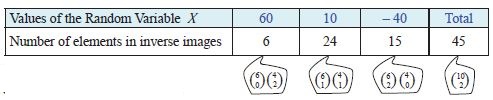
Two balls are chosen randomly from an urn containing 6 white and 4 black balls. Suppose that we win Rs. 30 for each black ball selected and we lose Rs. 20 for each white ball selected. If X denotes the winning amount, then find the values of X and number of points in its inverse images.
3.
Evaluate \(\\ \int _{ 0 }^{ 1 }{ { e }^{ -2x }(1+x-{ 2x }^{ 3 })dx } \)
4.
Find a linear approximation for the following functions at the indicated points.
f(x) = x3 - 5x + 12, x0 = 2
5.
Evaluate :\(\int _{ 0 }^{ 9 }{ \frac { 1 }{ x+\sqrt { x } } dx } \)
6.
A six sided die is marked '2' on one face, '3' on two ofits faces, and '4' on remaining three faces. The die is thrown twice. If X denotes the total score in two throws, find the values of the random variable and number of points in its inverse images.
7.
Evaluate: \(\underset{x\rightarrow \infty}{lim}(\frac{x^{2}+17x+29}{x^{4}})\).
8.
Find the absolute extrem of the following function on the given closed interval
f(x) = x2 -12x + 10; [1, 2]
9.
Solve \({ y }^{ 2 }+{ x }^{ 2 }\frac { dy }{ dx } =xy\frac { dy }{ dx } \)
10.
A particle moves along a straight line in such a way that after t seconds its distance from the origin is s = 2t2 + 3t metres.
11.
Obtain the Cartesian form of the locus of z = x + iy in each of the following cases:
Im[(1−i)z+1] = 0
12.
Find the adjoint of the following:
\(\left[ \begin{matrix} 2 & 3 & 1 \\ 3 & 4 & 1 \\ 3 & 7 & 2 \end{matrix} \right] \)
13.
Find the vector equation in parametric form and Cartesian equations of the line passing through (-4, 2, -3) and is parallel to the line \(\frac { -x-2 }{ 4 } =\frac { y+3 }{ -2 } =\frac { 2z-6 }{ 3 } \)
14.
Find the quotient \(\frac { 2\left( cos\frac { 9\pi }{ 4 } +isin\frac { 9\pi }{ 4 } \right) }{ 4\left( cos\left( \frac { -3\pi }{ 2 } + \right) isin\left( \frac { -3\pi }{ 2 } \right) \right) } \) in rectangular form
15.
Find the equation of the ellipse in each of the cases given below:
length of latus rectum 4, distance between foci 4 \( \sqrt{ 2}\) , centre (0, 0) and major axis as y - axis.
16.
Prove by vector method that if a line is drawn from the centre of a circle to the midpoint of a chord, then the line is perpendicular to the chord.
17.
If |z| = 1, show that \(2\le \left| { z }^{ 2 }-3 \right| \le 4\)
18.
Find the value of
\(tan\left( { cos }^{ -1 }\left( \frac { 1 }{ 2 } \right) -{ sin }^{ -1 }\left( -\frac { 1 }{ 2 } \right) \right) \)
19.
If A = \(\left[ \begin{matrix} 3 & 2 \\ 7 & 5 \end{matrix} \right] \) and B = \(\left[ \begin{matrix} -1 & -3 \\ 5 & 2 \end{matrix} \right] \), verify that (AB)-1 = B-1A-1
20.
Find the values of the real numbers x and y, if the complex numbers (3−i)x−(2−i)y+2i +5 and 2x+(−1+2i)y+3+ 2i are equal.
21.
Find the equation of the circle described on the chord 3x + y + 5 = 0 of the circle x2 + y2 = 16 as diameter.
22.
Verify the
(i) closure property,
(ii) commutative property,
(iii) associative property
(iv) existence of identity and
(v) existence of inverse for the arithmetic operation - on Z.
23.
If w (x, y, z) = x2 + y2 + y2, x = et, y = et sin t, z = et cos t, find \(\frac{dw}{dt}\)
24.
The probability density function random variable X is given by \(f(x)=\begin{cases} \begin{matrix} { 16xe }^{ -4x } & for\quad x>0 \end{matrix} \\ \begin{matrix} 0 & for\quad x\le 0 \end{matrix} \end{cases}\) find the mean and variance of X.
25.
Show that Γ(n) = 2\(\int _{ 0 }^{ \infty }{ { e }^{ -{ x }^{ 2 } }{ x }^{ 2n-1 }dx } \)
26.
If v(x, y, z) = x3 + y3 + z3 + 3xyz, show that \(\frac { { \partial }^{ 2 }v }{ \partial y\partial z } =\frac { { \partial }^{ 2 }v }{ \partial z\partial y } \)
27.
The trunk of a tree has diameter 30 cm. During the following year, the circumference grew 6cm.
(i) Approximately, how much did the tree's diameter grow?
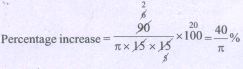
(ii) What is the percentage increase in area of the tree's cross-section?
28.
Does there exist a differentiable function f(x) such that f(0) = -1, f(2) = 4 and f'(x) ≤ 2 for all x. Justify you answer.
29.
Identify the type of conic and find centre, foci, vertices, and directrices of each of the following :
\(\frac { { \left( x+1 \right) }^{ 2 } }{ 100 } +\frac { { \left( y-2 \right) }^{ 2 } }{ 64 } =1\)
30.
Find the equation of the plane passing through the intersection of the planes \(\vec { r } .(\hat { i } +\hat { j } +\hat { k } )+1=0\) and \(\vec { r } .(2\hat { i } -3\hat { j } +5\hat { k } )=2\) and the point (-1, 2, 1).
31.
Show that the straight lines x + 1= 2y = −12z and x = y + 2 = 6z − 6 are skew and hence find the shortest distance between them.
32.
Find the equations of the tangent and normal to hyperbola 12x2−9y2 = 108 at \(\theta =\frac { \pi }{ 3 } \) (Hint: use parametric form)
33.
Find the inverse of the non-singular matrix A = \(\left[ \begin{matrix} 0 & 5 \\ -1 & 6 \end{matrix} \right] \), by Gauss-Jordan method.
34.
It is known that the roots of the equation x3- 6x2- 4x + 24 = 0 are in arithmetic progression. Find its roots.
35.
Find the sum of squares of roots of the equation 2x4- 8x3+ 6x2-3 = 0.
36.
Let \(A=\left( \begin{matrix} 1 & 0 \\ 0 & 1 \\ 1 & 0 \end{matrix}\begin{matrix} 1 & 0 \\ 0 & 1 \\ 0 & 1 \end{matrix} \right) ,B=\left( \begin{matrix} 0 & 1 \\ 1 & 0 \\ 1 & 0 \end{matrix}\begin{matrix} 0 & 1 \\ 1 & 0 \\ 0 & 1 \end{matrix} \right) ,C=\left( \begin{matrix} 1 & 1 \\ 0 & 1 \\ 1 & 1 \end{matrix}\begin{matrix} 0 & 1 \\ 1 & 0 \\ 1 & 1 \end{matrix} \right) \)be any three boolean matrices of the same type.
Find (A∨B)∧C
37.
Let \(A=\left( \begin{matrix} 1 & 0 \\ 0 & 1 \\ 1 & 0 \end{matrix}\begin{matrix} 1 & 0 \\ 0 & 1 \\ 0 & 1 \end{matrix} \right) ,B=\left( \begin{matrix} 0 & 1 \\ 1 & 0 \\ 1 & 0 \end{matrix}\begin{matrix} 0 & 1 \\ 1 & 0 \\ 0 & 1 \end{matrix} \right) ,C=\left( \begin{matrix} 1 & 1 \\ 0 & 1 \\ 1 & 1 \end{matrix}\begin{matrix} 0 & 1 \\ 1 & 0 \\ 1 & 1 \end{matrix} \right) \)be any three boolean matrices of the same type. Find AVB
38.
Evaluate \(\begin{matrix} lim \\ (x,y)\rightarrow (0,0) \end{matrix}cos=\left( \frac { { e }^{ x }siny }{ y } \right) \), if the limit exists.
39.
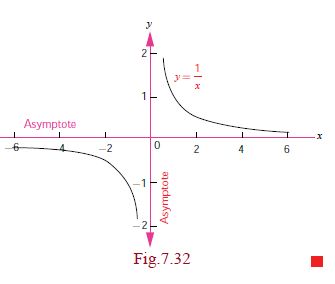
Find the asymptotes of the function f(x) = \(\frac{1}{x}\)
40.
Form the differential equation by eliminating the arbitrary constants A and B from y = A cos x + B sin x.
41.
Find the domain of the following functions
\(\frac{1}{2}tan^{-1}(1-x^2)-\frac{\pi}{4}\)
42.
Let \(\vec { a } =\hat { i } +\hat { j } +\hat { k } \), \(\vec { b } =\hat { i } \) and \(\vec { c } ={ c }_{ 1 }\hat { i } +{ c }_{ 2 }\hat { j } +{ c }_{ 3 }\hat { k } \). If \({ c }_{ 1 }=1\) and \({ c }_{ 2 }=2\), find \({ c }_{ 3 }\) such that \(\vec { a } ,\vec { b } \) and \(\vec { c } \) are coplanar.
43.
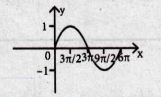
Sketch the graph of y = sin\((\frac{1}{3}x)\) for 0\(\le x <6\pi\).
1.
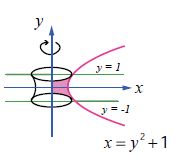
The parabola x = y2 +1 is y2 x = −1. It is symmetrical about x-axis and has the vertex at (1, 0) and focus at \(\left( \frac { 5 }{ 4 } ,0 \right) \). The region for revolution is shaded. Hence, the required volume is given by
\(V=\pi \int _{ -1 }^{ 1 }{ { x }^{ 2 }dy } \)
\(=\pi \int _{ -1 }^{ 1 }{ { ({ y }^{ 2 }+1) }^{ 2 }dy } \)
\(=2\pi \int _{ 0 }^{ 1 }{ \left( { y }^{ 4 }+{ 1y }^{ 2 }+1 \right) dy } \), since the integrand is an even function
\(=2\pi { \left( \frac { { y }^{ 5 } }{ 5 } +2\frac { { y }^{ 3 } }{ 3 } +y \right) }_{ 0 }^{ 1 }=2\pi \left( \frac { 1 }{ 5 } +\frac { 2 }{ 3 } +1 \right) \pi \)
2.
The possible events of selection are
(i) both balls may be black, or
(ii) one white and one black or
(iii) both are white.
Therefore X is a random variable that take the values,
X (both are black balls) = Rs. 2(30) = Rs. 60
X (one black and one white ball) = Rs. 30 − Rs. 20 = Rs. 10
X (both are white balls) = Rs. 2( − 20) = - Rs. 40
Therefore X takes on the values 60,10, and − 40.
3.
Taking u = 1 + x − 2x3 and v = e-2x, and applying the Bernoulli’s formula, we get
I = \(\\ \int _{ 0 }^{ 1 }{ { e }^{ -2x }(1+x-{ 2x }^{ 3 })dx } \)
\(={ \left[ (1+x-{ 2x }^{ 3 })\left( \frac { { e }^{ -2x } }{ -2 } \right) -(1-6{ x }^{ 2 })\left( \frac { { e }^{ -2x } }{ -4 } \right) +(-12x)\left( \frac { { e }^{ -2x } }{ -8 } \right) -(-12)\left( \frac { { e }^{ -2x } }{ 16 } \right) \right] }_{ 0 }^{ 1 }\)
\(={ \left[ \frac { { e }^{ -2x } }{ 16 } (16{ x }^{ 3 }+24{ x }^{ 2 }+16x) \right] }_{ 0 }^{ 1 }\)
\(\\ =\frac { 7 }{ 2{ e }^{ 2 } } \)
4.
f(x) = x3 - 5x + 12, x0 = 2
f(xo) = 23 - 5(2) + 12
= 8 - 10 + 12 = 10
f'(x) = 3x2 - 5
⇒ f'(xo) = 3 (22) - 5 = 7
∴ L(x) = f(xo) +f'(xo) (x - xo)
= 10 + 7(x - 2)
= 10 + 7x - 14
L(x) = 7x- 4
5.
Let \(\sqrt{x}\) = u
Then x = u2, and so dx = 2u du
When x = 0, u = 0
When x = 9, u = 3
\(\therefore \int _{ 0 }^{ 9 }{ \frac { 1 }{ x+\sqrt { x } } dx=\int _{ 0 }^{ 3 }{ \frac { 1 }{ { u }^{ 2 }+u } (2u)du=2\int _{ 0 }^{ 3 }{ \frac { 1 }{ 1+u } du=2{ \left[ log|1+u \right] }_{ 0 }^{ 3 }=2[log4-0]=log16 } } } \)
6.
Let X be the random variable denotes the total C score is two throws of a die.
Sample space S
| II | 2 | 3 | 3 | 4 | 4 | 4 |
| I | ||||||
| 2 | 4 | 5 | 5 | 6 | 6 | 6 |
| 3 | 5 | 6 | 6 | 7 | 7 | 7 |
| 3 | 5 | 6 | 6 | 7 | 7 | 7 |
| 4 | 6 | 7 | 7 | 8 | 8 | 8 |
| 4 | 6 | 7 | 7 | 8 | 8 | 8 |
| 4 | 6 | 7 | 7 | 8 | 8 | 8 |
n (S) = 36
X = {4,5,6,7,8}
From the sample space
| Values of random variable | 4 | 5 | 6 | 7 | 8 | Total |
| No of points in inverse image | 1 | 4 | 10 | 12 | 9 | 36 |
7.
This is an indeterminate of the form \((\frac{\infty}{\infty})\).
To evaluate this limit, we apply l ’Hôpital Rule.
\(\underset{x\rightarrow \infty }{lim}(\frac{x^{2}+17x+29}{x^{4}})=\underset{x\rightarrow \infty}{lim}(\frac{2x+17}{4x^{3}})\)
= \(\underset{x\rightarrow \infty}{lim}(\frac{2}{12x^{2}})=0\)
8.
f(x) = x2 -12x + 10; [1, 2]
Given f(x) = x2 -12x + 10 ; [1, 2]
f'(x) = 2x - 12
f'(x) = 0
\(\Rightarrow\) 2x-12 = 0
\(\Rightarrow\) 2x = 12
\(\Rightarrow\) x = 6
\(\therefore\) The critical number is 6
Evaluating f (x) at the end points x = 1,
x = 2 and at the critical number x = 6 we get
f(1) = 12-12(1)+10 = -1
f(2) = 22-12(2)+10 = -10
Absolute maximum f(1) = -1
Absolute minimum f(2) = -10
9.
The given equation is rewritten as \(\frac { dy }{ dx } =\frac { { y }^{ 2 } }{ xy-{ x }^{ 2 } } \)
This is a homogeneous differential equation
Put y = vx . Then, we have \(x\frac { dv }{ dx } =\frac { v }{ v-1 } \)
By separating the variables, \(\frac { v-1 }{ v } dv=\frac { dx }{ x } .\)
Integrating, we obtain v − log |v| = log |x| + log |C| or v = log |vxC|.
Replacing v by \(\frac{y}{x}\), we get, \(\frac{y}{x}\) = log |Cy| = ey/x or y = key/x (how!) which is the required solution.
10.
11.
Im[(1−i)z + 1] = 0
(1-i)z + 1 = (1-i)( x + iy) +1
= x + iy-ix-i2y+1
= x+iy-ix+y+1
= (x + y + 1) + i(y - x)
∴ Im[(1-i)z + 1] = y-x = 0
⇒ x - y = 0
Hence, the Cartesian equation is x - y = 0
12.
\(\left[ \begin{matrix} 2 & 3 & 1 \\ 3 & 4 & 1 \\ 3 & 7 & 2 \end{matrix} \right] \)
Let A =\(\left( \begin{matrix} 2 & 3 & 1 \\ 3 & 4 & 1 \\ 3 & 7 & 2 \end{matrix} \right) \)
adj A =\(\left( \begin{matrix} +\left| \begin{matrix} 4 & 1 \\ 7 & 2 \end{matrix} \right| & -\left| \begin{matrix} 3 & 1 \\ 3 & 2 \end{matrix} \right| & +\left| \begin{matrix} 3 & 4 \\ 3 & 7 \end{matrix} \right| \\ -\left| \begin{matrix} 3 & 1 \\ 7 & 2 \end{matrix} \right| & +\left| \begin{matrix} 2 & 1 \\ 3 & 2 \end{matrix} \right| & -\left| \begin{matrix} 2 & 3 \\ 3 & 7 \end{matrix} \right| \\ +\left| \begin{matrix} 3 & 1 \\ 4 & 1 \end{matrix} \right| & -\left| \begin{matrix} 2 & 1 \\ 3 & 1 \end{matrix} \right| & +\left| \begin{matrix} 2 & 3 \\ 3 & 4 \end{matrix} \right| \end{matrix} \right) \)
=\(\left[ \begin{matrix} +(8-7)-(6-3)+(21-12) \\ -(6-7)+(4-3)-(14-9) \\ +(3-4)-(2-3)+(8-9) \end{matrix} \right] ^{ T }\)
=\(\left[ \begin{matrix} 1 & -3 & 9 \\ 1 & 1 & -5 \\ -1 & 1 & -1 \end{matrix} \right] ^{ T }\)
adj A =\(\left[ \begin{matrix} 1 & 1 & -1 \\ -3 & 1 & 1 \\ 9 & -5 & -1 \end{matrix} \right] \)
13.
Rewriting the given equations as\(\frac { x+2 }{ 4 } =\frac { y+3 }{ -2 } =\frac { 2z-6 }{ 3/2 } \) and comparing with \(\frac { x-{ x }_{ 1 } }{ { b }_{ 1 } } =\frac { y-{ y }_{ 1 } }{ { b }_{ 2 } } =\frac { z-{ z }_{ 1 } }{ { b }_{ 3 } } \) we have \(\vec { b } ={ b }_{ 1 }\hat { i } +{ b }_{ 2 }\hat { j } +{ b }_{ 3 }\hat { k } \) = \(-4\hat { i } -2\hat { j } +\frac { 3 }{ 2 } \hat { k } =-\frac { 1 }{ 2 } (8\hat { i } +4\hat { j } -3\hat { k } )\). Clearly, \(\vec { b } \) is parallel to the vector \(8\hat { i } +4\hat { j } -3\hat { k } \). Therefore, a vector equation of the required straight line passing through the given point (-4, 2, -3) and parallel to the vector \(8\hat { i } +4\hat { j } -3\hat { k } \) in parametric form is
\(\vec { r } =(-4\hat { i } +2\hat { j } -3\hat { k } )+t(8\hat { i } +4\hat { j } -3\hat { k } )\), t ∈ R
Therefore, Cartesian equations of the required straight line are given by
\(\frac { x-4 }{ 8 } =\frac { y-2 }{ 4 } =\frac { z+3 }{ -3 } \)
14.
\(\frac { 2\left( cos\frac { 9\pi }{ 4 } +isin\frac { 9\pi }{ 4 } \right) }{ 4\left( cos\left( \frac { -3\pi }{ 2 } + \right) sin\left( \frac { -3\pi }{ 2 } \right) \right) } \)
= \(\frac { 1 }{ 2 } \left( cos\left( \frac { 9\pi }{ 4 } -\left( \frac { -3\pi }{ 2 } \right) \right) +isin\left( \frac { 9\pi }{ 4 } -\left( \frac { -3\pi }{ 2 } \right) \right) \right) \)
= \(\frac { 1 }{ 2 } \left( cos\left( \frac { 9\pi }{ 4 } +\frac { 3\pi }{ 2 } \right) +isin\left( \frac { 9\pi }{ 4 } +\frac { 3\pi }{ 2 } \right) \right) \)
= \(\frac { 1 }{ 2 } \left( cos\left( \frac { 15\pi }{ 4 } \right) +isin\left( \frac { 15\pi }{ 4 } \right) \right) =\frac { 1 }{ 2 } \left( cos\left( 4\pi -\frac { \pi }{ 4 } \right) +isin\left( 4\pi -\frac { \pi }{ 4 } \right) \right) \)
= \(\frac { 1 }{ 2 } \left( cos\left( \frac { \pi }{ 4 } \right) -isin\left( \frac { \pi }{ 4 } \right) \right) =\frac { 1 }{ 2 } \left( \frac { 1 }{ \sqrt { 2 } } +i\frac { 1 }{ \sqrt { 2 } } \right) \)
\(\frac { 2\left( cos\frac { 9\pi }{ 4 } +isin\frac { 9\pi }{ 4 } \right) }{ 4\left( cos\left( \frac { -3\pi }{ 2 } + \right) sin\left( \frac { -3\pi }{ 2 } \right) \right) } \) = \(\frac { 1 }{ 2\sqrt { 2 } } -i\frac { 1 }{ 2\sqrt { 2 } } =\frac { \sqrt { 2 } }{ 4 } +i\frac { \sqrt { 2 } }{ 4 } \) Which is in rectangular form.
15.
Length of latus rectum = 4,
distance between foci = 4\(\sqrt { 2 } \) major axis is y-axis
Given \(\frac { { 2b }^{ 2 } }{ a } =4\) and distance between foci = 2ae = 4\(\sqrt { 2 } \)
⇒ ae = \(2\sqrt { 2 } \)
⇒a2e2 = 8 ....(1)
\(\frac { { 2b }^{ 2 } }{ a } =4\Rightarrow { b }^{ 2 }=2a\) ...(2)
We know b2 = a2(1 - e2)
b2 = a2 - a2e2
2a = a2 - 8
[using (1) and (2)]
a2 - 2a - 8 = 0
On factorising we get
(a - 4)(a + 2) = 0
a = 4 or-2
a = 4
⇒ [∴ a = -2 is not possible]
⇒ ae = 16
∴ From (2), b2 = 2(4) = 8
Hence, the equation of the ellipse is
\(\frac { { x }^{ 2 } }{ 8 } +\frac { { y }^{ 2 } }{ 16 } =1\) [∵ Major axis is y -axis]
.JPG)
16.
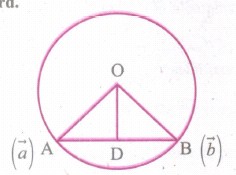
Let the position vectors of the parts A and B on the circle lie \(\vec { a } \) and \(\vec { b } \) respectively.
Since O is the centre of the circle
\(|\vec { OA } |=|\vec { OB } |\Rightarrow |\vec { a } |=|\vec { b } |\) ....(1)
Also D is the mid-point of AB,
⇒ \(\vec { OD } =\frac { \vec { a } +\vec { b } }{ 2 } \) (mid-point formula)
\(\left( \frac { \vec { a } +\vec { b } }{ 2 } \right) .(\vec { OB } -\vec { OA } )\)
=\(\left( \frac { \vec { a } +\vec { b } }{ 2 } \right) .(\vec { Ob } -\vec { Oa } )\)
= \(\frac { 1 }{ 2 } \left[ |\vec { b } |^{ 2 }-|\vec { a}| ^{ 2 } \right] \)
=\(\left[ \because (\vec { a } +\vec { b } ).(\vec { b } -\vec { a } )=|\vec { b } |^{ 2 }-|\vec { a } |^{ 2 } \right] \)
= \(\frac { 1 }{ 2 } \left[ |\vec { b } |^{ 2 }-|\vec { b| } ^{ 2 } \right] \) (using (1))
= \(\frac{1}{2}\)(0) = 0
⇒ \(\vec { OD } .\vec { AB } =0\Rightarrow \vec { OD } \bot \vec { AB } \)
Hence, if a line is drawn from the centre of a to the mid-point of a chord, then that line is perpendicular to the chord.
17.
|z2-3| ≤ |z2|+|-3| [Triangle law of inequality]
≤ |z|2+3≤1+3 [∴ |z| = 1]
|z2-3| ≤ 4 ..............(1)
Also, |z2- 3| ≥ ||z2|-|-3||
≥ ||z|2-3| [∵ |-3| = 3]
≥ |12-3| [∵ |z| = 1]
≥ |-2| .
|z2-3| ≥ 2.............(2)
From (1) and (2) we get 2 ≤ |z2-3| ≤ 4
Hence proved.
18.
\(tan\left( { cos }^{ -1 }\left( \frac { 1 }{ 2 } \right) -{ sin }^{ -1 }\left( -\frac { 1 }{ 2 } \right) \right) \)
Let \({ cos }^{ -1 }\left( \frac { -1 }{ 2 } \right) =x\)
\(\Rightarrow \frac { 1 }{ 2 } =cosx\)
\(\Rightarrow cosc=cos\frac { \pi }{ 3 } \)
\(\Rightarrow x=\frac { \pi }{ 3 } \)
Let \({ sin }^{ -1 }\left( \frac { -1 }{ 2 } \right) =y\)
\(\Rightarrow \left( \frac { -1 }{ 2 } \right) =siny\)
\(\Rightarrow siny=\frac { -1 }{ 2 } =-sin\frac { \pi }{ 6 } =\left( \frac { -\pi }{ 6 } \right) \)
\(\Rightarrow y=\frac { -\pi }{ 6 } \)
\(\therefore { tan }^{ -1 }\left( cos^{ -1 }\left( \frac { 1 }{ 2 } \right) -{ sin }^{ -1 }\left( \frac { 4 }{ 5 } \right) \right) \)
= \({ tan }^{ -1 }\left( \frac { \pi }{ 3 } -\left( \frac { -\pi }{ 6 } \right) \right) ={ tan }^{ -1 }\left( \frac { \pi }{ 3 } +\frac { \pi }{ 6 } \right) \)
= \(tan\left( \frac { 2\pi +\pi }{ 0 } \right) =tan\left( \frac { 3\pi }{ 6 } \right) =tan\left( \frac { \pi }{ 2 } \right) \)
= \(\infty \)
19.
Given A =\(\left[ \begin{matrix} 3 & 2 \\ 7 & 5 \end{matrix} \right] \) and B =\(\left[ \begin{matrix} -1 & -3 \\ 5 & 2 \end{matrix} \right] \)
AB =\(\left[ \begin{matrix} 3 & 2 \\ 7 & 5 \end{matrix} \right] \left[ \begin{matrix} -1 & -3 \\ 5 & 2 \end{matrix} \right] =\left[ \begin{matrix} -3+10 & -9+4 \\ -7+25 & -21+10 \end{matrix} \right] \)
=\(\left[ \begin{matrix} 7 & -5 \\ 18 & -11 \end{matrix} \right] \)
|AB| = -77+90 = 13 ≠ 0 ⇒ (AB)-1 exists
|A| = 15-14 = 1 ≠ 0 ⇒ A-1 exists
|B| = -2+15 = 13 ≠ 0 ⇒ B-1 exists
(AB)-1 = \(\frac { 1 }{ |AB| } adj(AB)=\frac { 1 }{ 13 } \left( \begin{matrix} -11 & 5 \\ -18 & 7 \end{matrix} \right) \) ...............(1)
B-1 = \(\frac { 1 }{ |B| } adj(B)=\frac { 1 }{ 13 } \left( \begin{matrix} 2 & 3 \\ -5 & -1 \end{matrix} \right) \)
A-1 = \(\frac { 1 }{ |A| } \)(adj A)
= \(\frac { 1 }{ 1 } \left( \begin{matrix} 5 & -2 \\ -7 & 3 \end{matrix} \right) =\left( \begin{matrix} 5 & -2 \\ -7 & 3 \end{matrix} \right) \)
∴ B-1A-1 = \(\frac { 1 }{ 13 } \left( \begin{matrix} 2 & 3 \\ -5 & -1 \end{matrix} \right) \left( \begin{matrix} 5 & -2 \\ -7 & 3 \end{matrix} \right) \)
= \(\frac { 1 }{ 13 } \left( \begin{matrix} 10-21 & -4+9 \\ -25+7 & 10-3 \end{matrix} \right) \)
= \(\frac { 1 }{ 13 } \left( \begin{matrix} -11 & 5 \\ -18 & 7 \end{matrix} \right) \) ..............(2)
From (1) or (2) it is proved that
(AB)-1 = B-1 A-1
20.
Given (3 -i) x - (2 - i) y + 2i + 5
= 2x + (-1 + 2i) y + 3 + 2i
⇒ 3x - ix - 2y + iy + 2i + 5 = 2x - y + 2iy + 3 + 2i
choosing the real and imaginary parts
(3x-2y + 5) + i (-x + y + 2) = 2x - y + 3 + i (2y+ 2)
Equating the real and imaginary parts both sides, we get
3x- 2y+ 5 = 2x-y+3
⇒ 3x - 2y + 5 - 2x +y - 3 = 0
⇒ x-y = -2... (1)
-x+y+2 = 2y+2
⇒ -x+y+2-2y-2 = 0
⇒ -x-y = 0 ⇒ x+y = 0.. (2)
(1)-(2) we get,
| x - y | = -2 |
| x + y | = 0 |
| 2y | = -2 |
y = 1
Substituting y = 1 in (2) we get.
x+1 = 0 ⇒ x = -1
∴ x = -1 and y = 1
21.
Equation of the circle passing through the points of intersection of the chord and circle by
Theorem is x2 + y2−16+\(\lambda \)(3x + y + 5) = 0 .
The chord 3x + y + 5 = 0 is a diameter of this circle if the centre\(\left( \frac { -3\lambda }{ 2 } \frac { -\lambda }{ 2 } \right) \) lies on the chord.
So we have 3\(\left( \frac { -3\lambda }{ 2 } \right) \)-\(\frac { -\lambda }{ 2 } \)+5 = 0,
\(\frac { -9\lambda }{ 2 } \)-\(\frac { \lambda }{ 2 } \)+5 = 0,
−5λ + 5 = 0 ,
λ = 1.
Therefore, the equation of the required circle is x2 + y2+3x + y −11 = 0.
22.
i) Though - is not binary on N; it is binary on Z. To check the validity of any more properties satisfied by – on Z, it is better to check them for some particular simple values.
ii) Take m = 4 , n = 5 and (m− n) = (4 − 5) = −1and (n −m) = (5 − 4) = 1.
Hence (m− n) ≠ (n −m). So the operation - is not commutative on Z.
iii) In order to check the associative property, let us put m = 4, n = 5 and p = 7 in both (m- n) - p and m- (n - p).
(m−n)− p = (4−5)−7 = (−1−7) = −8 …(1)
m−(n− p) = 4−(5−7) = (4+2) = 6 …(2)
From (1) and (2), it follows that (m - n) - p m - (n - p).
Hence – is not associative on Z.
iv) Identity does not exist (why?).
v) Inverse does not exist (why?).
23.
Given w (x, y, z) = x2 +y2 +y2,
x = et, y = et sin t, z = et cos t
\(\frac { \partial u }{ \partial x }\) = 2x; \(\frac { \partial u }{ \partial y}\) = 2y; \(\frac { \partial u }{ \partial z}\) = 2z
\(\frac { \partial u }{ \partial x }\) = 2et
\(\frac { \partial u }{ \partial y}\) = 2et sin t
\(\frac { \partial u }{ \partial z}\) = 2et cos t
\(\frac{dx}{dt}\) = et
\(\frac{dy}{dt}\) = et cas t + sin t et
⇒ \(\frac{dz}{dt}\) = et (- sin t ) + cos t et
By chain rule
\(\frac { dw }{ dt } =\frac { \partial u }{ \partial x } .\frac { dx }{ dt } +\frac { dw }{ \partial y } .\frac { dy }{ dt } +\frac { \partial w }{ \partial z } .\frac { dz }{ dt }\)
∴ \(\frac { dw }{ dt }\) = 2et(et) + 2et sin t (et cos t +sin t et) - et sin t + 2et cas t (et cos t - et sin t )
\(\therefore \frac{d w}{d t}=e^{2 t}\left[2+2 \sin t \cos t+2 \sin ^2 t-2 \sin t \cos t+2 \cos ^2 t\right]\)
= e2t [2 + 2] = 4e2t
24.
Given \(f(x)=\begin{cases} \begin{matrix} 16{ xe }^{ -4x } & foex>0 \end{matrix} \\ \begin{matrix} 0 & forx\le 0 \end{matrix} \end{cases}\)
Mean :
= \(E(x)=\int _{ 0 }^{ \infty }{ x.f(x)dx } \)
= \(\int _{ 0 }^{ \infty }{ x.16.xe^{ -4x }dx } \)
= \(16\int _{ 0 }^{ \infty }{ { x }^{ 2 } } .{ e }^{ -4x }dx=16\times \frac { 2! }{ { 4 }^{ 3 } } \) \(\left[ \because \int _{ 0 }^{ \infty }{ { x }^{ n }{ e }^{ -ax }dx=\frac { n! }{ { a }^{ n+1 } } } \right] \)
= \(16\times \frac { 2 }{ 64 } \)
\(=\frac { 1 }{ 2 } \)
Variance :
\(E({ x }^{ 2 })=\int _{ 0 }^{ \infty }{ { x }^{ 2 }.f(x)dx } \)
= \(\int _{ 0 }^{ \infty }{ { x }^{ 2 }.{ e }^{ -4x } } dx\)
= \(16\int _{ 0 }^{ \infty }{ { x }^{ 3 }{ e }^{ -4x }dx } \)
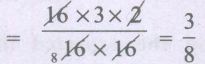
ஃ Var(X) = E(X2) - [E(x)]2
\(
=\frac{3}{8}-\frac{1}{4}
\)
\(=\frac{1}{8}
\)
∴ Var(X) \(=\frac{1}{8}
\)
25.
Using the substitution X = \(\sqrt u\), we get dx = \(\frac { 1 }{ 2\sqrt { u } } du\)
When x = 0, we get u = 0
When x = \(\infty\), we get u = \(\infty\)
\(\therefore \int _{ 0 }^{ \infty }{ { e }^{ -{ x }^{ 2 } }{ x }^{ 2n-1 }dx } =2\int _{ 0 }^{ \infty }{ { e }^{ -u }{ \left( \sqrt { u } \right) }^{ 2n-1 } } \frac { 1 }{ 2\sqrt { u } } du=\int _{ 0 }^{ \infty }{ { e }^{ -u }{ u }^{ n-1 }du } \) = Γ(n)
26.
Given v(x, y, z) = x3 + y3 + z3 + xyz3
\(\frac { \partial v }{ \partial z } \) = 0 + 0 +3z2 + 3xy = 3z2 + 3xy
\(\frac { \partial v }{ \partial y } \) = 0 + 3y2 + 0 + 3xz = 3y2 + 3xz
Now, \(\frac { { \partial }^{ 2 }v }{ \partial y\partial z } =\frac { { \partial } }{ \partial { y } } \left( \frac { \partial v }{ \partial z } \right) \) = 0 + 3x = 3x ...(1)
\(\frac { { \partial }^{ 2 }v }{ \partial z\partial y } =\frac { { \partial } }{ \partial { z } } \left( \frac { \partial v }{ \partial y } \right) \) = 0 + 3x = 3x ..... (2)
From (1) and (2),
\(\frac { { \partial }^{ 2 }v }{ \partial y\partial z } =\frac { { \partial }^{ 2 }v }{ \partial z\partial y } \)
27.
Diameter = 30 cm
Radius = 15 cm
Circumference (c) = 2πr
\(\frac{dc}{dr}\) = 2π(3) = 6πcm
dc = 2πdr
\(\frac{6}{2π}\) cm = dr
\(\frac{3}{π}\) cm = dr
Approximate growth of the diameter
= 2dr = 2 \(\times\) \(\frac{3}{π}\) cm = \(\frac{6}{2π}\)cm
(ii) A = πr2
dA = π 2r dr
\(d \mathrm{~A}=\not \pi 2(15) \frac{3}{\not \pi} \mathrm{cm}^{2}\)
dA = 90 cm2
Area = πr2 = π \(\times\)15 \(\times\) 15 cm2
28.
Given f(0) = -1, f(2) = 4
∴ f(x) is a continuous function in [0,2]
By Lagrange's mean value theorem,
f'(x) = \(\frac { f(b)-f(a) }{ b-a } \) = \(\frac{f(2)-f(0)}{2-0}\)
= \(\frac{4-(-1)}{2}\) = \(\frac{5}{2}\) = 2.5
= 2.5 ∉ [0, 2]
Since f'(x) cannot be 2.5 at any point in [0, 2], there does not exist a differentiable function f(x).
29.
Given equation is \(\frac { { (x-1) }^{ 2 } }{ 100 } +\frac { ({ y-2) }^{ 2 } }{ 64 } =1\)
This is an equation of the ellipse
∴ a2 = 100,b2 = 64
⇒ c2 = a2 - b2
⇒ c2 = 100 - 64 = 36
∴ c = 6
\(\sqrt { 1-\frac { { b }^{ 2 } }{ { a }^{ 2 } } } =\sqrt { 1-\frac { 64 }{ 100 } } =\sqrt { \frac { 100-64 }{ 100 } } \)
\(=\sqrt{\frac{36}{100}}=\frac{\not 6} {\not {10}}\)
∴ c = \(\frac { 3 }{ 5 } \)
(a) Center is (-1, 2) ⇒ h = -1, k = 2
(b) Foci are (h - c, k), (h + c, k) ⇒ (-1 - 6, 2), (-1 + 6, -2) ⇒ (-7, 2), (5, 2)
(c) Vertices are (h - a, k) and (h + a, k) ⇒ (-1 -10,2), (-1 + 10,2) ⇒ (-11, 2), (9, 2)
(d) Equation of directrices are x + 1 = \(\pm \frac { a }{ e } \)
\(\Rightarrow x+1=\pm \frac { 10 }{ \frac { 3 }{ 5 } } \Rightarrow x+1=\pm \frac { 50 }{ 3 } \)
\(\therefore x+1=\frac { 50 }{ 3 } and x+1=-\frac { 50 }{ 3 } \)
\(\Rightarrow x=\frac { 50 }{ 3 } -1\) and \(x=-\frac { 50 }{ 3 } -1\)
\(\Rightarrow x=\frac { 47 }{ 3 } \) and \(x=\frac { -53 }{ 3 } \)
30.
We know that the vector equation of a plane passing through the line of intersection of the planes
\(\vec { r } .\vec { { n }_{ 1 } } ={ d }_{ 1 }\) and \(\vec { r } .\vec { { n }_{ 2 } } ={ d }_{ 2 }\) is given by \((\vec { r } .\vec { { n }_{ 1 } } -{ d }_{ 1 })+\lambda (\vec { r } .\vec { { n }_{ 2 } } -{ d }_{ 2 })=0\)
Substituting \(\vec { r } =x\hat { i } +y\hat { j } +z\hat { k } ,\vec { { n }_{ 1 } } =\hat { i } +\hat { j } +\hat { k } ,\vec { { n }_{ 2 } } =2\hat { i } -3\hat { j } +5\hat { k } \), \({ d }_{ 1 }=1,{ d }_{ 2 }=-2\) in the above equation, we get
(x + y + z + 1) + \(\lambda \) (2x - 3y + 5z - 2) = 0
Since this plane passes through the point (−1, 2,1) , we get λ = \(\frac{3}{5}\), and hence the required equation
of the plane is 11x−4y+20z=1 .
31.
Given lines are x+1 = 2y = -12z
\(\Rightarrow \frac { x+1 }{ 1 } =\frac { y-0 }{ 1 } =\frac { z-0 }{ \frac { -1 }{ 12 } } \)
and x = y + 2 = 6z - 6
\(\Rightarrow \frac { x-0 }{ 1 } =\frac { y+2 }{ 1 } =\frac { z-1 }{ \frac { 1 }{ 6 } } \)
\(\therefore \vec { a } =-\hat { i } ,\vec { b } =\hat { i } +\frac { 1 }{ 2 } \vec { j } -\frac { 1 }{ 12 } \hat { k } \)
\(\vec { c } =-2\hat { j } +\hat { k } \ and\ \vec { d } =\hat { i } +\hat { j } +\frac { 1 }{ 6 } \hat { k } \)
\(\vec { c } -\vec { a } =2\hat { j } +\hat { k } -(-\hat { i } )=\hat { i } -2\hat { j } +\hat { k } \)
\(\vec { b } \times \vec { d } =\left| \begin{matrix} \hat { i } & \hat { j } & \hat { k } \\ 2 & \frac { 1 }{ 2 } & -\frac { 1 }{ 12 } \\ 1 & 1 & \frac { 1 }{ 6 } \end{matrix} \right| \)
\(=\hat { i } \left( \frac { 1 }{ 12 } +\frac { 1 }{ 12 } \right) -\hat { j } \left( \frac { 1 }{ 6 } +\frac { 1 }{ 12 } \right) +\hat { k } \left( 1-\frac { 1 }{ 12 } \right) \)
\(=\frac { 1 }{ 6 } \hat { i } -\frac { 1 }{ 4 } \hat { j } +\frac { 1 }{ 2 } \hat { k } \)
Now \((\vec { c } -\vec { a } ).(\vec { b } \times \vec { d } )\)
\(=\left( \hat { i } -2\hat { j } +\hat { k } \right) .\left( \frac { 1 }{ 6 } \hat { i } -\frac { 1 }{ 4 } \hat { j } +\frac { 1 }{ 2 } \hat { k } \right) \)
\(=\frac { 1 }{ 6 } +\frac { 2 }{ 4 } +\frac { 1 }{ 2 } =\frac { 1 }{ 6 } +\frac { 1 }{ 2 } +\frac { 1 }{ 2 } \)
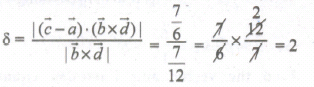
\(=\frac { 1 }{ 6 } +1=\frac { 7 }{ 6 } \)
Since \((\vec { c } -\vec { a } ).(\vec { b } \times \vec { d } )\)0, the given lines are skew lines.
\(\therefore |\vec { b } \times \vec { d } |=\sqrt { \frac { 1 }{ 36 } +\frac { 1 }{ 16 } +\frac { 1 }{ 4 } } \)
\(\sqrt { \frac { 4+9+36 }{ 144 } } =\sqrt { \frac { 49 }{ 144 } } =\frac { 7 }{ 12 } \)
Shortest distances between the skew lines
32.
Equation of the hyperbola is 12x2- 9y2 = 108
\(\div 108\) we get, \(\frac { { 12x }^{ 2 } }{ 108 } -\frac { 9{ y }^{ 2 } }{ 108 } =1\)
⇒ \(\frac { { x }^{ 2 } }{ 9 } -\frac { { y }^{ 2 } }{ 12 } =1\)
∴ a2 = 9, b2 = 12
Parametric equation of tangent to the hyperbola is \(\frac { x \ sec\ \theta }{ a } -\frac { y \ tan \ \theta }{ b } =1\)
When \(\theta =\frac { \pi }{ 3 } \), the equation is
\(\frac { xsec\frac { \pi }{ 3 } }{ 3 } -\frac { ytan\frac { \pi }{ 3 } }{ 2\sqrt { 3 } } =1\)
.JPG)
⇒ \(\frac { 4x-3y }{ 6 } =1\) ⇒ 4x - 3y - 6 = 0 is the required equation of tangent.
Parametric equation of normal to the hyperbola is
\(\frac { ax }{ sec\theta } +\frac { by }{ tan\theta } ={ a }^{ 2 }+{ b }^{ 2 }\)
At \(\theta =\frac { \pi }{ 3 } ,\frac { 3x }{ sec\frac { \pi }{ 3 } } +\frac { 2\sqrt { 3 } }{ tan\frac { \pi }{ 3 } } =9+12\)
\(\Rightarrow \frac{3 x}{2}+\frac{2 \sqrt{\not 3} y}{\sqrt{\not 3}}=21\)
⇒ \(\frac { 3x }{ 2 } \) + 2y = 21 ⇒ 3x + 4y = 42
⇒ 3x + 4y - 42 = 0 is the required equation of normal.
33.
Applying Gauss-Jordan method, we get
[A | I2] = \(\left[ \begin{matrix} 0 & 5 \\ -1 & 6 \end{matrix}|\begin{matrix} 1 & 0 \\ 0 & 1 \end{matrix} \right] \overset { { R }_{ 1 }\leftrightarrow { R }_{ 2 } }{ \longrightarrow } \left[ \begin{matrix} -1 & 6 \\ 0 & 5 \end{matrix}|\begin{matrix} 0 & 1 \\ 1 & 0 \end{matrix} \right] \overset { { R }_{ 1 }\longrightarrow \left( -1 \right) { R }_{ 1 } }{ \longrightarrow } \left[ \begin{matrix} 1 & -6 \\ 0 & 5 \end{matrix}|\begin{matrix} 0 & -1 \\ 1 & 0 \end{matrix} \right] \)\(\overset { { R }_{ 1 }\longrightarrow \left( -1 \right) { R }_{ 1 } }{ \longrightarrow } \left[ \begin{matrix} 1 & -6 \\ 0 & 5 \end{matrix}|\begin{matrix} 0 & -1 \\ 1 & 0 \end{matrix} \right] \overset { { R }_{ 2 }\longrightarrow \frac { 1 }{ 5 } { R }_{ 2 } }{ \longrightarrow } \left[ \begin{matrix} 1 & -6 \\ 0 & 1 \end{matrix}|\begin{matrix} 0 & -1 \\ \left( 1/5 \right) & 0 \end{matrix} \right] \)\(\overset { { R }_{ 1 }\longrightarrow { R }_{ 1 }+6{ R }_{ 2 } }{ \longrightarrow } \left[ \begin{matrix} 1 & 0 \\ 0 & 1 \end{matrix}|\begin{matrix} \left( 6/5 \right) & -1 \\ \left( 1/5 \right) & 0 \end{matrix} \right] \).
So, we get A-1 = \(\left[ \begin{matrix} \left( 6/5 \right) & -1 \\ \left( 1/5 \right) & 0 \end{matrix} \right] =\frac { 1 }{ 5 } \left[ \begin{matrix} 6 & -5 \\ 1 & 0 \end{matrix} \right] \).
34.
Let the roots be a−d, a, a+d.
Then the sum of the roots is 3a which is equal to 6 from the given equation.
Thus 3a = 6 and hence a = 2.
The product of the roots is a3− ad2 which is equal to −24 from the given equation.
Substituting the value of a, we get 8−2d2 = −24 and hence d = ±4.
If we take d = 4 we get −2, 2, 6 as roots and if we take d = −4, we get 6, 2, −2 as roots (same roots given in reverse order) of the equation.
35.
Given equation is 2x4- 8x + 6x2- 3 = 0
Here a = 2, b = -8, c = 6, d = 0, e = -3
Let ∝, β, ૪ and \(\delta \) be the roots of equation (1)
Then by Vieta's formula,
\(\sum { _{ 1 }= } \alpha +\beta +\gamma +\delta =\frac { -b }{ a } =\frac { -(-8) }{ 2 } =4\)
\(\sum { _{ 2 } } =\alpha \beta +\alpha \gamma +\alpha \delta +\beta \gamma +\beta \delta +\gamma \delta =\frac { c }{ a } =\frac { 6 }{ 2 } =3\)
\(\sum { _{ 3 } } =\alpha \beta \gamma +\alpha \beta \delta +\alpha \gamma \delta +\beta \gamma \delta =\frac { -d }{ a } =\frac { 0 }{ a } \)
\(\sum { _{ 4 } } =\alpha \beta \gamma \delta =\frac { e }{ a } =\frac { -3 }{ 2 } \)
Now, (a+b+c+d)2 = a2+b2+c2+d2+2(ab+ac+ad+bc+cd)
⇒ n∝2+β2+૪2+\(\delta\)2 = (∝ + β + ૪ + \(\delta\))2-2(\(\alpha \beta +\alpha \gamma +\alpha \delta +\beta \gamma +\beta \delta +\gamma \delta \))
∝2 + β2 + ૪2 = 42-2(3) = 16 - 6 = 10
36.
Given \(A=\left( \begin{matrix} 1 & 0 \\ 0 & 1 \\ 1 & 0 \end{matrix}\begin{matrix} 1 & 0 \\ 0 & 1 \\ 0 & 1 \end{matrix} \right) ,B=\left( \begin{matrix} 0 & 1 \\ 1 & 0 \\ 1 & 0 \end{matrix}\begin{matrix} 0 & 1 \\ 1 & 0 \\ 0 & 1 \end{matrix} \right) and\quad C=\left( \begin{matrix} 1 & 1 \\ 0 & 1 \\ 1 & 1 \end{matrix}\begin{matrix} 0 & 1 \\ 1 & 0 \\ 1 & 1 \end{matrix} \right) \)
\(\left( \begin{matrix} 1 & 1 \\ 1 & 1 \\ 1 & 0 \end{matrix}\begin{matrix} 1 & 1 \\ 1 & 1 \\ 0 & 1 \end{matrix} \right) \wedge \left( \begin{matrix} 1 & 1 \\ 0 & 1 \\ 1 & 1 \end{matrix}\begin{matrix} 0 & 1 \\ 1 & 0 \\ 1 & 1 \end{matrix} \right) =\left( \begin{matrix} 1 & 1 \\ 0 & 1 \\ 1 & 0 \end{matrix}\begin{matrix} 0 & 1 \\ 1 & 0 \\ 0 & 1 \end{matrix} \right) \)
37.
Given \(A=\left( \begin{matrix} 1 & 0 \\ 0 & 1 \\ 1 & 0 \end{matrix}\begin{matrix} 1 & 0 \\ 0 & 1 \\ 0 & 1 \end{matrix} \right) ,B=\left( \begin{matrix} 0 & 1 \\ 1 & 0 \\ 1 & 0 \end{matrix}\begin{matrix} 0 & 1 \\ 1 & 0 \\ 0 & 1 \end{matrix} \right) and\quad C=\left( \begin{matrix} 1 & 1 \\ 0 & 1 \\ 1 & 1 \end{matrix}\begin{matrix} 0 & 1 \\ 1 & 0 \\ 1 & 1 \end{matrix} \right) \)
\(=\left( \begin{matrix} 1 & 0 \\ 0 & 1 \\ 1 & 0 \end{matrix}\begin{matrix} 1 & 0 \\ 0 & 1 \\ 0 & 1 \end{matrix} \right) \vee \left( \begin{matrix} 0 & 1 \\ 1 & 0 \\ 1 & 0 \end{matrix}\begin{matrix} 0 & 1 \\ 1 & 0 \\ 0 & 1 \end{matrix} \right) \)
\(=\left( \begin{matrix} 1\vee 0 & 0\vee 1 \\ 0\vee 1 & 1\vee 0 \\ 1\vee 1 & 0\vee 0 \end{matrix}\begin{matrix} 1\vee 0 & 0\vee 1 \\ 0\vee 1 & 1\vee 0 \\ 0\vee 0 & 1\vee 1 \end{matrix} \right) \)
\(=\left( \begin{matrix} 1 & 1 \\ 1 & 1 \\ 1 & 0 \end{matrix}\begin{matrix} 1 & 1 \\ 1 & 1 \\ 0 & 1 \end{matrix} \right) \) [∵ a∨b=max(a,b)]
38.
\(\begin{matrix} lim \\ (x,y)\rightarrow (0,0) \end{matrix}cos=\left( \frac { { e }^{ x }siny }{ y } \right) \) = \(cos\left( { e }^{ 0 }\frac { siny }{ y } \right) \)
= cos[(1)(1)] = cos (1) \(\left[ \because \begin{matrix} lim \\ y\rightarrow 0 \end{matrix}\frac { siny }{ y } =1 \right] \)
39.
We have,
\(\underset { x\rightarrow { 0 }^{ - } }{ lim } =-\infty \ and\ \underset { x\rightarrow { 0 }^{ x } }{ lim } =\frac { 1 }{ x } =\infty \). Hence, the required vertical asymptote is x = 0 or the y -axis.
As the curve is symmetric with respect to both the axes, y = 0 or the x -axis is also an asymptote.
Hence this (rectangular hyperbola) curve has both the vertical and horizontal asymptotes.
40.
y = Acos x + Bsin x ... (1)
Differentiating (1) twice successively, we get
\(\frac{dy}{dx}\)= −Asin x + Bcos x. ...(2)
\(\frac{d^2y}{dx^2}\) = -Acos x − Bsin x = −(A cos x + B sin x). ...(3)
Substituting (1) in (3), we get \(\frac{d^2y}{dx^2}\) + = 0 as the required differential equation
41.
Let \(g(x)=\frac { 1 }{ 2 } { tan }^{ -1 }\left( 1-{ x }^{ 2 } \right) -\frac { \pi }{ 4 } \)
By the definition of tan-1 x, it is a function with
the entire real line \(\left( -\infty ,\infty \right) \) as its domain.
\(\therefore \) Domain of \(g(x)=\frac { 1 }{ 2 } { tan }^{ -1 }\left( 1-{ x }^{ 2 } \right) -\frac { \pi }{ 4 } \)is R
\(\therefore \) Domain of g(x) is R.
42.
Given \(\vec { a } =\hat { i } +\hat { j } +\hat { k } \), \(\vec { b } =\hat { i } \), \(\vec { c } ={ c }_{ 1 }\hat { i } +{ c }_{ 2 }\hat { j } +{ c }_{ 3 }\hat { k } \)
∴ \(\vec { c } =\hat { i } +2\hat { j } +{ c }_{ 3 }\hat { k } \)
Also, it given that \(\vec { a } ,\vec { b } \) and \(\vec { c } \) are co-planar.
∴ \(\vec { a } .(\vec { b } \times \vec { c } )\)
⇒ \(\left| \begin{matrix} 1 & 1 & 1 \\ 1 & 0 & 0 \\ 1 & 2 & { c }_{ 3 } \end{matrix} \right| \)= 0
⇒ \(1\left| \begin{matrix} 0 & 0 \\ 2 & { c }_{ 3 } \end{matrix} \right| -1\left| \begin{matrix} 1 & 0 \\ 1 & { c }_{ 3 } \end{matrix} \right| +1\left| \begin{matrix} 1 & 0 \\ 1 & 2 \end{matrix} \right| \) = 0
⇒ 1(0-0)-1(c3-0)+1(2-0) = 0
⇒ 0 - c3+2 = 0 ⇒ c3 = 2
∴ c3 = 2
43.
| x | 0 | \(\frac {3 \pi }{ 2 } \) | \(3\pi \) | \(\frac { 9\pi }{ 2 } \) | \(6\pi \) |
| y | 0 | 1 | 0 | -1 | 0 |

12th Standard Syllabus & Materials
12th Standard
TN 12th Computer Applications களப்பெயர் முறைமை (DNS) Sample Question Papers Study Material - QB365 Set A
NEW12th Standard
TN 12th Computer Applications வலையமைப்பு எடுத்துக்காட்டுகள் மற்றும் நெறிமுறைகள் Sample Question Papers Study Material - QB365 Set A
NEW12th Standard
TN 12th Computer Applications கணினி வலையமைப்பு ஓர் அறிமுகம் Sample Question Papers Study Material - QB365 Set A
NEW12th Standard
TN 12th Computer Applications PHP-உடன் MySQL-ஐ இணைத்தல் Sample Question Papers Study Material - QB365 Set A



Tamilnadu Stateboard 12th Standard Subjects
Maths

Chemistry

Physics

Biology

Computer Science

Business Maths and Statistics

Economics

Commerce

Accountancy

History

Computer Applications
Biology
Computer Technology
Computer Applications
Computer Science
Business Maths and Statistics
Commerce
Economics
Maths
Chemistry
Physics
Computer Technology
History
Accountancy

Tamil

English

French
Tamilnadu Stateboard Standards

