
 100% FREE ACCESS
12th Standard Syllabus & Materials
12th Standard
TN 12th Maths Applications of Matrices and Determinants Sample Question Papers Study Material - QB365 Set A
NEW12th Standard
TN 12th Computer Applications மின்னணு தரவு பரிமாற்றம் Sample Question Papers Study Material - QB365 Set A
NEW12th Standard
TN 12th Computer Applications மின் - வணிக பாதுகாப்பு அமைப்புகள் Sample Question Papers Study Material - QB365 Set A
NEW12th Standard
TN 12th Computer Applications மின்னணு செலுத்தல் முறைகள் Sample Question Papers Study Material - QB365 Set A
NEW12th Standard
TN 12th Computer Applications மின் - வணிகம் Sample Question Papers Study Material - QB365 Set A
NEW12th Standard
TN 12th Computer Applications திறந்த மூல கருத்துருக்கள் Sample Question Papers Study Material - QB365 Set A

Published on: 03/09/2020
12th Standard Maths English Medium Model 5 Mark Book Back Questions (New Syllabus) 2020
Download Tamil Nadu 12th Standard Maths question papers, model tests, one-mark questions, important questions, and public exam papers in PDF format. Free study materials and answer keys for TN State Board students.
Questions + Answers key
Take MCQ Maths Test1.
Solve \(\left( y+\sqrt { { x }^{ 2 }+{ y }^{ 2 } } \right) dx-xdy=0,\ y(1)=0\)
2.
3.
Find the tangent and normal to the following curves at the given points on the curve
y = x sin x at \(\left( \frac { \pi }{ 2 } ,\frac { \pi }{ 2 } \right) \)
4.
Show that y = ax + \(\frac { b }{ x } \), x ≠ 0 is a solution of the differential equation x2 y" + xy' - y = 0.
5.
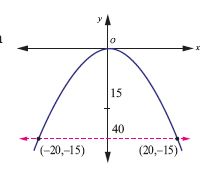
A concrete bridge is designed as a parabolic arch. The road over bridge is 40 m long and the maximum height of the arch is 15 m. Write the equation of the parabolic arch.
6.
If A = \(\left[ \begin{matrix} 4 & 3 \\ 2 & 5 \end{matrix} \right] \), find x and y such that A2 + xA + yI2 = O2. Hence, find A-1.
7.
Let A be Q\{1}. Define ∗ on A by x*y = x + y − xy. Is ∗ binary on A? If so, examine the commutative and associative properties satisfied by ∗ on A.
8.
Establish the equivalence property connecting the bi-conditional with conditional: p ↔️ q ≡ (p ➝ q) ∧ (q⟶ p)
9.
A watermelon has an ellipsoid shape which can be obtained by revolving an ellipse with major-axis 20 cm and minor-axis 10 cm about its major-axis. Find its volume using integration.
10.
Two balls are chosen randomly from an urn containing 8 white and 4 black balls. Suppose that we win Rs. 20 for each black ball selected and we lose Rs. 10 for each white ball selected. Find the expected winning amount and variance
11.
Using integration find the area of the region bounded by triangle ABC, whose vertices A, B, and C are (−1, 1), (3, 2), and (0, 5) respectively
12.
Find the constant C such that the function
\(f(x)= \begin{cases}C x^2, & 1<x<4 \\ 0, & \text { otherwise }\end{cases}\)
is a density function, and compute
(i) P(1.5 < X < 3.5)
(ii) P(X ≤ 2)
(iii) P(3 < X )
13.
The mean and standard deviation of a binomial variate X are respectively 6 and 2.
Find
(i) the probability mass function
(ii) P(X = 3)
(iii) P(X\(\ge \)2).
14.
If V(x,y) = ex(x cos y - y siny), then prove that \(\frac { { \partial }^{ 2 }V }{ \partial { x }^{ 2 } } =\frac { { \partial }^{ 2 }V }{ \partial { y }^{ 2 } } \) = 0
15.
Evaluate the following integrals using properties of integration:
\(\int _{ 0 }^{ \pi }{ x\left[ { sin }^{ 2 }(sinx)+{ cos }^{ 2 }(cosx) \right] } dx\)
16.
Evaluate \(\int ^{\pi}_{-\pi} \frac{cos ^2 x}{1+ a^x}\) dx
17.
If X is the random variable with probability density function f(x) given by,
\(f(x)=\begin{cases} \begin{matrix} x+1 & -1\le x<0 \end{matrix} \\ \begin{matrix} -x+1 & 0\le x<1 \end{matrix} \\ \begin{matrix} 0 & otherwise \end{matrix} \end{cases}\)
then find
(i) the distribution function F(x)
(ii) P( -0.5 ≤X ≤ 0.5)
18.
Evaluate\(\int _{ 1 }^{ 4 }{ ({ 2x }^{ 2 }+3) } \) dx, as the limit of a sum
19.
A steel plant is capable of producing x tonnes per day of a low-grade steel and y tonnes per day of a high-grade steel, where \(y=\frac { 40-5x }{ 10-x } \). If the fixed market price of low-grade steel is half that of high-grade steel, then what should be optimal productions in low-grade steel and high-grade steel in order to have maximum receipts.
20.
For the function f{x) = 4x3 + 3x2 - 6x + 1 find the intervals of monotonicity, local extrema, intervals of concavity and points of inflection.
21.
A tank initially contains 50 litres of pure water. Starting at time t = 0 a brine containing with 2 grams of dissolved salt per litre flows into the tank at the rate of 3 litres per minute. The mixture is kept uniform by stirring and the well-stirred mixture simultaneously flows out of the tank at the same rate. Find the amount of salt present in the tank at any time t > 0.
22.
Evaluate the following limit, if necessary use l’Hôpital Rule
\(\underset { x\rightarrow { 0 }^{ + } }{ lim } { x }^{ x }\)
23.
The equation of electromotive force for an electric circuit containing resistance and self inductance is E = Ri + L\(\frac{di}{dt},\) Where E is the electromotive force is given to the circuit, R the resistance and L, the coefficient of induction. Find the current i at time t when E = 0.
24.
Solve the Linear differential equation \((1+x+{ xy }^{ 2 })\frac { dy }{ dx } +(y+{ y }^{ 3 })=0\)
25.
Prove that among all the rectangles of the given perimeter, the square has the maximum area.
26.
Solve [y(1-x tan x)+x2 cosx] dx-dy = 0
27.
Find intervals of concavity and points of inflexion for the following function:
f(x) = sin x + cos x, 0 < x < 2
28.
A ladder 17 metre long is leaning against the wall. The base of the ladder is pulled away from the wall at a rate of 5 m/s. When the base of the ladder is 8 metres from the wall.
(i) How fast is the top of the ladder moving down the wall?
(ii) At what rate, the area of the triangle formed by the ladder, wall and the floor is changing?
29.
A camera is accidentally knocked off an edge of a cliff 400 ft high. The camera falls a distance of s = 16t2 in t seconds.
(i) How long does the camera fall before it hits the ground?
(ii) What is the average velocity with which the camera falls during the last 2 seconds?
(iii) What is the instantaneous velocity of the camera when it hits the ground?
30.
Find the vertex, focus, equation of directrix and length of the latus rectum of the following: y2−4y−8x+12 = 0
31.
Solve the following systems of linear equations by Cramer’s rule:
3x + 3y − z = 11, 2x − y + 2z = 9, 4x + 3y + 2z = 25.
32.
If the system of equations px + by + cz = 0, ax + qy + cz = 0, ax + by + rz = 0 has a non-trivial solution and p ≠ a, q ≠ b, r ≠ c, prove that \(\frac { p }{ p-a } +\frac { q }{ q-b } +\frac { r }{ r-c } =2\).
33.
Show that the lines \(\vec { r } =(\hat {- i } -3\hat { j } -5\hat { k } )+s(3\hat { i } +5\hat { j } +7\hat { k } )\) and \(\vec { r } =(2\hat { i } +4\hat { j } +6\hat { k } )+t(\hat { i } +4\hat { j } +7\hat { k } )\) are coplanar. Also, find the non-parametric form of vector equation of the plane containing these lines
34.
Solve the equation z3+ 8i = 0, where \(z \in \mathbb{C}\)
35.
An engineer designs a satellite dish with a parabolic cross section. The dish is 5 m wide at the opening, and the focus is placed 1.2 m from the vertex
(a) Position a coordinate system with the origin at the vertex and the x -axis on the parabola’s axis of symmetry and find an equation of the parabola.
(b) Find the depth of the satellite dish at the vertex.
36.
Investigate for what values of λ and μ the system of linear equations x + 2y + z = 7 , x + y + λz = μ , x + 3y − 5z = 5 has
(i) no solution
(ii) a unique solution
(iii) an infinite number of solutions
37.
Solve \(tan^{ -1 }\left( \frac { x-1 }{ x-2 } \right) +tan^{ -1 }\left( \frac { x+1 }{ x+2 } \right) =\frac { \pi }{ 4 } \)
38.
If ax2 + bx + c is divided by x + 3, x − 5, and x − 1, the remainders are 21, 61 and 9 respectively. Find a, b and c. (Use Gaussian elimination method.)
39.
Discuss the maximum possible number of positive and negative roots of the polynomial equations x2−5x+6 and x2−5x+16 . Also draw rough sketch of the graphs
40.
If z = x + iy and arg \(\left( \frac { z-i }{ z+2 } \right) =\frac { \pi }{ 4 } \), then show that x2 + y2 + 3x - 3y + 2 = 0
41.
42.
The prices of three commodities A, B and C are Rs. x, y and z per units respectively. A person P purchases 4 units of B and sells two units of A and 5 units of C. Person Q purchases 2 units of C and sells 3 units of A and one unit of B. Person R purchases one unit of A and sells 3 unit of B and one unit of C. In the process, P, Q and R earn Rs. 15,000, Rs. 1,000 and Rs. 4,000 respectively. Find the prices per unit of A, B and C. (Use matrix inversion method to solve the problem.)
43.
Find the equation of the ellipse whose eccentricity is \(\frac { 1 }{ 2 } \), one of the foci is(2, 3) and a directrix is x = 7. Also find the length of the major and minor axes of the ellipse.
44.
If 2+i and 3-\(\sqrt{2}\) are roots of the equation x6-13x5+ 62x4-126x3+ 65x2+127x-140 = 0, find all roots.
45.
Find the asymptotes of the following curves :\(f(x)=\frac { { x }^{ 2 }+6x-4 }{ 3x-6 } \)
46.
If the Cartesian equation of a plane is 3x - 4y + 3z = -8, find the vector equation of the plane in the standard form.
1.
The given differential equation is homogeneous (verify).
Now, we rewrite the given equation in differential form \(\frac { dy }{ dx } =\frac { y+\sqrt { { x }^{ 2 }+{ y }^{ 2 } } }{ x } \)
Since the initial value of x is 1, we consider x > 0 and take x =\(\sqrt { { x }^{ 2 } } \)
We have \(\frac { dy }{ dx } =\frac { y }{ x } +\sqrt { 1+{ \left( \frac { y }{ x } \right) }^{ 2 } } \)
Let y = vx. Then, \(v+x\frac { dv }{ dx } =v+\sqrt { 1+{ v }^{ 2 } } \), which becomes \(x\frac { dv }{ dx } =\sqrt { 1+{ v }^{ 2 } } \)
By separating variables, we have \(\frac { dv }{ \sqrt { { v }^{ 2 }+1 } } =\frac { dx }{ x } \)
Upon integration, we get \(|v+\sqrt { { v }^{ 2 }+1 } |=log|x|+log|C|\ or\ v+\sqrt { { v }^{ 2 }+1 } =xC\)
Now, we replace v by \(\frac{y}{x}\), we get \(\frac { y }{ x } +\sqrt { \frac { { y }^{ 2 } }{ { x }^{ 2 } } +1 } =Cx\quad (or)\quad y+\sqrt { { x }^{ 2 }+{ y }^{ 2 } } ={ Cx }^{ 2 }\) gives the general solution of the given differential equation
To determine the value of C, we use the condition that y = 0 when x = 1. So, we get C = 1.
Thus \(y=\sqrt { { x }^{ 2 }+{ y }^{ 2 } } ={ x }^{ 2 }\)is the particular solution of the given differential equation.
2.
3.
Equation of the given curve is y = x sin x
∴ slope = m = \(\left( \frac { dy }{ dx } \right) \)\(\left( \frac { \pi }{ 2 } ,\frac { \pi }{ 2 } \right) \)
= \(\frac { \pi }{ 2 } cos\frac { \pi }{ 2 } +sin\frac { \pi }{ 2 } \)
= \(\frac { \pi }{ 2 } \) (0) + 1 = 1
∴ Equating of the tangent is y - y1 = m (x - x1)
⇒ y - \(\frac { \pi }{ 2 } \) = 1 \(\left( x-\frac { \pi }{ 2 } \right) \)
\(\Rightarrow \frac{2 y-\pi}{\not 2}=\frac{2 x-\pi}{\not 2}\)
Equating of the normal is y - y1 = \(\frac{-1}{m}\) (x - x1)
\(\Rightarrow \frac{2 y-\pi}{\not 2}=\frac{2 x-\pi}{\not 2}\)
⇒ 2x + 2y = 2π
⇒ x + y- π = 0
4.
Given y = ax + \(\frac { b }{ x } \) .......(1)
Differentiating with respect to x
y' = ax - \(\frac { b }{ x ^2} \) ......(2)
Differentiating again with respect to x
\(y'' = \frac{-b(-2)}{x^3}= \frac{2b}{x^3}
\)
\(Now, x^2y'' + xy'-y
\)
\( = x^2 \times \frac{2b}{x^3}+x(a- \frac{b}{x^2})-(ax+\frac{b}{x})
\)
\(= 2\times (\frac{b}{x})+ax-(\frac{b}{x})-ax-(\frac{b}{x})\)
= 0
Hence, y = ax + b is the solution of the differential equation x2y"+xy'-y = 0.
5.
From the graph the vertex is at (0, 0) and the parabola is open down
Equation of the parabola is x2 = -4ay
(-20, -15) and (20, -15) lie on the parabola
202 = -4a(-15)
\(4a=\frac { 400 }{ 15 } \)
x2 =\(\frac { -80 }{ 3 } \) x y
Therefore equation is 3x2 = -80y
6.
Since A2 = \(\left[ \begin{matrix} 4 & 3 \\ 2 & 5 \end{matrix} \right] \left[ \begin{matrix} 4 & 3 \\ 2 & 5 \end{matrix} \right] =\left[ \begin{matrix} 22 & 27 \\ 18 & 31 \end{matrix} \right] \).
A2 + xA + yI2 = O2 ⇒ \(\left[ \begin{matrix} 22 & 27 \\ 18 & 31 \end{matrix} \right] +x\left[ \begin{matrix} 4 & 3 \\ 2 & 5 \end{matrix} \right] +y\left[ \begin{matrix} 1 & 0 \\ 0 & 1 \end{matrix} \right] =\left[ \begin{matrix} 0 & 0 \\ 0 & 0 \end{matrix} \right] \)
⇒ \(\left[ \begin{matrix} 22+4x+y & 27+3x \\ 18+2x & 31+5x+y \end{matrix} \right] =\left[ \begin{matrix} 0 & 0 \\ 0 & 0 \end{matrix} \right] \).
So, we get 22 + 4x + y = 0, 31 + 5x + y = 0, 27 + 3x = 0 and 18 + 2x = 0.
Hence x = −9 and y = 14. Then, we get A2 - 9A + 14I2 = O2.
Postmultiplying this equation by A-1, we get A - 9I2 + 14A-1 = O2. Hence, we get
A-1 = \(\frac { 1 }{ 14 } \) (9I2 - A) = \(\frac { 1 }{ 14 } \left( 9\left[ \begin{matrix} 1 & 0 \\ 0 & 1 \end{matrix} \right] -\left[ \begin{matrix} 4 & 3 \\ 2 & 5 \end{matrix} \right] \right) =\frac { 1 }{ 14 } \left[ \begin{matrix} 5 & -3 \\ -2 & 4 \end{matrix} \right] \).
7.
given A = {Q\{1}}
A is defined on A by x*y = x+y-xy
Let x,y ≠ 1
∴ x*y = x + y - xy
Now to prove that x + y - xy ≠ 1
Let us assume that x + y - xy = 1
x+y-xy-1 = 0
(x-1)-y(x-1) = 0
(x-1)(1-y) = 0
x =1 or y = 1 which is a false [∵x, y ≠ 1]
∴ is a binary operation on A.
Commutative property:
Let x,y ∈A ⇒ x, y≠1
∴x*y = x+y-xy
and y*x = y+x-yx
⇒x+y = y*x∀x, y∈A
A has commutative property under *
Associative property:
Let x,y,z ∊A ⇒x,y,z≠1
Consider (x*y)*z = (x+y-xy)*z
= x +y~xy +z- (x +y-xy)z
= x +y-xy+ z-xz- yz + xyz
= x +y+z-xy-yz-zx +xyz ...(1)
= x +y+z - yz - x (y + z - yz)
= x +y +z-yz-zy-xz +xyz ..(2)
From (1) & (2), (x*y)*z = x*(y*z)
A has associative property under *.
8.
| p | q | p ➝ q | q⟶ p | p ↔️ q | (p ➝ q) ∧ (q⟶ p) |
| T | T | T | T | T | T |
| T | F | F | T | F | F |
| F | T | T | F | F | F |
| F | F | T | T | T | T |
The entries in the columns corresponding to p ↔ q and ( p ⟶ q) ∧ (q ⟶ p) are identical and hence they are equivalent
9.
Given 2a = 20 cm \(\Rightarrow\) a = 10 cm;
2b = 10 cm \(\Rightarrow\)a = 5 cm
\(\therefore\) Equation of the ellipse is \(\frac { { x }^{ 2 } }{ { a }^{ 2 } } +\frac { { y }^{ 2 } }{ { b }^{ 2 } } =1\)
\(\Rightarrow \frac { { x }^{ 2 } }{ 100 } +\frac { { y }^{ 2 } }{ 25 } =1\Rightarrow \frac { { y }^{ 2 } }{ 25 } =1-\frac { { x }^{ 2 } }{ 100 } =\frac { 100-{ x }^{ 2 } }{ 100 } \)
\(\Rightarrow { y }^{ 2 }=\frac { 25 }{ 100 } (100-{ x }^{ 2 })\)
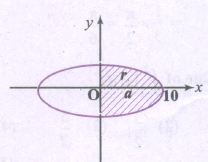
\(\therefore\) Required volume \(=2\pi \int _{ 0 }^{ 10 }{ { y }^{ 2 }dx } \)
\(=2\pi \int _{ 0 }^{ 10 }{ \frac { 25 }{ 100 } (100-{ x }^{ 2 })dx=\frac { 50\pi }{ 100 } \int _{ 0 }^{ 10 }{ (100-{ x }^{ 2 })dx } } \)
\(=\frac { \pi }{ 2 } { \left[ 100x-\frac { { x }^{ 3 } }{ 3 } \right] }_{ 0 }^{ 10 }=\frac { \pi }{ 2 } \left[ 100-\frac { 1000 }{ 3 } \right] \)
\(V=\frac { \pi }{ 2 } \left( \frac { 3000-1000 }{ 3 } \right) =\frac { \pi }{ 2 } \left( \frac { 2000 }{ 3 } \right) \)
\(=\frac { 1000\pi }{ 3 } \)
10.
Let X denote the winning amount. The possible events of selection are
(i) both balls are black, or
(ii) one white and one black or
(iii) both are white
Therefore X is a random variable that can be defined as
X (both are black balls) = Rs. 2(20) = Rs. 40
X (one black and one white ball) = Rs. 20 − Rs. 10 = Rs. 10
X (both are white balls) = (Rs. 20) = - Rs. 20
Therefore X takes on the values 40,10 and −20
Total number of balls n = 12
Total number of ways of selecting 2 balls = \(\left( \begin{matrix} 12 \\ 2 \end{matrix} \right) =\frac { 12\times 11 }{ 1\times 2 } =66\)
Number of ways of selecting 2 black balls = \(\left( \begin{matrix} 4 \\ 2 \end{matrix} \right) =6\)
Number of ways of selecting one black ball and one white ball = \(\left( \begin{matrix} 8 \\ 1 \end{matrix} \right) \left( \begin{matrix} 4 \\ 1 \end{matrix} \right) =32\)
Number of ways of selecting 2 white balls = \(\left( \begin{matrix} 8 \\ 2 \end{matrix} \right) =28\)
| Values of Random Variable X | 40 | 10 | -20 | Total |
| Number of elements in inverse images | 6 | 32 | 28 | 66 |
Probability mass function is
| X | 40 | 10 | -20 | Total |
| f (x) | \(\cfrac { 6 }{ 66 } \) | \(\cfrac { 32 }{ 66 } \) | \(\cfrac { 28 }{ 66 } \) | 1 |
Mean :
\(E(X)\Sigma xf(x)=40.\left( \frac { 6 }{ 66 } \right) +10.\left( \frac { 32 }{ 66 } \right) +\left( -20 \right) .\left( \frac { 28 }{ 66 } \right) =\frac { 4000 }{ 11 } \)
That is expected winning amount is 0
Variance :
\(\Sigma x^{ 2 }=\Sigma { x }^{ 2 }f(x)=40^{ 2 }.\left( \frac { 6 }{ 66 } \right) +10^{ 2 }.\left( \frac { 32 }{ 66 } \right) +\left( -20 \right) ^{ 2 }.\left( \frac { 28 }{ 66 } \right) =\frac { 4000 }{ 11 } \)
(E(X )2 = 02 = 0
This gives \(V(X)=E({ X }^{ 2 })-\left( E(X))^{ 2 } \right) =\frac { 4000 }{ 11 } -0=\frac { 4000 }{ 11 } \)
Therefore E(X ) = 0 and \(V(x)=\frac { 4000 }{ 11 } \)
11.
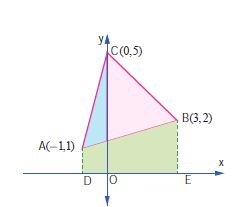
Equation of AB is \(\frac { y-1 }{ 2-1 } =\frac { x+1 }{ 3+1 } or\quad y=\frac { 1 }{ 4 } (x+5)\)
Equation of BC is \(\frac { y-5 }{ 2-5 } =\frac { x-0 }{ 3-0 } or\quad y=-x+5\)
Equation of AC is \(\frac { y-1 }{ 5-1 } =\frac { x+1 }{ 0+1 } or\quad y=4x+5\)
\(\therefore\) Area of \(\Delta\)ABC = Area DACO+ Area of OCBE − Area of DABE
\(=\int _{ -1 }^{ 0 }{ (4x+5)dx+\int _{ 0 }^{ 3 }{ (-x+5)dx-\frac { 1 }{ 4 } \int _{ -1 }^{ 3 }{ (x+5)dx } } } \)
\(\\ \\ \\ ={ \left[ \frac { { 4x }^{ 2 } }{ 2 } +5x \right] }_{ -1 }^{ 0 }+{ \left[ -\frac { { x }^{ 2 } }{ 2 } +5x \right] }_{ 0 }^{ 3 }-\frac { 1 }{ 4 } { \left[ \frac { { x }^{ 2 } }{ 2 } +5x \right] }_{ -1 }^{ 3 }\)
\(=0-(+2-5)+\left( -\frac { 9 }{ 2 } +15 \right) -0-\frac { 1 }{ 4 } \left[ \frac { 9 }{ 2 } +15 \right] +\frac { 1 }{ 4 } \left[ \frac { 1 }{ 2 } -5 \right] =\frac { 15 }{ 2 } \)
12.
Since the given function is a probability density function

\(\int _{ -\infty }^{ \infty }{ f(x) } dx=1\)
That is \(\int _{ -\infty }^{ 1 }{ f(x) } dx+\int _{ 1 }^{ 4 }{ f(x) } dx+\int _{ 4 }^{ \infty }{ f(x) } dx=1\)
From the given information
\(\int _{ -\infty }^{ 1 }{ 0dx } +\int _{ 1 }^{ 4 }{ { Cx }^{ 2 }dx } +\int _{ 4 }^{ \infty }{ 0dx } =1\)
\(0+C\left[ \cfrac { { x }^{ 3 } }{ 3 } \right] _{ 1 }^{ 4 }+0=1\Rightarrow C\left[ \cfrac { 64-1 }{ 3 } \right] =1\Rightarrow 21C\Rightarrow C=\cfrac { 1 }{ 21 }\)
Therefore the probability density function is
\(\)\(f(x)=\left\{C x^2, \quad x>1\right.\)
Since f (x) is continuous, the probability that X is equal to any particular value is zero. Therefore when the random variable is continuous, either or both of the signs < by ≤ and > by ≥ can be interchanged. Thus
(i) P(1.5 < X < 3.5) = P(1.5 ≤ X< 3.5)= P(1.5 < X ≤3.5) = P(1.5 ≤X ≤ 3.5)
Therefore
\(P(1.5<X<3.5)=\int_{1.5}^{3.5} f(x) d x\)

\(\begin{aligned} & =\frac{1}{21}\left(\frac{x^3}{3}\right)=\frac{1}{21}\left(\frac{(3.5)^3-(1.5)^3}{3}\right) \\ & =\frac{79}{126} \end{aligned}\)
(ii) \(P(X \leq 2)=\int_{-\infty}^2 f(x) d x=\int_{-\infty}^1 f(x) d x+\int_1^2 f(x) d x\)
Therefore
\(\begin{aligned} & P(X \leq 2)=0+\frac{1}{21} \int_1^2 x^2 d x=\frac{1}{21}\left(\frac{x^3}{3}\right)_1^2 \\ & =\frac{1}{21}\left(\frac{2^3-1^3}{3}\right)=\frac{7}{63} \end{aligned}\)
(iii) P(3 < X )

\(\begin{aligned} & =\frac{1}{21} \int_3^4 x^2 d x+0=\frac{1}{21}\left(\frac{x^3}{3}\right)_3^4 \\ & =\frac{1}{21}\left(\frac{4^3-3^3}{3}\right)=\frac{37}{63} \end{aligned}\)
13.
X~ B(n, p)
Given mean np = 6
\(S.D=\sqrt { npq } =2\)
\(\Rightarrow npq=4\)
\( \rightarrow \frac { npq }{ np } =\frac { 4 }{ 6 } =\frac { 2 }{ 3 } \)
\(\Rightarrow q=\frac { 2 }{ 3 } \)
\(\Rightarrow 1-P=\frac { 2 }{ 3 } \)
\(\Rightarrow 1-\frac { 2 }{ 3 } =P\)
\(\therefore P=\frac { 1 }{ 3 } \)
\(n\times \frac { 1 }{ 3 } =6\Rightarrow n=18\)
(i) The probability mass function
P(X = x) nCx px (1 - p )n-x,
X = 0,1,2, ... , n
\(\therefore P(X=x)=\ ^{18}{ C }_{ x }\left( \frac { 1 }{ 3 } \right) ^{ x }\left( \frac { 2 }{ 3 } \right) ^{ 18-x }\)
x=0,1,2...,8
(ii) \(P(X=3)=\ ^{ 18}{C }_{ 3 }\left( \frac { 1 }{ 3 } \right) ^{ 3 }\left( \frac { 2 }{ 3 } \right) ^{ 18-3 }\)
= \(^{ 18}{C }_{ 3 }\left( \frac { 1 }{ 3 } \right) ^{ 3 }\left( \frac { 2 }{ 3 } \right) ^{ 15 }\)
(iii) P(X ≥ 2)
P(X ≥ 2) 1 -P(X < 2)
= 1 - [P(X = 0) + P(X = 1)]
= \(1-\left[ ^{18}{ C }_{ 0 }\left( \frac { 1 }{ 3 } \right) ^{ 0 }\left( \frac { 2 }{ 3 } \right) ^{ 18 }+^{ 18}{C }_{ 1 }\left( \frac { 1 }{ 3 } \right) ^{ 1 }\left( \frac { 2 }{ 3 } \right) ^{ 17 } \right] \)
= \(1-\left[ \left( \frac { 2 }{ 3 } \right) ^{ 18 }+6\left( \frac { 2 }{ 3 } \right) ^{ 17 } \right] \)
= \(1-\left( \frac { 2 }{ 3 } \right) ^{ 17 }\left[ \frac { 2 }{ 3 } +6 \right] \)
= \(1-\left( \frac { 2 }{ 3 } \right) ^{ 17 }\left( \frac { 20 }{ 3 } \right) \)
= \(1-\frac { 20 }{ 3 } \left( \frac { 2 }{ 3 } \right) ^{ 17 }\)
14.
Given V(x, y) = ex(x cos y - y sin y)
\(\frac { \partial V }{ \partial x } \) = ex (cos y) +(x cos y - y sin y)ex
= ex (cos y + x cos y - y sin y)
\(\frac { { \partial }^{ 2 }V }{ \partial { x }^{ 2 } } \) = ex(0 + cos y - 0) + (cos y +x cos y.- y sin y)ex
= ex(2 cos y + x cos y - y sin y) ... (1)
\(\frac { \partial V }{ \partial y } \) = ex(-x sin y- y cos y- sin y)
\(\frac { { \partial }^{ 2 }V }{ \partial { y }^{ 2 } } \) = ex (-x cos y - (-y sin y + cos y) - cos y)
= ex(- x cos y + y sin y - cos y - cos y)
= ex (- x cos y + y sin y - 2 cos y) ... (2)
(1)+(2)➝
\(\frac { { \partial }^{ 2 }V }{ \partial { x }^{ 2 } } \) + \(\frac { { \partial }^{ 2 }V }{ \partial { y }^{ 2 } } \) = ex(2 cos y + x cos y - y sin y - x cos y + y sin y - 2 cos y]
= ex (0) = 0
Hence proved
15.
\(Let\ I=\int _{ 0 }^{ \pi }{ x\left[ { sin }^{ 2 }(sinx)+{ cos }^{ 2 }(cosx) \right] } dx\quad ...(1)\)
\(\left[ \because \int _{ 0 }^{ a }{ f(x)dx=\int _{ 0 }^{ a }{ f(a-x)dx } } \right] \)
\(I=\int _{ 0 }^{ \pi }{ (\pi -x) } [{ sin }^{ 2 }(sin(\pi -x))+{ cos }^{ 2 }(cos(\pi -x)]dx\)
\(=\int _{ 0 }^{ \pi }{ (\pi -x)[{ sin }^{ 2 }(sinx)+{ cos }^{ 2 }(-cosx)]dx } \)
\(=\int _{ 0 }^{ \pi }{ (\pi -x)[{ sin }^{ 2 }(sin\quad x)+{ cos }^{ 2 })(cosx)]dx } \)
\([\because cos(-x)=cos\quad x]\)
\(=\int _{ 0 }^{ \pi }{ \pi [{ sin }^{ 2 }(sinx)+{ cos }^{ 2 }(cosx)] } dx\)
\(-\int _{ 0 }^{ \pi }{ x[{ sin }^{ 2 }(sinx)+{ cos }^{ 2 }(cosx)] } dx\)
\(=\int _{ 0 }^{ \pi }{ \pi [{ sin }^{ 2 }(sinx)+{ cos }^{ 2 }(cosx)]dx-I } [from\quad (1)]\)
\(2I=\pi \int _{ 0 }^{ \pi }{ [{ sin }^{ 2 }(sinx)+{ cos }^{ 2 }(cosx)] } dx\)
\(I=\pi \int _{ 0 }^{ \pi /2 }{ \left[ { sin }^{ 2 }(sin\quad x)+{ cos }^{ 2 }(cos\quad x) \right] } dx\quad ...(2)\)
\(I=\pi \int _{ 0 }^{ \pi /2 }{ \left[ { sin }^{ 2 }(sin\frac { \pi }{ 2 } -x)+{ cos }^{ 2 }(cos\frac { \pi }{ 2 } -x) \right] dx } \)
\(I=\pi \int _{ 0 }^{ \pi /2 }{ [{ sin }^{ 2 }(cosx)+{ cos }^{ 2 }(sin\quad x)]dx] } ....(3)\)
Adding (2) and (3) we get,
\(2I=\pi \int _{ 0 }^{ \pi /2 }{ \left[ { sin }^{ 2 }(sinx)+{ cos }^{ 2 }(cosx) \right] dx } +{ sin }^{ 2 }(cosx)+{ cos }^{ 2 }(sin\quad x)]dx\)
\(I=\pi \int _{ 0 }^{ \pi /2 }{ (1+1)dx } \ [\because { sin }^{ 2 }\theta +{ cos }^{ 2 }\theta =1]\)
\(=\pi (2){ [x] }_{ 0 }^{ \frac { \pi }{ 2 } }=2\pi \left[ \frac { \pi }{ 2 } -0 \right] ={ \pi }^{ 2 }\ \)
\( \therefore I=\frac { { \pi }^{ 2 } }{ 2 } \)
16.
Let I = \(\int ^{\pi}_{-\pi} \frac{cos ^2 x}{1+ a^x} dx\)-- (1)
Using \(\int ^{b}_{a}\) f(x) dx =\(\int ^{b}_{a}\) f(a+b -x)dx we get,
I = \(\int ^{\pi}_{-\pi} \frac{cos ^2 (\pi -\pi - x)}{1+ a^{\pi -\pi - x}} dx\)
= \(\int ^{\pi}_{-\pi} \frac{cos ^2 (-x)}{1+ a^{-x}} dx\)
= \(\int ^{\pi}_{-\pi} a^x (\frac{cos ^2 x }{a^x+ 1} )dx\) --- (2)
Adding (1) and (2) we get
2I = \(\int ^{\pi}_{-\pi} \frac{cos ^2 x }{a^x+ 1}(a^x+ 1) dx\) = \(\int ^{\pi}_{-\pi} cos ^2 x dx\)
= 2 \(x =\int ^{\pi}_{-\pi} cos ^2 x dx\) (since cos2 x is an even function)
Hence, I = \(\int ^{\pi}_{0} (\frac{1 + cos2x }{2} )dx\)
= \(\frac {1}{2} [ x + \frac {sin 2x}{2}]^{x}_{0}\)
= \(\frac {1}{2} [\pi]\)
= \(\frac {\pi}{2}\)
17.
\(f(x)=\begin{cases} \begin{matrix} x+1 & -1\le x<0 \end{matrix} \\ \begin{matrix} -x+1 & 0\le x<1 \end{matrix} \\ \begin{matrix} 0 & otherwise \end{matrix} \end{cases}\)
(i) Distribution function
Case 1 : x < -1
F(x) = \(\int _{ -\infty }^{ x }{ f(u)du } \) = 0
Case 2 : -1 ≤ x < 0
\(\int _{ -\infty }^{ x }{ f(u)du } \)
= \(\int _{ -\infty }^{ x }{ f(x) } dx=\left[ \frac { { x }^{ 2 } }{ 2 } +x \right] _{ -1 }\)
= \(\left( \frac { {u }^{ 2 } }{ 2 } +u \right)=\frac{x^2}{2}+x -\left( \frac { 1 }{ 2 } +1 \right) \)
= \(\frac { { x }^{ 2 } }{ 2 } +x+\frac { 1 }{ 2 } \)
Case 3 : 0 ≤ x < 1,
\(F(X)=\int _{ 0 }^{ x }{ (-x+1)dx } =\left[ -\frac { { x }^{ 2 } }{ 2 } +x \right] _{ 0 }^{ x }\)
= \(\left( -\frac { { x }^{ 2 } }{ 2 } +x \right) -\left( 0 \right) =\frac { { x }^{ 2 } }{ 2 } +x\)
When 1 ≤ x,
\(F(x)=\int _{ 1 }^{ x }{ f(x)dx } =\int _{ 1 }^{ x }{ 0dx } \)
= \(\therefore F(X)=\begin{cases} \begin{matrix} \frac { { x }^{ 2 } }{ 2 } +x+\frac { 1 }{ 2 } & -1\le x<0 \end{matrix} \\ \begin{matrix} -\frac { { x }^{ 2 } }{ 2 } +x & 0\le x<1 \end{matrix} \\ \begin{matrix} 0 & otherwise \end{matrix} \end{cases}\)
(ii) p(0.5 ≤ X ≤ 0.5)
= \(\int _{ -0.5 }^{ 0.5 }{ f(x)dx } =\int _{ 0.5 }^{ 0 }{ f(x)dx+\int _{ 0 }^{ 0.5 }{ f(x)dx } } \)
= \(\int _{ -0.5 }^{ 0 }{ (x+1) } dx+\int _{ 0 }^{ 0.5 }{ \left( -x+1 \right) } dx\)
= \(\left[ \frac { { x }^{ 2 } }{ 2 } +x \right] _{ -0.5 }^{ 0 }+\left[ \frac { -{ x }^{ 2 } }{ 2 } +x \right] _{ 0 }^{ 0.5 }\)
= \(0-\left( \frac { { 0.5 }^{ 2 } }{ 2 } -0.5 \right) +\left( -\frac { \left( 0.5 \right) ^{ 2 } }{ 2 } +0.5 \right) -0\)
= \(-\left( \frac { .25 }{ 2 } -0.5 \right) +\left( \frac { -0.25 }{ 2 } +0.5 \right) \)
= \(\frac { .25 }{ 2 } +0.5-\frac { 0.25 }{ 2 } +0.5=0.25+1\)
= 0.75
18.
We use the formula
\(\int _{ a }^{ b }{ f(x)dx } =\underset { n\rightarrow \infty }{ lim } \frac { b-a }{ n } \sum _{ r=1 }^{ n }{ f } \left( a+(b-a)\frac { r }{ n } \right) \)
Here f(x) = 2x2+3, a = 1 and b = 4
So, we get
\(f\left( a+(b-a)\frac { r }{ n } \right) =f\left( 1+(4-1)\frac { r }{ n } \right) =f\left( 1+\frac { 3r }{ n } \right) =2{ \left( 1+\frac { 3r }{ n } \right) }^{ 2 }+3=5+\frac { { 18r }^{ 2 } }{ { n }^{ 2 } } +\frac { 12r }{ n } \)Hence, we get
\(\int _{ 1 }^{ 4 }{ ({ 2x }^{ 2 }+3) } dx=\underset { n\rightarrow \infty }{ lim } \frac { 3 }{ n } \sum _{ r=1 }^{ n }{ \left( 5+\frac { { 18r }^{ 2 } }{ { n }^{ 2 } } +\frac { 12r }{ n } \right) } =\underset { n\rightarrow \infty }{ lim } \left[ \frac { 15 }{ n } \sum _{ r=1 }^{ n }{ 1+\frac { 54 }{ { n }^{ 3 } } \sum _{ r=1 }^{ n }{ { r }^{ 2 } } +\frac { 36 }{ { n }^{ 2 } } \sum _{ r=1 }^{ n }{ r } } \right] \)
\(=\underset { n\rightarrow \infty }{ lim } \left[ \frac { 15 }{ n } n+\frac { 54 }{ { n }^{ 3 } } ({ 1 }^{ 2 }+{ 2 }^{ 2 }+...+{ n }^{ 2 })+\frac { 36 }{ { n }^{ 2 } } (1+2+..+n) \right] \)
\(=\underset { n\rightarrow \infty }{ lim } \left[ 15+\frac { 54 }{ { n }^{ 3 } } \frac { n(n+1)(2n+1) }{ 6 } +\frac { 36 }{ { n }^{ 2 } } \frac { n(n+1) }{ 2 } \right] \)
\(=\underset { n\rightarrow \infty }{ lim } \left[ 15+9\left( 1+\frac { 1 }{ n } \right) \left( 2+\frac { 1 }{ n } \right) +18\left( 1+\frac { 1 }{ n } \right) \right] \)
= 15+9(1+ 0)(2 + 0) +18(1+ 0) = 51.
19.
Let the price of low-grade steel be Rs. p per tonne. Then the price of high-grade steel is Rs. 2p per tonne.
The total receipt per day is given by \(R=px+py=px+2p\left( \frac { 40-5x }{ 10-x } \right) \). Hence the problem is to maximise R . Now, simplifying and differentiating R with respect to x , we get
\(R=p\left( \frac { 80-{ x }^{ 2 } }{ 10-x } \right) \)
\(\frac { dR }{ dx } =p\left( \frac { { x }^{ 2 }-20x+80 }{ (10-x)^{ 2 } } \right) \)
\(\frac { dR }{ dx } =-\frac { 40P }{ \left( 10-x \right) ^{ 3 } } \)
Now, \(\frac { dR }{ dx } =0\Rightarrow { x }^{ 2 }-20x+80=0\) and hence \(x=10\pm 2\sqrt { 5 } \)
At \(x=10-2\sqrt { 5 } ,\frac { { d }^{ 2 }R }{ { dx }^{ 2 } } <0\) and hence R will be maximum. If x \(x=10-2\sqrt { 5 } \) then \(y=5-\sqrt { 5 } \)
Therefore the steel plant must produce low-grade and high-grade steels respectively in tonnes per day are \(10-2\sqrt { 5 } \) and \(5-5\sqrt { 5 } \)
20.
Given f(x) = 4x3 + 3x2- 6x + 1
f'(x) = 12x2 + 6x - 6
f"(x) = 24x + 6
f'(x) = 0
⇒12x2 + 6x - 6 = 0
⇒ 2x2 + x - 1 = 0
⇒ (x + 1)(2x - 1) = 0
\(\Rightarrow x=-1,\frac { 1 }{ 2 } \)
The critical numbers are -1, \(\frac { 1 }{ 2 } \)
The possible intervals of monotonicity are
\(\left( -\infty ,-1 \right) \left( -1,\frac { 1 }{ 2 } \right) \left( \frac { 1 }{ 2 } ,\infty \right) \)
| Interval | (∞,-1) | \(\left( -1,\frac { 1 }{ 2 } \right) \) | \(\left( \frac { 1 }{ 2 } ,\infty \right) \) |
| Sign of f'(x) | Say x = -2 12(-2)2 + 6 (-2)-6 = +ve |
Say x = 0 = -6 -ve |
Say x = 1 I2(1)2 + 6(1) - 6 = +ve |
| Monoto nicity | strictly increasmg | Strictly decreasing | Strictly increasing |
∴ f(x) is strictly increasing in \(\left( -\infty ,-1 \right) \left( \frac { 1 }{ 2 } ,\infty \right) \) and strictly decreasing in \(\left( -1,\frac { 1 }{ 2 } \right) \)
f"(x) = 0
\(\Rightarrow 24x+6=0\Rightarrow 24x=-6\)
\(x=\frac { -6 }{ 24 } =\frac { -1 }{ 4 } \)
The possible intervals of concavity are \(\left( -\infty ,\frac { -1 }{ 4 } \right) \left( \frac { -1 }{ 4 } ,\infty \right) \)
| Interval | \(\left( -\infty ,\frac { -1 }{ 4 } \right) \) | \(\left( \frac { -1 }{ 4 } ,\infty \right) \) |
| Sign of f'(x) | Say x = -1 24(-1) + 6 = -ve |
Say x = 0 +ve |
| Concavity | Concave down | Concave up |
ஃf(x) concave down in \(\left( -\infty ,\frac { -1 }{ 4 } \right) \) and concave up in \(\left( \frac { -1 }{ 4 } ,\infty \right) \)
As f"(x) changes its sign when it passes through
\(x=\frac { -1 }{ 4 } \), the point of inflection is \(\left( -\frac { 1 }{ 4 } ,f\left( -\frac { 1 }{ 4 } \right) \right) \)
Now \(f\left( \frac { -1 }{ 4 } \right) =\left( -\frac { 1 }{ 4 } \right) ^{ 3 }+3\left( \frac { -1 }{ 4 } \right) ^{ 2 }-6\left( \frac { -1 }{ 4 } \right) +1\)
= \(4\left( \frac { -1 }{ 4 } \right) +\frac { 3 }{ 16 } +\frac { 6 }{ 4 } +1\)
= \(\frac { -1 }{ 16 } +\frac { 3 }{ 16 } +\frac { 3 }{ 22 } +1=\frac { 1 }{ 8 } +\frac { 3 }{ 2 } +1\)
= \(\frac { 1+12+8 }{ 8 } =\frac { 21 }{ 8 } \)
ஃ Point of inflection. \(\left( \frac { -1 }{ 4 } ,\frac { 21 }{ 8 } \right) \)
Since f'(x) changes its sign from positive to negative at x = -1, it has a local maximum at x = -1.
ஃf (-1) = 4 (-1)3 + 3 (-1)2 - 6(-1) + 1
Since f'(x) changes its sign from negative to positive at \(x=\frac { 1 }{ 2 } \) it has a local minimum at \(x=\frac { 1 }{ 2 } \)
\(\therefore f\left( \frac { 1 }{ 2 } \right) =4\left( \frac { 1 }{ 2 } \right) ^{ 3 }+3\left( \frac { 1 }{ 2 } \right) ^{ 2 }-6\left( \frac { 1 }{ 2 } \right) +1\)
= \(\frac { 4 }{ 8 } +\frac { 3 }{ 4 } -\frac { -3 }{ 2 } +1=\frac { 1 }{ 2 } +\frac { 3 }{ 4 } -\frac { 3 }{ 2 } +1\)
= \(\frac { 2+3-6+4 }{ 4 } =\frac { 3 }{ 4 } \)
21.
Let x(t) denote the amount of salt in the tank at time t.
Its rate of change is
\(\frac{dx}{dt}\) = inflow rate - outflow rate
Now, 2 gram time 3 litres per minutes is inflow rate = 6 grams of salt. (3 x 2 = 6)
The out flow of salt is \(\frac{3}{50}\) times x = \(\frac{3x}{50}\)
\(\therefore \frac { dx }{ dt } =6-\frac { 3x }{ 50 } =\frac { 300-3x }{ 50 } \)
\(=-\frac { 3(x-100) }{ 50 } \)
\(\Rightarrow \frac { dx }{ x-100 } =-\frac { 3 }{ 50 } dt\)
\(\Rightarrow \int { \frac { dx }{ x-100 } =-\frac { 3 }{ 50 } \int { dt } } \)
\(\Rightarrow log(x-100)=-\frac { 3 }{ 50 } t+logC\)
\(\\ \Rightarrow log(x-100)-logC=-\frac { 3 }{ 50 } t\)
\(\Rightarrow log\left( \frac { x-100 }{ C } \right) =-\frac { 3 }{ 50 } t\)
\(\Rightarrow \frac { x-100 }{ C } ={ e }^{ -\frac { 3t }{ 50 } }\)
\(\Rightarrow x-100={ C }_{ e }-\frac { 3t }{ 50 } \quad ...(1)\)
When t = 0, x = 0
[Since initial water was pure without any salt]
\(\Rightarrow\) 0-100 = Ce0
\(\Rightarrow\) C = -100
(1) becomes x-100 = -100\(\\ \\ \\ \\ \\ \\ \\ { e }^{ -\frac { 3t }{ 50 } }\)
\(\Rightarrow\) x = 100-100\(\\ \\ \\ \\ \\ \\ \\ { e }^{ -\frac { 3t }{ 50 } }\)
\(\Rightarrow\) x = 100(1-\(\\ \\ \\ \\ \\ \\ \\ { e }^{ -\frac { 3t }{ 50 } }\))
Hence the amount of salt in the tank at time t is x = 100(1-\(\\ \\ \\ \\ \\ \\ \\ { e }^{ -\frac { 3t }{ 50 } }\))
22.
\(\underset { x\rightarrow { 0 }^{ + } }{ lim } { x }^{ x }\)
This is an indeterminate of the form 00
Let g(x) xx
Taking logarithm, we get
\(log \ g(x)=log({ x }^{ 2 })=xlogx=\frac { log\quad x }{ \frac { 1 }{ x } } \)
\(\therefore \underset { x\rightarrow { 0 }^{ + } }{ lim } log \ g(x)={ \left[ \frac { logx }{ \frac { 1 }{ x } } \right] }=\frac { \infty }{ \infty } \)
\(=\underset { x\rightarrow { 0 }^{ + } }{ lim } \left( \frac { \frac { 1 }{ x } }{ -\frac { 1 }{ { x }^{ 2 } } } \right) \) [by L' Hopital rule]
= \(\underset { x\rightarrow { 0 }^{ + } }{ lim } \frac { 1 }{ x } \times \frac { { x }^{ 2 } }{ 1 } =\underset { x\rightarrow { 0 }^{ + } }{ lim } -x\)
= 0
But \(\underset { x\rightarrow { 0 }^{ + } }{ lim } (log(g(x))=log(\underset { x\rightarrow { 0 }^{ + } }{ lim } (g(x))\)
ஃ \(\underset { x\rightarrow { 0 }^{ + } }{ lim } (log(g(x))=0\)
\(\Rightarrow { e }^{ log }(\underset { x\rightarrow { 0 }^{ + } }{ lim } log(g(x))={ e }^{ 0 }\)
\(\Rightarrow \underset { x\rightarrow { 0 }^{ + } }{ lim } g(x)=1\)
\(\therefore \underset { x\rightarrow { 0 }^{ + } }{ lim } { x }^{ x }=1\)
23.
Given E = Ri + L \(\frac{di}{dt}\)
\(\frac { E }{ L } =\frac { Ri }{ L } +\frac { di }{ dt } \)
\(\Rightarrow \frac { Ri }{ L } +\frac { di }{ dt } =\frac { E }{ L } \)
This is a linear differential equation
\(Here\quad P=\frac { R }{ L } and\quad Q=\frac { E }{ L } \)
\(\therefore \int { pdt } =\int { \frac { R }{ L } dt } =\frac { R }{ L } t\)
\(\therefore I.F={ e }^{ \int { pdt } }={ e }^{ \frac { Rt }{ L } }\)
\(\therefore\) Solution is i\({ e }^{ \int { pdt } }=\int { Q{ e }^{ \int { pdt } }dt+C } \)
\(\Rightarrow i{ e }^{ \frac { Rt }{ L } }=\int { \frac { E }{ L } . } { e }^{ \frac { Rt }{ L } }dt+C\)
\(\therefore i{ e }^{ \frac { Rt }{ L } }=\frac { E }{ L } \frac { { e }^{ \frac { Rt }{ L } } }{ \frac { R }{ L } } dt+C\)
\(i=\frac { E }{ R } { e }^{ \frac { Rt }{ L } }+C\)
\(i=\frac { E }{ R } +c{ e }^{ -\frac { Rt }{ L } }\)
When E = 0,
\(i=0+c{ e }^{ -\frac { Rt }{ L } }\)
\(\Rightarrow i=c{ e }^{ -\frac { Rt }{ L } }\)
24.
The given differential cquation may be written as
\(\left(1+x+x y^2\right) \frac{d y}{d x}+\left(y+y^3\right)=0 \)
\(\left(1+x+x y^2\right) \frac{d y}{d x}=-\left(y+y^3\right) \)
\(\left(1+x+x y^2\right)=-1\left(y^2+1\right) \frac{d x}{d y} \)
\(y\left(y^2+1\right) \frac{d x}{d y}+1+x\left(y^2+1\right)=0\)
Divided by \( y\left(y^2+1\right) ,\)
\(\frac{d x}{d y}+\frac{1}{y\left(y^2+1\right)}+\frac{x\left(y^2+1\right)}{y\left(y^2+1\right)} =0 \)
\(\frac{d x}{d y}+\frac{x}{y} =-\frac{1}{y\left(y^2+1\right)}\)
This is the form of \( \frac{d x}{d y}+\mathrm{Px}=\mathrm{Q} \) where \( \mathrm{P}=\frac{1}{y} and \mathrm{Q}=\frac{-1}{y\left(1+y^2\right)}\)
\(\text { I.F }=e^{\int P d y}=e^{\int \frac{1}{y} d y}=e^{\log y}=y\)
So, the solution of the equation is given by
\(x \times \mathrm{I} . \mathrm{F} =\int(Q \times I . F) d y+c \)
\(x \times \mathrm{y} =\int \frac{-1}{y\left(1+y^2\right)} \times y \times d y+c \)
\(x \mathrm{y} =\int \frac{-1}{1+y^2} d y+c=-\int \frac{1}{1+y^2} d y+c\)
xy = -tan-1y + c
xy + tan-1y = c
Which is the required solution.
25.
Let x and y be the length and breadth of the rectangle.
ஃ Perimeter P = 2x + 2y
\(\Rightarrow 2y=P-2x\Rightarrow y=\frac { P-2x }{ 2 } \)
Let \(f(x)=Area=xy=x\left( \frac { P-2x }{ 2 } \right) \)
\(f(x)=\frac { Px-{ 2x }^{ 2 } }{ 2 } \)
\(f'(x)=\frac { 1 }{ 2 } \left[ P-4x \right] \)
f'(x) = 0
\(\Rightarrow \frac { 1 }{ 2 } \left[ P-4x \right] =0\)
\(\Rightarrow P=4x\)
\(\Rightarrow x=\frac { P }{ 4 } \)
∴The critical number is \(\frac { P }{ 4 } \)
Now,\(f''\left( \frac { P }{ 4 } \right) =-2<0\)
ஃf(x) is maximum when \(x=\frac { P }{ 4 } \)
When \(x=\frac { P }{ 4 } \)
\(\Rightarrow y=\frac { P-2\left( \frac { P }{ 4 } \right) }{ 2 } =\frac { P-\frac { P }{ 2 } }{ 2 } =\frac { P }{ 4 } \)
\(\therefore x=y=\frac { P }{ 4 } \)
ஃThe rectangle is a square when the area is maximum for a given perimeter.
26.
The given equation can be rewritten as \(\frac { dy }{ dx } +\frac { (x\quad tan\quad x-1) }{ x } y=xcosx\)
This is a linear differential equation. Here \(P=\frac { (x\quad tan\quad x-1) }{ x } ;Q=xcosx\)
\(\int { Pdx } =\int { \frac { (xtanx-1) }{ x } } dx=-log|cosx|-log|x|=-log|xcosx|=log\frac { 1 }{ |xcosx| } \)
Thus, \(I.F.={ e }^{ \int { pdx } }={ e }^{ log\frac { 1 }{ |xcosx| } }=\frac { 1 }{ xcosx } \)
Hence the solution is \({ ye }^{ \int { Pdf } }=\int { Q{ e }^{ \int { Pdx } }dx+C } \)
i.e., \(y\frac { 1 }{ xcosx } =\int { (xcosx)\frac { 1 }{ xcosx } dx+C } \)
or \(\\ \\ \\ \\ y\frac { 1 }{ xcosx } =x+C\)
or y = x2 cos x + Cx cos x is the required solution.
27.
Givenf(x) = sin x + cos x, 0
f"(x) = sin x - cos x
\(\therefore\) f"(x) = 0
\(\Rightarrow\) sin x - cos X = 0
\(\Rightarrow\) -sin x = cosx
\(\Rightarrow\) sin (-x) = cos x
\(\Rightarrow\) \(x=\frac { 3\pi }{ 4 } ,\frac { 7\pi }{ 4 } ,2\pi \)
ஃ The possible intervals are \(\left( 0,\frac { 3\pi }{ 4 } \right) \left( \frac { 3\pi }{ 4 } ,\frac { 7\pi }{ 4 } \right) \left( \frac { 7\pi }{ 4 } ,2\pi \right) \)
| Interval | \(\left( 0,\frac { 3\pi }{ 4 } \right) \) | \(\left( \frac { 3\pi }{ 4 } ,\frac { 7\pi }{ 4 } \right) \) | \(\left( \frac { 7\pi }{ 4 } ,2\pi \right) \) |
| Say x = -1 \(f''\left( x \right) =-\frac { 1 }{ \sqrt { 2 } } -\frac { 1 }{ \sqrt { 2 } } =-\frac { 2 }{ \sqrt { 2 } } \) |
Say x = π f''(x) = -sinπ-cosπ = 0-(1) = 1 +ve |
Say x = 320° f" (x) = - sin 320 - cos 320 = -sin (270 + 60) - cos (270 + 60) = cos 60 - sin 60 = \(\frac { 1 }{ 2 } -\frac { \sqrt { 3 } }{ 2 } \) -ve |
|
| Concavity | Concave down | Concave up | Concave down |
ஃf (x) is concave upward in \(\left( \frac { 3\pi }{ 4 } ,\frac { 7\pi }{ 4 } \right) \) and concave downward in \(\left( 0,\frac { 3\pi }{ 4 } \right) \left( \frac { 7\pi }{ 4 } ,2\pi \right) \)
Since f" (x) changes its sign from negative to positive at \(\frac { 3\pi }{ 4 } \) and positive at \(\frac { 7\pi }{ 4 } \) f(x) has point of inflection at \(\left( \frac { 3\pi }{ 4 } ,f\left( \frac { 3\pi }{ 4 } \right) \right) \) and
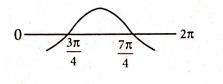
\(\left( \frac { 7\pi }{ 4 } ,f\left( \frac { 7\pi }{ 4 } \right) \right) \)
\(\therefore f\left( \frac { 3\pi }{ 4 } \right) =sin\frac { 3\pi }{ 4 } -cos\frac { \pi }{ 4 } \)
= \(sin\left( \pi -\frac { \pi }{ 4 } \right) +cos\left( \frac { \pi }{ 4 } \right) \)
= \(\frac { 1 }{ \sqrt { 2 } } -\frac { 1 }{ \sqrt { 2 } } =0\)
ஃ The points of inflection are \(\left( \frac { 3\pi }{ 4 } ,0 \right) \) and \(\left( \frac { 7\pi }{ 4 } ,0 \right) \)
28.
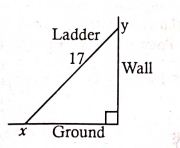
Let AB be the position of the ladder at any time t such that OA = x and OB = y
Then OA2 + OB2 = AB2
⇒ x2 + y2 = 172
Given \(\frac { dx }{ dt } \) = 5 and x = 8
When x = 8, 82 + y2 = 172
⇒ y2 = 289 - 64 = 225
⇒ y = 15
Differentiating (1) with respect to 't' we get,
\(2x\frac { dx }{ dt } +2y\frac { dy }{ dt } =0\)
⇒ 8(5) + 15 \(\frac { dy }{ dt } \) = 0 [∵ x = 8, \(\frac { dx }{ dt } \) = 15, y = 15]
⇒ 40 + 15\(\frac { dy }{ dt } \) = 0
⇒ \(\frac { dy }{ dt } =\frac { -40 }{ 15 } =\frac { -8 }{ 3 } \) m/sec
∴ The rate of top of the ladder moving down the wall is \(\frac{-8}{3}\) m/sec
(ii) The ladder, the wall and the floor forms a right angled triangle.
Area = \(\frac12\)xy
Differentiating with respect to 't' we get,
\(\frac { dA }{ dt } =\frac { 1 }{ 2 } \left[ x\frac { dy }{ dx } +y\frac { dx }{ dt } \right] \)
\(=\frac { 1 }{ 2 } \left[ 8\left( -\frac { 8 }{ 3 } \right) +15(5) \right] \)
= \(\frac { 1 }{ 2 } \left[ \frac { -64 }{ 3 } +75 \right] =\frac { 1 }{ 2 } \)
= \(\frac { 1 }{ 2 } \left[ \frac { -64+225 }{ 3 } \right] =\frac { 1 }{ 2 } \left( \frac { 161 }{ 3 } \right) \)
= \(\frac { dA }{ dt } \) = 26.83 sq.m/sec
29.
Given s (t) = 16t2, height = 400 ft.
⇒ t2 = \(\frac { 400 }{ 16 } =\frac { 100 }{ 4 } \)
t2 = 25
t = 5 sec
(ii) Average velocity = \(\frac { ds }{ dt } \) = 32 t
When t = 2 sec
Average in the last
2 sec = \(\frac { V \ at \ t=3+V \ at \ t=5 }{ 2 } \)
= \(\frac { 32(3)+32(5) }{ 2 } \)
= \(\frac { 96+160 }{ 2 } =\frac { 256 }{ 2 } \)
= 128 f/sec
(iii) Instantaneous Velocity
=\(\frac { ds }{ dt } \) = 32t
When t = 5 sec
Velocity = \(\frac { ds }{ dt } \) = 32(5)
= 160 ft/sec
30.
y2 - 4y - 8x + 12 = 0
y2-4y = 8x-12
Adding 4 both sides, we get,
y - 4y + 4 = 8x - 12 + 4 = 8x - 8
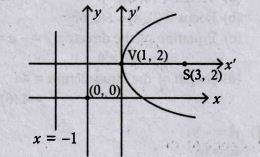
⇒ (y - 2)2 = 8(x - 1)
This is a right open parabola and latus
rectum is 4a = 8 ⇒ a = 2.
(a) Vertex is (1, 2) ⇒ h = 1, k = 2
(b) focus is (h + a, 0 + k)
⇒ (1 + 2, 0 + 2)
⇒ (3, 2)
(c) Equation of directrix is x = h - a
⇒ x = 1-2
⇒ x = -1
(d) Length of latus rectum is 4a = 8 units.
31.
3x + 3y − z = 11, 2x − y + 2z = 9, 4x + 3y + 2z = 25.
Δ = \(\left| \begin{matrix} 3 & 3 & -1 \\ 2 & -1 & 2 \\ 4 & 3 & 2 \end{matrix} \right| \)
= \(3\left| \begin{matrix} -1 & 2 \\ 3 & 2 \end{matrix} \right| -3\left| \begin{matrix} 2 & 2 \\ 4 & 2 \end{matrix} \right| -1\left| \begin{matrix} 2 & -1 \\ 4 & 3 \end{matrix} \right| \)
= 3(-2-6)-3(4-8)-1(6+4)·
= 3(- 8) - 3(- 4) - 1(10)
= - 24 + 12 - 10 = - 22
Δ2 = \(\left| \begin{matrix} 11 & 3 & -1 \\ 9 & -1 & 2 \\ 25 & 3 & 2 \end{matrix} \right| \)
= \(11\left| \begin{matrix} -1 & 2 \\ 3 & 2 \end{matrix} \right| -3\left| \begin{matrix} 9 & 2 \\ 25 & 2 \end{matrix} \right| -1\left| \begin{matrix} 9 & -1 \\ 25 & 3 \end{matrix} \right| \)
= 11(-2-6)-3(18-50)-1(27+25)
= 11(-8)-3(-32)-1(52)
= -88+96-52 = -44
Δ2 = \(\left| \begin{matrix} 3 & 11 & -1 \\ 2 & 9 & 2 \\ 4 & 25 & 2 \end{matrix} \right| \)
= \(3\left| \begin{matrix} 9 & 2 \\ 25 & 2 \end{matrix} \right| -11\left| \begin{matrix} 2 & 2 \\ 4 & 2 \end{matrix} \right| -1\left| 2\begin{matrix} 2 & 9 \\ 4 & 25 \end{matrix} \right| \)
= 3(18 - 50) -11(4 - 8) - 1(50- 36)
= 3(- 32) - 11(- 4) - 1(14)
= -96+44-14 = - 66
Δ3 = \(\left| \begin{matrix} 3 & 3 & 11 \\ 2 & -1 & 9 \\ 4 & 3 & 25 \end{matrix} \right| \)
\(3\left| \begin{matrix} -1 & 9 \\ 3 & 25 \end{matrix} \right| -3\left| \begin{matrix} 2 & 9 \\ 4 & 25 \end{matrix} \right| -11\left| \begin{matrix} 2 & -1 \\ 4 & 3 \end{matrix} \right| \)
= 3(-25-27)-3(50-36)+ 11(6+4)
= 3(- 52) - 3(14) + 11(10)
= -156 - 42 + 110= - 88
∴ x = \(\frac { { \triangle }_{ 1 } }{ \triangle } =\frac { -44 }{ -22 } \) = 2
y = \(\frac { { \triangle }_{ 2 } }{ \triangle } =\frac { -66 }{ -22 } \) = 3
z = \(\frac { { \triangle }_{ 3 } }{ \triangle } =\frac { -88 }{ -22 } \) = 4
∴ Solution set is {2, 3, 4}
32.
Assume that the system px + by + cz = 0, ax + qy + cz = 0, ax + by + rz = 0 has a non-trivial solution.
So, we have \(\left| \begin{matrix} p & b & c \\ a & q & c \\ a & b & r \end{matrix} \right| \) = 0, Applying R2 ➝ R2 - R1 and R3 ➝ R3 - R1 in the above equation,
we get \(\left| \begin{matrix} p & b & c \\ a-p & q-b & c \\ a-p & b & r-c \end{matrix} \right| \) = 0. That is, \(\left| \begin{matrix} p & b & c \\ -\left( p-a \right) & q-b & c \\ -\left( p-a \right) & b & r-c \end{matrix} \right| \) = 0.
Since p ≠ a, q ≠ b, r ≠ c, we get (p - a)(q - b)(r - c) \(\left| \begin{matrix} \frac { p }{ p-a } & \frac { b }{ q-b } & \frac { c }{ r-c } \\ -1 & 1 & 0 \\ -1 & 0 & 1 \end{matrix} \right| \) = 0.
So, we have \(\left| \begin{matrix} \frac { p }{ p-a } & \frac { b }{ q-b } & \frac { c }{ r-c } \\ -1 & 1 & 0 \\ -1 & 0 & 1 \end{matrix} \right| \) = 0.
Expanding the determinant, we get \(\frac { p }{ p-a } +\frac { b }{ q-b } +\frac { c }{ r-c } \) = 0.
That is, \(\frac { p }{ p-a } +\frac { q-\left( q-b \right) }{ q-b } +\frac { r-\left( r-c \right) }{ r-c } \) = 0
⇒ \(\frac { p }{ p-a } +\frac { b }{ q-b } +\frac { c }{ r-c } \) = 2.
33.
Comparing the two given lines with
\(\vec { r } =\vec { a } +t\vec { b } ,\vec { r } =\vec { c } +s\vec { d } \)
we have, \(\vec { a } =-\hat { i } -3\hat { j } -5\hat { k } ,\vec { b } =3\hat { i } +5\hat { j } +7\hat { k } ,\vec { c } =2\hat { i } +4\hat { j } +6\hat { k } \) and \(\vec { d } =\hat { i } +4\hat { j } +7\hat { k } \)
We know that the two given lines are coplar, if \((\vec { c } -\vec { a } ).(\vec { b } \times \vec { d } )\) = 0
Here, \(\vec { b } \times \vec { d } \left| \begin{matrix} \hat { i } & \hat { j } & \hat { k } \\ 3 & 5 & 7 \\ 1 & 4 & 7 \end{matrix} \right| =7\hat { i } -14\hat { j } +7\hat { k } \) and \(\vec { c } -\vec { a } =3\hat { i } +7\hat { j } +11\hat { k } \)
Then, \((\vec { c } -\vec { a } ).(\vec { b } \times \vec { d } )=(3\hat { i } +7\hat { j } +11\hat { k } )(7\hat { i } -14\hat { j } +7\hat { k } )=0\)
Therefore the two given lines are coplanar. Then we find the non parametric form of vector equation of the plane containing the two given coplanar lines. We know that the plane containing the two given coplanar lines is
\((\vec { r } -\vec { a } ).(\vec { b } \times \vec { d } )\)= 0
which implies that \((\vec { r } -(-\hat { i } -3\hat { j } -5\hat { k } )).(7\hat { i } -14\hat { j } +7\hat { k } )\) = 0.
Thus, the required non-parametric vector equation of the plane containing the two given coplanar lines is
\(\vec { r } .(\hat { i } -2\hat { j } +\hat { k } )\) = 0.
34.
Let \({ z }^{ 3 }+8i=0\)
\(\Rightarrow\) z3 = -8i
= \(8(-i)=8\left( cos\left( -\frac { \pi }{ 2 } +2k\pi \right) isin\left( -\frac { \pi }{ 2 } +2k\pi \right) \right) \),k\(\in Z\)
\(z=\sqrt [ 3 ]{ 8 } \left( cos\left( \frac { -\pi +4k\pi }{ 6 } \right) +isin\left( \frac { -\pi +4k\pi }{ 6 } \right) \right) \)
Taking k = 0, 1, 2 we get,
k = 0, \(z=2\left( cos\left( -\frac { \pi }{ 6 } \right) +isin\left( -\frac { \pi }{ 6 } \right) \right) =2\left( -\frac { 1 }{ 2 } -i\frac { \sqrt { 3 } }{ 2 } \right) =2\left( \frac { \sqrt { 3 } }{ 2 } -i\frac { 1 }{ 2 } \right) \)
k = 1, \(z=2\left( cos\left( \frac { \pi }{ 2 } \right) +isin\left( \frac { \pi }{ 2 } \right) \right) =2=\left( 0+i \right) =0+2i=2i\)
k = 2,\(z=2\left( xcos\left( \frac { 7\pi }{ 6 } \right) +isim\left( \frac { 7\pi }{ 6 } \right) \right) =2\left( cos\left( \pi +\frac { \pi }{ 6 } \right) \right) +isin\left( \pi +\frac { \pi }{ 6 } \right) \)
= \(2\left( -cos\left( \frac { \pi }{ 6 } \right) -isin\left( \frac { \pi }{ 6 } \right) \right) =2\left( -\frac { \sqrt { 3 } }{ 2 } -i\frac { 1 }{ 2 } \right) =-\sqrt { 3 } -i\)
The values of z are \(\sqrt { 3 } -i,2i\) and \(-\sqrt { 3 } -i\)
35.
Let the cross section of the satellite dish be an right open parabola.
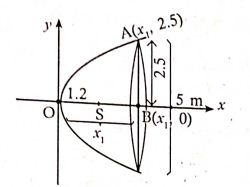
Its equation is y2 = 4ax
Since focus is placed 1.2 m from the vertex OA = 1.2 m and BC = 2.5 m since the width of the dish is 5 m.
From the diagram, a = 1.2 m
∴ y2 = 4(1.2)x
(a) ⇒ y2 = 4.8x ...(1)
(b) Since (x1, 2.5) lines on (1)(2.5)2 = 4.8(x1)
x1 = \(\frac { 2.5\times 2.5 }{ 4.8 } \)
x1 = 1.3 m
∴ Depth of the satellite dish at the vertex is 1.3 m.
36.
Here the number of unknowns is 3.
The matrix form of the system is AX = B, where A = \(\left[ \begin{matrix} 1 & 2 & 1 \\ 1 & 1 & \lambda \\ 1 & 3 & -5 \end{matrix} \right] \), X = \(\left[ \begin{matrix} x \\ y \\ z \end{matrix} \right] \), B = \(\left[ \begin{matrix} 7 \\ \mu \\ 5 \end{matrix} \right] \).
Applying elementary row operations on the augmented matrix [A | B], we get
[A | B] = \(\left[ \begin{matrix} 1 & 2 & 1 \\ 1 & 1 & \lambda \\ 1 & 3 & -5 \end{matrix}|\begin{matrix} 7 \\ \mu \\ 5 \end{matrix} \right] \overset { { R }_{ 2 }\leftrightarrow { R }_{ 3 } }{ \longrightarrow } \left[ \begin{matrix} 1 & 2 & 1 \\ 1 & 3 & -5 \\ 1 & 1 & \lambda \end{matrix}|\begin{matrix} 7 \\ 5 \\ \mu \end{matrix} \right] \overset { \begin{matrix} { R }_{ 2 }\longrightarrow { R }_{ 2 }-{ R }_{ 1 }, \\ { R }_{ 3 }\longrightarrow { R }_{ 3 }-{ R }_{ 1 } \end{matrix} }{ \longrightarrow } \left[ \begin{matrix} 1 & 2 & 1 \\ 0 & 1 & -6 \\ 0 & -1 & \lambda -1 \end{matrix}|\begin{matrix} 7 \\ -2 \\ \mu -7 \end{matrix} \right] \overset { { R }_{ 3 }\longrightarrow { R }_{ 3 }+{ R }_{ 2 } }{ \longrightarrow } \left[ \begin{matrix} 1 & 2 & 1 \\ 0 & 1 & -6 \\ 0 & 0 & \lambda -7 \end{matrix}|\begin{matrix} 7 \\ -2 \\ \mu -9 \end{matrix} \right] \).
(i) If λ =7 and μ \(\neq\) 9, then ρ(A) = 2 and ρ([A | B]) = 3. So ρ(A) ≠ ρ([A | B]) Hence the given system is inconsistent and has no solution.
(ii) If λ ≠ 7 and μ is any real number, then ρ(A) = 3 and ρ([A | B]) = 3.
So, ρ(A) = ρ([A | B]) = 3 = Number of unknown. Hence the given system is consistent and has a unique solution.
(iii) If λ = 7 and μ = 9, then ρ(A) = 2 and ρ([A | B]) = 2.
So, ρ(A) = ρ([A | B]) = 2 < Number of unknown. Hence the given system is consistent and has infinite number of solutions.
37.
Now, \(tan^{ -1 }\left( \frac { x-1 }{ x-2 } \right) +tan^{ -1 }\left( \frac { x+1 }{ x+2 } \right) =tan^{ -1 }\left[ \frac { \frac { x-1 }{ x-2 } +\frac { x+1 }{ x+2 } }{ 1-\frac { x-1 }{ x-2 } \left( \frac { x+1 }{ x+2 } \right) } \right] =\frac { \pi }{ 4 } \)
Thus, \(\frac { \frac { x-1 }{ x-2 } +\frac { x+1 }{ x+2 } }{ 1-\frac { x-1 }{ x-2 } \left( \frac { x+1 }{ x+2 } \right) } \) = 1, which on simplification gives 2x2−4 = −3
Thus, x2 = \(\frac{1}{2}\)gives x = \(\pm \frac { 1 }{ \sqrt { 2 } } \)
38.
Let P(x) = ax2+ bx + c
Given P(-3) = 21
[∵ P(x) ÷ x + 3, the remainder is 21]
⇒ a(-3)2 + b(-3) + c = 21
⇒ 9a - 3b + c = 21
Also, P(5) = 61
⇒ a(5)2 + b(5) + c = 61
[using remainder theorem]
⇒ 25a +5b + c = 61..........(2)
and P(1) = 9
⇒ a(1)2 + b(1) + c = 9
⇒ a + b + c = 9 ............(3)
Reducing the augment matrix to an equivalent row-echelon form using elementary row operations, we get
\(\left[ \begin{matrix} 9 & - & 1 \\ 25 & 5 & 1 \\ -1 & 1 & 1 \end{matrix}|\begin{matrix} 21 \\ 61 \\ 9 \end{matrix} \right] \overset { { R }_{ 1 }\leftrightarrow { R }_{ 3 } }{ \longrightarrow } \left[ \begin{matrix} 1 & 1 & 1 \\ 25 & 5 & 1 \\ 9 & -3 & 1 \end{matrix}|\begin{matrix} 9 \\ 61 \\ 21 \end{matrix} \right] \)
\(\overset { { R }_{ 3 }\rightarrow { R }_{ 3 }-9{ R }_{ 1 }\\ { R }_{ 2 }\rightarrow { R }_{ 2 }-25{ R }_{ 1 } }{ \longrightarrow } \left[ \begin{matrix} 1 & 1 & 1 \\ 0 & -20 & -24 \\ 0 & -12 & -8 \end{matrix}|\begin{matrix} 9 \\ -164 \\ -60 \end{matrix} \right] \)
\(\overset { { R }_{ 2 }\rightarrow { R }_{ 2 }\div \\ { R }_{ 3 }\rightarrow { R }_{ 3 }\div 4 }{ \longrightarrow } \left[ \begin{matrix} 1 & 1 & 1 \\ 0 & -5 & -6 \\ 0 & -3 & -2 \end{matrix}|\begin{matrix} 9 \\ -41 \\ -15 \end{matrix} \right] \)
\(\overset { { R }_{ 3 }\rightarrow { R }_{ 3 }-\frac { 3 }{ 5 } { R }_{ 2 } }{ \longrightarrow } \left[ \begin{matrix} 1 & 1 & 1 \\ 0 & -5 & -6 \\ 0 & 0 & \frac { 8 }{ 5 } \end{matrix}|\begin{matrix} 9 \\ -41 \\ \frac { 48 }{ 5 } \end{matrix} \right] \)
\(\overset { { R }_{ 3 }\rightarrow 5{ R }_{ 3 } }{ \longrightarrow } \left[ \begin{matrix} 1 & 1 & 1 \\ 0 & -5 & -6 \\ 0 & 0 & 8 \end{matrix}|\begin{matrix} 9 \\ -41 \\ 48 \end{matrix} \right] \)
Writing the equivalent equations from the row-echelon matrix we get,
a + b + c = 9 ............(1)
5b + 6c = 41 ................(2)
-8c = -48
⇒ c = 6
Substituting c = 6
⇒ 5b + 36 = 41
⇒ 5b = 5
b = 1
Substituting b = 1, c = 6
a + 1 + 6 = 9
⇒ a + 7 = 9
⇒ a = 9 - 7
⇒ a = 2
∴ a = 2, b = 1, and c = 6
39.
x = 1
y = x2 -5x + 6
y = 1 -5 + 6 = 2
x = 2
y = 4 -10 + 6 = 0
x = 0
y = 6
x = 3
y = 9 -15 + 6 = 12
x = -1
y = 1 + 5 + 6 = 12
x = 4
y = 16 - 20 + 6 = 2
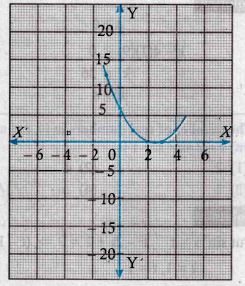
(1, 2), (0, 6), (-1, 12)
P(x) = (x2-5x + 6) (x2-5x+16)
= x4- 5x3+16x2-5x+25x2- 80x + 6x2- 30x + 96 = 0
x4-10x3+ 47x2 -110x + 96 = 0
It has two sign changes
\(\therefore\) it has two positive real roots
P(-x) = x4-10x3+ 47x2 -110x + 96
It has no sign changes, no negative real roots
y = x2- 5x + 16
| x | 0 | 1 | -1 | 2 | 4 |
| y | 16 | 12 | 23 | 10 | 12 |
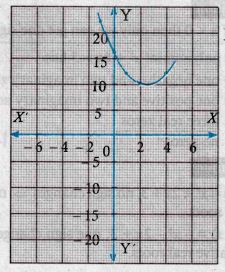
40.
Given z = x + iy and arg\(\left( \frac { z-i }{ z+2 } \right) =\frac { \pi }{ 4 } \)
⇒ arg(z-i) - arg(z+2) = \(\frac { \pi }{ 4 } \)
⇒ arg(x + iy-i) - arg(x+iy+2) = \(\frac { \pi }{ 4 } \)
⇒ arg(x+i(y-1)-arg((x+2)+iy) = \(\frac { \pi }{ 4 } \)
⇒ \(tan^{ -1 }\left( \frac { y-1 }{ x } \right) -tan^{ -1 }\left( \frac { y }{ x+2 } \right) \) = \(\frac { \pi }{ 4 } \)
⇒ \(tan^{ -1 }\left( \frac { \frac { y-1 }{ x } -\frac { y }{ x+2 } }{ 1+\frac { y-1 }{ x } .\frac { y }{ x+2 } } \right) \)
= \(\frac { \pi }{ 4 } \)\(\left[ \because tan^{ -1 }x-tan^{ -1 }y=tan^{ -1 }\left( \frac { x-y }{ 1+xy } \right) \right] \)
\(\Rightarrow \frac{\left(\frac{(x+2)(y-1)- x y}{\not {x (\not x+\not2)}}\right)}{\left(\frac{x(x+2)+y(y-1)}{\not x(\not x+\not 2)}\right)}=\tan \frac{\pi}{4}=1\)
⇒ \(\frac { (x+2)(y-1)-xy }{ x(x+2)+y(y-1) } \) = 1
⇒ -x + 2y-2 = x2+ 2x + y2-y
⇒ x2 + 2x + y2-y + x-2y + 2 = 0
⇒ x2 + y2+3x-3y + 2 = 0
Hence proved.
41.
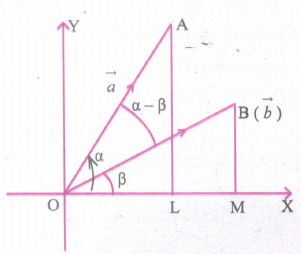
42.
Let the prices per unit for the commodities A, B and C be Rs. x, Rs. y and Rs. z.
By the given data,
2x - 4y + 5z = 15000
3x + y - 2z = 1000
-x + 3y + z = 4000
The matrix form of the system of equations is
\(\left[ \begin{matrix} 2 & -4 & 5 \\ 3 & 1 & -2 \\ -1 & 3 & 12 \end{matrix} \right] \left[ \begin{matrix} x \\ y \\ z \end{matrix} \right] =\left[ \begin{matrix} 15000 \\ 1000 \\ 4000 \end{matrix} \right] \)
AX = B where A =\(\left[ \begin{matrix} 2 & -4 & 5 \\ 3 & 1 & -2 \\ -1 & 3 & 1 \end{matrix} \right] ,X=\left[ \begin{matrix} x \\ y \\ z \end{matrix} \right] \)
and B =\(\left[ \begin{matrix} 15000 \\ 1000 \\ 4000 \end{matrix} \right] \)
⇒ X = A-1B
|A| = \(\left| \begin{matrix} 2 & -4 & 5 \\ 3 & 1 & -2 \\ -1 & 3 & 1 \end{matrix} \right| \)
= \(2\left| \begin{matrix} 1 & -2 \\ 3 & 1 \end{matrix} \right| +4\left| \begin{matrix} 3 & -2 \\ -1 & 1 \end{matrix} \right| +5\left| \begin{matrix} 3 & 1 \\ -1 & 3 \end{matrix} \right| \)
= 2 (1 + 6) + 4 (3 - 2) + 5 (9 + 1)
= 2 (7) + 4 (1) + 5(10) = 14 + 4 + 50 = 68.
adj A = \(\left[ \begin{matrix} +\left| \begin{matrix} 1 & -2 \\ 3 & 1 \end{matrix} \right| & -\left| \begin{matrix} 3 & -2 \\ -1 & 1 \end{matrix} \right| & +\left| \begin{matrix} 3 & 1 \\ -1 & 3 \end{matrix} \right| \\ -\left| \begin{matrix} -4 & 5 \\ 3 & 1 \end{matrix} \right| & +\left| \begin{matrix} 2 & 5 \\ -1 & 1 \end{matrix} \right| & -\left| \begin{matrix} 2 & -4 \\ -1 & 3 \end{matrix} \right| \\ +\left| \begin{matrix} -4 & 5 \\ 1 & -2 \end{matrix} \right| & -\left| \begin{matrix} 2 & 5 \\ 3 & -2 \end{matrix} \right| & +\left| \begin{matrix} 2 & -4 \\ 3 & 1 \end{matrix} \right| \end{matrix} \right] ^{ T }\)
= \(\left[ \begin{matrix} +(1+6) & -(3-2) & +(9+1) \\ -(-4-15) & +(2+5) & -(6-4) \\ +(8-5) & -(4-15) & +(2+12) \end{matrix} \right] \)
= \(\left[ \begin{matrix} 7 & -1 & 10 \\ 19 & 7 & -2 \\ 3 & 19 & 14 \end{matrix} \right] ^{ T }=\left[ \begin{matrix} 7 & 19 & 3 \\ -1 & 7 & 19 \\ 10 & -2 & 14 \end{matrix} \right] \)
∴ A-1 = \(\frac { 1 }{ |A| } adj=\frac { 1 }{ 68 } \left[ \begin{matrix} 7 & 19 & 3 \\ -1 & 7 & 19 \\ 10 & -2 & 14 \end{matrix} \right] \)
∴ X = A-1B = \(\frac { 1 }{ 68 } \left[ \begin{matrix} 7 & 19 & 3 \\ -1 & 7 & 19 \\ 10 & -2 & 14 \end{matrix} \right] \left[ \begin{matrix} 15000 \\ 1000 \\ 4000 \end{matrix} \right] \)
= \(\frac { 1 }{ 68 } \left[ \begin{matrix} 105000+19000+12000 \\ -15000+7000+76000 \\ 150000-2000+56000 \end{matrix} \right] \)
= \(\frac { 1 }{ 68 } \left[ \begin{matrix} 136000 \\ 68000 \\ 204000 \end{matrix} \right] =\left[ \begin{matrix} 2000 \\ 1000 \\ 3000 \end{matrix} \right] \)
∴ x = 2000, y = 1000, z = 3000
Hence the prices per unit of the commodities A, B and C are Rs. 2000, Rs. 1000 and Rs. 3000 respectively.
43.
By the definition of a conic \(\frac{SP}{PM}\)= e or SP2 = e2PM2
Then, (x−2)2 + (y−3)2 = \(\frac { 1 }{ 4 } \) (x-7)2
3x2+ 4y2−2x − 24y + 3 = 0
\({ 3\left( x-\frac { 1 }{ 3 } \right) }^{ 2 }+4(y-3)^{ 2 }=3\left( \frac { 1 }{ 9 } \right) +4\times 9-3=\frac { 100 }{ 3 } \)
\(\frac { { \left( x-\frac { 1 }{ 3 } \right) }^{ 2 } }{ \frac { 100 }{ 9 } } +\frac { (y-3{ ) }^{ 2 } }{ \frac { 100 }{ 12 } } \) = 1 which is in the standard form.
Therefore, the length of major axis = 2a = 2\(\sqrt { \frac { 100 }{ 9 } = } \frac { 20 }{ 3 } \) and
the length of minor axis = 2b = 2\(\sqrt { \frac { 100 }{ 12 } = } \frac { 10 }{ \sqrt { 3 } } \).
44.
Since the coefficients of the equation are all rational numbers, 2+i and 3-\(\sqrt{2}\) are roots, we get 2-i and 3+\(\sqrt{2}\) are also roots of the given equation. Thus (x-(2+i)), (x-(2-i)), (x-(3-\(\sqrt{2}\))) and (x-(3+\(\sqrt{2}\))) are factors. Thus their product.
((x-(2+i))(x-(2-i))(x-(3-\(\sqrt{2}\)))(x-(3+\(\sqrt{2}\))) is a factor of the given polynomial equation.
That is, (x2-4x+5)(x2-6x+7) is a factor. Dividing the given polynomial equation by this factor, we get the other factor as (x2-3x-4) which implies that 4 and −1 are the other two roots. Thus
2+i, 2-i, 3+\(\sqrt{2}\), 3-\(\sqrt{2}\), -1, and 4 are the roots of the given polynomial equation.
45.
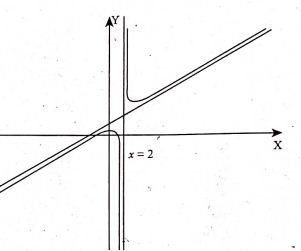
Given
\(f(x)=\frac { { x }^{ 2 }+6x-4 }{ 3x-6 } \)
\(\underset { x\rightarrow { 2 }^{ + } }{ lim } \frac { { x }^{ 2 }+6x-4 }{ 3x-6 } =\underset { h\rightarrow 0^{ + } }{ lim } \frac { (2+h)^{ 2 }+6(2+h)-4 }{ 3(2+h)-6 } \)
= \(\underset { h\rightarrow 0^{ + } }{ lim } \frac { (2+h)^{ 2 }+6(2+h)-4 }{ 6+3h-6 } \)
= -∞
ஃ x = 2 is the vertical asymptote,
Also
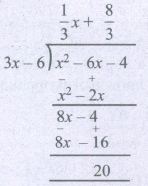
\(\therefore y=\frac { 1 }{ 3 } x+\frac { 8 }{ 3 } \) is the slanting asymptote.
46.
If \(\vec { r } =x\hat { i } +y\hat { j } +z\hat { k } \) is the position vector of an arbitrary point (x, y, z) on the plane, then the given equation can be written as \((x\hat { i } +y\hat { j } +z\hat { k } ).(3\hat { i } -4\hat { j } +3\hat { k } )=-8\) or \((x\hat { i } +y\hat { j } +z\hat { k } ).(-3\hat { i } +4\hat { j } -3\hat { k } )=8\).
That is, \(\hat { r } .(-3\hat { i } +4\hat { j } -3\hat { k } )=8\) which is the vector equation of the given plane in standard form.

12th Standard Syllabus & Materials
12th Standard
TN 12th Computer Applications வலையமைப்பு வடமிடல் Sample Question Papers Study Material - QB365 Set A
NEW12th Standard
TN 12th Computer Applications களப்பெயர் முறைமை (DNS) Sample Question Papers Study Material - QB365 Set A
NEW12th Standard
TN 12th Computer Applications வலையமைப்பு எடுத்துக்காட்டுகள் மற்றும் நெறிமுறைகள் Sample Question Papers Study Material - QB365 Set A
NEW12th Standard
TN 12th Computer Applications கணினி வலையமைப்பு ஓர் அறிமுகம் Sample Question Papers Study Material - QB365 Set A



Tamilnadu Stateboard 12th Standard Subjects
Maths

Chemistry

Physics

Biology

Computer Science

Business Maths and Statistics

Economics

Commerce

Accountancy

History

Computer Applications
Biology
Computer Technology
Computer Applications
Computer Science
Business Maths and Statistics
Commerce
Economics
Maths
Chemistry
Physics
Computer Technology
History
Accountancy

Tamil

English

French
Tamilnadu Stateboard Standards

