
 100% FREE ACCESS
12th Standard Syllabus & Materials
12th Standard
TN 12th Computer Applications மின்னணு தரவு பரிமாற்றம் Sample Question Papers Study Material - QB365 Set A
NEW12th Standard
TN 12th Computer Applications மின் - வணிக பாதுகாப்பு அமைப்புகள் Sample Question Papers Study Material - QB365 Set A
NEW12th Standard
TN 12th Computer Applications மின்னணு செலுத்தல் முறைகள் Sample Question Papers Study Material - QB365 Set A
NEW12th Standard
TN 12th Computer Applications மின் - வணிகம் Sample Question Papers Study Material - QB365 Set A
NEW12th Standard
TN 12th Computer Applications திறந்த மூல கருத்துருக்கள் Sample Question Papers Study Material - QB365 Set A
NEW12th Standard
TN 12th Computer Applications வலையமைப்பு வடமிடல் Sample Question Papers Study Material - QB365 Set A

Published on: 03/09/2020
12th Standard Maths English Medium Model 5 Mark Creative Questions (New Syllabus) 2020
Download Tamil Nadu 12th Standard Maths question papers, model tests, one-mark questions, important questions, and public exam papers in PDF format. Free study materials and answer keys for TN State Board students.
Questions + Answers key
Take MCQ Maths Test1.
Solve :(x2+xy)dy=(x2+y2)dx
2.
Find the area bounded by the curve y2(2a-x)=x2 and the line x=2a.
3.
Find the area of the region bounded by a2y2=a2(a2-x2)
4.
Find the area of the loop of the curve 3ay2=x(x-a)2
5.
Find \(\frac { \partial w }{ \partial u } ,\frac { \partial w }{ \partial v } \) if w=sin-1(x,y) where x=u+v,y=u-v
6.
Find the local maximum and local minimum values of f(x)=x4-3x+3x2-x.
7.
Find the intervals for which the function f(x)=2x2-9x2-12x+1 is increasing or decfreasing and find the local extermems.
8.
If the curves 4x=y2 and 4xy=k cut at right angles show that k2=512.
9.
Solve: \(\frac { dy }{ dx } \) = (3x+2y+1)2
10.
Verify (p ∧ ~p) ∧ (~q ∧ p) is a tautlogy, contradiction or contingency.
11.
Using integration, find the area of the triangle with sides y = 2x + 1, y = 3x + 1 and x = 4.
12.
Using differential find the approximate value of cos 61; if it is given that sin 60° = 0.86603 and 10 = 0.01745 radians.
13.
Show that the curves 4x = y2 and 4xy = k cut at right angles if k2 = 512.
14.
Verify that arg(1+i) + arg(1-i) = arg[(1+i) (1-i)]
15.
A kho-kho player In a practice session while running realises that the sum of tne distances from the two kho-kho poles from him is always 8m. Find the equation of the path traced by him of the distance between the poles is 6m.
16.
If \({ tan }^{ -1 }\left( \frac { \sqrt { 1+{ x }^{ 2 } } -\sqrt { 1-{ x }^{ 2 } } }{ \sqrt { 1+{ x }^{ 2 } } +\sqrt { 1-{ x }^{ 2 } } } \right) =a\) than prove that x2 = sin 2a
17.
ABCD is a quadrilateral with \(\overset { \rightarrow }{ AB } =\overset { \rightarrow }{ \alpha } \) and \(\overset { \rightarrow }{ AD } =\overset { \rightarrow }{ \beta } \) and \(\overset { \rightarrow }{ AC } =2\overset { \rightarrow }{ \alpha } +3\overset { \rightarrow }{ \beta } \). If the area of the quadrilateral is λ times the area of the parallelogram with \(\overset { \rightarrow }{ AB } \) and \(\overset { \rightarrow }{ AD } \) as adjacent sides, then prove that \(\lambda =\frac { 5 }{ 2 } \)
18.
Solve: \(\frac { 2 }{ x } +\frac { 3 }{ y } +\frac { 10 }{ z } =4,\frac { 4 }{ x } -\frac { 6 }{ y } +\frac { 5 }{ z } =1,\frac { 6 }{ x } +\frac { 9 }{ y } -\frac { 20 }{ z } \) = 2
19.
If a, b, c, d and p are distinct non-zero real numbers such that (a2+b2+c2) p2-2 (ab+bc+cd) p+(b2+c2+d2)≤ 0 then prove that a, b, c, d are in G.P and ad = bc
1.
c(x-y)2=|x|e-y/x,x≠0
2.
3πa2
3.
\(\frac { { 4a }^{ 2 } }{ 3 } sq.units\)
4.
\(\frac { 9\sqrt { 3 } { a }^{ 2 } }{ 45 } \)
5.
\( \frac { \partial w }{ \partial u } =\frac { 2u }{ \sqrt { 1-\left( { u }^{ 2 }-{ v }^{ 2 } \right) } } ;\frac { \partial w }{ \partial v } =\frac { -2v }{ \sqrt { 1-\left( { u }^{ 2 }-{ v }^{ 2 } \right) } } \)
6.
local min value = \(\frac { 27 }{ 256 } \)
No local maximum
7.
(−∞,−2)decreasing
(−2,−1)increasing
(−1,∞)decreasing
Local maximum value = 6
Local minimum value =5
8.
100 m / s, t = 4 sec, 200 m / s, −100 m / s
9.
Given \(\frac { dy }{ dx } \) =(3x+2y+1)2
Let z =3x+2y+1
\(\frac { dz }{ dx } =3+2\frac { dy }{ dx } \)
⇒ \(\frac { dz }{ dx } -3=2\frac { dy }{ dx } \)
⇒ \(\frac { dy }{ dx } =\frac { 1 }{ 2 } \left( \frac { dz }{ dx } -3 \right) \)
(1) becomes,
\(\frac { 1 }{ 2 } \left( \frac { dz }{ dx } -3 \right) \) =z2
⇒ \(\frac { dz }{ dx } \)-3 =2z2
⇒ \(\frac { dz }{ dx } \)=2x2+3
⇒ \(\frac { dz }{ 2{ z }^{ 2 }+3 } \) =dx
⇒ \(\frac { 1 }{ 2 } \int { \frac { dz }{ { z }^{ 2 }+\frac { 3 }{ 2 } } } =\int { dx } \)
⇒ \(\frac { 1 }{ 2 } \int { \frac { dz }{ { z }^{ 2 }+\left( \sqrt { \frac { 3 }{ 2 } } \right) ^{ 2 } } } \) =x+c
⇒ \(\frac { 1 }{ 2 } .\frac { 1 }{ \frac { \sqrt { 3 } }{ \sqrt { 2 } } } tan^{ -1 }\left( \frac { 1 }{ \frac { \sqrt { 3 } }{ \sqrt { 2 } } } \right) \) =x+c
⇒ \(\frac { 1 }{ \sqrt { 6 } } tan^{ -1 }\left( \frac { \sqrt { 2 } }{ \sqrt { 3 } } \right) \)= x+c
⇒ \(tan^{ -1 }\left( \frac { \sqrt { 2 } }{ \sqrt { 3 } } \right) =\sqrt { 6 } \) x+c
⇒ \(\frac { \sqrt { 2 } }{ \sqrt { 3 } } .z=tan(\sqrt { 6 } x+c)\)
⇒ \(\frac { \sqrt { 2 } }{ \sqrt { 3 } } (3x+2y+1)=tan(\sqrt { 6 } x+c)\).
10.
| p | q | ~p | p∧~p) | ~q | (~q)∧p | (p∧~p) ∧ (~q∧p) |
| T | T | F | F | F | F | F |
| T | F | F | F | T | T | F |
| F | T | T | F | F | F | F |
| F | F | T | F | T | F | F |
Since the entries in the last column are F, (p ∧ ~p) ∧ (~q ∧ P) is a contradiction
11.
Given sides are y = 2x + 1.....(1)
y = 3x + 1...(2)
x = 4...(3)
Solving (1) & (2), x = 0, y = 1
Solving (2) & (3), x = 4, y = 13
Solving (1) & (3), x = 4, y = 9
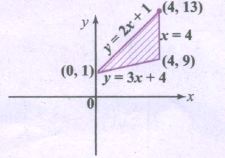
∴ Required area \(\int _{ 0 }^{ 4 }{ (3x+1) } dx-\int _{ 0 }^{ 4 }{ (2x+1) } dx\)
\({ =\left( \frac { { 3x }^{ 2 } }{ 2 } +x \right) }_{ 0 }^{ 4 }-{ \left( \frac { { 2x }^{ 2 } }{ 2 } +x \right) }_{ 0 }^{ 4 }\)
\(=\left( \frac { 48 }{ 2 } +4 \right) -(16+4)=28-20\)
Area = 8 sq. units
12.
Let f(x) = cos x, x = 60° dx = 1°
f(xo) = cos 60° = \(\frac12\) = 0.5
f'(x) = - sinx dx
f'(xo) = - sin xo dx
f'(60) = - sin 60° (1°)
= - (0.86603) (0.01745)
= - 0.0154
∴ f(x) = f(xo) +f(xo) dx
f(61) = 0.5 - 0.0154
∴ tan 46° = f(xo) +f(xo) dx
cos 61° = 0.4849
13.
Given curves are 4x = y2 ....(1)
⇒ 4xy = k....(2)
Substituting (1) in (2) we get
y3 = k ⇒ y = \(k^{ \frac { 1 }{ 3 } }\)
∴ (1) becomes, 4x = \(\left( { k }^{ \frac { 1 }{ 3 } } \right) ^{ 2 }=k^{ \frac { 2 }{ 3 } }\)
⇒ x = \(\frac { { k }^{ \frac { 2 }{ 3 } } }{ 4 } \)
∴ The point of intersection of the given curves is \(\left( \frac { k^{ \frac { 2 }{ 3 } } }{ 4 } ,{ k }^{ \frac { 1 }{ 3 } } \right) \)
Differentiating 4x = y2
4 = 2y\(\frac { dy }{ dx } \)
⇒ \(\frac { dy }{ dx } =\frac { 2 }{ y } \)
m1 = \(\frac { 2 }{ { k }^{ \frac { 1 }{ 3 } } } \)
Differentiating 4xy = k,
4x\(\frac { dy }{ dx } \)+4y = 0
⇒ \(\frac { dy }{ dx } =\frac { -y }{ x } \)
∴ m2 = \(\frac { { -k }^{ \frac { 1 }{ 3 } } }{ { k }^{ \frac { 2 }{ 3 } } } \)(4)
Since the given curves cut at right angles, m1m2 = -1.
∴ \(\left( \frac { 2 }{ { k }^{ \frac { 1 }{ 3 } } } \right) \left( \frac { -4.k^{ \frac { 1 }{ 3 } } }{ k^{ \frac { 2 }{ 3 } } } \right) \) = 1
⇒ \(\frac { 8 }{ { k }^{ \frac { 2 }{ 3 } } } \) = 1 ⇒ \({ k }^{ \frac { 2 }{ 3 } }\) = 8
⇒ \(\left( { k }^{ \frac { 2 }{ 3 } } \right) ^{ 3 }\) = 83
⇒ k2 = 512.
14.
arg(1+i) + arg(1-i) = arg[(1+i) (1-i)]
LHS = arg (1+i) + arg(1-i)
1+i = \(\sqrt { 2 } \left( \frac { 1 }{ \sqrt { 2 } } +\frac { i }{ \sqrt { 2 } } \right) \)
= \(\sqrt { 2 } \left( cos\frac { \pi }{ 4 } +isin\frac { \pi }{ 4 } \right) \)
∴ arg (1+i) = π/4
-1+i =\(\sqrt { 2 } \left( \frac { -1 }{ \sqrt { 2 } } +\frac { i }{ \sqrt { 2 } } \right) \)
= \(\sqrt { 2 } \left( cos3\frac { \pi }{ 4 } +isin3\frac { \pi }{ 4 } \right) \)
∴ (-1+i) = 3\(\frac { \pi }{ 4 } \)
∴ LHS = \(\frac { \pi }{ 4 } +\frac { 3\pi }{ 4 } =\frac { 4\pi }{ 4 } =\pi \)
RHS = arg[(1+i) (-1+i)]
= arg[-1-i + i + i2]
= (-1-i + i-1) = arg(-2)
= arg(2) - (1) = 2 arg(-1)
= 2 (cos π + isin π) = π
∴ LHS = RHS
15.
Given F1P + F2P = 8
By the focal property of ellipse
F1P + F2P = 2a
∴ 2a = 8 ⇒ a = 4
and distance between the foci = F1F2 = 6
2ae = 6 ⇒ ae = 3
∴ 4(e) = 3 ⇒ e \(\frac34\)
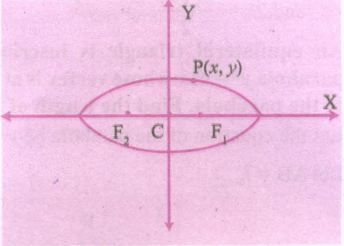
∴ b2 = a2(1- e2)
= \(16\left( { 1-\left( \frac { 3 }{ 4 } \right) }^{ 2 } \right) =16\left( 1-\frac { 9 }{ 10 } \right) =16\left( \frac { 7 }{ 16 } \right) =7\)
∴ The path traced by him is an ellipse and its equation is \(\frac { { x }^{ 2 } }{ { a }^{ 2 } } +\frac { { y }^{ 2 } }{ { b }^{ 2 } } =1\)
⇒ \(\frac { { x }^{ 2 } }{ 16 } -\frac { { y }^{ 2 } }{ 7 } \) = 1
16.
Given \({ tan }^{ -1 }\left( \frac { \sqrt { 1+{ x }^{ 2 } } -\sqrt { 1-{ x }^{ 2 } } }{ \sqrt { 1+{ x }^{ 2 } } +\sqrt { 1-{ x }^{ 2 } } } \right) =a\)
\(\Rightarrow \frac { \left( \sqrt { 1+{ x }^{ 2 } } -\sqrt { 1-{ x }^{ 2 } } \right) \left( \sqrt { 1+{ x }^{ 2 } } +\sqrt { 1-{ x }^{ 2 } } \right) }{ \left( \sqrt { 1+{ x }^{ 3 } } -\sqrt { 1-{ x }^{ 2 } } \right) \left( \sqrt { 1+{ x }^{ 2 } } +\sqrt { 1-{ x }^{ 2 } } \right) } \)
= \(\frac { tan\alpha +1 }{ tan\alpha -1 } \)
\(\Rightarrow \frac { 2\sqrt { 1+{ x }^{ 2 } } }{ -2\sqrt { 1-{ x }^{ 2 } } } =\frac { tan\alpha +1 }{ tan\alpha -1 } \)
\(\Rightarrow \sqrt { \frac { 1-{ x }^{ 2 } }{ 1+{ x }^{ 2 } } } =\frac { 1-tan\alpha }{ 1+tan\alpha } \)
\(\Rightarrow \sqrt { \frac { 1-{ x }^{ 2 } }{ 1+{ x }^{ 2 } } } =\frac { cos\alpha -sin\alpha }{ cos\alpha +sin\alpha } \)
\(\Rightarrow \frac { 1-{ x }^{ 2 } }{ 1+{ x }^{ 2 } } \left( \frac { cos\alpha -sin\alpha }{ cos\alpha +sin\alpha } \right) ^{ 2 }\)
\(\Rightarrow \frac { 1-{ x }^{ 2 } }{ 1+{ x }^{ 2 } } =\frac { 1-sin2\alpha }{ 1+sin2\alpha } \Rightarrow { x }^{ 2 }=sin2\alpha \)
17.
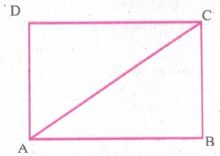
Given \(\overset { \rightarrow }{ AB } =\overset { \rightarrow }{ \alpha } \), \(\overset { \rightarrow }{ AD } =\overset { \rightarrow }{ \beta } \) and \(\overset { \rightarrow }{ AC } =2\overset { \rightarrow }{ \alpha } +3\overset { \rightarrow }{ \beta } \)
Area of the quadrilateral ABCD
∴ = are of ∆ ABC + area of ∆ ACD
\(=\frac { 1 }{ 2 } \left| \overset { \rightarrow }{ AB } \times \overset { \rightarrow }{ AC } \right| +\frac { 1 }{ 2 } \left| \overset { \rightarrow }{ AC } \times \overset { \rightarrow }{ AD } \right| \)
\(=\frac { 1 }{ 2 } \left| \overset { \rightarrow }{ \alpha } \times \left( 2\overset { \rightarrow }{ \alpha } +3\overset { \rightarrow }{ \beta } \right) \right| +\frac { 1 }{ 2 } \left| \left( 2\overset { \rightarrow }{ \alpha } +3\overset { \rightarrow }{ \beta } \right) \times \overset { \rightarrow }{ \beta } \right| \)
\(=\frac { 1 }{ 2 } \left| 2\left( \overset { \rightarrow }{ \alpha } \times \overset { \rightarrow }{ \alpha } \right) +3\left( \overset { \rightarrow }{ \alpha } \times \overset { \rightarrow }{ \beta } \right) \right| +\frac { 1 }{ 2 } \left| 2\left( \overset { \rightarrow }{ \alpha } \times \overset { \rightarrow }{ \beta } \right) +3\left( \overset { \rightarrow }{ \beta } \times \overset { \rightarrow }{ \beta } \right) \right| \)
\(=\frac { 1 }{ 2 } \left| 3\left( \overset { \rightarrow }{ \alpha } \times \overset { \rightarrow }{ \beta } \right) \right| +\frac { 1 }{ 2 } \left| 2\left( \overset { \rightarrow }{ \alpha } \times \overset { \rightarrow }{ \beta } \right) \right| \quad \quad \quad \left[ \because \overset { \rightarrow }{ \alpha } \times \overset { \rightarrow }{ \alpha } =\overset { \rightarrow }{ \beta } \times \overset { \rightarrow }{ \beta } =0 \right] \)
\(=\left( \frac { 3 }{ 2 } +\frac { 2 }{ 2 } \right) \left( \overset { \rightarrow }{ \alpha } \times \overset { \rightarrow }{ \beta } \right) =\left( \frac { 5 }{ 2 } \right) \left| \overset { \rightarrow }{ \alpha } \times \overset { \rightarrow }{ \beta } \right| \quad \quad (1)\)
Now, Area of the parallelogram with \(\overset { \rightarrow }{ AB } \) and \(\overset { \rightarrow }{ AD } \) as
adjacent sides = \(\left| \overset { \rightarrow }{ AB } \times \overset { \rightarrow }{ AD } \right| =\left| \overset { \rightarrow }{ \alpha } \times \overset { \rightarrow }{ \beta } \right| .... (2)\)
From (1) & (2), \(\frac { 5 }{ 2 } \left| \overset { \rightarrow }{ \alpha } \times \overset { \rightarrow }{ \beta } \right| =\lambda \left| \overset { \rightarrow }{ \alpha } \times \overset { \rightarrow }{ \beta } \right| \) [Given]
\(\lambda =\frac { 5 }{ 2 } \)
18.
Put \(\frac { 1 }{ x } \) = a, \(\frac { 1 }{ y } \) = b, \(\frac { 1 }{ z } \) = c
∴ 2a + 3b + 10c = 4 ....(1)
4a- 6b - 5c = 1 .....(2)
6a + 9b -20c = 2 ...(3)
Δ = \(\left| \begin{matrix} 2 & 3 & 10 \\ 4 & -6 & 5 \\ 6 & 9 & -20 \end{matrix} \right| \)
= \(2\left| \begin{matrix} -6 & 5 \\ 9 & -20 \end{matrix} \right| -3\left| \begin{matrix} 4 & 5 \\ 6 & -20 \end{matrix} \right| +10\left| \begin{matrix} 4 & -6 \\ 6 & 9 \end{matrix} \right| \)
= 2 (120 - 45) -3 (-80 - 30) + 10 (36 + 36)
= 150 + 330 + 720 = 1200
Δ1 = \(\left| \begin{matrix} 4 & 3 & 10 \\ 1 & -6 & 5 \\ 2 & 9 & -20 \end{matrix} \right| \)
= \(4\left| \begin{matrix} -6 & 5 \\ 9 & -20 \end{matrix} \right| -3\left| \begin{matrix} 1 & 5 \\ 2 & -20 \end{matrix} \right| +10\left| \begin{matrix} 1 & -6 \\ 2 & 9 \end{matrix} \right| \)
= 4 (120 - 45) -3 (-20 - 10) + 10 (9 + 12)
= 300 + 90 + 120 = 600
Δ2 = \(\left| \begin{matrix} 2 & 4 & 10 \\ 4 & 1 & 5 \\ 6 & 2 & -20 \end{matrix} \right| =2\left| \begin{matrix} 1 & 5 \\ 2 & -20 \end{matrix} \right| -4\left| \begin{matrix} 4 & 5 \\ 6 & -20 \end{matrix} \right| +10\left| \begin{matrix} 4 & 1 \\ 6 & 2 \end{matrix} \right| \)
= 2 (-2 - 10) - 4 (-80 - 30) + 10 (8 - 6)
= -60 + 440 + 20 = 400
Δ3 = \(\left| \begin{matrix} 2 & 3 & 4 \\ 4 & -6 & 1 \\ 6 & 9 & 2 \end{matrix} \right| 2\left| \begin{matrix} -6 & 1 \\ 9 & 2 \end{matrix} \right| -3\left| \begin{matrix} 4 & 1 \\ 6 & 2 \end{matrix} \right| +10\left| \begin{matrix} 4 & -6 \\ 6 & 9 \end{matrix} \right| \)
= 2 (-12 - 9) -3 (8 - 6) + 4 (36 + 36)
= - 42 - 6 + 288 = 240
∴ a = \(\frac { { \triangle }_{ 1 } }{ \triangle } =\frac { 600 }{ 1200 } =\frac { 1 }{ 2 } \Rightarrow \frac { 1 }{ x } =\frac { 1 }{ 2 } \) ⇒ x = 2
∴ b = \(\frac { { \triangle }_{ 2 } }{ \triangle } =\frac { 400 }{ 1200 } =\frac { 1 }{ 3 } \Rightarrow \frac { 1 }{ y } =\frac { 1 }{ 3 } \) ⇒ y = 1
∴ c = \(\frac { { \triangle }_{ 3 } }{ \triangle } =\frac { 240 }{ 1200 } =\frac { 1 }{ 5 } \Rightarrow \frac { 1 }{ z } =\frac { 1 }{ 5 } \) ⇒ z = 5
∴ Solution set is {2, 3, 5}
19.
Given equation is (a2+b2+c2) p2-2
(ab+bc+cd) p+(b2+c2+d2) ≤ 0...(1)
(1) can be rewritten as
(a2p2 - 2abp + b2) + (b2p2 - 2bcp + c2) + (c2p2 - 2cdp + d2) ≤ 0
Since a, b, c, d, p∈ R
(ap-b)2 ≥ 0, (bp-c)2 ≥ 0 and (cp-d)2 ≥ 0
∴ (2) will be satisfied only if
ap - b = 0, bp - c = 0, cp - d = 0
\(\Rightarrow \frac { b }{ a } =\frac { c }{ b } =\frac { d }{ c } =p\)
⇒ a, b, c, d are in G.P and ad = bc

12th Standard Syllabus & Materials
12th Standard
TN 12th Computer Applications களப்பெயர் முறைமை (DNS) Sample Question Papers Study Material - QB365 Set A
NEW12th Standard
TN 12th Computer Applications வலையமைப்பு எடுத்துக்காட்டுகள் மற்றும் நெறிமுறைகள் Sample Question Papers Study Material - QB365 Set A
NEW12th Standard
TN 12th Computer Applications கணினி வலையமைப்பு ஓர் அறிமுகம் Sample Question Papers Study Material - QB365 Set A
NEW12th Standard
TN 12th Computer Applications PHP-உடன் MySQL-ஐ இணைத்தல் Sample Question Papers Study Material - QB365 Set A



Tamilnadu Stateboard 12th Standard Subjects
Maths

Chemistry

Physics

Biology

Computer Science

Business Maths and Statistics

Economics

Commerce

Accountancy

History

Computer Applications
Biology
Computer Technology
Computer Applications
Computer Science
Business Maths and Statistics
Commerce
Economics
Maths
Chemistry
Physics
Computer Technology
History
Accountancy

Tamil

English

French
Tamilnadu Stateboard Standards

