
 100% FREE ACCESS
12th Standard Syllabus & Materials
12th Standard
TN 12th Computer Applications மின்னணு தரவு பரிமாற்றம் Sample Question Papers Study Material - QB365 Set A
NEW12th Standard
TN 12th Computer Applications மின் - வணிக பாதுகாப்பு அமைப்புகள் Sample Question Papers Study Material - QB365 Set A
NEW12th Standard
TN 12th Computer Applications மின்னணு செலுத்தல் முறைகள் Sample Question Papers Study Material - QB365 Set A
NEW12th Standard
TN 12th Computer Applications மின் - வணிகம் Sample Question Papers Study Material - QB365 Set A
NEW12th Standard
TN 12th Computer Applications திறந்த மூல கருத்துருக்கள் Sample Question Papers Study Material - QB365 Set A
NEW12th Standard
TN 12th Computer Applications வலையமைப்பு வடமிடல் Sample Question Papers Study Material - QB365 Set A

Published on: 02/09/2022
QB365 provides a detailed and simple solution for every Possible Book Back Questions in Class 12 Maths Subject - Ordinary Differential Equations, English Medium. It will help Students to get more practice questions, Students can Practice these question papers in addition to score best marks.
Download Tamil Nadu 12th Standard Maths question papers, model tests, one-mark questions, important questions, and public exam papers in PDF format. Free study materials and answer keys for TN State Board students.
Questions + Answers key
Take MCQ Maths Test1.
Show that y = mx + \(\frac{7}{m}\), m ≠ 0 is a solution of the differential equation xy'+7\(\frac{1}{y'}\)-y = 0.
2.
Show that x2 + y2 = r2, where r is a constant, is a solution of the differential equation \(\frac { dy }{ dx } \) = -\(\frac { x }{ y } \).
3.
Find the differential equation of the family of parabolas y2 = 4ax, where a is an arbitrary constant.
4.
Form the differential equation by eliminating the arbitrary constants A and B from y = A cos x + B sin x.
5.
Find the differential equation for the family of all straight lines passing through the origin.
6.
Determine the order and degree (if exists) of the following differential equations:
dy + (xy − cos x)dx = 0
7.
Determine the order and degree (if exists) of the following differential equations:
\(3\left( \frac { { d }^{ 2 }y }{ { dx }^{ 2 } } \right) ={ \left[ 4+{ \left( \frac { dy }{ dx } \right) }^{ 2 } \right] }^{ \frac { 3 }{ 2 } }\)
8.
Determine the order and degree (if exists) of the following differential equations:
\(\frac { { d }^{ 2 }y }{ { dx }^{ 2 } } +3{ \left( \frac { dy }{ dx } \right) }^{ 2 }={ x }^{ 2 }log\left( \frac { { d }^{ 2 }y }{ { dx }^{ 2 } } \right) \)
9.
Determine the order and degree (if exists) of the following differential equations:
\({ \left( \frac { { d }^{ 4 }y }{ { dx }^{ 4 } } \right) }^{ 3 }+4{ \left( \frac { dy }{ dx } \right) }^{ 7 }+6y=5cos3x\)
10.
Determine the order and degree (if exists) of the following differential equations:
\(\frac { dy }{ dx } =x+y+5\)
11.
Find value of m so that the function y = emx is a solution of the given differential equation, y''− 5y' + 6y = 0
12.
Find value of m so that the function y = emx is a solution of the given differential equation.
y '+ 2y = 0
13.
Show that each of the following expressions is a solution of the corresponding given differential equation.
y = aex + be−x; y − y = 0
14.
Show that each of the following expressions is a solution of the corresponding given differential equation.
y = 2x2; xy' = 2y
15.
Find the differential equation of the curve represented by xy = aex + be−x + x2.
16.
Express each of the following physical statements in the form of differential equation.
A saving amount pays 8% interest per year, compounded continuously. In addition, the income from another investment is credited to the amount continuously at the rate of Rs. 400 per year.
17.
Express each of the following physical statements in the form of differential equation.
For a certain substance, the rate of change of vapor pressure P with respect to temperature T is proportional to the vapor pressure and inversely proportional to the square of the temperature.
18.
Express each of the following physical statements in the form of differential equation.
(i) Radium decays at a rate proportional to the amount Q present.
(ii) The population P of a city increases at a rate proportional to the product of population and to the difference between 5,00,000 and the population.
(iii) For a certain substance, the rate of change of vapor pressure P with respect to temperature T is proportional to the vapor pressure and inversely proportional to the square of the temperature.
(iv) A saving amount pays 8% interest per year, compounded continuously. In addition, the income from another investment is credited to the amount continuously at the rate of Rs. 400 per year.
19.
For each of the following differential equations, determine its order, degree (if exists)
\(x={ e }^{ xy\left( \frac { dy }{ dx } \right) }\)
20.
For each of the following differential equations, determine its order, degree (if exists)
\(\frac { { d }^{ 2 }y }{ d{ x }^{ 2 } } +5\frac { dy }{ dx } +\int { ydx } ={ x }^{ 3 }\)
21.
For each of the following differential equations, determine its order, degree (if exists)
\(\frac { { d }^{ 2 }y }{ d{ x }^{ 2 } } =xy+cos\left( \frac { dy }{ dx } \right) \)
22.
For each of the following differential equations, determine its order, degree (if exists)
\({ \left( \frac { d^2y }{ dx^2 } \right) }^{ 3 }=\sqrt { 1+\left( \frac { dy }{ dx } \right) } \)
23.
For each of the following differential equations, determine its order, degree (if exists)
\({ x }^{ 2 }\frac { { d }^{ 2 }y }{ d{ x }^{ 2 } } +{ \left[ 1+{ \left( \frac { dy }{ dx } \right) }^{ 2 } \right] }^{ \frac { 1 }{ 2 } }=0\)
24.
For each of the following differential equations, determine its order, degree (if exists)
\(y\left( \frac { dy }{ dx } \right) =\frac { x }{ \left( \frac { dy }{ dx } \right) +{ \left( \frac { dy }{ dx } \right) }^{ 3 } } \)
25.
For each of the following differential equations, determine its order, degree (if exists)
\(\sqrt { \frac { dy }{ dx } } -4\frac { dy }{ dx } -7x=0\)
26.
For each of the following differential equations, determine its order, degree (if exists)
\({ { \left( \frac { { d }^{ 2 }y }{ d{ x }^{ 2 } } \right) } }^{ 2 }+{ \left( \frac { dy }{ dx } \right) }^{ 2 }=xsin\left( \frac { { d }^{ 2 }y }{ d{ x }^{ 2 } } \right) \)
27.
For each of the following differential equations, determine its order, degree (if exists)
\({ \left( \frac { { d }^{ 3 }y }{ d{ x }^{ 3 } } \right) }^{ \frac { 2 }{ 3 } }-3\frac { { d }^{ 2 }y }{ d{ x }^{ 2 } } +5\frac { dy }{ dx } +4=0\)
28.
For each of the following differential equations, determine its order, degree (if exists)
\(\frac { dy }{ dx } +xy=cotx\)
29.
Solve \({ y }^{ 2 }+{ x }^{ 2 }\frac { dy }{ dx } =xy\frac { dy }{ dx } \)
30.
Solve:\(\frac { dy }{ dx } \) = (3x+y+4)2.
31.
Show that y = a cos(log x) + bsin (log x), x > 0 is a solution of the differential equation x2 y" + xy'+y = 0.
32.
Show that y = 2(x2−1)+Ce−x2 is a solution of the differential equation \(\frac { dy }{ dx } +2xy-4{ x }^{ 3 }=0\)
33.
Find the differential equation of the family of all ellipses having foci on the x -axis and centre at the origin.
34.
The slope of the tangent to the curve at any point is the reciprocal of four times the ordinate at that point. The curve passes through (2, 5). Find the equation of the curve.
35.
Find the differential equation corresponding to the family of curves represented by the equation y = Ae8x + Be-8x, where A and B are arbitrary constants.
36.
Find the differential equations of the family of all the ellipses having foci on the y-axis and centre at the origin.
37.
Find the differential equation of the family of parabolas with vertex at (0, −1) and having axis along the y-axis.
38.
Find the differential equation of the family of all the parabolas with latus rectum 4a and whose axes are parallel to the x-axis.
39.
Find the differential equation of the family of circles passing through the origin and having their centres on the x -axis.
40.
Form the differential equation of all straight lines touching the circle x2 + y2 = r2.
41.
Find the differential equation of the family of all nonhorizontal lines in a plane.
42.
Find the differential equation of the family of all non-vertical lines in a plane.
1.
The given function is y mx +\(\frac{7}{m}\), where m is an arbitrary constant ....(1)
Differentiating both sides of equation (1) with respect to x, we get y' = m.
Substituting the values of y' and y in the given differential equation
we get xy'\(\frac{1}{y'}\)-y = xm +\(\frac{7}{m}\)- mx -\(\frac{7}{m}\) = 0
Therefore, the given function is a solution of the differential equation xy' + 7\(\frac{1}{y'}\) - y = 0
2.
Given that x2 + y2 = r2, r∈R ...(1)
The given equation contains exactly one arbitrary constant.
So, we have to differentiate the given equation once. Differentiate (1) with respect to x, we get
2x +2y\(\frac{dy}{dx}\) = 0 which implies \(\frac{dy}{dx}\) = \(-\frac{x}{y}\)
Thus, x2 + y2 = r2 satisfies the differential equation \(\frac { dy }{ dx } \) = -\(\frac { x }{ y } \).
Hence, x2 + y2 = r2 is a solution of the differential equation \(\frac { dy }{ dx } \) = -\(\frac { x }{ y } \).
3.
The equation of the family of parabolas is given by y2 ax = 4, a is an arbitrary constant. ... (1)
Differentiating both sides of (1) with respect to x , we get 2y\(\frac{dy}{dx}=4a\Rightarrow a=\frac{y}{2}\frac{dy}{dx}\)
Substituting the value of a in (1) and simplifying, we get \(\frac{dy}{dx}=\frac{y}{2x}\) as the required differential equation.
4.
y = Acos x + Bsin x ... (1)
Differentiating (1) twice successively, we get
\(\frac{dy}{dx}\)= −Asin x + Bcos x. ...(2)
\(\frac{d^2y}{dx^2}\) = -Acos x − Bsin x = −(A cos x + B sin x). ...(3)
Substituting (1) in (3), we get \(\frac{d^2y}{dx^2}\) + = 0 as the required differential equation
5.
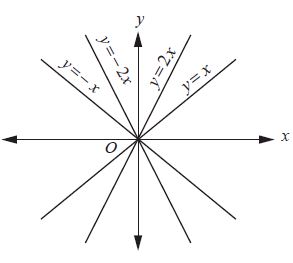
The family of straight lines passing through the origin is y = mx, where m is an arbitrary constant.
Differentiating both sides with respect to x, we get \(\frac{dy}{dx}=m\)
From (1) and (2), we get y = x\(\frac{dy}{dx}\). This is the required differential equation.
Observe that the given equation y = mx contains only one arbitrary constant and thus we get the differential equation of order one.
6.
dy + (xy − cos x)dx = 0 is a first order differential equation with degree 1
since the equation can be rewritten as
\(\frac{dy}{dx}\) + xy - cos x = 0
7.
The given differential equation is \(3\left( \frac { { d }^{ 2 }y }{ { dx }^{ 2 } } \right) ={ \left[ 4+{ \left( \frac { dy }{ dx } \right) }^{ 2 } \right] }^{ \frac { 3 }{ 2 } }\)Squaring both sides, we get
\(9{ \left( \frac { { d }^{ 2 }y }{ { dx }^{ 2 } } \right) }^{ 2 }={ \left[ 4+{ \left( \frac { dy }{ dx } \right) }^{ 2 } \right] }^{ 3 }\)
In this equation, the highest order derivative is \(\frac { { d }^{ 2 }y }{ { dx }^{ 2 } } \) whose power is 2.
Therefore, the given differential equation is of order 2 and degree 2.
8.
In the given differential equation, the highest order derivative is \(\frac { { d }^{ 2 }y }{ { dx }^{ 2 } } \) whose power is 1.
Therefore, the given differential equation is of order 2.
The given differential equation is not a polynomial equation in its derivatives and so its degree is not defined.
9.
Here, the highest order derivative is \(\frac { { d }^{ 4 }y }{ { dx }^{ 4 } } \) whose power is 3.
Therefore, the given differential equation is of order 4 and degree 3.
10.
In this equation, the highest order derivative is \(\\ \\ \\ \frac { dy }{ dx } \) whose power is 1.
Therefore, the given differential equation is of order 1 and degree 1.
11.
y''− 5y' + 6y = 0 ......(1)
Given y = emx .....(2)
Differentiating cquation (2) w.r.t 'x', we get
\(\frac{dy}{dx} = em^x . m\)
To find the value of m:
Given y" - 5y' + 6y = 0
emx . m2 -5emx+ 6emx = 0
emx [m- 5m +6] = 0
m - 5m + 6 = 0
(m - 3) (m - 2) = 0
m = 3, 2
12.
Given = emx is the solution of
y' + 2y = 0 ...(1)
y = emx ...... (2)
\(\frac{dy}{dx} = e^{mx}. m\)
\(\frac{dy}{dx} = ym\)
\(\frac{dy}{dx} - my=0\)
⇒ y' - my = 0 ...(3)
Comparing equation (1) & (3),
we get m = -2
13.
y = aex + be−x; y − y = 0
Consider y = aex + be−x
Differentiating with respect to 'x' we get,
\(\frac { dy }{ dx } = ae^{x} -be^{-x} \)
Again differentiating, we get
\(\frac { d^2y }{ dx^2 } = ae^{x} -be^{-x} \)
\(\frac { d^2y }{ dx^2 } = y\)
\(\frac { d^2y }{ dx^2 } - y = 0\) is a required differential equation.
Thus y = aex + be−x satisfies the diferential| equation y"- y = 0
Hence y = aex + be−x is a solution of the differential equation y"- y = 0
14.
y = 2x2 ; xy' = 2y
Consider y = ax2 ...(1)
Differentiating with respect to 'x' we get,
⇒ \(\frac { dy }{ dx } = 2.2x\) ...(2)
Multiply by x on both sides, we get,
x = \(\frac { dy }{ dx } = 2.2x\)
y' = 2y is a given differential equation
Thus y = 2x2 satislies the differential equation
xy' = 2y
Hence y = 2x2 is a solution of the differential equation xy' = 2y.
15.
Given equation of curve is
xy = aex + be−x + x2 ...(1)
where a &b are aribitrary constant. differentiate equation (1) twice successively, because we have two arbitray constant.
\(x \frac{d y}{d x}+y(1)=a \mathrm{e}^{x}-\mathrm{be}^{-x}+2 x\) ...(2)
\(
x \frac{d^{2} y}{d x^{2}}+\frac{d y}{d x}(1)+\frac{d y}{d x}=\mathrm{ae}^{x}+\mathrm{be}^{-x}+2
\)
\( x \frac{d^{2} y}{d x^{2}}+\frac{2 d y}{d x}=\mathrm{ae}^{x}+\mathrm{be}^{-x}+2
\) ...(3)
From (1), we get \(x y-x^{2}=\mathrm{ae}^{x}+\mathrm{be}^{-x}\) ...(4)
Substituting equation (a) in (3), we get
\(\therefore x \frac{d^{2} y}{d x^{2}}+\frac{2 d y}{d x}-x y+x^{2}-2=0\) which is the required differential equaiton.
16.
Let x represent the principal in the saving amount.
R = 8% and N = 1.
∴ Interest = \(\frac { PNR }{ 100 } =\frac { x\times 1\times 8 }{ 100 } =\frac { 2x }{ 25 } \)
∴ Given \(\frac { dx }{ dt } \) = interest + Rs. 400.
∴ \(\frac { dx }{ dt } =\frac { 2x }{ 25 } +400\)
17.
Let P represent the vapour pressure and T represent the vapour temperature.
Given \(\frac { dp }{ dt } \alpha \quad p.\frac { 1 }{ { T }^{ 2 } } \)
[∴ Inversely proportional to the square of the temperature]
\(\Rightarrow \frac { dp }{ dt } =\frac { kP }{ { T }^{ 2 } } \) where k is a constant.
18.
(i) If at any time t, The amount of Radium present is Q. The rate at which Q is decreasing \(\frac { dQ }{ dt } \).
This rate of decrease or decay is found to be proportional to Q itself. Hence we have the law, \(\frac { dQ }{ dt } = kQ\). where k is the dt constant of proportionality. Which is a required differential equation.
(ii) The rate of change of population Solution increases with respect to time t, is \(\frac { dp }{ dt } \) & the rate of population is proportional| the product of population is \(\frac { dp }{ dt } \) = kP & the also the difference between 5,00,000 & the population is \(\frac { dp }{ dt } \) = kP (5,00,000 - P) is a required differential equation.
(iii) The rate of change of vapor pressure P with respect to time t is \(\frac { dp }{ dt } \)& the rate of dt increase vapor pressure is P at time T is proportional to the vapor pressure and also is inversely proportional to the square of the temperature is \(\frac { dp }{ dt } \)\(\infty\) P and \(\frac { dp }{ dt } \infty\frac{1}{T^2}\)
Combining the two, we get
\(\frac { dp }{ dt } \infty\frac{p}{T^2} \Rightarrow \frac { dp }{ dt }= k(\frac{p}{T^2})\), where 'k' is constantof proportionality
(iv) Let x be the amount. Amount varies from every year. (ie) Amount varies with respect to time t is \(\frac { dp }{ dt } \) & in addition the income from other source credited Rs. 400 continuously for every year.
\(\frac { dx }{ dt } = \frac{8}{100}\times x + 400\)
\(\Rightarrow\frac{dx}{dt} = \frac{2x}{25}+400\) is a required differential equation.
19.
\(x={ e }^{ xy\left( \frac { dy }{ dx } \right) }\)
Taking log on both sides, log x = xy \(\frac{dy}{dx}\)
In this equation, the highest-order derivative is \(\frac{dy}{dx}\) so its power is 1.
The highest derivative is 1.
∴ its Order = 1, Degree = 1
20.
\(\frac { { d }^{ 2 }y }{ d{ x }^{ 2 } } +5\frac { dy }{ dx } +\int { ydx } ={ x }^{ 3 }\)
The given differential equation is
\(\frac { { d }^{ 2 }y }{ d{ x }^{ 2 } } +5\frac { dy }{ dx } +\int { ydx } ={ x }^{ 3 }.\)
Differentiating again with respect to 'x' we get.
\(\frac { { d }^{ 2 }y }{ d{ x }^{ 2 } } +5\frac { { d }^{ 2 }y }{ d{ x }^{ 2 } } +y=3{ x }^{ 2 }\)
The highest derivative is 3 and its power is 1.
∴ Order is 3 and degree is 1.
21.
\(\frac { { d }^{ 2 }y }{ d{ x }^{ 2 } } =xy+cos\left( \frac { dy }{ dx } \right) \)
The given differential equation is
\(\frac { { d }^{ 2 }y }{ d{ x }^{ 2 } } =xy+cos\left( \frac { dy }{ dx } \right) \)
The highest derivative is 2
∴ Order 2.
The given differential equation is not a polynomial equations in its derivatives and so its degree is not defined.
22.
The given differential equation is
\({ \left( \frac { d^2y }{ dx^2 } \right) }^{ 3\times2 }= { 1+\left( \frac { dy }{ dx } \right) } \)
squaring both sides, we get
\({ \left( \frac { dy }{ dx } \right) }^{ 6 }=1+\left( \frac { dy }{ dx } \right) \)
In this equation, the highest order derivative is 2 and its power is 6.
∴ Order 2, degree 6.
23.
\({ x }^{ 2 }\frac { { d }^{ 2 }y }{ d{ x }^{ 2 } } +{ \left[ 1+{ \left( \frac { dy }{ dx } \right) }^{ 2 } \right] }^{ \frac { 1 }{ 2 } }=0\)
The given differential equation is
\({ x }^{ 2 }\left( \frac { { d }^{ 2 }y }{ d{ x }^{ 2 } } \right) \) = -\({ \left[ 1+{ \left( \frac { dy }{ dx } \right) }^{ 2 } \right] }^{ \frac { 1 }{ 2 } }\)
= - \(\sqrt { 1+{ \left( \frac { dy }{ dx } \right) }^{ 2 } } \)
Squaring both sides,
\({ x }^{ 4 }\left( \frac { { d }^{ 2 }y }{ d{ x }^{ 2 } } \right) =1+{ \left( \frac { dy }{ dx } \right) }^{ 2 }\)
The highest derivative is 2 and its power is 2.
∴ Order 2, degree 2.
24.
\(y\left( \frac { dy }{ dx } \right) =\frac { x }{ \left( \frac { dy }{ dx } \right) +{ \left( \frac { dy }{ dx } \right) }^{ 3 } } \)
is the given differential equation.
\(\Rightarrow y{ \left( \frac { dy }{ dx } \right) }^{ 2 }+{ \left( \frac { dy }{ dx } \right) }^{ 4 }=x\)
The highest derivative is 1 and its maximum power is 4.
∴ Order 1, degree 4.
25.
\(\sqrt { \frac { dy }{ dx } } -4\frac { dy }{ dx } -7x=0\)
The given differential equation is
\(\sqrt { \frac { dy }{ dx } } =4\frac { dy }{ dx } +7x\)
Squaring both sides,
\(\frac { dy }{ dx } =\quad { \left( 4\frac { dy }{ dx } +7x \right) }^{ 2 }\)
\(16{ \left( \frac { dy }{ dx } \right) }^{ 2 }+{ 49 }x^{ 2 }+56x{ \left( \frac { dy }{ dx } \right) }\)
The highest derivative is 1 and its maximum power is 2.
∴ Order 1, degree 2.
26.
\({ { \left( \frac { { d }^{ 2 }y }{ d{ x }^{ 2 } } \right) } }^{ 2 }+{ \left( \frac { dy }{ dx } \right) }^{ 2 }=xsin\left( \frac { { d }^{ 2 }y }{ d{ x }^{ 2 } } \right) \)
The highest derivative is 2
∴ Order 2
The given differential equation is not a polynomial equation in its derivative and so its degree is not defined.
27.
\({ \left( \frac { { d }^{ 3 }y }{ d{ x }^{ 3 } } \right) }^{ \frac { 2 }{ 3 } }-3\frac { { d }^{ 2 }y }{ d{ x }^{ 2 } } +5\frac { dy }{ dx } +4=0\)
Given differential equation is
\({ \left( \frac { { d }^{ 3 }y }{ d{ x }^{ 3 } } \right) }^{ \frac { 2 }{ 3 } }-3\left( \frac { { d }^{ 2 }y }{ d{ x }^{ 2 } } \right) +5\frac { dy }{ dx } +4=0\)
\(\Rightarrow { \left( \frac { { d }^{ 3 }y }{ d{ x }^{ 3 } } \right) }^{ \frac { 2 }{ 3 } }=3\left( \frac { { d }^{ 2 }y }{ d{ x }^{ 2 } } \right) -5\left( \frac { dy }{ dx } \right) -4\)
Taking power 3 both sides,
\(\Rightarrow { \left( \frac { { d }^{ 3 }y }{ d{ x }^{ 3 } } \right) }^{ 2 }={ \left( 3\left( \frac { { d }^{ 2 }y }{ d{ x }^{ 2 } } \right) -5\left( \frac { dy }{ dx } \right) -4 \right) }^{ 3 }\)
The highest derivative is 3 and its power is 2.
∴ Order 3, degree 2.
28.
\(\frac { dy }{ dx } +xy=cotx\)
Given differential equation is
\(\frac { dy }{ dx } +xy=cotx\)
The highest derivative is 1 and its power is 1 order 1, degree 1.
29.
The given equation is rewritten as \(\frac { dy }{ dx } =\frac { { y }^{ 2 } }{ xy-{ x }^{ 2 } } \)
This is a homogeneous differential equation
Put y = vx . Then, we have \(x\frac { dv }{ dx } =\frac { v }{ v-1 } \)
By separating the variables, \(\frac { v-1 }{ v } dv=\frac { dx }{ x } .\)
Integrating, we obtain v − log |v| = log |x| + log |C| or v = log |vxC|.
Replacing v by \(\frac{y}{x}\), we get, \(\frac{y}{x}\) = log |Cy| = ey/x or y = key/x (how!) which is the required solution.
30.
To solve the given differential equation, we make the substitution 3x + y + 4 = z.
Differentiating with respect to x, we get \(\frac { dy }{ dx } =\frac { dz }{ dx } \)-3.
So the given differential equation becomes \(\frac { dz }{ dx } \) = z2+ 3.
In this equation variables are separable. So, separating the variables and integrating, we get the general solution of the given differential equation as \(\frac { 1 }{ \sqrt { 3 } } { tan }^{ -1 }\left( \frac { 3x+y+4 }{ \sqrt { 3 } } \right) =x+C\)
31.
The given function is y = a cos(log x) + bsin (log x) ...(1)
where a, b are two arbitrary constants. In order to eliminate the two arbitrary constants, we have to differentiate the given function two times successively
Differentiating equation (1) with respect to x , we get
y' = -a sin (log x).\(\frac{1}{x}\)+ b cos (log x).\(\frac{1}{x}\Rightarrow\)xy' = -a sin(log x)+b cos (log x).
Again differentiating this with respect to x, we get
xy" + y' = -a cos(log x).\(\frac{1}{x}-b\) sin (log x).\(\frac{1}{x}\Rightarrow\)x2y" + xy'+ y = 0
Therefore, y = a cos(log x) + bsin (log x) is a solution of the given differential equation.
32.
The given function is y = 2(x2−1) + \(Ce^{x^2}\), where C is an arbitrary constant ... (1)
Differentiating both sides of equation (1) with respect to x, we get \(\frac { dy }{ dx } =4x-2x{ Ce }^{ -x2 }\)
Substituting the values of \(\frac { dy }{ dx } \) and y in the given differential equation, we get
\(\frac { dy }{ dx } \) + 2xy - 4x3 = 4x - 2xCe-x2 + 2x[2(x2-1)+Ce-x2]-4x3 = 0
Therefore, the given function is a solution of the differential equation \(\frac { dy }{ dx } \)+2xy-4x3 = 0
33.
The equation of the family of all ellipses having foci on the x -axis and centre at the origin is given by \(\frac { { x }^{ 2 } }{ { a }^{ 2 } } +\frac { { y }^{ 2 } }{ { b }^{ 2 } } =1,a>b\).
where a and b are arbitrary constants.
Differentiating equation (1) with respect to x, we get
\(\frac { 2x }{ { a }^{ 2 } } +\frac { 2y }{ { b }^{ 2 } } \frac { dy }{ dx } =0\quad \Rightarrow \frac { x }{ { a }^{ 2 } } +\frac { y }{ { b }^{ 2 } } \frac { dy }{ dx } =0\)
Differentiating equation (2) with respect to x, we get
\(\frac { 1 }{ { a }^{ 2 } } +\frac { 1 }{ { b }^{ 2 } } \left[ y\frac { { d }^{ 2 }y }{ { dx }^{ 2 } } +{ \left( \frac { dy }{ dx } \right) }^{ 2 } \right] =0\Rightarrow \frac { 1 }{ { a }^{ 2 } } +\frac { 1 }{ { b }^{ 2 } } \left[ y\frac { { d }^{ 2 }y }{ { dx }^{ 2 } } +{ \left( \frac { dy }{ dx } \right) }^{ 2 } \right] \)
Substituting the value of \(\frac{1}{a^2}\) in equation (2) and simplifying, we get \(-\frac { 1 }{ { b }^{ 2 } } \left[ y\frac { { d }^{ 2 }y }{ { dx }^{ 2 } } +{ \left( \frac { dy }{ dx } \right) }^{ 2 } \right] x+\frac { v }{ { b }^{ 2 } } \frac { dy }{ dx } =0\Rightarrow xy\frac { { d }^{ 2 }y }{ { dx }^{ 2 } } +{ \left( \frac { dy }{ dx } \right) }^{ 2 }-y\frac { dy }{ dx } =0\) which is the required differential equation
34.
The slope of the tangent to the curve at any point = \(\frac { 1 }{ 4(odinate\ at\ the\ point) } \)
\(\Rightarrow \frac { dy }{ dx } =\frac { 1 }{ 4y } \)
The equation can be written as
\(\Rightarrow 4ydy\ =\ dx\) ....(1)
Integrating equation (1) on both sides, we get
\(4\int { y\quad dy } =\int { dx } \)
\(\Rightarrow 4.\frac { { y }^{ 2 } }{ 2 } =x+c\)
\(\Rightarrow { 2y }^{ 2 }=x+c\) ...(2)
Since the curve passes through (2, 5), we get
2(5)2 = 2 + c
⇒ 50 - 2 = c
⇒ c = 48
Substituting the value of cincquation (2), we get
2y2 = x + 48 which is the requaired equation of the curve.
35.
given equation of family of curves is
y = Ae8x + Be-8x ..(1)
where A & B are arbitrary constants. Differentiating cquation (1) twice successively (because we have two arbitrary constant), we get
Differentiating with respect to 'x' we get,
\(\frac { dy }{ dx } \\ \\ \) = 8Ae8x + 8Be-8x
Differentiating again with respect to 'x' we get,
\(\frac { d^{ 2 }y }{ dx^{ 2 } } \) = 64Ae8x + 64Be-8x
= 64(Ae8x + Be-8x)
\(\frac { d^{ 2 }y }{ dx^{ 2 } } \) = 64 y [using (1)]
\(\frac { d^{ 2 }y }{ dx^{ 2 } } \) - 64 y = 0
Which is the required differential equation.
36.
The equation of the family of ellipses having centre at the origin & foci on the y-axis, is given
\(\frac { { x }^{ 2 } }{ { b }^{ 2 } } +\frac { { y }^{ 2 } }{ { a }^{ 2 } } =1\) ...(1)
where b >a & a, b are the parameters or a,b are arbitrary constant.
Differentiating equation (1) twice successively, because we have two arbitrary constant) we get
\( \frac{2 x}{a^{2}}+\frac{2 y}{b^{2}} \frac{d y}{d x} =0 \)
\(2\left(\frac{x}{a^{2}}+\frac{y}{b^{2}} \frac{d y}{d x}\right) =0 \)
\(\frac{x}{a^{2}}+\frac{y}{b^{2}} \frac{d y}{d x} =0\) ............(2)
Again differentiating equation (2)
\(\frac{1}{a^{2}}+\frac{y}{b^{2}} \frac{d^{2} y}{d x^{2}}+\frac{d y}{d x} \frac{d y}{d x b^{2}}=0\)
\(\frac{1}{a^{2}}+\frac{y}{b^{2}} \frac{d^{2} y}{d x^{2}}+\left(\frac{d y}{d x}\right)^{2} \frac{1}{b^{2}}=0\)
multiply by x
\(\frac{x}{a^{2}}+\frac{x y}{b^{2}}\left(\frac{d^{2} y}{d x^{2}}\right)+\left(\frac{d y}{d x}\right)^{2} \frac{x}{b^{2}}=0\) .........(3)
Equation (3)-(2)
\( \frac{x}{a^{2}}+\frac{x y}{b^{2}}\left(\frac{d^{2} y}{d x^{2}}\right)+\left(\frac{d y}{d x}\right)^{2}\left(\frac{x}{b^{2}}\right) -\left(\frac{x}{a^{2}}+\frac{y}{b^{2}} \frac{d y}{d x}\right) =0 \)
\(\frac{x y}{b^{2}}\left(\frac{d^{2} y}{d x^{2}}\right)+\left(\frac{d y}{d x}\right)^{2} \frac{x}{b^{2}}-\frac{y}{b^{2}} \frac{d y}{d x} =0 \)
Taking \(\frac{1}{b^{2}}\) outside, we get
\( \frac{1}{b^{2}}\left[x y \frac{d^{2} y}{d x^{2}}+x\left(\frac{d y}{d x}\right)^{2}-y \frac{d y}{d x}\right]=0 \\ x y \frac{d^{2} y}{d x^{2}}+x\left(\frac{d y}{d x}\right)^{2}-y \frac{d y}{d x}=0 \)
is the required differential equation.
37.
Equation of family of parabolas with axis as y axis is given by,
(x-0) = 4a(y-k) .... (1)
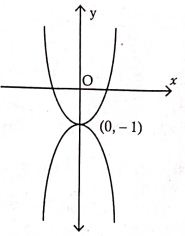
Given: Vertex at (0, - 1).
Putting k = -1 in (1), we get
⇒ x2 = \(\pm\)4a(y + 1) ....(2)
Differentiating with respect to 'x'
2x = \(\pm\)4a\(\left( \frac { dy }{ dx } \right) \) ....(3)
⇒ 4a = \(\frac { 2x }{ \frac { dy }{ dx } } \)
\(\frac{x^2}{2x} = \frac{y+1}{\frac{dt}{dx}}\)
ie) \(x \frac{dy}{dx}-2(y+1) =0\)
This is the required differential equation.
38.
The equation of the family of parabolas with latus rectum (4a) and whose axes are parallel to the x-axis is shown in sketch
Let vertex 'V' be (h, k) and focus at 'F" and let
L-L' be latus rectum = 4a
Hence, FL = 2a and VF = a.
Thus 'F' is at (h+a, k).
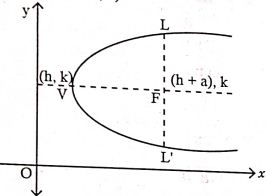
Equation of parabola with vertex at (h, k) and focal length 'a', latus rectum 4a' is
(y - k)2 = 4a(x - h) .......(1)
Differentiating with respect to 'x' we got
2(y - k) \(\frac{dy}{dx}\) = 4a
⇒ (y - k). \(\frac{dy}{dx}\) = 2a ....... (2)
Again differentiating with respect to x,
(y-k) y''+y'\(\times\) y' = 0 ............(3)
From(2),(y-k) = From(2),(y-k) = \(\frac{2a}{y'}\)
Putting in (3), we get
\((\frac{2a}{y'})y''+(y')^2=0 (or) 2ay'' +(y')^3 = 0\)
This is the required differential equation.
39.
Given the circles centre on r-axis & the circle is passing through the origin.
Let it be (r, 0) & its radius r.
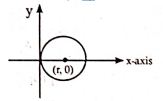
Equation of the circle is
(x - a)2 + (y - b)2 = r2
(x - r)2 + (y - 0)2 = r2
⇒ x2 - 2xr + r2 + y2 = r2
⇒ x2 - 2xr + y2 = 0 ...(1)
defferentiating equation (1) with respect to 'x' we get
⇒ 2x - 2r + 2y \(\frac { dy }{ dx } =0\)
⇒ 2x + 2y \(\frac { dy }{ dx } =2r\)
⇒ x + y \(\frac { dy }{ dx } =r\) ...(2)
Substituting r value in equation (1), we get
x2 - 2x \(\left( x+y\frac { dy }{ dx } \right) +{ y }^{ 2 }=0\)
\(\Rightarrow \ { x }^{ 2 }-{ 2x }^{ 2 }-2xy\frac { dy }{ dx } +{ y }^{ 2 }=0\)
\(\Rightarrow \ { -x }^{ 2 }{ -2x }y\left( \frac { dy }{ dx } \right) { +y }^{ 2 }\)
Multiply by '-', we get
\(\Rightarrow \ { x }^{ 2 }{ +2x }y\left( \frac { dy }{ dx } \right) { -y }^{ 2 }\) which is the required differential equation.
40.
Given circle equation be x2 y2 = r2
Let y = mx + c be the family of lines which touches the circle.
The condition for y = mx + c be all straight lines which towards the given circle x2 y2 = r2 (1 + m2)
\(c=\sqrt { { 1+m }^{ 2 } } \)
Hence, equation of tangent to the circle is .......(1)
y = mx + r\(\sqrt { { 1+m }^{ 2 } } \) .......(1)
Differentiating with respect to x,
\(\frac { dy }{ dx } =m\quad ...(2)\)
Substituting 'm' in (1) we get,
\(y= \left( \frac { dy }{ dx } \right) \times x \pm r\sqrt { 1+{ \left( \frac { dy }{ dx } \right) }^{ 2 } } \)
\(y-x\left( \frac { dy }{ dx } \right) =\pm r\sqrt { 1+{ \left( \frac { dy }{ dx } \right) }^{ 2 } } \)
Squaring both sides we get,
\(\Rightarrow { \left[ y-x\left( \frac { dy }{ dx } \right) \right] }^{ 2 }={ r }^{ 2 }\left[ 1+{ \left( \frac { dy }{ dx } \right) }^{ 2 } \right] \)
This is the differential equation of all straight lines touching the circle x2 y2 = r2
41.
General equation of a straight line in a plane is ax + by = 1 .....(1)
Since, the lines are non - horizontal, a ≠ 0
Hence, differentiating with respect to y, equation (1)
a \(\\ \frac { dx }{ dy }+b =0\)
Differentiating again with respect to 'y'; we get,
\((a) \ \frac { { d }^{ 2 }x }{ d{ y }^{ 2 } } =0\Rightarrow \frac { { d }^{ 2 }x }{ d{ y }^{ 2 } } =0\quad [\because a\neq 0]\)
This is the differential equation of all non-horizontal lines in a plane.
42.
General equation of a straight line is
ax + by + c = 0 .......(1)
where a, b, c \(\in\) R.
Since, the lines are non - vertical,we have b \(\neq\) 0
Dividing b' by equation (1),
\(( \frac{a}{b})x+y+(\frac{c}{b}) = 0
\)
\(Ax+y=C = 0, where A = \frac{a}{b}, C = \frac{c}{b}\) .....(2)
Thus, eventhough 3 arbitrary constants (a, b, c) are present in (1), they can be considered as 2 constants only, as above (2).
Differentiating (1) with respect to x
a + b \(\\ \frac { dy }{ dx } =0\)
Differentiating again with respect to 'x' we get,
(b) \(\frac { { d }^{ 2 }y }{ d{ x }^{ 2 } } =0\Rightarrow \frac { { d }^{ 2 }y }{ d{ x }^{ 2 } } =0\quad [\because b\neq 0]\) .....(3)
This is the differential equation of family of all non - vertical lines in a plane.

12th Standard Syllabus & Materials
12th Standard
TN 12th Computer Applications களப்பெயர் முறைமை (DNS) Sample Question Papers Study Material - QB365 Set A
NEW12th Standard
TN 12th Computer Applications வலையமைப்பு எடுத்துக்காட்டுகள் மற்றும் நெறிமுறைகள் Sample Question Papers Study Material - QB365 Set A
NEW12th Standard
TN 12th Computer Applications கணினி வலையமைப்பு ஓர் அறிமுகம் Sample Question Papers Study Material - QB365 Set A
NEW12th Standard
TN 12th Computer Applications PHP-உடன் MySQL-ஐ இணைத்தல் Sample Question Papers Study Material - QB365 Set A



Tamilnadu Stateboard 12th Standard Subjects
Maths

Chemistry

Physics

Biology

Computer Science

Business Maths and Statistics

Economics

Commerce

Accountancy

History

Computer Applications
Biology
Computer Technology
Computer Applications
Computer Science
Business Maths and Statistics
Commerce
Economics
Maths
Chemistry
Physics
Computer Technology
History
Accountancy

Tamil

English

French
Tamilnadu Stateboard Standards

