
 100% FREE ACCESS
12th Standard Syllabus & Materials
12th Standard
TN 12th Computer Applications மின்னணு தரவு பரிமாற்றம் Sample Question Papers Study Material - QB365 Set A
NEW12th Standard
TN 12th Computer Applications மின் - வணிக பாதுகாப்பு அமைப்புகள் Sample Question Papers Study Material - QB365 Set A
NEW12th Standard
TN 12th Computer Applications மின்னணு செலுத்தல் முறைகள் Sample Question Papers Study Material - QB365 Set A
NEW12th Standard
TN 12th Computer Applications மின் - வணிகம் Sample Question Papers Study Material - QB365 Set A
NEW12th Standard
TN 12th Computer Applications திறந்த மூல கருத்துருக்கள் Sample Question Papers Study Material - QB365 Set A
NEW12th Standard
TN 12th Computer Applications வலையமைப்பு வடமிடல் Sample Question Papers Study Material - QB365 Set A

Published on: 02/02/2021
12th Standard Maths English Medium Ordinary Differential Equations Reduced Syllabus Important Questions With Answer Key 2021
Download Tamil Nadu 12th Standard Maths question papers, model tests, one-mark questions, important questions, and public exam papers in PDF format. Free study materials and answer keys for TN State Board students.
Questions + Answers key
Take MCQ Maths Test1.
Form the Differential Equation representing the family of curves y = A cos(x + B) where A and B are parameters.
2.
Determine the order and degree of \(\frac { \left[ 1+\left( \frac { dy }{ dx } \right) ^{ 2 } \right] ^{ \frac { 3 }{ 2 } } }{ \frac { { d }^{ 2 }y }{ { dx }^{ 2 } } } =k\)
3.
Solve: \(\frac{dy}{dx}+y=e^{-x}\)
4.
Find the differential equation of the family of parabolas y2 = 4ax, where a is an arbitrary constant.
5.
Determine the order and degree (if exists) of the following differential equations:
\({ \left( \frac { { d }^{ 4 }y }{ { dx }^{ 4 } } \right) }^{ 3 }+4{ \left( \frac { dy }{ dx } \right) }^{ 7 }+6y=5cos3x\)
6.
Show that y = e−x + mx + n is a solution of the differential equation ex \(\left( \frac { { d }^{ 2 }y }{ { dx }^{ 2 } } \right) \) -1 = 0
7.
For each of the following differential equations, determine its order, degree (if exists)
\({ \left( \frac { d^2y }{ dx^2 } \right) }^{ 3 }=\sqrt { 1+\left( \frac { dy }{ dx } \right) } \)
8.
For each of the following differential equations, determine its order, degree (if exists)
\(\frac { dy }{ dx } +xy=cotx\)
9.
Water at temperature 100℃ cools in 5 minutes to 80℃ in a room of temperature 30℃. Find (i) the temperature of water after 10 minutes. (ii) the time when the temperature is 40℃.
10.
Solve : \(\frac { dy }{ dx } =-\frac { x+ycos }{ 1+sinx } \) .Also find the domain of the function.
11.
Solve : \({ 2x }^{ 2 }\left( \frac { dy }{ dx } \right) -2xy+{ y }^{ 2 }=0,y(e)=e\)
12.
Solve : (1+y2)(1 + log x)dx + x dy = 0, given that x = 1,y = 1.
13.
Solve the Linear differential equation \((1+x+{ xy }^{ 2 })\frac { dy }{ dx } +(y+{ y }^{ 3 })=0\)
14.
Find the equation of the curve whose slope is \(\frac { y-1 }{ { x }^{ 2 }+x } \) and which passes through the point (1, 0).
15.
If F is the constant force generated by the motor of an automobile of mass M, its velocity is given by M \(\frac{dV}{dt}\)= F-kV, where k is a constant. Express V in terms of t given that V = 0 when t = 0.
16.
Find the particular solution of (1+ x3)dy − x2 ydx = 0 satisfying the condition y(1) = 2.
17.
Assume that a spherical rain drop evaporates at a rate proportional to its surface area. Form a differential equation involving the rate of change of the radius of the rain drop.
18.
Solve : ydx+(x-y2)dy=0
19.
Solve:\(\frac { dy }{ dx } =\frac { 1-cosx }{ 1+cosx } \)
20.
Verify that y=-x-1 is a solution of the D.E (y-x)dy-(y2-x2)dx=0
21.
Solve: x\(\frac{dy}{dx}\)+ 2y = x2
22.
Form the differential equation for y = e-2x [A cos 3x-B sin 3x]
23.
Solve \(\frac { dy }{ dx } +\frac { { y }^{ 2 } }{ { x }^{ 2 } } =\frac { y }{ x } \)
24.
Solve (x2 -3y2) dx + 2xydy = 0.
25.
Find the differential equation of the family of parabolas with vertex at (0, −1) and having axis along the y-axis.
26.
Find the differential equation of the family of circles passing through the origin and having their centres on the x -axis.
27.
Find the differential equation of the family of all non-vertical lines in a plane.
28.
The I.F. of (1+y2) dx = (tan-1-t-x) dy is ________.
etan-1 y
etan-1 x
tan-1 y
tan-1x
29.
The differential equation of x2y = k is _________.
\({ x }^{ 2 }\frac { dy }{ dx } =0\)
\({ x }^{ 2 }\frac { dy }{ dx } +y=0\)
\({ x }\frac { dy }{ dx } +2y=0\)
\(y\frac { dy }{ dx } +2x=0\)
30.
31.
32.
33.
34.
35.
The number of arbitrary constants in the general solutions of order n and n +1 are respectively
n-1,n
n,n+1
n+1,n+2
n+1,n
36.
If sin x is the integrating factor of the linear differential equation \(\frac { dy }{ dx } +Py=Q,\) then P is
log sin x
cos x
tan x
cot x
37.
38.
39.
If p and q are the order and degree of the differential equation \(y=\frac { dy }{ dx } +{ x }^{ 3 }\left( \frac { { d }^{ 2 }y }{ { dx }^{ 2 } } \right) +xy=cosx,\) When
p < q
p = q
p > q
p exists and q does not exist
40.
The degree of the differential equation \(y(x)=1+\frac { dy }{ dx } +\frac { 1 }{ 1.2 } { \left( \frac { dy }{ dx } \right) }^{ 2 }+\frac { 1 }{ 1.2.3 } { \left( \frac { dy }{ dx } \right) }^{ 3 }+....\) is
2
3
1
4
41.
The integrating factor of the differential equation \(\frac{d y}{d x}+P(x) y=Q(x)\) is x, then P(x)
x
\(\frac { { x }^{ 2 } }{ 2 } \)
\(\frac{1}{x}\)
\(\frac{1}{x^2}\)
42.
The differential equation representing the family of curves y = Acos(x + B), where A and B are parameters,is
\(\frac { { d }^{ 2 }y }{ { dx }^{ 2 } } -y=0\)
\(\frac { { d }^{ 2 }y }{ { dx }^{ 2 } }+y=0\)
\(\frac { { d }^{ 2 }y }{ { dx }^{ 2 } }=0\)
\(\frac { { d }^{ 2 }x }{ { dy }^{ 2 } }=0\)
1.
\(\frac { { d }^{ 2 }y }{ { dx }^{ 2 } } +y=0\)
2.
order – 2 : degree 2
3.
This is a linear differential equation
Here P = 1, Q = e-x
\(\therefore \int { p\ dx } =\int { 1.dx } =x\)
\(I.F={ e }^{ \int { pdx } }={ e }^{ x }\)
The solution is
\({ ye }^{ \int { pdx } }\int { { Qe }^{ \int { p\ dx } }dx+c } \)
\(\Rightarrow y{ e }^{ x }=\int { { e }^{ -x }.{ e }^{ x }dx+c=\int { dx+c } } \)
\(\int { y{ e }^{ x }=x+c } \)
4.
The equation of the family of parabolas is given by y2 ax = 4, a is an arbitrary constant. ... (1)
Differentiating both sides of (1) with respect to x , we get 2y\(\frac{dy}{dx}=4a\Rightarrow a=\frac{y}{2}\frac{dy}{dx}\)
Substituting the value of a in (1) and simplifying, we get \(\frac{dy}{dx}=\frac{y}{2x}\) as the required differential equation.
5.
Here, the highest order derivative is \(\frac { { d }^{ 4 }y }{ { dx }^{ 4 } } \) whose power is 3.
Therefore, the given differential equation is of order 4 and degree 3.
6.
Given y = e−x + mx + n .... (1)
Derentiating cquation (1) wr.t 'x', we get
\(\frac { dx }{ dx } =-e^{ -x }(-1)+m\)
\(\frac { d^{ 2 }y }{ d{ x }^{ 2 } } =-e^{ -x }+m\)
Again differentiating, we get
\(\Rightarrow \frac { d^{ 2 }y }{ d{ x }^{ 2 } } ={ e^{ x } }+0\)
\(\Rightarrow \left( \frac { d^{ 2 }y }{ d{ x }^{ 2 } } \right) =e^x\)
Substituting the value of \(\frac{d^2y}{dx^2}\) in the given differential equation, we get
\(\Rightarrow e^{ x }\left( \frac { d^{ 2 }y }{ d{ x }^{ 2 } } \right) -1=e^x(e^x)-1\\= e^{x-x}-1\\
e^0-1= 1-1=0\)
Thus the solution of the given differential equation ex \(\left( \frac { { d }^{ 2 }y }{ { dx }^{ 2 } } \right) \) -1 = 0
7.
The given differential equation is
\({ \left( \frac { d^2y }{ dx^2 } \right) }^{ 3\times2 }= { 1+\left( \frac { dy }{ dx } \right) } \)
squaring both sides, we get
\({ \left( \frac { dy }{ dx } \right) }^{ 6 }=1+\left( \frac { dy }{ dx } \right) \)
In this equation, the highest order derivative is 2 and its power is 6.
∴ Order 2, degree 6.
8.
\(\frac { dy }{ dx } +xy=cotx\)
Given differential equation is
\(\frac { dy }{ dx } +xy=cotx\)
The highest derivative is 1 and its power is 1 order 1, degree 1.
9.
(i) 65.33oC
(ii) 53.46
10.
\(y=\frac { 2x-{ x }^{ 2 } }{ 2(1+sinx) } ,x\neq n\pi +(-1)^{ n }\frac { \pi }{ 2 } ,\)∀ n ε Z
11.
\(y=\frac { 2x }{ 1+log|x| } ,x\neq 0\)
12.
\({ tan }^{ -1 }y=\frac { \pi }{ 4 } +\frac { 1 }{ 2 } -\frac { 1 }{ 2 } \left( 1+logx \right) ^{ 2 }\)
13.
The given differential cquation may be written as
\(\left(1+x+x y^2\right) \frac{d y}{d x}+\left(y+y^3\right)=0 \)
\(\left(1+x+x y^2\right) \frac{d y}{d x}=-\left(y+y^3\right) \)
\(\left(1+x+x y^2\right)=-1\left(y^2+1\right) \frac{d x}{d y} \)
\(y\left(y^2+1\right) \frac{d x}{d y}+1+x\left(y^2+1\right)=0\)
Divided by \( y\left(y^2+1\right) ,\)
\(\frac{d x}{d y}+\frac{1}{y\left(y^2+1\right)}+\frac{x\left(y^2+1\right)}{y\left(y^2+1\right)} =0 \)
\(\frac{d x}{d y}+\frac{x}{y} =-\frac{1}{y\left(y^2+1\right)}\)
This is the form of \( \frac{d x}{d y}+\mathrm{Px}=\mathrm{Q} \) where \( \mathrm{P}=\frac{1}{y} and \mathrm{Q}=\frac{-1}{y\left(1+y^2\right)}\)
\(\text { I.F }=e^{\int P d y}=e^{\int \frac{1}{y} d y}=e^{\log y}=y\)
So, the solution of the equation is given by
\(x \times \mathrm{I} . \mathrm{F} =\int(Q \times I . F) d y+c \)
\(x \times \mathrm{y} =\int \frac{-1}{y\left(1+y^2\right)} \times y \times d y+c \)
\(x \mathrm{y} =\int \frac{-1}{1+y^2} d y+c=-\int \frac{1}{1+y^2} d y+c\)
xy = -tan-1y + c
xy + tan-1y = c
Which is the required solution.
14.
Given slope curve
\(\Rightarrow \frac { dy }{ dx } =\frac { y-1 }{ { x }^{ 2 }+x } \) ..... (1)
\(\Rightarrow \frac { dy }{ y-1 } =\frac { dx }{ { x }^{ 2 }+x } \)
\(
\Rightarrow \frac{d y}{y-1}=\frac{d x}{x^2+x}=\frac{d x}{x^2+2\left(\frac{x}{2}\right)+\left(\frac{1}{2}\right)^2-\left(\frac{1}{2}\right)^2}
\)
\(ie) \frac{d y}{y-1}=\frac{d x}{\left(x+\frac{1}{2}\right)^2-\left(\frac{1}{2}\right)^2} \)
Integrating on both sides, we get
\( \int \frac{d y}{\log (y-1)}=\int \frac{d x}{\left(x+\frac{1}{2}\right)^2-\left(\frac{1}{2}\right)^2} \\
\text { ie) } \log (y-1)=\left(\frac{1}{2\left(\frac{1}{2}\right)}\right) \log \left[\frac{\left(x+\frac{1}{2}\right)-\left(\frac{1}{2}\right)}{\left(x+\frac{1}{2}\right)+\left(\frac{1}{2}\right)}\right]+\log C \\
\log (y-1)=\log \left(\frac{x}{x+1}\right)+\log C\\
ie) (y-1)=\frac{C x}{x+1}
\)
\(\Rightarrow log(y-1)=log\left( \frac { cx }{ x+1 } \right) \)
\(\Rightarrow y-1=\frac { cx }{ x+1 } \)
Since the curve passes through (1, 0) we get,
\(0-1=\frac { c }{ 2 } \Rightarrow c=-2\)
\(\Rightarrow y-1=\frac { -2x }{ x+1 } \)
\(\Rightarrow y=1-\frac { -2x }{ x+1 } \)
\(\Rightarrow y=\frac { x+1-2x }{ x+1 } =\frac { 1-x }{ x+1 } \)
\(\therefore y=\frac { 1-x }{ 1+x } \)
15.
Given equation is m \(\frac{dV}{dt}\) = F- kv
The given equation can be written as
\(\frac { dv }{ F-kv } =\frac { dt }{ m } \)
Now Integrating, we get
\(\int { \frac { dv }{ F-kv } } =\int { \frac { dt }{ m } } \)
\(\int \frac{d V}{F-k V}=\int \frac{d t}{M}
\frac{\log (F-k V)}{-k}=\frac{t}{M}+C_1 \\
\log [\mathrm{F}-\mathrm{kV}]=-\frac{k t}{M}-k C_1 \\
\log [\mathrm{F}-\mathrm{kV}]=-\frac{k t}{M}+\log \mathrm{C} \\
\log [\mathrm{F}-\mathrm{kV}]-\log \mathrm{C}=-\frac{k t}{M} \\
\log \left(\frac{F-k V}{C}\right)=-\frac{k t}{M} \\
\frac{F-k V}{C}=e^{\frac{-k t}{M}} \\
\frac{F-k V}{e^{\frac{-t}{M}}}=\mathrm{C} \Rightarrow \mathrm{C}=e^{\frac{k t}{M}}(F-k V) \\\)
Initial condition:
Given V = 0 when t = 0
\(\mathrm{C}=e^{\frac{k(0)}{M}}[\mathrm{~F}-\mathrm{k}(0)] \\
=\mathrm{e}^0[\mathrm{~F}-0] \\
\mathrm{C}=\mathrm{F} \\
\therefore \mathrm{F}=(F-k V) e^{\frac{k t}{M}}\)
16.
Given that (1 + x3)dy - x2 ydx = 0.
The above equation is written as \(\frac { dy }{ y } -\frac { { x }^{ 2 } }{ 1+{ x }^{ 2 } } dx=0\)
Integrating both sides gives log y- \(\frac{1}{3}\)log(1 + x3) = C1, which implies,
3 log y - log (1 + x3) = log C.
Thus, 3 log y = log (1 + x3) + log C,
which reduces to log y3 = log C(1+x3)
Hence, y3= C (1+x3) gives the general solution of the given differential equation. It is given that when x = 1, y = 2. Then 23 = C(1 + 1) \(\Rightarrow\) C = 4 and hence the particular solution is y3 = 4(1 + x3).
17.
Given, Spherical rain drop evaporates at a rate proportionate to the Surface Area
\(\frac { dQ }{ dt } \)\(\infty\) S, where V - volume at anytime t' and S surface area at time 't'
\(\frac { dV }{ dt } =-kS\) .......(1)
Where k is constant of proportionality (k > 0). Negative (-) sign due to decrease in volume on evaporation
\(V = \frac { 4 }{ 3 } 4\pi { r }^{ 2 } =and\ S = 4 \pi r^2\)
\(\frac { dV }{ dt } = \frac{4}{3}\times\pi \times 3r^3 \frac{dr}{dt}= 4 \pi r^2 \frac{dr}{dt}\)
Substituting in (1),
\(4\pi { r }^{ 2 } . \frac{dr}{dt}= -k \times 4\pi r^2\)
\(\frac{dr}{dr}= -k\)
This is equation for rate of change of radius with respect to time 't'.
18.
\(xy=\frac { { y }^{ 4 } }{ 4 } +c\)
19.
\(y=2tan\frac { x }{ 2 } -x+c\)
20.
prove
21.
x\(\frac{dy}{dx}\)+2y = x2
\( \Rightarrow \frac { dy }{ dx } +\frac { 2y }{ x } =x\)
This is a linear differential equation
Here \(p=\frac { 2 }{ x } \)and Q = x
\(\int { pdx } =2\int { \frac { 1 }{ x } } =2logx={ logx }^{ 2 }\)
\(I.F={ e }^{ \int { pdx } }={ e }logx^{ 2 }={ x }^{ 2 }\)
∴ The solution is
\({ ye }^{ \int { dx } }=\int { Q{ e }^{ \int { pdx } }dx+c } \)
\(\Rightarrow { yx }^{ 2 }=\int { x.{ x }^{ 2 }dx+c } \)
\(\Rightarrow { yx }^{ 2 }=\int { { x }^{ 3 }dx+c } \)
\(\Rightarrow { yx }^{ 2 }=\frac { { x }^{ 2 } }{ 4 } +c\)
22.
Given y = e-2x[A cos 3x- B sin 3x]
⇒ ye2x = A cos 3x-B sin 3x
Differentiating,y1e2+2y e2x = -3A sin 3x-3B
cos 3x
Differentiating again we get,
y"e2x+2(2y')e2x+4ye2x = -9(A cos 3x-B sin 3x)
⇒ e2x( y"+4y'+4y) = -9(A cos 3x - B sin 3x)
⇒ z y"+4y'+4y = -9(A cos 3x-B sin 3x)
⇒ y"+4y'+4y = -9(using (1))
⇒ y"+4y'+13y = 0
is the required differential equation
23.
Given \(\frac { dy }{ dx } +\frac { { y }^{ 2 } }{ { x }^{ 2 } } =\frac { y }{ x } \)
\(\Rightarrow \frac { dy }{ dx } =\frac { y }{ x } -\frac { { y }^{ 2 } }{ { x }^{ 2 } } ...(1)\)
This is a homogeneous differential equation
put y = vx
\(\Rightarrow \frac { dy }{ dx } =v+x\frac { dv }{ dx } \)
∴ (1) becomes,
\(v+x\frac { dv }{ dx } =\frac { vx }{ x } -\frac { { v }^{ 2 }{ x }^{ 2 } }{ { x }^{ 2 } } =v-{ v }^{ 2 }\)
\(x\frac { dv }{ dx } =v-{ v }^{ 2 }-v=-v\)
\(\therefore \frac { dv }{ { v }^{ 2 } } =\frac { -dx }{ x } \)
\(\Rightarrow \int { \frac { dv }{ { v }^{ 2 } } =-\int { \frac { dx }{ x } } } \)
\(\Rightarrow \frac { -1 }{ v } =-log\quad x+c\)
\(\Rightarrow \frac { -1 }{ \frac { y }{ x } } =-log\quad x+c\)
\(\Rightarrow \frac { -x }{ y } +logx=c\)
24.
We know that the given equation is homogeneous
Now, we rewrite the given equation as \(\frac { dy }{ dx } =\frac { 3y }{ 2x } -\frac { x }{ 2y } \)
Taking y = vx , we have \(v+x\frac { dv }{ dx } =\frac { 3v }{ 2 } -\frac { 1 }{ 2v } orx\frac { dv }{ dx } =\frac { { v }^{ 2 }-1 }{ 2v }\)
Separating the variables, we obtain \(\frac { 2vdv }{ { v }^{ 2 }-1 } =\frac { dx }{ x } \)
On integration, we get log\(|{ v }^{ 2 }-1|=log|x|+log|C|,\)
Hence, |v2-1| = |Cx|, where C is an arbitrary constant
Now, replace v by\(\frac{y}{x}\) to get \(|\frac { { y }^{ 2 } }{ { x }^{ 2 } } -1|\) = |Cx|.
Thus, we have |y2-x2| = |Cx3|
Hence, y2 − x2 = ±Cx3 (or) y2 − x2 = kx3 gives the general solution
25.
Equation of family of parabolas with axis as y axis is given by,
(x-0) = 4a(y-k) .... (1)
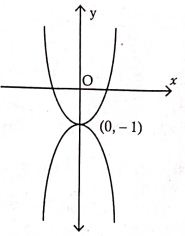
Given: Vertex at (0, - 1).
Putting k = -1 in (1), we get
⇒ x2 = \(\pm\)4a(y + 1) ....(2)
Differentiating with respect to 'x'
2x = \(\pm\)4a\(\left( \frac { dy }{ dx } \right) \) ....(3)
⇒ 4a = \(\frac { 2x }{ \frac { dy }{ dx } } \)
\(\frac{x^2}{2x} = \frac{y+1}{\frac{dt}{dx}}\)
ie) \(x \frac{dy}{dx}-2(y+1) =0\)
This is the required differential equation.
26.
Given the circles centre on r-axis & the circle is passing through the origin.
Let it be (r, 0) & its radius r.
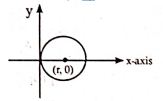
Equation of the circle is
(x - a)2 + (y - b)2 = r2
(x - r)2 + (y - 0)2 = r2
⇒ x2 - 2xr + r2 + y2 = r2
⇒ x2 - 2xr + y2 = 0 ...(1)
defferentiating equation (1) with respect to 'x' we get
⇒ 2x - 2r + 2y \(\frac { dy }{ dx } =0\)
⇒ 2x + 2y \(\frac { dy }{ dx } =2r\)
⇒ x + y \(\frac { dy }{ dx } =r\) ...(2)
Substituting r value in equation (1), we get
x2 - 2x \(\left( x+y\frac { dy }{ dx } \right) +{ y }^{ 2 }=0\)
\(\Rightarrow \ { x }^{ 2 }-{ 2x }^{ 2 }-2xy\frac { dy }{ dx } +{ y }^{ 2 }=0\)
\(\Rightarrow \ { -x }^{ 2 }{ -2x }y\left( \frac { dy }{ dx } \right) { +y }^{ 2 }\)
Multiply by '-', we get
\(\Rightarrow \ { x }^{ 2 }{ +2x }y\left( \frac { dy }{ dx } \right) { -y }^{ 2 }\) which is the required differential equation.
27.
General equation of a straight line is
ax + by + c = 0 .......(1)
where a, b, c \(\in\) R.
Since, the lines are non - vertical,we have b \(\neq\) 0
Dividing b' by equation (1),
\(( \frac{a}{b})x+y+(\frac{c}{b}) = 0
\)
\(Ax+y=C = 0, where A = \frac{a}{b}, C = \frac{c}{b}\) .....(2)
Thus, eventhough 3 arbitrary constants (a, b, c) are present in (1), they can be considered as 2 constants only, as above (2).
Differentiating (1) with respect to x
a + b \(\\ \frac { dy }{ dx } =0\)
Differentiating again with respect to 'x' we get,
(b) \(\frac { { d }^{ 2 }y }{ d{ x }^{ 2 } } =0\Rightarrow \frac { { d }^{ 2 }y }{ d{ x }^{ 2 } } =0\quad [\because b\neq 0]\) .....(3)
This is the differential equation of family of all non - vertical lines in a plane.
28.
(a)
etan-1 y
29.
(b)
\({ x }^{ 2 }\frac { dy }{ dx } +y=0\)
30.
(b)
31.
(a)
32.
(b)
33.
(a)
34.
(b)
35.
(b)
n,n+1
36.
(d)
cot x
37.
(c)
38.
(b)
39.
(c)
p > q
40.
(c)
1
41.
(c)
\(\frac{1}{x}\)
42.
(b)
\(\frac { { d }^{ 2 }y }{ { dx }^{ 2 } }+y=0\)

12th Standard Syllabus & Materials
12th Standard
TN 12th Computer Applications களப்பெயர் முறைமை (DNS) Sample Question Papers Study Material - QB365 Set A
NEW12th Standard
TN 12th Computer Applications வலையமைப்பு எடுத்துக்காட்டுகள் மற்றும் நெறிமுறைகள் Sample Question Papers Study Material - QB365 Set A
NEW12th Standard
TN 12th Computer Applications கணினி வலையமைப்பு ஓர் அறிமுகம் Sample Question Papers Study Material - QB365 Set A
NEW12th Standard
TN 12th Computer Applications PHP-உடன் MySQL-ஐ இணைத்தல் Sample Question Papers Study Material - QB365 Set A



Tamilnadu Stateboard 12th Standard Subjects
Maths

Chemistry

Physics

Biology

Computer Science

Business Maths and Statistics

Economics

Commerce

Accountancy

History

Computer Applications
Biology
Computer Technology
Computer Applications
Computer Science
Business Maths and Statistics
Commerce
Economics
Maths
Chemistry
Physics
Computer Technology
History
Accountancy

Tamil

English

French
Tamilnadu Stateboard Standards

