
 100% FREE ACCESS
12th Standard Syllabus & Materials
12th Standard
TN 12th Computer Applications மின்னணு தரவு பரிமாற்றம் Sample Question Papers Study Material - QB365 Set A
NEW12th Standard
TN 12th Computer Applications மின் - வணிக பாதுகாப்பு அமைப்புகள் Sample Question Papers Study Material - QB365 Set A
NEW12th Standard
TN 12th Computer Applications மின்னணு செலுத்தல் முறைகள் Sample Question Papers Study Material - QB365 Set A
NEW12th Standard
TN 12th Computer Applications மின் - வணிகம் Sample Question Papers Study Material - QB365 Set A
NEW12th Standard
TN 12th Computer Applications திறந்த மூல கருத்துருக்கள் Sample Question Papers Study Material - QB365 Set A
NEW12th Standard
TN 12th Computer Applications வலையமைப்பு வடமிடல் Sample Question Papers Study Material - QB365 Set A

Published on: 02/09/2022
QB365 provides a detailed and simple solution for every Possible Book Back Questions in Class 12 Maths Subject -Probability Distributions, English Medium. It will help Students to get more practice questions, Students can Practice these question papers in addition to score best marks.
Download Tamil Nadu 12th Standard Maths question papers, model tests, one-mark questions, important questions, and public exam papers in PDF format. Free study materials and answer keys for TN State Board students.
Questions + Answers key
Take MCQ Maths Test1.
Find the binomial distribution function for each of the following.
(i) Five fair coins are tossed once and X denotes the number of heads.
(ii) A fair die is rolled 10 times and X denotes the number of times 4 appeared.
2.
Suppose that f (x) given below represents a probability mass function
| x | 1 | 2 | 3 | 4 | 5 | 6 |
| f(x) | c2 | 2c2 | 3c2 | 4c2 | c | 2c |
Find
(i) the value of c
(ii) Mean and variance.
3.
Let X be a random variable denoting the life time of an electrical equipment having probability density function
\(f(x)=\begin{cases} \begin{matrix} { ke }^{ -2x } & forx>0 \end{matrix} \\ \begin{matrix} 0 & forx\le 0 \end{matrix} \end{cases}\)
Find
(i) the value of k
(ii) Distribution function
(iii) P(X < 2)
(iv) calculate the probability that X is at least for four unit of time
(v) P(X = 3)
4.
If X is the random variable with distribution function F(x) given by,
\(F(x)=\begin{cases} \begin{matrix} 0 & x<0 \end{matrix} \\ \begin{matrix} x & 0\le x<1 \end{matrix} \\ \begin{matrix} 1 & 1\le x \end{matrix} \end{cases}\)
then find
(i) the probability density function f(x)
(ii) P(0.2 ≤ X ≤ 0.7)
5.
Suppose a pair of unbiased dice is rolled once. If X denotes the total score of two dice, write down
(i) the sample space
(ii) the values taken by the random variable X,
(iii) the inverse image of 10, and
(iv) the number of elements in inverse image of X.
6.
In a binomial distribution consisting of 5 independent trials, the probability of 1 and 2 successes are 0.4096 and 0.2048 respectively. Find the mean and variance of the random variables.
7.
If X~ B(n, p) such that 4P(X = 4) = P(X = 2) and n = 6. Find the distribution, mean and standard deviation of X.
8.
A retailer purchases a certain kind of electronic device from a manufacturer. The manufacturer, indicates that the defective rate of the device is 5%. The inspector of the retailer randomly picks 10 items from a shipment. What is the probability that there will be
(i) at least one defective item
(ii) exactly two defective items.
9.
The probability that Mr.Q hits a target at any trial is \(\frac { 1 }{ 4 } \). Suppose he tries at the target 10 times. Find the probability that he hits the target
(i) exactly 4 times
(ii) at least one time.
10.
11.
A commuter train arrives punctually at a station every half hour. Each morning, a student leaves his house to the train station. Let X denote- the amount of time, in minutes that the student waits for the train from the time he reaches the train station. It is known that the pdf of X is
\(f(x)= \begin{cases}\frac{1}{30} & 0<x<30 \\ 0 & \text { elsewhere }\end{cases}\)
Obtain and interpret the expected value of therandom variable X.
12.
If μ and σ2 are the mean and variance of the discrete random variable X, and E(X + 3) =10 and E(X + 3)2 = 116, find μ and \(\sigma\)2
13.
A six sided die is marked '2' on one face, '3' on two ofits faces, and '4' on remaining three faces. The die is thrown twice. If X denotes the total score in two throws, find the values of the random variable and number of points in its inverse images.
14.
Two balls are chosen randomly from an urn containing 6 red and 8 black balls. Suppose that we win Rs. 15 for each red ball selected and we lose Rs. 10 for each black ball selected. X denotes the winning amount, then find the values of X and number of points in its inverse images.
15.
An urn contains 5 mangoes and 4 apples. Three fruits are taken at randaom. If the number of apples taken is a random variable, then find the values of the random variable and number of points in its inverse images.
16.
In a pack of 52 playing cards, two cards are drawn at random simultaneously. If the number of black cards drawn is a random variable, find the values of the random variable and number of points in its inverse images.
17.
On the average, 20% of the products manufactured by ABC Company are found to be defective. If we select 6 of these products at random and X denote the number of defective products find the probability that
(i) two products are defective
(ii) at most one product is defective
(iii) at least two products are defective.
18.
A multiple choice examination has ten questions, each question has four distractors with exactly one correct answer. Suppose a student answers by guessing and if X denotes the number of correct answers, find
(i) binomial distribution
(ii) probability that the student will get seven correct answers
(iii) the probability of getting at least one correct answer
19.
Two balls are chosen randomly from an urn containing 8 white and 4 black balls. Suppose that we win Rs. 20 for each black ball selected and we lose Rs. 10 for each white ball selected. Find the expected winning amount and variance
20.
The probability density function of random variable X is given by \(f(x)=\begin{cases} \begin{matrix} k & 1\le x\le 5 \end{matrix} \\ \begin{matrix} 0 & otherwise \end{matrix} \end{cases}\) Find
(i) Distribution function
(ii) P(X < 3)
(iii) P(2 < X < 4)
(iv) P(3 ≤ X )
21.
If X is the random variable with probability density function f(x) given by,
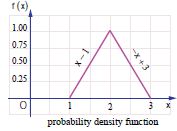
\(f(x)=\begin{cases} \begin{matrix} x-1 & 1\le x<2 \end{matrix} \\ \begin{matrix} -x+3 & 2\le x<3 \end{matrix} \\ \begin{matrix} 0 & Otherwise \end{matrix} \end{cases}\)
find
(i) the distribution function F(x)
(ii) P(1.5 ≤ X ≤ 2.5)
22.
Find the constant C such that the function
\(f(x)= \begin{cases}C x^2, & 1<x<4 \\ 0, & \text { otherwise }\end{cases}\)
is a density function, and compute
(i) P(1.5 < X < 3.5)
(ii) P(X ≤ 2)
(iii) P(3 < X )
23.
A random variable X has the following probability mass function
| x | 1 | 2 | 3 | 4 | 5 | 6 |
| f(x) | k | 2k | 6k | 5k | 6k | 10k |
Find
(i) P(2 < X < 6)
(ii) P(2 ≤ X < 5)
(iii) P(X ≤4)
(iv) P(3 < X )
24.
Find the probability mass function f(x) of the discrete random variable X whose cumulative distribution function F(x) is given by
\(F(x)=\left\{\begin{array}{lc}
0 & -\infty<x<-2 \\
0.25 & -2 \leq x<-1 \\
0.60 & -1 \leq x<0 \\
0.90 & 0 \leq x<1 \\
1 & 1 \leq x<\infty
\end{array}\right.\)
Also find
(i) P(X < 0) and
(ii) P(\(X \geq-1)\)
25.
A six sided die is marked ‘1’ on one face, ‘2’ on two of its faces, and ‘3’ on remaining three faces. The die is rolled twice. If X denotes the total score in two throws.
(i) Find the probability mass function.
(ii) Find the cumulative distribution function.
(iii) Find P(3 ≤ X< 6)
(iv) Find P(X ≥ 4) .

26.
If the probability mass function f(x) of a random variable X is
| x | 1 | 2 | 3 | 4 |
| f (x) | \(\cfrac { 1 }{ 12 } \) | \(\cfrac { 5 }{ 12 } \) | \(\cfrac { 5 }{ 12 } \) | \(\cfrac { 1 }{ 12 } \) |
find (i) its cumulative distribution function, hence find
(ii) P(X ≤ 3) and,
(iii) P(X ≥ 2)
27.
The mean and standard deviation of a binomial variate X are respectively 6 and 2.
Find
(i) the probability mass function
(ii) P(X = 3)
(iii) P(X\(\ge \)2).
28.
If the probability that a fluorescent light has a useful life of at least 600 hours is 0.9, find the probabilities that among 12 such lights
(i) exactly 10 will have a useful life of at least 600 hours
(ii) at least 11 will have a useful life of at least 600 hours
(iii) at least 2 will not have a useful life of at least 600 hours.
29.
The probability density function random variable X is given by \(f(x)=\begin{cases} \begin{matrix} { 16xe }^{ -4x } & for\quad x>0 \end{matrix} \\ \begin{matrix} 0 & for\quad x\le 0 \end{matrix} \end{cases}\) find the mean and variance of X.
30.
Four fair coins are tossed once. Find the probability mass function, mean and variance for number of heads occurred.
31.
Two balls are drawn in succession without replacement from an urn containing four red balls and three black balls. Let X be the possible outcomes drawing red balls. Find the probability mass function and mean for X.
32.
If X is the random variable with distribution function F(x) given by,
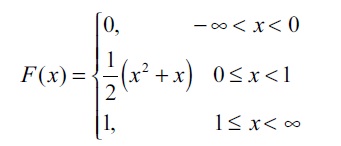
then find (i) the probability density function f(x)
(ii) P(0.3 ≤ X ≤ 0.6)
33.
If X is the random variable with probability density function f(x) given by,
\(f(x)=\begin{cases} \begin{matrix} x+1 & -1\le x<0 \end{matrix} \\ \begin{matrix} -x+1 & 0\le x<1 \end{matrix} \\ \begin{matrix} 0 & otherwise \end{matrix} \end{cases}\)
then find
(i) the distribution function F(x)
(ii) P( -0.5 ≤X ≤ 0.5)
34.
The probability density function of X is given
\(f(x)=\begin{cases} \begin{matrix} { Ke }^{ \frac { -x }{ 3 } } & \begin{matrix} for & x>0 \end{matrix} \end{matrix} \\ \begin{matrix} 0 & \begin{matrix} for & x\le 0 \end{matrix} \end{matrix} \end{cases}\)
Find
(i) the value of k
(ii) the distribution function.
(iii) P(X <3)
(iv) P(5 ≤X)
(v) P(X ≤ 4)
35.
Suppose the amount of milk sold daily at a milk booth is distributed with a minimum of 200 Iitres and a maximum of 600 litres with probability density function
\(\begin{cases} \begin{matrix} k & 200\le x\le 600 \end{matrix} \\ \begin{matrix} 0 & otherwise \end{matrix} \end{cases}\)
Find
(i) the value of k
(ii) the distribution function
(iii) the probability that daily sales will fall between 300 litres and 500 litres?
36.
The cumulative distribution function of a discrete random variable is given by
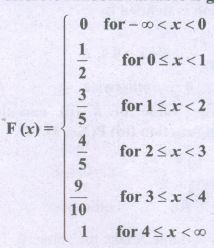
Find
(i) the probability mass function
(ii) P(X < 3) and
(iii) P(X \(\ge \)2).
37.
A random variable X has the following probability mass function.
| x | 1 | 2 | 3 | 4 | 5 |
| f(x) | k2 | 2k2 | 3k2 | 2k | 3k |
Find
(i) the value of k
(ii) P(2 \(\le\) X < 5)
(iii) P(3 < X )
38.
The cumulative distribution function of a discrete random variable is given by
\(F(x)=\left\{\begin{array}{lc}
0 & -\infty<x<-1 \\
0.15 & -1 \leq x<0 \\
0.35 & 0 \leq x<1 \\
0.60 & 1 \leq x<2 \\
0.85 & 2 \leq x<3 \\
1 & 3 \leq x<\infty
\end{array}\right.\)
Find
(i) the probability mass function
(ii) P(X < 1 ) and
(iii) P(X \(\geq\)2)
39.
Suppose a discrete random variable can only take the values 0, 1, and 2. The probability mass function is defined by
\(\\ \\ \\ \\ \\ f(x)=\begin{cases} \begin{matrix} \frac { { x }^{ 2 }+1 }{ k } & forx=0,1,2 \end{matrix} \\ \begin{matrix} 0 & otherwise \end{matrix} \end{cases}\\ \\ \\ \\ \\ \\ \)
Find
(i) the value of k
(ii) cumulative distribution function
(iii) P(X ≥ 1).
40.
Find the probability mass function and cumulative distribution function of number of girl child in families with 4 children, assuming equal probabilities for boys and girls.
41.
A six sided die is marked '1' on one face, '3' on two of its faces, and '5' on remaining three faces. The die is thrown twice. If X denotes the total score in two throws, find
(i) the probability mass function
(ii) the cumulative distribution function
(iii) P(4 ≤ X < 10)
(iv) P(X ≥ 6)
42.
The mean and variance of a binomial variate X are respectively 2 and 1.5. Find
(i) P(X = 0)
(ii) P(X =1)
(iii) P(X ≥1)
43.
A pair of fair dice is rolled once. Find the probability mass function to get the number of fours.
44.
The probability that a certain kind of component will survive a electrical test is \(\frac { 3 }{ 4 } \). Find the probability that exactly 3 of the 5 components tested survive.
45.
Using binomial distribution find the mean and variance of X for the following experiments
(i) A fair coin is tossed 100 times, and X denote the number of heads.
(ii) A fair die is tossed 240 times, and X denote the number of times that four appeared.
46.
Compute P(X = k) for the binomial distribution, B(n, p) where
n = 9, \(p=\frac { 1 }{ 2 } \), k = 7
47.
Compute P(X = k) for the binomial distribution, B(n, p) where
n = 6, \(p=\frac { 1 }{ 3 } \), k = 3
48.
The time to failure in thousands of hours of an electronic equipment used in a manufactured computer has the density function \(f(x)=\begin{cases} \begin{matrix} { 3e }^{ -3x } & x>0 \end{matrix} \\ \begin{matrix} 0 & elsewhere \end{matrix} \end{cases}\)
Find the expected life of this electronic equipment.
49.
For the random variable X with the given probability mass function as below, find the mean and variance.
\(f(x)=\begin{cases} \begin{matrix} \cfrac { 1 }{ 2 } e^{ -\frac { x }{ 2 } } & for\quad x>0 \end{matrix} \\ \begin{matrix} 0 & otherwise \end{matrix} \end{cases}\)
50.
For the random variable X with the given probability mass function as below, find the mean and variance
\(f(x)= \begin{cases}2(x-1) & 1<x<2 \\ 0 & \text { otherwise }\end{cases}\)\(\)
51.
For the random variable X with the given probability mass function as below, find the mean and variance
\(f(x)=\left\{\frac{4-x}{6} x=1,2,3\right.\)
52.
For the random variable X with the given probability mass function as below, find the mean and variance.
\(f(x)=\begin{cases} \begin{matrix} \frac { 1 }{ 10 } & x=2,5 \end{matrix} \\ \begin{matrix} \frac { 1 }{ 5 } & x=0,1,2,3,4 \end{matrix} \end{cases}\)
53.
The probability density function of X is \(f(x)= \begin{cases}x & 0<x<1 \\ 2-x & 1 \leq x<2 \\ 0 & \text { otherwise }\end{cases}\)find P(0.5≤X<1.5)
54.
The probability density function of X is \(f(x)= \begin{cases}x & 0<x<1 \\ 2-x & 1 \leq x<2 \\ 0 & \text { otherwise }\end{cases}\) find P(1.2 ≤ X < 1.8)
55.
The probability density function of X is \(f(x)= \begin{cases}x & 0<x<1 \\ 2-x & 1 \leq x<2 \\ 0 & \text { otherwise }\end{cases}\) find P(0.2 ≤ X< 0.6)
1.
(i) Given that five fair coins are tossed once. Since the coins are fair coins the probability of getting an head in a single coin is
\(p=\frac { 1 }{ 2 } \) and \(q=1-p=\frac { 1 }{ 2 } \)
Let X denote the number of heads that appear in five coins. X is binomial random variable that takes on the values 0, 1, 2, 3, 4 and 5 and \(p=\frac { 1 }{ 2 } \) That is \(X\sim B\left( 5,\cfrac { 1 }{ 2 } \right) \)
Therefore the binomial distribution is
\(f(x)=\left( \begin{matrix} n \\ x \end{matrix} \right) p*\left( 1-p \right) ^{ n-x }\), x = 0, 1, 2,..,n
becomes
\(f(x)=\left( \begin{matrix} 5 \\ x \end{matrix} \right) \left( \cfrac { 1 }{ 2 } \right) ^{ x }\left( \cfrac { 1 }{ 2 } \right) ^{ n-x }\), x = 0, 1, 2,..,5
That is
\(f(x)=\left( \begin{matrix} 5 \\ x \end{matrix} \right) \left( \cfrac { 1 }{ 2 } \right) ^{ n }\), x = 0, 1, 2...,n
(ii) A fair die is rolled ten times and X denotes the number of times 4 appeared. X is binomial
random variable that takes on the values 0, 1, 2, 3,...10 , with n = 10 and \(p=\cfrac { 1 }{ 6 } \). That is \(X\sim B\left( 10,\cfrac { 1 }{ 6 } \right) \)
Probability of getting a four in a die is \(p=\frac { 1 }{ 2 } \) and \(q=1-p=\frac { 5 }{ 6 } \)
Therefore the binomial distribution is
\(f(x)=\left( \begin{matrix} 10 \\ x \end{matrix} \right) \left( \cfrac { 1 }{ 6 } \right) ^{ x }\left( \cfrac { 5 }{ 6 } \right) ^{ 10-x }\) x = 0, 1, 2,...,10
2.
(i) Since f (x) is a probability mass function, f (x) ≥ 0 for all x , and d \(\sum_{x} f(x)=1\)
Thus, \(\sum_{x} f(x)=1\)
\(c^{2}+2 c^{2}+3 c^{2}+4 c^{2}+c+2 c=0\)
\(c=\frac{1}{5} \text { or }-\frac{1}{2}\)
Since f x( ) ≥ 0 for all x , the possible value of c is \(\frac{1}{5}\)
Hence, the probability mass function is
| x | 1 | 2 | 3 | 4 | 5 | 6 |
| f(x) | \( \frac{1}{25} \) | \( \frac{2}{25} \) | \( \frac{3}{25} \) | \(\frac{4}{25} \) | \(\frac{1}{5}\) | \( \frac{2}{5}\) |
(ii) To find mean and variance, let us use the following table
| x | f(x) | xf(x) | x2f(x) |
| 1 | \(\cfrac { 1 }{ 25 } \) | \(\cfrac { 2 }{ 25 } \) | \(\cfrac { 1 }{ 25 } \) |
| 2 | \(\cfrac { 2 }{ 25 } \) | \(\cfrac { 4 }{ 25 } \) | \(\cfrac { 8 }{ 25 } \) |
| 3. | \(\cfrac { 3 }{ 25 } \) | \(\cfrac { 9 }{ 25 } \) | \(\cfrac { 27 }{ 25 } \) |
| 4. | \(\cfrac { 4 }{ 25 } \) | \(\cfrac { 16 }{ 25 } \) | \(\cfrac { 64 }{ 25 } \) |
| 5. | \(\cfrac { 1 }{ 5 } \) | \(\cfrac { 5 }{ 5 } \) | \(\cfrac { 25 }{ 5 } \) |
| 6. | \(\cfrac { 2 }{ 25 } \) | \(\cfrac { 12 }{ 5 } \) | \(\cfrac { 72 }{ 5 } \) |
| \(\Sigma f(x)=1\) | \(\Sigma xf(x)=\cfrac { 115 }{ 25 } \) | \({ \Sigma x }^{ 2 }f(x)=\cfrac { 585 }{ 25 } \) |
Mean : \(E(X)=\Sigma xf(x)=\frac { 115 }{ 25 } =4.6\)
Variance : \(V(x)=E\left( x \right) ^{ 2 }=\Sigma { x }^{ 2 }f(x)-\left( \Sigma xf(x) \right) ^{ 2 }\)
= \(\frac { 585 }{ 25 } -\left( \frac { 115 }{ 25 } \right) ^{ 2 }=23.40-21.16=2.24\)
Therefore the mean and variance are 4.6 and 2.24 respectively.
3.
(i) Since f (x) is a probability density function, f (x) ≥ 0 and \(\int _{ - }^{ \infty }{ f(x) } dx=1\)
That is \(\int _{ -\infty }^{ 0 }{ 0dx } +\int _{ 0 }^{ \infty }{ k{ e }^{ -2x }dx } =1\)
\(0+k\left( \frac { { e }^{ -2x } }{ -2 } \right) =1\Rightarrow k\left( \frac { { e }^{ -\infty }-{ e }^{ 0 } }{ -2 } \right) =1\Rightarrow k=2\)
Therefore the probability density function is
\(f\left( x \right) =\begin{cases} \begin{matrix} 2{ e }^{ -2x } & forx>0 \end{matrix} \\ \begin{matrix} 0 & forx \end{matrix}\le 0 \end{cases}\)
(ii) Distribution function
By definition the distribution function \(F(x)=P\left( x\le x \right) =\int _{ -\infty }^{ x }{ f(u) } du\)
When x≤0 \(F(x)=\int _{ -\infty }^{ x }{ F(u) } du=\int _{ -\infty }^{ x }{ odu=0 } \)
When x > 0 \(F(x)=\int _{ -\infty }^{ x }{ f(u) } du\int _{ -\infty }^{ x }{ 0du } +\int _{ 0 }^{ x }{ { 2e }^{ -2x }du\left( \frac { { e }^{ -2x } }{ -2 } \right) } =1-{ e }^{ 2x }\)
This gives \(F(x)=\begin{cases} \begin{matrix} 0 & forx\le 0 \end{matrix} \\ \begin{matrix} 1-{ e }^{ 2x } & forx>0 \end{matrix} \end{cases}\)
(iii) P(X < ) = P(X ≤2 ) = F(2 ) = 1-e2\(\times\)2 (since F(x) is continuous)
(iv) The probability that X is at least equal to four unit of time is
P(X ≥ 4 ) = 1 - P(X < 4 ) = 1- F( 4) = 1 - ( 1-e-2\(\times\)4) = e8
(v) In the continuous case, f (x) at x = a is not the probability that X takes the value a, that is f (x) at x = a is not equal to P( X ) a. If X is continuous type, P(X = a) = 0 for a ∈ R. Therefore P(x = 3) = 0.
4.
(i) Differentiating F(x) with respect to x at continuity points of f(x), we get
\(f(x)={ F }^{ 1 }(x)=\begin{cases} \begin{matrix} 0 & x<0 \end{matrix} \\ \begin{matrix} 1 & 0\le x<1 \end{matrix} \\ \begin{matrix} 0 & x\ge 1 \end{matrix} \end{cases}\)
The pdf f(x) is not continuous at x = 0, or at x = 1. We can define f(0) and f(1) in any manner. Choosing f(0) = 1, and f(1) = 0 .
Therefore the probability density function f(x) is
\(f(x)=\begin{cases} \begin{matrix} 1 & 0\le x<1 \end{matrix} \\ \begin{matrix} 0 & otherwise \end{matrix} \end{cases}\)
(ii) P(0.2 ≤ X ≤ 0.7) = F(0.7) − F(0.2)
= 0.7-0.2 = 0.5
\(P(0.2\le X\le 0.7)=\int _{ 0.2 }^{ 0.7 }{ f(x) } dx=\int _{ 0.2 }^{ 0.7 }{ 1dx } =0.5\)
5.
\(S=\left\{\begin{array}{l} (1,1),(1,2),(1,3),(1,4),(1,5),(1,6) \\ (2,1),(2,2),(2,3),(2,4),(2,5),(2,6) \\ (3,1),(3,2),(3,3),(3,4),(3,5),(3,6) \\ (4,1),(4,2),(4,3),(4,4),(4,5),(4,6) \\ (5,1),(5,2),(5,3),(5,4),(5,5),(5,6) \\ (6,1),(6,2),(6,3),(6,4),(6,5),(6,6) \end{array}\right\}\)
(i) The sample space
S = {1, 2, 3, 4, 5, 6}\(\times\){1, 2, 3, 4, 5, 6}
consists of 36 ordered pairs (α, β) where α and β can take any integer value between 1 and 6 as shown. X is assigned to each point (α, β) the sum of the numbers on the dice .
That is X (α, β) = α + β
Therefore
X (1,1) = 1+1 = 2
X (1, 2) = X (2,1) = 3
X (1,3) = X (2,2) = X (3,1)= 4
X (1, 4) = X (2,3) = X (3, 2) X (4,1) = 5
X (1,5) = X (2,4) = X (3,3) = X (4, 2) = X (5,1) = 6
X (1,6) = X (2,5) = X (3, 4) = X (4,3 = X (5, 2) X (6,1) = 7
X (2,6) = X (3,5) = X (4,4) = X (5,3) = X (6,2) = 8
X (3,6) = X (4,5) = X (5,4) X (6,3) = 9
X (4,6) = X (5,5) X (6,4) = 10
X (5,6) = (6,5) = 11
X (6,6) = 12
(ii) Then the random variable X takes on the values 2, 3, 4, 5, 6, 7, 8, 9, 10, 11, 12.
(iii) The inverse images of 10 is {(4, 6), (5, 5), (6, 4)}.
(iv) The number of inverse images are given below
| Values of the random variable | 2 | 3 | 4 | 5 | 6 | 7 | 8 | 9 | 10 | 11 | 12 | Total |
| Number of elements in inverse image | 1 | 2 | 3 | 4 | 5 | 6 | 5 | 4 | 3 | 2 | 1 | 36 |
6.
n = 5, X B{n, p)
P(X = 1) = 0.4096
P(X = 2) 0.2048
P(X = x) = nCx px qn-x, x = 0, 1, 2, .., n
ஃnC1,p1q4 0.4096
5C1, p2q4 = 0.4096
5C2 p2q3 = 0.2048
5pq4 = 0.4096 .....(1)
10 p2 q3 = 0.2048 ....(2)
Dividing (2) by (1) we get
\(\cfrac { 5{ pq }^{ 4 } }{ 10{ p }^{ 2 }{ q }^{ 3 } } =2\)
q = 4p
q = 4(1- q)
q = 4 - 4q
5q = 4
q = 4/5
\(p=1-q= p=\frac { 1 }{ 5 } \)
\(Mean=np=5\times \frac { 1 }{ 5 } =1\)
\( Variance =n p q=\not 5 \times \frac{1}{\not 5} \times \frac{4}{5}=\frac{4}{5}\)
Distribution
(i) \(P(X=x)= ^5C_{ x }\left( \frac { 1 }{ 5 } \right) ^{ x }\left( \frac { 4 }{ 5 } \right) ^{ 5-x }\) , x = 0,1,2..n
7.
X B(n, p)
Given 4P(X = 4) = P(X = 2) and n = 6.
4. [6C4p4 (1 - p)2] = 6C2p2 q4
⇒ 4p2 = q2
⇒ 4(1-q2) = q2
4(1-2q+q2) = q2
⇒ 3q2 - 8q +4 = 0
⇒ (q - 2)(3q - 2) = 0
\( -q=\frac { 2 }{ 3 } \ \ \ (q\neq2)\)
\(p = 1- q=\cfrac { 1 }{ 3 } \)
Distribution
P(X = x) = nCxpx (1- p)n-x, x = 0, 1,2, ... n
(i) \(P(X=x)= ^6C_{ x }\left( \frac { 1 }{ 3 } \right) ^{ x }\left( \frac { 2 }{ 3 } \right) ^{ 6-x }\) , x = 0,1,2..n
(ii) \(mean=np=6\times \frac { 1 }{ 3 } =2\)
(iii) standard deviation = \(\sqrt { npq } =\sqrt { 2 \times \frac {2}{ 3 } } \)
= \( { \frac { 2 }{ \sqrt 3 } } \)
8.
Let p be the probability that indicates the defective rate of an electronic device
n = 10
\(P=5\%=0.05 \)
q = 1 - p
n = 10, p = 0.05, X ~ B(n, p)
P(X = x) = nCx px qn-x, x = 0, 1,2, .., n
(i) Atleast 1 defective item
P(X ≥ 1) = 1 - P(X < 1)
= 1-P(X = 0)
= 1-10C0 (0.05)0 (0.95)10
P(X ≥1) = 1 - (0.95)10
(ii) Exactly two defective items
P(X = 2) =10C2(0.05)2 (0.95)8
9.
Given P (hitting the target) = \(\frac { 1 }{ 4 } \Rightarrow P=\frac { 1 }{ 4 } \)
n = 10,
(i) P(X = 4)
\(P(X+4)=\left( \begin{matrix} n \\ x \end{matrix} \right) { p }^{ x }(1-p)^{ n-x },x\)
= 0,1,2,...n
(i) Probability of hitting the target exactly 4 times
P(X = 4) = \(^{10}{ C }_{ 4 } \times\left( \begin{matrix} 1 \\ 4 \end{matrix} \right) ^{ 4 }\times \left( \cfrac { 3 }{ 4 } \right) ^{ 6 }\)
\( =\frac{10 \times 9 \times 8 \times 7}{4 \times 3 \times 2} \times \frac{1}{4^{4}} \times \frac{3^{6}}{4^{6}} \\ =210 \times \frac{3^{6}}{4^{10}} \)
(ii) Probability of hitting atleast one time
= P(X≥1) = 1-P(x<1)
= 1-P(X = 0)
\( =1-{ }^{10} \mathrm{C}_{0} \times\left(\frac{1}{4}\right)^{0} \times\left(\frac{3}{4}\right)^{10} \\ =1-\frac{3^{10}}{4^{10}} \)
10.
11.
Expected value = \(\mu=\int_{-\infty}^{\infty} x f(x) d x=\int_{-\infty}^0 x(0) d x+\int_0^{30} \frac{x}{30} d x+\int_{30}^{\infty} x(0) d x\)
\(=\int_0^{30} \frac{x}{30} d x=\frac{1}{60}\left[x^2\right]_0^{30}=15\)
Average delay is 15 minutes.
12.
Given E(X + 3) = 10
E(aX + b) = aE(X) + b
⇒ E(X) + 3 = 10
E(X) + 3 = 10
⇒ E(X) = 7
⇒μ = 7 ...(1)
E(X + 3)2 = 116
E(X2 + 6x + 9) 116
E(X2) + 6E(X) + 9 = 116 [ஃ E(9) = 9]
E(X2) + 6(7) + 9 = 116
E(X2) + 116 - 42 - 9 116 - 51
E(X2) = 65 ...(2)
Var(X) = E(X2) - [E(X)2]
65 - 72 = 65 - 49 = 16
ஃμ = 7 and σ2 = 16.
13.
Let X be the random variable denotes the total C score is two throws of a die.
Sample space S
| II | 2 | 3 | 3 | 4 | 4 | 4 |
| I | ||||||
| 2 | 4 | 5 | 5 | 6 | 6 | 6 |
| 3 | 5 | 6 | 6 | 7 | 7 | 7 |
| 3 | 5 | 6 | 6 | 7 | 7 | 7 |
| 4 | 6 | 7 | 7 | 8 | 8 | 8 |
| 4 | 6 | 7 | 7 | 8 | 8 | 8 |
| 4 | 6 | 7 | 7 | 8 | 8 | 8 |
n (S) = 36
X = {4,5,6,7,8}
From the sample space
| Values of random variable | 4 | 5 | 6 | 7 | 8 | Total |
| No of points in inverse image | 1 | 4 | 10 | 12 | 9 | 36 |
14.
Let X be the random variable denotes the Winning amount.
X (Both are black balls) = Rs. 2 (-10) = Rs. -20
X (one red and oneblack ball) = Rs.15-Rs. 10 = Rs. 5
X (both are red ball) = Rs. 2 (15) = Rs. 30
= {-20, 5, 30}
The sample space consists of 14C2 = 91
X = -20, Both are black balls= 8C1 = 28
X = 5, One black, one redball = 8C1 x 6C1 = 8 x 6 = 48
X = 30, Both are white balls = 6C1 = 15
| Values of random variable | 30 | 5 | -20 | Total |
| Number of points in inverse image | 15 | 48 | 28 | 91 |
15.
Let X be the random variable of getting apples Given 5 mangoes and 4 apples are in an urn
= {0, 1,2,3}
The sample space consists of 9C3 = 84
X = 0, X (3 mangoes) = 5C3 = 10
X = 1, X (2 mangoes and 1 apples) = 5C2 x 4C1 = 40
X = 2, X (1 mangoes and 2 apples) = 5C1 x 4C2 = 30
X = 3, X (apples) = 4C3 = 4
| Values of random variable | 0 | 1 | 2 | 3 | Total |
| No of points in inverse image | 10 | 40 | 30 | 4 | 84 |
16.
Let X be the random variable of number of black cards occur.
X = {0,1,2}
Sample space 52C2 = 1326
Let X denote the number of black cards drawn.
X = 0, X (both are red cards) = 26C2 = 325
X = 1 (1 black card and 1 red card) = 26C1 \(\times\) 26C1 = 676
X = 2 (both are black cards) = 26C2 = 325
∴ X takes the values 0, 1, 2
| Values of random variable X | 0 | 1 | 2 | Total |
| Number of elements in inverse images | 325 | 676 | 325 | 1326 |
17.
Given that n = 6
Probability for selecting a defective product is \(\frac { 20 }{ 100 } \) that is \(p=\frac { 1 }{ 5 } \)
Since X denotes the number defective products, X can take on the values 0,1,2,...,6
The probability for defective (success) is \(p-\frac { 1 }{ 5 } \) and for failure \(q=1-p=\frac { 4 }{ 5 } \), and n = 6
Therefore X follows a binomial distribution denoted by \(X\sim B\left( 6,\frac { 1 }{ 5 } \right) \)
This gives \(f(x)=\left( \begin{matrix} 6 \\ x \end{matrix} \right) \left( \cfrac { 1 }{ 5 } \right) ^{ x }\left( \cfrac { 4 }{ 5 } \right) ^{ 6-x }\), x = 0,1,2,...,6,
(i) Probability for two defective products is
\(P(X=2)=f(2)=\left( \begin{matrix} 6 \\ x \end{matrix} \right) \left( \cfrac { 1 }{ 5 } \right) ^{ x }\left( \cfrac { 4 }{ 5 } \right) ^{ 6-x }=15\left( \cfrac { { 4 }^{ 4 } }{ { 5 }^{ 6 } } \right) \)
(ii) Probability for at most one defective products is
P(X ≤1) = P(X = 0) + P(X = 1)
\(-\left( \begin{matrix} 6 \\ 0 \end{matrix} \right) \left( \cfrac { 1 }{ 5 } \right) ^{ 0 }\left( \cfrac { 4 }{ 5 } \right) ^{ 6-0 }+\left( \begin{matrix} 6 \\ 1 \end{matrix} \right) \left( \frac { 1 }{ 5 } \right) ^{ 1 }\left( \cfrac { 4 }{ 5 } \right) ^{ 6-1 }\)
\(-\left( \cfrac { 4 }{ 5 } \right) ^{ 6 }+\left( 6 \right) \left( \cfrac { { 4 }^{ 2 } }{ { 5 }^{ 2 } } \right) =2\left( \cfrac { 4 }{ 5 } \right) ^{ 2 }\)
Probability for at most one defective products is \(2\left( \frac { 4 }{ 5 } \right) ^{ 5 }\)
(iii) Probability for at least two defective products is
P(X≥2)-1-P(X<2) = 1-P(X≤1) = \(1-2\left( \frac { 4 }{ 5 } \right) ^{ 5 }\)
Probability for at least two defective products is \(1-2\left( \frac { 4 }{ 5 } \right) ^{ 5 }\)
18.
(i) Since X denotes the number of success, X can take the values 0,1, 2, ...10
The probability for success is \(p=\frac { 1 }{ 4 } \) and for failure \(q=1-p=\frac { 3 }{ 4 } \) and n = 10
Therefore X follows a binomial distribution denoted by \(X\sim B\left( 10,\frac { 1 }{ 4 } \right) \)
This gives,\(f(x)=\left( \begin{matrix} 10 \\ x \end{matrix} \right) \left( \cfrac { 1 }{ 4 } \right) ^{ x }\left( \cfrac { 3 }{ 4 } \right) ^{ 10-x }\) x = 0, 1, 2,..,10
(ii) Probability for seven correct answers is
\(P(X=7)=f(7)=\left( \begin{matrix} 10 \\ 7 \end{matrix} \right) \left( \cfrac { 1 }{ 4 } \right) ^{ 7 }\left( \cfrac { 3 }{ 4 } \right) ^{ 10-7 }=120\left( \cfrac { { 3 }^{ 2 } }{ { 4 }^{ 10 } } \right) \)
Probability that the student will get seven correct answers is \(120\left( \cfrac { { 3 }^{ 2 } }{ { 4 }^{ 10 } } \right) \)
(iii) Probability for at least one correct answer is
P(X ≥1) = 1- P(X <1) = 1- P(X = 0)
= \(1-\left( \begin{matrix} 10 \\ 0 \end{matrix} \right) \left( \cfrac { 1 }{ 4 } \right) ^{ 0 }\left( \cfrac { 3 }{ 4 } \right) ^{ 10 }=1-\left( \cfrac { 3 }{ 4 } \right) ^{ 10 }\)
Probability that the student will get for at least one correct answer is \(1-\left( \cfrac { 3 }{ 4 } \right) ^{ 10 }\)
19.
Let X denote the winning amount. The possible events of selection are
(i) both balls are black, or
(ii) one white and one black or
(iii) both are white
Therefore X is a random variable that can be defined as
X (both are black balls) = Rs. 2(20) = Rs. 40
X (one black and one white ball) = Rs. 20 − Rs. 10 = Rs. 10
X (both are white balls) = (Rs. 20) = - Rs. 20
Therefore X takes on the values 40,10 and −20
Total number of balls n = 12
Total number of ways of selecting 2 balls = \(\left( \begin{matrix} 12 \\ 2 \end{matrix} \right) =\frac { 12\times 11 }{ 1\times 2 } =66\)
Number of ways of selecting 2 black balls = \(\left( \begin{matrix} 4 \\ 2 \end{matrix} \right) =6\)
Number of ways of selecting one black ball and one white ball = \(\left( \begin{matrix} 8 \\ 1 \end{matrix} \right) \left( \begin{matrix} 4 \\ 1 \end{matrix} \right) =32\)
Number of ways of selecting 2 white balls = \(\left( \begin{matrix} 8 \\ 2 \end{matrix} \right) =28\)
| Values of Random Variable X | 40 | 10 | -20 | Total |
| Number of elements in inverse images | 6 | 32 | 28 | 66 |
Probability mass function is
| X | 40 | 10 | -20 | Total |
| f (x) | \(\cfrac { 6 }{ 66 } \) | \(\cfrac { 32 }{ 66 } \) | \(\cfrac { 28 }{ 66 } \) | 1 |
Mean :
\(E(X)\Sigma xf(x)=40.\left( \frac { 6 }{ 66 } \right) +10.\left( \frac { 32 }{ 66 } \right) +\left( -20 \right) .\left( \frac { 28 }{ 66 } \right) =\frac { 4000 }{ 11 } \)
That is expected winning amount is 0
Variance :
\(\Sigma x^{ 2 }=\Sigma { x }^{ 2 }f(x)=40^{ 2 }.\left( \frac { 6 }{ 66 } \right) +10^{ 2 }.\left( \frac { 32 }{ 66 } \right) +\left( -20 \right) ^{ 2 }.\left( \frac { 28 }{ 66 } \right) =\frac { 4000 }{ 11 } \)
(E(X )2 = 02 = 0
This gives \(V(X)=E({ X }^{ 2 })-\left( E(X))^{ 2 } \right) =\frac { 4000 }{ 11 } -0=\frac { 4000 }{ 11 } \)
Therefore E(X ) = 0 and \(V(x)=\frac { 4000 }{ 11 } \)
20.
Since f (x) is a probability density function, f (x) ≥ 0 and \(\int _{ -\infty }^{ \infty }{ f(x) } dx=1\)
That is \(\int _{ -\infty }^{ 1 }{ 0dx } +\int _{ 1 }^{ 5 }{ kdx } +\int _{ 5 }^{ \infty }{ 0dx } =1\)
\(0+k\left( x \right) _{ 1 }^{ 5 }+0=1\Rightarrow 4k=1\Rightarrow k=\frac { 1 }{ 4 } \)
Therefore the probability density function is
\(f\left( x \right) =\begin{cases} \begin{matrix} \frac { 1 }{ 4 } & 1\le x\le 5 \end{matrix} \\ \begin{matrix} 0 & Otherwise \end{matrix} \end{cases}\)
(i) Distribution function
The distribution function
\(F(x)=P\left( X\le x \right) =\int _{ -\infty }^{ x }{ f(u)dx } \)
When x < 1, \(F(x)=\int _{ -\infty }^{ x }{ f(u)du } =\int _{ -\infty }^{ x }{ oldu } =0\)
When 1 ≤ x ≤ 5 \(F(x)=\int _{ -\infty }^{ x }{ f(u)du=\int _{ -\infty }^{ x }{ 0du } +\int _{ 1 }^{ x }{ odu } +\int _{ 1 }^{ x }{ \frac { 1 }{ 4 } du } =\frac { 1 }{ 4 } (x-1) } \)
When x ≥ 5 \(F(x)=\int _{ -\infty }^{ x }{ f(u) } du=\int _{ -\infty }^{ x }{ odu } +\int _{ 1 }^{ 5 }{ \frac { 1 }{ 4 } du } +\int _{ 1 }^{ 5 }{ \frac { 1 }{ 4 } du } +\int _{ 5 }^{ 5 }{ odu } =1\)
Thus \(F(x)=\begin{cases} \begin{matrix} 0 & x<1 \end{matrix} \\ \begin{matrix} \frac { x-1 }{ 1 } & 1\le x\le 5 \end{matrix} \\ \begin{matrix} 1 & x>5 \end{matrix} \end{cases}\)
(ii) P(X < 3) = P(X ≤ 3) = F(3) = \(\frac { 3-1 }{ 2 } =\frac { 1 }{ 2 } \) (Since F(x) is continuous)
(iii) P(2 < X < 4) = P(2 ≤ X ≤ 4) F(4) - F(2) = \(\frac { 3 }{ 4 } -\frac { 1 }{ 4 } =\frac { 1 }{ 2 } \)
(iv) P(3 ≤ X ) = P(X ≥ 3) = 1− P(X < 3) = 1 - \(1-\frac { 1 }{ 2 } =\frac { 1 }{ 2 } \)
21.
(i) By definition \(F(x)=\le x)=\int _{ -\infty }^{ x }{ f(u)dx } \)
When x < 1 \(F(x)=P\left( x\le x \right) =\int _{ 1 }^{ x }{ odu+\int _{ 1 }^{ 0 }{ (u-1) } du } \)
When 1 ≤ x < 2 \(F(x)=P(X\le x)=\int _{ -\infty }^{ x }{ odu } =0\)
When 1 ≤ x < 2 \(F(x)=P\left( x\le x \right) =\int _{ 1 }^{ x }{ odu+\int _{ 1 }^{ 0 }{ (u-1) } du } \)
= \(0+\left[ \frac { \left( u-1 \right) ^{ 2 } }{ 2 } \right] =\frac { \left( x-1 \right) ^{ 2 } }{ 2 } \)
When 2 ≤ x <3 \(F(x)=P(X\le x)=\int _{ -\infty }^{ 1 }{ du } +\int _{ 1 }^{ 2 }{ \left( u-1 \right) du } +\int _{ 2 }^{ x }{ \left( 3-u \right) du } \)
= \(0+\left[ \frac { \left( u-1 \right) ^{ 2 } }{ 2 } \right] +\left[ \frac { (3-u)^{ 2 } }{ 2 } \right] \)
= \(\frac { { 1 }^{ 2 }-0 }{ 2 } +\frac { 1-(3-x)^{ 2 } }{ 2 } =1\frac { \left( 3-x \right) ^{ 2 } }{ 2 } \)
When x ≥ 3, \(F(x)=P\left( X\le x \right) =\int _{ -\infty }^{ 1 }{ odu } +\int _{ 1 }^{ 3 }{ (u-1) } +\int _{ 2 }^{ 1 }{ (3-u) } +\int _{ 3 }^{ x }{ odu } \)
= \(\int _{ -\infty }^{ 1 }{ 0du } +\int _{ 1 }^{ 2 }{ (u-1)du } +\int _{ 2 }^{ 3 }{ (3-u) } du+\int _{ 3 }^{ x }{ 0du } \)
= \(0+\left[ \frac { \left( u-1 \right) ^{ 2 } }{ 2 } \right] +\left[ \frac { \left( 3-u \right) ^{ 2 } }{ 2 } \right] _{ 2 }^{ 3 }+0\)
= \(\cfrac { 1 }{ 2 } +\cfrac { 1 }{ 2 } =1\)
These give
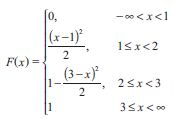
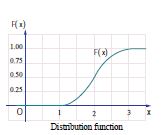
(ii) P(1.5 ≤ X ≤ 2.5) = F(2.5) − F(1.5)
= \(\left( 1-\frac { \left( 3-2.5 \right) ^{ 2 } }{ 2 } \right) -\left( \frac { \left( 1.5-1 \right) ^{ 2 } }{ 2 } \right) \)
= \(\cfrac { 1.75-0.25 }{ 2 } =0.75\)
\(P\left( 1.5\le X\le \right) =\int _{ 1.5 }^{ 2.5 }{ f(x)dx } =\int _{ 1.5 }^{ 2 }{ (x-1) } dx+\int _{ 2 }^{ 2.5 }{ (-x+3) } dx=0.75\)
22.
Since the given function is a probability density function

\(\int _{ -\infty }^{ \infty }{ f(x) } dx=1\)
That is \(\int _{ -\infty }^{ 1 }{ f(x) } dx+\int _{ 1 }^{ 4 }{ f(x) } dx+\int _{ 4 }^{ \infty }{ f(x) } dx=1\)
From the given information
\(\int _{ -\infty }^{ 1 }{ 0dx } +\int _{ 1 }^{ 4 }{ { Cx }^{ 2 }dx } +\int _{ 4 }^{ \infty }{ 0dx } =1\)
\(0+C\left[ \cfrac { { x }^{ 3 } }{ 3 } \right] _{ 1 }^{ 4 }+0=1\Rightarrow C\left[ \cfrac { 64-1 }{ 3 } \right] =1\Rightarrow 21C\Rightarrow C=\cfrac { 1 }{ 21 }\)
Therefore the probability density function is
\(\)\(f(x)=\left\{C x^2, \quad x>1\right.\)
Since f (x) is continuous, the probability that X is equal to any particular value is zero. Therefore when the random variable is continuous, either or both of the signs < by ≤ and > by ≥ can be interchanged. Thus
(i) P(1.5 < X < 3.5) = P(1.5 ≤ X< 3.5)= P(1.5 < X ≤3.5) = P(1.5 ≤X ≤ 3.5)
Therefore
\(P(1.5<X<3.5)=\int_{1.5}^{3.5} f(x) d x\)

\(\begin{aligned} & =\frac{1}{21}\left(\frac{x^3}{3}\right)=\frac{1}{21}\left(\frac{(3.5)^3-(1.5)^3}{3}\right) \\ & =\frac{79}{126} \end{aligned}\)
(ii) \(P(X \leq 2)=\int_{-\infty}^2 f(x) d x=\int_{-\infty}^1 f(x) d x+\int_1^2 f(x) d x\)
Therefore
\(\begin{aligned} & P(X \leq 2)=0+\frac{1}{21} \int_1^2 x^2 d x=\frac{1}{21}\left(\frac{x^3}{3}\right)_1^2 \\ & =\frac{1}{21}\left(\frac{2^3-1^3}{3}\right)=\frac{7}{63} \end{aligned}\)
(iii) P(3 < X )

\(\begin{aligned} & =\frac{1}{21} \int_3^4 x^2 d x+0=\frac{1}{21}\left(\frac{x^3}{3}\right)_3^4 \\ & =\frac{1}{21}\left(\frac{4^3-3^3}{3}\right)=\frac{37}{63} \end{aligned}\)
23.
Since the given function is a probability mass function, the total probability is one. That is \(\underset { x }{ \Sigma } f(x)=1\)
From the given data k + 2k + 6k + 5k + 6k +10k+1
\(30k=1\Rightarrow k=\frac { 1 }{ 30 } \)
Therefore the probability mass function is
| x | 1 | 2 | 3 | 4 | 5 | 6 |
| f(x) | \(\cfrac { 1 }{ 30 } \) | \(\cfrac { 2 }{ 30 } \) | \(\cfrac { 6 }{ 30 } \) | \(\cfrac { 5 }{ 30 } \) | \(\cfrac { 6 }{ 30 } \) | \(\cfrac { 10 }{ 30 } \) |
(i) P(2 < X < 6) = f(3)+ f(4)+ f(5) = \(\frac { 6 }{ 30 } +\frac { 5 }{ 30 } +\frac { 6 }{ 30 } =\frac { 17 }{ 30 } \)
(ii) P(2≤X≤5) = f(2)+f(3)+f(4) = \(\frac { 2 }{ 30 } +\frac { 6 }{ 30 } +\frac { 5 }{ 30 } =\frac { 13 }{ 30 } \)
(iii) P(2≤4) = f(1)+f(2)+f(3)+f(4) = \(\frac { 1 }{ 30 } +\frac { 2 }{ 30 } +\frac { 6 }{ 30 } +\frac { 5 }{ 30 } =\frac { 14 }{ 30 } \)
(iv) P(3>X) = f(4)+f(5)+f(6) = \(\frac { 5 }{ 30 } +\frac { 6 }{ 30 } +\frac { 10 }{ 30 } =\frac { 21 }{ 30 } \)
24.
Since X is a discrete random variable, from the given data, X takes on the values
−2, −1, 0, and 1.
For discrete random variable X, by definition, we have f (x) = P(X = x)
Therefore left hand limit of f(x) at x = -2 is F(− 2− )
f (−2) = P(X =-2 ) = F(-2 ) - F(- 2- )= 0.25-0 = 0.25
Similarly for other jump points, we have
f (−1) = P(X = -1) = F(-1) - F(-2) = 0.60 - 0.25 = 0.35.
f (0) = P(X ) 0) = F(0) - F(-1) = 0.90 - 0.60 = 0.30 ,
f (1) = P(X =1) = F(1) - F(0) 1- 0.90 = 0.10 .
Therefore the probability mass function is
| x | -2 | -1 | 0 | 1 |
| f(x) | 0.25 | 0.35 | 0.30 | 0.10 |
The distribution function F(x) has jumps at x = -2, -1, 0, and 1. The jumps are respectively 0.25, 0.35, 0.30, and 0.1 is shown in the figure given below.
These jumps determine the probability mass function

(i) \(P(X<0)=\sum _{ -\infty }^{ -1 }{ P(X=x)=P(X=-1)=0.25+0.35 } =0.60\)
(ii) \(P(X\ge -1)=\sum _{ -1 }^{ 1 }{ P(X=x)=P(x=-1) } +P(X=0)+P(X=1)=0.35+030+0.10=0.75\)
25.
Since X denotes the total score in two throws, it takes on the values 2, 3, 4, 5 and 6. From the Sample space S, we have

Values of the Random Variable | 2 | 3 | 4 | 5 | 6 | Total |
Number of elements in inverse images | 1 | 4 | 10 | 12 | 9 | 36 |
\(P(X=2)=\frac { 1 }{ 36 }\), \(P(X=3)=\frac { 4 }{ 36 }\)
\(P\left( X=4 \right) =\frac { 10 }{ 36 }\) , \(P(X=5)=\frac { 12 }{ 36 }\) and
\(P(X=6)=\frac { 9 }{ 36 }\)
(i) Probability mass function is

x | 2 | 3 | 4 | 5 | 6 |
f(x) | \(\cfrac { 1 }{ 36 }\) | \(\cfrac { 4 }{ 36 }\) | \(\cfrac { 10 }{ 36 }\) | \(\cfrac { 12}{ 36 }\) | \(\cfrac { 9 }{ 36 }\) |
(ii) Cumulative distribution function By definition of the cumulative distribution function for discrete random variable we have
\(f(x)=P(X\le x)=\underset { x_{ 1 }\le x }{ \Sigma } P(X={ x }_{ 1 })\)
\(P(X=x)= \begin{cases}0, & -\infty<x<\cdots \\ \cdots & \end{cases}\)
\(\begin{aligned} & \left.F(2)=P(X \leq 2)=\sum_{-\infty}^2 P(X=x)=P(X)<2\right)+P(X=2)=0+\frac{1}{36}=\frac{1}{36} \\ & F(3)=P(X \leq 3)=\sum_{-\infty}^3 P(X=x)=P(x<2)+P(X=2)+P(X=3)+P(X=4)=0+\frac{1}{36}+\frac{4}{36}+\frac{10}{36}=\frac{15}{36} \end{aligned}\)
\(\begin{aligned} & F(4)=P(X \leq 3)=\sum_{-\infty}^3 P(X=x)=P(x<2)+P(X=2)+P(X=3)+P(X=4) \\ & 0+\frac{1}{36}+\frac{4}{36}+\frac{10}{36}=\frac{15}{36} \\ & F(5)=P(X \leq 5)=\sum_{-\infty}^5 P(X=x)=P(X<2)+P(X=3)+P(X=4)+P(X=5) \\ & =0+\frac{1}{36}+\frac{4}{36}+\frac{10}{36}+\frac{12}{36}=\frac{27}{36} \end{aligned}\)
\(\begin{aligned} & F(6)=P(X \leq 6)=\sum_{-\infty}^6 P(X=x) \\ & =P(X<2)+P(X=2)+P(X=3)+P(x=4)+P(x=5) P(X=6) \\ & 0+\frac{1}{36}+\frac{4}{36}+\frac{10}{36}+\frac{12}{36}+\frac{9}{36}=1 \end{aligned}\)
Therefore the cumulative distribution function is
\(F(x)= \begin{cases}0, & -\infty<x<2, \\ \frac{1}{36}, & 2 \leq x<3, \\ \frac{5}{36}, & 3 \leq x<4, \\ \frac{15}{36}, & 4 \leq x<5, \\ \frac{27}{36}, & 5 \leq x<6, \\ 1, & 6 \leq x<\infty .\end{cases}\)
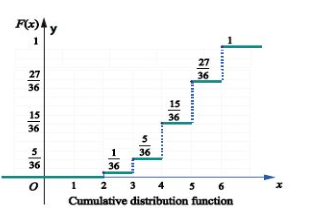
\(\text { (iii) } P(3 \leq X \leq 6)=\sum_{x=3}^5 P\left(X=x_1\right)=P(X=3)+P(X=4)+P(X=5)\)
\(\begin{aligned} & =\frac{4}{36}+\frac{10}{36}+\frac{12}{36}+\frac{26}{36} \\ & \text { (iv) } X \geq 4)=\sum_{x=4}^5 P\left(X=x_1\right) \end{aligned}\)
\(=\frac{10}{36}+\frac{12}{36}+\frac{9}{36}=\frac{31}{36}\)
26.
By definition the cumulative distribution function for discrete random variable is
\(F(x)P\left( X\le x \right) =\underset { { x }_{ 1 }\le x }{ \Sigma } P(X={ x }_{ 1 })\)
\(P(X<1)=0\) for -∞
\(F(1)=P\left( X\le 1 \right) =\underset { { x }_{ 1 }\le x }{ \Sigma } P(X={ x }_{ i })=\sum _{ -\infty }^{ 1 }{ P(X=x) } =P\left( X<1 \right) +P\left( X=1 \right) =0+\frac { 1 }{ 12 } =\frac { 1 }{ 12 }\)
\(F(2)=P\left( X\le 2 \right) =\sum _{ -\infty }^{ 2 }{ P\left( X=x \right) } =P\left( X\le 1 \right) +P\left( X=1 \right) +P\left( X=2 \right)\)
= \(0+\frac { 1 }{ 12 } +\frac { 5 }{ 12 } =\frac { 1 }{ 2 }\)
\(F(3)=P\left( X\le 3 \right) =\sum _{ -\infty }^{ 3 }{ P(X=x) } =P\left( X<1 \right) +P\left( X=1 \right) +P\left( X=2 \right) +P\left( X=3 \right)\)
= \(0+\frac { 1 }{ 2 } +\frac { 5 }{ 12 } +\frac { 5 }{ 12 } =\frac { 11 }{ 12 }\)
\(F(4)=P\left( X\le 4 \right) =\sum _{ -\infty }^{ 4 }{ P\left( X=x \right) } =P\left( X=1 \right) +P\left( X=2 \right) +P\left( X=3 \right) +P(X=4)\)
= \(0+\frac { 1 }{ 12 } +\frac { 5 }{ 12 } +\frac { 5 }{ 12 } +\frac { 1 }{ 12 } =1\)
\(F(x)=\{0, \quad-\infty \ldots\)

(ii) \(P(X\le 3)=F(3)\frac { 11 }{ 12 }\)
(iii) \(P(X\ge 2)=1-P\left( X<2 \right) =1-P(X\le 1)=1-F(1)=1-\frac { 1 }{ 12 } =\frac { 11 }{ 12 }\)
27.
X~ B(n, p)
Given mean np = 6
\(S.D=\sqrt { npq } =2\)
\(\Rightarrow npq=4\)
\( \rightarrow \frac { npq }{ np } =\frac { 4 }{ 6 } =\frac { 2 }{ 3 } \)
\(\Rightarrow q=\frac { 2 }{ 3 } \)
\(\Rightarrow 1-P=\frac { 2 }{ 3 } \)
\(\Rightarrow 1-\frac { 2 }{ 3 } =P\)
\(\therefore P=\frac { 1 }{ 3 } \)
\(n\times \frac { 1 }{ 3 } =6\Rightarrow n=18\)
(i) The probability mass function
P(X = x) nCx px (1 - p )n-x,
X = 0,1,2, ... , n
\(\therefore P(X=x)=\ ^{18}{ C }_{ x }\left( \frac { 1 }{ 3 } \right) ^{ x }\left( \frac { 2 }{ 3 } \right) ^{ 18-x }\)
x=0,1,2...,8
(ii) \(P(X=3)=\ ^{ 18}{C }_{ 3 }\left( \frac { 1 }{ 3 } \right) ^{ 3 }\left( \frac { 2 }{ 3 } \right) ^{ 18-3 }\)
= \(^{ 18}{C }_{ 3 }\left( \frac { 1 }{ 3 } \right) ^{ 3 }\left( \frac { 2 }{ 3 } \right) ^{ 15 }\)
(iii) P(X ≥ 2)
P(X ≥ 2) 1 -P(X < 2)
= 1 - [P(X = 0) + P(X = 1)]
= \(1-\left[ ^{18}{ C }_{ 0 }\left( \frac { 1 }{ 3 } \right) ^{ 0 }\left( \frac { 2 }{ 3 } \right) ^{ 18 }+^{ 18}{C }_{ 1 }\left( \frac { 1 }{ 3 } \right) ^{ 1 }\left( \frac { 2 }{ 3 } \right) ^{ 17 } \right] \)
= \(1-\left[ \left( \frac { 2 }{ 3 } \right) ^{ 18 }+6\left( \frac { 2 }{ 3 } \right) ^{ 17 } \right] \)
= \(1-\left( \frac { 2 }{ 3 } \right) ^{ 17 }\left[ \frac { 2 }{ 3 } +6 \right] \)
= \(1-\left( \frac { 2 }{ 3 } \right) ^{ 17 }\left( \frac { 20 }{ 3 } \right) \)
= \(1-\frac { 20 }{ 3 } \left( \frac { 2 }{ 3 } \right) ^{ 17 }\)
28.
Let p be the probability of the useful life hours of a fluorescent light.
n = 12
P = 0.9
q = 1-p = 0.1
P(X= x)= nCx px qn-x, x = 0, 1,2, .., n
(i) Exactly 10
P(X = 10) = 12C10(0.9)10(1 - 0.9)2
= 12C10(0.9)10 (0.1)2
(ii) Atleast 11
P(X≥11) = R(X = 11) + P(X = 12)
= 12C11(0.9)11 (0.1)1 + 12C12(0.9)12(0.1)6
= 12C1 (0.9)11 (0.1) + (0.9)12
= 12(0.9)11 (0.1) + (0.9)12
= (0.9)11 ((12)(0.1) + 0.9)
= (0.9)11 (1.2 + 0.9)
= (0.9)11 (2.1)
(ii) Atleast 2 will not have a useful
P(X,10) = 1 -P(X > 10)
= 1 - [P(X = 11) + P(X = 12)]
= 1-(2.1) (0.9)11
29.
Given \(f(x)=\begin{cases} \begin{matrix} 16{ xe }^{ -4x } & foex>0 \end{matrix} \\ \begin{matrix} 0 & forx\le 0 \end{matrix} \end{cases}\)
Mean :
= \(E(x)=\int _{ 0 }^{ \infty }{ x.f(x)dx } \)
= \(\int _{ 0 }^{ \infty }{ x.16.xe^{ -4x }dx } \)
= \(16\int _{ 0 }^{ \infty }{ { x }^{ 2 } } .{ e }^{ -4x }dx=16\times \frac { 2! }{ { 4 }^{ 3 } } \) \(\left[ \because \int _{ 0 }^{ \infty }{ { x }^{ n }{ e }^{ -ax }dx=\frac { n! }{ { a }^{ n+1 } } } \right] \)
= \(16\times \frac { 2 }{ 64 } \)
\(=\frac { 1 }{ 2 } \)
Variance :
\(E({ x }^{ 2 })=\int _{ 0 }^{ \infty }{ { x }^{ 2 }.f(x)dx } \)
= \(\int _{ 0 }^{ \infty }{ { x }^{ 2 }.{ e }^{ -4x } } dx\)
= \(16\int _{ 0 }^{ \infty }{ { x }^{ 3 }{ e }^{ -4x }dx } \)
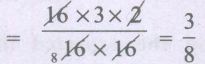
ஃ Var(X) = E(X2) - [E(x)]2
\(
=\frac{3}{8}-\frac{1}{4}
\)
\(=\frac{1}{8}
\)
∴ Var(X) \(=\frac{1}{8}
\)
30.
Let X b the random variable denotes number of heads when four coins are tossed once.
Then X take the values 0,1,2,3,4.
n(S) = 16
| Values of random variable | 0 | 1 | 2 | 3 | 4 | Total |
| Number of elem in inverse image | 1 | 4 | 6 | 4 | 1 | 16 |
The probability mass function is
| x | 0 | 1 | 2 | 3 | 4 |
| f(x) | \(\cfrac { 1 }{ 16 } \) | \(\cfrac { 4 }{ 16 } \) | \(\cfrac { 6 }{ 16 } \) | \(\cfrac { 4 }{ 16 } \) | \(\cfrac { 1 }{ 16 } \) |
Mean
= \(\\ E(x)=E(X)=\Sigma xf(x)\)
= \(0\left( \frac {4 }{ 16 } \right) +1\left( \frac {24 }{ 16 } \right) +2\left( \frac { 36 }{ 16 } \right) +3\left( \frac { 16}{ 16 } \right) = \frac { 80 }{ 16 } \)
= \(\frac { 1 }{ 4 } +\frac { 3 }{ 4 } +\frac { 3 }{ 4 } +\frac { 1 }{ 4 } =\frac { 8 }{ 4 } =2\)
Variance
\(E({ X }^{ 2 })=\Sigma { x }^{ 2 }f(x)\)
= \(0^{ 2 }\left( \frac { 1 }{ 16 } \right) +1^{ 2 }\left( \frac { 1 }{ 4 } \right) +2^{ 2 }\left( \frac { 3 }{ 8 } \right) +3^{ 2 }\left( \frac { 1 }{ 4 } \right) +4^{ 2 }\left( \frac { 1 }{ 16 } \right) \)
\(0\left( \frac {4 }{ 16 } \right) +1\left( \frac {24 }{ 16 } \right) +2\left( \frac { 36 }{ 16 } \right) +3\left( \frac { 16}{ 16 } \right) = \frac { 80 }{ 16 } \)
\( =5\)
(X) = E(X2) - [E(X)]2
= 5 - 22 = 5 - 4 = 1
31.
Let X be the random variablc denotes number of red balls.
Then X take the values 0, 1, 2
Sample space = 7C2 = 21
Let X denote the drawing the red ball.
Then X take the values 0, 1, 2
P(X = 0), X-1 (BB) = 3C2 = 3
P(X = 1), X-1 (BR) = 3C1 x 4C1 = 12
P(X = 2), X-1 (BR) = 3C2 = 6
| Values of random variable | 0 | 1 | 2 | Total |
| Number of elements in inverseimage | 3 | 12 | 6 | 21 |
The probability mass function is
| x | 0 | 1 | 2 |
| f(x) | \(\cfrac { 1 }{ 7 } \) | \(\cfrac { 4 }{ 7 } \) | \(\cfrac { 2 }{ 7 } \) |
Mean :
\(E(x)=\Sigma x.f\left( x \right) \)
= \(0(\frac { 1 }{ 7 } )+1\left( \frac { 4 }{ 7 } \right) +2\left( \frac { 2 }{ 7 } \right) \)
= \(\frac { 4 }{ 7 } +\frac { 4 }{ 7 } =\frac { 8 }{ 7 }\)
32.
Given
(i) The probability density function. Differentiating F(x) with respect to 'x' at continuity points of F(x), we get
\(F(x)=\begin{cases} \begin{matrix} 0 & x<0 \end{matrix} \\ \begin{matrix} \frac { 1 }{ 2 } ({ 2x }+1) & 0\le x<1 \end{matrix} \\ \begin{matrix} 1 & x\ge 1 \end{matrix} \end{cases}\)
(ii) \(p(0.3\le X\le 0.6)=\int _{ 0.3 }^{ 0.6 }{ f(x)dx } \)
= \(\int _{ 0.3 }^{ 0.6 }{ \frac { 1 }{ 2 } \left( 2x+1 \right) dx } =\frac { 1 }{ 2 } \left[ \frac { { 2x }^{ 2 } }{ 2 } +x \right] _{ 0.3 }^{ 0.6 }\)
= \(\frac { 1 }{ 2 } \left( { x }^{ 2 }+x \right) _{ 0.3 }^{ 0.6 }=\frac { 1 }{ 2 } \left[ \left( { 0.6 }^{ 2 }+0.6 \right) -\left( { 0.3 }^{ 2 }+0.3 \right) \right] \)
= \(\frac { 1 }{ 2 } \left[ \left( .36.6 \right) \right] -\left( .09+0.3 \right) ]\)
= \(\frac { 1 }{ 2 } \left[ 0.96-.39 \right] =\frac { 0.57 }{ 2 } =0.285\)
= 0.285
33.
\(f(x)=\begin{cases} \begin{matrix} x+1 & -1\le x<0 \end{matrix} \\ \begin{matrix} -x+1 & 0\le x<1 \end{matrix} \\ \begin{matrix} 0 & otherwise \end{matrix} \end{cases}\)
(i) Distribution function
Case 1 : x < -1
F(x) = \(\int _{ -\infty }^{ x }{ f(u)du } \) = 0
Case 2 : -1 ≤ x < 0
\(\int _{ -\infty }^{ x }{ f(u)du } \)
= \(\int _{ -\infty }^{ x }{ f(x) } dx=\left[ \frac { { x }^{ 2 } }{ 2 } +x \right] _{ -1 }\)
= \(\left( \frac { {u }^{ 2 } }{ 2 } +u \right)=\frac{x^2}{2}+x -\left( \frac { 1 }{ 2 } +1 \right) \)
= \(\frac { { x }^{ 2 } }{ 2 } +x+\frac { 1 }{ 2 } \)
Case 3 : 0 ≤ x < 1,
\(F(X)=\int _{ 0 }^{ x }{ (-x+1)dx } =\left[ -\frac { { x }^{ 2 } }{ 2 } +x \right] _{ 0 }^{ x }\)
= \(\left( -\frac { { x }^{ 2 } }{ 2 } +x \right) -\left( 0 \right) =\frac { { x }^{ 2 } }{ 2 } +x\)
When 1 ≤ x,
\(F(x)=\int _{ 1 }^{ x }{ f(x)dx } =\int _{ 1 }^{ x }{ 0dx } \)
= \(\therefore F(X)=\begin{cases} \begin{matrix} \frac { { x }^{ 2 } }{ 2 } +x+\frac { 1 }{ 2 } & -1\le x<0 \end{matrix} \\ \begin{matrix} -\frac { { x }^{ 2 } }{ 2 } +x & 0\le x<1 \end{matrix} \\ \begin{matrix} 0 & otherwise \end{matrix} \end{cases}\)
(ii) p(0.5 ≤ X ≤ 0.5)
= \(\int _{ -0.5 }^{ 0.5 }{ f(x)dx } =\int _{ 0.5 }^{ 0 }{ f(x)dx+\int _{ 0 }^{ 0.5 }{ f(x)dx } } \)
= \(\int _{ -0.5 }^{ 0 }{ (x+1) } dx+\int _{ 0 }^{ 0.5 }{ \left( -x+1 \right) } dx\)
= \(\left[ \frac { { x }^{ 2 } }{ 2 } +x \right] _{ -0.5 }^{ 0 }+\left[ \frac { -{ x }^{ 2 } }{ 2 } +x \right] _{ 0 }^{ 0.5 }\)
= \(0-\left( \frac { { 0.5 }^{ 2 } }{ 2 } -0.5 \right) +\left( -\frac { \left( 0.5 \right) ^{ 2 } }{ 2 } +0.5 \right) -0\)
= \(-\left( \frac { .25 }{ 2 } -0.5 \right) +\left( \frac { -0.25 }{ 2 } +0.5 \right) \)
= \(\frac { .25 }{ 2 } +0.5-\frac { 0.25 }{ 2 } +0.5=0.25+1\)
= 0.75
34.
Given
\(f(x)=\begin{cases} \begin{matrix} { Ke }^{ \frac { -x }{ 3 } } & \begin{matrix} for & x>0 \end{matrix} \end{matrix} \\ \begin{matrix} 0 & \begin{matrix} for & x\le 0 \end{matrix} \end{matrix} \end{cases}\)
(i) Since f(x) is a probability density function
\(\int _{ -\infty }^{ \infty }{ f(x) } dx=1\)
\(\Rightarrow \int _{ 0 }^{ \infty }{ K.{ e }^{ \frac { -x }{ 3 } } } dx=1\Rightarrow k\frac { \left[ { e }^{ \frac { -x }{ 3 } } \right] ^{ \infty } }{ -\frac { 1 }{ 3 } } \)
\(\Rightarrow -3k\left[ { e }^{ -\infty }-{ e }^{ 0 } \right] =1\) [∵ e∞ = 0, e0 = 1]
\(\Rightarrow 3k=1\Rightarrow k=\frac { 1 }{ 3 } \)
\(\therefore k=\cfrac { 1 }{ 3 } \)
(ii) The distribution function F(x) = \(\int _{ -\infty }^{ x }{ f(u)du } \)
Case 1: x < 0,
\(F(x)=\int _{ -\infty }^{ x }{ f(x)dx=0 } \)
Case 2: x > 0,
\(f(x)=\int _{ -\infty }^{ x }{ f(x)dx } \)
= \(\int _{ -\infty }^{ 0 }{ f(x)dx+\int _{ 0 }^{ x }{ f(x) } dx } \)
= \(0+k\int _{ 0 }^{ x }{ { e }^{ \frac { -x }{ 3 } } } dx\)
= \(\frac { 1 }{ 3 } \left[ \cfrac { { e }^{ \frac { -x }{ 3 } } }{ -\frac { 1 }{ 3 } } \right] =-\left[ { e }^{ -\frac { x }{ 3 } }-{ e }^{ o } \right] \)
= \(-[{ e }^{ -\frac { x }{ 3 } }-1]\)
= \(1-{ e }^{ -\frac { x }{ 3 } }\)
\(\therefore F(x)=\begin{cases} \begin{matrix} 0 & x\le 0 \end{matrix} \\ \begin{matrix} 1-{ e }^{ \frac { -x }{ 3 } } & x>0 \end{matrix} \end{cases}\)
(iii) p(X < 3)
= \(\int _{ 0 }^{ 3 }{ ke^{ -\frac { x }{ 3 } } } dx=\cfrac { 1 }{ 3 } \int _{ 0 }^{ 3 }{ { e }^{ -\frac { x }{ 3 } }dx } \)
= \(\cfrac { 1 }{ 3 } \left[ \frac { { e }^{ -\frac { x }{ 3 } } }{ \frac { -1 }{ 3 } } \right] \)
= -[e-1-e0] = -[e-1-1]
(iv) \(p(5\le X)=p(X\ge 5)=\int _{ 5 }^{ \infty }{ f(x)dx } \)
= \(\int _{ 5 }^{ \infty }{ ke^{ -\frac { x }{ 3 } } } dx=\cfrac { 1 }{ 3 } \cfrac { \left[ { e }^{ -\frac { x }{ 3 } } \right] _{ 5 }^{ \infty } }{ \frac { -1 }{ 3 } } \)
= \(-\left[ { e }^{ -\infty }-e^{ \frac { -3 }{ 5 } } \right] =\left[ 0-{ e }^{ \frac { -5 }{ 3 } } \right] \)
= \({ e }^{ \frac { -5 }{ 3 } }\)
(v) \(p(X\le 4)=\int _{ -\infty }^{ 4 }{ f(x)dx } \)
= \(\int _{ -\infty }^{ 0 }{ f(x)dx+\int _{ 0 }^{ 4 }{ f(x)dx } } \)
= \(0+\int _{ 0 }^{ 4 }{ { ke }^{ -\frac { x }{ 3 } }dx } =k\left[ \frac { { e }^{ -\frac { x }{ 3 } } }{ -\frac { 1 }{ 3 } } \right] _{ 0 }^{ 4 }\)
= \(\cfrac { 1 }{ 3 } \cfrac { \left[ { e }^{ -\frac { x }{ 3 } } \right] _{ 0 }^{ 4 } }{ -\frac { 1 }{ 3 } } =-\left[ { e }^{ \frac { -4 }{ 3 } }-{ e }^{ o } \right] \)
= \(-\left[ { e }^{ \frac { -4 }{ 3 } }-1 \right] =1-{ e }^{ \frac { -4 }{ 3 } }\)
35.
Given \(\begin{cases} \begin{matrix} k & 200\le x\le 600 \end{matrix} \\ \begin{matrix} 0 & otherwise \end{matrix} \end{cases}\)
(i) Since f{x) is a probability density function
\(\int _{ -\infty }^{ \infty }{ f(x)d=1\Rightarrow \int _{ 200 }^{ 600 }{ kda } =1 } \)
\(\Rightarrow k[x]_{ 200 }^{ 600 }=1\Rightarrow k(600-200)=1\)
400 k = 1
\(\Rightarrow k=\frac { 1 }{ 400 } \)
(ii) The distribution function
= \(\int _{ -\infty }^{ x }{ f(u) } du\)
Case 1: x < 200
\(F(x) =\int _{ -\infty }^{ u }{ du } =0\)
Case 1: x < 200 ≤ x ≤ 600
\(\int _{ -\infty }^{ x }{ f(u) } du\)
\(F(x)=\int _{ -\infty }^{ 200 }{ f(u)du } =+\int _{ 200 }^{ x }{ f(u)du } \)
= \( =\frac { 1 }{ 400 }(x-200) =\frac { x }{ 400 } =\frac { 1 }{ 2 } \)
Case 3: x > 600
\(F(x) =\int _{ -\infty }^{ u }{ du } =0\)
\(f(x)= \begin{cases}0, & x<200 \\ \frac{x}{400}-\frac{1}{2}, & 200 \leq x \leq 600 \\ 0, & x>600\end{cases}\)
(iii) P(300 < x < 500)
= \(\int _{ 300 }^{ 500 }{ kdx=\frac { 1 }{ 400 } \left[ x \right] _{ 300 }^{ 500 } } \)
= \(\frac { 1 }{ 400 } \left[ 500-300 \right] =\frac { 200 }{ 400 } =\frac { 1 }{ 2 } \)
36.
(i) Probability mass function
For a discrete random variable we have
f(x) = p(X = x)
\(\therefore f(0)=F(0)=\frac { 1 }{ 2 } \)
f(1) = F(1) - F(0)
= \(\frac { 3 }{ 5 } -\frac { 1 }{ 2 } =\frac { 6-5 }{ 10 } =\frac { 1 }{ 10 } \)
f(2) = F(2)-F(1)
= \(\frac { 4 }{ 5 } -\frac { 3 }{ 5 } =\frac { 1 }{ 5 } \)
f(3) = F(3) - F(2)
\(\frac { 9 }{ 10 } -\frac { 4 }{ 5 } =\frac { 9-8 }{ 10 } =\frac { 1 }{ 10 } \)
f(4) = F(4)-F(3)
= \(1-\frac { 9 }{ 10 } =\frac { 1 }{ 10 } \)
ஃThe probability mass function is
| X | 0 | 1 | 2 | 3 | 4 |
| f(x) | \(\cfrac { 1 }{ 2 } \) | \(\cfrac { 1 }{ 10 } \) | \(\cfrac { 1 }{ 5 } \) | \(\cfrac { 1 }{ 10 } \) | \(\cfrac { 1 }{ 10 } \) |
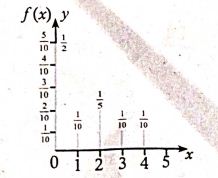
(ii) p(x < 3) = p(x = 0) + p(x = 1) + p(x = 2)
= \(\frac { 1 }{ 2 } +\frac { 1 }{ 10 } +\frac { 1 }{ 5 } =\frac { 5+1+2 }{ 10 } =\frac { 8 }{ 10 } \)
= \(\frac { 4 }{ 5 } \)
(iii) p(x≥2) = p(x = 2) + p(x = 3) + p(x = 4)
= \(\frac { 1 }{ 5 } +\frac { 1 }{ 10 } +\frac { 1 }{ 10 } =\frac { 2+1+1 }{ 10 } =\frac { 4 }{ 10 } \)
= \(\frac { 2 }{ 5 } \)
37.
Given probability mass function is
| x | 0 | 1 | 2 | 3 | 4 |
| f(x) | \(\frac{1}{36}\) | \(\frac{2}{36}\) | \(\frac{3}{36}\) | \(\frac{2}{36}\) | \(\frac{3}{36}\) |
(i) Since f(x) is a probability mass function.
\(\sum _{ i=1 }^{ 5 }{ f({ x }_{ i }) } =1\)
⇒ k2 + 2k2 + 3k2 + 2k + 3k = 1
⇒ 6k2 + 5k = 1
⇒ 6k2 + 5k - 1 = 0
⇒ (k + 1) (6k - 1) = 0
⇒ k = -1 or ⇒ \(k=\frac { 1 }{ 6 } \)
⇒ \(k=\frac { 1 }{ 6 } \)
(ii) p(2 ≤ x < 5)
= p(x = 2) + p(x = 3) + p(x = 4)
= 2k2 + 3k2 + 2k = 5k2 + 2k
= \(5\left( \frac { 1 }{ 36 } \right) +2\left( \frac { 1 }{ 6 } \right) \)
= \(\frac { 5 }{ 36 } +\frac { 1 }{ 3 } =\frac { 5+12 }{ 36 } \)
= \(\frac { 17 }{ 36 } \)
(iii) p(3 < x) = p(x > 3)
= p(x = 4) + p(x = 5)
= 2k + 3k = 5k
= \(5\left( \frac { 1 }{ 6 } \right) \)
= \(\frac { 5 }{ 6 } \)
38.
(i) The equivalent table is
X | -1 | 0 | 1 | 2 | 3 |
|---|---|---|---|---|---|
F(x) | 0.15 | 0.35 | 0.60 | 0.85 | 1 |
f(x) = P[X= x] | 0.15 | 0.20 | 0.25 | 0.25 | 0.15 |
(ii) P(X <1) = P(X =-1)+P(X =0) =0.35
\(\text { (iii) } P(X \geq 2)=\) P(X =2)+P(X =3) = 0.40
39.
Given
\(\\ \\ \\ \\ \\ f(x)=\begin{cases} \begin{matrix} \frac { { x }^{ 2 }+1 }{ k } & forx=0,1,2 \end{matrix} \\ \begin{matrix} 0 & otherwise \end{matrix} \end{cases}\\ \\ \\ \\ \\ \\ \)
The random variable X take the values 0, 1, 2.
Probability mass function.
| x | 0 | 1 | 2 |
| f(x) | \(\cfrac { 1 }{ k } \) | \(\cfrac { 2 }{ k } \) | \(\cfrac {5 }{ k } \) |
\(\sum _{ i=0 }^{ 2 }{ f(x_{ i })=1\Rightarrow f(0)+f(1)+f(2)=1 } \)
\(\Rightarrow \frac { 0+1 }{ k } +\frac { 1+1 }{ k } +\frac { 4+1 }{ k } \)
\(\Rightarrow \frac { 1 }{ k } +\frac { 2 }{ k } +\frac { 5 }{ k } =1\)
\(\Rightarrow \frac { 8 }{ k } =1\)
\(\Rightarrow k=8\)
(ii) Cumulative distribution function
| x | 0 | 1 | 2 |
| f(x) | \(\cfrac { 1 }{ 8 } \) | \(\cfrac { 2 }{ 8 } \) | 1 |
\(F(0)=P(X<0)\\P(x=0)\\ =\frac { 1 }{ 8 } \)
\(F(1)=P(X = 0)+ P(X = 1)\\
\frac { 1 }{ 8 } +\frac { 2 }{ 8 } =\frac { 3 }{ 8 } \)
\(F(2)=P(X= 0) + P(X = 1) + P(X = 2) = \frac { 1 }{ 8 } +\frac { 2 }{ 8 } +\frac { 5 }{ 8 } =1\)
Cumulative distribution function is
\(f(x)=\begin{cases} \begin{matrix} \frac { 1 }{ 8 } & for & x\le 0 \end{matrix} \\ \begin{matrix} \frac { 2 }{ 8 } +\frac { 1 }{ 8 } & for & \frac { 3 }{ 8 } forx\le 1 \end{matrix} \\ \begin{matrix} \frac { 3 }{ 8 } +\frac { 5 }{ 8 } =1 & for & x\le 2 \end{matrix} \end{cases}\)
(iii) p(x ≥ 1) = p(x = 1) + p(x = 2)
= \(\frac { 2 }{ 8 } +\frac { 5 }{ 8 } \)
\(p(x\ge 1)=\frac { 7 }{ 8 } \)
40.
Let X be the random variable denotes number of| girl child among 4 children
X = {0, 1, 2, 3, 4}
X =2) (0) {BBBB}
X(1) = {GBBB, BGBB, BBGB, BBBG}
X(2) = {GGBB, BBGG, GBGB, BGBG, BGGB, GBBG}
X(3) = {BGGG, GGGB, GBGG, GGBG}
X(4) = {GGGG}
| Values of the random variable | 0 | 1 | 2 | 3 | 4 | Total |
| No. of elements in inverse images | 1 | 4 | 6 | 4 | 1 | 16 |
(i) Probability mass function
| x | 0 | 1 | 2 | 3 | 4 | Total |
| f(x) | \(\\ \cfrac { 1 }{16 } \) | \(\cfrac { 4 }{ 16 } \) | \(\cfrac { 6 }{ 16 } \) | \(\cfrac { 4 }{ 16 } \) | \(\\ \cfrac { 1 }{16 } \) | 1 |
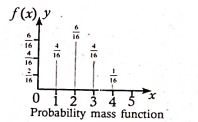
(ii) Cumulative distribution function
F(x) = p(X ≤ x) = \(\sum_{x_i ≤ x }\)P(X = xi)
P(X<0) = 0 for -\(\infty\) < x < 0
\(F(0)=\frac { 1 }{ 16 } \)
\(F(1)=\frac { 1 }{ 16 } +\frac { 1 }{ 4 } =\frac { 5 }{ 16 } \)
\(F(2)=\frac { 5 }{ 16 } +\frac { 3 }{ 8 } =\frac { 5 }{ 16 } +\frac { 6 }{ 16 } =\frac { 11 }{ 16 } \)
\(F(3)=\frac { 11 }{ 6 } +\frac { 1 }{ 4 } =\frac { 11 }{ 16 } +\frac { 4 }{ 16 } =\frac { 15 }{ 16 } \)
\(F(4)=\frac { 15 }{ 16 } +\frac { 1 }{ 16 } =\frac { 16 }{ 16 } =1\)
\(F(x)=\left\{\begin{array}{lll} \frac{0}{16} & \text { for } & x<0 \\ \frac{1}{16} & \text { for } & x \leq 0 \\ \frac{5}{16} & \text { for } & x \leq 1 \\ \frac{11}{16} & \text { for } & x \leq 2 \\ \frac{15}{16} & \text { for } & x \leq 3 \\ 1 & \text { for } & x \leq 4 \end{array}\right.\)
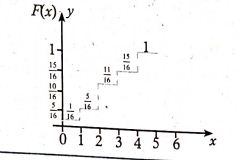
41.
Let X be the thrown random variable denotes the total in two the thrown a die.
Sample space S
| I/II | 1 | 3 | 3 | 5 | 5 | 5 |
| 1 | 2 | 4 | 4 | 6 | 6 | 6 |
| 3 | 4 | 6 | 6 | 8 | 8 | 8 |
| 3 | 4 | 6 | 6 | 8 | 8 | 8 |
| 5 | 6 | 8 | 8 | 10 | 10 | 10 |
| 5 | 6 | 8 | 8 | 10 | 10 | 10 |
| 5 | 6 | 8 | 8 | 10 | 10 | 10 |
n (S) = 36
X = {2, 4, 6, 8, 10}
| Values of the random variable | 2 | 4 | 6 | 8 | 10 | Total |
| No. of elements in inverse images | 1 | 4 | 10 | 12 | 9 | 36 |
\(p(x=2)=\cfrac { 1 }{ 36 } \)
\(p(x=4)=\cfrac { 4 }{ 36 } \)
\(p(x=6)=\cfrac { 10 }{ 36 } \)
\(p(x=8)=\cfrac { 12 }{ 36 } \)
\(p(x=10)=\cfrac { 9 }{ 36 } \)
(i) Probability mass function is
| x | 2 | 4 | 6 | 8 | 10 |
| f(x) | \(\\ \cfrac { 1 }{ 36 } \) | \(\cfrac { 4 }{ 36 } \) | \(\cfrac { 10 }{ 36 } \) | \(\cfrac { 12 }{ 36 } \) | \(\cfrac { 9 }{ 36 } \) |
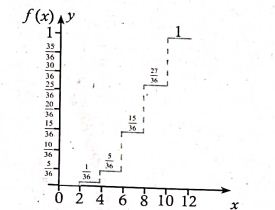
(ii) Cumulative distribution function .
F(x) = p(X ≤ x) = \(\sum_{x_i ≤ x }\)(X = xi)
P(X<2) = 0 for \(\infty\) < x < 2
\(F(2)=\frac { 1 }{ 36 } \)
\(F(4)=\frac { 1 }{ 36 } +\frac { 4 }{ 36 } =\frac { 5 }{ 36 } \)
\(F(6)=\frac { 1 }{ 36 } +\frac { 4 }{ 36 } +\frac { 10 }{ 36 } =\frac { 15 }{ 36 } \)
\(F(8)=\frac { 1 }{ 36 } +\frac { 4 }{ 36 } +\frac { 10 }{ 36 } +\frac { 12 }{ 36 } =\frac { 27 }{ 36 }\)
\(F(10)=\frac { 27 }{ 36 } +\frac { 9 }{ 36 } =\frac { 36 }{ 36 } =1\)
∵ The cumulative distribution function n
\(F(x)=\left\{\begin{array}{lll} 0 & \text { for } & x<2 \\ \frac{1}{36} & \text { for } & x \leq 2 \\ \frac{5}{36} & \text { for } & x \leq 6 \\ \frac{15}{36} & \text { for } & x \leq 8 \\ 1 & \text { for } & x \leq 10 \end{array}\right.\)
(iii) p(4≤ X < 10) = p(x = 4) + p(x = 6) + p(x = 8)
= \(\frac { 4 }{ 36 } +\frac { 10 }{ 36 } +\frac { 12 }{ 36 } +\frac { 26 }{ 36 } =\frac { 13 }{ 18 } \)
(iv) p(x ≥ 6) = p(x = 6) + p(x = 8) + p(x = 10)
= \(\frac { 10 }{ 36 } +\frac { 12 }{ 36 } +\frac { 9 }{ 36 } =\frac { 31 }{ 36 } \)
Sample space = {4 childrens}
42.
To find the probabilities, the values of the parameters n and p must be known.
Given that
Mean = np = 2 and variance = npq = 1.5
This gives \(\frac { npq }{ np } =\frac { 1.5 }{ 2 } =\frac { 3 }{ 4 } \)
\(q=\frac { 3 }{ 4 } \) and \(p=1-q=1-3\frac { 4 }{ 4 } =\frac { 1 }{ 4 } \)
np = 2 gives \(n=\frac { 2 }{ p } =8\) . Therefore \(X\sim B\left( 8,\frac { 1 }{ 4 } \right) \)
Therefore probability distribution is
\(P(X=x)=f(x)=\left( \begin{matrix} 8 \\ x \end{matrix} \right) \left( \cfrac { 1 }{ 4 } \right) ^{ x }\left( \cfrac { 3 }{ 4 } \right) ^{ 8-x }\)
(i) \(P(X=0)=f(0)=\left( \begin{matrix} 8 \\ 0 \end{matrix} \right) \left( \cfrac { 1 }{ 4 } \right) ^{ 0 }\left( \cfrac { 3 }{ 4 } \right) ^{ 8-0 }=\left( \cfrac { 3 }{ 4 } \right) ^{ 8 }\)
(ii) \(P(X=1)=f(1)=\left( \begin{matrix} 8 \\ 1 \end{matrix} \right) \left( \cfrac { 1 }{ 4 } \right) \left( \cfrac { 3 }{ 4 } \right) ^{ 8-1 }=2\left( \cfrac { 3 }{ 4 } \right) ^{ 2 }\)
(iii) P(X≥1) = 1-P(X<1) = 1-P(X = 0) = \(1-\left( \frac { 3 }{ 4 } \right) ^{ 8 }\)
43.
\(S=\left|\begin{array}{l} (1,1),(1,2),(1,3),(1,4),(1,5),(1,6) \\ (2,1),(2,2),(2,3),(2,4),(2,5),(2,6) \\ (3,1),(3,2),(3,3),(3,4),(3,5),(3,6) \\ (4,1),(4,2),(4,3),(4,4),(4,5),(4,6) \\ (5,1),(5,2),(5,3),(5,4),(5,5),(5,6) \\ (6,1),(6,2),(6,3),(6,4),(6,5),(6,6) \end{array}\right|\)
Let X be a random variable whose values x are the number of fours.
The sample space S is given in the table.
It can also be written as
S = {(i, j)} , where i = 1, 2, 3, 6 and j = 1, 2, 3, 6
Therefore X takes on the values of 0, 1 and 2.
We observe that
(i) X = 0, if (i, j) for i ≠ 4, j≠ 4,
(ii) X = 1, if (1, 4), (2, 4), (3, 4), (5, 4), (6, 4), (4, 1), (4, 2), (4, 3), (4, 5), (4, 6)
(iii) X = 2, if (4, 4) ,
Therefore,
| Values of the Random Variable X | 0 | 1 | 2 | Toatal |
| Number of elements in inverse images | 25 | 10 | 1 | 36 |
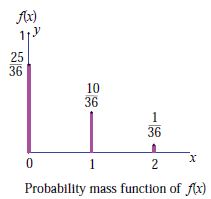
The probabilities are
\(f(0)=P(X=0)\cfrac { 25 }{ 36 } \)
\(f(1)=P(X=1)=\cfrac { 10 }{ 36 } \)
and \(f(20=P(X=2)=\cfrac { 1 }{ 36 } \)
Clearly the function f(x) satisfies the conditions
(i) f (x) ≥ 0, for x = 0, 1, 2 and
(ii) \(\underset { x }{ \Sigma } f(x)=\sum _{ x=0 }^{ x=-2 }{ f(x) } =f(0)+f(1)+f(2)=1\)
\(=\frac{25}{36}+\frac{10}{36}+\frac{1}{36}=1\)
The probability mass function is presented as
| x | 0 | 1 | 2 |
| f(x) | \(\frac { 25 }{ 36 } \) | \(\frac { 10 }{ 36 } \) | \(\frac { 1 }{ 36 } \) |
(or)
\(f(x)=\begin{cases} \begin{matrix} \frac { 25 }{ 36 } & for \ x=0 \end{matrix} \\ \begin{matrix} \frac { 10 }{ 36 } & for \ x=1 \end{matrix} \\ \begin{matrix} \frac { 1 }{ 36 } & for \ x=2 \end{matrix} \end{cases}\)
44.
Given \(p=\frac { 3 }{ 4 }\)
n = 5
P(X = x) = nCxpx (1-p)n-x
\(P(X=3)={ 5C }_{ 3 }\left( \frac { 3 }{ 4 } \right) ^{ 3 }\left( 1-\frac { 3 }{ 4 } \right) ^{ 2 }\)
\(P(X=3)={ 5C }_{ 2 }\left( \frac { 3 }{ 4 } \right) ^{ 3 }\left( \frac { 1 }{ 4 } \right) ^{ 2 }\) [∵nCr = nCn-r]
\(P(X=3)=\frac{5 \times 4}{2 \times 1} \times \frac{3 \times 3 \times 3}{4 \times 4 \times 4 \times 4 \times 4}\)
= \(\frac { 135 }{ 512 }\)
45.
Let p be the probability of getting heads
q = 1-p
\(p=\frac { 1 }{ 2 } \)
\(Mean=np=100\times \frac { 1 }{ 2 } =50\)
\(Variance=npq=100\times \frac { 1 }{ 2 } \times \frac { 1 }{ 2 } =25\)
(ii)Let p be the probability of getting 4 when a die is thrown
n = 240
\(p=\frac { 1 }{ 6 } \) [ஃ 4 appears only one]
\(\therefore Mean=np =240\times \frac { 1 }{ 6 } =40\)
\(Variance=npq= 40\times \frac { 5 }{ 6 } \)
\(Variance=\frac { 100 }{ 3 } \)
46.
\(\mathrm{n}=9, \mathrm{p}=\frac{1}{2}, \mathrm{k}=7
\)
\(
\mathrm{P}(X=x)={ }^{n} C_{x} p^{x} q^{n-x}, x=0,1,2, \ldots, n
\)
\(p =\frac{1}{2}
\)
\(q =1-p=\frac{1}{2} \)
\(P(X=7) ={ }^{9} C_{7}\left(\frac{1}{2}\right)^{7}\left(\frac{1}{2}\right)^{2}
\)
\( =\frac{9 \times 8}{2} \times \frac{1}{2^{9}} \)
\( =36 \times \frac{1}{512}=\frac{9}{128}
\)
47.
Given n = 6, \(p=\frac { 1 }{ 3 }\), k = 3
\(P(X=k)=\left( \begin{matrix} n \\ k \end{matrix} \right) { p }^{ k }\left( 1-p \right) ^{ n-k },\)
n = 0,1,2, ... n
\(\therefore P(X=k)=\left( \begin{matrix} n \\ k \end{matrix} \right) { p }^{ k }(1-p)^{ n-k }\)
n = 0,1,2, ... n
\(P(X=3)=\left( \begin{matrix} 6 \\ 3 \end{matrix} \right) \left( \cfrac { 1 }{ 3 } \right) ^{ 3 }\left( 1-p \right) ^{ 6-3 }\)
= \(\left( \begin{matrix} 6 \\ 3 \end{matrix} \right) \left( \cfrac { 1 }{ 3 } \right) ^{ 3 }\left( \cfrac { 2 }{ 3 } \right) ^{ 2 }\)
\(=\frac{6 \times 5 \times 4}{8 \times 2 \times 1} \times \frac{1}{27} \times \frac{8}{27}\)
\(P(X=3)=\frac { 160 }{ 729 }\)
48.
Given \(f(x)=\begin{cases} \begin{matrix} { 3e }^{ -3x } & x>0 \end{matrix} \\ \begin{matrix} 0 & elsewhere \end{matrix} \end{cases}\)
\(E(X)=\int _{ 0 }^{ \infty }{ x.f(x)dx } =\int _{ 0 }^{ \infty }{ x.3.{ e }^{ -3x }dx } \)
= \(3\int _{ 0 }^{ \infty }{ x.{ e }^{ -3x }dx } \left[ \therefore \int _{ 0 }^{ \infty }{ { x }^{ n }{ e }^{ -ax }dx=\cfrac { n! }{ { a }^{ n+1 } } } \right] \)
= \(3\times \frac { 1! }{ { 3 }^{ 2 } } =\frac { 3 }{ 9 } =\frac { 1 }{ 3 } \)
ஃ Expected life of the electronic equipment is = \(\frac { 1 }{ 3 } \)
49.
\(f(x)=\begin{cases} \begin{matrix} \frac { 1 }{ 2 } e^{ -\frac { x }{ 2 } } & for\quad x>0 \end{matrix} \\ \begin{matrix} 0 & otherwise \end{matrix} \end{cases}\)
\(\int _{ 0 }^{ \infty }{ x.f(x)dx } =\frac { 1 }{ 2 } \int _{ 0 }^{ \infty }{ x.{ e }^{ \frac { -x }{ 2 } } } dx\)
\(\left[ \int _{ 0 }^{ \infty }{ { e }^{ -ax }.{ x }^{ n }dx=\cfrac { n! }{ { a }^{ n+1 } } } \right] \)
= \(\frac { 1 }{ 2 } \times \frac { 1! }{ \left( \frac { 1 }{ 2 } \right) ^{ 2 } } =\frac { 1 }{ 2 } \times \frac { 1 }{ \frac { 1 }{ 4 } } \)
= \(\frac { 1 }{ 2 } \times \frac { 4 }{ 1 } =2\)
\(E({ X }^{ 2 })=\int _{ 0 }^{ \infty }{ { x }^{ 2 }.f(x) } dx\)
= \(\int _{ 0 }^{ \infty }{ { x }^{ 2 }.\frac { 1 }{ 2 } { e }^{ -\frac { x }{ 2 } } } dx\)
= \(\frac { 1 }{ 2 } \int { { x }^{ 2 }.{ e }^{ -\frac { x }{ 2 } }dx } \)
= \(\frac { 1 }{ 2 } \times \frac { 2! }{ \left( \frac { 1 }{ 3 } \right) ^{ 3 } } =\frac { 1 }{ 2 } \times \frac { 2 }{ \frac { 1 }{ 8 } } \)
= \(\frac { 1 }{ 2 } \times 2\times 8=8\)
ஃVar(X)=E(X2) - [E(x)]2
= 8-22
= 8 - 4 = 4
50.
\(\)\(Mean=E(X)=\int _{ 1 }^{ 2 }{ f(x)dx=\int _{ 1 }^{ 2 }{ 2((x-1)dx } }\)
\(=2\left[\frac{8}{3}-\frac{4}{2}-\frac{1}{3}+\frac{1}{2}\right]\)
\(=2\left(\frac{7}{3}-\frac{3}{2}\right)\)
\(=2 \times \frac{5}{6}\)
\(=\frac{5}{3}\)
\(E({ x }^{ 2 })=\int _{ 1 }^{ 2 }{ { x }^{ 2 }f(x)dx }\)
= \(\int _{ 1 }^{ 2 }{ { x }^{ 2 }.2\left( x-1 \right) } dx\)
= \(2\int _{ 1 }^{ 2 }{ ({ x }^{ 3 }-{ x }^{ 2 })dx }\)
= \(2\left[ \frac { { x }^{ 4 } }{ 4 } -\frac { { x }^{ 3 } }{ 3 } \right] _{ 1 }^{ 2 }\)
= \(2\left[ \left( 4-\frac { 8 }{ 3 } \right) -\left( \frac { 1 }{ 4 } -\frac { 1 }{ 3 } \right) \right]\)
= \(2\left[ \frac { 4 }{ 3 } +\frac { 1 }{ 12 } \right] =2\left[ \frac { 16+1 }{ 12 } \right]\)
= \(\frac { 17 }{ 6 }\)
ஃ Var(X) = E(X2) - [E(X)]2
= \(\frac { 17 }{ 6 } -(\frac{5}{ 3 }^{ 2 })=\frac { 17 }{ 6 } -\frac { 25 }{ 9 }\)
= \(\frac{51-50}{18}\)
= \(\frac{1}{18}\)
51.
Given
\(f(x)=\cfrac { 4-x }{ 6 } \)
\(f(x)=\cfrac { 4-1 }{ 6 } =\cfrac { 3 }{ 6 } =\cfrac { 1 }{ 2 } \)
\(f(2)=\cfrac { 4-2 }{ 6 } =\cfrac { 2 }{ 6 } =\cfrac { 1 }{ 3 } \)
\(f(3)=\cfrac { 4-3 }{ 6 } =\cfrac { 1 }{ 6 } \)
ஃ The probability mass function is
| x | 1 | 2 | 3 |
| f(x) | \(\cfrac { 1 }{ 2 } \) | \(\cfrac { 1 }{ 3 } \) | \(\cfrac { 1 }{ 6 } \) |
Mean \(E(X)=\Sigma xf(x)\)
= \(1\left( \cfrac { 1 }{ 2 } \right) +2\left( \cfrac { 1 }{ 3 } \right) +3\left( \cfrac { 1 }{ 6 } \right) \)
= \(\cfrac { 1 }{ 2 } +\cfrac { 2 }{ 3 } +\cfrac { 3 }{ 6 } =\cfrac { 3+4+6 }{ 6 } \)
= \(\cfrac { 10 }{ 6 } =\cfrac { 5 }{ 3 } =1.67\)
\(E({ x }^{ 2 })=\Sigma { x }^{ 2 }f(x)\)
= \({ 1 }^{ 2 }\left( \cfrac { 1 }{ 2 } \right) +{ 2 }^{ 2 }\left( \cfrac { 1 }{ 3 } \right) +3^{ 2 }\left( \cfrac { 1 }{ 6 } \right) \)
= \(\cfrac { 1 }{ 2 } +\cfrac { 4 }{ 9 } +\cfrac { 9 }{ 6 } =\cfrac { 3+8+9 }{ 6 } \)
= \(\cfrac { 20 }{ 6 } =\cfrac { 10 }{ 3 } =3.33\)
var(X) E(X2) - [E(X)]2
= \(\cfrac { 10 }{ 3 } -\left( \cfrac { 5 }{ 3 } \right) ^{ 2 }=\cfrac { 10 }{ 3 } -\cfrac { 25 }{ 9 } \)
= \(\cfrac { 30-25 }{ 9 } =\cfrac { 5 }{ 9 } =0.54\)
52.
| x | 0 | 1 | 2 | 3 | 4 | 5 |
| f(x) | \(\cfrac { 1 }{ 5 } \) | \(\cfrac { 1 }{ 5 } \) | \(\cfrac { 1 }{ 10 } \) | \(\cfrac { 1 }{ 5 } \) | \(\cfrac { 1 }{ 5 } \) | \(\cfrac { 1 }{ 10 } \) |
\(\therefore Mean=E(x)=\Sigma xf(x)=0\left( \frac { 1 }{ 5 } \right) +1\left( \frac { 1 }{ 5 } \right) +2\left( \frac { 1 }{ 10 } \right) +3\left( \frac { 1 }{ 5 } \right) +4\left( \frac { 1 }{ 5 } \right) +5\left( \frac { 1 }{ 10 } \right) \)
\(\frac { 1 }{ 5 } +\frac { 1 }{ 5 } +\frac { 3 }{ 5 } +\frac { 4 }{ 5 } +\frac { 1 }{ 2 } \)
= \(\frac { 2+2+6+8+5+ }{ 10 } =\frac { 23 }{ 10 } =2.3\)
= \(f({ x }^{ 2 })=\Sigma { x }^{ 2 }f(x)\)
= \({ 0 }^{ 2 }\left( \frac { 1 }{ 5 } \right) +{ 1 }^{ 2 }\left( \frac { 1 }{ 5 } \right) +2^{ 2 }\left( \frac { 1 }{ 10 } \right) +{ 3 }^{ 2 }\left( \frac { 1 }{ 5 } \right) +{ 4 }^{ 2 }\left( \frac { 1 }{ 5 } \right) +{ 5 }^{ 2 }\left( \frac { 1 }{ 10 } \right) \)
= \(0+\frac { 1 }{ 5 } +\frac { 4 }{ 10 } +\frac { 9 }{ 5 } +\frac { 16 }{ 5 } +\frac { 25 }{ 10 } \)
= \(\frac { 2+4+18+32+25 }{ 10 } =\frac { 81 }{ 10 } =8.1\)
= \(\frac { 2+4+18+32+25 }{ 10 } =\frac { 81 }{ 10 } =8.1\)
Variance = E(X2) - [E(X)]2
= 8.1- (2.3)2
= 8.1- 5.29
= 2.81
53.
P(0.5≤X<1.5)
= \(\int _{ 0.5 }^{ 1.5 }{ f(x)dx } =\int _{ 0.5 }^{ 1 }{ f(x)dx+\int _{ 1 }^{ 1.5 }{ f(x)dx } } \)
= \(\int _{ 0.5 }^{ 1 }{ xdx+\int _{ 1 }^{ 1.5 }{ (2-x)dx } } \)
= \(\left[ \cfrac { { x }^{ 2 } }{ 2 } \right] _{ 0.5 }^{ 1 }+\left[ 2x-\cfrac { { x }^{ 2 } }{ 2 } \right] _{ 1 }^{ \\ 1.5 }\)
= \(\frac { 1 }{ 2 } -\frac { (0.5)^{ 2 } }{ 2 } +\left[ 2(1.5)-\frac { (1.5)^{ 2 } }{ 2 } \right] -\left( 2-\frac { 1 }{ 2 } \right) \)
\(= 1+3-2-\frac { 2.50 }{ 2 } \)
\( 2-\frac { 2.5 }{ 2 } =\frac { 1.5 }{ 2 } \)
= 0.75
54.
P(1.2≤X<1.8)
= \(\int _{ 1.2 }^{ 1.8 }{ f(x)dx } =\int _{ 1.2 }^{ 1.8 }{ \left( 2-x \right) } dx\)
\(=\left[ 2x-\frac { { x }^{ 2 } }{ 2 } \right] _{ 1.2 }^{ 1.8 }\)
= 3.6- 1.62- 2.4 + 0.72 = 0.3

55.
P(0.2≤X < 0.6)
= \(\int _{ 0.2 }^{ 0.6 }{ f(x)dx } =\int _{ 0.2 }^{ 0.6 }{ x.dx } =\left[ \frac { { x }^{ 2 } }{ 2 } \right] _{ 0.2 }^{ 0.6 }\)
= 0.18 - 0.02
= 0.16


12th Standard Syllabus & Materials
12th Standard
TN 12th Computer Applications களப்பெயர் முறைமை (DNS) Sample Question Papers Study Material - QB365 Set A
NEW12th Standard
TN 12th Computer Applications வலையமைப்பு எடுத்துக்காட்டுகள் மற்றும் நெறிமுறைகள் Sample Question Papers Study Material - QB365 Set A
NEW12th Standard
TN 12th Computer Applications கணினி வலையமைப்பு ஓர் அறிமுகம் Sample Question Papers Study Material - QB365 Set A
NEW12th Standard
TN 12th Computer Applications PHP-உடன் MySQL-ஐ இணைத்தல் Sample Question Papers Study Material - QB365 Set A



Tamilnadu Stateboard 12th Standard Subjects
Maths

Chemistry

Physics

Biology

Computer Science

Business Maths and Statistics

Economics

Commerce

Accountancy

History

Computer Applications
Biology
Computer Technology
Computer Applications
Computer Science
Business Maths and Statistics
Commerce
Economics
Maths
Chemistry
Physics
Computer Technology
History
Accountancy

Tamil

English

French
Tamilnadu Stateboard Standards

