
 100% FREE ACCESS
12th Standard Syllabus & Materials
12th Standard
TN 12th Computer Applications மின்னணு தரவு பரிமாற்றம் Sample Question Papers Study Material - QB365 Set A
NEW12th Standard
TN 12th Computer Applications மின் - வணிக பாதுகாப்பு அமைப்புகள் Sample Question Papers Study Material - QB365 Set A
NEW12th Standard
TN 12th Computer Applications மின்னணு செலுத்தல் முறைகள் Sample Question Papers Study Material - QB365 Set A
NEW12th Standard
TN 12th Computer Applications மின் - வணிகம் Sample Question Papers Study Material - QB365 Set A
NEW12th Standard
TN 12th Computer Applications திறந்த மூல கருத்துருக்கள் Sample Question Papers Study Material - QB365 Set A
NEW12th Standard
TN 12th Computer Applications வலையமைப்பு வடமிடல் Sample Question Papers Study Material - QB365 Set A

Published on: 30/01/2021
12th Standard Maths English Medium Reduced Syllabus Important Questions - 2021 Part - 1
Download Tamil Nadu 12th Standard Maths question papers, model tests, one-mark questions, important questions, and public exam papers in PDF format. Free study materials and answer keys for TN State Board students.
Questions + Answers key
Take MCQ Maths Test1.
Express each of the following physical statements in the form of differential equation.
A saving amount pays 8% interest per year, compounded continuously. In addition, the income from another investment is credited to the amount continuously at the rate of Rs. 400 per year.
2.
Simplify the following:
\(\sum _{ n=1 }^{ 102 }{ { i }^{ n } } \)
3.
Find the principal value of cosec-1\((-\sqrt{2})\)
4.
Find the distance of a point (2, 5, −3) from the plane \(\vec { r } .(6\hat { i } -3\hat { j } +2\hat { k } )\) = 5
5.
Find the acute angle between the following lines
\(\vec { r } =(4\hat { i } -\hat { j } )+t(\hat { i } +2\hat { j } -2\hat { k } )\), \(\hat{r}=(\hat { i } +2\hat { j } -2\hat { k } )+s(\hat {- i } -2\hat { j } +2\hat { k } )\)
6.
Find the value of
\(tan^{-1}(tan\frac{5\pi}{4})\)
7.
Find the inverse (if it exists) of the following:
\(\left[ \begin{matrix} -2 & 4 \\ 1 & -3 \end{matrix} \right] \)
8.
If zi = 2− i and z2 = -4+3i , find the inverse of z1z2 and \(\frac { { z }_{ 1 } }{ { z }_{ 2 } } \)
9.
State the reason for cos-1\([cos(-\frac{\pi}{6})]\neq \frac{\pi}{6}.\)
10.
Solve :x2dy+y(x+y)dx=0 given that y=1 when x=1.
11.
Solve : \(\frac { dy }{ dx } =\left( { sin }^{ 2 }x{ cos }^{ 2 }x+{ xe }^{ x } \right) dx\)
12.
Solve \(\left( x+2 \right) \frac { dy }{ dx } =x2+4x-9\) .Also find the domain of the function.
13.
Show that the ratio of the area under the curve y=sinx and y=sin2x between x=0 and \(x=\frac { \pi }{ 3 } \) and x- axis are as 2 : 3.
14.
Find the area bounded by the curves y=|x|-1 and y=-|x|+1
15.
missle fired from ground level rises x metres vertically upwards in t seconds and \(x=100t-\frac { 25 }{ 2 } { t }^{ 2 }\). Find the
(i) initial velocity of the missile
(ii) the time when the height of the missile is maximum
(iii) the maximum height reached
(iv) the velocity which the missile strikes the ground.
16.
Solve: (1 + e2x) dy + (1 + y2)ex dx = 0 when y(0) = 1
17.
Using differential find the approximate value of cos 61; if it is given that sin 60° = 0.86603 and 10 = 0.01745 radians.
18.
If Rolle's theorem holds for f (x) = x3 + bx2 + ax + 5 on [1,3] with c = \(\left( 2+\frac { 1 }{ \sqrt { 3 } } \right) \) find the values of a and b.
19.
Verify the above theorem for F(x, y) = x2 - 2y2 + 2xy and x(t) = cos t, y(t) = sin t, t ∈ [0, 2\(\pi\)]
20.
Let (x, y) = e-2y cos(2x) for all (x, y) ∈ R2. Prove that u is a harmonic function in R2.
21.
Find the absolute extrema of the following function on the given closed interval
f(x) = 3x4-4x3 ;[-1, 2]
22.
Four men and 4 women can finish a piece of work jointly in 3 days while 2 men and 5 women can finish the same work jointly in 4 days. Find the time taken by one man alone and that of one woman alone to finish the same work by using matrix inversion method.
23.
Find the inverse of the non-singular matrix A = \(\left[ \begin{matrix} 0 & 5 \\ -1 & 6 \end{matrix} \right] \), by Gauss-Jordan method.
24.
Solve: (2x-1) (x+3) (x-2) (2x+3)+20 = 0
25.
Decrypt the received encoded message \(\left[ \begin{matrix} 2 & -3 \end{matrix} \right] \left[ \begin{matrix} 20 & 4 \end{matrix} \right] \) with the encryption matrix \(\left[ \begin{matrix} -1 & -1 \\ 2 & 1 \end{matrix} \right] \) and the decryption matrix as its inverse, where the system of codes are described by the numbers 1 - 26 to the letters A - Z respectively, and the number 0 to a blank space.
26.
Evaluate the following definite integrals:
\(\int _{ 0 }^{ \frac { \pi }{ 2 } }{ { e }^{ x }\left( \frac { 1+sinx }{ 1+cosx } \right) dx } \)
27.
Find a linear approximation for the following functions at the indicated points.
\(h(x)=\frac{x}{x+1}, x_{0}=1\)
28.
An urn contains 5 mangoes and 4 apples. Three fruits are taken at randaom. If the number of apples taken is a random variable, then find the values of the random variable and number of points in its inverse images.
29.
Suppose X is the number of tails occurred when three fair coins are tossed once simultaneously. Find the values of the random variable X and number of points in its reverse images.
30.
Evaluate : \(\underset{x\rightarrow 1^{-}}{lim}(\frac{log(1-x)}{cot(\pi x)})\).
31.
Find the absolute extrema of the following functions on the given closed interval.
\(f(x)=6x^{ \frac { 3 }{ 4 } }-3x^{ \frac { 1 }{ 3 } };\left[ -1,1 \right] \)
32.
Without actually solving show that the equation x4+2x3-2 = 0 has only one real root in the interval (0, 1).
33.
Compute the value of 'c' satisfied by Rolle’s theorem for the function \(f(x)=log(\frac{x^{2}+6}{5x})\) in the interval [2, 3]
34.
Solve the following system of linear equations by matrix inversion method :
2x − y = 8 , 3x + 2y = −2.
35.
Find the inverse (if it exists) of the following:
\(\left[ \begin{matrix} 5 & 1 & 1 \\ 1 & 5 & 1 \\ 1 & 1 & 5 \end{matrix} \right] \)
36.
Find the distance between the planes \(\vec { r } .(2\hat { i } -\hat { j } -2\hat { k } )\) = 6 and \(\vec { r } .(6\hat { i } -\hat { 3j } -\hat { 6k } )\) = 27
37.
Find the parametric form of vector equation and Cartesian equations of the straight line passing through the point (−2, 3, 4) and parallel to the straight line \(\frac { x-1 }{ -4 } =\frac { y+3 }{ 5 } =\frac { 8-z }{ 6 } \)
38.
Represent the complex number −1−i
39.
40.
A coin is tossed 3 times. The probability of getting exactly 2 heads is________
\(\frac { 1 }{ 2 } \)
\(\frac { 1 }{ 8 } \)
\(\frac { 3 }{ 8 } \)
\(\frac { 1 }{ 4 } \)
41.
In eight throws of a die, 1 or 3 is considered a success. Then the mean number of success is _____________
\(\frac { 8 }{ 3 } \)
\(\frac { 4 }{ 3 } \)
\(\frac { 2 }{ 3 } \)
\(\frac { 5 }{ 3 } \)
42.
The general solution of x \(\frac{dy}{dx}\) = y is _________.
y = cx
x2+ y2 = c
x2- y2 = c
y = cx
43.
44.
The number whose multiplication universe does not exist in C.
0
1
0
1
45.
\(\int _{ a }^{ b }{ f(x) } dx=\) ..............
\(2\int _{ 0 }^{ a }{ f(x) } dx\)
\(\int _{ a }^{ b }{ f(a-x) } dx\)
\(\int _{ b }^{ a }{ f(b-x) } dx\)
\(\int _{ a }^{ b }{ f(a+b-x) } dx\)
46.
\(\int _{ 0 }^{ \infty }{ { e }^{ -mx } } { x }^{ 7 }\) dx is __________


47.
The value of \(\int _{ -\pi }^{ \pi }{ { sin }^{ 3 }x \ { cos }^{ 3 }x \ } dx\) is __________
0
\(\pi \)
2\(\pi \)
4\(\pi \)
48.
If u = y sin x then \(\frac { { \partial }^{ 2 }u }{ \partial x\partial y } \) = ..........
cos x
cos y
sin x
0
49.
50.
The curve y = ex is ________
convex
concave
convex upwards
concave upwards
51.
The least value of a when f f(x) = x2 + ax + 1 is increasing on (1, 2) is __________
-2
2
1
-1
52.
53.
A pair of dice numbered 1, 2, 3, 4, 5, 6 of a six-sided die and 1, 2, 3, 4 of a four-sided die is rolled and the sum is determined. Let the random variable X denote this sum. Then the number of elements in the inverse image of 7 is
1
2
3
4
1.
Let x represent the principal in the saving amount.
R = 8% and N = 1.
∴ Interest = \(\frac { PNR }{ 100 } =\frac { x\times 1\times 8 }{ 100 } =\frac { 2x }{ 25 } \)
∴ Given \(\frac { dx }{ dt } \) = interest + Rs. 400.
∴ \(\frac { dx }{ dt } =\frac { 2x }{ 25 } +400\)
2.
\(\sum _{ n=1 }^{ 102 }{ { i }^{ n } } \) = (i1+i2+i3+i4)+(i5+i6+i7+i8)+....+(i97+i98+i99+i100)+i101+i102
= (i1+i2+i3+i4)+(i1+i2+i3+i4)+...+(i1+i2+i3+i4)+i-1+i-2
= {i+(-1)+(-i)+1}+{i+(-1)+(-i)}+......+{i+(-1)+(-i)+1}+i+(-1)
= 0+0+...0+i-1
= -1+i
3.
cosec-1\((-\sqrt{2})\)
\(\Rightarrow -\sqrt { 2 } =cosex\theta \)
\(\Rightarrow sin\theta =\frac { -1 }{ \sqrt { 2 } } \)
\(\Rightarrow sin\theta =-sin\frac { \pi }{ 4 } \)
\(\Rightarrow sin\theta =sin\left( \frac { -\pi }{ 4 } \right) \)
\(\Rightarrow sin\theta =sin\left( \frac { -\pi }{ 4 } \right) \)
\(\Rightarrow \theta =-\frac { \pi }{ 4 } \)
\(\therefore\) \(\theta cosec^{ -1 }\left( -\sqrt { 2 } \right) =-\frac { \pi }{ 4 } \)
4.
Comparing the given equation of the plane with \(\vec { r } .\vec { n } \) = p, we have \(\vec { n } =6\hat { i } -3\hat { j } +2\hat { k } \).
We know that the perpendicular distance from the given point with position vector u to the plane \(\vec { r } .\vec { n } \)= p is given by \(\delta =\frac { |\vec { u } .\vec { n } -p| }{ |\vec { n } | } \). Therefore, substi \(\vec { u } \)= (2, 5, -3) = \(2\hat { i } +5\hat { j } -3\hat { k } \) and \(\ \vec { n } =6\hat { i } -3\hat { j } +2\hat { k } \) in the formula, we get
\(\delta =\frac { |\vec { u } .\vec { n } -p| }{ |\vec { n } | } =\frac { |(2\hat { i } +5\hat { j } -3\hat { k } ).(6\hat { i } -3\hat { j } +2\hat { k } )-5| }{ |6\hat { i } -3\hat { j } +2\hat { k } | } \) = 2 unit.
5.
Given lines are \(\vec { r } =(4\hat { i } -\hat { j } )+t(\hat { i } +2\hat { j } -2\hat { k } )\) \([\vec { r } =\vec { a } +t\vec { b } ]\)
∴ \(\vec { b } =\hat { i } +2\hat { j } -2\hat { k } \)
and \(\vec { r } =(\hat { i } -2\hat { j } +4\hat { k } )+s(-\hat { i } -2\hat { j } +2\hat { k } )\)
∴ \(\vec { d } =-\hat { i } -2\hat { j } +2\hat { k } \)
Let θ be the angle between the given lines
Then cos θ = \(\frac { \vec { b } .\vec { d } }{ |\vec { b } ||\vec { d } | } \)
= \(\frac { (\hat { i } +2\hat { j } -2\hat { k } ).(-\hat { i } -2\hat { j } +2\hat { k } ) }{ \sqrt { { 1 }^{ 2 }+{ 2 }^{ 2 }+(-2)^{ 2 } } .\sqrt { (-1)^{ 2 }+{ (-2) }^{ 2 }+{ (2) }^{ 2 } } } \)
= \(\frac { -1-4-4 }{ \sqrt { 9 } .\sqrt { 9 } } =\frac { -9 }{ 9 } \) = -1
∴ cos θ = -1
⇒ cos-1(-1)
⇒ θ = 0
6.
\(tan^{-1}(tan\frac{5\pi}{4})\)
= \({ tan }^{ -1 }\left( tan\left( \pi +\frac { \pi }{ 4 } \right) \right) \)
= \({ tan }^{ -1 }\left( tan\frac { \pi }{ 4 } \right) \) \(\left[ \because tan\left( \pi +\theta =tan\theta \right) \right] \)
= \(\frac { \pi }{ 4 } \varepsilon \left( \frac { -\pi }{ 2 } ,\frac { \pi }{ 2 } \right) \)
7.
\(\left[ \begin{matrix} -2 & 4 \\ 1 & -3 \end{matrix} \right] \)
Let A = \(\left[ \begin{matrix} -2 & 4 \\ 1 & -3 \end{matrix} \right] \)
|A| = \(\left| \begin{matrix} -2 & 4 \\ 1 & -3 \end{matrix} \right| \)= 6 - 4 = 2 ≠ 0
Since A is nonsingular, A-1 exists
A-1 = \(\frac { 1 }{ |A| } \)
Now, adj A = \(\left[ \begin{matrix} -3 & -4 \\ -1 & -2 \end{matrix} \right] \)
[Interchange the entries in leading diagonal and change the sign of elements in the off diagonal]
∴ A-1 = \(\frac{1}{2}\)\(\left[ \begin{matrix} -3 & -4 \\ -1 & -2 \end{matrix} \right] \).
8.
Given z1= 2 - i and z2= -4+3i
z1z2 = (2-i)(-4+3i)
= -8 + 6i + 4i - 3i2
= -8 +10i - 3(-1)
= -8 +10i + 3 = -5 +10i
Inverse of z1z1 is \(\frac { 1 }{ { z }_{ 1 }{ z }_{ 2 } } \)
= \(\frac { 1 }{ -5+10i } \times \frac { -5-10i }{ -5-10i } \)
= \(\frac { -5-10i }{ (-5)^{ 2 }-(10i)^{ 2 } } \)
= \(\frac { -5-10i }{ 25-100i^{ 2 } } \)
= \(\frac { -5-10i }{ 25+100 } \) [∵ i2 = -1]
\(=\frac{\not{5}(-1-2 i)}{\not{5}\langle(2 5)}=\frac{-1-2 i}{25}\)
∴ Inverse of z1z2 is \(\frac { 1 }{ 25 } \) (-1-2i)
Inverse of \(\frac { { z }_{ 1 } }{ { z }_{ 2 } } \) is \(\frac { 1 }{ \frac { { z }_{ 1 } }{ { z }_{ 2 } } } =\frac { { z }_{ 2 } }{ { z }_{ 2 } } \)
∴ Inverse of \(\frac { { z }_{ 1 } }{ { z }_{ 2 } } =\frac { { z }_{ 2 } }{ { z }_{ 1 } } =\frac { -4+3i }{ 2-i } \times \frac { 2+i }{ 2+i } \)
= \(\frac { -4+3i }{ 2-i } \times \frac { 2+i }{ 2+i } \)
= \(\frac { -8-4i+6i+3i^{ 2 } }{ 2^{ 2 }-({ i }^{ 2 }) } \)
= \(\frac { -8+2i-3 }{ 4+1 } =\frac { -11+2i }{ 5 }\)
\( =\frac { 1 }{ 5 } \)(-11 + 2i)
∴ Inverse of \(\frac { { z }_{ 1 } }{ { z }_{ 2 } } \) is \(\frac { -11+2i }{ 5 }\)or \(\frac { 1 }{ 5 } \)(-11 + 2i)
9.
cos-1\([cos(-\frac{\pi}{6})]\neq \frac{\pi}{6}.\)
Since \(\frac { -\pi }{ 6 } \notin \left[ 0,\pi \right] \) which is the principal domain of cosine function. [\(\therefore \) cos -\(\theta\) = cos \(\theta\)]
10.
\(y=\frac { 2x }{ { 2x }^{ 2-1 } } ,x\neq \pm \frac { 1 }{ \sqrt { 2 } } \)
11.
\(y=-\frac { 1 }{ 2 } { cos }^{ 2 }x+\frac { { cos }^{ 5 }x }{ 5 } +{ xe }^{ x }-{ e }^{ x }+c\)
12.
\(y=\frac { { x }^{ 2 } }{ 2 } +2x-13log|x+2|+c,x\varepsilon R-\{ 2\} \)
13.
prove.
14.
2 sq.units
15.
100 m / s, t = 4 sec, 200 m / s, −100 m / s
16.
Given (1 + e2x) dy + (1 + y2)ex dx = 0
\(\frac { dy }{ 1+{ y }^{ 2 } } =\frac { -{ e }^{ x } }{ 1+{ e }^{ 2x } } dx\)
\(\int { \frac { dy }{ 1+{ y }^{ 2 } } } =-\int { \frac { { e }^{ x }dx }{ 1+({ e }^{ x })^{ 2 } } } \)
tan-1(y) = -tan-1(ex)+c
y(0) = 1 ⇒ when x = 0, y = 1;
t = ex ⇒ dt = ex dx
\(\int { \frac { dt }{ 1+{ t }^{ 2 } } } \) = tan-1(t)
= tan-1(ex)
∴ tan-1(1) + tan-1(e0) = c;
⇒ \(\frac { \pi }{ 4 } +\frac { \pi }{ 4 } =c\Rightarrow c=\frac { \pi }{ 2 } \)
∴ (1) becomes, tan-1(y) + tan-1(ex) = \(\frac { \pi }{ 2 } \) which is the required solution.
17.
Let f(x) = cos x, x = 60° dx = 1°
f(xo) = cos 60° = \(\frac12\) = 0.5
f'(x) = - sinx dx
f'(xo) = - sin xo dx
f'(60) = - sin 60° (1°)
= - (0.86603) (0.01745)
= - 0.0154
∴ f(x) = f(xo) +f(xo) dx
f(61) = 0.5 - 0.0154
∴ tan 46° = f(xo) +f(xo) dx
cos 61° = 0.4849
18.
Given f(x) = x3 + bx2 + ax + b
Given that Rolle's theorem holds for c = \(2+\frac { 1 }{ \sqrt { 3 } } \)
⇒ f'(c) = 0
⇒ 3c2+ 2bc+ a = 0
⇒ c = \(\frac { -2b\pm \sqrt { 4b^{ 2 }-4(3)a } }{ 6 } \)
= \(\frac { -2b\pm \sqrt { 4b^{ 2 }-12a } }{ 6 } \)
⇒ \(2+\frac { 1 }{ \sqrt { 3 } } =2\left( \frac { (-b)\pm \sqrt { { b }^{ 2 }-3a } }{ 6 } \right) \)
= \(\frac { -b\pm \sqrt { { b }^{ 2 }-3a } }{ 3 } \)
= \(\left( \frac { -b }{ 3 } \right) \pm \frac { \sqrt { { b }^{ 2 }-3a } }{ 3 } \)
⇒ \(\frac { -b }{ 3 } \) = -2 ⇒ -b = 6 ⇒ b = -6
Also, \(\frac { \sqrt { { b }^{ 2 }-3a } }{ 3 } =\frac { 1 }{ \sqrt { 3 } } \)
⇒ \(\frac { { b }^{ 2 }-3a }{ 9 } =\frac { 1 }{ 3 } \)
⇒ b2-3a = 3
⇒ (-6)2-3a = 3
⇒ 36-3 = 3a
⇒ 33 = 3a
⇒ a = 11
∴ a = 11, b = -6
19.
Let F(x, y) = x2 – 2y2 + 2xy and x(t) = cost, y(t) = sint
Then F(x, y) = cos2 t - 2sin2 t + 2cos t sin t and thus F has becomes a function of one variable t. So by using chain rule, we see that
\(\frac { dF }{ dt } \) = 2 cos t(-sin t) -4 sin t cos t 2 (-sin2 t + cos2 t).
= -6 cos t sin t +2 ( -sin2 t + cos2 t)
On the other hand if we calculate
\(\frac { \partial F }{ \partial x } \frac { \partial x }{ \partial t } +\frac { \partial F }{ \partial y } \frac { \partial y }{ \partial t } \) = (2x+2y)\(\frac { d x }{ dt } \)+(2x - 4y) \(\frac { dy }{ dt } \)
= 2(cos t + sin t)(-sin t) + 2(cos t - 2sin t)(cos t)
= -6 cos t sin t +2 ( -sin2 t + cos2 t)
= \(\frac { dF }{ dt } \)
20.
We need to show that u satisfies the Laplace’s equation in R2. Observe that ux(x, y) = e-2y(-2)sin(2x) and hence uxx (x, y) = e-2y(-2)(2) cos(2x).
Similarly, uy( x y) = e-2y (-2)cos(2x) and uyy (x, y) = (-2)(-2)e-2ycos(2x)
Thus, uxx + uyy = -4e-2y cos(2x) + 4e-2y cos(2x) = 0.
21.
Given f(x) = 3x2 - 4x3 ; [-1, 2]
f'(x) = 12x3 - 12x2
f'(x) = 0
⇒12x3- 12x2 = 0
⇒ 12x2(x-1) = 0
⇒ x = 0 or x = 1
Evaluatingf(x) at the end points x = -1, x = 2 and at the critical number x = 0, x = 1 we get
f(-1) = 3(-1)4-4 (-1)3
= 3 + 4 = 7
f(2) = 3(2)4 - 4(23)
= 48 - 32 =16
f(0) = 0
f(1) = 3(1)4 - 4(1)3
= 3 - 4 = -1
From these values, the absolute maximum is 16 at x = 2 and the absolute minimum is -1 which occurs at x = 1.
22.
Let the time by one man alone be x days and one woman alone be y days
∴ By the given data,
\(\frac { 4 }{ x } +\frac { 4 }{ y } =\frac { 1 }{ 3 } \)
and \(\frac { 2 }{ x } +\frac { 5 }{ y } =\frac { 1 }{ 4 } \)
put \(\frac { 1 }{ x } \) = s and \(\frac { 1 }{ y } \) = t
∴ 4s + 4t = \(\frac { 1 }{ 3 } \)
and 2s + 5t = \(\frac { 1 }{ 4 } \)
The matrix form of the system of equation is
\(\left[ \begin{matrix} 4 & 4 \\ 2 & 5 \end{matrix} \right] \left[ \begin{matrix} s \\ t \end{matrix} \right] =\left[ \begin{matrix} \frac { 1 }{ 3 } \\ \frac { 2 }{ 4 } \end{matrix} \right] \) ⇒ AX = B where
A = \(\left[ \begin{matrix} 4 & 4 \\ 2 & 5 \end{matrix} \right] \) and B =\(\left[ \begin{matrix} \frac { 1 }{ 3 } \\ \frac { 2 }{ 4 } \end{matrix} \right] \)
X = A-1B
Now |A| = \(\left| \begin{matrix} 4 & 4 \\ 2 & 5 \end{matrix} \right| \) = 20 - 8 =12 ≠ 0
∴ A-1 =\(\frac { 1 }{ |A| } adjA=\frac { 1 }{ 12 } \left[ \begin{matrix} 5 & -4 \\ -2 & 4 \end{matrix} \right] \)
∴ X = A-1B = \(\frac { 1 }{ 12 } \left[ \begin{matrix} 5 & -4 \\ -2 & 4 \end{matrix} \right] \left[ \frac { \begin{matrix} 1 \\ 3 \end{matrix} }{ \begin{matrix} 1 \\ 4 \end{matrix} } \right] \)
=\(\frac { 1 }{ 12 } \left[ \begin{matrix} \frac { 5 }{ 3 } & -1 \\ \frac { -2 }{ 3 } & +1 \end{matrix} \right] \)
= \(\frac { 1 }{ 12 } \left[ \frac { \begin{matrix} 2 \\ 3 \end{matrix} }{ \begin{matrix} 1 \\ 3 \end{matrix} } \right] =\left[ \begin{matrix} \frac { 2 }{ 3 } \times \frac { 1 }{ 12 } \\ \frac { 1 }{ 3 } \times \frac { 1 }{ 12 } \end{matrix} \right] =\left[ \begin{matrix} \frac { 1 }{ 18 } \\ \frac { 1 }{ 36 } \end{matrix} \right] \)
∴ \(\frac { 1 }{ 18 } \Rightarrow \frac { 1 }{ x } =\frac { 1 }{ 18 } \Rightarrow \)x = 18
t = \(\frac { 1 }{ 36 } \Rightarrow \frac { 1 }{ y } =\frac { 1 }{ 36 } \Rightarrow \)y = 36
one man can do 18 days
one woman can do 36 days.
23.
Applying Gauss-Jordan method, we get
[A | I2] = \(\left[ \begin{matrix} 0 & 5 \\ -1 & 6 \end{matrix}|\begin{matrix} 1 & 0 \\ 0 & 1 \end{matrix} \right] \overset { { R }_{ 1 }\leftrightarrow { R }_{ 2 } }{ \longrightarrow } \left[ \begin{matrix} -1 & 6 \\ 0 & 5 \end{matrix}|\begin{matrix} 0 & 1 \\ 1 & 0 \end{matrix} \right] \overset { { R }_{ 1 }\longrightarrow \left( -1 \right) { R }_{ 1 } }{ \longrightarrow } \left[ \begin{matrix} 1 & -6 \\ 0 & 5 \end{matrix}|\begin{matrix} 0 & -1 \\ 1 & 0 \end{matrix} \right] \)\(\overset { { R }_{ 1 }\longrightarrow \left( -1 \right) { R }_{ 1 } }{ \longrightarrow } \left[ \begin{matrix} 1 & -6 \\ 0 & 5 \end{matrix}|\begin{matrix} 0 & -1 \\ 1 & 0 \end{matrix} \right] \overset { { R }_{ 2 }\longrightarrow \frac { 1 }{ 5 } { R }_{ 2 } }{ \longrightarrow } \left[ \begin{matrix} 1 & -6 \\ 0 & 1 \end{matrix}|\begin{matrix} 0 & -1 \\ \left( 1/5 \right) & 0 \end{matrix} \right] \)\(\overset { { R }_{ 1 }\longrightarrow { R }_{ 1 }+6{ R }_{ 2 } }{ \longrightarrow } \left[ \begin{matrix} 1 & 0 \\ 0 & 1 \end{matrix}|\begin{matrix} \left( 6/5 \right) & -1 \\ \left( 1/5 \right) & 0 \end{matrix} \right] \).
So, we get A-1 = \(\left[ \begin{matrix} \left( 6/5 \right) & -1 \\ \left( 1/5 \right) & 0 \end{matrix} \right] =\frac { 1 }{ 5 } \left[ \begin{matrix} 6 & -5 \\ 1 & 0 \end{matrix} \right] \).
24.
Rearrange the terms as
(2x-1)(2x+ 3) (x + 3) (x - 2) + 20 = 0
⇒ (4x2 + 6x - 2x- 3)(x2 - 2x + 3x - 6) + 20 = 0
⇒ (4x2 + 4x - 3) (x2 + x - 6) + 20 = 0
put x2+ x = y
⇒ (4y - 3) (y - 6) + 20 = 0
⇒ 4y2 - 24y - 3y + 18 + 20 = 0
⇒ 4y2-27y +38 = 0
⇒ (y - 2)( 4y - 19) = 0
\(y=2,\frac { 19 }{ 4 } \)
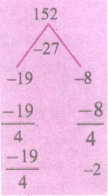
Case (i)
When y = 2
x2+ x = 2
x2 + x - 2 = 0
⇒ (x + 2)(x - 1) = 0
⇒ x = -2, 1
Case (ii)
When \(y=\frac { 19 }{ 4 } ,{ x }^{ 2 }+x=\frac { 19 }{ 4 } \)
\(\Rightarrow { 4x }^{ 2 }+4x=19\)
\(\Rightarrow { 4x }^{ 2 }-4x-19=0\)
\(\Rightarrow x=\frac { -4\pm \sqrt { 16-4(4)(-19) } }{ 8 } \)
\(\Rightarrow x=\frac { -4\pm \sqrt { 16+304 } }{ 8 } \)
\(\Rightarrow x=\frac { -4\pm \sqrt { 320 } }{ 8 } \)
\(\Rightarrow x=\frac { 4\pm 8\sqrt { 5 } }{ 8 } \)
\(\Rightarrow x=\frac { -4(-1\pm 2\sqrt { 5 } ) }{ 8 } \)
\(\frac{-1 \pm 2 \sqrt{5}}{2}\)
Hence the roots are 1, -2, \(\frac{-1 \pm 2 \sqrt{5}}{2}\)
25.
Let the encryption matrix be A =\(\left[ \begin{matrix} -1 & -1 \\ 2 & 1 \end{matrix} \right] \)
|A| = -1 + 2 = 1 ≠ 0
∴ A-1 =\(\frac { 1 }{ |A| } adjA=\frac { 1 }{ 1 } \left[ \begin{matrix} 1 & 1 \\ -2 & -1 \end{matrix} \right] =\left[ \begin{matrix} 1 & 1 \\ -2 & -1 \end{matrix} \right] \)
Hence the decryption matrix is \(\left[ \begin{matrix} 1 & 1 \\ -2 & -1 \end{matrix} \right] \)
| Coded row matrix | Decoding matrix | Decoded row matrix |
| [2 -3] | \(\left[ \begin{matrix} 1 & 1 \\ -2 & -1 \end{matrix} \right] \) | = [2+ 6 2+3] = [8 5] |
| [20 4] | \(\left[ \begin{matrix} 1 & 1 \\ -2 & -1 \end{matrix} \right] \) | = [20-8 20-4] = [12 16] |
So, the sequence of decoded row matrices is [8 5], [12 16]
Now the 8th English alphabet is H.
5th English alphabet is E.
12th English alphabet is L.
and the 16th English alphabet is P.
Thus the receiver reads the message as "HELP".
26.
\(Let\int _{ 0 }^{ \frac { \pi }{ 2 } }{ { e }^{ x }\left( \frac { sinx }{ 1+cosx } \right) dx } \)
\(\int _{ 0 }^{ \frac { \pi }{ 2 } }{ { e }^{ x }\left( \frac { 1+sinx }{ { cos }^{ 2 }\frac { x }{ 2 } } \right) dx } \)
\(\left[ \because cosx=2{ cos }^{ 2 }x-1\Rightarrow 1+cos2x=2{ cos }^{ 2 }x \right] \)
\(=\frac { 1 }{ 2 } \int _{ 0 }^{ \frac { \pi }{ 2 } }{ { e }^{ x }\left( \frac { 1 }{ { cos }^{ 2 }\frac { x }{ 2 } } +\frac { sinx }{ { cos }^{ 2 }\frac { x }{ 2 } } \right) dx } \)
\(=\frac { 1 }{ 2 } \int _{ 0 }^{ \frac { \pi }{ 2 } }{ { e }^{ x }\left( { sec }^{ 2 }\frac { x }{ 2 } +\frac { 2sin\frac { x }{ 2 } cos\frac { x }{ 2 } }{ { cos }^{ 2 }\frac { x }{ 2 } } \right) dx } \)
\(\\ [\because sin2x=2sinx\quad cosx]\)
\(=\frac { 1 }{ 2 } \int _{ 0 }^{ \frac { \pi }{ 2 } }{ { e }^{ x }\left( { sec }^{ 2 }\frac { x }{ 2 } 2tan\frac { x }{ 2 } \right) dx } \)
\(=\frac { 1 }{ 2 } \int _{ 0 }^{ \frac { \pi }{ 2 } }{ { e }^{ x }(f'(x)+f(x)dx } \)
Where \(f(x)=2tan\frac { x }{ 2 } \)
\(=\frac { 1 }{ 2 } .{ e }^{ x }.f(x)={ \left[ \left( \frac { 1 }{ 2 } { e }^{ x }.2tan\frac { x }{ 2 } \right) \right] }_{ 0 }^{ \frac { \pi }{ 2 } }\)
\(={ \left[ { e }^{ x }tan\frac { x }{ 2 } \right] }_{ 0 }^{ \frac { \pi }{ 2 } }\)
\(={ e }^{ \frac { \pi }{ 2 } }tan\frac { \pi }{ 4 } -{ e }^{ 0 }tan0={ e }^{ \frac { \pi }{ 2 } }(1)\)
\(\therefore I={ e }^{ \frac { \pi }{ 2 } }\)
27.
\({ h }({ x }_{ o })=\frac { x }{ 1+1 } =\frac { 1 }{ 2 } \)
\({ h }^{ ' }(x)=\frac { (x+1)(1)-x(1) }{ { (x+1) }^{ 2 } } \)
\(\frac { x+1-x }{ { (x+1) }^{ 2 } } =\frac { 1 }{ ({ x+1) }^{ 2 } } \)
\({ h }^{ ' }({ x }_{ o })=\frac { 1 }{ { 2 }^{ 2 } } =\frac { 1 }{ 4 } \)
∴ L(x) = h(xo) + h'(x0)(x - xo)
\(=\frac { 1 }{ 2 } +\frac { 1 }{ 4 } (x-1)=\frac { 2+x-1 }{ 4 } =\frac { x+1 }{ 4 } \)
∴ L(x) = \(\frac { x+1 }{ 4 } \)
28.
Let X be the random variable of getting apples Given 5 mangoes and 4 apples are in an urn
= {0, 1,2,3}
The sample space consists of 9C3 = 84
X = 0, X (3 mangoes) = 5C3 = 10
X = 1, X (2 mangoes and 1 apples) = 5C2 x 4C1 = 40
X = 2, X (1 mangoes and 2 apples) = 5C1 x 4C2 = 30
X = 3, X (apples) = 4C3 = 4
| Values of random variable | 0 | 1 | 2 | 3 | Total |
| No of points in inverse image | 10 | 40 | 30 | 4 | 84 |
29.
Let X be the random variable of number of tails when three coins tossed.
S = {HHH, HHT, THH, HTH, HTT, THT, TTH,TTT}
n(S) = 8
Let X denote the number of tarits occured.
X-1 (0) {HHH} = 1
X-1 (1) = {HHT, THT, HTH} = 3
X-1 (2) =, {HTT, THT, TTH} = 3
X-1 (3) = {TTT} = 1
ஃ X takes the values 0, 1, 2, 3.
Values of random variable X | 0 | 1 | 2 | 3 | Total |
Number of elements in reverse images | 1 | 3 | 3 | 1 | 8 |
30.
This is an indeterminate form \(\frac{\infty}{\infty}\) and hence we use the l’Hôpital’s Rule to evaluate.
\(\underset{x\rightarrow 1^{-}}{lim}(\frac{log(1-x)}{cot(\pi x)})=\underset{x\rightarrow1^{-}}{lim}(\frac{-\frac{1}{1-x}}{-\pi cosec^{2}(\pi x)})\) \((\frac{\infty}{\infty})\)
On Simplication,
\(=\underset{x\rightarrow-1}{lim}(\frac{sin^{2}(\pi x)}{\pi (1-x)})\) \((\frac{0}{0})\)
again applying the l’Hôpital Rule
\(= \underset{x\rightarrow 1^{-}}{lim}(\frac{2\pi sin(\pi x). cos(\pi x)}{-\pi})\)
=\(\underset{x\rightarrow -1}{lim}(-2 sin(\pi x).cos (\pi x))\)
= 0.
31.
\(f'\left( x \right) =6\times \frac { 4 }{ 3 } { x }^{ \frac { 4 }{ 3 } -1 }-3\times \frac { 1 }{ 3 } { x }^{ \frac { 1 }{ 3 } -1 }\)
= \({ 8x }^{ \frac { 1 }{ 3 } }-x^{ \frac { -2 }{ 3 } }\)
f'(x) = 0
\(\Rightarrow{ 8 }x^{ \frac { 1 }{ 3 } }-\frac { 1 }{ { x }^{ \frac { 2 }{ 3 } } } =0\)
\(\Rightarrow \frac { 8x-1 }{ { x }^{ \frac { 2 }{ 3 } } } =0\)
\(\Rightarrow x=\frac { 1 }{ 8 } \)
Thus, the critical number is \(x=\frac { 1 }{ 8 } \)
Evaluating f(x) at the end points = -1
x = 1 and at the critical number x = \(\frac { 1 }{ 8 } \)
we get
\(f(-1)=6(-1)^{ \frac { 4 }{ 3 } }-3\left( -1 \right) ^{ \frac { 1 }{ 3 } }\)
= 6( 1) - 3 (-1) = 6 + 3 = 9
\(f(1)=6(1)^{ \frac { 4 }{ 3 } }-3(1)^{ \frac { 1 }{ 3 } }=6-3=3\)
\(f\left( \frac { 1 }{ 8 } \right) =6\left( \frac { 1 }{ 8 } \right) ^{ \frac { 4 }{ 3 } }-3\left( \frac { 1 }{ 8 } \right) ^{ \frac { 1 }{ 3 } }\)
=\(6\left( { 2 }^{ -3 } \right) ^{ \frac { 4 }{ 3 } }-3\left( 2^{ -3 } \right) ^{ \frac { 1 }{ 3 } }\)
= \(\frac { 6 }{ 16 } -\frac { 3 }{ 2 } =\frac { 3 }{ 8 } -\frac { 3 }{ 2 } \)
= \(\frac { 3-12 }{ 8 } =\frac { -9 }{ 8 } \)
From these values, the absolute maximum is 9 which occurs at x = -1 and the absolute minimum is \(-\frac { 9 }{ 8 } \) which occurs at x = \(\frac { 1 }{ 8 } \)
32.
Let f (x) = x4 + 2x3-2
Then f (x) is continuous in [0, 1] and differentiable in (0, 1)
Now, f'(x) = 4x3+6x2
If f'(x) = 0, then
2x2(2x+3) = 0
Therefore, \(x=0, -\frac{3}{2}\) but \(0,-\frac{3}{2} \notin (0,1)\).
Thus, \(f'(x)>0, \forall x\in (0,1)\).
Hence by the Rolle’s theorem there do not exist \(a,b \in(0,1)\) such that, f(a) = 0 = f(b). Therefore the equation f(x ) = 0 cannot have two roots in the interval (0, 1) . But, f (0, 2) = −2 < 0 and f (1) = 1 > 0 tells us the curve y f = (x) crosses the x -axis between 0 and 1 only once by the Intermediate value theorem. Therefore the equation x4 + 2x3 − 2 = 0 has only one real root in the interval (0, 1) .
33.
Observe that, f (2) = 0 = f (3) and f (x) is continuous in the interval [2, 3] and differentiable in (2, 3). Now,
\(f'(x)=\frac{x^{2}-6}{x(x^{2}+6)} \)
Therefore, \(f'{(c)}=0\) gives
\(\frac{c^{2}-6}{c(c^{2}+6)}=0\)
which implies \( c=\pm\sqrt{6}\)
Now c = \(\pm\sqrt{6} \in (2,3).\)
Observe that \(-\sqrt{6}\notin (2,3)\) and hence \(c=\pm\sqrt{6}\) satisfies the Rolle’s theorem.
Rolle’s theorem can also be used to compute the number of roots of an algebraic equation in an interval without actually solving the equation.
34.
2x-y = 8, 3x+2y+2 = -2
The matrix form of the system is
\(\left[ \begin{matrix} 2 & -1 \\ 3 & 2 \end{matrix} \right] \left[ \begin{matrix} x \\ y \end{matrix} \right] =\left[ \begin{matrix} 8 \\ -2 \end{matrix} \right] \)
⇒ AX = B where A =\(\\ \left[ \begin{matrix} 2 & -1 \\ 3 & 2 \end{matrix} \right] \)
B =\(\left[ \begin{matrix} 8 \\ -2 \end{matrix} \right] \)
⇒ X = A-1N
Now, |A| =\(\left[ \begin{matrix} 2 & -1 \\ 3 & 2 \end{matrix} \right] \)= 4 + 3 = 7
∴ A-1= \(\frac { 1 }{ |A| } \)adj A
= \(\frac { 1 }{ 7 } \left[ \begin{matrix} 2 & 1 \\ -3 & 2 \end{matrix} \right] \)
∴ X = A-1B = \(\frac { 1 }{ 7 } \left[ \begin{matrix} 2 & 1 \\ -3 & 2 \end{matrix} \right] \left[ \begin{matrix} 8 \\ -2 \end{matrix} \right] \)
= \(\frac { 1 }{ 7 } \left[ \begin{matrix} 16-2 \\ -24-4 \end{matrix} \right] \)
= \(\frac { 1 }{ 7 } \left[ \begin{matrix} 14 \\ -28 \end{matrix} \right] =\left[ \begin{matrix} \frac { 14 }{ 7 } \\ \frac { -28 }{ 7 } \end{matrix} \right] =\left[ \begin{matrix} 2 \\ -4 \end{matrix} \right] \)
∴ x = 2, y = -4
Hence, the solution set is {2, -4}
35.
\(\left[ \begin{matrix} 5 & 1 & 1 \\ 1 & 5 & 1 \\ 1 & 1 & 5 \end{matrix} \right] \)
Let A =\(\left[ \begin{matrix} 5 & 1 & 1 \\ 1 & 5 & 1 \\ 1 & 1 & 5 \end{matrix} \right] \)
Expending along R1,
|A| = \(5\left| \begin{matrix} 5 & 1 \\ 1 & 5 \end{matrix} \right| -1\left| \begin{matrix} 1 & 1 \\ 1 & 5 \end{matrix} \right| +1\left| \begin{matrix} 1 & 5 \\ 1 & 1 \end{matrix} \right| \)
= 5 (25 - 1)-1 (5 - 1)+ 1 (1 - 5)
= 5 (24) - 1(4) + 1(- 4)
= 120 - 4 - 4 = 120 - 8 = 112 ≠ 0
Since A is non singular, A-1 exit
adj A =\(\left[ \begin{matrix} +\left| \begin{matrix} 5 & 1 \\ 1 & 5 \end{matrix} \right| & -\left| \begin{matrix} 1 & 1 \\ 1 & 5 \end{matrix} \right| & +\left| \begin{matrix} 1 & 5 \\ 1 & 1 \end{matrix} \right| \\ -\left| \begin{matrix} 1 & 1 \\ 1 & 5 \end{matrix} \right| & +\left| \begin{matrix} 5 & 1 \\ 1 & 5 \end{matrix} \right| & -\left| \begin{matrix} 5 & 1 \\ 1 & 1 \end{matrix} \right| \\ +\left| \begin{matrix} 1 & 1 \\ 5 & 1 \end{matrix} \right| & -\left| \begin{matrix} 5 & 1 \\ 1 & 1 \end{matrix} \right| & +\left| \begin{matrix} 5 & 1 \\ 1 & 5 \end{matrix} \right| \end{matrix} \right] ^{ T }\)
=\(\left[ \begin{matrix} +(25-1)-(5-1)+(1-5) \\ -(5-1)+(25-1)-(5-1) \\ +(1-5)+(5-1)+(25-1) \end{matrix} \right] ^{ T }\)
=\(\left[ \begin{matrix} 24 & -4 & -4 \\ -4 & 24 & -4 \\ -4 & -4 & 24 \end{matrix} \right] ^{ T }=\left[ \begin{matrix} 24 & -4 & -4 \\ -4 & 24 & -24 \\ -4 & -4 & 24 \end{matrix} \right] \)
Taking 4 common from every entry we get,
adj A = \(4\left[ \begin{matrix} 6 & -1 & -1 \\ -1 & 6 & -1 \\ -1 & -1 & 6 \end{matrix} \right] \)
∴ A-1 = \(\frac { 1 }{ |A| } adjA=\frac { 1 }{ 112 } .4\left[ \begin{matrix} 6 & -1 & -1 \\ -1 & 6 & -1 \\ -1 & -1 & 6 \end{matrix} \right] \)
= \(\frac { 1 }{ 28 } \left[ \begin{matrix} 6 & -1 & -1 \\ -1 & 6 & -1 \\ -1 & -1 & 6 \end{matrix} \right] \).
36.
Let \(\vec { \mu } \) the position vector of an arbitrary point on the plane \(\vec { r } .(2\hat { i } -\hat { j } -2\hat { k } )\) = 6. Then, we have
\(\vec { \mu } .(2\hat { i } -\hat { j } -2\hat { k } )=6\) .........(1)
If δ is the distance between the given planes, then δ is the perpendicular distance from \(\vec { \mu } \) to the plane
\(\vec { r } .(6\hat { i } -3\hat { j } -6\hat { k} )\) = 27
Therefore, δ = \(\frac { \left| \vec { u } .\vec { n } -p \right| }{ \left| \vec { n } \right| } =\left| \frac { \vec { u } .(6\hat { i } -3\hat { j } -6\hat { k } )-27 }{ \sqrt { 6^{ 2 }+(-{ 3) }^{ 2 }+(-{ 6 })^{ 2 } } } \right| =\left| \frac { 3(\vec { u } .(2\hat { i } -\hat { j } -2\hat { k } ))-27 }{ 9 } \right| =\left| \frac { (3(6)-27 }{ 9 } \right| =1\) unit
37.
Let \(\vec { a } =-2\hat { i } +3\hat { j } +4\hat { k } \) and \(\vec { b } =-4\hat { i } +5\hat { j } -6\hat { k } \)
The parametric form of vector equation of a straight line passing through a point \((\vec { b } )\) and parallel to is \(\vec { b } \)is
\(\vec { r } =\vec { a } +t\vec { b } \) where \(t\in R\)
∴ \(\vec { r } =-2\hat { i } +3\hat { j } +4\hat { k } +t(-4\hat { i } +5\hat { j } -6\hat { k } ),t\in R\)
Its Cartesian equation is
\(\frac { x-{ x }_{ 1 } }{ { b }_{ 1 } } =\frac { y-{ y }_{ 1 } }{ { b }_{ 2 } } =\frac { z-{ z }_{ 1 } }{ { b }_{ 3 } } \)
⇒ \(\frac { x+2 }{ -4 } =\frac { y-3 }{ 5 } =\frac { z-4 }{ -6 } \)
[∵ (x1, y1, z1) is (-2, 3, 4) & (b1, b2, b3) is (-4, -5, -6)]
38.
Let −1−i = \(r(cos\ \theta +i\ sin\ \theta )\)
We have r = \(\sqrt { { x }^{ 2 }+{ y }^{ 2 } } =\sqrt { { 1 }^{ 2 }+{ 1 }^{ 2 } } =\sqrt { 1+1 } =\sqrt { 2 } \)
\(\alpha =tan^{ -1 }\left| \frac { y }{ x } \right| =tan^{ -1 }1=\frac { \pi }{ 4 } \)
Since the complex number −1−i lies in the third quadrant, it has the principal value,
\(\theta =\alpha -\pi =\frac { \pi }{ 4 } -\pi =-\frac { 3\pi }{ 4 } \)
Therefore,\(-1-i=\sqrt { 2 } \left( cos\left( \frac { 3\pi }{ 4 } \right) +isin\left( \frac { 3\pi }{ 4 } \right) \right) \)
= \(\sqrt { 2 } \left( cos\frac { 3\pi }{ 4 } -isin\frac { 3\pi }{ 4 } \right) \)
\(-1-i=\sqrt { 2 } \left( cos\left( \frac { 3\pi }{ 4 } +2k\pi \right) -isin\left( \frac { 3\pi }{ 4 } +2k\pi \right) \right) \)
Depending upon the various values of k , we get various alternative polar forms.
39.
(c)
40.
(c)
\(\frac { 3 }{ 8 } \)
41.
(a)
\(\frac { 8 }{ 3 } \)
42.
(a)
y = cx
43.
(c)
44.
(a)
0
45.
(d)
\(\int _{ a }^{ b }{ f(a+b-x) } dx\)
46.
(d)
47.
(a)
0
48.
(a)
cos x
49.
(b)
50.
(d)
concave upwards
51.
(a)
-2
52.
(c)
53.
(d)
4

12th Standard Syllabus & Materials
12th Standard
TN 12th Computer Applications களப்பெயர் முறைமை (DNS) Sample Question Papers Study Material - QB365 Set A
NEW12th Standard
TN 12th Computer Applications வலையமைப்பு எடுத்துக்காட்டுகள் மற்றும் நெறிமுறைகள் Sample Question Papers Study Material - QB365 Set A
NEW12th Standard
TN 12th Computer Applications கணினி வலையமைப்பு ஓர் அறிமுகம் Sample Question Papers Study Material - QB365 Set A
NEW12th Standard
TN 12th Computer Applications PHP-உடன் MySQL-ஐ இணைத்தல் Sample Question Papers Study Material - QB365 Set A



Tamilnadu Stateboard 12th Standard Subjects
Maths

Chemistry

Physics

Biology

Computer Science

Business Maths and Statistics

Economics

Commerce

Accountancy

History

Computer Applications
Biology
Computer Technology
Computer Applications
Computer Science
Business Maths and Statistics
Commerce
Economics
Maths
Chemistry
Physics
Computer Technology
History
Accountancy

Tamil

English

French
Tamilnadu Stateboard Standards

