
 100% FREE ACCESS
12th Standard Syllabus & Materials
12th Standard
TN 12th Computer Applications மின்னணு தரவு பரிமாற்றம் Sample Question Papers Study Material - QB365 Set A
NEW12th Standard
TN 12th Computer Applications மின் - வணிக பாதுகாப்பு அமைப்புகள் Sample Question Papers Study Material - QB365 Set A
NEW12th Standard
TN 12th Computer Applications மின்னணு செலுத்தல் முறைகள் Sample Question Papers Study Material - QB365 Set A
NEW12th Standard
TN 12th Computer Applications மின் - வணிகம் Sample Question Papers Study Material - QB365 Set A
NEW12th Standard
TN 12th Computer Applications திறந்த மூல கருத்துருக்கள் Sample Question Papers Study Material - QB365 Set A
NEW12th Standard
TN 12th Computer Applications வலையமைப்பு வடமிடல் Sample Question Papers Study Material - QB365 Set A

Published on: 30/01/2021
12th Standard Maths English Medium Reduced Syllabus Important Questions - 2021 Part - 2
Download Tamil Nadu 12th Standard Maths question papers, model tests, one-mark questions, important questions, and public exam papers in PDF format. Free study materials and answer keys for TN State Board students.
Questions + Answers key
Take MCQ Maths Test1.
Find the values in the interval \((\frac{1}{2},2)\) satisfied by the Rolle's theorem for the function \(f(x)=x+\frac{1}{x}, x\in[\frac{1}{2},2]\)
2.
Find the value of
\(sin\left( { tan }^{ -1 }\left( \frac { 1 }{ 2 } \right) -{ cos }^{ -1 }\left( \frac { 4 }{ 5 } \right) \right) \)
3.
Obtain the Cartesian equation for the locus of z = x + iy in each of the following cases:
|z - 4|2- |z -1 |2 = 16
4.
Solve the following system of linear equations by matrix inversion method :
2x − y = 8 , 3x + 2y = −2.
5.
Find the parametric form of vector equation and Cartesian equations of a straight line passing through (5, 2,8) and is perpendicular to the straight lines
\(\vec { r } =(\hat { i } +\hat { j } -\hat { k } )+s(2\hat { i } -2\hat { j } +\hat { k } )\)
\(\vec { r } =(\hat { 2i } -\hat { j } -3\hat { k } )+t(\hat { i } +2\hat { j } +2\hat { k } )\).
6.
If the straight line joining the points (2, 1, 4) and (a−1, 4, −1) is parallel to the line joining the points (0, 2, b −1) and (5, 3, −2), find the values of a and b.
7.
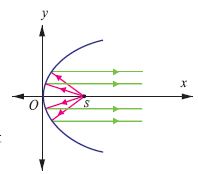
A search light has a parabolic reflector (has a cross-section that forms a ‘bowl’). The parabolic bowl is 40 cm wide from rim to rim and 30 cm deep. The bulb is located at the focus.
(1) What is the equation of the parabola used for reflector?
(2) How far from the vertex is the bulb to be placed so that the maximum distance covered?
8.
Find the equation of the hyperbola in each of the cases given below:
passing through (5, −2) and length of the transverse axis along x axis and of length 8 units.
9.
Find solution, if any, of the equation 2cos2x - 9cosx + 4 = 0
10.
Given A = \(\left[ \begin{matrix} 1 & -1 \\ 2 & 0 \end{matrix} \right] \), B = \(\left[ \begin{matrix} 3 & -2 \\ 1 & 1 \end{matrix} \right] \) and C = \(\left[ \begin{matrix} 1 & 1 \\ 2 & 2 \end{matrix} \right] \), find a matrix X such that A X B = C.
11.
Find the domain of sin−1(2−3x2)
12.
Solve :\(x\frac { dy }{ dx } sin\left( \frac { y }{ x } \right) +x-ysin\left( y\frac { y }{ x } \right) =,y(1)=\frac { \pi }{ 2 } \)
13.
Solve :(x2+xy)dy=(x2+y2)dx
14.
Solve : \({ e }^{ \frac { dy }{ dx } }=x+1,y(0)=5\)
15.
AOB is the positive quadrant of the ellipse \(\frac { { x }^{ 2 } }{ { a }^{ 2 } } +\cfrac { { y }^{ 2 } }{ { b }^{ 2 } } =1\) where OA=a and OB=b.Find the area between the arc AB and chord AB of the elipse.
16.
Find the area of the region bounded by a2y2=a2(a2-x2)
17.
Find the area bounded by the curves y=|x|-1 and y=-|x|+1
18.
A population grows at the rate of 2% per year. How long does it take for the population to double?
19.
Verify (p ∧ ~p) ∧ (~q ∧ p) is a tautlogy, contradiction or contingency.
20.
Prove that the semi-vertical angle of a cone of maximum volume and of given slant height is tan-1(\(\sqrt { 2 } \)).
21.
Find the value of \(tan\left[ \frac { 1 }{ 2 } { sin }^{ -1 }\left( \frac { 2a }{ 1+{ a }^{ 2 } } \right) +\frac { 1 }{ 2 } { cos }^{ -1 }\left( \frac { 1-{ a }^{ 2 } }{ 1+{ a }^{ 2 } } \right) \right] \)
22.
Find the coordinates of the foot of the perpendicular drawn from the point (-1, 2, 3) to the straight line \(\vec { r } =(\hat { i } -4\hat { j } +3\hat { k } )+t(2\hat { i } +3\hat { j } +\hat { k } )\). Also, find the shortest distance from the point to the straight line.
23.
If \(cos\alpha +cos\beta +cos\gamma =sin\alpha +sin\beta +sin\gamma =0\) then show that
(i) \(cos3\alpha +cos3\beta +cos3\gamma =3cos(\alpha +\beta +\gamma )\)
(ii) \(sin3\alpha +sin3\beta +sin3\gamma +sin3\gamma =3sin\left( \alpha +\beta +\gamma \right) \)
24.
Find the inverse of each of the following by Gauss-Jordan method:
\(\left[ \begin{matrix} 2 & -1 \\ 5 & -2 \end{matrix} \right] \)
25.
The rank of the matrix \(\left[ \begin{matrix} 1 \\ \begin{matrix} 2 \\ -1 \end{matrix} \end{matrix}\begin{matrix} 2 \\ \begin{matrix} 4 \\ -2 \end{matrix} \end{matrix}\begin{matrix} 3 \\ \begin{matrix} 6 \\ -3 \end{matrix} \end{matrix}\begin{matrix} 4 \\ \begin{matrix} 8 \\ -4 \end{matrix} \end{matrix} \right] \) is
1
2
4
3
26.
If P = \(\left[ \begin{matrix} 1 & x & 0 \\ 1 & 3 & 0 \\ 2 & 4 & -2 \end{matrix} \right] \) is the adjoint of 3 × 3 matrix A and |A| = 4, then x is
15
12
14
11
27.
If A = \(\left[ \begin{matrix} 2 & 0 \\ 1 & 5 \end{matrix} \right] \) and B = \(\left[ \begin{matrix} 1 & 4 \\ 2 & 0 \end{matrix} \right] \) then |adj (AB)| =
-40
-80
-60
-20
28.
The locus of a point whose distance from (-2,0) is \(\frac { 2 }{ 3 } \) times its distance from the line x = \(\frac { -9 }{ 2 } \) is
a parabola
a hyperbola
an ellipse
a circle
29.
If x + y = k is a normal to the parabola y2 = 12x, then the value of k is
3
-1
1
9
30.
If the normals of the parabola y2 = 4x drawn at the end points of its latus rectum are tangents to the circle (x − 3)2 + (y + 2)2 = r2 , then the value of r2 is
2
3
1
4
31.
The eccentricity of the hyperbola whose latus rectum is 8 and conjugate axis is equal to half the distance between the foci is
\(\frac { 4 }{ 3 } \)
\(\frac { 4 }{ \sqrt { 3 } } \)
\(\frac { 2 }{ \sqrt { 3 } } \)
\(\frac { 3 }{ 2 } \)
32.
The equation of the circle passing through (1, 5) and (4, 1) and touching y-axis is x2 + y2 − 5x − 6y + 9 + \(\lambda\)(4x + 3y − 19) = 0 where λ is equal to
\(0,-\frac { 40 }{ 9 } \)
0
\(\frac { 40 }{ 9 } \)
\(\frac { -40 }{ 9 } \)
33.
\(\tan ^{-1}\left(\frac{1}{4}\right)+\tan ^{-1}\left(\frac{2}{9}\right)\) is equal to
\(\frac { 1 }{ 2 } \ { cos }^{ -1 }\left( \frac { 3 }{ 5 } \right) \)
\(\frac { 1 }{ 2 } { sin }^{ -1 }\left( \frac { 3 }{ 5 } \right) \)
\(\frac { 1 }{ 2 } {tan }^{ -1 }\left( \frac { 3 }{ 5 } \right) \)
\({ tan}^{ -1 }\left( \frac { 1}{ 2 } \right) \)
34.
If \(x = \frac{1}{5}\), the value of cos (cos-1x+2sin-1x) is
\(-\sqrt { \frac { 24 }{ 25 } } \)
\(\sqrt { \frac { 24 }{ 25 } } \)
\(\frac{1}{5}\)
\(-\frac{1}{5}\)
35.
If \(\frac { z-1 }{ z+1 } \) is purely imaginary, then |z| is
\(\frac { 1 }{ 2 } \)
1
2
3
36.
z1, z2 and z3 are complex number such that z1 + z2 + z3 = 0 and |z1| = |z2| = |z3| = 1 then z12 + z22 + z33 is
3
2
1
0
37.
The polynomial x3 + 2x + 3 has
one negative and two imaginary zeros
one positive and two imaginary zeros
three real zeros
no zeros
38.
39.
The polynomial x3 - kx2 + 9x has three real zeros if and only if, k satisfies
|k| ≤ 6
k = 0
|k| > 6
|k| ≥ 6
40.
Determine the order and degree of \(\frac { \left[ 1+\left( \frac { dy }{ dx } \right) ^{ 2 } \right] ^{ \frac { 3 }{ 2 } } }{ \frac { { d }^{ 2 }y }{ { dx }^{ 2 } } } =k\)
41.
Find the area of the region bounded by the curve \(\sqrt { x } +\sqrt { y } =\sqrt { a } \) (x,y>0) and the co-ordinate axes.
42.
Evaluate \(\int _{ 0 }^{ \frac { \pi }{ 2 } }{ { e }^{ 2x }cosxdx } \)
43.
Prove that the function f(x)=e-x is strictky increasing on [0,1]
44.
Prove that the function f(x)=2x2+3x is strictly increasing on \(\left[ -\frac { 1 }{ 2 } ,\frac { 1 }{ 2 } \right] \)
45.
Evaluate the following limits, if necessary using L’Hopitalrule
(i) \(\underset { x\rightarrow 2 }{ lim } \cfrac { sin\pi x }{ 2-x } \)
(ii) \(\cfrac { lim }{ x\rightarrow 2 } \cfrac { { x }^{ n }-{ a }^{ n } }{ x-2 } \)
(iii) \(\underset { x\rightarrow \infty }{ lim } \cfrac { sin\frac { 2 }{ x } }{ \frac { 1 }{ x } } \)
(iv) \(\underset { x\rightarrow \infty }{ lim } \cfrac { { x }^{ 2 } }{ { e }^{ x } } \)
46.
Find the point on the parabola y2=18x at which the ordinate increases at twice the rate of the abscissa.
47.
Evaluate \(\int _{ 1 }^{ 2 }{ \frac { 3x }{ { 9x }^{ 2 }-1 } dx } \)
48.
IF u(x, y) = x2 + 3xy + y2, x, y, ∈ R, find tha linear appraoximation for u at (2, 1)
49.
Find the intervals of increasing and decreasing function for f(x) = x3 + 2x2 - 1.
50.
Find the equation of the plane containing the line of intersection of the planes x + y + Z - 6 = 0 and 2x + 3y + 4z + 5 = 0 and passing through the point (1, 1, 1)
1.
We have, f (x) is continuous in \([\frac{1}{2},2 ]\) and differentiable in \((\frac{1}{2},2 )\) with \(f(\frac{1}{2})=\frac{5}{2}=f(2) \).
By the Rolle’s theorem there must exist a \(c \in (\frac{1}{2},2 )\) such that, \(f'(c)=1-\frac{1}{c^{2}}=0 \Rightarrow c^{2}=1 \) gives \(\Rightarrow c=\pm1, \) As \(1\in(\frac{1}{2},2)\) we choose c = 1.
2.
\(sin\left( { tan }^{ -1 }\left( \frac { 1 }{ 2 } \right) -{ cos }^{ -1 }\left( \frac { 4 }{ 5 } \right) \right) \)
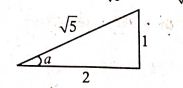
Let \({ tan }^{ -1 }\left( \frac { 1 }{ 2 } \right) =x\Rightarrow \frac { 1 }{ 2 } =tanx\)
\(cosx=\frac { adj }{ hyp } =\frac { 2 }{ \sqrt { 5 } } \)
\(\therefore sinx= \frac { 1 }{ \sqrt { 5 } } \)
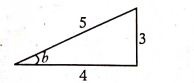
Let \({ cos }^{ -1 }\left( \frac { 4 }{ 5 } \right) =y\Rightarrow \frac { 4 }{ 5 } =cosy\)
\(siny=\frac { opp }{ hyp } =\frac { 3 }{ 5 } \)
\(\therefore sin\left( { tan }^{ -1 }\left( \frac { 1 }{ 2 } \right) \right) -{ cos }^{ -1 }\left( \frac { 4 }{ 5 } \right) \)
= sin (x - y) = sin x cos y - cos x sin y
= \(\frac { 1 }{ \sqrt { 5 } } .\frac { 4 }{ 5 } -\frac { 2 }{ \sqrt { 5 } } .\frac { 3 }{ 5 } \)
= \(\frac { 4 }{ 5\sqrt { 5 } } =\frac { 6 }{ 5\sqrt { 5 } } =\frac { -2 }{ 5\sqrt { 5 } }\)
3.
|z-4|2-|z-1|2 = 16
|x+iy-4|2 - |x+iy-1|2 = 16
⇒ |(x-4)+iy|2 - |(x-1)+iy2|2 = 16
⇒ [(x-4)2+y2] - [(x-1)2+y2] = 16
⇒ x2-8x+16+y2-[x2-2x+1+y2] = 16
\(\Rightarrow \not x^{2}-8 x+16+\not y^{2}-\not x^{2}+2 x-1-\not y^{2}=16\)
⇒ -6x+15-16 = 0
⇒ -6x-1 = 0
⇒ 6x+1 = 0 Which is the required Cartesian equation.
The locus of the point is a straight line.
4.
2x-y = 8, 3x+2y+2 = -2
The matrix form of the system is
\(\left[ \begin{matrix} 2 & -1 \\ 3 & 2 \end{matrix} \right] \left[ \begin{matrix} x \\ y \end{matrix} \right] =\left[ \begin{matrix} 8 \\ -2 \end{matrix} \right] \)
⇒ AX = B where A =\(\\ \left[ \begin{matrix} 2 & -1 \\ 3 & 2 \end{matrix} \right] \)
B =\(\left[ \begin{matrix} 8 \\ -2 \end{matrix} \right] \)
⇒ X = A-1N
Now, |A| =\(\left[ \begin{matrix} 2 & -1 \\ 3 & 2 \end{matrix} \right] \)= 4 + 3 = 7
∴ A-1= \(\frac { 1 }{ |A| } \)adj A
= \(\frac { 1 }{ 7 } \left[ \begin{matrix} 2 & 1 \\ -3 & 2 \end{matrix} \right] \)
∴ X = A-1B = \(\frac { 1 }{ 7 } \left[ \begin{matrix} 2 & 1 \\ -3 & 2 \end{matrix} \right] \left[ \begin{matrix} 8 \\ -2 \end{matrix} \right] \)
= \(\frac { 1 }{ 7 } \left[ \begin{matrix} 16-2 \\ -24-4 \end{matrix} \right] \)
= \(\frac { 1 }{ 7 } \left[ \begin{matrix} 14 \\ -28 \end{matrix} \right] =\left[ \begin{matrix} \frac { 14 }{ 7 } \\ \frac { -28 }{ 7 } \end{matrix} \right] =\left[ \begin{matrix} 2 \\ -4 \end{matrix} \right] \)
∴ x = 2, y = -4
Hence, the solution set is {2, -4}
5.
Let the given point be \(\vec { a } =5\hat { i } +2\hat { j } +8\hat { k } \)
Given lines are \(\vec { r } =(\hat { i } +\hat { j } -\hat { k } )+s(2\hat { i } -2\hat { j } +\hat { k } )\)
⇒ \(\vec { b } =2\hat { i } -2\hat { j } +\hat { k } \)
and \(\vec { r } =(2\hat { i } -\hat { j } -3\hat { k } )+t(\hat { i } +2\hat { j } +2\hat { k } )\)
⇒ \(\vec { d } =\hat { i } +2\hat { j } +2\hat { k } \)
Since the required line is perpendicular to both \(\vec { b } \) and \(\vec { d } \), it will be parallel to \(\vec { b } \times \vec { d } \)
\(\vec { b } \times \vec { d } =\left| \begin{matrix} \hat { i } & \hat { j } & \hat { k } \\ 2 & -2 & 1 \\ 1 & 2 & 2 \end{matrix} \right| \)
= \(\hat { i } (-4-2)-\hat { j } (4-1)+\hat { k } (4+2)\)
= \(-6\hat { i } -3\hat { j } +6\hat { k } \)
= \(-3(2\hat { i } +\hat { j } -2\hat { k } )\)
∴ Equation of required straight line is
\(\vec { r } =\vec { a } +m(\vec { b } \times \vec { d } ),m\in R\)
\(\vec { r } =(5\hat { i } +2\hat { j } +8\hat { k } )-3m(2\hat { i } +\hat { j } -2\hat { k } )\)
\(\vec { r } =(5\hat { i } +2\hat { j } +8\hat { k } )+t(2\hat { i } +\hat { j } -2\hat { k } )\)
where t =\(-3m\in R\)
Cartesian equation of a straight line passing through (5, 2, 8) and is 丄 to the straight lines
\(\vec { r } =(\vec { i } +\vec { j } -\vec { k } )+s(2\vec { i } -2\vec { j } +\vec { k } )\)
\(\vec { r } =(2\vec { i } -\vec { j } -3\vec { k } )+t(\vec { i } +2\vec { j } +2\vec { k } )\)
\(\frac { x-{ x }_{ 1 } }{ b_{ 1 } } =\frac { y-{ y }_{ 1 } }{ { b }_{ 2 } } =\frac { z-{ z }_{ 1 } }{ { b }_{ 3 } } \)
\(\frac { x-5 }{ 2 } =\frac { y-2 }{ 1 } =\frac { z-8 }{ -2 } \).
6.
Cartesian equation of straight line passing through two points (2, 1,4) and (a - 1,4, -1) is
\(\frac { x-{ x }_{ 1 } }{ { x }_{ 2 }-{ x }_{ 1 } } =\frac { y-{ y }_{ 1 } }{ { y }_{ 2 }-{ y }_{ 1 } } =\frac { z-{ z }_{ 1 } }{ { z }_{ 2 }-{ z }_{ 1 } } \)
[∵ (x1, y1, z1) = (2, 1, 4) (x2, y2, z2) = (a, -1, 4, -1)]
⇒ \(\frac { x-2 }{ a-1-2 } =\frac { y-1 }{ 4-1 } =\frac { z-4 }{ -1-4 } \)
⇒ \(\frac { x-2 }{ a-3 } =\frac { y-1 }{ 3 } =\frac { z-4 }{ -5 } \)
Similarly, Cartesian equation of straight liens passing through two points (0, 2, b - 1) and (5, 3, -2) is
\(\frac { x-5 }{ 5-0 } =\frac { y-3 }{ 2-3 } =\frac { z+3 }{ b-1+2 } \)
[∵ (x1,y1,z1)=(5,3,-2) (x2,y2,z2) is (0,2,b)...(1)
⇒ \(\frac { x-5 }{ -5 } =\frac { y-3 }{ -1 } =\frac { z+2 }{ b+1 } \)
(1) and (2) are parallel if their direction cosines are equal
∴ Direction ratios ofline (1) are a - 3, 3, -5 ........... (3)
Direction ratios of line (2) are -5, -1, b + 1 ............ (4)
To make the direction ratios equal, multiply (4) by-3.
∴ (4) ⟶ +15, 3, -3b-3
(3) ⟶ a-3, 3, -5
∴ a-3 = +5 ⇒ a = 15+3 = 18
3 = 3
-3b-3 = -15 ⇒ -3b = -5+3 = -2
⇒ b = \(\frac { -2 }{ -3 } =\frac { 2 }{ 3 } \)
∴ a = 18 and b = \(\frac { 2 }{ 3 } \).
7.
Let the vertex be (0, 0) .
The equation of the parabola is
y2 = 4ax
(1) Since the diameter is 40cm and the depth is 30 cm , the point (30, 20) lies on the parabola.
202 = 4a × 30
4a = \(\frac { 400 }{ 30 } \) = \(\frac { 40 }{ 3 } \)
Equation is y2 = \(\frac { 40 }{ 3 } \)x.
(2) The bulb is at focus (0, a).
Hence the bulb is at a distance of \(\frac { 10 }{ 3 } \)cm from the vertex.
8.
Passing through (5, -2) length of the transverse axis is a long x-axis and of length 8 units.
2a = 8 ⇒ a = 4
Since the transverse axis is along x-axis, centre is (0, 0)
Equation of the hyperbola is
\(\frac { { x }^{ 2 } }{ 16 } -\frac { { y }^{ 2 } }{ b^{ 2 } } =1\)
Since (5, -2)passes through the parabola,
\(\frac { 25 }{ 16 } -\frac { 4 }{ { b }^{ 2 } } \Rightarrow \frac { 4 }{ { b }^{ 2 } } =\frac { 25 }{ 16 } -1=\frac { 25-16 }{ 16 } =\frac { 9 }{ 16 } \)
∴ \({ b }^{ 2 }=\frac { 16\times 4 }{ 9 } =\frac { 64 }{ 9 } \)
∴ Equation of the hyperbola is
\(\frac { { x }^{ 2 } }{ 16 } -\frac { { y }^{ 2 } }{ \frac { 64 }{ 9 } } =1\Rightarrow \frac { { x }^{ 2 } }{ 16 } -\frac { 9{ y }^{ 2 } }{ 64 } =1\)
9.
2cos2x - 9cosx + 4 = 0 ............ (1)
The left hand side of this equation is not a polynomial in x. But it looks like a polynomial. In fact, we can say that this is a polynomial in cos x. However, we can solve the equation (1) by using our knowledge on polynomial equations. If we replace cos x by y, then we get the polynomial equation 2y2- 9y + 4 = 0 for which 4 and \(\frac{1}{2}\) are solutions.
From this we conclude that x must satisfy cos x = 4 or cos x = \(\frac{1}{2}\).
But cos x = 4 is never possible, if we take cos x = \(\frac{1}{2}\), then we get infinitely many real numbers x satisfying cos x = \(\frac{1}{2}\); in fact, for all n\(\in \)Z, x = 2nπ ±\(\frac { \pi }{ 3 } \) are solutions for the given equation (1).
If we repeat the steps by taking the equation cos2x - 9 cosx + 20 = 0, we observe that this equation has no solution.
10.
Given A =\(\left[ \begin{matrix} 1 & -1 \\ 2 & 0 \end{matrix} \right] \), B =\(\left[ \begin{matrix} 3 & -2 \\ 1 & 1 \end{matrix} \right] \) and C =\(\left[ \begin{matrix} 1 & 1 \\ 2 & 2 \end{matrix} \right] \)
Also, A X B = C
Premultiply by A-1 we get,
(A-1 A) X B = A-1 C
⇒ XB = A-1C [∵ A-1a = 1]
Post Multiply by B-1 we get
(X B) B-1 = (A-1 C) B-1
⇒ X = (A-1 C) B-1
|A| = \(\left| \begin{matrix} 1 & -1 \\ 2 & 0 \end{matrix} \right| \) = 0 + 2 = 2 ≠ 0
∴ A-1 = \(\frac { 1 }{ |A| } adjA=\frac { 1 }{ 2 } \left[ \begin{matrix} 0 & 1 \\ -2 & 1 \end{matrix} \right] \)
|B| = \(\left| \begin{matrix} 3 & -2 \\ 1 & 1 \end{matrix} \right| \) = 3 + 2 = 5 ≠ 0
∴ B-1 = \(\frac { 1 }{ |B| } adjB=\frac { 1 }{ 5 } \left[ \begin{matrix} 1 & 2 \\ -1 & 3 \end{matrix} \right] \)
A-1C = \(\\ \frac { 1 }{ 2 } \left[ \begin{matrix} 0 & 1 \\ -2 & 1 \end{matrix} \right] \left[ \begin{matrix} 1 & 1 \\ 2 & 2 \end{matrix} \right] \)
= \(\frac { 1 }{ 2 } \left[ \begin{matrix} 0+2 & 0+2 \\ -2+2 & -2+2 \end{matrix} \right] \)
=\(\frac { 1 }{ 2 } \left[ \begin{matrix} 2 & 2 \\ 0 & 0 \end{matrix} \right] =\frac { 1 }{ 2 } (2)\left[ \begin{matrix} 1 & 1 \\ 0 & 0 \end{matrix} \right] \)
=\(\left[ \begin{matrix} 1 & 1 \\ 0 & 0 \end{matrix} \right] \)
∴ X = Z(A-1C).B-1
= \(\left[ \begin{matrix} 1 & 1 \\ 0 & 0 \end{matrix} \right] \frac { 1 }{ 5 } \left[ \begin{matrix} 1 & 2 \\ -1 & 3 \end{matrix} \right] =\frac { 1 }{ 5 } \left[ \begin{matrix} 1-1 & 2+3 \\ 0+0 & 0+0 \end{matrix} \right] \)
= \(\frac { 1 }{ 5 } \left[ \begin{matrix} 0 & 5 \\ 0 & 0 \end{matrix} \right] =\frac { 1 }{ 5 } (5)\left[ \begin{matrix} 0 & 1 \\ 0 & 0 \end{matrix} \right] =\frac { 1 }{ 10 }\left[ \begin{matrix} 0 & 1 \\ 0 & 0 \end{matrix} \right] \)
∴ X = \(\frac { 1 }{ 10 } \left[ \begin{matrix} 0 & 1 \\ 0 & 0 \end{matrix} \right] \).
11.
We know that the domain of sin−1(x) is [-1, 1].
This leads to −1\(\le\)2 - 3x2\(\le\)1, Which implies -3\(\le\) -3x2\(\le\)-1
Now, -3\(\le\) -3x2, gives x2\(\le\)1 and ............(1)
-3\(\le\)-3x2\(\le\)-1, gives x2\(\ge\)\(\frac{1}{2}\) .........(2)
Combining the equations (1) and (2), we get \(\frac{1}{3}\le x^2\le 1\). That is \(\frac{1}{\sqrt3}\le |x|\le1\), Which gives \(x\in[-1,-1\frac{1}{\sqrt3}]\cup[\frac{1}{\sqrt3},1]\)
since a\(\le|x|\le b\) implies x \(\in[-b,-a]\cup[a,b]\).
12.
\(log|x|=cos\left( \frac { y }{ x } \right) ,x\neq 0\)
13.
c(x-y)2=|x|e-y/x,x≠0
14.
y=log(x+1)+log(x+1)-x+5
15.
\(\frac { ab\left( \pi -2 \right) }{ 4 } \)
16.
\(\frac { { 4a }^{ 2 } }{ 3 } sq.units\)
17.
2 sq.units
18.
Let Po be the initial population and the population after t year be P.
Given \(\frac { dp }{ dt } =\frac { 2p }{ 100 } \Rightarrow \frac { dp }{ dt } =\frac { p }{ 50 } \)
⇒ \(\frac { dp }{ p } =\frac { dt }{ 50 } \Rightarrow \int { \frac { dp }{ p } } =\int { \frac { dt }{ 50 } } \)
⇒ log p =\(\frac { t }{ 50 } \) + c ...(1)
when t = 0, p = 0
⇒ log p0 = 0+c ⇒ log p0 ....(1)
∴ (1) becomes, log p =\(\frac { t }{ 50 } \)+log P0.
⇒ log\(\left( \frac { P }{ { p }_{ 0 } } \right) =\frac { t }{ 50 } \)
⇒ t = 50 log\(\left( \frac { P }{ { p }_{ 0 } } \right) \)
when p = 2p0, t = 50 log\(\left( \frac { 2P_{ 0 } }{ { p }_{ 0 } } \right) \) = 50 log 2
= 50(0.3) = 15 years.
Hence the population doubles in 15 years.
19.
| p | q | ~p | p∧~p) | ~q | (~q)∧p | (p∧~p) ∧ (~q∧p) |
| T | T | F | F | F | F | F |
| T | F | F | F | T | T | F |
| F | T | T | F | F | F | F |
| F | F | T | F | T | F | F |
Since the entries in the last column are F, (p ∧ ~p) ∧ (~q ∧ P) is a contradiction
20.
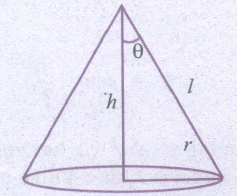
Let r be the radius of the base, h be the height of the cone, I be the slant height and θ be the semi vertical angle.
In ΔOAB l2 = h2+r2
⇒ r2 =l2-h2
⇒ V =\(\frac { 1 }{ 3 } { \pi }r^{ 2 }h=\frac { \pi }{ 3 } \)(l2-h2)h
=\(\frac { \pi }{ 3 } \) (l2h - h3)
\(\frac { dv }{ dh } =\frac { \pi }{ 3 } \)(l2-3h2)
\(\frac { dv }{ dh } \)=0
⇒ \(\frac { \pi }{ 3 } \)(l2 - 3h2) = 0
⇒ l2 - 3h2 = 0 ⇒ \(\frac { { l }^{ 2 } }{ { h }^{ 2 } } \) =3
⇒ \(\frac { l }{ h } \) = \(\sqrt { 3 } \) ⇒ h=\(\frac { 1 }{ \sqrt { 3 } } \)
Now, \(\frac { d^{ 2 }V }{ dh^{ 2 } } =\frac { \pi }{ 3 } \)(-6h) = -2πh
at h =\(\frac { l }{ \sqrt { 3 } } ,\frac { d^{ 2 }V }{ dh^{ 2 } } =-2\pi \left( \frac { l }{ \sqrt { 3 } } \right) \) < 0
V is max at h =\(\frac { l }{ \sqrt { 3 } } \)
∴ r2 =l2-\(\frac { { l }^{ 2 } }{ 3 } =\frac { 2{ l }^{ 2 } }{ 3 } \) =2h2
\(\\ \left[ \because h=\frac { l }{ \sqrt { 3 } } \Rightarrow h^{ 2 }=\frac { { l }^{ 2 } }{ 3 } \right] \)
∴ \(\frac { { r }^{ 2 } }{ { h }^{ 2 } } \) =2
⇒ \(\frac { r }{ h } =\sqrt { 2 } \)
⇒ tanθ =\(\sqrt { 2 } \)
⇒ θ = tan-1(\(\sqrt { 2 } \))
21.
\(tan\left[ \frac { 1 }{ 2 } { sin }^{ -1 }\left( \frac { 2a }{ 1+{ a }^{ 2 } } \right) +\frac { 1 }{ 2 } { cos }^{ -1 }\left( \frac { 1-{ a }^{ 2 } }{ 1+{ a }^{ 2 } } \right) \right] \)
Let a = tan 0
Now, \(tan\left[ \frac { 1 }{ 2 } { sin }^{ -1 }\left( \frac { 2a }{ 1+{ a }^{ 2 } } \right) +\frac { 1 }{ 2 } { cos }^{ -1 }\left( \frac { 1-{ a }^{ 2 } }{ 1+{ a }^{ 2 } } \right) \right] =tan\left[ \frac { 1 }{ 2 } { sin }^{ -1 }\left( \frac { 2tan\theta }{ 1+{ tan }^{ 2 }\theta } \right) +\frac { 1 }{ 2 } { cos }^{ -1 }\left( \frac { 1-{ tan }^{ 2 }\theta }{ 1+{ tan }^{ 2 }\theta } \right) \right] \)
\(tan\left[ \frac { 1 }{ 2 } { sin }^{ -1 }(sin2\theta )+\frac { 1 }{ 2 } { cos }^{ 1 }(cos2\theta ) \right] =tan[2\theta ]=\frac { 2tan\theta }{ 1-{ tan }^{ 2 }\theta } =\frac { 2a }{ 1-{ a }^{ 2 } } \)
22.
Comparing the given equation \(\vec { r } =(\hat { i } -4\hat { j } +3\hat { k } )+t(2\hat { i } +3\hat { j } +\hat { k } )\) with \(\vec { r } =\hat { a } +t\hat { b } \),
we get \(\vec { a } =\hat { i } -4\hat { j } +3\hat { k } \) and \(\vec { b } =2\hat { i } +3\hat { j } +\hat { k } \). We denote the given point (-1, 2, 3) by D and the point (1, -4, 3) on the straight line by F.
If F is the foot of the perpendicular from to the straight line, then F is of the form (2t + 1, 3t - 4, t+3) and \(\vec { DF } =\vec { OF } -\vec { OD } =(2t+2)\hat { i } +(3t-6)\hat { j } +t\hat { k } \)
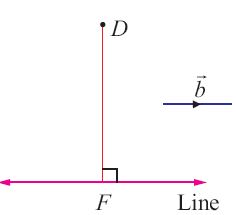
Since \(\vec { b } \) is perpendicular to \(\vec { DF } \), we have
\(\vec { b } .\vec { DF } \) = 0 ⇒ 2(2t + 2)+ 3(3t - 6) + 1(t) ⇒ t= 1
Therefore, the coordinate of F is (3, -1, 4)
Now, the perpendicular distance from the given point to the given line is
\(DF=\left| \vec { DF } \right| =\sqrt { { 4 }^{ 2 }+(-{ 3) }^{ 2 }+{ 1 }^{ 2 } } =\sqrt { 26 } \)
23.
Given cos α + cos β + cos \(\gamma\) = sin α + sin β + sin \(\gamma\)
∴ (cos α + cos β + cos \(\gamma\)) + i(sin α + sin β + sin \(\gamma\)) = 0
⇒ (cos α + i sin α) + (cos β + i sin β) + (cos \(\gamma\)+i sin \(\gamma\)) = 0
⇒ a + b + c = 0 where a = cos α + i sin α, b = cos β + i sin β, c = cos \(\gamma\) + i sin\(\gamma\)
If a + b + c = 0, then a3+b3+c3 = 3abc
∴ (cos α + i sin α)3 + (cos β + i sin β)3 + (cos \(\gamma\) + i sin \(\gamma\))3 = 3[ (cos α + i sin α) + (cos β + i sin β) + (cos \(\gamma\) + i sin \(\gamma\))
= 3[(cos(α + β + \(\gamma\)) + i sin(α + β + \(\gamma\))]
⇒ (cos 3α + cos β + cos \(\gamma\)) + i[sin 3α + sin 3β + sin 3\(\gamma\))]
= 3(cos(α + β + \(\gamma\)) + i sin(α + β + \(\gamma\))
Equating the real and imaginary parts, we get
\(
\cos 3 \alpha+\cos 3 \beta+\cos 3 \gamma=3 \cos (\alpha+\beta+\gamma)
\)
\( \sin 3 \alpha+\sin 3 \beta+\sin 3 \gamma=3 \sin (\alpha+\beta+\gamma)
\)
24.
\(\left[ \begin{matrix} 2 & -1 \\ 5 & -2 \end{matrix} \right] \)
Let A =\(\left[ \begin{matrix} 2 & -1 \\ 5 & -2 \end{matrix} \right] \)
Applying Gauss - Jordan method, we get
[A|I2] =\(\left[ \begin{matrix} 2 & -1 \\ 5 & -2 \end{matrix}|\begin{matrix} 1 & 0 \\ 0 & 1 \end{matrix} \right] \)
\(\overset { { R }_{ 1 }\rightarrow { R }_{ 1 }\div 2 }{ \longrightarrow } \left[ \begin{matrix} 1 & -\frac { 1 }{ 2 } \\ 5 & -2 \end{matrix}|\begin{matrix} \frac { 1 }{ 2 } & 0 \\ 0 & 1 \end{matrix} \right] \)
\(\overset { { R }_{ 2 }\rightarrow { R }_{ 2 }-5{ R }_{ 1 } }{ \longrightarrow } \left[ \begin{matrix} 1 & -\frac { 1 }{ 2 } \\ 5 & -2 \end{matrix}|\begin{matrix} \frac { 1 }{ 2 } & 0 \\ -\frac { 5 }{ 2 } & 1 \end{matrix} \right] \)
\(\overset { { R }_{ 2 }\rightarrow { R }_{ 2 }\times 2 }{ \longrightarrow } \left[ \begin{matrix} 1 & -\frac { 1 }{ 2 } \\ 0 & 1 \end{matrix}|\begin{matrix} \frac { 1 }{ 2 } & 0 \\ -5 & 2 \end{matrix} \right] \)
\(\overset { { R }_{ 1 }\rightarrow { R }_{ 1 }+\frac { 1 }{ 2 } { R }_{ 2 } }{ \longrightarrow } \left[ \begin{matrix} 1 & 0 \\ 0 & 1 \end{matrix}|\begin{matrix} -2 & 1 \\ -5 & 2 \end{matrix} \right] \)
∴ We get A-1=\(\left[ \begin{matrix} -2 & 1 \\ -5 & 2 \end{matrix} \right] \)
25.
(a)
1
26.
(d)
11
27.
(b)
-80
28.
(c)
an ellipse
29.
(d)
9
30.
(a)
2
31.
(c)
\(\frac { 2 }{ \sqrt { 3 } } \)
32.
(a)
\(0,-\frac { 40 }{ 9 } \)
33.
(d)
\({ tan}^{ -1 }\left( \frac { 1}{ 2 } \right) \)
34.
(d)
\(-\frac{1}{5}\)
35.
(b)
1
36.
(d)
0
37.
(a)
one negative and two imaginary zeros
38.
(d)
39.
(d)
|k| ≥ 6
40.
order – 2 : degree 2
41.
\(\frac { { a }^{ 2 } }{ 6 } \)
42.
\(\frac { 1 }{ 5 } \left( { e }^{ 5 }-2 \right) \)
43.
f(x) is strictly decreasing on [0, 1]
44.
f(x) is strictly increasing \(\left[ -\frac { 1 }{ 2 } ,\frac { 1 }{ 2 } \right] \)
45.
(i) π
(ii) πX2n-1
(iii) 2
(iv) 0
46.
\(\left( \frac { 9 }{ 8 } ,\frac { 9 }{ 2 } \right) \)
47.
Let I = \(\int _{ 1 }^{ 2 }{ \frac { 3x }{ { 9x }^{ 2 }-1 } dx } \) ⇒ IA3| = \(\left| I \right| \)
Put t = 9x2 - 1 ⇒ dt = 18x dx
\(\frac{d t}{6}=3 x d x\)
| x | 1 | 2 |
| t | 9 | 35 |
∴ \(\int _{ 8 }^{ 35 }{ \frac { dt }{ 6t } } \)
= \(\frac { 1 }{ 6 } { \left[ log \ t \right] }_{ 8 }^{ 35 }\)
= \(\frac { 1 }{ 6 } [log35-log8]\)
= \(\frac { 1 }{ 6 } \left[ log\left( \frac { 35 }{ 8 } \right) \right] \)
48.
Given u(x, y) = x2 + 3xy + y2
u(xo, yo) = u(2,1)
= 22 + 3(2)(1) + 12
= 4 + 6 + 1 = 11
\(\frac { \partial u }{ \partial x } \) = 2x+ 3y
\({ \left( \frac { \partial u }{ \partial x } \right) }_{ (2,1) }\)= 2 + 3 = 5
\(\frac { \partial u }{ \partial y } \) = 3x+ 2y
\({ \left( \frac { \partial u }{ \partial y } \right) }_{ (2,1) }\) = 6 + 2 = 8
Linear approximation
L(x,y) = U(xo, yo) + \({ \left( \frac { \partial u }{ \partial x } \right) }_{ ({ x }_{ 0 },{ y }_{ 0 }) }\) (x - xo) + \({ \left( \frac { \partial u }{ \partial y} \right) }_{ ({ x }_{ 0 }{ ,y }_{ 0 }) }\)(y - yo)
L (x,y) = 11 + 5 (x - 2) + 8 (y - 1)
= 11 + 5x - 10 + 8y - 8
L(x,y) = 5x + 8y - 7
49.
f(x) = x3+ 2x2-1
f'(x) = 3x2 + 4x = 0
⇒ x (3x + 4) = 0
⇒ x = 0 or \(\frac { 4 }{ 3 } \)
The possible intervals are \(\left( -\infty ,-\frac { 4 }{ 3 } \right) \left( -\frac { 4 }{ 3 } ,0 \right) \) and (0, ∞).
| Interval | \(\left( -\infty ,-\frac { 4 }{ 3 } \right) \) | \(\left( -\frac { 4 }{ 3 } ,0 \right) \) | (0, ∞) |
| Sign of f'(x) | Say x = -2 3(-2)2+4(-2) = 4 +ve |
say x = -1 3(-1)2+4(-1) = -1 -ve |
say x = 1 3(1)2+4(1) = 7 +ve |
| Monotonicity | Strictly increasing | Strictly decreasing | Strictly increasing |
50.
The equation of the required plane through the intersection of the given planes is
( x + y + z - 6 ) + λ (2x + 3y + 4z + 5) = 0 ......(1)
This passes through (1, 1, 1)
∴ ( 1+ 1 + z - 6) + λ (2 + 3+ 4 + 5) = 0
⇒ -3 +14λ = 0 \(\Rightarrow \lambda =\frac { 3 }{ 14 } \)
Substituting \(\lambda =\frac { 3 }{ 14 } \) in (1) we get
( x + y + z - 6 )+\(\frac { 3 }{ 14 } \) (2x + 3y + 4z + 5) = 0
⇒ 14( x + y + z - 6 ) +3 (2 + 3+ 4 + 5) = 0
⇒ 20x + 23y + 26z - 69 = 0

12th Standard Syllabus & Materials
12th Standard
TN 12th Computer Applications களப்பெயர் முறைமை (DNS) Sample Question Papers Study Material - QB365 Set A
NEW12th Standard
TN 12th Computer Applications வலையமைப்பு எடுத்துக்காட்டுகள் மற்றும் நெறிமுறைகள் Sample Question Papers Study Material - QB365 Set A
NEW12th Standard
TN 12th Computer Applications கணினி வலையமைப்பு ஓர் அறிமுகம் Sample Question Papers Study Material - QB365 Set A
NEW12th Standard
TN 12th Computer Applications PHP-உடன் MySQL-ஐ இணைத்தல் Sample Question Papers Study Material - QB365 Set A



Tamilnadu Stateboard 12th Standard Subjects
Maths

Chemistry

Physics

Biology

Computer Science

Business Maths and Statistics

Economics

Commerce

Accountancy

History

Computer Applications
Biology
Computer Technology
Computer Applications
Computer Science
Business Maths and Statistics
Commerce
Economics
Maths
Chemistry
Physics
Computer Technology
History
Accountancy

Tamil

English

French
Tamilnadu Stateboard Standards

