
 100% FREE ACCESS
12th Standard Syllabus & Materials
12th Standard
TN 12th Computer Applications மின்னணு தரவு பரிமாற்றம் Sample Question Papers Study Material - QB365 Set A
NEW12th Standard
TN 12th Computer Applications மின் - வணிக பாதுகாப்பு அமைப்புகள் Sample Question Papers Study Material - QB365 Set A
NEW12th Standard
TN 12th Computer Applications மின்னணு செலுத்தல் முறைகள் Sample Question Papers Study Material - QB365 Set A
NEW12th Standard
TN 12th Computer Applications மின் - வணிகம் Sample Question Papers Study Material - QB365 Set A
NEW12th Standard
TN 12th Computer Applications திறந்த மூல கருத்துருக்கள் Sample Question Papers Study Material - QB365 Set A
NEW12th Standard
TN 12th Computer Applications வலையமைப்பு வடமிடல் Sample Question Papers Study Material - QB365 Set A

Published on: 02/02/2021
12th Standard Maths English Medium Reduced Syllabus Important Questions with Answer key - 2021 Part - 1
Download Tamil Nadu 12th Standard Maths question papers, model tests, one-mark questions, important questions, and public exam papers in PDF format. Free study materials and answer keys for TN State Board students.
Questions + Answers key
Take MCQ Maths Test1.
Write the converse, inverse, and contrapositive of each of the following implication.
If x and y are numbers such that x = y, then x2 = y2
2.
Express each of the following physical statements in the form of differential equation.
For a certain substance, the rate of change of vapor pressure P with respect to temperature T is proportional to the vapor pressure and inversely proportional to the square of the temperature.
3.
Find the value, if it exists. If not, give the reason for non-existence.
sin-1 [sin5]
4.
Write the following in the rectangular form:
\(\overline { 3i } +\frac { 1 }{ 2-i } \).
5.
Find the rank of the following matrices which are in row-echelon form :
\(\left[ \begin{matrix} 6 \\ \begin{matrix} 0 \\ \begin{matrix} 0 \\ 0 \end{matrix} \end{matrix} \end{matrix}\begin{matrix} 0 \\ \begin{matrix} 2 \\ \begin{matrix} 0 \\ 0 \end{matrix} \end{matrix} \end{matrix}\begin{matrix} -9 \\ \begin{matrix} 0 \\ \begin{matrix} 0 \\ 0 \end{matrix} \end{matrix} \end{matrix} \right] \)
6.
Find the rank of the following matrices which are in row-echelon form :
\(\left[ \begin{matrix} -2 & 2 & -1 \\ 0 & 5 & 1 \\ 0 & 0 & 0 \end{matrix} \right] \)
7.
Find the distance between the parallel planes x + 2y - 2z + 1 = 0 and 2x + 4y - 4z + 5 = 0
8.
Find the square root of 6−8i .
9.
Find the rank of the following matrices which are in row-echelon form :
\(\left[ \begin{matrix} 2 & 0 & -7 \\ 0 & 3 & 1 \\ 0 & 0 & 1 \end{matrix} \right] \)
10.
Find the value of sec−1\(\left( -\frac { 2\sqrt { 3 } }{ 3 } \right) \)
11.
Find the principal value of
\({ Sin }^{ -1 }\left( \frac { 1 }{ \sqrt { 2 } } \right) \)
12.
Find the principal value of sin-1(2), if it exists.
13.
Solve:\(\frac { dy }{ dx } =\frac { 1-cosx }{ 1+cosx } \)
14.
Show that the function y=Acos2x-Bsin2x is a solution of the D.E y2+4y=0
15.
Form the D.E of family of curves represented by y=c(x-c)2.where c is the parameter.
16.
Evaluate \(\int _{ 0 }^{ \frac { \pi }{ 2 } }{ { sin }^{ 0 }xdx } \)
17.
Evaluate : \(\underset { \left( x,y \right) \rightarrow \left( 0,0 \right) }{ lim } \frac { { x }^{ 2 }-xy }{ \sqrt { x } -\sqrt { y } } \)
18.
Evaluate : \(\underset { \left( x,y \right) \rightarrow \left( 2,0 \right) }{ lim } \frac { \sqrt { 2x-y-2 } }{ 2x-y-4 } \)
19.
Find the linear approximation to \(g(z)=\sqrt [ 4 ]{ zat } z=2\)
20.
Find the approximate value of f (3.02) where f(x) = 3x2 + 5x +3.
21.
A six sided die is marked '2' on one face, '3' on two ofits faces, and '4' on remaining three faces. The die is thrown twice. If X denotes the total score in two throws, find the values of the random variable and number of points in its inverse images.
22.
An urn contains 5 mangoes and 4 apples. Three fruits are taken at randaom. If the number of apples taken is a random variable, then find the values of the random variable and number of points in its inverse images.
23.
Find the inverse (if it exists) of the following:
\(\left[ \begin{matrix} 5 & 1 & 1 \\ 1 & 5 & 1 \\ 1 & 1 & 5 \end{matrix} \right] \)
24.
Show that the matrix \(\left[ \begin{matrix} 3 & 1 & 4 \\ 2 & 0 & -1 \\ 5 & 2 & 1 \end{matrix} \right] \) is non-singular and reduce it to the identity matrix by elementary row transformations.
25.
Reduce the matrix \(\left[ \begin{matrix} 3 & -1 & 2 \\ -6 & 2 & 4 \\ -3 & 1 & 2 \end{matrix} \right] \) to a row-echelon form.
26.
Let S be a non-empty set and 0 be a binary operation on s defined by x 0 y = x; x, Y \(\in \) s. Determine whether 0 is commutative and association.
27.
Define an operation∗ on Q as follows: a*b = \(\left( \frac { a+b }{ 2 } \right) \); a,b ∈Q. Examine the existence of identity and the existence of inverse for the operation * on Q.
28.
Verify
(i) closure property
(ii) commutative property
(iii) associative property
(iv) existence of identity and
(v) existence of inverse for the operation ×11 on a subset A = {1, 3, 4, 5, 9} of the set of remainders {0,1, 2, 3, 4, 5, 6, 7, 8, 9,10}
29.
Verify the
(i) closure property,
(ii) commutative property,
(iii) associative property
(iv) existence of identity and
(v) existence of inverse for the arithmetic operation - on Z.
30.
Solve the equations:
6x4- 35x3+ 62x2- 35x + 6 = 0
31.
Find the inverse of each of the following by Gauss-Jordan method:
\(\left[ \begin{matrix} 2 & -1 \\ 5 & -2 \end{matrix} \right] \)
32.
Find the inverse of A = \(\left[ \begin{matrix} 2 & 1 & 1 \\ 3 & 2 & 1 \\ 2 & 1 & 2 \end{matrix} \right] \) by Gauss-Jordan method.
33.
The differential equation of x2y = k is _________.
\({ x }^{ 2 }\frac { dy }{ dx } =0\)
\({ x }^{ 2 }\frac { dy }{ dx } +y=0\)
\({ x }\frac { dy }{ dx } +2y=0\)
\(y\frac { dy }{ dx } +2x=0\)
34.
The solution of sec2x tan y dx + sec2y tan x dy = 0 is _________
tan x+tan y = c
sec x + sec y = c
tan x tan y = c
sec x- sec y = c
35.
If p is true and q is unknown, then _________
~ p is true
p v (~p) is false
p ∧ (~p) is true
p v q is true
36.
Which of the following is a contradiction?
p v q
p ∧ q
q v ~ q
q ∧ ~ q
37.
Which one of the following is not a statement?
2 + 3 =5
How beautiful is this flower?
Delhi is the capital of Tamil Nadu
A triangle has found angles.
38.
The area bounded by the parabola y = x2 and the line y = 2x is __________
\(\frac43\)
\(\frac23\)
\(\frac{51}{3}\)
\(\frac{30}{3}\)
39.
The approximate value of (627)\(\frac14\) is ................
5.002
5.003
5.005
5.004
40.
The function f(x) = x9 + 3x7+ 64 is increasing on ________
R
(-∞, 0)
(0, ∞)
None of these
41.
The function -3x+12 is ________ function on R.
decreasing
strictly decreasing
increasing
strictly increasing
42.
The critical points of the function f(x) = \((x-2)^{ \frac { 2 }{ 3 } }(2x+1)\) are __________
-1, 2
1, \(\frac { 1 }{ 2 } \)
1, 2
none
43.
44.
The two planes 3x + 3y - 3z - 1 = 0 and x + y - z + 5 = 0 are _____________
mutually perpendicular
parallel
inclined at 45o
inclined at 30
45.
If (1, -3) is the centre of the circle x2 + y2 + ax + by + 9 = 0 its radius is _________
\(\sqrt{10}\)
1
5
\(\sqrt{19}\)
46.
Which of the following is not an elementary transformation?
Ri ↔️ Rj
Ri ⟶ 2Ri + Rj
Cj ⟶ Cj + Ci
Ri ⟶ Ri + Cj
47.
Let A = \(\left[ \begin{matrix} 2 & -1 & 1 \\ -1 & 2 & -1 \\ 1 & -1 & 2 \end{matrix} \right] \) and 4B = \(\left[ \begin{matrix} 3 & 1 & -1 \\ 1 & 3 & x \\ -1 & 1 & 3 \end{matrix} \right] \). If B is the inverse of A, then the value of x is
2
4
3
1
1.
If x and y are numbers such that x = y, then x2 = y2
Converse statement :
If x and y are numbers such that x2 = y2 then x = y
Inverse statement :
If x and y are numbers such that x ≠ y then x2 ≠ y2
Contrapositive statement :
If x and y are numbers such that x2≠ y2 then x ≠ y
2.
Let P represent the vapour pressure and T represent the vapour temperature.
Given \(\frac { dp }{ dt } \alpha \quad p.\frac { 1 }{ { T }^{ 2 } } \)
[∴ Inversely proportional to the square of the temperature]
\(\Rightarrow \frac { dp }{ dt } =\frac { kP }{ { T }^{ 2 } } \) where k is a constant.
3.
sin-1 [sin5]
We know that \({ sin }^{ -1 }\left( sin5 \right) =0\quad if\quad \theta \varepsilon \left[ \frac { -\pi }{ 2 } ,\frac { \pi }{ e } \right] \)
Consiideerning the approximation \(\frac { \pi }{ 2 } =\frac { 11 }{ 7 } \)
\(5=5\times \frac { 11 }{ 7 } \times \frac { 7 }{ 11 } =5\times \frac { \pi }{ 2 } \times \frac { 7 }{ 11 } =\frac { 35\pi }{ 22 } \notin \left[ -\frac { \pi }{ 2 } ,\frac { \pi }{ 2 } \right] \)
But \(5-2\pi =5-2\times \frac { 22 }{ 7 } =5-\frac { 44 }{ 7 } =\frac { 35z44 }{ 7 } \)
= \(\frac { -11 }{ 7 } \varepsilon \left( -\frac { \pi }{ 2 } ,\frac { \pi }{ 2 } \right) \)
\(5-2\pi \notin \left[ -\frac { \pi }{ 2 } ,\frac { \pi }{ 2 } \right] \)
\({ sin }^{ -1 }\left( sin5 \right) ={ sin }^{ -1 }\left( sin(5-2\pi ) \right) \)
= \(5-2\pi \quad \)
4.
\(\overline { 3i } +\frac { 1 }{ 2-i } \)
= - 3i + \(\frac { 1 }{ 2-i } \times \frac { 2+i }{ 2+i } \)
[∴ Conjugate of 3i is -3i]
= - 3i + \(\frac { 2+i }{ 2^{ 2 }-{ i }^{ 2 } } =-3i+\frac { 2+i }{ 4+1 } \)
= - 3i + \(\frac { 2+i }{ 5 } \)
= \(\frac { -15i+2+i }{ 5 } =\frac { -14i+2 }{ 5 } \)
\(=\frac { 2 }{ 5 } -\frac { 14}{ 5 }i \).
5.
Let A = \(\left[ \begin{matrix} 6 \\ \begin{matrix} 0 \\ \begin{matrix} 0 \\ 0 \end{matrix} \end{matrix} \end{matrix}\begin{matrix} 0 \\ \begin{matrix} 2 \\ \begin{matrix} 0 \\ 0 \end{matrix} \end{matrix} \end{matrix}\begin{matrix} -9 \\ \begin{matrix} 0 \\ \begin{matrix} 0 \\ 0 \end{matrix} \end{matrix} \end{matrix} \right] \). Then A is a matrix of order 4 × 3 and ρ(A) ≤ 3.
The last two rows are zero rows. There are several second order minors.
We find that there is a second order minor, for example, \(\left| \begin{matrix} 6 & 0 \\ 0 & 2 \end{matrix} \right| \) = (6)(2) = 12 ≠ 0. So, ρ(A) = 2.
Note that there are two non-zero rows. The third and fourth rows are zero rows.
6.
Let A = \(\left[ \begin{matrix} -2 & 2 & -1 \\ 0 & 5 & 1 \\ 0 & 0 & 0 \end{matrix} \right] \). Then A is a matrix of order 3 × 3 and ρ(A) ≤ 3.
The only third order minor is |A| = \(\left| \begin{matrix} -2 & 2 & -1 \\ 0 & 5 & 1 \\ 0 & 0 & 0 \end{matrix} \right| \) = (-2)(5)(0) = 0. So ρ(A) ≤ 2.
There are several second order minors. We find that there is a second order minor, for example, \(\left| \begin{matrix} -2 & 2 \\ 0 & 5 \end{matrix} \right| \) = (-2)(5) = -10 ≠ 0. So, ρ(A) = 2.
Note that there are two non-zero rows. The third row is a zero row.
7.
We know that the formula for the distance between two parallel ax + by + cz + d1 = 0 and ax + by + cz + d2 = 0 is \(\delta =\frac { |{ d }_{ 1 }-{ d }_{ 2 }| }{ \sqrt { { a }^{ 2 }+{ b }^{ 2 }+{ c }^{ 2 } } } \). Rewrite the second equation as x + 2y - 2z + \(\frac { 5 }{ 2 } \) = 0.
Comparing the given equations with the general equations, we get a = 1, b = 2, c = -2, d1 = 1, d2 = \(\frac { 5 }{ 2 } \). Substituting these values in the formula, we get the distance
\(\delta =\frac { |{ d }_{ 1 }-{ d }_{ 2 }| }{ \sqrt { { a }^{ 2 }+{ b }^{ 2 }+{ c }^{ 2 } } } =\frac { |1-\frac { 5 }{ 2 } | }{ \sqrt { { 1 }^{ 2 }+{ 2 }^{ 2 }+(-2^{ 2 }) } } =\frac { 1 }{ 2 } \) units.
8.
We compute \(\left| 6-8i \right| =\sqrt { { 6 }^{ 2 }+\left( -8 \right) ^{ 2 } } =10\)
and applying the formula for square root, we get
\(\sqrt { 6-8i } =\pm \left( \sqrt { \frac { 10+6 }{ 2 } } -i\sqrt { \frac { 10-6 }{ 2 } } \right) \) (\(\therefore\) b is negative\( \frac{b}{|b|}=-1 \))
= \(\pm \left( \sqrt { 8 } +i\sqrt { 2 } \right) \)
= \(\pm \left( 2\sqrt { 2 } -i\sqrt { 2 } \right) \)
9.
Let A = \(\left[ \begin{matrix} 2 & 0 & -7 \\ 0 & 3 & 1 \\ 0 & 0 & 1 \end{matrix} \right] \). Then A is a matrix of order 3 × 3 and ρ(A) ≤ 3
The third order minor |A| = \(\left| \begin{matrix} 2 & 0 & -7 \\ 0 & 3 & 1 \\ 0 & 0 & 1 \end{matrix} \right| \) = (2)(3)(1) = 6 ≠ 0. So, ρ(A) = 3.
Note that there are three non-zero rows.
10.
Let sec-1\(\left( -\frac { 2\sqrt { 3 } }{ 3 } \right) =\theta \).
Then, sec\(\theta\) = \(-\frac{2}{\sqrt3}\) where \(\theta\in[0,\pi]\)\{\(\frac{\pi}{2}\)}.
Thus, cos \(\theta =-\frac{\sqrt{3}}{2}\).
Now, \(cos\frac { 5\pi }{ 6 } =cos\left( \pi -\frac { \pi }{ 6 } \right) =-cos\left( \frac { \pi }{ 6 } \right) =-\frac { \sqrt { 3 } }{ 2 } .\)
Hence, Sec-1 \(\left( -\frac { 2\sqrt { 3 } }{ 3 } \right) =\frac { 5\pi }{ 6 } \)
11.
We know that sin-1: [-1, 1] \(\rightarrow \left[ -\frac { \pi }{ 2 } ,\frac { \pi }{ 2 } \right] \)is given by
sin−1x = y if and only if x = sin y for −1\(\le x\le \) and -\(\frac { \pi }{ 2 } \le y \le \frac { \pi }{ 2 } \). Thus,
\({ Sin }^{ -1 }\left( \frac { 1 }{ \sqrt { 2 } } \right) \)= \(\frac{\pi}{4}\), Since \(\frac{\pi}{4}\)\(\in \left[ -\frac { \pi }{ 2 } ,\frac { \pi }{ 2 } \right] \)and sin \(\frac { \pi }{ 4 } =\frac { 1 }{ \sqrt { 2 } } \)
12.
Since the domain of y = sin-1 is −[11], and 2\(\notin \)[-1, 1], sin−1(2) does not exist.
13.
\(y=2tan\frac { x }{ 2 } -x+c\)
14.
prove
15.
\(\left( \frac { dy }{ dx } \right) ^{ 2 }=4y\left( x\frac { dy }{ dx } -2y \right) \)
16.
\(\frac { 128 }{ 315 } \)
17.
0
18.
\(\frac { 1 }{ 4 } \)
19.
\(L(z)={ 2 }^{ 1/4 }+\frac { 1 }{ 4 } \left( { 2 }^{ -3/4 } \right) \left( z-2 \right) \)
20.
Let xo = 3 and dx = 0.02
f(xo) = f(3) = 3 (32) + 5 (3) + 3
= 27 + 15 + 3 = 45
f'(x) = 6x + 5
f'(x) = f'(3) = 6 (3) + 5 = 23
∴ f(3. 02) = f(xo) +f'(xo) dx
= 45 + 23 (.02)
= 45 + 0.46 = 45.46
21.
Let X be the random variable denotes the total C score is two throws of a die.
Sample space S
| II | 2 | 3 | 3 | 4 | 4 | 4 |
| I | ||||||
| 2 | 4 | 5 | 5 | 6 | 6 | 6 |
| 3 | 5 | 6 | 6 | 7 | 7 | 7 |
| 3 | 5 | 6 | 6 | 7 | 7 | 7 |
| 4 | 6 | 7 | 7 | 8 | 8 | 8 |
| 4 | 6 | 7 | 7 | 8 | 8 | 8 |
| 4 | 6 | 7 | 7 | 8 | 8 | 8 |
n (S) = 36
X = {4,5,6,7,8}
From the sample space
| Values of random variable | 4 | 5 | 6 | 7 | 8 | Total |
| No of points in inverse image | 1 | 4 | 10 | 12 | 9 | 36 |
22.
Let X be the random variable of getting apples Given 5 mangoes and 4 apples are in an urn
= {0, 1,2,3}
The sample space consists of 9C3 = 84
X = 0, X (3 mangoes) = 5C3 = 10
X = 1, X (2 mangoes and 1 apples) = 5C2 x 4C1 = 40
X = 2, X (1 mangoes and 2 apples) = 5C1 x 4C2 = 30
X = 3, X (apples) = 4C3 = 4
| Values of random variable | 0 | 1 | 2 | 3 | Total |
| No of points in inverse image | 10 | 40 | 30 | 4 | 84 |
23.
\(\left[ \begin{matrix} 5 & 1 & 1 \\ 1 & 5 & 1 \\ 1 & 1 & 5 \end{matrix} \right] \)
Let A =\(\left[ \begin{matrix} 5 & 1 & 1 \\ 1 & 5 & 1 \\ 1 & 1 & 5 \end{matrix} \right] \)
Expending along R1,
|A| = \(5\left| \begin{matrix} 5 & 1 \\ 1 & 5 \end{matrix} \right| -1\left| \begin{matrix} 1 & 1 \\ 1 & 5 \end{matrix} \right| +1\left| \begin{matrix} 1 & 5 \\ 1 & 1 \end{matrix} \right| \)
= 5 (25 - 1)-1 (5 - 1)+ 1 (1 - 5)
= 5 (24) - 1(4) + 1(- 4)
= 120 - 4 - 4 = 120 - 8 = 112 ≠ 0
Since A is non singular, A-1 exit
adj A =\(\left[ \begin{matrix} +\left| \begin{matrix} 5 & 1 \\ 1 & 5 \end{matrix} \right| & -\left| \begin{matrix} 1 & 1 \\ 1 & 5 \end{matrix} \right| & +\left| \begin{matrix} 1 & 5 \\ 1 & 1 \end{matrix} \right| \\ -\left| \begin{matrix} 1 & 1 \\ 1 & 5 \end{matrix} \right| & +\left| \begin{matrix} 5 & 1 \\ 1 & 5 \end{matrix} \right| & -\left| \begin{matrix} 5 & 1 \\ 1 & 1 \end{matrix} \right| \\ +\left| \begin{matrix} 1 & 1 \\ 5 & 1 \end{matrix} \right| & -\left| \begin{matrix} 5 & 1 \\ 1 & 1 \end{matrix} \right| & +\left| \begin{matrix} 5 & 1 \\ 1 & 5 \end{matrix} \right| \end{matrix} \right] ^{ T }\)
=\(\left[ \begin{matrix} +(25-1)-(5-1)+(1-5) \\ -(5-1)+(25-1)-(5-1) \\ +(1-5)+(5-1)+(25-1) \end{matrix} \right] ^{ T }\)
=\(\left[ \begin{matrix} 24 & -4 & -4 \\ -4 & 24 & -4 \\ -4 & -4 & 24 \end{matrix} \right] ^{ T }=\left[ \begin{matrix} 24 & -4 & -4 \\ -4 & 24 & -24 \\ -4 & -4 & 24 \end{matrix} \right] \)
Taking 4 common from every entry we get,
adj A = \(4\left[ \begin{matrix} 6 & -1 & -1 \\ -1 & 6 & -1 \\ -1 & -1 & 6 \end{matrix} \right] \)
∴ A-1 = \(\frac { 1 }{ |A| } adjA=\frac { 1 }{ 112 } .4\left[ \begin{matrix} 6 & -1 & -1 \\ -1 & 6 & -1 \\ -1 & -1 & 6 \end{matrix} \right] \)
= \(\frac { 1 }{ 28 } \left[ \begin{matrix} 6 & -1 & -1 \\ -1 & 6 & -1 \\ -1 & -1 & 6 \end{matrix} \right] \).
24.
Let A = \(\left[ \begin{matrix} 3 & 1 & 4 \\ 2 & 0 & -1 \\ 5 & 2 & 1 \end{matrix} \right] \). Then, |A| = 3(0 - 2) - 1(2 + 5) + 4(4 - 0) = 6 - 7 + 16 = 15 ≠ 0. So, A is non-singular.
Keeping the identity matrix as our goal, we perform the row operations sequentially on A as follows:
\(\left[ \begin{matrix} 3 & 1 & 4 \\ 2 & 0 & -1 \\ 5 & 2 & 1 \end{matrix} \right] \overset { { R }_{ 1 }\longrightarrow \frac { 1 }{ 3 } { R }_{ 1 } }{ \longrightarrow } \left[ \begin{matrix} 1 & \frac { 1 }{ 3 } & \frac { 4 }{ 3 } \\ 2 & 0 & -1 \\ 5 & 2 & 1 \end{matrix} \right] \)
\(\overset { { R }_{ 2 }\longrightarrow { R }_{ 2 }-2{ R }_{ 1 },{ R }_{ 3 }\longrightarrow { R }_{ 3 }-5{ R }_{ 1 } }{ \longrightarrow } \left[ \begin{matrix} 1 & \frac { 1 }{ 3 } & \frac { 4 }{ 3 } \\ 0 & -\frac { 2 }{ 3 } & -\frac { 11 }{ 3 } \\ 0 & \frac { 1 }{ 3 } & -\frac { 17 }{ 3 } \end{matrix} \right] \overset { { R }_{ 2 }\longrightarrow \left( \frac { 3 }{ 2 } \right) { R }_{ 2 } }{ \longrightarrow } \left[ \begin{matrix} 1 & \frac { 1 }{ 3 } & \frac { 4 }{ 3 } \\ 0 & 1 & \frac { 11 }{ 2 } \\ 0 & \frac { 1 }{ 3 } & -\frac { 17 }{ 3 } \end{matrix} \right] \)
\(\overset { { R }_{ 1 }\longrightarrow { R }_{ 1 }-\frac { 1 }{ 3 } { R }_{ 2 },{ R }_{ 3 }-\frac { 1 }{ 3 } { R }_{ 2 } }{ \longrightarrow } \left[ \begin{matrix} 1 & 0 & -\frac { 1 }{ 2 } \\ 0 & 1 & \frac { 11 }{ 2 } \\ 0 & 0 & -\frac { 15 }{ 2 } \end{matrix} \right] \overset { { R }_{ 3 }\longrightarrow \left( -\frac { 2 }{ 15 } \right) { R }_{ 3 } }{ \longrightarrow } \left[ \begin{matrix} 1 & 0 & -\frac { 1 }{ 2 } \\ 0 & 1 & \frac { 11 }{ 2 } \\ 0 & 0 & 1 \end{matrix} \right] \)
\(\overset { { R }_{ 1 }\longrightarrow { R }_{ 1 }+\frac { 1 }{ 2 } { R }_{ 3 }.{ R }_{ 2 }-\frac { 11 }{ 2 } { R }_{ 3 } }{ \longrightarrow } \left[ \begin{matrix} 1 & 0 & 0 \\ 0 & 1 & 0 \\ 0 & 0 & 1 \end{matrix} \right] \)
25.
\(\left[ \begin{matrix} 3 & -1 & 2 \\ -6 & 2 & 4 \\ -3 & 1 & 2 \end{matrix} \right] \overset { \begin{matrix} { R }_{ 2 }\longrightarrow { R }_{ 2 }+2{ R }_{ 1 }, \\ { R }_{ 3 }\longrightarrow { R }_{ 3 }+{ R }_{ 1 } \end{matrix} }{ \longrightarrow } \left[ \begin{matrix} 3 & -1 & 2 \\ 0 & 0 & 8 \\ 0 & 0 & 4 \end{matrix} \right] \overset { { R }_{ 3 }\longrightarrow { R }_{ 3 }-\frac { 1 }{ 2 } { R }_{ 2 } }{ \longrightarrow } \left[ \begin{matrix} 3 & -1 & 2 \\ 0 & 0 & 8 \\ 0 & 0 & 0 \end{matrix} \right] \)
Note
\(\left[ \begin{matrix} 3 & -1 & 2 \\ 0 & 0 & 8 \\ 0 & 0 & 0 \end{matrix} \right] \overset { { R }_{ 2 }\longrightarrow { R }_{ 2 }/8 }{ \longrightarrow } \left[ \begin{matrix} 3 & -1 & 2 \\ 0 & 0 & 1 \\ 0 & 0 & 0 \end{matrix} \right] \).
This is also a row-echelon form of the given matrix.
So, a row-echelon form of a matrix is not necessarily unique.
26.
Given s is a non-empty set and x 0 y = x, x,y \(\in \) s y0x = y
x0u ≠ y0x ⇒ is not commutative
Now, x0(y0z) = x0y = x
and (x0y) 0 z = x0z = x
x0(y0z) = (y0z) 0 z
0 is associative.
27.
Given \(a*b=\frac { a+b }{ 2 } \), where a.b ∈Q Let a,b ∈Q
An element e has to found out such that
a*e = e*a = a
Let a = 5, Then 5*e = 5
\(\Rightarrow \frac { 5+e }{ 2 } =\)5 ⇒ 5 + e = 10
Let a = \(\frac{2}{3}\). Then \(\frac{2}{3}\)*e = \(\frac{2}{3}\)
\(\Rightarrow \frac { \frac { 2 }{ 3 } +e }{ 2 } =\frac { 2 }{ 3 } \)
\(\Rightarrow \frac { 2 }{ 3 } +e=\frac { 4 }{ 3 } \)
\(\Rightarrow e=\frac { 4 }{ 3 } -\frac { 2 }{ 3 } =\frac { 2 }{ 3 } \)
It is seen that for the binary operation * defined on Q, identity element e is not unique. Hence identity element not defined for the binary operation * on Q.
The identity does not exist. Hence inverse also does not exist for the operation * on Q.
28.
The table for the operation x11 is as follows.
| x11 | 1 | 3 | 4 | 5 | 9 |
| 1 | 1 | 3 | 4 | 5 | 9 |
| 3 | 3 | 9 | 1 | 4 | 5 |
| 4 | 4 | 1 | 5 | 9 | 3 |
| 5 | 5 | 4 | 9 | 3 | 1 |
| 9 | 9 | 5 | 3 | 1 | 4 |
Following the same kind of procedure as explained in the previous example, a brief outline of the process of verification of the properties of ×11 on A is given below.
(i) Since each box has an unique element of A, ×11 is a binary operation on A.
(ii) The entries are symmetrical about the main diagonal. Hence ×11 has commutative property.
(iii) As usual, the associative property can be seen to be true.
(iv) The entries of both the row and column headed by the element 1 are identical. Hence 1 is the identity element.
(v) Since the identity 1 exists in each row and each column, the existence of inverse property is assured for ×11. The inverse of 1 is 1, that of 3 is 4, that of 4 is 3, 5 is 9, and, that of 9 is 5.
29.
i) Though - is not binary on N; it is binary on Z. To check the validity of any more properties satisfied by – on Z, it is better to check them for some particular simple values.
ii) Take m = 4 , n = 5 and (m− n) = (4 − 5) = −1and (n −m) = (5 − 4) = 1.
Hence (m− n) ≠ (n −m). So the operation - is not commutative on Z.
iii) In order to check the associative property, let us put m = 4, n = 5 and p = 7 in both (m- n) - p and m- (n - p).
(m−n)− p = (4−5)−7 = (−1−7) = −8 …(1)
m−(n− p) = 4−(5−7) = (4+2) = 6 …(2)
From (1) and (2), it follows that (m - n) - p m - (n - p).
Hence – is not associative on Z.
iv) Identity does not exist (why?).
v) Inverse does not exist (why?).
30.
6x4- 35x3+ 62x2- 35x + 6 = 0
This equation is type I even degree reciprocal equation.
Hence, it can be rewritten as
\(6\left( { x }^{ 2 }+\frac { 1 }{ x } \right) -35(x+\frac { 1 }{ x } )+62=0 ...(1)\)
putting \(x+\frac { 1 }{ x } =y\)
\(\Rightarrow { x }^{ 2 }+\frac { 1 }{ { x }^{ 2 } } +2={ y }^{ 2 }\)
\(\Rightarrow { x }^{ 2 }+\frac { 1 }{ { x }^{ 2 } } ={ y }^{ 2 }-2\)
∴ (1) becomes as,
\(\Rightarrow 6({ y }^{ 2 }-2)-35y+62=0\)
\(\Rightarrow { 6y }^{ 2 }-12-35y+62=0\)
\(\Rightarrow { 6y }^{ 2 }-35y+50=0\)
\(\Rightarrow (3y-10)(2y-5)=0\)
\(\Rightarrow y=\frac { 10 }{ 3 } ,\frac { 5 }{ 2 } \)
Case (i) when \(y=\frac { 10 }{ 3 } ,x+\frac { 1 }{ x } =\frac { 10 }{ 3 } \)
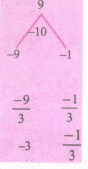
\(\Rightarrow \frac { { x }^{ 2 }+1 }{ x } =\frac { 10 }{ 3 } \)
\(\Rightarrow { 3x }^{ 2 }-10x+3=10x\)
\(\Rightarrow { 3x }^{ 2 }-10x+3=0\)
\(\Rightarrow (x-3)(3x-1)=0\)
\(\Rightarrow x=3,\frac { 1 }{ 3 } \)
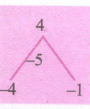
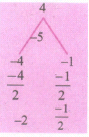
Case (ii) when \(y=\frac { 5 }{ 2 } ,x+\frac { 1 }{ x } =\frac { 5 }{ 2 } \Rightarrow \frac { { x }^{ 2 }+1 }{ x } =\frac { 5 }{ 2 } \)
\(\Rightarrow { 2x }^{ 2 }+2=5x\Rightarrow { 2x }^{ 2 }-5x+2=0\)
\(\Rightarrow (x-2)(2x-1)=0\)
Hence the roots are \(2,\frac { 1 }{ 2 } ,3,\frac { 1 }{ 3 } \)
31.
\(\left[ \begin{matrix} 2 & -1 \\ 5 & -2 \end{matrix} \right] \)
Let A =\(\left[ \begin{matrix} 2 & -1 \\ 5 & -2 \end{matrix} \right] \)
Applying Gauss - Jordan method, we get
[A|I2] =\(\left[ \begin{matrix} 2 & -1 \\ 5 & -2 \end{matrix}|\begin{matrix} 1 & 0 \\ 0 & 1 \end{matrix} \right] \)
\(\overset { { R }_{ 1 }\rightarrow { R }_{ 1 }\div 2 }{ \longrightarrow } \left[ \begin{matrix} 1 & -\frac { 1 }{ 2 } \\ 5 & -2 \end{matrix}|\begin{matrix} \frac { 1 }{ 2 } & 0 \\ 0 & 1 \end{matrix} \right] \)
\(\overset { { R }_{ 2 }\rightarrow { R }_{ 2 }-5{ R }_{ 1 } }{ \longrightarrow } \left[ \begin{matrix} 1 & -\frac { 1 }{ 2 } \\ 5 & -2 \end{matrix}|\begin{matrix} \frac { 1 }{ 2 } & 0 \\ -\frac { 5 }{ 2 } & 1 \end{matrix} \right] \)
\(\overset { { R }_{ 2 }\rightarrow { R }_{ 2 }\times 2 }{ \longrightarrow } \left[ \begin{matrix} 1 & -\frac { 1 }{ 2 } \\ 0 & 1 \end{matrix}|\begin{matrix} \frac { 1 }{ 2 } & 0 \\ -5 & 2 \end{matrix} \right] \)
\(\overset { { R }_{ 1 }\rightarrow { R }_{ 1 }+\frac { 1 }{ 2 } { R }_{ 2 } }{ \longrightarrow } \left[ \begin{matrix} 1 & 0 \\ 0 & 1 \end{matrix}|\begin{matrix} -2 & 1 \\ -5 & 2 \end{matrix} \right] \)
∴ We get A-1=\(\left[ \begin{matrix} -2 & 1 \\ -5 & 2 \end{matrix} \right] \)
32.
Applying Gauss-Jordan method, we get
[A | I3] =\(\left[ \begin{matrix} 2 & 1 & 1 \\ 3 & 2 & 1 \\ 2 & 1 & 2 \end{matrix}|\begin{matrix} 1 & 0 & 0 \\ 0 & 1 & 0 \\ 0 & 0 & 1 \end{matrix} \right] \overset { { R }_{ 1 }\longrightarrow \frac { 1 }{ 2 } { R }_{ 1 } }{ \longrightarrow } \left[ \begin{matrix} 1 & \left( 1/2 \right) & \left( 1/2 \right) \\ 3 & 2 & 1 \\ 2 & 1 & 2 \end{matrix}|\begin{matrix} \left( 1/2 \right) & 0 & 0 \\ 0 & 1 & 0 \\ 0 & 0 & 1 \end{matrix} \right] \)
\(\overset { \begin{matrix} { R }_{ 2 }\longrightarrow { R }_{ 2 }-3{ R }_{ 1 } \\ { R }_{ 3 }\longrightarrow { R }_{ 3 }-2{ R }_{ 1 } \end{matrix} }{ \longrightarrow } \left[ \begin{matrix} 1 & \left( 1/2 \right) & \left( 1/2 \right) \\ 0 & \left( 1/2 \right) & -\left( 1/2 \right) \\ 0 & 0 & 1 \end{matrix}|\begin{matrix} \left( 1/2 \right) & 0 & 0 \\ -\left( 3/2 \right) & 1 & 0 \\ -1 & 0 & 1 \end{matrix} \right] \)
\(\overset { { R }_{ 2 }\longrightarrow 2{ R }_{ 2 } }{ \longrightarrow } \left[ \begin{matrix} 1 & \left( 1/2 \right) & \left( 1/2 \right) \\ 0 & 1 & -1 \\ 0 & 0 & 1 \end{matrix}|\begin{matrix} \left( 1/2 \right) & 0 & 0 \\ -3 & 2 & 0 \\ -1 & 0 & 1 \end{matrix} \right] \)
\(\overset { { R }_{ 1 }\longrightarrow { R }_{ 1 }-\frac { 1 }{ 2 } { R }_{ 2 } }{ \longrightarrow } \left[ \begin{matrix} 1 & 0 & 1 \\ 0 & 1 & -1 \\ 0 & 0 & 1 \end{matrix}|\begin{matrix} 2 & -1 & 0 \\ -3 & 2 & 0 \\ -1 & 0 & 1 \end{matrix} \right] \overset { \begin{matrix} { R }_{ 1 }\longrightarrow { R }_{ 1 }-{ R }_{ 3 } \\ { R }_{ 2 }\longrightarrow { R }_{ 2 }+{ R }_{ 3 } \end{matrix} }{ \longrightarrow } \left[ \begin{matrix} 1 & 0 & 0 \\ 0 & 1 & 0 \\ 0 & 0 & 1 \end{matrix}|\begin{matrix} 3 & -1 & -1 \\ -4 & 2 & 1 \\ -1 & 0 & 1 \end{matrix} \right] \).
So, A-1 = \(\left[ \begin{matrix} 3 & -1 & -1 \\ -4 & 2 & 1 \\ -1 & 0 & 1 \end{matrix} \right] \).
33.
(b)
\({ x }^{ 2 }\frac { dy }{ dx } +y=0\)
34.
(c)
tan x tan y = c
35.
(d)
p v q is true
36.
(d)
q ∧ ~ q
37.
(b)
How beautiful is this flower?
38.
(a)
\(\frac43\)
39.
(d)
5.004
40.
(a)
R
41.
(b)
strictly decreasing
42.
(c)
1, 2
43.
(b)
44.
(b)
parallel
45.
(b)
1
46.
(d)
Ri ⟶ Ri + Cj
47.
(d)
1

12th Standard Syllabus & Materials
12th Standard
TN 12th Computer Applications களப்பெயர் முறைமை (DNS) Sample Question Papers Study Material - QB365 Set A
NEW12th Standard
TN 12th Computer Applications வலையமைப்பு எடுத்துக்காட்டுகள் மற்றும் நெறிமுறைகள் Sample Question Papers Study Material - QB365 Set A
NEW12th Standard
TN 12th Computer Applications கணினி வலையமைப்பு ஓர் அறிமுகம் Sample Question Papers Study Material - QB365 Set A
NEW12th Standard
TN 12th Computer Applications PHP-உடன் MySQL-ஐ இணைத்தல் Sample Question Papers Study Material - QB365 Set A



Tamilnadu Stateboard 12th Standard Subjects
Maths

Chemistry

Physics

Biology

Computer Science

Business Maths and Statistics

Economics

Commerce

Accountancy

History

Computer Applications
Biology
Computer Technology
Computer Applications
Computer Science
Business Maths and Statistics
Commerce
Economics
Maths
Chemistry
Physics
Computer Technology
History
Accountancy

Tamil

English

French
Tamilnadu Stateboard Standards

