
 100% FREE ACCESS
12th Standard Syllabus & Materials
12th Standard
TN 12th Maths Applications of Matrices and Determinants Sample Question Papers Study Material - QB365 Set A
NEW12th Standard
TN 12th Computer Applications மின்னணு தரவு பரிமாற்றம் Sample Question Papers Study Material - QB365 Set A
NEW12th Standard
TN 12th Computer Applications மின் - வணிக பாதுகாப்பு அமைப்புகள் Sample Question Papers Study Material - QB365 Set A
NEW12th Standard
TN 12th Computer Applications மின்னணு செலுத்தல் முறைகள் Sample Question Papers Study Material - QB365 Set A
NEW12th Standard
TN 12th Computer Applications மின் - வணிகம் Sample Question Papers Study Material - QB365 Set A
NEW12th Standard
TN 12th Computer Applications திறந்த மூல கருத்துருக்கள் Sample Question Papers Study Material - QB365 Set A

Published on: 02/02/2021
12th Standard Maths English Medium Reduced Syllabus Important Questions with Answer key - 2021 Part - 2
Download Tamil Nadu 12th Standard Maths question papers, model tests, one-mark questions, important questions, and public exam papers in PDF format. Free study materials and answer keys for TN State Board students.
Questions + Answers key
Take MCQ Maths Test1.
Solve :\(\frac { dy }{ dx } =\frac { 2x }{ { x }^{ 2 }+1 } \)
2.
A firm produces two types of calculators each week, x number of type A and y number of type B. The weekly revenue and cost functions (in rupees) are R(x, y) = 80x + 90y + 0.04xy − 0.05x2 − 0.05y2 and C(x, y) = 8x + 6y + 2000 respectively
(i) Find the profit function P(x, y)
(ii) Find \(\frac { { \partial P } }{ \partial { x } } \) (1200, 1800) and \(\frac { \partial v }{ \partial y} \) (1200, 1800)
3.
Find the value of the complex number (i25)3.
4.
Find the eccentricity of the hyperbola with foci on the x-axis if the length of its conjugate axis is \({ \left( \frac { 3 }{ 4 } \right) }^{ th }\) of the length of its tranverse axis.
5.
Find the modulus and principal argument of the following complex numbers.
\(-\sqrt { 3 } +i\)
6.
Find the modulus of the following complex numbers
(1-i)10
7.
Find the modulus of the following complex numbers
\(\frac { 2i }{ 3+4i } \)
8.
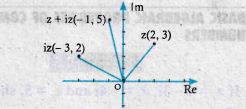
Given the complex number z = 2 + 3i, represent the complex numbers in Argand diagram z, iz , and z+iz
9.
Find the partial derivatives of the following functions at the indicated point
h (x, y, z) = x sin (xy) + z2x, \(\left( 2,\frac { \pi }{ 4 }, 1\right) \)
10.
Evaluate the following definite integrals:
\(\int _{ 0 }^{ 1 }{ \sqrt { \frac { 1-x }{ 1+x } } } dx\)
11.
Assuming log10e = 0.4343, find an approximate value of log10 1003
12.
Find the absolute extrem of the following function on the given closed interval
f(x) = x2 -12x + 10; [1, 2]
13.
For the hyperbola 3x2 - 6y2 = -18, find the length of transverse and conjugate axes and eccentricity.
14.
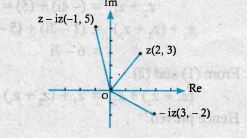
Given the complex number z = 2 + 3i, represent the complex numbers in Argand diagram z, −iz , and z−iz
15.
Find the equation of the plane which passes through the point (3, 4, -1) and is parallel to the plane 2x - 3y + 5z = 0. Also, find the distance between the two planes.
16.
Find the equation of the plane passing through the line of intersection of the planes \(\vec { r } .(2\hat { i } -7\hat { j } +4\hat { k } )=3\) and 3x - 5y + 11 = 0, and the point (-2, 1, 3)
17.
Find a polynomial equation of minimum degree with rational coefficients, having \(\sqrt{5}\)−\(\sqrt{3}\) as a root.
18.
Find a polynomial equation of minimum degree with rational coefficients, having 2i+3 as a root.
19.
Find a polynomial equation of minimum degree with rational coefficients, having 2-\(\sqrt{3}\) as a root.
20.
If α, β, γ and \(\delta\) are the roots of the polynomial equation 2x4 + 5x3 − 7x2 + 8 = 0, find a quadratic equation with integer coefficients whose roots are α + β + γ + \(\delta\) and αβ૪\(\delta\).
21.
22.
If we measure the side of a cube to be 4 cm with an error of 0.1 cm, then the error in our calculation of the volume is
0.4 cu.cm
0.45 cu.cm
2 cu.cm
4.8 cu.cm
23.
If f (x, y) = exy then \(\frac { { \partial }^{ 2 }f }{ \partial x\partial y } \) is equal to
xyexy
(1 +xy)exy
(1 +y)exy
(1 + x)exy
24.
If p and q are the order and degree of the differential equation \(y=\frac { dy }{ dx } +{ x }^{ 3 }\left( \frac { { d }^{ 2 }y }{ { dx }^{ 2 } } \right) +xy=cosx,\) When
p < q
p = q
p > q
p exists and q does not exist
25.
The maximum value of the function \(x^{2} e^{-2 x}, x>0\) is
\(\frac { 1 }{ e } \)
\(\frac { 1 }{ 2e } \)
\(\frac { 1 }{ { e }^{ 2 } } \)
\(\frac { 4 }{ { e }^{ 4 } } \)
26.
27.
28.
If a, b, c ∈ Q and p +√q (p, q ∈ Q) is an irrational root of ax2+bx+c = 0 then the other root is ___________
-p+√q
p-iq
p-√q
-p-√q
29.
Which of the following is/are correct?
(i) Adjoint of a symmetric matrix is also a symmetric matrix.
(ii) Adjoint of a diagonal matrix is also a diagonal matrix.
(iii) If A is a square matrix of order n and λ is a scalar, then adj(λA) = λn adj(A).
(iv) A(adjA) = (adjA)A = |A| I
Only (i)
(ii) and (iii)
(iii) and (iv)
(i), (ii) and (iv)
30.
If ATA−1 is symmetric, then A2 =
A-1
(AT)2
AT
(A-1)2
31.
If A = \(\left[ \begin{matrix} 2 & 0 \\ 1 & 5 \end{matrix} \right] \) and B = \(\left[ \begin{matrix} 1 & 4 \\ 2 & 0 \end{matrix} \right] \) then |adj (AB)| =
-40
-80
-60
-20
32.
According to the rational root theorem, which number is not possible rational zero of 4x7 + 2x4 - 10x3 - 5?
-1
\(\frac { 5 }{ 4 } \)
\(\frac { 4 }{ 5 } \)
5
33.
If z is a non zero complex number, such that 2iz2 = \(\bar { z } \) then |z| is
\(\cfrac { 1 }{ 2 } \)
1
2
3
34.
The conjugate of a complex number is \(\cfrac { 1 }{ i-2 } \). Then the complex number is
\(\cfrac { 1 }{ i+2 } \)
\(\cfrac { -1 }{ i+2 } \)
\(\cfrac { -1 }{ i-2 } \)
\(\cfrac { 1 }{ i-2 } \)
35.
The area of the triangle formed by the complex numbers z, iz and z+iz in the Argand’s diagram is
\(\cfrac { 1 }{ 2 } \left| z \right| ^{ 2 }\)
|z|2
\(\cfrac { 3 }{ 2 } \left| z \right| ^{ 2 }\)
2|z|2
36.
Solve :\(x\frac { dy }{ dx } sin\left( \frac { y }{ x } \right) +x-ysin\left( y\frac { y }{ x } \right) =,y(1)=\frac { \pi }{ 2 } \)
37.
Solve :x2dy+y(x+y)dx=0 given that y=1 when x=1.
38.
Solve : \({ e }^{ \frac { dy }{ dx } }=x+1,y(0)=5\)
39.
Find the area bounded by the curve y2(2a-x)=x2 and the line x=2a.
40.
Find the ratio of the area between the curves y=cosx and y=cos2x and x- axis from x=0 to \(x=\frac { \pi }{ 3 } \)
41.
Let U(x, y, z) = xyz, x = e-t, y = e-t cos t, z = sin t, t ∈ R. Find \(\frac{dU}{dt}\)
42.
A right circular cylinder has radius r =10 cm. and height h = 20 cm. Suppose that the radius of the cylinder is increased from 10 cm to 10. 1 cm and the height does not change. Estimate the change in the volume of the cylinder. Also, calculate the relative error and percentage error.
43.
Find the domain of the following functions
(i) f(x) = sin-1(2x - 3)
(ii) f(x) = sin-1x + cos x
44.
For what value of λ, the system of equations x + y + z = 1, x + 2y + 4z = λ, x + 4y + 10z = λ2 is consistent.
45.
Examine for the rational roots of x8- 3x + 1 = 0
46.
Find the equation of the plane passing through the intersection of the planes \(\vec { r } .(\hat { i } +\hat { j } +\hat { k } )+1=0\) and \(\vec { r } .(2\hat { i } -3\hat { j } +5\hat { k } )=2\) and the point (-1, 2, 1).
1.
y = log(x2+1)+c
2.
Given R (x, y) = 80 x + 90 y + 0.04xy - 0.05 x2 + 0.05 y2 and
(x,y) = 8x + 6y + 2000
Profit function P (x,y) = Revenue - cost
P (x,y) = R (x,y) - C (x,y)
= -80 x + 90 y + 0.04xy - 0.05 x2 - 0.05y2 - 8x - 6y - 2000
P (x, y) = 72x + 84y + 0.04 xy - 0.05 x2 - 0.05y2 - 2000
(ii) \(\frac { { \partial P } }{ \partial { x } } \) = 72 + 0 + 0.04y - 0.05(2x) - 0 - 0
= 72 + 0.04y- 0.1x
∴ \(\frac { { \partial P } }{ \partial { x } } \) (1200, (1800)
= 72+ 0.04 (1800) - 0.1(1200)
= 72 + 72 - 120 = 24 .......(1)
\(\frac { \partial v }{ \partial y} \) = 0 + 84+ 0.4x-0-0.5(2y) - 0
= 84 + 0.04x - 0.1y
= 84 + 0.04 (1200) - 0.1(1800)
∴ \(\frac { \partial v }{ \partial y} \)(1200,1800) = 84 + 48 - 180 = - 48 .......(2)
From (1) and (2), keeping y constant and 4 increasing x then increases profit.
3.
i25 = (i4)6 \(\times\) i1 = i6 \(\times\) i = i
∴ |i25| = |i| = 1
4.
Since the foci are one the x-axis, the equation of the hyperbola is \(\frac { { x }^{ 2 } }{ { a }^{ 2 } } +\frac { { y }^{ 2 } }{ { b }^{ 2 } } =1\)
Given conjugate axis = \(\frac34\) (transverse axis)
⇒ 2b = \(\frac34\) (2a) ⇒ b = \(\frac{3a}4\) ⇒ b2 = \(\frac { { 9a }^{ 2 } }{ 16 } \)
∴ e = \(\sqrt { 1-\frac { { b }^{ 2 } }{ { a }^{ 2 } } } =\sqrt { 1-\frac { 9{ a }^{ 2 } }{ { 16a }^{ 2 } } } =\sqrt { 1+\frac { 9 }{ 16 } } =\sqrt { \frac { 25 }{ 16 } } =\frac { 5 }{ 4 } \)
∴ e = \(\frac { 5 }{ 4 } \)
5.
\(-\sqrt { 3 } +i\)
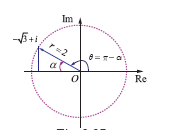
Modulus = 2 and
\(a={ tan }^{ -1 }\left| \frac { y }{ x } \right| ={ tan }^{ -1 }\frac { 1 }{ \sqrt { 3 } } =\frac { \pi }{ 6 } \)
Since the complex number \(-\sqrt { 3 } +i\) lies in the second quadrant has the principal value
\(\theta =\pi -\alpha =\pi -\frac { \pi }{ 6 } =\frac { 5\pi }{ 6 } \)
Therefore the modulus and principal argument of \(-\sqrt { 3 } +i\) are 2 and \(\frac { 5\pi }{ 6 } \) respectively.
6.
(1-i)10
Let z = (1- i)10
|z| = |1- i|10 = \(\left[ \sqrt { { 1 }^{ 2 }+(-1)^{ 2 } } \right] ^{ 10 }\)
= \(\left[ \sqrt { 2 } \right] ^{ 10 }\) = 21/2 x 10 = 25 = 32
7.
\(\frac { 2i }{ 3+4i } \)
Let z = \(\frac { 2i }{ 3+4i } \)
|z| = \(\left| \frac { 2i }{ 3+4i } \right| =\frac { |2i| }{ |3+4i| } =\frac { \sqrt { 2^{ 2 } } }{ \sqrt { { 3 }^{ 2 }+{ 4 }^{ 2 } } } =\frac { 2 }{ \sqrt { 9+16 } } \)
= \(\frac { 2 }{ \sqrt { 25 } } =\frac { 2 }{ 5 } \).
8.
Represent z, iz and z + iz in the Argand diagram.
z = 2 + 3i can be represented as (2,3)
iz = i(2 + 3i)
= 2i + 3i2
= 2i-3
= -3 + 2i can be represented as (-3, 2)
z + iz = 2 + 3i - 3 + 2i = -1 + 5i can be represented as (-1, 5) in the argand diagram.
9.
Given h (x, y, z) = x sin (xy) + z2x
\(\frac { \partial h }{ \partial x } =x.cos(x,y).\frac { \partial }{ \partial x } (xy)+sin(xy)(1)+{ z }^{ 2 }(1)\)
= x cos (xy) (y)(1) + sin (xy) + z2
= xy cos (xy) + sin (xy) + z2
\(\therefore { \left( \frac { \partial h }{ \partial x } \right) }_{ \left( 2,\frac { \pi }{ 4 } ,1 \right) }=2\left( \frac { \pi }{ 4 } \right) cos\left( 2\frac { \pi }{ 4 } \right) +sin\left( 2\frac { \pi }{ 4 } (1) \right) +{ 1 }^{ 2 }\)
\(=\frac { \pi }{ 2 } cos\left( \frac { \pi }{ 2 } \right) +sin\left( \frac { \pi }{ 2 } \right) +1\)
\(=\frac { \pi }{ 2 } (0)+1+1=2\)
\(\frac { \partial h }{ \partial y } =x.cos(xy).\frac { \partial h }{ \partial y } (xy)+0\)
= x cos (xy) x(1)
= x2 cos (xy)
\(\therefore { \left( \frac { \partial h }{ \partial x } \right) }_{ \left( 2,\frac { \pi }{ 4 } ,1 \right) }={ 2 }^{ 2 }cos\left( 2\frac { \pi }{ 4 } \right) \)
= \(4cos\left( \frac { \pi }{ 2 } \right) \)
= 4(0) = (0)
\(\left( \frac { \partial h }{ \partial z } \right) =0+x(2z)=2xz\)
\(\therefore { \left( \frac { \partial h }{ \partial x } \right) }_{ \left( 2,\frac { \pi }{ 4 } ,1 \right) }=2(2)(1)=4\)
10.
I \(=\int _{ 0 }^{ 1 }{ \sqrt { \frac { (1-x)(1-x) }{ (1+x)(1-x) } } } dx\)
\(=\int _{ 0 }^{ 1 }{ \sqrt { \frac { (1-x) 2}{ (1-x)^2 } } } dx\)
\(=\int _{ 0 }^{ 1 }{ \frac { 1-x }{ \sqrt { 1-{ x }^{ 2 } } } } dx\)
Put x = sin u, dx = cosu.du, 0u = sin-1(x)
For x = 0, u = 0 and x = 1, u = \(\frac{\pi}{2}\)
\(=\int _{ 0 }^{ 1 }{ \frac { 1-sin\ u }{ \sqrt { 1-{ sin }^{ 2 }u } } } \times cos u.du\)
\(=\int _{ 0 }^{ 1 } \frac { 1-sin\ u }{cos u} \times cos u.du\)
= \( [u+cos u]^\frac{\pi }{2}_0\)= (\(\frac{\pi}{2}\)+0)-(0+1) = \(\frac{\pi}{2}\) -1
\(=\frac { \pi }{ 2 } -0-1=\frac { \pi }{ 2 } -1\)
11.
log10e = 0.4343 to find log10g 1003
f(1000) = log101000 = log10103 = 3log10103 = 3 log1010
= 3(1) = 3
f'(x) = \(\frac1x\). log10e
f'(1000) = \(\frac{1}{1000}\)(0.4343)
∴ L(x) = f(x0) f'(x0) (x - x0)
= 3 + \(\frac{1}{1000}\) (0.4343) (3)
= 3 + \(\frac{1.3029}{1000}\)
= 3 + 0.0013029
log101003 = 3.0013029
12.
f(x) = x2 -12x + 10; [1, 2]
Given f(x) = x2 -12x + 10 ; [1, 2]
f'(x) = 2x - 12
f'(x) = 0
\(\Rightarrow\) 2x-12 = 0
\(\Rightarrow\) 2x = 12
\(\Rightarrow\) x = 6
\(\therefore\) The critical number is 6
Evaluating f (x) at the end points x = 1,
x = 2 and at the critical number x = 6 we get
f(1) = 12-12(1)+10 = -1
f(2) = 22-12(2)+10 = -10
Absolute maximum f(1) = -1
Absolute minimum f(2) = -10
13.
Given equation of the hyperbola is
3x2 - 6y2 = -18; \(\div \)by (-18) we get \(\frac{y^2}{3}- \frac{x^2}{6}\) = 1
The transverse axis is long y-axis.
Here a2 = 3, b2 = 6
Length of transverse axis is 2a = 2\(\sqrt { 3 } \)
Length of conjugate axis is 2b = 2\(\sqrt { 3 } \)
\(e=\sqrt { 1+\frac { { b }^{ 2 } }{ { a }^{ 2 } } } =\sqrt { 1+\frac { 6 }{ 3 } } =\sqrt { 1+2 } =\sqrt { 3 } \)
14.
z = 2+3t
-iz = -i(2+3i)
= 2i -3i2 = -2i+3
= 3 - 2i
z - iz = 2+ 3i-3+2i
= -1+5i
15.
Equation of the given plane is 2x - 3y + 5z +7 = 0
Equation of the plane parallel to the given plane
is 2x - 3y + 5z + k = 0 ..(1)
Since this plane passes through the point (3, 4, -1). we get
2(3) - 3(4) + 5(-1) + k = 0
\(\Rightarrow\) 6 - 12 - 5 + k = 0
\(\Rightarrow\) 11 +k = 0
k = 11
\(\therefore\) (1) becomes, 2x - 3y + 5z + 11 = 0 which is the equation of the required plane. Distance between two parallel planes.
= \(\frac { \left| { d }_{ 1 }-{ d }_{ 2 } \right| }{ \sqrt { { a }^{ 2 }+{ b }^{ 2 }+{ c }^{ 2 } } } \)
\(d=\frac { \left| 7-11 \right| }{ \sqrt { { 2 }^{ 2 }+\left( -3 \right) ^{ 2 }+{ 5 }^{ 2 } } } \)
= \(\cfrac { \left| -4 \right| }{ \sqrt { 4+9+25 } } \)
= \(\cfrac { 4 }{ \sqrt { 38 } } \) units.
16.
\(\vec { r } .(2\hat { i } -7\hat { j } +4\hat { k } )=3\) and 3x - 5y + 11 = 0,
The vector equation of a plane passing through the line of intersection of the planes
\(\vec { r } .\vec { { n }_{ 1 } } ={ d }_{ 1 }\) and \(\vec { r } .\vec { n_{ 2 } } ={ d }_{ 2 }\) is given by
\(\left( \vec { r } .\vec { { n }_{ 1 } } -{ d }_{ 1 } \right) +\lambda \left( \vec { r } .{ \vec { n } }_{ 2 }-{ d }_{ 2 } \right) =0\) ...(1)
put \(\vec { r } =x\hat { i } +y\hat { j } +z\hat { k } \)
\({ \vec { n } }_{ 1 }=2\hat { i } -7\hat { j } +4\hat { k } ,{ \vec { n } }_{ 2 }=3\hat { i } -5\hat { j } +4\hat { k } \)
\({ d }_{ 1 }=+3,{ d }_{ 2 }=-11\) in (1) we get
\(\left[ (x\hat { i } +y\hat { j } +z\hat { k } ).\left( 2\hat { i } -7\hat { j } +4\hat { k } -3 \right) \right] +\lambda \left[ \left( x\hat { i } +y\hat { j } +z\hat { k } \right) .\left( 3\hat { i } -5y+4z+11 \right) \right] =0\)
\(\Rightarrow \left( 2x-7y+4z-3 \right) +\lambda \left( 3x-5y+4z+11 \right) =0\)....2
Since the plane passes through the point (-2, 1, 3) we get,
\(\left[ 2(-2)-7(1)+4(3)-3 \right] +\lambda \left[ -6-5+12+11 \right] =0\)
\(\Rightarrow (-4-7+12-3)+\lambda (12)=0\)
\(\Rightarrow -2+12\lambda =0\Rightarrow 12\lambda =2\Rightarrow \lambda =\frac { 1 }{ 6 } \)
Substituting \(\lambda =\frac { 1 }{ 6 } \) in (1) we get,
\(\left( 2x-7y+4z-3 \right) +\frac { 1 }{ 6 } \left( 3x-5y+4z+11 \right) =0\)
Multiplying by 6, we get,
\(\Rightarrow 12x-42y+24z-18+3x-5y+4z+11=0\)
\(\Rightarrow 15x-47y+28z-7=0\) which is the required equation of the plane.
17.
Given \((\sqrt { 5 } -\sqrt { 3 } )\) is a root
Another root \(\Rightarrow \sqrt { 5 } +\sqrt { 3 } \)
∴ Sum of the roots \(=\sqrt { 5 } -\sqrt { 3 } +\sqrt { 5 } +\sqrt { 3 } =2\sqrt { 5 } \)
Product of the roots
\(=(\sqrt { 5 } -\sqrt { 3 } )(\sqrt { 5 } +\sqrt { 3 } )\)
\(=(\sqrt { 5 } )^{ 2 }-{ (\sqrt { 3 } ) }^{ 2 }=5-3=2\)
∴ One of the factor is x2 -x (sum of the roots) + product of the roots
\(\Rightarrow { x }^{ 2 }-2x\sqrt { 5 } +2\)
The other factor also will be \({ x }^{ 2 }-2x\sqrt { 5 } +2\)
\(({ x }^{ 2 }-2x\sqrt { 5 } +2)({ x }^{ 2 }+2x\sqrt { 5 } +2)=0\)
\(\Rightarrow ({ x }^{ 2 }+2-2\sqrt { 5 } x)({ x }^{ 2 }+2+2\sqrt { 5 } x)=0\)
\(\Rightarrow \left( { x }^{ 2 }+2 \right) ^{ 2 }-{ (2\sqrt { 5 } x) }^{ 2 }=0\)
\([\because (a+b)(a-b)={ a }^{ 2 }-{ b }^{ 2 }]\)
\(\Rightarrow { x }^{ 4 }+{ 4x }^{ 2 }+4{ (5)x }^{ 2 }=0\)
\(\Rightarrow { x }^{ 4 }+{ 4x }^{ 2 }+4-{ 20x }^{ 2 }=0\)
\(\Rightarrow { x }^{ 4 }-{ 16x }^{ 2 }+4=0\) is a rational co-efficient polynomial equation.
18.
Given 2i + 3 is a root
∴ Its conjugate 3 - 2i is also a root of the polynomial equation.
∴ Sum of the roots 3 + 2i + 3 - 2i = 6
Product of the roots = (3 + 2i) (3 - 2i)
= 32 + 22 = 9+ 4 = 13
∴ The polynomial equation of minimum degree with rational co-efficients is
x2 - x (sum of the roots) + product of the roots = 0
⇒x2 -x (6) + 13 = 0
⇒ x2- 6x + 13 = 0
19.
Since 2-\(\sqrt{3}\)i is a root and the coefficients are rational numbers, 2+\(\sqrt{3}\)i is also a root. A required polynomial equation is given by
x2 −(Sum of the roots) x + Product of the roots = 0
and hence
x2- 4x +1 = 0 is a required equation.
20.
Given polynomial equation is
2x4+ 5x3−7x2 + 8 = 0
Here a = 2, b = 5, c = -7, d = 0, e = 8
By Vieta's formula,
\(\alpha +\beta +\gamma +\delta =\frac { -b }{ a } =\frac { -5 }{ 2 } \)
\(\alpha \beta +\alpha \gamma +\alpha \delta +\beta \gamma +\beta \delta +\gamma \delta =\frac { c }{ a } =\frac { -7 }{ 2 } \)
\(\alpha \beta \gamma +\alpha \beta \delta +\alpha \gamma \delta +\beta \gamma \delta =\frac { -d }{ a } =0\)
\(\alpha \beta \gamma \delta =\frac { e }{ a } =\frac { 8 }{ 2 } =4\)
Given roots of quadratic equation are
∝ + β + ૪ + \(\delta \) and ∝β૪\(\delta \)
∴ sum of the roots = (∝+β+૪+\(\delta \)) (∝β૪\(\delta \))
\(=\left( \frac { -5 }{ 2 } +4 \right) =\frac { -5+8 }{ 2 } =\frac { 3 }{ 2 } \)
\(=\left( \alpha +\beta +\gamma +\delta \right) (\alpha \beta \gamma \delta )\)
\(=\left( \frac { -5 }{ 2 } \right) (4)=\frac { -20 }{ 2 } =-10\)
∴ The required quadratic equation is x2-x
(sum of the roots) + product of the roots = 0
\(\Rightarrow { x }^{ 2 }-x\left( \frac { 3 }{ 2 } \right) -10=0\)
\(\Rightarrow { 2x }^{ 2 }-3x-20=0\)
21.
(d)
22.
(d)
4.8 cu.cm
23.
(b)
(1 +xy)exy
24.
(c)
p > q
25.
(c)
\(\frac { 1 }{ { e }^{ 2 } } \)
26.
(b)
27.
(a)
28.
(c)
p-√q
29.
(d)
(i), (ii) and (iv)
30.
(b)
(AT)2
31.
(b)
-80
32.
(c)
\(\frac { 4 }{ 5 } \)
33.
(a)
\(\cfrac { 1 }{ 2 } \)
34.
(b)
\(\cfrac { -1 }{ i+2 } \)
35.
(a)
\(\cfrac { 1 }{ 2 } \left| z \right| ^{ 2 }\)
36.
\(log|x|=cos\left( \frac { y }{ x } \right) ,x\neq 0\)
37.
\(y=\frac { 2x }{ { 2x }^{ 2-1 } } ,x\neq \pm \frac { 1 }{ \sqrt { 2 } } \)
38.
y=log(x+1)+log(x+1)-x+5
39.
3πa2
40.
2 : 1
41.
Given u (x, y, z) = xyz; x = e-t y = e-t cas t; z = sin t
\(\frac { \partial u }{ \partial x } \) = yz; \(\frac { \partial u }{ \partial y } \) = xz; \(\frac { \partial u }{ \partial z } \) = xy
⇒ \(\frac { \partial u }{ \partial x } \) = et cas t sin t
\(\frac { \partial u }{ \partial y } \) = et sin t
\(\frac { \partial u }{ \partial z } \) = e-2t cas t and
\(\frac{dx}{dt}=-e^{-t}\)
⇒ \(\frac{dy}{dt}\) = e-t (- sin t) - cas t e-t
⇒ \(\frac{dz}{dt}\) = cos t
∴ By chain rule;
\(\frac { dw }{ dt } =\frac { \partial w }{ \partial x } .\frac { dx }{ dt } +\frac { \partial w }{ \partial y } .\frac { dy }{ dt } +\frac { \partial w }{ \partial z } .\frac { dz }{ dt } \)
∴ \(\frac { dw }{ dt } =\frac { \partial u }{ \partial x } .\frac { dx }{ dt } +\frac { \partial u }{ \partial y } .\frac { dy }{ dt } +\frac { \partial u }{ \partial z } .\frac { dz }{ dt } \)
= e-1 cos t sin t (-e-t) + e-t sin t (-e-t) + e-t sin t (-e-t sin t - e-t cos t)+ (-e-2t) cos t(cos t)
= -e-2t [(sin t cos t + sin2 t + sin t cos t - cos2 t]
= -e-2t [2 sin t cos t - (cos2 t - sin2 t)]
\(\frac { du }{ dt } \) = - e-2t, [sin 2t - cos2t]
[∵ cas 2 t = cos2 t - sin2 t and sin 2t = 2 sin t cos t]
42.
Recall that volume of a right circular cylinder is given by V = \(\pi \)r2h where r is the radius and h is the height. So we have V (r) = \(\pi \)r2h = 20\(\pi \)r2
V (10.1) −V (10)≈ \(\frac { dV }{ dr } { { | }_{ r=10 } }\) (10.1 10) = 20\(\pi \)2(10(0.1))
Thus the estimate for the change in the volume is 40 \(\pi \) cm3
Exact calculation of the volume change gives
V (10.1) −V (10) = 2040.2\(\pi \) -2000\(\pi \) = 40.2\(\pi \) cm3.
So relative error = \(\frac { 40.2\pi -40\pi }{ 40.2\pi } \) = \(\frac { 1 }{ 201 } \) = 0.00497 and hence
the percentage error = relative error x 100 = \(\frac { 1 }{ 201 } \)x100 = 0.497%
43.
The domain of sin-1x is [-1, 1]
\(\therefore\) f(x) = sin-1(2x - 3) is defined for all x, satisfying
\(-1\le 2x-3\le 1\)
\(\Rightarrow 3-1\le 2x\le 1+3\)
\(\Rightarrow 2\le 2x\le 4\Rightarrow 1\le x\le 2\Rightarrow x\epsilon \left[ 1,2 \right] \)
\(\therefore\) Domain of f(x) = sin-1(2x - 3) is [1, 2].
(ii) The domain of f(x) is [-1, 1] and that of cosx is R
\(\therefore\) Domain of f(x) = sin-1x + cos x is
\(\left[ -1,1 \right] \cap R=\left[ -1,1 \right] \)
44.
Augmented matrix = [A|B] = \(\left[ \begin{matrix} 1 & 1 & 1 \\ 1 & 2 & 4 \\ 1 & 4 & 10 \end{matrix}|\begin{matrix} 1 \\ \lambda \\ { \lambda }^{ 2 } \end{matrix} \right] \)
[A|B] = \(\overset { { R }_{ 2 }\rightarrow { R }_{ 2 }-{ R }_{ 1 }\\ { R }_{ 3 }\rightarrow { R }_{ 3 }-{ R }_{ 1 } }{ \longrightarrow } \left[ \begin{matrix} 1 & 1 & 1 \\ 0 & 1 & 3 \\ 0 & 3 & 9 \end{matrix}|\begin{matrix} 1 \\ \lambda -1 \\ { \lambda }^{ 2 }-1 \end{matrix} \right] \)
\(\overset { { R }_{ 3 }\rightarrow { R }_{ 3 }-3{ R }_{ 2 } }{ \longrightarrow } \left[ \begin{matrix} 1 & 1 & 1 \\ 0 & 1 & 3 \\ 0 & 0 & 0 \end{matrix}|\begin{matrix} 1 \\ \lambda -1 \\ { \lambda }^{ 2 }-1-3\lambda +3 \end{matrix} \right] \)
⟶ \(\left[ \begin{matrix} 1 & 1 & 1 \\ 0 & 1 & 3 \\ 0 & 0 & 0 \end{matrix}|\begin{matrix} 1 \\ \lambda -1 \\ { \lambda }^{ 2 }-3\lambda +2 \end{matrix} \right] \)
Here \(\rho\)(A) = 2
The given system of equations is consistent only when \(\rho\)([AIB]) = 2
\(\rho\)([AIB]) = 2 only when λ2-3λ + 2 = 0
⇒ (λ-1) (λ-2) = 0 ⇒ λ = 1 or λ = 2
∴ The given system is consistent when the values of A are 1 and 2.
45.
x8- 3x + 1 = 0
Here an = 1, ao = 1
If \(\frac{p}{q}\) is a root of the polynomial, then as
(p, q) = 1p is a factor of ao = 1 and q is a factor of an = 1
Since 1 has no factors, the given equation has no rational roots.
46.
We know that the vector equation of a plane passing through the line of intersection of the planes
\(\vec { r } .\vec { { n }_{ 1 } } ={ d }_{ 1 }\) and \(\vec { r } .\vec { { n }_{ 2 } } ={ d }_{ 2 }\) is given by \((\vec { r } .\vec { { n }_{ 1 } } -{ d }_{ 1 })+\lambda (\vec { r } .\vec { { n }_{ 2 } } -{ d }_{ 2 })=0\)
Substituting \(\vec { r } =x\hat { i } +y\hat { j } +z\hat { k } ,\vec { { n }_{ 1 } } =\hat { i } +\hat { j } +\hat { k } ,\vec { { n }_{ 2 } } =2\hat { i } -3\hat { j } +5\hat { k } \), \({ d }_{ 1 }=1,{ d }_{ 2 }=-2\) in the above equation, we get
(x + y + z + 1) + \(\lambda \) (2x - 3y + 5z - 2) = 0
Since this plane passes through the point (−1, 2,1) , we get λ = \(\frac{3}{5}\), and hence the required equation
of the plane is 11x−4y+20z=1 .

12th Standard Syllabus & Materials
12th Standard
TN 12th Computer Applications வலையமைப்பு வடமிடல் Sample Question Papers Study Material - QB365 Set A
NEW12th Standard
TN 12th Computer Applications களப்பெயர் முறைமை (DNS) Sample Question Papers Study Material - QB365 Set A
NEW12th Standard
TN 12th Computer Applications வலையமைப்பு எடுத்துக்காட்டுகள் மற்றும் நெறிமுறைகள் Sample Question Papers Study Material - QB365 Set A
NEW12th Standard
TN 12th Computer Applications கணினி வலையமைப்பு ஓர் அறிமுகம் Sample Question Papers Study Material - QB365 Set A



Tamilnadu Stateboard 12th Standard Subjects
Maths

Chemistry

Physics

Biology

Computer Science

Business Maths and Statistics

Economics

Commerce

Accountancy

History

Computer Applications
Biology
Computer Technology
Computer Applications
Computer Science
Business Maths and Statistics
Commerce
Economics
Maths
Chemistry
Physics
Computer Technology
History
Accountancy

Tamil

English

French
Tamilnadu Stateboard Standards

