
 100% FREE ACCESS
12th Standard Syllabus & Materials
12th Standard
TN 12th Maths Applications of Matrices and Determinants Sample Question Papers Study Material - QB365 Set A
NEW12th Standard
TN 12th Computer Applications மின்னணு தரவு பரிமாற்றம் Sample Question Papers Study Material - QB365 Set A
NEW12th Standard
TN 12th Computer Applications மின் - வணிக பாதுகாப்பு அமைப்புகள் Sample Question Papers Study Material - QB365 Set A
NEW12th Standard
TN 12th Computer Applications மின்னணு செலுத்தல் முறைகள் Sample Question Papers Study Material - QB365 Set A
NEW12th Standard
TN 12th Computer Applications மின் - வணிகம் Sample Question Papers Study Material - QB365 Set A
NEW12th Standard
TN 12th Computer Applications திறந்த மூல கருத்துருக்கள் Sample Question Papers Study Material - QB365 Set A

Published on: 02/02/2021
12th Standard Maths English Medium Reduced Syllabus Model Question paper - 2021 Part - 1
Download Tamil Nadu 12th Standard Maths question papers, model tests, one-mark questions, important questions, and public exam papers in PDF format. Free study materials and answer keys for TN State Board students.
Questions + Answers key
Take MCQ Maths Test1.
The sum of the mean and variance of a binomial distribution for 6 total is 2.16. Then the probability of success p =__________
0.4
0.6
0.8
0.2
2.
3.
The I.F of y log y \(\frac{dx}{dy}+x-log\ y=0\) is __________
log(log y)
log y
\(\frac{1}{log\ y}\)
\(\frac{1}{log(log\ y)}\)
4.
Which of the following is a statement?
7+2<10
Wish you all success
All the best
How old are you?
5.
Define * on Z by a * b = a + b + 1 ∀ a,b \(\in \) Z. Then the identity element of z is ________
1
0
1
-1
6.
The identity element of \(\left\{ \left( \begin{matrix} x & x \\ x & x \end{matrix} \right) \right\} \) |x \(\in \) R, x ≠ 0} under matrix multiplication is __________
\(\left( \begin{matrix} 1 & 0 \\ 0 & 1 \end{matrix} \right) \)
\(\left( \begin{matrix} \frac { 1 }{ 4x } & \frac { 1 }{ 4x } \\ \frac { 1 }{ 4x } & \frac { 1 }{ 4x } \end{matrix} \right) \)
\(\left( \begin{matrix} \frac { 1 }{ 2 } & \frac { 1 }{ 2 } \\ \frac { 1 }{ 2 } & \frac { 1 }{ 2 } \end{matrix} \right) \)
\(\left( \begin{matrix} \frac { 1 }{ 2x } & \frac { 1 }{ 2x } \\ \frac { 1 }{ 2x } & \frac { 1 }{ 2x } \end{matrix} \right) \)
7.
The value of \(\int _{ -\pi }^{ \pi }{ { sin }^{ 3 }x \ { cos }^{ 3 }x \ } dx\) is __________
0
\(\pi \)
2\(\pi \)
4\(\pi \)
8.
If the radius of the sphere is measured as 9 cm with an error of 0.03 cm, the approximate error in calculating its volume is _____________
9.72 cm3
0.972 cm3
0.972π cm3
9.72π cm3
9.
The equation of the tangent to the curve y = x2-4x+2 at (4, 2) is __________
x + 4y + 12 = 0
4x + y + 12 = 0
4x - y - 14 = 0
x + 4y - 12 = 0
10.
The tangent at any point P on the ellipse \(\frac { { x }^{ 2 } }{ 6 } +\frac { { y }^{ 2 } }{ 3 } \) = 1 whose centre C meets the major axis at T and PN is the perpendicular to the major axis; The CN CT = ______________
\(\sqrt6\)
3
\(\sqrt3\)
6
11.
12.
If the vectors \(a\overset { \wedge }{ i } +\overset { \wedge }{ j } +\overset { \wedge }{ k } \), \(\overset { \wedge }{ i } +b\overset { \wedge }{ j } +\overset { \wedge }{ k } \) and \(\overset { \wedge }{ i } +\overset { \wedge }{ j } +c\overset { \wedge }{ k } \) (a ≠ b ≠ c ≠ 1) are coplaner, then \(\frac { 1 }{ 1-a } +\frac { 1 }{ 1-b } +\frac { 1 }{ 1-c } =\) _____________
0
1
2
\(\frac { abc }{ (1-a)(1-b)(1-c) } \)
13.
If \(\lambda \overset { \wedge }{ i } +2\lambda \overset { \wedge }{ j } +2\lambda \overset { \wedge }{ k } \) is a unit vector, then the value of λ is _____________
土 \(\frac { 1 }{ 3 } \)
土 \(\frac { 1 }{ 4 } \)
土 \(\frac { 1 }{ 9 } \)
\(\frac { 1 }{ 2 } \)
14.
If the foci of the ellipse \(\frac { { x }^{ 2 } }{ 16 } +\frac { { y }^{ 2 } }{ { b }^{ 2 } } \) = 1 and the hyperbola \(\frac { { x }^{ 2 } }{ 144 } -\frac { { y }^{ 2 } }{ 81 } =\frac { 1 }{ 25 } \) coincide then b2 is __________
1
5
7
9
15.
16.
The value of tan \(\left( { cos }^{ -1 }\frac { 3 }{ 5 } +{ tan }^{ -1 }\frac { 1 }{ 4 } \right) \) is ______
\(\frac { 19 }{ 8 } \)
\(\frac { 8 }{ 19 } \)
\(\frac { 19 }{ 12 } \)
\(\frac { 3 }{ 4 } \)
17.
Equation of tangent at (-4, -4) on x2 = -4y is _____________
2x - y + 4 = 0
2x + y - 4 = 0
2x - y - 12 = 0
2x + y + 4 = 0
18.
If \(4{ cos }^{ -1 }x+{ sin }^{ -1 }x=\pi \) then x is _____________
\(\frac { 3 }{ 2 } \)
\(\frac { 1 }{ \sqrt { 2 } } \)
\(\frac { \sqrt { 3 } }{ 2 } \)
\(\frac { 2 }{ \sqrt { 3 } } \)
19.
If ATA−1 is symmetric, then A2 =
A-1
(AT)2
AT
(A-1)2
20.
If P = \(\left[ \begin{matrix} 1 & x & 0 \\ 1 & 3 & 0 \\ 2 & 4 & -2 \end{matrix} \right] \) is the adjoint of 3 × 3 matrix A and |A| = 4, then x is
15
12
14
11
21.
If w=log(x2+y2),x=cosθ,y=sinθ, find \(\frac { dw }{ d\theta } \)
22.
Write the converse, inverse, and contrapositive of each of the following implication.
If x and y are numbers such that x = y, then x2 = y2
23.
Find df for f(x) = x2 + 3x and evaluate it for
x = 3 and dx = 0.02
24.
Evaluate \(\underset{x\rightarrow 1}{lim}(\frac{x^{2}-3x+2}{x^{2}-4x+3})\).
25.
For each of the following differential equations, determine its order, degree (if exists)
\({ \left( \frac { d^2y }{ dx^2 } \right) }^{ 3 }=\sqrt { 1+\left( \frac { dy }{ dx } \right) } \)
26.
If \(\overset { \rightarrow }{ a } =\overset { \wedge }{ i } +2\overset { \wedge }{ j } +3\overset { \wedge }{ k } \), \(\overset { \rightarrow }{ b } =-\overset { \wedge }{ i } +2\overset { \wedge }{ j } +\overset { \wedge }{ k } \) and \(\overset { \rightarrow }{ c } =3\overset { \wedge }{ i } +\overset { \wedge }{ j } \) find \(\frac { \lambda }{ c } \) such that \(\overset { \rightarrow }{ a } +\lambda \overset { \rightarrow }{ b } \) is perpendicular to \(\overset { \rightarrow }{ c } \)
27.
Find the local maximum and local minimum values for f(x)=12x2-2x2-x4.
28.
Find the intervals for which the function f(x)=2x2-9x2-12x+1 is increasing or decfreasing and find the local extermems.
29.
Gas is escaping from a spherical balloon at the rate of 900 cm3/sec. How fast is the surface area and radius of the balloon shrinking when the radius of the balloon is 30 cm?
30.
Prove that p➝(¬q V r) ≡ ¬pV(¬qVr) using truth table.
31.
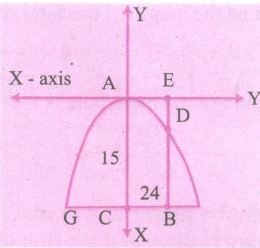
The girder of a railway bridge is a parabola with its vertex at the highest point 15 m above the ends. If the span is 120 m, find the height of the bridge at 24 m from the middle point.
32.
Solve: (2x2 - 3x + 1) (2x2 + 5x + 1) = 9x2.
33.
Solve : ydx+(x-y2)dy=0
34.
A ball is thrown vertically upwards, moves according to the law s = 13.8 t - 4.9 t2 where s
is in metres and t is in seconds.
(i) Find the acceleration at t = 1
(ii) Find velocity at t = 1
(iii) Find the maximum height reached by the ball?
35.
Let X be a random variable denoting the life time of an electrical equipment having probability density function
\(f(x)=\begin{cases} \begin{matrix} { ke }^{ -2x } & forx>0 \end{matrix} \\ \begin{matrix} 0 & forx\le 0 \end{matrix} \end{cases}\)
Find
(i) the value of k
(ii) Distribution function
(iii) P(X < 2)
(iv) calculate the probability that X is at least for four unit of time
(v) P(X = 3)
36.
Evaluate: \(\int _{ 0 }^{ 3 }{ (3{ x }^{ 2 }-4x+5) } dx\)
37.
Prove that \({ tan }^{ -1 }\left( \frac { m }{ n } \right) -{ tan }^{ -1 }\left( \frac { m-n }{ m+n } \right) =\frac { \pi }{ 4 } \)
38.
Show that the lines \(\frac { x-1 }{ 3 } =\frac { y+1 }{ 2 } =\frac { z-1 }{ 5 } \) and \(\frac { x+2 }{ 4 } =\frac { y-1 }{ 3 } =\frac { z+1 }{ -2 } \) do not intersect
39.
Find the rank of the matrix math \(\left[ \begin{matrix} 4 \\ -2 \\ 1 \end{matrix}\begin{matrix} 4 \\ 3 \\ 4 \end{matrix}\begin{matrix} 0 \\ -1 \\ 8 \end{matrix}\begin{matrix} 3 \\ 5 \\ 7 \end{matrix} \right] \).
1.
(d)
0.2
2.
(b)
3.
(b)
log y
4.
(a)
7+2<10
5.
(d)
-1
6.
(c)
\(\left( \begin{matrix} \frac { 1 }{ 2 } & \frac { 1 }{ 2 } \\ \frac { 1 }{ 2 } & \frac { 1 }{ 2 } \end{matrix} \right) \)
7.
(a)
0
8.
(a)
9.72 cm3
9.
(c)
4x - y - 14 = 0
10.
(d)
6
11.
(c)
12.
(b)
1
13.
(a)
土 \(\frac { 1 }{ 3 } \)
14.
(c)
7
15.
(a)
16.
(b)
\(\frac { 8 }{ 19 } \)
17.
(a)
2x - y + 4 = 0
18.
(c)
\(\frac { \sqrt { 3 } }{ 2 } \)
19.
(b)
(AT)2
20.
(d)
11
21.
\(\frac { { \vartheta }^{ 2 }u }{ \vartheta x\vartheta y } \)
22.
If x and y are numbers such that x = y, then x2 = y2
Converse statement :
If x and y are numbers such that x2 = y2 then x = y
Inverse statement :
If x and y are numbers such that x ≠ y then x2 ≠ y2
Contrapositive statement :
If x and y are numbers such that x2≠ y2 then x ≠ y
23.
x = 3 and dx = 0.02
When x = 3 and dx = 0.02,
df = (6 + 3) (0.02)
= 9(0.02) = 0.18
24.
If we put directly x = 1 we observe that the given function is in an indeterminate form \(\frac{0}{0}\). As the numerator and the denominator functions are polynomials of degree 2 they both are differentiable.
Hence, by an application of the l’Hôpital Rule, we get
\(\underset{x\rightarrow 1}{lim}(\frac{x^{2}-3x+2}{x^{2}-4x+3})=\underset{x\rightarrow 1}{lime}(\frac{2x-3}{2x-4})\)
= \(\frac{1}{2}\)
Note that this limit may also be evaluated through the factorization of the numerator and denominator as \(\frac{x^{2}-3x+2}{x^{2}-4x+3}=\frac{(x-1)(x-2)}{(x-1)(x-3)}\)
25.
The given differential equation is
\({ \left( \frac { d^2y }{ dx^2 } \right) }^{ 3\times2 }= { 1+\left( \frac { dy }{ dx } \right) } \)
squaring both sides, we get
\({ \left( \frac { dy }{ dx } \right) }^{ 6 }=1+\left( \frac { dy }{ dx } \right) \)
In this equation, the highest order derivative is 2 and its power is 6.
∴ Order 2, degree 6.
26.
\(\overset { \rightarrow }{ a } =\overset { \wedge }{ i } +2\overset { \wedge }{ j } +3\overset { \wedge }{ k } \), \(\overset { \rightarrow }{ b } =-\overset { \wedge }{ i } +2\overset { \wedge }{ j } +\overset { \wedge }{ k } \) and \(\overset { \rightarrow }{ c } =3\overset { \wedge }{ i } +\overset { \wedge }{ j } \)
Since \(\overset { \rightarrow }{ a } +\lambda \overset { \rightarrow }{ b } \) ⏊r to \(\overset { \rightarrow }{ c } \)
\(\Rightarrow \left[ \overset { \wedge }{ i } +\overset { \wedge }{ 2j } +\overset { \wedge }{ 3k } +\lambda \left( \overset { \wedge }{ -i } +\overset { \wedge }{ 2j } +\overset { \wedge }{ k } \right) \right] .\left( \overset { \wedge }{ 3i } +\overset { \wedge }{ j } \right) =0\)
\(\Rightarrow \left[ \left( 1-\lambda \right) \overset { \wedge }{ i } +\left( 2+2\lambda \right) \overset { \wedge }{ j } +\left( 3+\lambda \right) \overset { \wedge }{ k } \right] .\left( \overset { \wedge }{ 3i } +\overset { \wedge }{ j } \right) =0\)
⇒ 3(1 - λ) + (2 + 2λ) = 0 ⇒ 3 - 3λ + 2+ 2λ = 0
⇒ 5 - λ = 0 ⇒ λ = 5
27.
Local min value =−4
Local max.value = 0
28.
(−∞,−2)decreasing
(−2,−1)increasing
(−1,∞)decreasing
Local maximum value = 6
Local minimum value =5
29.
\(\frac { ds }{ dt } ={ 60cm }^{ 2 }/sec\frac { dt }{ dr } =\frac { 1 }{ 4\pi } cm/sec\)
30.
| p | q | r | ~ q | ~q V r | p➝(¬qVr) | ~p | ~pV(~qVr) |
| T | T | T | F | T | T | F | T |
| T | T | F | F | F | F | F | F |
| T | F | T | T | T | T | F | T |
| T | F | F | T | T | T | F | T |
| F | T | T | F | T | T | T | T |
| F | T | F | F | F | T | T | T |
| F | F | T | T | T | T | T | T |
| F | F | F | T | T | T | T | T |
From the table, it is clear that the column of p➝(¬q V ~r) and ~pV(~q V r) are identical
∴ p➝(¬q V ~r) ≡ ~pV(~q V r)
Hence proved.
31.
Let us take the axis AX as the and the tangent AY at A as y-axis.
Equation of the parabola is y2 = 4ax
CA 15, FG = 120
CF = CG= 60
F is (15, 60)
Since F lies on (1), 602 = Aa(15) ∴ ⇒ a = 60
y2 = 240x
When y = 24, 242 = 240(x)
⇒ x = \(\frac { 24\times 24 }{ 240 } \)
x = \(\frac{24}{10}\) = \(\frac{12}{5}\) = 2.4
From the diagram
BD = BE - ED = 15-2.4 = 12.6m.
Hence the required height is 12.6 m.
32.
Given equation is
(2x2 - 3x + 1) (2x2 + 5x + 1) = 9x2 ....(1)
Clearly x = 0 does not satisfy (1),
∴ (1) can be rewritten as
\(\left( 2x+\frac { 1 }{ x } -3 \right) \left( 2x+\frac { 1 }{ x } +5 \right) =9...(2)\)
put \(2x+\frac { 1 }{ x } =y\)
∴ (2)⇒ (y - 3) (y + 5) = 9
⇒ y2+ 2y-15 = 9
or y2+ 2y - 24 = 0
⇒ (y + 6) (y - 4) = 0
⇒ y = -6, -4
Case (i)
When \(y=-6,2x+\frac { 1 }{ x } =-6\)
2x2+6x+1 = 0
\(\Rightarrow =\frac { -6\pm \sqrt { 36-8 } }{ 4 } \)
\(x=-3\pm \frac { \sqrt { 7 } }{ 2 } \)
Case(ii)
When \(y=4,2x+\frac { 1 }{ x } =4\)
⇒ 2x2- 4x+1 = 0
\(x=\frac{4 \pm \sqrt{16-8}}{4}\)
\(x=\frac { 2\pm \sqrt { 2 } }{ 2 } \)
This, the roots are
\(\\ \frac { -3+\sqrt { 7 } }{ 2 } ,\frac { -3-\sqrt { 7 } }{ 2 } ,\frac { 2+\sqrt { 2 } }{ 2 } ,\frac { 2-\sqrt { 2 } }{ 2 } \)
33.
\(xy=\frac { { y }^{ 4 } }{ 4 } +c\)
34.
s = 13.8 t - 4.9 t2
v = \(\frac { ds }{ dt } \) =13.8 - 4.9 (2t)
=13.8-9.8t
When t = 1, v = 13.8 - 9.8(1)
4 m/sec.
Acceleration = \(\frac { d^{ 2 }x }{ { dt }^{ 2 } } \) = -9.8 m/sec2
At maximum height, v = 0
∴ 13.8 - 9.8 t = 0
⇒ 13.8 = 9.8 t
⇒ t = \(\frac { 13.8 }{ 9.8 } \) = 1.40 sec
At t = 1.4 sec,
distance (s) = 13.8 (1.40) - 4.9 (1.40)2
= 19.32 - 9.604 = 9.716 m
35.
(i) Since f (x) is a probability density function, f (x) ≥ 0 and \(\int _{ - }^{ \infty }{ f(x) } dx=1\)
That is \(\int _{ -\infty }^{ 0 }{ 0dx } +\int _{ 0 }^{ \infty }{ k{ e }^{ -2x }dx } =1\)
\(0+k\left( \frac { { e }^{ -2x } }{ -2 } \right) =1\Rightarrow k\left( \frac { { e }^{ -\infty }-{ e }^{ 0 } }{ -2 } \right) =1\Rightarrow k=2\)
Therefore the probability density function is
\(f\left( x \right) =\begin{cases} \begin{matrix} 2{ e }^{ -2x } & forx>0 \end{matrix} \\ \begin{matrix} 0 & forx \end{matrix}\le 0 \end{cases}\)
(ii) Distribution function
By definition the distribution function \(F(x)=P\left( x\le x \right) =\int _{ -\infty }^{ x }{ f(u) } du\)
When x≤0 \(F(x)=\int _{ -\infty }^{ x }{ F(u) } du=\int _{ -\infty }^{ x }{ odu=0 } \)
When x > 0 \(F(x)=\int _{ -\infty }^{ x }{ f(u) } du\int _{ -\infty }^{ x }{ 0du } +\int _{ 0 }^{ x }{ { 2e }^{ -2x }du\left( \frac { { e }^{ -2x } }{ -2 } \right) } =1-{ e }^{ 2x }\)
This gives \(F(x)=\begin{cases} \begin{matrix} 0 & forx\le 0 \end{matrix} \\ \begin{matrix} 1-{ e }^{ 2x } & forx>0 \end{matrix} \end{cases}\)
(iii) P(X < ) = P(X ≤2 ) = F(2 ) = 1-e2\(\times\)2 (since F(x) is continuous)
(iv) The probability that X is at least equal to four unit of time is
P(X ≥ 4 ) = 1 - P(X < 4 ) = 1- F( 4) = 1 - ( 1-e-2\(\times\)4) = e8
(v) In the continuous case, f (x) at x = a is not the probability that X takes the value a, that is f (x) at x = a is not equal to P( X ) a. If X is continuous type, P(X = a) = 0 for a ∈ R. Therefore P(x = 3) = 0.
36.
\(\int _{ 0 }^{ 3 }{ (3{ x }^{ 2 }-4x+5) } dx=\int _{ 0 }^{ 3 }{ 3{ x }^{ 2 } } dx-\int _{ 0 }^{ 3 }{ 4x } dx+\int _{ 0 }^{ 3 }{ 5 } dx\)
\(=3\int _{ 0 }^{ 3 }{ { x }^{ 2 } } dx-4\int _{ 0 }^{ 3 }{ c } dx+5\int _{ 0 }^{ 3 }{ dx } \)
\(=3{ \left[ \frac { { x }^{ 3 } }{ 3 } \right] }_{ 0 }^{ 3 }-4{ \left[ \frac { { x }^{ 2 } }{ 2 } \right] }_{ 0 }^{ 3 }+5{ \left[ x \right] }_{ 0 }^{ 3 }\)
= (27 − 0) − 2(9 − 0) + 5(3− 0)
= 27 −18 +15 = 24.
37.
LHS = \({ tan }^{ -1 }\left( \frac { m }{ n } \right) -{ tan }^{ -1 }\left( \frac { m-n }{ m+n } \right) \)
= \({ tan }^{ -1 }\left( \cfrac { \frac { m }{ n } -\frac { m-n }{ m+n } }{ 1+\frac { m }{ n } \left( \frac { m-n }{ m+n } \right) } \right) \)
= \({ tan }^{ -1 }\left( \cfrac { \frac { m(m+n)-n(m-n) }{ m(m+n) } }{ \frac { n(m+n)+m(m-n) }{ n(m+n) } } \right) \)
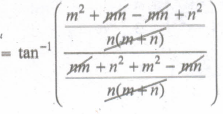
= \({ tan }^{ -1 }\left( \frac { { m }^{ 2 }+{ n }^{ 2 } }{ { m }^{ 2 }+{ n }^{ 2 } } \right) ={ tan }^{ -1 }(1)\)
= \(\frac { \pi }{ 4 } =RHS\)
Hence proved.
38.
From the line \(\frac { x-1 }{ 3 } =\frac { y+1 }{ 2 } =\frac { z-1 }{ 5 } \)
(x1, y1, z1) is (1, -1, 1)
(l1, m1, n1) is (3, 2, 5)
From the line \(\frac { x+2 }{ 4 } =\frac { y-1 }{ 3 } =\frac { z+1 }{ -2 } \)
we get, (x2, y2, z2) is (-2, 1, -1)
(l2, m2, n2) is 4, 3, -2
The Condition for intersecting lines is
\(\left| \begin{matrix} { x }_{ 2 }-{ x }_{ 1 } \\ { l }_{ 1 } \\ { l }_{ 2 } \end{matrix}\begin{matrix} { y }_{ 2 }-{ y }_{ 1 } \\ { m }_{ 1 } \\ { m }_{ 2 } \end{matrix}\begin{matrix} { z }_{ 2 }-{ z }_{ 1 } \\ { n }_{ 1 } \\ { n }_{ 2 } \end{matrix} \right| =0\)
\(\Rightarrow \left| \begin{matrix} -2-1 \\ 3 \\ 4 \end{matrix}\begin{matrix} 1+1 \\ 2 \\ 3 \end{matrix}\begin{matrix} -1-1 \\ 5 \\ -2 \end{matrix} \right| \)
\(\Rightarrow \left| \begin{matrix} -3 \\ 3 \\ 4 \end{matrix}\begin{matrix} 2 \\ 2 \\ 3 \end{matrix}\begin{matrix} -2 \\ 5 \\ -2 \end{matrix} \right| \)
= -3 (-4 -15) -2 (-6 -20) -2 (9 - 8)
= -3(-19) - 2(-26) -2 (1)
= 57 + 52 - 2 = 57 + 50
= 107 ≠ 0
Hence the given lines do not intersect
39.
Let A =\(\left[ \begin{matrix} 4 \\ -2 \\ 1 \end{matrix}\begin{matrix} 4 \\ 3 \\ 4 \end{matrix}\begin{matrix} 0 \\ -1 \\ 8 \end{matrix}\begin{matrix} 3 \\ 5 \\ 7 \end{matrix} \right] \)
A\(\overset { { R }_{ 1 }\leftrightarrow { R }_{ 3 } }{ \longrightarrow } \left[ \begin{matrix} 1 \\ -2 \\ 4 \end{matrix}\begin{matrix} 4 \\ 3 \\ 4 \end{matrix}\begin{matrix} 8 \\ -1 \\ 0 \end{matrix}\begin{matrix} 3 \\ 5 \\ 7 \end{matrix} \right] \)
\(\overset { { R }_{ 2 }\rightarrow { R }_{ 2 }+2{ R }_{ 1 }\\ { R }_{ 3 }\rightarrow { R }_{ 3 }-4{ R }_{ 1 } }{ \longrightarrow } \left[ \begin{matrix} 1 \\ 0 \\ 0 \end{matrix}\begin{matrix} 4 \\ 11 \\ -12 \end{matrix}\begin{matrix} 8 \\ 15 \\ -32 \end{matrix}\begin{matrix} 7 \\ 19 \\ -25 \end{matrix} \right] \)
A is in row - echelon form and it has 3 non-zero rows.
∴ \(\rho\) (A) = 3

12th Standard Syllabus & Materials
12th Standard
TN 12th Computer Applications வலையமைப்பு வடமிடல் Sample Question Papers Study Material - QB365 Set A
NEW12th Standard
TN 12th Computer Applications களப்பெயர் முறைமை (DNS) Sample Question Papers Study Material - QB365 Set A
NEW12th Standard
TN 12th Computer Applications வலையமைப்பு எடுத்துக்காட்டுகள் மற்றும் நெறிமுறைகள் Sample Question Papers Study Material - QB365 Set A
NEW12th Standard
TN 12th Computer Applications கணினி வலையமைப்பு ஓர் அறிமுகம் Sample Question Papers Study Material - QB365 Set A



Tamilnadu Stateboard 12th Standard Subjects
Maths

Chemistry

Physics

Biology

Computer Science

Business Maths and Statistics

Economics

Commerce

Accountancy

History

Computer Applications
Biology
Computer Technology
Computer Applications
Computer Science
Business Maths and Statistics
Commerce
Economics
Maths
Chemistry
Physics
Computer Technology
History
Accountancy

Tamil

English

French
Tamilnadu Stateboard Standards

