
 100% FREE ACCESS
12th Standard Syllabus & Materials
12th Standard
TN 12th Computer Applications மின்னணு தரவு பரிமாற்றம் Sample Question Papers Study Material - QB365 Set A
NEW12th Standard
TN 12th Computer Applications மின் - வணிக பாதுகாப்பு அமைப்புகள் Sample Question Papers Study Material - QB365 Set A
NEW12th Standard
TN 12th Computer Applications மின்னணு செலுத்தல் முறைகள் Sample Question Papers Study Material - QB365 Set A
NEW12th Standard
TN 12th Computer Applications மின் - வணிகம் Sample Question Papers Study Material - QB365 Set A
NEW12th Standard
TN 12th Computer Applications திறந்த மூல கருத்துருக்கள் Sample Question Papers Study Material - QB365 Set A
NEW12th Standard
TN 12th Computer Applications வலையமைப்பு வடமிடல் Sample Question Papers Study Material - QB365 Set A

Published on: 02/02/2021
12th Standard Maths English Medium Reduced Syllabus Model Question paper - 2021 Part - 2
Download Tamil Nadu 12th Standard Maths question papers, model tests, one-mark questions, important questions, and public exam papers in PDF format. Free study materials and answer keys for TN State Board students.
Questions + Answers key
Take MCQ Maths Test1.
The probability density function of X is \(f(x)= \begin{cases}x & 0<x<1 \\ 2-x & 1 \leq x<2 \\ 0 & \text { otherwise }\end{cases}\) find P(0.2 ≤ X< 0.6)
2.
Find the following \(\left| \overline { (1+i) } (2+3i)(4i-3) \right| \)
3.
Evaluate the following if z = 5−2i and w = −1+3i
2z + 3w
4.
Find the modulus of the following complex numbers
\(\frac { 2i }{ 3+4i } \)
5.
Write \(\frac { 3+4i }{ 5-12i } \) in the x + iy form, hence find its real and imaginary parts.
6.
Evaluate the following
\(\int _{ 0 }^{ \pi /4 }{ { sin}^{ 6}2x\ dx } \)
7.
Find the rank of each of the following matrices:
\(\left[ \begin{matrix} 4 & 3 \\ -3 & -1 \\ 6 & 7 \end{matrix}\begin{matrix} 1 & -2 \\ -2 & 4 \\ -1 & 2 \end{matrix} \right] \)
8.
If \(\omega \neq 1\) is a cube root of unity, then the show that \(\cfrac { a+b\omega +c{ \omega }^{ 2 } }{ b+c\omega +{ a\omega }^{ 2 } } +\cfrac { a+b\omega +{ c\omega }^{ 2 } }{ c+a\omega +b{ \omega }^{ 2 } } =-1\)
9.
Show that the equation x9- 5x5+ 4x4+ 2x2+ 1 = 0 has atleast 6 imaginary solutions.
10.
If a compound statement involves 3 simple statements, then the number of rows in the truth table is
9
8
6
3
11.
12.
The value of \(\int _{ 0 }^{ 1 }{ { ({ sin }^{ -1 }x) }^{ 2 } } dx\) is
\(\frac { { \pi }^{ 2 } }{ 4 } -1\)
\(\frac { { \pi }^{ 2 } }{ 4 } +2\)
\(\frac { { \pi }^{ 2 } }{ 4 } +1\)
\(\frac { { \pi }^{ 2 } }{ 4 } -2\)
13.
If \(f(x)=\int_{1}^{x} \frac{e^{\sin u}}{u} d u, x>1 \text { and }\int_{1}^{3} \frac{e^{\sin x^{2}}}{x} d x=\frac{1}{2}[f(a)-f(1)]\), then one of the possible value of a is
3
6
9
5
14.
15.
If w (x, y, z) = x2 (y - z) + y2 (z - x) + z2(x - y), then \(\frac { { \partial }w }{ \partial x } +\frac { \partial w }{ \partial y } +\frac { \partial w }{ \partial z } \) is
xy + yz + zx
x(y + z)
y(z + x)
0
16.
The number of arbitrary constants in the particular solution of a differential equation of third order is
3
2
1
0
17.
The number of arbitrary constants in the general solutions of order n and n +1 are respectively
n-1,n
n,n+1
n+1,n+2
n+1,n
18.
The number given by the Mean value theorem for the function \(\frac { 1 }{ x } \), x ∈ [1, 9] is
2
2.5
3
3.5
19.
The number given by the Rolle's theorem for the functlon x3 - 3x2, x ∈ [0, 3] is
1
\(\sqrt { 2 } \)
\(\frac { 3 }{ 2 } \)
2
20.
21.
The rank of the matrix \(\left[ \begin{matrix} 1 \\ \begin{matrix} 2 \\ -1 \end{matrix} \end{matrix}\begin{matrix} 2 \\ \begin{matrix} 4 \\ -2 \end{matrix} \end{matrix}\begin{matrix} 3 \\ \begin{matrix} 6 \\ -3 \end{matrix} \end{matrix}\begin{matrix} 4 \\ \begin{matrix} 8 \\ -4 \end{matrix} \end{matrix} \right] \) is
1
2
4
3
22.
If A = \(\left[ \begin{matrix} 3 & 5 \\ 1 & 2 \end{matrix} \right] \), B = adj A and C = 3A, then \(\frac { \left| adjB \right| }{ \left| C \right| } \) =
\(\frac { 1 }{ 3 } \)
\(\frac { 1 }{ 9 } \)
\(\frac { 1 }{ 4 } \)
1
23.
If the length of the perpendicular from the origin to the plane 2x + 3y + λz =1, λ > 0 is \(\frac{1}{5}\), then the value of λ is
\(2\sqrt { 3 } \)
\(3\sqrt { 2 } \)
0
1
24.
25.
If \(\vec { a } ,\vec { b } ,\vec { c } \) are three non-coplanar vectors such that \(\vec { a } \times (\vec { b } \times \vec { c } )=\frac { \vec { b } +\vec { c } }{ \sqrt { 2 } } \), then the angle between \(\vec { a } \ and \ \vec { b } \) is
\(\frac { \pi }{ 2 } \)
\(\frac { 3\pi }{ 4 } \)
\(\frac { \pi }{ 4 } \)
\( { \pi }\)
26.
The equation of the circle passing through (1, 5) and (4, 1) and touching y-axis is x2 + y2 − 5x − 6y + 9 + \(\lambda\)(4x + 3y − 19) = 0 where λ is equal to
\(0,-\frac { 40 }{ 9 } \)
0
\(\frac { 40 }{ 9 } \)
\(\frac { -40 }{ 9 } \)
27.
The polynomial x3 - kx2 + 9x has three real zeros if and only if, k satisfies
|k| ≤ 6
k = 0
|k| > 6
|k| ≥ 6
28.
If \(\left| z-\frac { 3 }{ z } \right| =2\), then the least value |z| is
1
2
3
5
29.
If |z - 2 + i | ≤ 2, then the greatest value of |z| is
\(\sqrt { 3 } -2\)
\(\sqrt { 3 } +2\)
\(\sqrt { 5 } -2\)
\(\sqrt { 5 } +2\)
30.
Solve : \(\left( 1+{ x }^{ 2 } \right) \frac { dy }{ dx } -x={ 2tan }^{ -1 }x\)
31.
Show that the ratio of the area under the curve y=sinx and y=sin2x between x=0 and \(x=\frac { \pi }{ 3 } \) and x- axis are as 2 : 3.
32.
Verify the
(i) closure property,
(ii) commutative property,
(iii) associative property
(iv) existence of identity and
(v) existence of inverse for the arithmetic operation + on Z.
33.
Let z(x, y) = x3 - 3x2y3, where x = set, y = se-t, s, t ∈ R. Find \(\frac { \partial z }{ \partial s } \) and \(\frac { \partial z }{ \partial t } \)
34.
If the probability mass function f(x) of a random variable X is
| x | 1 | 2 | 3 | 4 |
| f (x) | \(\cfrac { 1 }{ 12 } \) | \(\cfrac { 5 }{ 12 } \) | \(\cfrac { 5 }{ 12 } \) | \(\cfrac { 1 }{ 12 } \) |
find (i) its cumulative distribution function, hence find
(ii) P(X ≤ 3) and,
(iii) P(X ≥ 2)
35.
If w (x, y, z) = x2 + y2 + y2, x = et, y = et sin t, z = et cos t, find \(\frac{dw}{dt}\)
36.
Solve the differential equation:
x cos y dy = ex(x log x + 1)dx
1.
P(0.2≤X < 0.6)
= \(\int _{ 0.2 }^{ 0.6 }{ f(x)dx } =\int _{ 0.2 }^{ 0.6 }{ x.dx } =\left[ \frac { { x }^{ 2 } }{ 2 } \right] _{ 0.2 }^{ 0.6 }\)
= 0.18 - 0.02
= 0.16

2.
\(\left| \left( \overline { 1+i } \right) \left( 2+3i \right) \left( 4i-3 \right) \right| =\left| \left( \overline { 1+i } \right) \right| \left| 2+3i \right| \left| 4i-3 \right| \) (\(\because \) |z1z2z3|=|z1|z2||z3|)
= |1+i| |2+3i| |-3+4i| \(\left( \because |z|=\left| \overline { z } \right| \right) \)
= \(\left( \sqrt { { 1 }^{ 2 }+{ 1 }^{ 2 } } \right) \left( \sqrt { { 2 }^{ 2 }+{ 3 }^{ 2 } } \right) \left( \sqrt { \left( 3 \right) ^{ 2 }+{ 4 }^{ 2 } } \right) \).
\(=(\sqrt{2})(\sqrt{13})(\sqrt{25})=5 \sqrt{26}\)
3.
2z+3w
= 2(5-2i)+3(-1+3i)
= 10-4i-3+9i
= (10-3)+ i(-4+9)
= 7+5i
4.
\(\frac { 2i }{ 3+4i } \)
Let z = \(\frac { 2i }{ 3+4i } \)
|z| = \(\left| \frac { 2i }{ 3+4i } \right| =\frac { |2i| }{ |3+4i| } =\frac { \sqrt { 2^{ 2 } } }{ \sqrt { { 3 }^{ 2 }+{ 4 }^{ 2 } } } =\frac { 2 }{ \sqrt { 9+16 } } \)
= \(\frac { 2 }{ \sqrt { 25 } } =\frac { 2 }{ 5 } \).
5.
To find the real and imaginary parts of \(\frac { 3+4i }{ 5-12i } \) first it should be expressed in the rectangular form x + iy .
To simplify the quotient of two complex numbers, multiply the numerator and denominator by the conjugate of the denominator to eliminate i in the denominator
\(\frac { 3+4i }{ 5-12i } =\frac { (3-4i)(5+12i) }{ (5-12i)(5+12i) } \)
= \(\frac { (15-48)+(20+36)i }{ { 5 }^{ 2 }+{ 12 }^{ 2 } } \)
= \(\frac { -33+56i }{ 169 } =-\frac { 33 }{ 169 } +i\frac { 56 }{ 169 } \)
Therefore,\(\frac { 3+4i }{ 5-12i } =-\frac { 33 }{ 169 } +i\frac { 56 }{ 169 } \) This is in the x + iy form.
Hence real part is \(-\frac { 33 }{ 169 } \) and imaginary part is \(\frac { 56 }{ 169 } \)
6.
\(Let\quad t=2x\Rightarrow dt=2dx\Rightarrow \frac { dt }{ 2 } =dx\)
\(\therefore I=\frac { 1 }{ 2 } \int _{ 0 }^{ \frac { \pi }{ 2 } }{ { sin }^{ 6 }t\quad dt=\frac { 1 }{ 2 } { I }_{ 6 } } \)
| x | 0 | \(\frac{\pi}{4}\) |
| t | 0 | \(\frac{\pi}{t}\) |
\([\int _{ 0 }^{ \pi /2 }{ { sin }^{ n }xdx=\frac { n-1 }{ n } { I }_{ n-2 }, } n\ge 2]\)
\(\\ =\frac { 1 }{ 2 } \times \frac { 5 }{ 6 } \times \frac { 3 }{ 4 } \times \frac { 1 }{ 2 } \times \frac { \pi }{ 2 } =\frac { 5\pi }{ 64 } \)
7.
Let A = \(\left[ \begin{matrix} 4 & 3 \\ -3 & -1 \\ 6 & 7 \end{matrix}\begin{matrix} 1 & -2 \\ -2 & 4 \\ -1 & 2 \end{matrix} \right] \). Then A is a matrix of order 3 \(\times\) 4. So ρ(A) ≤ min {3, 4} = 3.
The highest order of minors of A is 3. We search for a non-zero third-order minor of A. But we find that all of them vanish. In fact, we have
\(\left| \begin{matrix} 4 & 3 & 1 \\ -3 & -1 & -2 \\ 6 & 7 & -1 \end{matrix} \right| \) = 0; \(\left| \begin{matrix} 4 & 3 & -2 \\ -3 & -1 & 4 \\ 6 & 7 & 2 \end{matrix} \right| \) = 0; \(\left| \begin{matrix} 4 & 1 & -2 \\ -3 & -2 & 4 \\ 6 & -1 & 2 \end{matrix} \right| \) = 0; \(\left| \begin{matrix} 3 & 1 & -2 \\ -1 & -2 & 4 \\ 7 & -1 & 2 \end{matrix} \right| \) = 0.
So, ρ(A) < 3. Next, we search for a non-zero second-order minor of A.
We find that \(\left| \begin{matrix} 4 & 3 \\ -3 & -1 \end{matrix} \right| \) = -4 + 9 = 5 ≠ 0. So, ρ(A) = 2.
8.
LHS = \(\cfrac { a+b\omega +c{ \omega }^{ 2 } }{ b+c\omega +{ a\omega }^{ 2 } } +\cfrac { a+b\omega +{ c\omega }^{ 2 } }{ c+a\omega +b{ \omega }^{ 2 } } \)
\(\cfrac { a\omega ^{ 3 }+b\omega +c{ \omega }^{ 2 } }{ b+c\omega +{ a\omega }^{ 2 } } +\cfrac { a\omega ^{ 3 }+b\omega ({ \omega }^{ 3 })+{ c\omega }^{ 2 } }{ c+a\omega +b{ \omega }^{ 2 } } \) [∵ ω3 = 1]
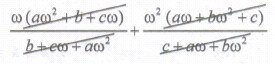
= ω + ω2 = -1 [ ∵ 1 + ω + ω2 = 0]
9.
Let p(-x) = x9- 5x5 + 4x4 + 2x2 + 1 = 0
P(x) has only one sign change. It has atmost one positive roots.
Also p(-x) = (-x)9 - 5(-x)5 + 4(-x)4 +2(-x)2 +1 = 0
p(-x) = -x9+ 5x5+4x4+ 2x2+1 = 0
It has only one sign change.
It has atmost one negative roots.
Clearly 0 is not a root.
So maximum number of real roots is 3 and hence there are atleast six imaginary solutions.
10.
(b)
8
11.
(c)
12.
(d)
\(\frac { { \pi }^{ 2 } }{ 4 } -2\)
13.
(c)
9
14.
(b)
15.
(d)
0
16.
(d)
0
17.
(b)
n,n+1
18.
(c)
3
19.
(d)
2
20.
(a)
21.
(a)
1
22.
(b)
\(\frac { 1 }{ 9 } \)
23.
(a)
\(2\sqrt { 3 } \)
24.
(a)
25.
(b)
\(\frac { 3\pi }{ 4 } \)
26.
(a)
\(0,-\frac { 40 }{ 9 } \)
27.
(d)
|k| ≥ 6
28.
(a)
1
29.
(d)
\(\sqrt { 5 } +2\)
30.
\(y=\frac { 1 }{ 2 } log(x+1)+(tan^{ -1 }+x)^{ 2 }+c\)
31.
prove.
32.
(i) m + n∈Z, ∀m, n∈Z. Hence + is a binary operation on Z.
(ii) Also m + n = n + m,∀m, n∈Z. So the commutative property is satisfied
(iii) ∀m, n, p∈Z, m+ (n + p) = (m+ n) + p. Hence the associative property is satisfied.
(iv) m + e = e + m = m ⇒ e = 0. Thus ヨ 0∈Z⋺(m+ 0) = (0 + m) = m. Hence the existence of identity is assured.
(v) m + m' = m'+ m = 0 ⇒ m' = −m. Thus ∀∈Z,ョ−m∈Z ⋺ m+ (−m) = (−m) + m = 0. Hence, the existence of inverse property is also assured. Thus we see that the usual addition + on Z satisfies all the above five properties.
33.
Given z(x, y) = x3 - 3x2y3 ; x = set; y = se-t
\(\frac { \partial z }{ \partial s } \) = 3x2 - 6xy3; \(\frac { \partial z }{ \partial y } \) = -9x2y2
∴ \(\frac { \partial z }{ \partial s } \) 3s2e2t - 6 set s3 e-3t
\(\frac { \partial z }{ \partial y } \) = 9s2e2t.s2e-2t
\(\frac { \partial z }{ \partial y } \) = -9s4
\(\frac { \partial z }{ \partial s} \) = et; \(\frac { \partial y }{ \partial s} \) = e-t
\(\frac { \partial x }{ \partial t} \) = set; \(\frac { \partial y }{ \partial s} \) = -se-t
By chain rule;
\(\therefore \frac { \partial z }{ \partial s } =\frac { \partial z }{ \partial x } .\frac { dx }{ ds } +\frac { \partial u }{ \partial y } .\frac { dy }{ dx } \)
= (3s2e2t - 6 s4 e-2t) (et) + (-9s4) (e-t)
= 3s2e3t - 6 s4 e-t -9s4 e-t
\(\frac { \partial z }{ \partial s } \) = 3s2e3t - 15 s4 e-t
By chain rule;
\(\frac { \partial z }{ \partial t } =\frac { \partial z }{ \partial x } .\frac { dx }{ dt } +\frac { \partial z }{ \partial y } .\frac { dy }{ dt } \)
= (3s2e2t - 6 s4e-2t) (set) + (-9 s4) (-se-t)
= 3s3e3t - 6 s5e-t + 9 s5 e-t
= 3s3 e3t + 3 s5e-t
= 3s3(e3t + s2e-t)
34.
By definition the cumulative distribution function for discrete random variable is
\(F(x)P\left( X\le x \right) =\underset { { x }_{ 1 }\le x }{ \Sigma } P(X={ x }_{ 1 })\)
\(P(X<1)=0\) for -∞
\(F(1)=P\left( X\le 1 \right) =\underset { { x }_{ 1 }\le x }{ \Sigma } P(X={ x }_{ i })=\sum _{ -\infty }^{ 1 }{ P(X=x) } =P\left( X<1 \right) +P\left( X=1 \right) =0+\frac { 1 }{ 12 } =\frac { 1 }{ 12 }\)
\(F(2)=P\left( X\le 2 \right) =\sum _{ -\infty }^{ 2 }{ P\left( X=x \right) } =P\left( X\le 1 \right) +P\left( X=1 \right) +P\left( X=2 \right)\)
= \(0+\frac { 1 }{ 12 } +\frac { 5 }{ 12 } =\frac { 1 }{ 2 }\)
\(F(3)=P\left( X\le 3 \right) =\sum _{ -\infty }^{ 3 }{ P(X=x) } =P\left( X<1 \right) +P\left( X=1 \right) +P\left( X=2 \right) +P\left( X=3 \right)\)
= \(0+\frac { 1 }{ 2 } +\frac { 5 }{ 12 } +\frac { 5 }{ 12 } =\frac { 11 }{ 12 }\)
\(F(4)=P\left( X\le 4 \right) =\sum _{ -\infty }^{ 4 }{ P\left( X=x \right) } =P\left( X=1 \right) +P\left( X=2 \right) +P\left( X=3 \right) +P(X=4)\)
= \(0+\frac { 1 }{ 12 } +\frac { 5 }{ 12 } +\frac { 5 }{ 12 } +\frac { 1 }{ 12 } =1\)
\(F(x)=\{0, \quad-\infty \ldots\)

(ii) \(P(X\le 3)=F(3)\frac { 11 }{ 12 }\)
(iii) \(P(X\ge 2)=1-P\left( X<2 \right) =1-P(X\le 1)=1-F(1)=1-\frac { 1 }{ 12 } =\frac { 11 }{ 12 }\)
35.
Given w (x, y, z) = x2 +y2 +y2,
x = et, y = et sin t, z = et cos t
\(\frac { \partial u }{ \partial x }\) = 2x; \(\frac { \partial u }{ \partial y}\) = 2y; \(\frac { \partial u }{ \partial z}\) = 2z
\(\frac { \partial u }{ \partial x }\) = 2et
\(\frac { \partial u }{ \partial y}\) = 2et sin t
\(\frac { \partial u }{ \partial z}\) = 2et cos t
\(\frac{dx}{dt}\) = et
\(\frac{dy}{dt}\) = et cas t + sin t et
⇒ \(\frac{dz}{dt}\) = et (- sin t ) + cos t et
By chain rule
\(\frac { dw }{ dt } =\frac { \partial u }{ \partial x } .\frac { dx }{ dt } +\frac { dw }{ \partial y } .\frac { dy }{ dt } +\frac { \partial w }{ \partial z } .\frac { dz }{ dt }\)
∴ \(\frac { dw }{ dt }\) = 2et(et) + 2et sin t (et cos t +sin t et) - et sin t + 2et cas t (et cos t - et sin t )
\(\therefore \frac{d w}{d t}=e^{2 t}\left[2+2 \sin t \cos t+2 \sin ^2 t-2 \sin t \cos t+2 \cos ^2 t\right]\)
= e2t [2 + 2] = 4e2t
36.
x cos y dy = ex(x log x + 1)dx
\(\Rightarrow cos\ y\ dy={ e }^{ x }\frac { (x\ log+1) }{ x } dx\)
\(=\left[ { e }^{ x }\left( log\quad x+\frac { 1 }{ x } \right) \right] dx\)
\(\Rightarrow \int { cos\quad y\quad dy } =\int { { e }^{ x }\left( log\quad x+\frac { 1 }{ x } \right) dx } \)
Taking integration on both sides, we get
\( \int \cos y d y=\int e^x\left[\log x+\frac{1}{x}\right] d x \)
RHS
\( \int e^x\left[\log x+\frac{1}{x}\right] d x\)
Take \(\mathrm{f}(x)=\log x \Rightarrow f^{\prime}(x)=\frac{1}{x} \)
This of the form \(\int e^x\left[f(x)+f^{\prime}(x)\right] d x=e^x f(x)+C \)
\(\therefore \int e^x\left[\log x+\frac{1}{x}\right] d x=\mathrm{e}^x \log x+\mathrm{C}\)
Substituting in (1), we get
\(\sin y=e^x \log x+C \)

12th Standard Syllabus & Materials
12th Standard
TN 12th Computer Applications களப்பெயர் முறைமை (DNS) Sample Question Papers Study Material - QB365 Set A
NEW12th Standard
TN 12th Computer Applications வலையமைப்பு எடுத்துக்காட்டுகள் மற்றும் நெறிமுறைகள் Sample Question Papers Study Material - QB365 Set A
NEW12th Standard
TN 12th Computer Applications கணினி வலையமைப்பு ஓர் அறிமுகம் Sample Question Papers Study Material - QB365 Set A
NEW12th Standard
TN 12th Computer Applications PHP-உடன் MySQL-ஐ இணைத்தல் Sample Question Papers Study Material - QB365 Set A



Tamilnadu Stateboard 12th Standard Subjects
Maths

Chemistry

Physics

Biology

Computer Science

Business Maths and Statistics

Economics

Commerce

Accountancy

History

Computer Applications
Biology
Computer Technology
Computer Applications
Computer Science
Business Maths and Statistics
Commerce
Economics
Maths
Chemistry
Physics
Computer Technology
History
Accountancy

Tamil

English

French
Tamilnadu Stateboard Standards

