
 100% FREE ACCESS
12th Standard Syllabus & Materials
12th Standard
TN 12th Computer Applications மின்னணு தரவு பரிமாற்றம் Sample Question Papers Study Material - QB365 Set A
NEW12th Standard
TN 12th Computer Applications மின் - வணிக பாதுகாப்பு அமைப்புகள் Sample Question Papers Study Material - QB365 Set A
NEW12th Standard
TN 12th Computer Applications மின்னணு செலுத்தல் முறைகள் Sample Question Papers Study Material - QB365 Set A
NEW12th Standard
TN 12th Computer Applications மின் - வணிகம் Sample Question Papers Study Material - QB365 Set A
NEW12th Standard
TN 12th Computer Applications திறந்த மூல கருத்துருக்கள் Sample Question Papers Study Material - QB365 Set A
NEW12th Standard
TN 12th Computer Applications வலையமைப்பு வடமிடல் Sample Question Papers Study Material - QB365 Set A

Published on: 02/02/2021
12th Standard Maths English Medium Reduced Syllabus Model Question paper with answer key - 2021 Part - 1
Download Tamil Nadu 12th Standard Maths question papers, model tests, one-mark questions, important questions, and public exam papers in PDF format. Free study materials and answer keys for TN State Board students.
Questions + Answers key
Take MCQ Maths Test1.
Using truth table check whether the statements ¬(p V q) V (¬p ∧ q) and ¬p are logically equivalent.
2.
Let M = \(\left\{ \left( \begin{matrix} x & x \\ x & x \end{matrix} \right) :x\in R-\{ 0\} \right\} \) and let * be the matrix multiplication. Determine whether M is closed under ∗. If so, examine the commutative and associative properties satisfied by ∗ on M.
3.
Verify
(i) closure property
(ii) commutative property
(iii) associative property
(iv) existence of identity and
(v) existence of inverse for the operation +5 on Z5 using table corresponding to addition modulo 5.
4.
Find the constant C such that the function
\(f(x)= \begin{cases}C x^2, & 1<x<4 \\ 0, & \text { otherwise }\end{cases}\)
is a density function, and compute
(i) P(1.5 < X < 3.5)
(ii) P(X ≤ 2)
(iii) P(3 < X )
5.
The probability density function of X is given
\(f(x)=\begin{cases} \begin{matrix} { Ke }^{ \frac { -x }{ 3 } } & \begin{matrix} for & x>0 \end{matrix} \end{matrix} \\ \begin{matrix} 0 & \begin{matrix} for & x\le 0 \end{matrix} \end{matrix} \end{cases}\)
Find
(i) the value of k
(ii) the distribution function.
(iii) P(X <3)
(iv) P(5 ≤X)
(v) P(X ≤ 4)
6.
Solve the Linear differential equation:
\((x+a)\frac { dy }{ dx } -2y={ (x+a) }^{ 4 }\)
7.
If p and q are the roots of the equation I x2+ nx + n = 0, show that \(\sqrt{\frac{p}{q}}+\sqrt{\frac{q}{p}}+\sqrt{\frac{n}{i}}\) = 0
8.
Linear approximation for g(x) = cos x at \(x=\frac{\pi}{2}\) is
\(x+\frac{\pi}{2}\)
\(-x +\frac{\pi}{2}\)
\(x - \frac{\pi}{2}\)
\(-x - \frac{\pi}{2}\)
9.
If u(x, y) = x2+ 3xy + y - 2019, then \(\left.\frac{\partial u}{\partial x}\right|_{(4,-5)}\) is equal to
-4
-3
-7
13
10.
The number given by the Rolle's theorem for the functlon x3 - 3x2, x ∈ [0, 3] is
1
\(\sqrt { 2 } \)
\(\frac { 3 }{ 2 } \)
2
11.
The function sin4 x + cos4 x is increasing in the interval
\(\left[ \frac { 5\pi }{ 8 } ,\frac { 3\pi }{ 4 } \right] \)
\(\left[ \frac { \pi }{ 2 } ,\frac { 5\pi }{ 8 } \right] \)
\(\left[ \frac { \pi }{ 4 } ,\frac { \pi }{ 2 } \right] \)
\(\left[ 0,\frac { \pi }{ 4 } \right] \)
12.
If A = \(\left[ \begin{matrix} 3 & -3 & 4 \\ 2 & -3 & 4 \\ 0 & -1 & 1 \end{matrix} \right] \), then adj(adj A) is
\(\left[ \begin{matrix} 3 & -3 & 4 \\ 2 & -3 & 4 \\ 0 & -1 & 1 \end{matrix} \right] \)
\(\left[ \begin{matrix} 6 & -6 & 8 \\ 4 & -6 & 8 \\ 0 & -2 & 2 \end{matrix} \right] \)
\(\left[ \begin{matrix} -3 & 3 & -4 \\ -2 & 3 & -4 \\ 0 & 1 & -1 \end{matrix} \right] \)
\(\left[ \begin{matrix} 3 & -3 & 4 \\ 0 & -1 & 1 \\ 2 & -3 & 4 \end{matrix} \right] \)
13.
Let A = \(\left[ \begin{matrix} 2 & -1 & 1 \\ -1 & 2 & -1 \\ 1 & -1 & 2 \end{matrix} \right] \) and 4B = \(\left[ \begin{matrix} 3 & 1 & -1 \\ 1 & 3 & x \\ -1 & 1 & 3 \end{matrix} \right] \). If B is the inverse of A, then the value of x is
2
4
3
1
14.
If adj A = \(\left[ \begin{matrix} 2 & 3 \\ 4 & -1 \end{matrix} \right] \) and adj B = \(\left[ \begin{matrix} 1 & -2 \\ -3 & 1 \end{matrix} \right] \) then adj (AB) is
\(\left[ \begin{matrix} -7 & -1 \\ 7 & -9 \end{matrix} \right] \)
\(\left[ \begin{matrix} -6 & 5 \\ -2 & -10 \end{matrix} \right] \)
\(\left[ \begin{matrix} -7 & 7 \\ -1 & -9 \end{matrix} \right] \)
\(\left[ \begin{matrix} -6 & -2 \\ 5 & -10 \end{matrix} \right] \)
15.
If ATA−1 is symmetric, then A2 =
A-1
(AT)2
AT
(A-1)2
16.
If (AB)-1 = \(\left[ \begin{matrix} 12 & -17 \\ -19 & 27 \end{matrix} \right] \) and A-1 = \(\left[ \begin{matrix} 1 & -1 \\ -2 & 3 \end{matrix} \right] \), then B-1 =
\(\left[ \begin{matrix} 2 & -5 \\ -3 & 8 \end{matrix} \right] \)
\(\left[ \begin{matrix} 8 & 5 \\ 3 & 2 \end{matrix} \right] \)
\(\left[ \begin{matrix} 3 & 1 \\ 2 & 1 \end{matrix} \right] \)
\(\left[ \begin{matrix} 8 & -5 \\ -3 & 2 \end{matrix} \right] \)
17.
If A is a 3 \(\times\) 3 non-singular matrix such that AAT = ATA and B = A-1AT, then BBT =
A
B
I3
BT
18.
If the distance of the point (1, 1, 1) from the origin is half of its distance from the plane x + y + z + k = 0, then the values of k are
\(\pm 3\)
\(\pm 6\)
-3, 9
3, -9
19.
If \(\vec { a } ,\vec { b } ,\vec { c } \) are three non-coplanar vectors such that \(\vec { a } \times (\vec { b } \times \vec { c } )=\frac { \vec { b } +\vec { c } }{ \sqrt { 2 } } \), then the angle between \(\vec { a } \ and \ \vec { b } \) is
\(\frac { \pi }{ 2 } \)
\(\frac { 3\pi }{ 4 } \)
\(\frac { \pi }{ 4 } \)
\( { \pi }\)
20.
If \(\vec { a } ,\vec { b } ,\vec { c } \) are non-coplanar, non-zero vectors such that \([\vec { a } ,\vec { b } ,\vec { c } ]\) = 3, then \({ \{ [\vec { a } \times \vec { b } ,\vec { b } \times \vec { c } ,\vec { c } \times \vec { a } }]\} ^{ 2 }\) is equal to
81
9
27
18
21.
If P(x, y) be any point on 16x2 + 25y2 = 400 with foci F1 (3, 0) and F2 (-3, 0) then PF1 + PF2 is
8
6
10
12
22.
23.
\(\sin ^{-1} \frac{3}{5}-\cos ^{-1} \frac{12}{13}+\sec ^{-1} \frac{5}{3}-\operatorname{cosec}^{-1} \frac{13}{12}\) is equal to
2\(\pi\)
\(\pi\)
0
tan-1\(\frac{12}{65}\)
24.
25.
26.
If |z| = 1, then the value of \(\frac { 1+z }{ 1+\overline { z } }\) is
z
\(\bar { z } \)
\(\cfrac { 1 }{ z } \)
1
27.
If \(\left| z-\frac { 3 }{ z } \right| =2\), then the least value |z| is
1
2
3
5
28.
A retailer purchases a certain kind of electronic device from a manufacturer. The manufacturer, indicates that the defective rate of the device is 5%. The inspector of the retailer randomly picks 10 items from a shipment. What is the probability that there will be
(i) at least one defective item
(ii) exactly two defective items.
29.
Obtain the Cartesian form of the locus of z in in each of the following cases.
|2z - 3 - i| = 3
30.
Show that \(\left( \frac { 19-7i }{ 9+i } \right) ^{ 12 }+\left( \frac { 20-5i }{ 7-6i } \right) ^{ 12 }\) is real
31.
Form the D.E of family of parabolas having vertex at the origin and axis along positive y-axis.
32.
Find the order and degree of \(y+\frac { dy }{ dx } =\frac { 1 }{ 4 } \int { ydx } \)
33.
Find the area bounded by the curve y=sin2x between the ordinates x=0.x=π and x-axis.
34.
Evaluate \(\int _{ 0 }^{ \infty }{ \left( { a }^{ -x }-{ b }^{ -x } \right) } dx\)
35.
Let \(A=\left( \begin{matrix} 1 & 0 \\ 0 & 1 \\ 1 & 0 \end{matrix}\begin{matrix} 1 & 0 \\ 0 & 1 \\ 0 & 1 \end{matrix} \right) ,B=\left( \begin{matrix} 0 & 1 \\ 1 & 0 \\ 1 & 0 \end{matrix}\begin{matrix} 0 & 1 \\ 1 & 0 \\ 0 & 1 \end{matrix} \right) ,C=\left( \begin{matrix} 1 & 1 \\ 0 & 1 \\ 1 & 1 \end{matrix}\begin{matrix} 0 & 1 \\ 1 & 0 \\ 1 & 1 \end{matrix} \right) \)be any three boolean matrices of the same type.
Find AΛB
36.
How many rows are needed for following statement formulae?
(( p ∧ q) ∨ (¬r ∨¬s)) ∧ (¬ t ∧ v))
37.
How many rows are needed for following statement formulae?
\(p \vee \neg t \wedge(p \vee \neg s)\)
38.
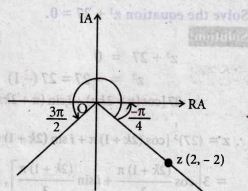
If z = 2−2i, find the rotation of z by θ radians in the counter clockwise direction about the origin when \(\theta =\frac { 3\pi }{ 2 } \).
1.
~(p V q) V (~p ∧ q) and ~p
| p | q | p V q | ~(p ∧ q) | ~p | ~p ∧ q | ~(p V q) V (~p ∧ q) |
| T | T | T | F | F | F | F |
| T | F | T | F | F | F | F |
| F | T | T | F | T | T | T |
| F | F | F | T | T | F | T |
The entries in column (5) and column (7) are identical.
∴ ~(p V q) V (~p ∧ q) and ~p are logically equivalent.
2.
Given M = \(\left\{ \left( \begin{matrix} x & x \\ x & x \end{matrix} \right) :x\in R-\{ 0\} \right\} \) and * be the matrix multipilication.
Let A \(=\left( \begin{matrix} x & x \\ x & x \end{matrix} \right) \) and B = \(\left( \begin{matrix} y & y \\ y & y \end{matrix} \right) \in M\)
Where x, y ∈R-{0}.
\(A*B=\left( \begin{matrix} x & x \\ x & x \end{matrix} \right) \left( \begin{matrix} y & y \\ y & y \end{matrix} \right) \)
\(\\ =\left( \begin{matrix} 2xy & 2xy \\ 2xy & 2xy \end{matrix} \right) \in M\)
[∵ 2xy ∈R-{0}]
∴ M is closed under *.
Commutative property:
we know A*B =\(\left( \begin{matrix} 2xy & 2xy \\ 2xy & 2xy \end{matrix} \right) ..(1)\)
Let x,y∈R-{0}
Now B + A \(=\left( \begin{matrix} y & y \\ y & y \end{matrix} \right) \left( \begin{matrix} x & x \\ x & x \end{matrix} \right) \)
\(=\left( \begin{matrix} xy+xy & xy+xy \\ xy+xy & xy+xy \end{matrix} \right) \)
\(=\left( \begin{matrix} 2xy & 2xy \\ 2xy & 2xy \end{matrix} \right) \\ \)
From (1) &(2), A*B = B*A
∴ *has commutative property on M
Associative property:
Let A = \(\left( \begin{matrix} x & x \\ x & x \end{matrix} \right) \)
B =\(\left( \begin{matrix} y & y \\ y & y \end{matrix} \right) \) and
C = \(\left( \begin{matrix} z & z \\ z & z \end{matrix} \right) \)
for x, y, z ∈R-{0}
\((A*B)*C=\left( \begin{matrix} 2xy & 2xy \\ 2xy & 2xy \end{matrix} \right) *\left( \begin{matrix} z & z \\ z & z \end{matrix} \right) \)
\(=\left( \begin{matrix} 2xyz+2xyz & 2xyz+2xyz \\ 2xyz+2xyz & 2xyz+2xyz \end{matrix} \right) \)
\(=\left( \begin{matrix} 4xyz & 4xyz \\ 4xyz & 4xyz \end{matrix} \right) ...(1)\)
Now\(A*(B*C)=A*\left( \begin{matrix} 2yz & 2yz \\ 2yz & 2yz \end{matrix} \right) \)
\(=\left( \begin{matrix} x & x \\ x & x \end{matrix} \right) *\left( \begin{matrix} 2yz & 2yz \\ 2yz & 2yz \end{matrix} \right) \)
\(=\left( \begin{matrix} 4xyz & 4xyz \\ 4xyz & 4xyz \end{matrix} \right) ...(2)\\ \)
From (1)&(2), (a*B)*C = A*B*C)
Since matrix multiplication is associative, this axiom holds good for M.
3.
It is known that Z5 = {[0], [1], [2], [3], [4]}. The table corresponding to addition modulo 5 is as follows: We take reminders {0,1,2,3,4} to represent the classes {[0], [1], [2], [3], [4]}.
| +5 | 0 | 1 | 2 | 3 | 4 |
| 0 | 0 | 1 | 2 | 3 | 4 |
| 1 | 1 | 2 | 3 | 4 | 0 |
| 2 | 2 | 3 | 4 | 0 | 1 |
| 3 | 3 | 4 | 0 | 1 | 2 |
| 4 | 4 | 0 | 1 | 2 | 3 |
(i) Since each box in the table is filled by exactly one element of Z5, the output a +5 b is unique and hence +5 is a binary operation.
(ii) The entries are symmetrically placed with respect to the main diagonal. So +5 has commutative property
(iii) The table cannot be used directly for the verification of the associative property. So it is to be verified as usual
For instance, (2+53)+5 4 = 0+5 4 = 4(mod 5)
and 2+5(3+54) = 2 +5 2 = 4(mod5)
Hence (2+53)+54 = 2+5(3+54)
Proceeding like this one can verify this for all possible triples and ultimately it can be shown that +5 is associative
(iv) The row headed by 0 and the column headed by 0 are identical. Hence the identity element is 0.
(v) The existence of inverse is guaranteed provided the identity 0 exists in each row and each column. From Table, it is clear that this property is true in this case. The method of finding the inverse of any one of the elements of Z5, say 2 is outlined below.
First find the position of the identity element 0 in the III row headed by 2. Move horizontally along the III row and after reaching 0, move vertically above 0 in the IV column, because 0 is in the III row and IV column. The element reached at the topmost position of IV column is 3. This element 3 is nothing but the inverse of 2, because, 2+5 5+ = 0 (mod5). In this way, the inverse of each and every element of Z5 can be obtained. Note that the inverse of 0 is 0, that of 1 is 4, that of 2 is 3, that of 3 is 2, and, that of 4 is 1.
4.
Since the given function is a probability density function

\(\int _{ -\infty }^{ \infty }{ f(x) } dx=1\)
That is \(\int _{ -\infty }^{ 1 }{ f(x) } dx+\int _{ 1 }^{ 4 }{ f(x) } dx+\int _{ 4 }^{ \infty }{ f(x) } dx=1\)
From the given information
\(\int _{ -\infty }^{ 1 }{ 0dx } +\int _{ 1 }^{ 4 }{ { Cx }^{ 2 }dx } +\int _{ 4 }^{ \infty }{ 0dx } =1\)
\(0+C\left[ \cfrac { { x }^{ 3 } }{ 3 } \right] _{ 1 }^{ 4 }+0=1\Rightarrow C\left[ \cfrac { 64-1 }{ 3 } \right] =1\Rightarrow 21C\Rightarrow C=\cfrac { 1 }{ 21 }\)
Therefore the probability density function is
\(\)\(f(x)=\left\{C x^2, \quad x>1\right.\)
Since f (x) is continuous, the probability that X is equal to any particular value is zero. Therefore when the random variable is continuous, either or both of the signs < by ≤ and > by ≥ can be interchanged. Thus
(i) P(1.5 < X < 3.5) = P(1.5 ≤ X< 3.5)= P(1.5 < X ≤3.5) = P(1.5 ≤X ≤ 3.5)
Therefore
\(P(1.5<X<3.5)=\int_{1.5}^{3.5} f(x) d x\)

\(\begin{aligned} & =\frac{1}{21}\left(\frac{x^3}{3}\right)=\frac{1}{21}\left(\frac{(3.5)^3-(1.5)^3}{3}\right) \\ & =\frac{79}{126} \end{aligned}\)
(ii) \(P(X \leq 2)=\int_{-\infty}^2 f(x) d x=\int_{-\infty}^1 f(x) d x+\int_1^2 f(x) d x\)
Therefore
\(\begin{aligned} & P(X \leq 2)=0+\frac{1}{21} \int_1^2 x^2 d x=\frac{1}{21}\left(\frac{x^3}{3}\right)_1^2 \\ & =\frac{1}{21}\left(\frac{2^3-1^3}{3}\right)=\frac{7}{63} \end{aligned}\)
(iii) P(3 < X )

\(\begin{aligned} & =\frac{1}{21} \int_3^4 x^2 d x+0=\frac{1}{21}\left(\frac{x^3}{3}\right)_3^4 \\ & =\frac{1}{21}\left(\frac{4^3-3^3}{3}\right)=\frac{37}{63} \end{aligned}\)
5.
Given
\(f(x)=\begin{cases} \begin{matrix} { Ke }^{ \frac { -x }{ 3 } } & \begin{matrix} for & x>0 \end{matrix} \end{matrix} \\ \begin{matrix} 0 & \begin{matrix} for & x\le 0 \end{matrix} \end{matrix} \end{cases}\)
(i) Since f(x) is a probability density function
\(\int _{ -\infty }^{ \infty }{ f(x) } dx=1\)
\(\Rightarrow \int _{ 0 }^{ \infty }{ K.{ e }^{ \frac { -x }{ 3 } } } dx=1\Rightarrow k\frac { \left[ { e }^{ \frac { -x }{ 3 } } \right] ^{ \infty } }{ -\frac { 1 }{ 3 } } \)
\(\Rightarrow -3k\left[ { e }^{ -\infty }-{ e }^{ 0 } \right] =1\) [∵ e∞ = 0, e0 = 1]
\(\Rightarrow 3k=1\Rightarrow k=\frac { 1 }{ 3 } \)
\(\therefore k=\cfrac { 1 }{ 3 } \)
(ii) The distribution function F(x) = \(\int _{ -\infty }^{ x }{ f(u)du } \)
Case 1: x < 0,
\(F(x)=\int _{ -\infty }^{ x }{ f(x)dx=0 } \)
Case 2: x > 0,
\(f(x)=\int _{ -\infty }^{ x }{ f(x)dx } \)
= \(\int _{ -\infty }^{ 0 }{ f(x)dx+\int _{ 0 }^{ x }{ f(x) } dx } \)
= \(0+k\int _{ 0 }^{ x }{ { e }^{ \frac { -x }{ 3 } } } dx\)
= \(\frac { 1 }{ 3 } \left[ \cfrac { { e }^{ \frac { -x }{ 3 } } }{ -\frac { 1 }{ 3 } } \right] =-\left[ { e }^{ -\frac { x }{ 3 } }-{ e }^{ o } \right] \)
= \(-[{ e }^{ -\frac { x }{ 3 } }-1]\)
= \(1-{ e }^{ -\frac { x }{ 3 } }\)
\(\therefore F(x)=\begin{cases} \begin{matrix} 0 & x\le 0 \end{matrix} \\ \begin{matrix} 1-{ e }^{ \frac { -x }{ 3 } } & x>0 \end{matrix} \end{cases}\)
(iii) p(X < 3)
= \(\int _{ 0 }^{ 3 }{ ke^{ -\frac { x }{ 3 } } } dx=\cfrac { 1 }{ 3 } \int _{ 0 }^{ 3 }{ { e }^{ -\frac { x }{ 3 } }dx } \)
= \(\cfrac { 1 }{ 3 } \left[ \frac { { e }^{ -\frac { x }{ 3 } } }{ \frac { -1 }{ 3 } } \right] \)
= -[e-1-e0] = -[e-1-1]
(iv) \(p(5\le X)=p(X\ge 5)=\int _{ 5 }^{ \infty }{ f(x)dx } \)
= \(\int _{ 5 }^{ \infty }{ ke^{ -\frac { x }{ 3 } } } dx=\cfrac { 1 }{ 3 } \cfrac { \left[ { e }^{ -\frac { x }{ 3 } } \right] _{ 5 }^{ \infty } }{ \frac { -1 }{ 3 } } \)
= \(-\left[ { e }^{ -\infty }-e^{ \frac { -3 }{ 5 } } \right] =\left[ 0-{ e }^{ \frac { -5 }{ 3 } } \right] \)
= \({ e }^{ \frac { -5 }{ 3 } }\)
(v) \(p(X\le 4)=\int _{ -\infty }^{ 4 }{ f(x)dx } \)
= \(\int _{ -\infty }^{ 0 }{ f(x)dx+\int _{ 0 }^{ 4 }{ f(x)dx } } \)
= \(0+\int _{ 0 }^{ 4 }{ { ke }^{ -\frac { x }{ 3 } }dx } =k\left[ \frac { { e }^{ -\frac { x }{ 3 } } }{ -\frac { 1 }{ 3 } } \right] _{ 0 }^{ 4 }\)
= \(\cfrac { 1 }{ 3 } \cfrac { \left[ { e }^{ -\frac { x }{ 3 } } \right] _{ 0 }^{ 4 } }{ -\frac { 1 }{ 3 } } =-\left[ { e }^{ \frac { -4 }{ 3 } }-{ e }^{ o } \right] \)
= \(-\left[ { e }^{ \frac { -4 }{ 3 } }-1 \right] =1-{ e }^{ \frac { -4 }{ 3 } }\)
6.
\((x+a)\frac { dy }{ dx } -2y={ (x+a) }^{ 4 }\)
\(\div (x+a)\)we get,
\(\frac { dy }{ dx } -\frac { 2 }{ x+a } y={ (x+a) }^{ 3 }\)
This is a linear differential equation
\(\therefore P=\frac { -2 }{ x+a } ;Q={ (x+a) }^{ 3 }\)
\(\int { pdx } =\int { \frac { -2 }{ x+a } } dx=-2log(x+a)\)
\(=log{ \left( \frac { 1 }{ x+a } \right) }^{ 2 }\)
\(\therefore I.F.={ e }^{ \int { pdx } }={ e }^{ log{ \left( \frac { 1 }{ x+a } \right) }^{ 2 } }=\frac { 1 }{ { (x+a) }^{ 2 } } \)
The solution is \(\Rightarrow { ye }^{ \int { pdx } }=\int { Q{ e }^{ \int { pdx } }dx+c } \)
\(\Rightarrow y\left( \frac { 1 }{ { (x+a) }^{ 2 } } \right) =\int { { (x+a) }^{ 3 }\frac { 1 }{ (x+a{ ) }^{ 2 } } dx+c } \)
\(\Rightarrow \frac { y }{ { (x+a) }^{ 2 } } =\int { (x+a)dx+c } \)
\(\Rightarrow \frac { y }{ { (x+a) }^{ 2 } } =\int { (x+a)dx+c } \)
\(\Rightarrow \frac { y }{ { (x+a) }^{ 2 } } =\frac { { (x+a) }^{ 2 } }{ 2 } +c\)
\(\Rightarrow \frac { y }{ { (x+a) }^{ 2 } } =\frac { { (x+a) }^{ 2 }+2c }{ 2 } \)
\(2y={ (x+a) }^{ 4 }{ +2c(x+a) }^{ 2 }\)
7.
Given p, q are the roots of lx2 + nx + n = 0
\(p+q=\frac { -b }{ a } =\frac { -n }{ l } ...(1)\)
\(pq=\frac { c }{ a } =\frac { n }{ l } ...(2)\)
L.H.S
\( \sqrt{\frac{p}{q}}+\sqrt{\frac{q}{p}}+\sqrt{\frac{n}{l}} =\frac{\sqrt{p}}{\sqrt{q}}+\frac{\sqrt{q}}{\sqrt{p}}+\frac{\sqrt{n}}{\sqrt{l}}=\frac{p+q}{\sqrt{p} \sqrt{q}}+\frac{\sqrt{n}}{\sqrt{l}} \)
\( =\frac{-\frac{n}{l}}{\sqrt{p q}}+\frac{\sqrt{n}}{\sqrt{l}}=\frac{-\frac{n}{l}}{\frac{\sqrt{n}}{\sqrt{l}}}+\frac{\sqrt{n}}{\sqrt{l}} \)
\(=\frac{-\frac{n}{l}+\frac{n}{l}}{\sqrt{\frac{n}{l}}}=0\) R.H.S
8.
(b)
\(-x +\frac{\pi}{2}\)
9.
(c)
-7
10.
(d)
2
11.
(c)
\(\left[ \frac { \pi }{ 4 } ,\frac { \pi }{ 2 } \right] \)
12.
(a)
\(\left[ \begin{matrix} 3 & -3 & 4 \\ 2 & -3 & 4 \\ 0 & -1 & 1 \end{matrix} \right] \)
13.
(d)
1
14.
(b)
\(\left[ \begin{matrix} -6 & 5 \\ -2 & -10 \end{matrix} \right] \)
15.
(b)
(AT)2
16.
(a)
\(\left[ \begin{matrix} 2 & -5 \\ -3 & 8 \end{matrix} \right] \)
17.
(c)
I3
18.
(d)
3, -9
19.
(b)
\(\frac { 3\pi }{ 4 } \)
20.
(a)
81
21.
(c)
10
22.
(b)
23.
(c)
0
24.
(b)
25.
(b)
26.
(a)
z
27.
(a)
1
28.
Let p be the probability that indicates the defective rate of an electronic device
n = 10
\(P=5\%=0.05 \)
q = 1 - p
n = 10, p = 0.05, X ~ B(n, p)
P(X = x) = nCx px qn-x, x = 0, 1,2, .., n
(i) Atleast 1 defective item
P(X ≥ 1) = 1 - P(X < 1)
= 1-P(X = 0)
= 1-10C0 (0.05)0 (0.95)10
P(X ≥1) = 1 - (0.95)10
(ii) Exactly two defective items
P(X = 2) =10C2(0.05)2 (0.95)8
29.
We have |2z-3-i| = 3
|2(x + iy)-3 - i| = 3
Squaring on both sides, we get
|(2x - 3) + (2y - 1)i|2 = 9
\(\Rightarrow\) (2x - 3)2 + (2y - 1)2 = 9
\(\Rightarrow\) 4x2 + 4y2 -12x - 4y + 1 = 0, the locus of z in Cartesian form
30.
Consider \(\frac { 19-7i }{ 9+i } =\frac { 19-7i }{ 9+i } \times \frac { 9-i }{ 9-i } \)
= \(\frac { 171-19i-63i+7i^{ 2 } }{ (9)^{ 2 }-{ i }^{ 2 } } =\frac { 171-82i-7 }{ 81+1 } \)
= \(\frac { 164-82i }{ 82 } =\frac { 82(2-i) }{ 82 } \) = 2- i
Also \(\frac { 20-5i }{ 7-6i } =\frac { 20-5i }{ 7-6i } \times \frac { 7+6i }{ 7+6i } \)
= \(\frac { 140+120i-35i-30^{ 2 } }{ { 7 }^{ 2 }-(6i)^{ 2 } } \)
\(=\frac{140+85 i+30}{49+36}=\frac{170+85 i}{85}=\frac{\not 85(2+i)}{\not 85}=2+i\)
∴ \(\left( \frac { 19-7i }{ 9+i } \right) ^{ 12 }+\left( \frac { 20-5i }{ 7-6i } \right) ^{ 12 }\) = (2-i)12+(2+i)12
Let z = (2-i)12+(2+i)12
∴ \(\overline { z } \) = \(\overline { (2-i)^{ 12 }+(2+i)^{ 12 } } =\overline { (2-i)^{ 12 } } +\overline { (2+i)^{ 12 } } \)
[∵ \(\overline { { z }_{ 1 }+{ z }_{ 2 } } =\overline { { z }_{ 1 } } +\overline { { z }_{ 2 } } \)]
= (2 + i)12+(2 - i)12= z
∴ \(\overline { z } \) = z ⇒ z is purely real
∴ \(\left( \frac { 19-7i }{ 9+i } \right) ^{ 12 }+\left( \frac { 20-5i }{ 7-6i } \right) ^{ 12 }\) is real.
31.
\(x\frac { dy }{ dx } =2y\)
32.
order 2 ; degree 1
33.
2
34.
\(\frac { 1 }{ loga } -\frac { 1 }{ logb } \)
35.
Given \(A=\left( \begin{matrix} 1 & 0 \\ 0 & 1 \\ 1 & 0 \end{matrix}\begin{matrix} 1 & 0 \\ 0 & 1 \\ 0 & 1 \end{matrix} \right) ,B=\left( \begin{matrix} 0 & 1 \\ 1 & 0 \\ 1 & 0 \end{matrix}\begin{matrix} 0 & 1 \\ 1 & 0 \\ 0 & 1 \end{matrix} \right) and\quad C=\left( \begin{matrix} 1 & 1 \\ 0 & 1 \\ 1 & 1 \end{matrix}\begin{matrix} 0 & 1 \\ 1 & 0 \\ 1 & 1 \end{matrix} \right) \)
\(=\left( \begin{matrix} 1 & 0 \\ 0 & 1 \\ 1 & 0 \end{matrix}\begin{matrix} 1 & 0 \\ 0 & 1 \\ 0 & 1 \end{matrix} \right) \vee \left( \begin{matrix} 0 & 1 \\ 1 & 0 \\ 1 & 0 \end{matrix}\begin{matrix} 0 & 1 \\ 1 & 0 \\ 0 & 1 \end{matrix} \right) \)
\(=\left( \begin{matrix} 1\wedge 0 & 0\wedge 1 \\ 0\wedge 1 & 1\wedge 0 \\ 1\wedge 1 & 0\wedge 0 \end{matrix}\begin{matrix} 1\wedge 0 & 0\wedge 1 \\ 0\wedge 1 & 1\wedge 0 \\ 0\wedge 0 & 1\wedge 1 \end{matrix} \right) \)
\(=\left( \begin{matrix} 0 & 0 \\ 0 & 0 \\ 1 & 0 \end{matrix}\begin{matrix} 0 & 0 \\ 0 & 0 \\ 0 & 1 \end{matrix} \right) \) [∵ a៱b=max(a,b)]
36.
(( p ∧ q) ∨ (¬r ∨¬s)) ∧ (¬ t ∧ v)) contains 6 variables p, q, r, s, t, and v. Hence the corresponding truth table will contain 26 = 64 rows.
37.
p ∨ ¬ t ( p ∨ ¬s) contains 3 variables p, s, and t. Hence the corresponding truth table will contain 23 = 8 rows
38.
\(\theta =\frac { 3\pi }{ 2 } \)
When θ = \(\frac { 3\pi }{ 2 } \)
Rotation of z is \(ze^{ i\theta }=ze^{ i\frac { 3\pi }{ 2 } }\)
= \(2\sqrt { 2 } e^{ -\frac { \pi }{ 4 } }.e^{ i\frac { 3\pi }{ 2 } }=2\sqrt { 2 } e^{ i\left( i\frac { \pi }{ 2 } -\frac { \pi }{ 4 } \right) }\)
= \(2\sqrt { 2 } e^{ i5^{ \frac { \pi }{ 4 } } }\)

12th Standard Syllabus & Materials
12th Standard
TN 12th Computer Applications களப்பெயர் முறைமை (DNS) Sample Question Papers Study Material - QB365 Set A
NEW12th Standard
TN 12th Computer Applications வலையமைப்பு எடுத்துக்காட்டுகள் மற்றும் நெறிமுறைகள் Sample Question Papers Study Material - QB365 Set A
NEW12th Standard
TN 12th Computer Applications கணினி வலையமைப்பு ஓர் அறிமுகம் Sample Question Papers Study Material - QB365 Set A
NEW12th Standard
TN 12th Computer Applications PHP-உடன் MySQL-ஐ இணைத்தல் Sample Question Papers Study Material - QB365 Set A



Tamilnadu Stateboard 12th Standard Subjects
Maths

Chemistry

Physics

Biology

Computer Science

Business Maths and Statistics

Economics

Commerce

Accountancy

History

Computer Applications
Biology
Computer Technology
Computer Applications
Computer Science
Business Maths and Statistics
Commerce
Economics
Maths
Chemistry
Physics
Computer Technology
History
Accountancy

Tamil

English

French
Tamilnadu Stateboard Standards

