
 100% FREE ACCESS
12th Standard Syllabus & Materials
12th Standard
TN 12th Computer Applications மின்னணு தரவு பரிமாற்றம் Sample Question Papers Study Material - QB365 Set A
NEW12th Standard
TN 12th Computer Applications மின் - வணிக பாதுகாப்பு அமைப்புகள் Sample Question Papers Study Material - QB365 Set A
NEW12th Standard
TN 12th Computer Applications மின்னணு செலுத்தல் முறைகள் Sample Question Papers Study Material - QB365 Set A
NEW12th Standard
TN 12th Computer Applications மின் - வணிகம் Sample Question Papers Study Material - QB365 Set A
NEW12th Standard
TN 12th Computer Applications திறந்த மூல கருத்துருக்கள் Sample Question Papers Study Material - QB365 Set A
NEW12th Standard
TN 12th Computer Applications வலையமைப்பு வடமிடல் Sample Question Papers Study Material - QB365 Set A

Published on: 02/02/2021
12th Standard Maths English Medium Reduced Syllabus Model Question paper with answer key - 2021 Part - 2
Download Tamil Nadu 12th Standard Maths question papers, model tests, one-mark questions, important questions, and public exam papers in PDF format. Free study materials and answer keys for TN State Board students.
Questions + Answers key
Take MCQ Maths Test1.
It is given that the rate at which some bacteria multiply is proportional to the instantaneous number present. If the original number of bacteria doubles in two hours, in how many hours will it be five times.
2.
Solve : \(\frac { dy }{ dx } =-\frac { x+ycos }{ 1+sinx } \) .Also find the domain of the function.
3.
Solve : \(\frac { dy }{ dx } =\left( { sin }^{ 2 }x{ cos }^{ 2 }x+{ xe }^{ x } \right) dx\)
4.
Solve \(\left( x+2 \right) \frac { dy }{ dx } =x2+4x-9\) .Also find the domain of the function.
5.
Find the radius and centre of the circle \(z\bar { z } \)-(2+3i)z-(2-3i)\(\bar { z } \)+9 = 0 where z is a complex number.
6.
Find all the roots \((2-2i)^{ \frac { 1 }{ 3 } }\) and also find the product of its roots.
7.
If 1, ω, ω2 are the cube roots of unity then show that (1+5ω2+ω4) (1+5ω+ω2) (5+ω+ω5) = 64
8.
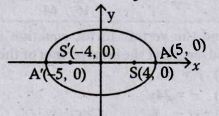
Identify the type of conic and find centre, foci, vertices, and directrices of each of the following:
\(\frac { { x }^{ 2 } }{ 25 } +\frac { { y }^{ 2 } }{ 9 } =1\)
9.
Let z1, z2 and z3 be complex numbers such that \(\left| { z }_{ 1 } \right\| =\left| { z }_{ 2 } \right| =\left| { z }_{ 3 } \right| =r>0\) and z1+ z2+ z3 \(\neq \) 0 prove that \(\left| \frac { { z }_{ 1 }{ z }_{ 2 }+{ z }_{ 2 }{ z }_{ 3 }+{ z }_{ 3 }{ z }_{ 1 } }{ { z }_{ 1 }+{ z }_{ 2 }+{ z }_{ 3 } } \right| \) = r
10.
Fill in the following table so that the binary operation ∗ on A = {a, b, c} is commutative.
| * | a | b | c |
| a | b | ||
| b | c | b | a |
| c | a | c |
11.
Let p: Jupiter is a planet and q: India is an island be any two simple statements. Give verbal sentence describing each of the following statements.
(i) ¬p
(ii) p ∧ ¬q
(iii) ¬p ∨ q
(iv) p➝ ¬q
(v) p↔q
12.
Show that y = e−x + mx + n is a solution of the differential equation ex \(\left( \frac { { d }^{ 2 }y }{ { dx }^{ 2 } } \right) \) -1 = 0
13.
For each of the following differential equations, determine its order, degree (if exists)
\(x={ e }^{ xy\left( \frac { dy }{ dx } \right) }\)
14.
For any 2 \(\times\) 2 matrix, if A (adj A) =\(\left[ \begin{matrix} 10 & 0 \\ 0 & 10 \end{matrix} \right] \) then find |A|.
15.
Find the modulus and principal argument of the following complex numbers.
\(\sqrt { 3 } \)-i
16.
Simplify the following
\(\sum _{ n=1 }^{ 12 }{ { i }^{ n } } \)
17.
Find the square root of 6−8i .
18.
Which one of the following is a binary operation on N?
Subtraction
Multiplication
Division
All the above
19.
A pair of dice numbered 1, 2, 3, 4, 5, 6 of a six-sided die and 1, 2, 3, 4 of a four-sided die is rolled and the sum is determined. Let the random variable X denote this sum. Then the number of elements in the inverse image of 7 is
1
2
3
4
20.
The integrating factor of the differential equation \(\frac{d y}{d x}+P(x) y=Q(x)\) is x, then P(x)
x
\(\frac { { x }^{ 2 } }{ 2 } \)
\(\frac{1}{x}\)
\(\frac{1}{x^2}\)
21.
The conjugate of \(\frac { 1+2i }{ 1-(1-i)^{ 2 } } \) is _______
\(\frac { 1+2i }{ 1-(1-i)^{ 2 } } \)
\(\frac { 5 }{ 1-(1-i)^{ 2 } } \)
\(\frac { 1-2i }{ 1+(1+i)^{ 2 } } \)
\(\frac { 1+2i }{ 1+(1-i)^{ 2 } } \)
22.
If a = cos α + i sin α, b = -cos β + i sin β then \(\left( ab-\frac { 1 }{ ab } \right) \) is _________
-2i sin(α - β)
2i sin(α - β)
2 cos(α - β)
-2 cos(α - β)
23.
\(\frac { 1+e^{ -i\theta } }{ 1+{ e }^{ i\theta } } \) =__________
cosθ + i sinθ
cosθ - i sinθ
sinθ - i cosθ
sinθ + icosθ
24.
If z = a + ib lies in quadrant then \(\frac { \bar { z } }{ z } \) also lies in the III quadrant if _________
a > b > 0
a < b < 0
b < a < 0
b > a > 0
25.
If z = 1-cos θ + i sin θ, then |z| = _____________
2 sin\(\frac { 1 }{ 3 } \)
2 cos\(\frac { \theta }{ 2 } \)
2|sin\(\frac { \theta }{ 2 } \)|
2|cos\(\frac { \theta }{ 2 } \)|
26.
If z = \(\frac { 1 }{ (2+3i)^{ 2 } } \) then |z| = ____________
\(\frac { 1 }{ 13 } \)
\(\frac { 1 }{ 5} \)
\(\frac { 1 }{ 12 } \)
none of these
27.
The line y = mx +1 is a tangent to the parabola y2 = 4x if m = ______________
1
2
3
4
28.
If the foci of the ellipse \(\frac { { x }^{ 2 } }{ 16 } +\frac { { y }^{ 2 } }{ { b }^{ 2 } } \) = 1 and the hyperbola \(\frac { { x }^{ 2 } }{ 144 } -\frac { { y }^{ 2 } }{ 81 } =\frac { 1 }{ 25 } \) coincide then b2 is __________
1
5
7
9
29.
\({ tan }^{ -1 }\left( tan\cfrac { 9\pi }{ 8 } \right) \)
\(\cfrac { 9\pi }{ 8 } \)
\(\cfrac { -9\pi }{ 8 } \)
\(\cfrac { \pi }{ 8 } \)
\(\cfrac { -\pi }{ 8 } \)
30.
If \(\theta ={ sin }^{ -1 }\left( sin(-{ 60 }^{ 0 }) \right) \) then one of the possible values of \(\theta\) is _________
\(\frac { \pi }{ 3 } \)
\(\frac { \pi }{ 2 } \)
\(\frac { 2\pi }{ 3 } \)
\(\frac { -2\pi }{ 3 } \)
31.
32.
Equation of tangent at (-4, -4) on x2 = -4y is _____________
2x - y + 4 = 0
2x + y - 4 = 0
2x - y - 12 = 0
2x + y + 4 = 0
33.
In a \(\Delta ABC\) if C is a right angle, then \({ tan }^{ -1 }\left( \frac { a }{ b+c } \right) +{ tan }^{ -1 }\left( \frac { b }{ c+a } \right) =\) ________
\(\frac { \pi }{ 3 } \)
\(\frac { \pi }{ 4 } \)
\(\frac { 5\pi }{ 2 } \)
\(\frac { \pi }{ 6 } \)
34.
If \(\alpha ={ tan }^{ -1 }\left( \frac { \sqrt { 3 } }{ 2y-x } \right) ,\beta ={ tan }^{ -1 }\left( \frac { 2x-y }{ \sqrt { 3y } } \right) \) then \(\alpha -\beta \) __________
\(\frac { \pi }{ 6 } \)
\(\frac { \pi }{ 3 } \)
\(\frac { \pi }{ 2 } \)
\(\frac { -\pi }{ 3 } \)
35.
In a homogeneous system if \(\rho\) (A) =\(\rho\) ([A|0]) < the number of unknouns then the system has ________
trivial solution
only non - trivial solution
no solution
trivial solution and infinitely many non - trivial solutions
36.
Cramer's rule is applicable only when ______
Δ ≠ 0
Δ = 0
Δ =0, Δx =0
Δx = Δy = Δz =0
37.
If A is a non-singular matrix such that A-1 = \(\left[ \begin{matrix} 5 & 3 \\ -2 & -1 \end{matrix} \right] \), then (AT)−1 =
\(\left[ \begin{matrix} -5 & 3 \\ 2 & 1 \end{matrix} \right] \)
\(\left[ \begin{matrix} 5 & 3 \\ -2 & -1 \end{matrix} \right] \)
\(\left[ \begin{matrix} -1 & -3 \\ 2 & 5 \end{matrix} \right] \)
\(\left[ \begin{matrix} 5 & -2 \\ 3 & -1 \end{matrix} \right] \)
38.
If the function f(x) = sin-1(x2 - 3), then x belongs to
[-1, 1]
[\(\sqrt2\), 2]
\(\\ \\ \\ \left[ -2,-\sqrt { 2 } \right] \cup \left[ \sqrt { 2 } ,2 \right] \)
\([-2,-\sqrt{2}]\)
39.
\(\sin ^{-1}(\cos x)=\frac{\pi}{2}-x\) is valid for
\(-\pi \le x\le 0\)
\(0 \le x\le \pi\)
\(-\frac { \pi }{ 2 } \le x\le \frac { \pi }{ 2 } \)
\(-\frac { \pi }{ 4 } \le x\le \frac { 3\pi }{ 4 } \)
40.
If \(\sin ^{-1} x+\sin ^{-1} y=\frac{2 \pi}{3}\); then cos-1 x + cos-1 y is equal to
\(\frac{2\pi}{3}\)
\(\frac{\pi}{3}\)
\(\frac{\pi}{6}\)
\(\pi\)
41.
42.
The value of \(\sum_{n=1}^{13}\left(i^{n}+i^{n-1}\right)\) is
1+ i
i
1
0
43.
Find the area bounded by x=0,x=6+5y-y2
44.
If w=xy+z and x=cot, y=sint, z=t then find \(\frac { dw }{ dt } \)
45.
Evaluate the following limits, if necessary use L’Hopitals rule
(i) \(\underset { x\rightarrow { 0 }^{ + } }{ lim } { x }^{ sinx }\)
(ii) \(\underset { x\rightarrow 0 }{ lim } \cfrac { cotx }{ cot2x } \)
(iii) \(\underset { x\rightarrow \frac { { \pi }^{ - } }{ 2 } }{ lim } \left( tanx \right) ^{ cosx }\)
46.
Let G = {1, i, -1, -i} under the binary operation multiplication. Find the inverse of all the elements.
47.
The time T, taken for a complete oscillation of a single pendulum with length l, is given by the equation T = 2ㅠ\(\sqrt { \frac { 1 }{ g } } \), where g is a constant. Find the approximate percentage error in the calculated value of T corresponding to an error of 2 percent in the value of l.
48.
Suppose X is the number of tails occurred when three fair coins are tossed once simultaneously. Find the values of the random variable X and number of points in its reverse images.
49.
Show that the lines \(\frac { x-1 }{ 3 } =\frac { y+1 }{ 2 } =\frac { z-1 }{ 5 } \) and \(\frac { x+2 }{ 4 } =\frac { y-1 }{ 3 } =\frac { z+1 }{ -2 } \) do not intersect
50.
Simplify: (1+i)18
51.
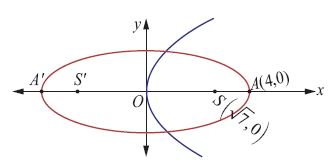
An equation of the elliptical part of an optical lens system is \(\frac { { x }^{ 2 } }{ 16 } +\frac { { y }^{ 2 } }{ 9 } \) = 1. The parabolic part of the system has a focus in common with the right focus of the ellipse. The vertex of the parabola is at the origin and the parabola opens to the right. Determine the equation of the parabola.
52.
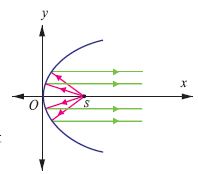
A search light has a parabolic reflector (has a cross-section that forms a ‘bowl’). The parabolic bowl is 40 cm wide from rim to rim and 30 cm deep. The bulb is located at the focus.
(1) What is the equation of the parabola used for reflector?
(2) How far from the vertex is the bulb to be placed so that the maximum distance covered?
53.
If \(2cos\alpha=x+\frac { 1 }{ x } \) and \(2cos\ \beta =y+\frac { 1 }{ y } \), show that \({ x }^{ m }{ y }^{ n }+\frac { 1 }{ { x }^{ m }{ y }^{ n } } =2cos(m\alpha +n\beta )\)
54.
Show that \(\left( \frac { \sqrt { 3 } }{ 2 } +\frac { i }{ 2 } \right) ^{ 5 }+\left( \frac { \sqrt { 3 } }{ 2 } -\frac { i }{ 2 } \right) ^{ 5 }=-\sqrt { 3 } \)
1.
\(\frac { 2log5 }{ lof2 } hours\)
2.
\(y=\frac { 2x-{ x }^{ 2 } }{ 2(1+sinx) } ,x\neq n\pi +(-1)^{ n }\frac { \pi }{ 2 } ,\)∀ n ε Z
3.
\(y=-\frac { 1 }{ 2 } { cos }^{ 2 }x+\frac { { cos }^{ 5 }x }{ 5 } +{ xe }^{ x }-{ e }^{ x }+c\)
4.
\(y=\frac { { x }^{ 2 } }{ 2 } +2x-13log|x+2|+c,x\varepsilon R-\{ 2\} \)
5.
Let z = x+iy be the given complex number
∴ \(\bar { z } \) = x-iy
z\(\bar { z } \) = (x+iy) (x-iy) = x2+y2
∴ z\(\bar { z } \) -(2+3i)z -(2-3i)\(\bar { z } \)+9
⇒ x2+y2-(2+3i)(x+iy)-(2-3i)(x-iy)+9 = 0
⇒ x2+y2-[2x+2iy+3ix+i2y] - [2x-2iy-3ix+3i2y]+9 = 0
\(\Rightarrow x^{2}+y^{2}-2 x -\not 2 i y-\not 3i x +3 y-2 x+\not 2 i y+\not 3 i x+3 y+9=0 \)
⇒ x2+y2-4x+6y+9 = 0
Here 2u = -4 ⇒ u = -2
2v = 6 ⇒ v = 3 and d = 9
∴ Centre of the circle is (-u, -v) = (2, -3)
Radius =\(\sqrt { { u }^{ 2 }+{ v }^{ 2 }-d } =\sqrt { 4+9-9 } \)
=\(\sqrt { 4 } \) = 2 units
Hence, the centre of the circle is (2, -3) and radius is 2 units.
6.
Let 2-2i = r(cosθ + isinθ)
r =\(\sqrt { { 2 }^{ 2 }+(-2)^{ 2 } } =\sqrt { 4+4 } =\sqrt { 8 } =2\sqrt { 2 } \)
The principal value α =tan-1\(\left| \frac { y }{ x } \right| =tan^{ -1 }\left| \frac { -z }{ z } \right| |\)
= tan-1(1) = \(\frac { \pi }{ 4 } \)
Since the complex number 2 - 2i lies in the quadrant
θ = -α = -\(\frac { \pi }{ 4 } \)
∴ 2-2i = \(2\sqrt { 2 } \left[ cos\left( -\frac { \pi }{ 4 } \right) +isin\left( \frac { \pi }{ 4 } \right) \right] ^{ \frac { 1 }{ 3 } }\)
∴ \((2\sqrt { 2 } )^{ \frac { 1 }{ 3 } }\left[ cos\left( -\frac { \pi }{ 4 } \right) +isin\left( \frac { \pi }{ 4 } \right) \right] ^{ \frac { 1 }{ 3 } }\)
= \(8^{ \frac { 1 }{ 6 } }\left[ cos\frac { 1 }{ 3 } \left( 2k\pi -\frac { \pi }{ 4 } \right) +isin\frac { 1 }{ 3 } \left( 2k\pi -\frac { \pi }{ 4 } \right) \right] \)
k = 0, 1, 2
The roots are
∴ When k = 0, \(8^{ \frac { 1 }{ 6 } }cis\left( -\frac { \pi }{ 12 } \right) \)
when k = 1, \(8^{ \frac { 1 }{ 6 } }cis\left( \frac { 7\pi }{ 12 } \right) \)
when k = 2, \(8^{ \frac { 1 }{ 6 } }cis\left( \frac { 15\pi }{ 12 } \right) \)
∴ The product of the root
= \(8^{ \frac { 1 }{ 6 } }cis\left( -\frac { \pi }{ 12 } +\frac { 7\pi }{ 12 } +\frac { 15\pi }{ 12 } \right) \)
= \(8^{ \frac { 1 }{ 6 } }cis\left( \frac { 21\pi }{ 12 } \right) =8^{ \frac { 1 }{ 6 } }cis\left( \frac { 7\pi }{ 12 } \right) \)
= \(8^{ \frac { 1 }{ 6 } }cis\left( 2\pi -\frac { \pi }{ 4 } \right) =8^{ \frac { 1 }{ 6 } }cis\left( -\frac { \pi }{ 4 } \right) \)
= \(8^{ \frac { 1 }{ 6 } }\left[ cos\left( -\frac { \pi }{ 4 } \right) +isin\left( -\frac { \pi }{ 4 } \right) \right] \)
= \(8^{ \frac { 1 }{ 6 } }\left[ cos\left( \frac { \pi }{ 4 } \right) +isin\left( \frac { \pi }{ 4 } \right) \right] \)
= \(8^{ \frac { 1 }{ 6 } }\left[ \frac { 1 }{ \sqrt { 2 } } -\frac { i }{ \sqrt { 2 } } \right] =2^{ 3\times \frac { 1 }{ 6 } }\left( \frac { 1-i }{ \sqrt { 2 } } \right) =2^{ 1/2 }\left( \frac { 1-i }{ \sqrt { 2 } } \right) \)
= 1-i
7.
(1+5ω2+ω4)(1+5ω+ω2)(5+ω+ω2)
= (1+5ω2+ω)(1+5ω+ω2)(5+ω+ω2)
[∴ ω4 = ω3.ω1= ω]
= (1+ω+5ω2)(1+ω2+5ω)(5+ω+ω2)
= (-ω2+5ω2)(-ω+5ω)(5-1)
= (4ω2)(4ω)(4) = 64 ω3
= 64(1) = 64 [∴ ω3 = 1]
RHS
Hence proved
8.
\(\frac { { x }^{ 2 } }{ 25 } +\frac { { y }^{ 2 } }{ 9 } =1\)
This is an equation of the ellipse.
a2 = 25 and b2 = 9 and c2 = a2 - b2
⇒ c2 = 25 - 9 = 16 ⇒ c = 4
(a) Center is (0, 0) ⇒ h = 0, k = 0
(b) foci are (h - c, k), (h + c, k)
⇒ (0 - 4, 0), (0 + 4, 0)
⇒ (-4, 0) and (4, 0)
(c) Vertices are (h - a, k) and (h + a, k)
⇒ (0 - 5, 0) and (0 + 5, 0)
⇒ (-5, 0) and (5, 0)
(d) Directrices are x = \(\pm \frac { a }{ e } \)
⇒ x = \(\pm \frac { 5 }{ e } \)
\(e=\sqrt { 1-\frac { { b }^{ 2 } }{ { a }^{ 2 } } } =\sqrt { 1-\frac { 9 }{ 25 } } =\sqrt { \frac { 16 }{ 25 } } =\frac { 4 }{ 5 } \)
∴ Directrice are x = \(\pm \frac { 5 }{ \frac { 4 }{ 5 } } \Rightarrow x=\pm \frac { 25 }{ 4 } \)
9.
Given that \(\left| { z }_{ 1 } \right| =\left| { z }_{ 2 } \right| =\left| { z }_{ 3 } \right| =r\Rightarrow { z }_{ 1 }\bar { { z }_{ 1 } } ={ z }_{ 2 }\bar { { z }_{ 2 } } ={ r }^{ 2 }\)
\(\Rightarrow { z }_{ 1 }=\frac { { r }^{ 2 } }{ \bar { { z }_{ 1 } } } ,{ z }_{ 2 }=\frac { { r }^{ 2 } }{ \bar { { z }_{ 2 } } } ,{ z }_{ 3 }=\frac { { r }^{ 2 } }{ { \bar { z } }_{ 3 } } \)
Therefore \({ z }_{ 1 }+{ z }_{ 2 }+{ z }_{ 3 }=\frac { { r }^{ 2 } }{ { \bar { z } }_{ 1 } } +\frac { { r }^{ 2 } }{ \bar { { z }_{ 2 } } } +\frac { { r }^{ 2} }{ \bar { { z }_{ 3 } } } \)
= \({ r }^{ 2 }\left( \frac { \bar { { z }_{ 2 } } \bar { { z }_{ 3 } } +\bar { { z }_{ 1 } } \bar { { z }_{ 3 } } +\bar { { z }_{ 1 } } { \overline { z } }_{ 2 } }{ \overline { { z }_{ 1 } } \bar { { z }_{ 2 } } \bar { { z }_{ 3 } } } \right) \)
\(\left| { z }_{ 1 }+{ z }_{ 2 }+{ z }_{ 3 } \right| =\left| { r }^{ 2 } \right| \left| \frac { \overline { { z }_{ 2}{ z }_{ 3 }+{ z }_{ 1 }{ z }_{ 3 }+{ z }_{ 1 }{ z }_{ 2 } } }{ \overline { { z }_{ 1 }{ z }_{ 2 }{ z }_{ 3 } } } \right| \) \(\left(\because \bar{z}_{1}+\bar{z}_{2}=\overline{z_{1}+z_{2}}\right)\)
= \({ r }^{ 2 }\frac { \left| { z }_{ 2 }{ z }_{ 3 }+{ z }_{ 1 }{ z }_{ 3 }+{ z }_{ 1 }{ z }_{ 2 } \right| }{ \left| { z }_{ 1 } \right| \left| { z }_{ 2 } \right| \left| { z }_{ 3 } \right| } \) \(\left( \because |z|=|\bar { z } |and\ \left| { z }_{ 1 }{ z }_{ 2 }{ z }_{ 3 } \right| =\left| { z }_{ 1 } \right| \left| { z }_{ 2 } \right| \left| { z }_{ 3 } \right| \right) \)
= \(\left| { z }_{ 1 }+{ z }_{ 2 }+{ z }_{ 3 } \right| ={ r }^{ 2 }\frac { \left| { z }_{ 2 }{ z }_{ 3 }+{ z }_{ 1 }{ z }_{ 3 }+{ z }_{ 1 }{ z }_{ 2 } \right| }{ { r }^{ 3 } } =\frac { \left| { z }_{ 2 }{ z }_{ 3 }+{ z }_{ 1 }{ z }_{ 3 }+{ z }_{ 1 }{ z }_{ 2 } \right| }{ r } \)
\(\frac { \left| { z }_{ 2 }{ z }_{ 3 }+{ z }_{ 1 }{ z }_{ 3 }+{ z }_{ 1 }{ z }_{ 2 } \right| }{ \left| { z }_{ 1 }+{ z }_{ 2 }+{ z }_{ 3 } \right| } \) = r (given that \(z_{1}+z_{2}+z_{3} \neq 0\))
Thus,\(\left| \frac { { z }_{ 2 }{ z }_{ 3 }+{ z }_{ 1 }{ z }_{ 3 }+{ z }_{ 1 }{ z }_{ 2 } }{ { z }_{ 1 }+{ z }_{ 2 }+{ z }_{ 3 } } \right| \) = r
10.
Given * on A is commutative
Given b * a = c ⇒ a * b = c
Given c * a = a ⇒ a * c = a
Given b * c = a ⇒ c * b = a
Hence
| * | a | b | c |
| a | b | c | a |
| b | c | b | a |
| c | a | a | c |
11.
Given p : Jupiter is a planet and
q : India is an island.
(i) ¬p : Jupiter is not a planet.
(ii) p ∧ ¬q : Jupiter is a planet and India is not an island.
(iii) ¬p ∨ q : Jupiter is not a planet or India is an island.
(iv) p➝ ¬q : If Jupiter is a planet then India is not an island.
(v) p↔q : Jupiter is a planet if and only if India is an island.
12.
Given y = e−x + mx + n .... (1)
Derentiating cquation (1) wr.t 'x', we get
\(\frac { dx }{ dx } =-e^{ -x }(-1)+m\)
\(\frac { d^{ 2 }y }{ d{ x }^{ 2 } } =-e^{ -x }+m\)
Again differentiating, we get
\(\Rightarrow \frac { d^{ 2 }y }{ d{ x }^{ 2 } } ={ e^{ x } }+0\)
\(\Rightarrow \left( \frac { d^{ 2 }y }{ d{ x }^{ 2 } } \right) =e^x\)
Substituting the value of \(\frac{d^2y}{dx^2}\) in the given differential equation, we get
\(\Rightarrow e^{ x }\left( \frac { d^{ 2 }y }{ d{ x }^{ 2 } } \right) -1=e^x(e^x)-1\\= e^{x-x}-1\\
e^0-1= 1-1=0\)
Thus the solution of the given differential equation ex \(\left( \frac { { d }^{ 2 }y }{ { dx }^{ 2 } } \right) \) -1 = 0
13.
\(x={ e }^{ xy\left( \frac { dy }{ dx } \right) }\)
Taking log on both sides, log x = xy \(\frac{dy}{dx}\)
In this equation, the highest-order derivative is \(\frac{dy}{dx}\) so its power is 1.
The highest derivative is 1.
∴ its Order = 1, Degree = 1
14.
Given A (adj A) =\(\left[ \begin{matrix} 10 & 0 \\ 0 & 10 \end{matrix} \right] =10\left[ \begin{matrix} 1 & 0 \\ 0 & 1 \end{matrix} \right] \)...(1)
We know A (adj A) = (adj A) A = |A|. I2 ...(2)
Comparing (1) and (2), we get |A| = 10
15.
\(\sqrt { 3 } -i\)
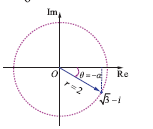
r = 2 and \(-\alpha =\frac { \pi }{ 6 } \)
Since the complex number lies in the fourth quadrant, has the principal value
\(\theta =-\alpha =-\frac { \pi }{ 6 } \)
Therefore, the modulus and principal argument of
\(-\sqrt { 3 } -i\) are 2 and \(\frac { \pi }{ 6 } \)
16.
\(\overset { 12 }{ \underset { n-1 }{ \Sigma } } \)in
\(\overset { 12 }{ \underset { n-1 }{ \Sigma } } \)in = (i1+i2+i3+i4)+(i5+i6+i7+i8)+(i9+i10+i11+i12)
= (i-1-i+1)+(i4+1+i4+2+i4+3+(i4)2+(i8+1+i8+2+i8+3+(i4)3)
= 0+(i+i2+i3+i4)+(i1+i2+i3+i4)
[∴ i2 = -1, i3 = -i, i4 = 1]
= 0 +(i-1-i+1)+(i-1-i+1)
= 0+0+0 = 0
17.
We compute \(\left| 6-8i \right| =\sqrt { { 6 }^{ 2 }+\left( -8 \right) ^{ 2 } } =10\)
and applying the formula for square root, we get
\(\sqrt { 6-8i } =\pm \left( \sqrt { \frac { 10+6 }{ 2 } } -i\sqrt { \frac { 10-6 }{ 2 } } \right) \) (\(\therefore\) b is negative\( \frac{b}{|b|}=-1 \))
= \(\pm \left( \sqrt { 8 } +i\sqrt { 2 } \right) \)
= \(\pm \left( 2\sqrt { 2 } -i\sqrt { 2 } \right) \)
18.
(b)
Multiplication
19.
(d)
4
20.
(c)
\(\frac{1}{x}\)
21.
(b)
\(\frac { 5 }{ 1-(1-i)^{ 2 } } \)
22.
(a)
-2i sin(α - β)
23.
(b)
cosθ - i sinθ
24.
(c)
b < a < 0
25.
(c)
2|sin\(\frac { \theta }{ 2 } \)|
26.
(a)
\(\frac { 1 }{ 13 } \)
27.
(a)
1
28.
(c)
7
29.
(c)
\(\cfrac { \pi }{ 8 } \)
30.
(a)
\(\frac { \pi }{ 3 } \)
31.
(b)
32.
(a)
2x - y + 4 = 0
33.
(b)
\(\frac { \pi }{ 4 } \)
34.
(a)
\(\frac { \pi }{ 6 } \)
35.
(d)
trivial solution and infinitely many non - trivial solutions
36.
(a)
Δ ≠ 0
37.
(d)
\(\left[ \begin{matrix} 5 & -2 \\ 3 & -1 \end{matrix} \right] \)
38.
(c)
\(\\ \\ \\ \left[ -2,-\sqrt { 2 } \right] \cup \left[ \sqrt { 2 } ,2 \right] \)
39.
(b)
\(0 \le x\le \pi\)
40.
(b)
\(\frac{\pi}{3}\)
41.
(b)
42.
(a)
1+ i
43.
\(\frac { 343 }{ 6 } \)
44.
2
45.
(i) 1
(ii) 2
(iii) 1
46.
Clearly 1 is the identity element of (G1)
Inverse of 1 is 1 [∴ (1)(1) = 1]
Inverse of i is -i [∴ (i) (-i) = -i2 = 1]
Inverse of -1 is -1 [∴ (-1)(-1) = 1]
Inverse of is i [∴ (-i)(i) = -i2 = 1]
47.
Given absolute error = 2%
⇒ \(\frac { dl }{ l } =2 \% =\frac { 2 }{ 100 } =0.02\)
Given T = 2ㅠ\(\sqrt { \frac { 1 }{ g } } \)
Taking logarithm on both sides,
log T = log 2ㅠ + \(\frac12\) log l - \(\frac12\) log g
Taking differential on both sides we get,
\(\frac{1}{T}dT=0+\frac{1}{2}.\frac{1}{l}.dl\)
\(\frac { \Delta T }{ T } =\frac { 1 }{ 2 } (.02)\)
\(\frac { \Delta T }{ T } =0\)
ஃ Percentage error = \(\frac { \Delta T }{ T } \times100=.01\times100=1 \%\)
48.
Let X be the random variable of number of tails when three coins tossed.
S = {HHH, HHT, THH, HTH, HTT, THT, TTH,TTT}
n(S) = 8
Let X denote the number of tarits occured.
X-1 (0) {HHH} = 1
X-1 (1) = {HHT, THT, HTH} = 3
X-1 (2) =, {HTT, THT, TTH} = 3
X-1 (3) = {TTT} = 1
ஃ X takes the values 0, 1, 2, 3.
Values of random variable X | 0 | 1 | 2 | 3 | Total |
Number of elements in reverse images | 1 | 3 | 3 | 1 | 8 |
49.
From the line \(\frac { x-1 }{ 3 } =\frac { y+1 }{ 2 } =\frac { z-1 }{ 5 } \)
(x1, y1, z1) is (1, -1, 1)
(l1, m1, n1) is (3, 2, 5)
From the line \(\frac { x+2 }{ 4 } =\frac { y-1 }{ 3 } =\frac { z+1 }{ -2 } \)
we get, (x2, y2, z2) is (-2, 1, -1)
(l2, m2, n2) is 4, 3, -2
The Condition for intersecting lines is
\(\left| \begin{matrix} { x }_{ 2 }-{ x }_{ 1 } \\ { l }_{ 1 } \\ { l }_{ 2 } \end{matrix}\begin{matrix} { y }_{ 2 }-{ y }_{ 1 } \\ { m }_{ 1 } \\ { m }_{ 2 } \end{matrix}\begin{matrix} { z }_{ 2 }-{ z }_{ 1 } \\ { n }_{ 1 } \\ { n }_{ 2 } \end{matrix} \right| =0\)
\(\Rightarrow \left| \begin{matrix} -2-1 \\ 3 \\ 4 \end{matrix}\begin{matrix} 1+1 \\ 2 \\ 3 \end{matrix}\begin{matrix} -1-1 \\ 5 \\ -2 \end{matrix} \right| \)
\(\Rightarrow \left| \begin{matrix} -3 \\ 3 \\ 4 \end{matrix}\begin{matrix} 2 \\ 2 \\ 3 \end{matrix}\begin{matrix} -2 \\ 5 \\ -2 \end{matrix} \right| \)
= -3 (-4 -15) -2 (-6 -20) -2 (9 - 8)
= -3(-19) - 2(-26) -2 (1)
= 57 + 52 - 2 = 57 + 50
= 107 ≠ 0
Hence the given lines do not intersect
50.
(1+i)18
Let 1+ i = \(r(cos\theta +isin\theta )\). Then , we get
\(r=\sqrt { { 1 }^{ 2 }+{ 1 }^{ 2 } } =\sqrt { 2 } ;\alpha ={ tan }^{ -1 }\left( \frac { 1 }{ 1 } \right) =\frac { \pi }{ 4 } \)
\(\theta =\alpha =\frac { \pi }{ 4 } \) (\(\because\) 1+i lies in the first Quadrant)
Therefore 1+ i = \(\sqrt { 2 } \left( cos\frac { \pi }{ 4 } +isin\frac { \pi }{ 4 } \right) \)
Raising the power 18 on both sides
\(\left( 1+i \right) ^{ 18 }=\left[ \sqrt { 2 } \left( cos\frac { \pi }{ 4 } +isin\frac { \pi }{ 4 } \right) \right] ^{ 18 }=\sqrt { 12 } ^{ 18 }\left( cos\frac { \pi }{ 4 } +isin\frac { \pi }{ 4 } \right) \)
By de Moivre’s theorem
\(\left( 1+i \right) ^{ 18 }={ 2 }^{ 9 }\left( cos\frac { 18\pi }{ 4 } +isin\frac { 18\pi }{ 4 } \right) \)
= \({ 2 }^{ 9 }\left( cos\left( 4\pi +\frac { \pi }{ 2 } \right) +isin\left( 4\pi +\frac { \pi }{ 2 } \right) \right) ={ 2 }^{ 9 }\left( cos\frac { \pi }{ 2 } +isin\frac { \pi }{ 2 } \right) \)
\(\left( 1+i \right) ^{ 18 }={ 2 }^{ 9 }\left( cos\frac { 18\pi }{ 4 } +isin\frac { 18\pi }{ 4 } \right) \)
= \(\left( 1+i \right) ^{ 18 }={ 2 }^{ 9 }(i)=512i\)
51.
In the given ellipse a2 = 16, b2 = 9
then c2 = a2 - b2
c2 = 16 - 9
= 7
c = ±\(\sqrt { 7 } \)
Therefore the foci are F(\(\sqrt { 7 } \), 0) F1(-\(\sqrt { 7 } \), 0). The focus of the parabola is (\(\sqrt { 7 } \), 0) \(\Rightarrow \) a = \(\sqrt { 7 } \)
Equation of the parabola is y2 = 4\(\sqrt { 7 } \) x.
52.
Let the vertex be (0, 0) .
The equation of the parabola is
y2 = 4ax
(1) Since the diameter is 40cm and the depth is 30 cm , the point (30, 20) lies on the parabola.
202 = 4a × 30
4a = \(\frac { 400 }{ 30 } \) = \(\frac { 40 }{ 3 } \)
Equation is y2 = \(\frac { 40 }{ 3 } \)x.
(2) The bulb is at focus (0, a).
Hence the bulb is at a distance of \(\frac { 10 }{ 3 } \)cm from the vertex.
53.
Given 2cos α = x+\(\frac { 1 }{ x } \)
⇒ 2cos α = \(\frac { { x }^{ 2 }+1 }{ x } \)
⇒ x2+1 = 2xcos α
⇒ x2-2x cos α+1 = 0
⇒ \(\frac { 2cos\alpha \pm \sqrt { (-2cos\alpha )^{ 2 }-4(1)(1) } }{ 2 } \)
= \(\frac { 2cos\alpha \pm \sqrt { 4cos^{ 2 }\alpha -4 } }{ 2 } \) \(\left[ \because \frac { b\pm \sqrt { { b }^{ 2 }-4ac } }{ 2a } \right] \)
= \(\frac { 2cos\alpha \pm \sqrt { -sin^{ 2 }\alpha } }{ 2 } \)
= \(\frac { 2cos\alpha \pm isin\alpha }{ 2 } \) [∵ sin2α+cos2α = 1]
⇒ x2 = cos α ± sin α
Also, 2cos β = y+\(\frac { 1 }{ y } \)
⇒ 2cos β = \(\frac { { y }^{ 2 }+1 }{ y } \)
⇒ y2-2y cos β+1 = 0
⇒ \(\frac { 2cos\beta \pm \sqrt { (-2cos^{ 2 }\beta ^{ 2 }-4(1)(1) } }{ 2 } \)
=\(\frac { 2cos\beta \pm \sqrt { 4cos^{ 2 }\beta } -4 }{ 2 } =\frac { 2cos\beta \pm 2isin\beta }{ 2 } \)
⇒ y = cosβ ± i sinβ
\({ x }^{ m }{ y }^{ n }+\cfrac { 1 }{ { x }^{ m }{ y }^{ n } } =2cos(m\alpha +n\beta )\)
xmyn = (cos α + i sin mα) (cos nβ + i sin nβ)
cos(mα+nβ)+i sin(mα+nβ)
\(\frac { 1 }{ { x }^{ m }{ y }^{ n } } \) = cos(mα+nβ)-i sin(mα+nβ)
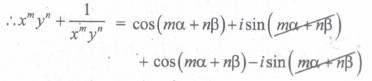
= 2cos(mα+nβ)
54.
Let \(\frac { \sqrt { 3 } }{ 2 } +\frac { i }{ 2 } \) = r(cos θ + i sin θ)
r = \(\sqrt { \left( \frac { \sqrt { 3 } }{ 2 } \right) ^{ 2 }+\left( \frac { 1 }{ 2 } \right) ^{ 2 } } =\sqrt { \frac { 3 }{ 4 } +\frac { 1 }{ 4 } } =\sqrt { \frac { 4 }{ 4 } } \)=1
α = \(tan^{ -1 }\left| \frac { y }{ x } \right| =tan^{ -1 }\left| \frac { \frac { 1 }{ 2 } }{ \frac { \sqrt { 3 } }{ 2 } } \right| =tan^{ -1 }\left( \frac { 1 }{ \sqrt { 3 } } \right) =\frac { \pi }{ 6 } \)
Since \(\frac { \sqrt { 3 } }{ 2 } +\frac { i }{ 2 } \) lies is the I quadrant, θ = α
∴ \(\frac { \sqrt { 3 } }{ 2 } +\frac { i }{ 2 } =1\left( cos\frac { \pi }{ 6 } +isin\frac { \pi }{ 6 } \right) \)
∴ \(\left( \frac { \sqrt { 3 } }{ 2 } +\frac { i }{ 2 } \right) ^{ 5 }=1^{ 5 }\left( cos\frac { \pi }{ 6 } +isin\frac { \pi }{ 6 } \right) ^{ 5 }\)
= \(cos\frac { 5\pi }{ 6 } +isin\frac { 5\pi }{ 6 } \) ....(1) [De moivres theorem]
Similarly \(\frac { \sqrt { 3 } }{ 2 } +\frac { i }{ 2 } =1\left( cos\frac { \pi }{ 6 } -isin\frac { \pi }{ 6 } \right) \)
∴ \(\left( \frac { \sqrt { 3 } }{ 2 } -\frac { i }{ 2 } \right) ^{ 5 }=1^{ 5 }\left[ cos\frac { \pi }{ 6 } +isin\frac { \pi }{ 6 } \right] ^{ 5 }\)
= \(cos\frac { 5\pi }{ 6 } -isin\frac { 5\pi }{ 6 } \) ....(2)
Adding (1) and (2) we get,
\(\left( \frac { \sqrt { 3 } }{ 2 } +\frac { i }{ 2 } \right) ^{ 5 }+\left( \frac { \sqrt { 3 } }{ 2 } -\frac { i }{ 2 } \right) ^{ 5 }\)

= \(2cos\frac { 5\pi }{ 6 } =2cos\left( \pi -\frac { \pi }{ 6 } \right) \)
= \(-2cos\ \frac { \pi }{ 6 } \) [∵ \(\frac { 5\pi }{ 6 } \) lies in the II quard]
= \(-2\left( \frac { \sqrt { 3 } }{ 2 } \right) =-\sqrt { 3 } \).

12th Standard Syllabus & Materials
12th Standard
TN 12th Computer Applications களப்பெயர் முறைமை (DNS) Sample Question Papers Study Material - QB365 Set A
NEW12th Standard
TN 12th Computer Applications வலையமைப்பு எடுத்துக்காட்டுகள் மற்றும் நெறிமுறைகள் Sample Question Papers Study Material - QB365 Set A
NEW12th Standard
TN 12th Computer Applications கணினி வலையமைப்பு ஓர் அறிமுகம் Sample Question Papers Study Material - QB365 Set A
NEW12th Standard
TN 12th Computer Applications PHP-உடன் MySQL-ஐ இணைத்தல் Sample Question Papers Study Material - QB365 Set A



Tamilnadu Stateboard 12th Standard Subjects
Maths

Chemistry

Physics

Biology

Computer Science

Business Maths and Statistics

Economics

Commerce

Accountancy

History

Computer Applications
Biology
Computer Technology
Computer Applications
Computer Science
Business Maths and Statistics
Commerce
Economics
Maths
Chemistry
Physics
Computer Technology
History
Accountancy

Tamil

English

French
Tamilnadu Stateboard Standards

