
 100% FREE ACCESS
12th Standard Syllabus & Materials
12th Standard
TN 12th Computer Applications மின்னணு தரவு பரிமாற்றம் Sample Question Papers Study Material - QB365 Set A
NEW12th Standard
TN 12th Computer Applications மின் - வணிக பாதுகாப்பு அமைப்புகள் Sample Question Papers Study Material - QB365 Set A
NEW12th Standard
TN 12th Computer Applications மின்னணு செலுத்தல் முறைகள் Sample Question Papers Study Material - QB365 Set A
NEW12th Standard
TN 12th Computer Applications மின் - வணிகம் Sample Question Papers Study Material - QB365 Set A
NEW12th Standard
TN 12th Computer Applications திறந்த மூல கருத்துருக்கள் Sample Question Papers Study Material - QB365 Set A
NEW12th Standard
TN 12th Computer Applications வலையமைப்பு வடமிடல் Sample Question Papers Study Material - QB365 Set A

Published on: 03/09/2020
12th Standard Maths English Medium Sample 3 Mark Creative Questions (New Syllabus) 2020
Download Tamil Nadu 12th Standard Maths question papers, model tests, one-mark questions, important questions, and public exam papers in PDF format. Free study materials and answer keys for TN State Board students.
Questions + Answers key
Take MCQ Maths Test1.
Solve : \(\frac { dy }{ dx } -\frac { y }{ x } ={ 2x }^{ 2 },x>0\)
2.
Find the D.E of all circles touching y-axis at the origin.
3.
Evaluate \(\int _{ -2 }^{ 3 }{ \left| 1-{ x }^{ 2 } \right| } dx\)
4.
Find the area bounded by the parabolas \({ x }^{ 2 }=\frac { y }{ 4 } \) and x2=9y and the straight line y = 2.
5.
Find the approximate value of \(\left( \frac { 17 }{ 81 } \right) ^{ \frac { 1 }{ 4 } }\) using linear approximation.
6.
Find the intervals of concavity and the point of inflection of the function f(x) = 2x2 + 5x2 - 4x
7.
Find the equation of normal to the curve y4=ax2at(a,a)
8.
Evaluate \(\int _{ 0 }^{ 1 }{ \sqrt { 9-4{ x }^{ 2 } } dx } \)
9.
If w = xy + z where x = cos t; y = sin t; z = t find \(\frac{dw}{dt}\)
10.
Show that \(\left| \frac { z-3 }{ z+3 } \right| \) = 2 represent a circle.
11.
Find the value of c if y = x + c is a tangent to the hyperbola 9x2 - 16y2 = 144.
12.
Find the value of p so that 3x + 4y - p = 0 is a tangent to the circle x2 +y2 - 64 = 0.
13.
Evaluate \(cos\left[ { cos }^{ -1 }\left( \frac { -\sqrt { 3 } }{ 2 } +\frac { \pi }{ 6 } \right) \right] \)
14.
Prove by vector method, that in a right angled triangle the square of the hypotenuse is equal to the sum of the square of the other two sides.
15.
Verify that (A-1)T = (AT)-1 for A =\(\left[ \begin{matrix} -2 & -3 \\ 5 & -6 \end{matrix} \right] \).
16.
Solve: (x-1)4+(x-5)4 = 82
1.
y = x2 + cx
2.
\({ y }^{ 2 }-{ x }^{ 2 }=2xy\frac { dy }{ dx } \)
3.
\(\frac { 28 }{ 3 } \)
4.
\(\frac { 20\sqrt { 2 } }{ 3 } \)
5.
0.677
6.
\(\left( -\infty ,-\frac { 5 }{ 6 } \right) \) concave downward
\(\left( -\frac { 5 }{ 6 } ,\infty \right) \) concave upward
Points of inflection is \(\left( -\frac { 5 }{ 6 } ,\frac { 305 }{ 54 } \right) \)
7.
4x + 3y = 7a
8.
Let I = \(\int _{ 0 }^{ 1 }{ \sqrt { 9-4{ x }^{ 2 } } dx } =\int _{ 0 }^{ 1 }{ 2\sqrt { \left( \frac { 3 }{ 2 } \right) ^{ 2 }-{ x }^{ 2 } } } dx\)
\(={ 2\left[ \frac { x }{ 2 } \sqrt { \left( \frac { 3 }{ 2 } \right) ^{ 2 }-{ x }^{ 2 } } +\frac { 9 }{ 8 } { sin }^{ -1 }\left( \frac { x }{ \frac { 3 }{ 2 } } \right) \right] }_{ 0 }^{ 1 }\)
\(\left[ \because \sqrt { { a }^{ 2 }-{ x }^{ 2 } } =\frac { x }{ 2 } \sqrt { { a }^{ 2 }-{ x }^{ 2 } } +\frac { { a }^{ 2 } }{ 2 } \left( \frac { x }{ a } \right) \right] \)
\(=2\left[ \frac { 1 }{ 2 } \sqrt { \frac { 9 }{ 4 } -1 } +\frac { 9 }{ 8 } { sin }^{ -1 }\left( \frac { 2 }{ 3 } \right) -0 \right] \)
\(=2\left[ \frac { 1 }{ 2 } \sqrt { \frac { 5 }{ 4 } } +\frac { 9 }{ 8 } { sin }^{ -1 }\left( \frac { 2 }{ 3 } \right) \right] \)
\(=\frac { \sqrt { 5 } }{ 2 } +\frac { 9 }{ 4 } { sin }^{ -1 }\left( \frac { 2 }{ 3 } \right) \)
9.
w = xy + z
\(\frac { \partial w }{ \partial x } =y;\frac { \partial w }{ \partial y } =x;\frac { \partial w }{ \partial z } =1\)
⇒ \(\frac { \partial w }{ \partial x } \) = sin t; \(\frac { \partial w }{ \partial y } \) = cos t; \(\frac { \partial w }{ \partial z } \) = 1
\(\frac { dx }{ dt } \) = - sin t; \(\frac { dy}{ dt } \) = cos t; \(\frac { dz }{ dt } \) = 1
∴ \(\frac { dw }{ dt } \) = \(\frac { \partial w }{ \partial x } .\frac { dx }{ dt } +\frac { \partial w }{ \partial y } .\frac { dy }{ dt } +\frac { \partial w }{ \partial z } .\frac { dz }{ dt } \)
= sin t(-sin t) + cos t(cost) + 1 (1)
= - sin2 t + cos2 t + 1
= cos2 t + 1 - sin2 t
= cos2 t + cos2 t [∵ 1- sin2 t = cos2 t]
\(\frac { dw }{ dt } \) = 2 cos2 t
10.
Let z = x + iy be a complex number
∴ \(\left| \frac { x+iy-3 }{ x+iy+3 } \right| \) = 2
⇒ \(\left| \frac { x+iy-3 }{ x+iy+3 } \right| \) = 2
⇒ |(x-3) + iy| = 2|(x+3)+iy|
⇒ \(\sqrt { (x-3)^{ 2 }+{ y }^{ 2 } } =2\sqrt { (x+3)^{ 2 }+{ y }^{ 2 } } \)
Squaring both sides we get,
(x - 3)2 + y2 = 4[(x + 3)2 + y2]
⇒ x2 + 9 - 6x + y2 = 4 [x2+ 9 + 6x + y2]
x2 + 9 - 6x + 1 = 4x2 + 36 + 24x + 4y2
⇒ 3x2 + 3y2 + 30x + 27 = which represent a circle.
11.
Given line is y = x + c
m = 1, c = c
Equation of the hyperbola is 9x2 - 16y2 = 144
\(\div \)144 we get \(\frac { { x }^{ 2 } }{ 16 } +\frac { { y }^{ 2 } }{ 9 } \) = 1
a2 = 16, b2 = 9
The condition for the line y = mx + c to be a tangent to the hyperbola is c2 = a2m2 - b2
∴ c2 = 16(1)2 - 9 = 16 - 9 = 7
∴ c = ±\(\sqrt7\)
12.
Equation of circle is x2 + y2 = 64
∴ a2 = 64 ⇒ a = 8
Given line is 3x+ 4y = P
4y = -3x + p
y = \(y=\frac { -3 }{ 4 } x+\frac { p }{ 4 } \)
m = \(\frac { -3 }{ 4 } \) and c = \(\frac { p }{ 4 } \)
The condition for y = mx + c to be a tangent to the circle in c2 = a2(1 + m2).
∴ \({ \left( \frac { p }{ 4 } \right) }^{ 2 }=64\left( 1+\frac { 9 }{ 16 } \right) \)
\(\Rightarrow \frac{p^{2}}{\not 16}=64\left(\frac{16+9}{\not 16}\right) \Rightarrow p^{2}=64(25)\)
\(p=\pm \sqrt { 64(25) } =\pm 8(5)\)
∴ p = ±40
13.
\(cos\left[ { cos }^{ -1 }\left( \frac { -\sqrt { 3 } }{ 2 } +\frac { \pi }{ 6 } \right) \right] \)
= \(cos\left[ \pi -{ cos }^{ -1 }\left( \frac { -\sqrt { 3 } }{ 2 } +\frac { \pi }{ 6 } \right) \right] \)
\(\left[ \because { cos }^{ -1 }\left( -x \right) =\pi -{ cos }^{ -1 }x \right] \)
= \(cos\left[ \pi -\frac { \pi }{ 6 } +\frac { \pi }{ 6 } \right] \)
\(\left[ \because { cos }^{ -1 }\frac { \sqrt { 3 } }{ 2 } =x\Rightarrow \frac { \sqrt { 3 } }{ 2 } =cosx\Rightarrow x=\frac { \pi }{ 6 } \right] \)
= \(cos\pi -1\)
14.
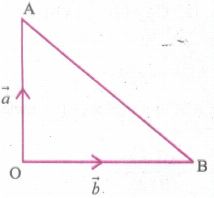
Let AOB be right angled triangle, right angled at O.
Take O as origin.
Then \(\overset { \rightarrow }{ OA } =\overset { \rightarrow }{ a } ,\overset { \rightarrow }{ OB } =\overset { \rightarrow }{ b } \)
\(\therefore \overset { \rightarrow }{ AB } =\overset { \rightarrow }{ OB } -\overset { \rightarrow }{ OA } =\overset { \rightarrow }{ b } -\overset { \rightarrow }{ a } \)
\(\therefore \overset { \rightarrow }{ OA } \bot \overset { \rightarrow }{ OA } =\overset { \rightarrow }{ a } \bot \overset { \rightarrow }{ b } \Rightarrow \overset { \rightarrow }{ a } .\overset { \rightarrow }{ b } =0\)
\(\therefore { AB }^{ 2 }={ \left| \overset { \rightarrow }{ AB } \right| }^{ 2 }=\overset { \rightarrow }{ AB } .\overset { \rightarrow }{ AB } \)
\(=0=\left( \overset { \rightarrow }{ b } -\overset { \rightarrow }{ a } \right) .\left( \overset { \rightarrow }{ b } -\overset { \rightarrow }{ a } \right) \)
\(=\overset { \rightarrow }{ b } .\overset { \rightarrow }{ b } -\overset { \rightarrow }{ b } .\overset { \rightarrow }{ a } -\overset { \rightarrow }{ a } .\overset { \rightarrow }{ b } +\overset { \rightarrow }{ a } .\overset { \rightarrow }{ a } \)
\(={ \left| \overset { \rightarrow }{ b } \right| }^{ 2 }-2\overset { \rightarrow }{ a } .\overset { \rightarrow }{ b } +{ \left| \overset { \rightarrow }{ a } \right| }^{ 2 }\)
= OB2 - 0 + OA2 \(\left[ \because \overset { \rightarrow }{ a } .\overset { \rightarrow }{ b } =0 \right] \)
⇒ AB2 = OA2 + OB2
Hence the Pythagoras theorem
15.
|A| =\(\left[ \begin{matrix} -2 & -3 \\ 5 & -6 \end{matrix} \right] \) = 12+15 = 27
∴ A-1 = \(\frac { 1 }{ |A| } adjA=\frac { 1 }{ 27 } \left[ \begin{matrix} -6 & 3 \\ -5 & 2 \end{matrix} \right] \)
(A-1)T = \(\frac { 1 }{ 27 } \left[ \begin{matrix} -6 & -5 \\ 3 & 2 \end{matrix} \right] \)...(1)
AT =\(\left[ \begin{matrix} -2 & 5 \\ -3 & -6 \end{matrix} \right] \)
|AT| =\(\left[ \begin{matrix} -2 & 5 \\ -3 & -6 \end{matrix} \right] \) = 12+15 = 27
∴ (AT)-1 = \(\frac { 1 }{ |A^{ T }| } adj(A^{ T })=\frac { 1 }{ 27 } \left[ \begin{matrix} -6 & -5 \\ 3 & -2 \end{matrix} \right] \)...(2)
From (1) and (2), (A-1)T = (AT)-1
16.
Put y = \(\frac { x-1+x-5 }{ 2 } =-3\)
⇒ x = y + 3
∴ (x-1)4+(x-5)4 = 82
⇒ (y+3-1)4+(y+3-5)4 = 82
⇒ (y+2)4+(y-2)4 = 82
⇒ 2(y4+24y2+16) = 82
⇒ y4+24y2+16 = 41
⇒ y4+24y2-25 = 0
⇒ (y2+25)(y2-1) = 0
⇒ y = 土5i, y = 士1
∴ x = 3土5i, 4, 2.

12th Standard Syllabus & Materials
12th Standard
TN 12th Computer Applications களப்பெயர் முறைமை (DNS) Sample Question Papers Study Material - QB365 Set A
NEW12th Standard
TN 12th Computer Applications வலையமைப்பு எடுத்துக்காட்டுகள் மற்றும் நெறிமுறைகள் Sample Question Papers Study Material - QB365 Set A
NEW12th Standard
TN 12th Computer Applications கணினி வலையமைப்பு ஓர் அறிமுகம் Sample Question Papers Study Material - QB365 Set A
NEW12th Standard
TN 12th Computer Applications PHP-உடன் MySQL-ஐ இணைத்தல் Sample Question Papers Study Material - QB365 Set A



Tamilnadu Stateboard 12th Standard Subjects
Maths

Chemistry

Physics

Biology

Computer Science

Business Maths and Statistics

Economics

Commerce

Accountancy

History

Computer Applications
Biology
Computer Technology
Computer Applications
Computer Science
Business Maths and Statistics
Commerce
Economics
Maths
Chemistry
Physics
Computer Technology
History
Accountancy

Tamil

English

French
Tamilnadu Stateboard Standards

