
 100% FREE ACCESS
12th Standard Syllabus & Materials
12th Standard
TN 12th Computer Applications மின்னணு தரவு பரிமாற்றம் Sample Question Papers Study Material - QB365 Set A
NEW12th Standard
TN 12th Computer Applications மின் - வணிக பாதுகாப்பு அமைப்புகள் Sample Question Papers Study Material - QB365 Set A
NEW12th Standard
TN 12th Computer Applications மின்னணு செலுத்தல் முறைகள் Sample Question Papers Study Material - QB365 Set A
NEW12th Standard
TN 12th Computer Applications மின் - வணிகம் Sample Question Papers Study Material - QB365 Set A
NEW12th Standard
TN 12th Computer Applications திறந்த மூல கருத்துருக்கள் Sample Question Papers Study Material - QB365 Set A
NEW12th Standard
TN 12th Computer Applications வலையமைப்பு வடமிடல் Sample Question Papers Study Material - QB365 Set A

Published on: 03/09/2020
12th Standard Maths English Medium Sample 5 Mark Book Back Questions (New Syllabus) 2020
Download Tamil Nadu 12th Standard Maths question papers, model tests, one-mark questions, important questions, and public exam papers in PDF format. Free study materials and answer keys for TN State Board students.
Questions + Answers key
Take MCQ Maths Test1.
Using truth table check whether the statements ¬(p V q) V (¬p ∧ q) and ¬p are logically equivalent.
2.
Verify
(i) closure property
(ii) commutative property
(iii) associative property
(iv) existence of identity and
(v) existence of inverse for the operation +5 on Z5 using table corresponding to addition modulo 5.
3.
Find the area of the region common to the circle x2 + y2 = 16 and the parabola y2 = 6x.
4.
If z(x, y) = x tan-1 (xy), x = t2, y = set, s, t ∈ R. Find \(\frac { \partial z }{ \partial s } \) and \(\frac { \partial z }{ \partial t } \) at s = t = 1
5.
Two balls are chosen randomly from an urn containing 8 white and 4 black balls. Suppose that we win Rs. 20 for each black ball selected and we lose Rs. 10 for each white ball selected. Find the expected winning amount and variance
6.
Using integration, find the area of the region which is bounded by x-axis, the tangent and normal to the circle x2 + y2 = 4 drawn at (1, \(\sqrt 3\))
7.
If X is the random variable with probability density function f(x) given by,
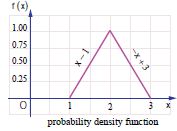
\(f(x)=\begin{cases} \begin{matrix} x-1 & 1\le x<2 \end{matrix} \\ \begin{matrix} -x+3 & 2\le x<3 \end{matrix} \\ \begin{matrix} 0 & Otherwise \end{matrix} \end{cases}\)
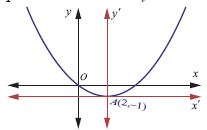
find
(i) the distribution function F(x)
(ii) P(1.5 ≤ X ≤ 2.5)
8.
The mean and standard deviation of a binomial variate X are respectively 6 and 2.
Find
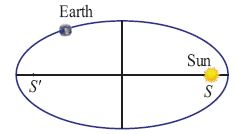
(i) the probability mass function
(ii) P(X = 3)
(iii) P(X\(\ge \)2).
9.
Evaluate the following integrals using properties of integration:
\(\int _{ 0 }^{ 1 }{ \frac { log(1+x) }{ 1+{ x }^{ 2 } } } dx\)
10.
Let w(x, y) = xy+\(\frac { { e }^{ y } }{ { y }^{ 2 }+1 } \) for all (x, y) ∈ R2. Calculate \(\frac { { \partial }^{ 2 }w }{ { \partial y\partial x } } \) and \(\frac { { \partial }^{ 2 }w }{ { \partial x\partial y } } \)
11.
If X is the random variable with probability density function f(x) given by,
\(f(x)=\begin{cases} \begin{matrix} x+1 & -1\le x<0 \end{matrix} \\ \begin{matrix} -x+1 & 0\le x<1 \end{matrix} \\ \begin{matrix} 0 & otherwise \end{matrix} \end{cases}\)
then find
(i) the distribution function F(x)
(ii) P( -0.5 ≤X ≤ 0.5)
12.
Prove that \(\int ^\frac {\pi}{4}_{0} \frac{dx}{a^2 sin^2 x+b^2 cos^2 x}\) = \(\frac{1}{ab} tan^{-1} (\frac{a}{b})\) where a, b > 0
13.
Evaluate the following integrals as the limits of sums.
\(\int _{ 0 }^{ 1 }{ (5x+4)dx } \)
14.
Find the local maximum and minimum of the function x2 y2 on the line x + y = 10
15.
For the function f{x) = 4x3 + 3x2 - 6x + 1 find the intervals of monotonicity, local extrema, intervals of concavity and points of inflection.
16.
A tank initially contains 50 litres of pure water. Starting at time t = 0 a brine containing with 2 grams of dissolved salt per litre flows into the tank at the rate of 3 litres per minute. The mixture is kept uniform by stirring and the well-stirred mixture simultaneously flows out of the tank at the same rate. Find the amount of salt present in the tank at any time t > 0.
17.
Sketch the graphs of the following function
\(y=\frac { 1 }{ 1+{ e }^{ -x } } \)
18.
19.
Solve the Linear differential equation:
(2x- 10y3) dy + ydx = 0
20.
Find the dimensions of the largest rectangle that can be inscribed in a semi circle of radius r cm.
21.
Find the smallest possible value x2+y2 given that x +y = 10.
22.
Solve the differential equation (y2-2xy) dx = (x2-2xy) dy
23.
Find the intervals of monotonicities and hence find the local extremum for the following function:
\(f(x)=\frac { { e }^{ x } }{ 1-{ e }^{ x } } \)
24.
Prove that the ellipse x2 + 4y2 = 8 and the hyperbola x2-2y2 = 4 intersect orthogonally.
25.
A particle moves along a line according to the law s(t) = 2t3 − 9t2 +12t − 4, where t ≥ 0.
26.
A road running north to south crosses a road going east to west at the point P. Car A is driving north along the first road, and car B is driving east along the second road. At a particular time car A 10 kilometres to the north of P and traveling at 80 km/hr, while car B is 15 kilometres to the east of P and traveling at 100 km/hr. How fast is the distance between the two cars changing?
27.
Solve: (x - 4)(x - 7)(x - 2)(x + 1) = 16
28.
Simplify: \(\left( -\sqrt { 3 } +3i \right) ^{ 31 }\)
29.
Find the inverse of each of the following by Gauss-Jordan method:
\(\left[ \begin{matrix} 1 & 2 & 3 \\ 2 & 5 & 3 \\ 1 & 0 & 8 \end{matrix} \right] \)
30.
Show that the lines \(\vec { r } =(\hat {- i } -3\hat { j } -5\hat { k } )+s(3\hat { i } +5\hat { j } +7\hat { k } )\) and \(\vec { r } =(2\hat { i } +4\hat { j } +6\hat { k } )+t(\hat { i } +4\hat { j } +7\hat { k } )\) are coplanar. Also, find the non-parametric form of vector equation of the plane containing these lines
31.
Find the non-parametric form of vector equation, and Cartesian equations of the plane passing through the points (2, 2, 1), (9, 3, 6) and perpendicular to the plane 2x + 6y + 6z = 9
32.
On lighting a rocket cracker it gets projected in a parabolic path and reaches a maximum height of 4 m when it is 6 m away from the point of projection. Finally it reaches the ground 12 m away from the starting point. Find the angle of projection.
33.
An engineer designs a satellite dish with a parabolic cross section. The dish is 5 m wide at the opening, and the focus is placed 1.2 m from the vertex
(a) Position a coordinate system with the origin at the vertex and the x -axis on the parabola’s axis of symmetry and find an equation of the parabola.
(b) Find the depth of the satellite dish at the vertex.
34.
Investigate the values of λ and μ the system of linear equations 2x + 3y + 5z = 9, 7x + 3y - 5z = 8, 2x + 3y + λz = μ, have
(i) no solution
(ii) a unique solution
(iii) an infinite number of solutions.
35.
Test for consistency of the following system of linear equations and if possible solve:
4x − 2y + 6z = 8, x + y − 3z = −1, 15x − 3y + 9z = 21.
36.
Solve \(tan^{ -1 }\left( \frac { x-1 }{ x-2 } \right) +tan^{ -1 }\left( \frac { x+1 }{ x+2 } \right) =\frac { \pi }{ 4 } \)
37.
In a T20 match, a team needed just 6 runs to win with 1 ball left to go in the last over. The last ball was bowled and the batsman at the crease hit it high up. The ball traversed along a path in a vertical plane and the equation of the path is y = ax2 + bx + c with respect to a xy-coordinate system in the vertical plane and the ball traversed through the points (10, 8), (20, 16) (40, 22) can you conclude that the team won the match?
Justify your answer. (All distances are measured in metres and the meeting point of the plane of the path with the farthest boundary line is (70, 0).)
38.
Find the vertex, focus, directrix, and length of the latus rectum of the parabola x2−4x−5y−1 = 0.
39.
Solve the equation (x-2) (x-7) (x-3) (x+2)+19 = 0
40.
If A = \(\frac { 1 }{ 7 } \left[ \begin{matrix} 6 & -3 & a \\ b & -2 & 6 \\ 2 & c & 3 \end{matrix} \right] \) is orthogonal, find a, b and c , and hence A−1.
41.
Evaluate the following:
\(\int _{ 0 }^{ \frac { \pi }{ 2 } }{ { x }^{ 2 }cos2x\ dx } \)
42.
Solve \(\frac { dy }{ dx } =\frac { x-y+5 }{ 2(x-y)+7 } .\)
43.
Find the point of intersection of the lines \(\frac { x-1 }{ 2 } =\frac { y-2 }{ 3 } =\frac { z-3 }{ 4 } \) and \(\frac { x-4 }{ 5 } =\frac { y-1 }{ 2 } =z\)
44.
The maximum and minimum distances of the Earth from the Sun respectively are 152 × 106 km and 94.5 × 10⁶ km. The Sun is at one focus of the elliptical orbit. Find the distance from the Sun to the other focus.
45.
Show that \(\left( \frac { \sqrt { 3 } }{ 2 } +\frac { i }{ 2 } \right) ^{ 5 }+\left( \frac { \sqrt { 3 } }{ 2 } -\frac { i }{ 2 } \right) ^{ 5 }=-\sqrt { 3 } \)
46.
With usual notations, in any triangle ABC, prove by vector method that \(\frac { a }{ sinA } =\frac { b }{ sinB }=\frac { c }{ sinc }\)
47.
Find the asymptotes of the following curve \(f(x)=\frac { { x }^{ 2 }-6x-1 }{ x+3 } \)
1.
~(p V q) V (~p ∧ q) and ~p
| p | q | p V q | ~(p ∧ q) | ~p | ~p ∧ q | ~(p V q) V (~p ∧ q) |
| T | T | T | F | F | F | F |
| T | F | T | F | F | F | F |
| F | T | T | F | T | T | T |
| F | F | F | T | T | F | T |
The entries in column (5) and column (7) are identical.
∴ ~(p V q) V (~p ∧ q) and ~p are logically equivalent.
2.
It is known that Z5 = {[0], [1], [2], [3], [4]}. The table corresponding to addition modulo 5 is as follows: We take reminders {0,1,2,3,4} to represent the classes {[0], [1], [2], [3], [4]}.
| +5 | 0 | 1 | 2 | 3 | 4 |
| 0 | 0 | 1 | 2 | 3 | 4 |
| 1 | 1 | 2 | 3 | 4 | 0 |
| 2 | 2 | 3 | 4 | 0 | 1 |
| 3 | 3 | 4 | 0 | 1 | 2 |
| 4 | 4 | 0 | 1 | 2 | 3 |
(i) Since each box in the table is filled by exactly one element of Z5, the output a +5 b is unique and hence +5 is a binary operation.
(ii) The entries are symmetrically placed with respect to the main diagonal. So +5 has commutative property
(iii) The table cannot be used directly for the verification of the associative property. So it is to be verified as usual
For instance, (2+53)+5 4 = 0+5 4 = 4(mod 5)
and 2+5(3+54) = 2 +5 2 = 4(mod5)
Hence (2+53)+54 = 2+5(3+54)
Proceeding like this one can verify this for all possible triples and ultimately it can be shown that +5 is associative
(iv) The row headed by 0 and the column headed by 0 are identical. Hence the identity element is 0.
(v) The existence of inverse is guaranteed provided the identity 0 exists in each row and each column. From Table, it is clear that this property is true in this case. The method of finding the inverse of any one of the elements of Z5, say 2 is outlined below.
First find the position of the identity element 0 in the III row headed by 2. Move horizontally along the III row and after reaching 0, move vertically above 0 in the IV column, because 0 is in the III row and IV column. The element reached at the topmost position of IV column is 3. This element 3 is nothing but the inverse of 2, because, 2+5 5+ = 0 (mod5). In this way, the inverse of each and every element of Z5 can be obtained. Note that the inverse of 0 is 0, that of 1 is 4, that of 2 is 3, that of 3 is 2, and, that of 4 is 1.
3.
Equation of the given circle is x2 + y2 = 16 ...(1)
and the parabola is y2 = 6x. ...(2)
Substituting (2) in (1) we get,
x2 + 6x - 16 = 0 \(\Rightarrow\) (x + 8) (x - 2) = 0
\(\Rightarrow\) (x-4) (x-2) = 0 \(\Rightarrow\) x = 2, 4
\(\Rightarrow\) x = -8, 2
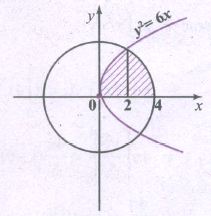
\(\therefore\) Required area = 2
\(\\ \\ \\ \\ \\ \\ \\ \int _{ 0 }^{ 2 }{ Area\ below\ the\ parabola } +\int _{ 2 }^{ 4 }{ Area\ below\ the\ circle } \)
\(=2\left[ \int _{ 0 }^{ 2 }{ \sqrt { 6x } } dx+\int _{ 2 }^{ 4 }{ \sqrt { 16-{ x }^{ 2 } } dx } \right] \)
\(=2\left[ { \left( \frac { \sqrt { 6 } .{ x }^{ \frac { 3 }{ 2 } } }{ \frac { 3 }{ 2 } } \right) }_{ 0 }^{ 2 }+{ \left( \frac { x }{ 2 } \sqrt { 16-{ x }^{ 2 } } +\frac { 16 }{ 2 } { sin }^{ -1 }\left( \frac { x }{ 4 } \right) \right) }_{ 0 }^{ 4 } \right] \)
\(=2\left[ \frac { 2 }{ 3 } \sqrt { 6. } 2\sqrt { 2 } +8{ sin }^{ -1 }\left( \frac { 1 }{ 2 } \right) \right] \)
\(=2\left[ \frac { 4\sqrt { 12 } }{ 3 } +8\left( \frac { \pi }{ 2 } \right) -\sqrt { 12 } -8\left( \frac { \pi }{ 6 } \right) \right] \)
\(=2\left[ \frac { 4\sqrt { 12 } }{ 3 } +4\pi -2\sqrt { 3 } -\frac { 4\pi }{ 3 } \right] \)
\(=2\left[ \frac { 8\sqrt { 3 } -6\sqrt { 3 } }{ 3 } +\frac { 12\pi -4\pi }{ 3 } \right] \)
\(=\left[ \frac { 2\sqrt { 3 } }{ 3 } +\frac { 8\pi }{ 3 } \right] =2\times \frac { 2 }{ 3 } \left[ \sqrt { 3 } +4\pi \right] \)
\(=\frac { 4 }{ 3 } \left[ 4\pi +\sqrt { 3 } \right] \)sq.units
4.
\(\frac { \partial z }{ \partial x } =x.\frac { 1 }{ 1+{ x }^{ 2 }{ y }^{ 2 } } (y)+{ tan }^{ -1 }(xy)\)
\(\frac { \partial z }{ \partial y } =x.\frac { 1 }{ 1+{ x }^{ 2 }{ y }^{ 2 } } \)(x)
\(\frac { \partial z }{ \partial z } =\frac { xy }{ 1+{ x }^{ 2 }{ y }^{ 2 } } \) + tan-1 (xy)
\(\frac { \partial z }{ \partial y } =\frac { x^2 }{ 1+{ x }^{ 2 }{ y }^{ 2 } } \)
\(\frac { \partial z }{ \partial y } =\frac { x^2 }{ 1+{ x }^{ 2 }{ y }^{ 2 } } \)
\(\frac { \partial z }{ \partial x } =\frac { { t }^{ 2 }{ se }^{ t } }{ 1+{ t }^{ 4 }{ s }^{ 2 }{ e }^{ 2t } } +{ tan }^{ -1 }({ t }^{ 2 }{ se }^{ 2 })\)
\(\frac { \partial z }{ \partial y } =\frac { { t }^{ 4 } }{ 1+{ t }^{ 4 }{ s }^{ 2 }{ e }^{ 2t } } \)
\(\frac { dx }{ dt } =2t;\frac { dy }{ dt } ={ s.e }^{ t }\)
Also, \(\frac { dx }{ ds } =0;\frac { dy }{ ds } ={ e }^{ t }\)
By chain rule
\(\frac { dw }{ ds } =\frac { \partial z }{ \partial x } .\frac { dx }{ ds } +\frac { \partial z }{ \partial y } .\frac { dy }{ ds } \)
= \(\frac { { t }^{ 2 }{ se }^{ t } }{ 1+{ t }^{ 4 }{ s }^{ 2 }{ e }^{ 2t } } (0)+\frac { { t }^{ 4 } }{ 1+{ t }^{ 4 }{ s }^{ 2 }{ e }^{ 2t } } { (e }^{ t })=\frac { { e }^{ t }{ t }^{ 4 } }{ 1+{ t }^{ 4 }{ s }^{ 2 }{ e }^{ 2t } } \)
\(\therefore { \left( \frac { \partial z }{ \partial s } \right) }_{ s=t=1 }=\frac { e(1) }{ 1+{ e }^{ 2 } } =\frac { e }{ 1+{ e }^{ 2 } } \)
By chain rule
= \(\frac { dz }{ dt } =\frac { \partial z }{ \partial x } .\frac { dx }{ dt } +\frac { \partial z }{ \partial y } .\frac { dy }{ dt } \)
\(\therefore { \left( \frac { \partial z }{ \partial t } \right) }_{ (s=t=1) }=\frac { e }{ 1+{ e }^{ 2 } } =\frac { e }{ 1+{ e }^{ 2 } } \)
= \(\frac { 2e+e }{ 1+{ e }^{ 2 } } =\frac { 3e }{ 1+{ e }^{ 2 } } \)+ 2 tan-1(e)
5.
Let X denote the winning amount. The possible events of selection are
(i) both balls are black, or
(ii) one white and one black or
(iii) both are white
Therefore X is a random variable that can be defined as
X (both are black balls) = Rs. 2(20) = Rs. 40
X (one black and one white ball) = Rs. 20 − Rs. 10 = Rs. 10
X (both are white balls) = (Rs. 20) = - Rs. 20
Therefore X takes on the values 40,10 and −20
Total number of balls n = 12
Total number of ways of selecting 2 balls = \(\left( \begin{matrix} 12 \\ 2 \end{matrix} \right) =\frac { 12\times 11 }{ 1\times 2 } =66\)
Number of ways of selecting 2 black balls = \(\left( \begin{matrix} 4 \\ 2 \end{matrix} \right) =6\)
Number of ways of selecting one black ball and one white ball = \(\left( \begin{matrix} 8 \\ 1 \end{matrix} \right) \left( \begin{matrix} 4 \\ 1 \end{matrix} \right) =32\)
Number of ways of selecting 2 white balls = \(\left( \begin{matrix} 8 \\ 2 \end{matrix} \right) =28\)
| Values of Random Variable X | 40 | 10 | -20 | Total |
| Number of elements in inverse images | 6 | 32 | 28 | 66 |
Probability mass function is
| X | 40 | 10 | -20 | Total |
| f (x) | \(\cfrac { 6 }{ 66 } \) | \(\cfrac { 32 }{ 66 } \) | \(\cfrac { 28 }{ 66 } \) | 1 |
Mean :
\(E(X)\Sigma xf(x)=40.\left( \frac { 6 }{ 66 } \right) +10.\left( \frac { 32 }{ 66 } \right) +\left( -20 \right) .\left( \frac { 28 }{ 66 } \right) =\frac { 4000 }{ 11 } \)
That is expected winning amount is 0
Variance :
\(\Sigma x^{ 2 }=\Sigma { x }^{ 2 }f(x)=40^{ 2 }.\left( \frac { 6 }{ 66 } \right) +10^{ 2 }.\left( \frac { 32 }{ 66 } \right) +\left( -20 \right) ^{ 2 }.\left( \frac { 28 }{ 66 } \right) =\frac { 4000 }{ 11 } \)
(E(X )2 = 02 = 0
This gives \(V(X)=E({ X }^{ 2 })-\left( E(X))^{ 2 } \right) =\frac { 4000 }{ 11 } -0=\frac { 4000 }{ 11 } \)
Therefore E(X ) = 0 and \(V(x)=\frac { 4000 }{ 11 } \)
6.
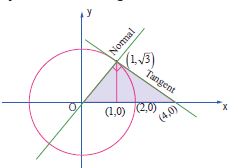
We recall that the equation of the tangent to the circle x2 + y2 = a2 at (x1, y1) is xx1+yy1 = a2. So, the equation of the tangent to the circle x2 + y2 + = 4 at (1, \(\sqrt 3\)) is x+y\(\sqrt 3\) = 4; that is y = -\(\frac{1}{\sqrt 3}\)( x - 4). The tangent meets the x-axis at the point (4,0). The slope of the tangent is-\(\frac{1}{\sqrt 3}\). So the slope of the normal is \(\sqrt 3\) and hence equation of the normal is y-\(\sqrt 3\) =\(\sqrt 3\)(x-1); that is y = \(\sqrt 3\) x and it passes through the origin. The area to be found is shaded in the adjoining figure. It can be found by two methods.
7.
(i) By definition \(F(x)=\le x)=\int _{ -\infty }^{ x }{ f(u)dx } \)
When x < 1 \(F(x)=P\left( x\le x \right) =\int _{ 1 }^{ x }{ odu+\int _{ 1 }^{ 0 }{ (u-1) } du } \)
When 1 ≤ x < 2 \(F(x)=P(X\le x)=\int _{ -\infty }^{ x }{ odu } =0\)
When 1 ≤ x < 2 \(F(x)=P\left( x\le x \right) =\int _{ 1 }^{ x }{ odu+\int _{ 1 }^{ 0 }{ (u-1) } du } \)
= \(0+\left[ \frac { \left( u-1 \right) ^{ 2 } }{ 2 } \right] =\frac { \left( x-1 \right) ^{ 2 } }{ 2 } \)
When 2 ≤ x <3 \(F(x)=P(X\le x)=\int _{ -\infty }^{ 1 }{ du } +\int _{ 1 }^{ 2 }{ \left( u-1 \right) du } +\int _{ 2 }^{ x }{ \left( 3-u \right) du } \)
= \(0+\left[ \frac { \left( u-1 \right) ^{ 2 } }{ 2 } \right] +\left[ \frac { (3-u)^{ 2 } }{ 2 } \right] \)
= \(\frac { { 1 }^{ 2 }-0 }{ 2 } +\frac { 1-(3-x)^{ 2 } }{ 2 } =1\frac { \left( 3-x \right) ^{ 2 } }{ 2 } \)
When x ≥ 3, \(F(x)=P\left( X\le x \right) =\int _{ -\infty }^{ 1 }{ odu } +\int _{ 1 }^{ 3 }{ (u-1) } +\int _{ 2 }^{ 1 }{ (3-u) } +\int _{ 3 }^{ x }{ odu } \)
= \(\int _{ -\infty }^{ 1 }{ 0du } +\int _{ 1 }^{ 2 }{ (u-1)du } +\int _{ 2 }^{ 3 }{ (3-u) } du+\int _{ 3 }^{ x }{ 0du } \)
= \(0+\left[ \frac { \left( u-1 \right) ^{ 2 } }{ 2 } \right] +\left[ \frac { \left( 3-u \right) ^{ 2 } }{ 2 } \right] _{ 2 }^{ 3 }+0\)
= \(\cfrac { 1 }{ 2 } +\cfrac { 1 }{ 2 } =1\)
These give
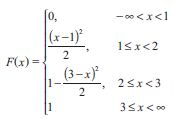
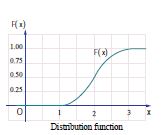
(ii) P(1.5 ≤ X ≤ 2.5) = F(2.5) − F(1.5)
= \(\left( 1-\frac { \left( 3-2.5 \right) ^{ 2 } }{ 2 } \right) -\left( \frac { \left( 1.5-1 \right) ^{ 2 } }{ 2 } \right) \)
= \(\cfrac { 1.75-0.25 }{ 2 } =0.75\)
\(P\left( 1.5\le X\le \right) =\int _{ 1.5 }^{ 2.5 }{ f(x)dx } =\int _{ 1.5 }^{ 2 }{ (x-1) } dx+\int _{ 2 }^{ 2.5 }{ (-x+3) } dx=0.75\)
8.
X~ B(n, p)
Given mean np = 6
\(S.D=\sqrt { npq } =2\)
\(\Rightarrow npq=4\)
\( \rightarrow \frac { npq }{ np } =\frac { 4 }{ 6 } =\frac { 2 }{ 3 } \)
\(\Rightarrow q=\frac { 2 }{ 3 } \)
\(\Rightarrow 1-P=\frac { 2 }{ 3 } \)
\(\Rightarrow 1-\frac { 2 }{ 3 } =P\)
\(\therefore P=\frac { 1 }{ 3 } \)
\(n\times \frac { 1 }{ 3 } =6\Rightarrow n=18\)
(i) The probability mass function
P(X = x) nCx px (1 - p )n-x,
X = 0,1,2, ... , n
\(\therefore P(X=x)=\ ^{18}{ C }_{ x }\left( \frac { 1 }{ 3 } \right) ^{ x }\left( \frac { 2 }{ 3 } \right) ^{ 18-x }\)
x=0,1,2...,8
(ii) \(P(X=3)=\ ^{ 18}{C }_{ 3 }\left( \frac { 1 }{ 3 } \right) ^{ 3 }\left( \frac { 2 }{ 3 } \right) ^{ 18-3 }\)
= \(^{ 18}{C }_{ 3 }\left( \frac { 1 }{ 3 } \right) ^{ 3 }\left( \frac { 2 }{ 3 } \right) ^{ 15 }\)
(iii) P(X ≥ 2)
P(X ≥ 2) 1 -P(X < 2)
= 1 - [P(X = 0) + P(X = 1)]
= \(1-\left[ ^{18}{ C }_{ 0 }\left( \frac { 1 }{ 3 } \right) ^{ 0 }\left( \frac { 2 }{ 3 } \right) ^{ 18 }+^{ 18}{C }_{ 1 }\left( \frac { 1 }{ 3 } \right) ^{ 1 }\left( \frac { 2 }{ 3 } \right) ^{ 17 } \right] \)
= \(1-\left[ \left( \frac { 2 }{ 3 } \right) ^{ 18 }+6\left( \frac { 2 }{ 3 } \right) ^{ 17 } \right] \)
= \(1-\left( \frac { 2 }{ 3 } \right) ^{ 17 }\left[ \frac { 2 }{ 3 } +6 \right] \)
= \(1-\left( \frac { 2 }{ 3 } \right) ^{ 17 }\left( \frac { 20 }{ 3 } \right) \)
= \(1-\frac { 20 }{ 3 } \left( \frac { 2 }{ 3 } \right) ^{ 17 }\)
9.
Let x = tan \(\theta \Rightarrow\)dx = sec2\(\theta d \theta\)
| x | 0 | 1 |
| \(\theta\) | 0 | \(\frac{\pi}{4}\) |
\(\therefore I=\int _{ 0 }^{ \frac { \pi }{ 4 } }{ \frac { log(1+tan\theta ) }{ { sec }^{ 2 }\theta } } { sec }^{ 2 }\theta d\theta \)
\(=\int _{ 0 }^{ \frac { \pi }{ 4 } }{ log(1+tan\theta )d\theta } \quad ...(1)\)
Using property,
\(I=\int _{ 0 }^{ \frac { \pi }{ 4 } }{ log(1+tan(\frac { \pi }{ 4 } -\theta ))d\theta } \)
\(I=\int _{ 0 }^{ \frac { \pi }{ 4 } }{ log\left( \frac { 1+tan\theta +1-tan\theta }{ 1+tan\theta } \right) } d\theta \)
\(I=\int _{ 0 }^{ \frac { \pi }{ 4 } }{ log\left( \frac { 2 }{ 1+tan\theta } \right) } d\theta \quad ..(2)\)
(1)+(2)
\(2I=\int _{ 0 }^{ \frac { \pi }{ 4 } }{ log(1+tan\theta )d\theta } +\int _{ 0 }^{ \frac { \pi }{ 4 } }{ log\left( \frac { 2 }{ 1+tan\theta } \right) } d\theta \)
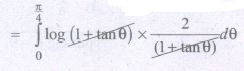
\(=\int _{ 0 }^{ \frac { \pi }{ 4 } }{ log2d\theta =log2{ [\theta ] }_{ 0 }^{ \frac { \pi }{ 4 } } } \)
\(2I=log2(\frac { \pi }{ 4 } -0)=\frac { \pi }{ 4 } log2\)
\(\therefore I=\frac { \pi }{ 8 } log2\)
10.
First we calculate \(\frac { { \partial }w }{ { \partial x } } (x,y)=\frac { { \partial }(xy) }{ { \partial x } } +\frac { \partial \left( \frac { { e }^{ y } }{ { y }^{ 2 }+1 } \right) }{ \partial x } \)
This gives \(\frac { { \partial }^{ }w }{ { \partial x } } \) (x, y) = y + 0 and hence \(\frac { { \partial }^{ 2 }w }{ \partial y\partial x } \) (x, y) = 1 On the other hand,
\(\frac { { \partial }w }{ { \partial y } } (x,y)=\frac { { \partial }(xy) }{ { \partial y } } +\frac { \partial \left( \frac { { e }^{ y } }{ { y }^{ 2 }+1 } \right) }{ \partial y } \)
\(=x+\frac { \left( { y }^{ 2 }+1 \right) { e }^{ y }-{ e }^{ y }2y }{ \left( { y }^{ 2 }+1 \right) } \)
Hence, \(\frac { { \partial }^{ 2 }w }{ { \partial x\partial y } } \) (x, y) = 1
11.
\(f(x)=\begin{cases} \begin{matrix} x+1 & -1\le x<0 \end{matrix} \\ \begin{matrix} -x+1 & 0\le x<1 \end{matrix} \\ \begin{matrix} 0 & otherwise \end{matrix} \end{cases}\)
(i) Distribution function
Case 1 : x < -1
F(x) = \(\int _{ -\infty }^{ x }{ f(u)du } \) = 0
Case 2 : -1 ≤ x < 0
\(\int _{ -\infty }^{ x }{ f(u)du } \)
= \(\int _{ -\infty }^{ x }{ f(x) } dx=\left[ \frac { { x }^{ 2 } }{ 2 } +x \right] _{ -1 }\)
= \(\left( \frac { {u }^{ 2 } }{ 2 } +u \right)=\frac{x^2}{2}+x -\left( \frac { 1 }{ 2 } +1 \right) \)
= \(\frac { { x }^{ 2 } }{ 2 } +x+\frac { 1 }{ 2 } \)
Case 3 : 0 ≤ x < 1,
\(F(X)=\int _{ 0 }^{ x }{ (-x+1)dx } =\left[ -\frac { { x }^{ 2 } }{ 2 } +x \right] _{ 0 }^{ x }\)
= \(\left( -\frac { { x }^{ 2 } }{ 2 } +x \right) -\left( 0 \right) =\frac { { x }^{ 2 } }{ 2 } +x\)
When 1 ≤ x,
\(F(x)=\int _{ 1 }^{ x }{ f(x)dx } =\int _{ 1 }^{ x }{ 0dx } \)
= \(\therefore F(X)=\begin{cases} \begin{matrix} \frac { { x }^{ 2 } }{ 2 } +x+\frac { 1 }{ 2 } & -1\le x<0 \end{matrix} \\ \begin{matrix} -\frac { { x }^{ 2 } }{ 2 } +x & 0\le x<1 \end{matrix} \\ \begin{matrix} 0 & otherwise \end{matrix} \end{cases}\)
(ii) p(0.5 ≤ X ≤ 0.5)
= \(\int _{ -0.5 }^{ 0.5 }{ f(x)dx } =\int _{ 0.5 }^{ 0 }{ f(x)dx+\int _{ 0 }^{ 0.5 }{ f(x)dx } } \)
= \(\int _{ -0.5 }^{ 0 }{ (x+1) } dx+\int _{ 0 }^{ 0.5 }{ \left( -x+1 \right) } dx\)
= \(\left[ \frac { { x }^{ 2 } }{ 2 } +x \right] _{ -0.5 }^{ 0 }+\left[ \frac { -{ x }^{ 2 } }{ 2 } +x \right] _{ 0 }^{ 0.5 }\)
= \(0-\left( \frac { { 0.5 }^{ 2 } }{ 2 } -0.5 \right) +\left( -\frac { \left( 0.5 \right) ^{ 2 } }{ 2 } +0.5 \right) -0\)
= \(-\left( \frac { .25 }{ 2 } -0.5 \right) +\left( \frac { -0.25 }{ 2 } +0.5 \right) \)
= \(\frac { .25 }{ 2 } +0.5-\frac { 0.25 }{ 2 } +0.5=0.25+1\)
= 0.75
12.
Put I = \(\int _{ 0 }^{ \frac { \pi }{ 4 } } \frac { dx }{ a^{ 2 }sin^{ 2 }x+b^{ 2 }cos^{ 2 }x } =\int _{ 0 }^{ \frac { \pi }{ 4 } } \frac { sec^{ 2 }xdx }{ a^{ 2 }tan^{ 2 }x+b^{ 2 } } \)
Put u = tan x
Then du = sec2 x dx
When x = 0 , we have u = tan 0 = 0
When x = \(\frac{\pi}{4}\), we have u = tan\(\frac{\pi}{4}\) = 1
\(\therefore I=\int _{ 0 }^{ 1 } \frac { du }{ a^{ 2 }u^{ 2 }+b^{ 2 } } =\frac { 1 }{ a^{ 2 } } \int _{ 0 }^{ 1 } \frac { du }{ u^{ 2 }+\left( \frac { b }{ a } \right) ^{ 2 } } =\frac { 1 }{ a^{ 2 } } { \left[ \frac { a }{ b } tan^{ -1 }(\frac { au }{ b } ) \right] }_{ 0 }^{ 1 }=\frac { 1 }{ ab } tan^{ -1 }\left( \frac { a }{ b } \right) \)
We derive some more properties of definite integrals
13.
Here a = 0, b = 1,f (x) = 5x + 4
\(\therefore f(a+(b-a)\frac { r }{ n } )=f\left( 0+1(\frac { r }{ n } ) \right) =f(\frac { r }{ n } )=5(\frac { r }{ n } )+4\)
\(\int _{ a }^{ b }{ f(x)dx } =\underset { n\rightarrow \infty }{ lim } \frac { b-a }{ n } \sum _{ r=1 }^{ n }{ f(a+(b-a)\frac { r }{ n } } \)
\(\therefore \int _{ 0 }^{ 1 }{ (5x+4)dx } =\underset { n\rightarrow \infty }{ lim } \frac { 1 }{ n } \sum _{ r=1 }^{ n }{ \left( \frac { 5r }{ n } +4 \right) } \)
\(=\underset { n\rightarrow \infty }{ lim } \left[ \frac { 1 }{ n } \sum _{ r=1 }^{ n }{ \frac { 5r }{ n } +\frac { 1 }{ n } \sum _{ r=1 }^{ n }{ 4 } } \right] \)
\(=\underset { n\rightarrow \infty }{ lim } \left[ \frac { 1 }{ n } .\frac { 5 }{ n } .(1+2+3+...+n)+\frac { 1 }{ n } .4n \right] \)
\(=\underset { n\rightarrow \infty }{ lim } \left[ \frac { 5 }{ { n }^{ 2 } } \frac { n(n+1) }{ 2 } +4 \right] \)
\([\because \sum { r=\frac { n(n+1) }{ 2 } ;\sum { { r }^{ 2 }=\frac { n(n+1)(2n+1) }{ 6 } } } ]\)
\(=\underset { n\rightarrow \infty }{ lim } \frac { 5 }{ { n }^{ 2 } } { n }^{ 2 }\frac { (1+\frac { 1 }{ n } ) }{ 2 } +4\)
\(=\frac { 5 }{ 2 } (1+0)+4=\frac { 5 }{ 2 } +4\)
\([wehen\quad n\rightarrow \infty ,1/n\quad \rightarrow 0]\)
\(=\frac { 5+8 }{ 2 } =\frac { 13 }{ 2 } \)
\(\therefore \int _{ 0 }^{ 1 }{ (5x+4)dx } =\frac { 13 }{ 2 } \)
14.
Let the given function be written as f (x) = x2 ( 10− x)2 . Now
f(x) = x2(100 - 20x + x2) = x4-20x3+100x2
Therefore, f'(x) = 4x3- 60x3 + 200x = 4x(x2-15x+50)
f'(x) = 4x(x2-15x + 50) = 0 ⇒ x = 0, 5, 10
and f"(x) = 12x2-120x + 200
The stationary points of f(x) are x = 0, 5, 10 at these points the values of f′′(x) are respectively 200, −100 and 200. At x = 0, it has local minimum and its value is f(0) = 0. At x = 5, it has local maximum and its value is f(5) = 625. At x = 10, it has local minimum and its value is f(10) = 0.
15.
Given f(x) = 4x3 + 3x2- 6x + 1
f'(x) = 12x2 + 6x - 6
f"(x) = 24x + 6
f'(x) = 0
⇒12x2 + 6x - 6 = 0
⇒ 2x2 + x - 1 = 0
⇒ (x + 1)(2x - 1) = 0
\(\Rightarrow x=-1,\frac { 1 }{ 2 } \)
The critical numbers are -1, \(\frac { 1 }{ 2 } \)
The possible intervals of monotonicity are
\(\left( -\infty ,-1 \right) \left( -1,\frac { 1 }{ 2 } \right) \left( \frac { 1 }{ 2 } ,\infty \right) \)
| Interval | (∞,-1) | \(\left( -1,\frac { 1 }{ 2 } \right) \) | \(\left( \frac { 1 }{ 2 } ,\infty \right) \) |
| Sign of f'(x) | Say x = -2 12(-2)2 + 6 (-2)-6 = +ve |
Say x = 0 = -6 -ve |
Say x = 1 I2(1)2 + 6(1) - 6 = +ve |
| Monoto nicity | strictly increasmg | Strictly decreasing | Strictly increasing |
∴ f(x) is strictly increasing in \(\left( -\infty ,-1 \right) \left( \frac { 1 }{ 2 } ,\infty \right) \) and strictly decreasing in \(\left( -1,\frac { 1 }{ 2 } \right) \)
f"(x) = 0
\(\Rightarrow 24x+6=0\Rightarrow 24x=-6\)
\(x=\frac { -6 }{ 24 } =\frac { -1 }{ 4 } \)
The possible intervals of concavity are \(\left( -\infty ,\frac { -1 }{ 4 } \right) \left( \frac { -1 }{ 4 } ,\infty \right) \)
| Interval | \(\left( -\infty ,\frac { -1 }{ 4 } \right) \) | \(\left( \frac { -1 }{ 4 } ,\infty \right) \) |
| Sign of f'(x) | Say x = -1 24(-1) + 6 = -ve |
Say x = 0 +ve |
| Concavity | Concave down | Concave up |
ஃf(x) concave down in \(\left( -\infty ,\frac { -1 }{ 4 } \right) \) and concave up in \(\left( \frac { -1 }{ 4 } ,\infty \right) \)
As f"(x) changes its sign when it passes through
\(x=\frac { -1 }{ 4 } \), the point of inflection is \(\left( -\frac { 1 }{ 4 } ,f\left( -\frac { 1 }{ 4 } \right) \right) \)
Now \(f\left( \frac { -1 }{ 4 } \right) =\left( -\frac { 1 }{ 4 } \right) ^{ 3 }+3\left( \frac { -1 }{ 4 } \right) ^{ 2 }-6\left( \frac { -1 }{ 4 } \right) +1\)
= \(4\left( \frac { -1 }{ 4 } \right) +\frac { 3 }{ 16 } +\frac { 6 }{ 4 } +1\)
= \(\frac { -1 }{ 16 } +\frac { 3 }{ 16 } +\frac { 3 }{ 22 } +1=\frac { 1 }{ 8 } +\frac { 3 }{ 2 } +1\)
= \(\frac { 1+12+8 }{ 8 } =\frac { 21 }{ 8 } \)
ஃ Point of inflection. \(\left( \frac { -1 }{ 4 } ,\frac { 21 }{ 8 } \right) \)
Since f'(x) changes its sign from positive to negative at x = -1, it has a local maximum at x = -1.
ஃf (-1) = 4 (-1)3 + 3 (-1)2 - 6(-1) + 1
Since f'(x) changes its sign from negative to positive at \(x=\frac { 1 }{ 2 } \) it has a local minimum at \(x=\frac { 1 }{ 2 } \)
\(\therefore f\left( \frac { 1 }{ 2 } \right) =4\left( \frac { 1 }{ 2 } \right) ^{ 3 }+3\left( \frac { 1 }{ 2 } \right) ^{ 2 }-6\left( \frac { 1 }{ 2 } \right) +1\)
= \(\frac { 4 }{ 8 } +\frac { 3 }{ 4 } -\frac { -3 }{ 2 } +1=\frac { 1 }{ 2 } +\frac { 3 }{ 4 } -\frac { 3 }{ 2 } +1\)
= \(\frac { 2+3-6+4 }{ 4 } =\frac { 3 }{ 4 } \)
16.
Let x(t) denote the amount of salt in the tank at time t.
Its rate of change is
\(\frac{dx}{dt}\) = inflow rate - outflow rate
Now, 2 gram time 3 litres per minutes is inflow rate = 6 grams of salt. (3 x 2 = 6)
The out flow of salt is \(\frac{3}{50}\) times x = \(\frac{3x}{50}\)
\(\therefore \frac { dx }{ dt } =6-\frac { 3x }{ 50 } =\frac { 300-3x }{ 50 } \)
\(=-\frac { 3(x-100) }{ 50 } \)
\(\Rightarrow \frac { dx }{ x-100 } =-\frac { 3 }{ 50 } dt\)
\(\Rightarrow \int { \frac { dx }{ x-100 } =-\frac { 3 }{ 50 } \int { dt } } \)
\(\Rightarrow log(x-100)=-\frac { 3 }{ 50 } t+logC\)
\(\\ \Rightarrow log(x-100)-logC=-\frac { 3 }{ 50 } t\)
\(\Rightarrow log\left( \frac { x-100 }{ C } \right) =-\frac { 3 }{ 50 } t\)
\(\Rightarrow \frac { x-100 }{ C } ={ e }^{ -\frac { 3t }{ 50 } }\)
\(\Rightarrow x-100={ C }_{ e }-\frac { 3t }{ 50 } \quad ...(1)\)
When t = 0, x = 0
[Since initial water was pure without any salt]
\(\Rightarrow\) 0-100 = Ce0
\(\Rightarrow\) C = -100
(1) becomes x-100 = -100\(\\ \\ \\ \\ \\ \\ \\ { e }^{ -\frac { 3t }{ 50 } }\)
\(\Rightarrow\) x = 100-100\(\\ \\ \\ \\ \\ \\ \\ { e }^{ -\frac { 3t }{ 50 } }\)
\(\Rightarrow\) x = 100(1-\(\\ \\ \\ \\ \\ \\ \\ { e }^{ -\frac { 3t }{ 50 } }\))
Hence the amount of salt in the tank at time t is x = 100(1-\(\\ \\ \\ \\ \\ \\ \\ { e }^{ -\frac { 3t }{ 50 } }\))
17.
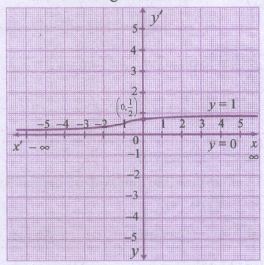
Let f(x) = \(y=\frac { 1 }{ 1+{ e }^{ -x } } \)
1. The domain of y is R
2. It is not symmetric
3. Putting y = 0, we get x does not exist
∴ It has no X intercept
4. Putting x = 0, we get \(y=\frac { 1 }{ 1+{ e }^{ o } } =\frac { 1 }{ 1+1 } =\frac { 1 }{ 2 } \)
∴ Y-intercept is \(\left( 0,\frac { 1 }{ 2 } \right) \)
5. \(f'(x)=\frac { d }{ dx } \left( 1+e^{ -x } \right) ^{ -1 }=-1\left( 1+{ e }^{ -x } \right) \left( -e^{ -x } \right) \)
= \(\frac { { e }^{ -x } }{ \left( 1+e^{ -x } \right) ^{ 2 } } ={ e }^{ -x }\left( 1+{ e }^{ -x } \right) ^{ -2 }\)
\(f'(x)=0\Rightarrow { e }^{ -x }0\Rightarrow -x=log0\Rightarrow x=\infty \)
Also, f(x) > 0 ∀ X ∈ R
6. Since there is no sign change inf'(x), it has no local extreme.
7. f"(x) = e-x(-2)(1+e-x)-3(_e-x)+(1+e-x)-2(_e-x)
= 2e-2x (I+e-x )-3 -e-x ( 1+e-x )-2
= e-2x (1+e-x r3 [2 - e-x (1+e-x)]
= e-2X(I+e-xr3[2-ex -1]
= \(\frac { { e }^{ -2x }\left( 1-{ e }^{ x } \right) }{ \left( 1+{ { e }^{ x } } \right) ^{ 3 } } \)
f"(x) = 0 ⇒ x = 0
The intervals of concavity is tabulated as follows.
| Interval | (-∞,0) | (0,∞) |
|---|---|---|
| Sign of f"(x) | + | - |
| Concavity | Concave up | Concave down |
8.\(\underset { x\rightarrow \infty }{ lim } \frac { 1 }{ 1+{ e }^{ -x } } =1\)
⇒ y = 1 is the horizontal asymptote and
\(\underset { x\rightarrow \infty }{ lim } \frac { 1 }{ 1+{ e }^{ -x } } =0\)
⇒ y = 0 is the horizontal asymptote
ஃ The rough sketch is
18.
19.
\(\mathrm{y} \mathrm{d} x=-\left(2 x-10 \mathrm{y}^3\right) \mathrm{dy} \)
\(y \frac{d x}{d y}=-2 x+10 \mathrm{y}^3 \)
\(\div y, \frac{y}{y} \frac{d x}{d y}+\frac{2}{y} x=\frac{10 y^3}{y} \)
\(\frac{d x}{d y}+\left(\frac{2}{y}\right) x=10 \mathrm{y}^2\)
This is of the form \( \frac{d x}{d y}+P x=Q \)
where \(\mathrm{P}=\frac{2}{y} \quad \mathrm{Q}=10 \mathrm{y}^2 \)
Thus, the given equation is linear. \( I.F =e^{\int p d y}=e^{\int \frac{2}{y} d y}=e^{2 \log y}=\mathrm{y}^2\)
So, the required solution is
\(x \times \text { I.F } =\int(Q \times I . F) d y+c \)
\(x \mathrm{y}^2 =\int 10 y^2 \times y^2 d y+c \)
\(=\int 10 y^4 d y+c \)
\(=\frac{10 y^5}{5}+c=2 \mathrm{y}^5+\mathrm{c}\)
\(x y^2=2 y^5+c\) is a required solution
20.
Let us take the semi circle with center (0, 0) an radius r
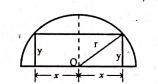
x = r cos θ,
y = r sin θ
ஃ Length of the rectangle = 2x = 2r cos θ
Breadth of the rectangle = y = r sin θ
ஃ Area = 2xy = 2r2 cos θ sin θ
= r2 sin 2θ
Letf'(θ) = r2 2 cos 2θ
f(θ) = r2cosθ sinθ
⇒ 2r2 cos 2θ = 0
\(\Rightarrow cos2\theta =0=cos\frac { \pi }{ 2 } \)
\(\Rightarrow 2\theta =\frac { \pi }{ 2 } \)
\(\Rightarrow \theta =\frac { \pi }{ 4 } \)
\(f''={ 2r }^{ 2 }(2)-(-sin2\theta )\)
= \(-4{ r }^{ 2 }sin2\theta \)
\(\therefore f''\left( \frac { 4\pi }{ 4 } \right) =-4{ r }^{ 2 }sin2\left( \frac { \pi }{ 4 } \right) \)
= \(-4{ r }^{ 2 }sin\frac { \pi }{ 2 } ={ 4r }^{ 2 }<0\)
ஃ f(θ) is maximum when \(\theta =\frac { \pi }{ 4 } \)
ஃ Length of the rectangle \((x)=2ros\frac { \pi }{ 4 } \)
= \(2r\times \frac { 1 }{ \sqrt { 2 } } =\sqrt { 2 } r\)
ஃ Breadth of the rectangle = y = r sin θ
= \(rsin\frac { \pi }{ 4 } =\frac { r }{ \sqrt { 2 } } \)
21.
Given x + y = 10
⇒ y = 10 -x ...(1)
Let f(x) = x2+y
= x2+ (10 -x)2
= x + 100 +x2- 20x
f(x) = 2x2 - 20x+ 100
f'(x) = 4x - 20
f'(x) = 0
4x-20 = 0
4x = 20
⇒ x = 5
∴The critical number is 5
f"(x) = 4
ஃ f"(5) = 4 > 0
ஃf(x) is minimum when x = 5
When x = 5, y = 10- 5 = 5
[From (1)]
ஃ Smallest possible value of x2+y2
= 52 + 52 = 25 + 25 = 50
22.
\(\Rightarrow \frac { dy }{ dx } =\frac { { y }^{ 2 }-2xy }{ { x }^{ 2 }-2xy }\) ...(1)
This is a homogeneous differential equation
\(\therefore put\ y=vx\Rightarrow \frac { dy }{ dx } =v+x\frac { dv }{ dx }\)
\(\therefore\) (1) becomes,
\(v+x\frac { dv }{ dx } =\frac { { v }^{ 2 }{ x }^{ 2 }-2xvx }{ { x }^{ 2 }-2xvx }\)
\(=\frac{x^z\left(v^2-2 v\right)}{x^z(1-2 v)}\)
\(\Rightarrow x\frac { dv }{ dx } =\frac { { v }^{ 2 }-2v }{ 1-2v } -v\)
\(=\frac { { v }^{ 2 }-2v-v+2{ v }^{ 2 } }{ 1-2v }\)
\(=\frac { { 3v }^{ 2 }-3v }{ 1-2v }\)
Separating the variables we get,
\(\frac { 1-2v }{ 3{ v }^{ 2 }-3v } dv=\frac { dx }{ x }\)
\(\frac { 6v-3 }{ 3{ v }^{ 2 }-3v } dv=-3\frac { dx }{ x }\)
Integrating on both sides,
\(\int \frac{(2 v-1) d v}{\left(v^2-v\right)} =\int-3 \frac{d x}{x}\)
\(\log \left(v^2-v\right) =-3 \log x+\log \mathrm{c}\)
\(\log \left(v^2-v\right)+\log \left(x^3\right) =\log \mathrm{c}\)
\(\left(v^2-v\right)\left(x^3\right) =\mathrm{c}\)
\(\left(\frac{y^2}{x^2}-\frac{y}{x}\right) x^3 =c\)
\(x y^2-x^2 \mathrm{y} =\mathrm{c}\)
23.
f(x) is defined and differentiable in (-∞, ∞)
\(\therefore f'(x)=\frac { (1-{ e }^{ x }){ e }^{ x }-{ e }^{ x }\left( -{ e }^{ x } \right) }{ (1-{ e }^{ x })^{ 2 } } \)
= \(\frac { 1-{ e }^{ 2 }+{ e }^{ 2 }x }{ (1-{ e }^{ x })^{ 2 } } =\frac { 1 }{ \left( 1-{ e }^{ x } \right) ^{ 2 } } \)
\(f'\left( x \right) =0\Rightarrow \frac { 1 }{ (1-{ e }^{ x })^{ 2 } } \neq 0\)
Thus there is no stationary point
Since \(f'\left( x \right) =\frac { 1 }{ \left( 1-{ e }^{ x } \right) ^{ 2 } } >0\) for-all x ∈ (-∞, ∞)
Since there is no stationary print, the curve does not change its position.
Hence there is no local extremum.
24.
Let the point of intersection of the two curves be (a,b) . Hence,
\(a^{2}+4b^{2}=8\) and \(a^{2}-2b^{2}=4\) ...(4)
It is enough if we show that the product of the slopes of the two curves evaluated at (a, b) is −1.
Differentiation of \(x^{2}+4y^{2}=8\) with respect x, gives
\(2x+8y=\frac{dy}{dx}=0\).
Therefore \(\frac{dy}{dx}= -\frac{-x}{4y}\),
\((\frac{dy}{dx})_{(a,b)}=m_{1}= -\frac{a}{4b}\)
Differentiation of x2-2y2 = 4 with respect to x, gives
\(2x-4y\frac{dy}{dx}=0\)
Therefore, \(\frac{dy}{dx}=\frac{x}{2y}\),
at \((a,b)(\frac{dy}{dx})=m_{2}= \frac{a}{4b}\).
Therefore, \(m_{1}\times m_{2}=(-\frac{a}{4b})\times (\frac{a}{2b})= -\frac{a^{2}}{8b^{2}}\) ...(5)
Applying the ratio of proportions in (4), we get
\(\frac{a^{2}}{-16-16}=\frac{b^{2}}{-8+4}=\frac{1}{-2-4}\)
Therefore, \(\frac{a^{2}}{b^{2}}=\frac{32}{4}=8\) Substituting in (5), we get \(m_{1}\times m_{2}=-1\) Hence, the curves cut orthogonally.
25.
Given s (t) = 2t3 − 9t2 + 12t ≥ 0
26.
Let a(t) be the distance of car A north of P at time t, and b (t) the distance of car B east of P at time t, and let c(t) be the distance from car A to car B at time t. By the Pythagorean Theorem, c(t)2 = a(t)2 + b(t)2
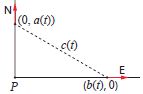
Taking derivatives, we get 2c(t)c'(t) = 2a(t)a'(t) + 2b(t)b'(t).
So, c′ = \(\frac { { aa }^{ ' }+{ bb }^{ ' } }{ c } =\frac { { aa }^{ ' }+{ bb }^{ ' } }{ \sqrt { { a }^{ 2 }+{ b }^{ 2 } } } \)
Substituting known values, we get
\(c' =\frac { (10\times 80)+(15\times 100) }{ \sqrt { { 10 }^{ 2 }+{ 15 }^{ 2 } } } =\frac { 460 }{ \sqrt { 13 } } \) ≈ 127.6 km/hr at the time of intersect
27.
(x-4)(x-7)(x-2)(x+1) = 16
Given (x - 4)(x -7)(x - 2)(x + 1) = 16
Rearrange the terms as
(x - 4)(x - 2)(x -7)(x + 1) = 16
⇒ (x2 - 6x + 8)(x2 - 6x -7) = 16
Put x2-6x = y
⇒ (y + 8) (y - 7) = 16
⇒ y2 +y - 56 - 16 = 0
⇒ (y+9)(y-8) = 0
⇒ y = -9, 8
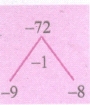
case (i)
When y = -9
⇒ x2-6x = -9
⇒ x2-6x+9 = 0
⇒ (x-3)2 = 0
⇒ x = 3, 3

case ii
When y = 8,
\(\Rightarrow x=\frac { 6\pm \sqrt { 36-4(1)(-8) } }{ 2 } \)
\(\Rightarrow x=\frac { 6\pm \sqrt { 36-32 } }{ 2 } \Rightarrow x=\frac { 6\pm \sqrt { 68 } }{ 2 } \)
\(\Rightarrow x=\frac { 6\pm 2\sqrt { 17 } }{ 2 } \Rightarrow x=\frac { 2(3\pm \sqrt { 17 } ) }{ 2 } \)
\(\Rightarrow x=3\pm \sqrt { 17 } \)
∴ The roots are 3, 3, 3 +\(\sqrt{17}\), and 3 -\(\sqrt{17}\)
28.
\(\left( -\sqrt { 3 } +3i \right) ^{ 31 }\)
Let \(-\sqrt { 3 } +3i=r\left( cos\theta +isin\theta \right) \). Then, we get
\(r=\sqrt { \left( -\sqrt { 3 } \right) ^{ 2 }+{ 3 }^{ 2 } } =\sqrt { 12 } =2\sqrt { 3 } \)
\(\alpha ={ tan }^{ -1 }\left| \frac { 3 }{ -\sqrt { 3 } } \right| ={ tan }^{ -1 }\sqrt { 3 } =\frac { \pi }{ 3 } \)
\(\theta =\pi -\alpha =\pi -\frac { \pi }{ 3 } =\frac { 2\pi }{ 3 } \) (\(\because\) \(\sqrt { 3 } +3i\) lies in II Quadrant)
Therefore,\(-\sqrt { 3 } +3i=2\sqrt { 3 } \left( cos\frac { 2\pi }{ 3 } +isin\frac { 2\pi }{ 3 } \right) \)
Raising power 31 on both sides,
\(\left( -\sqrt { 3 } +3i \right) ^{ 31 }=\left( 2\sqrt { 3 } \right) ^{ 31 }\left( cos\frac { 2\pi }{ 3 } +isin\frac { 2\pi }{ 3 } \right) ^{ 31 }\)
= \(\left( 2\sqrt { 3 } \right) ^{ 31 }\left( cos\left( 20\pi +\frac { 2\pi }{ 3 } \right) +isin\left( 20\pi +\frac { 2\pi }{ 3 } \right) \right) \)
= \(\left( 2\sqrt { 3 } \right) ^{ 31 }\left( cos\frac { 2\pi }{ 3 } +isin\frac { 2\pi }{ 3 } \right) \)
= \(\left( 2\sqrt { 3 } \right) ^{ 31 }\left( cos\left( \pi -\frac { \pi }{ 3 } \right) +isin\left( \pi -\frac { \pi }{ 3 } \right) \right) \)
= \(\left( 2\sqrt { 3 } \right) ^{ 31 }\left( -cos\frac { \pi }{ 3 } +isin\frac { \pi }{ 3 } \right) =\left( 2\sqrt { 3 } \right) ^{ 31 }\left( -\frac { 1 }{ 2 } +i\frac { \sqrt { 3 } }{ 2 } \right) \).
29.
\(\left[ \begin{matrix} 1 & 2 & 3 \\ 2 & 5 & 3 \\ 1 & 0 & 8 \end{matrix} \right] \)
Let A =\(\left[ \begin{matrix} 1 & 2 & 3 \\ 2 & 5 & 3 \\ 1 & 0 & 8 \end{matrix} \right] \)
Applying Gauss - Jordan method, we get
[A|I3] =\(\left[ \begin{matrix} 1 & 2 & 3 \\ 2 & 5 & 3 \\ 1 & 0 & 8 \end{matrix}|\begin{matrix} 1 & 0 & 0 \\ 0 & 1 & 0 \\ 0 & 0 & 1 \end{matrix} \right] \)
\(\overset { { R }_{ 2 }\rightarrow { R }_{ 2 }-2{ R }_{ 1 }\\ { R }_{ 3 }\rightarrow { R }_{ 3 }-{ R }_{ 1 } }{ \longrightarrow } \left[ \begin{matrix} 1 & 2 & 3 \\ 0 & 1 & -3 \\ 0 & -2 & 5 \end{matrix}|\begin{matrix} 1 & 0 & 0 \\ -2 & 1 & 0 \\ -1 & 0 & 1 \end{matrix} \right] \)
\(\overset { { R }_{ 1 }\rightarrow { R }_{ 1 }+{ R }_{ 3 } }{ \longrightarrow } \left[ \begin{matrix} 1 & 0 & 8 \\ 0 & 1 & -3 \\ 0 & -2 & 5 \end{matrix}|\begin{matrix} 0 & 0 & 1 \\ -2 & 1 & 0 \\ -1 & 0 & 1 \end{matrix} \right] \)
\(\\ \overset { { R }_{ 3 }\rightarrow { R }_{ 3 }+2{ R }_{ 2 } }{ \longrightarrow } \left[ \begin{matrix} 1 & 0 & 8 \\ 0 & 1 & -3 \\ 0 & 0 & -1 \end{matrix}|\begin{matrix} 0 & 0 & 1 \\ -2 & 1 & 0 \\ -5 & 2 & 1 \end{matrix} \right] \)
\(\overset { { R }_{ 2 }\rightarrow { R }_{ 2 }-3{ R }_{ 3 } }{ \longrightarrow } \left[ \begin{matrix} 1 & 0 & 8 \\ 0 & 1 & 0 \\ 0 & 0 & -1 \end{matrix}|\begin{matrix} 0 & 0 & 1 \\ 13 & -5 & -3 \\ -5 & 2 & 1 \end{matrix} \right] \)
\(\overset { R_{ 1 }\rightarrow { R }_{ 1 }+8R_{ 3 } }{ \longrightarrow } \left[ \begin{matrix} 1 & 0 & 0 \\ 0 & 1 & 0 \\ 0 & 0 & -1 \end{matrix}|\begin{matrix} -40 & 16 & 9 \\ 13 & -5 & -3 \\ -5 & 2 & 1 \end{matrix} \right] \)
\(\overset { { R }_{ 3 }\rightarrow { R }_{ 3 }\times (-1) }{ \longrightarrow } \left[ \begin{matrix} 11 & 0 & 0 \\ 0 & 1 & 0 \\ 0 & 0 & 1 \end{matrix}|\begin{matrix} -40 & 16 & 9 \\ 13 & -5 & -3 \\ 5 & -2 & -1 \end{matrix} \right] \)
So we get A-1 =\(\left[ \begin{matrix} -40 & 16 & 9 \\ 13 & -5 & -3 \\ 5 & -2 & -1 \end{matrix} \right] \).
30.
Comparing the two given lines with
\(\vec { r } =\vec { a } +t\vec { b } ,\vec { r } =\vec { c } +s\vec { d } \)
we have, \(\vec { a } =-\hat { i } -3\hat { j } -5\hat { k } ,\vec { b } =3\hat { i } +5\hat { j } +7\hat { k } ,\vec { c } =2\hat { i } +4\hat { j } +6\hat { k } \) and \(\vec { d } =\hat { i } +4\hat { j } +7\hat { k } \)
We know that the two given lines are coplar, if \((\vec { c } -\vec { a } ).(\vec { b } \times \vec { d } )\) = 0
Here, \(\vec { b } \times \vec { d } \left| \begin{matrix} \hat { i } & \hat { j } & \hat { k } \\ 3 & 5 & 7 \\ 1 & 4 & 7 \end{matrix} \right| =7\hat { i } -14\hat { j } +7\hat { k } \) and \(\vec { c } -\vec { a } =3\hat { i } +7\hat { j } +11\hat { k } \)
Then, \((\vec { c } -\vec { a } ).(\vec { b } \times \vec { d } )=(3\hat { i } +7\hat { j } +11\hat { k } )(7\hat { i } -14\hat { j } +7\hat { k } )=0\)
Therefore the two given lines are coplanar. Then we find the non parametric form of vector equation of the plane containing the two given coplanar lines. We know that the plane containing the two given coplanar lines is
\((\vec { r } -\vec { a } ).(\vec { b } \times \vec { d } )\)= 0
which implies that \((\vec { r } -(-\hat { i } -3\hat { j } -5\hat { k } )).(7\hat { i } -14\hat { j } +7\hat { k } )\) = 0.
Thus, the required non-parametric vector equation of the plane containing the two given coplanar lines is
\(\vec { r } .(\hat { i } -2\hat { j } +\hat { k } )\) = 0.
31.
Given plane is passing through the points
\(\vec { a } =2\hat { i } +2\hat { j } +2\hat { k }, \vec { b } =9\hat { i } +3\hat { j } +6\hat { k } \)
Equation of the given plane is 2x + 6y + 6z = 9. It can be written as \(\vec { r } .(2\hat { i } +6\hat { j } +6\hat { k } )=9\)
Since the given plane is perpendicular to \(2\hat { i } +6\hat { j } +6\hat { k } \), the required plane is parallel to \(\vec { c } =2\hat { i } +6\hat { j } +6\hat { k } \). Hence, parametric form of vector equation of plane passing through two points and parallel to a vector is
\(\vec { r } =\vec { a } +s(\vec { b } -\vec { a } )+t\vec { c } ,s,t\in R\)
\(\vec { r } =2\hat { i } +2\hat { j } +\hat { k } +s(7\hat { i } +\hat { j } +5\hat { k } )+t(2\hat { i } +6\hat { j } +6\hat { k } ),s,t\in R\)
Cartesian equation of the plane is
\(\left| \begin{matrix} x-{ x }_{ 1 } & y-{ y }_{ 1 } & z-{ z }_{ 1 } \\ { x }_{ 2 }-{ x }_{ 1 } & { y }_{ 2 }-{ y }_{ 1 } & { z }_{ 2 }-{ z }_{ 1 } \\ { c }_{ 1 } & { c }_{ 2 } & { c }_{ 3 } \end{matrix} \right| =0\)
\(\Rightarrow \left| \begin{matrix} x-2 & y-2 & z-1 \\ 7 & 1 & 5 \\ 2 & 6 & 6 \end{matrix} \right| =0\)
⇒ (x-2)(6-30) - (y-2)(42-10) + (z-1)(42-2) = 0
⇒ (x - 2)(-24) - (y - 2)(32) + (z - 1)(40) = 0
⇒ 24x + 48 - 32y + 64 + 40z - 40 = 0
⇒ -24x - 32y + 40z + 72 = 0
\(\div\) - 8 we get
3x+ 4y - 5z - 9 = 0 is the Cartesian form.
∴ The parametric form of vector equation is
\(\vec { r } =\vec { r } (3\vec { i } +4\vec { j } -5\vec { k } )=9\)
32.
By taking the vertex; at the origin, the parabola is open downward.
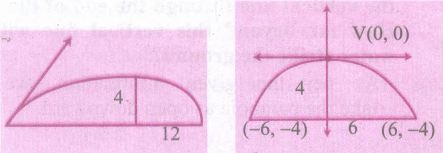
Its equation is x2 = -4ay
It passes through (6, -4)
∴ 36 = -4a(-4) ⇒ 4a = - \(\frac { 36 }{ 4 } \) = 9
∴ (1) becomes, x2 = -9y
To find the slope at (-6, -4)
Differentiating (1) with respect to 'x' we get,
2x = -9\(\frac { dy }{ dx } \)
⇒ \(\frac { dy }{ dx } =\frac { -2x }{ 9 } \)
At (-6, -4), \(\frac { dy }{ dx } =-2\frac { (-6) }{ 9 } =\frac { 12 }{ 9 } =\frac { 4 }{ 3 } \)
∴ \(tan\theta =\frac { 4 }{ 3 } \Rightarrow \theta ={ tan }^{ -1 }\left( \frac { 4 }{ 3 } \right) \)
∴ The angle of projection is tan-1 \(\left( \frac { 4 }{ 3 } \right) \)
33.
Let the cross section of the satellite dish be an right open parabola.
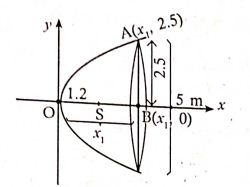
Its equation is y2 = 4ax
Since focus is placed 1.2 m from the vertex OA = 1.2 m and BC = 2.5 m since the width of the dish is 5 m.
From the diagram, a = 1.2 m
∴ y2 = 4(1.2)x
(a) ⇒ y2 = 4.8x ...(1)
(b) Since (x1, 2.5) lines on (1)(2.5)2 = 4.8(x1)
x1 = \(\frac { 2.5\times 2.5 }{ 4.8 } \)
x1 = 1.3 m
∴ Depth of the satellite dish at the vertex is 1.3 m.
34.
2x+3y = 9, 7x+3y-5z = 8, 2x+3y+⋋z = μ
The matrix form of the system is AX = B where
A =\(\left[ \begin{matrix} 2 & 3 & 5 \\ 7 & 3 & -5 \\ 2 & 3 & \lambda \end{matrix} \right] ,X=\left[ \begin{matrix} x \\ y \\ z \end{matrix} \right] ,B=\left[ \begin{matrix} 9 \\ 8 \\ \mu \end{matrix} \right] \)
Applying elementary row operations augmented matrix [A|B] we get
[A|B] =\(\left[ \begin{matrix} 2 & 3 & 5 \\ 7 & 3 & -5 \\ 2 & 3 & \lambda \end{matrix}|\begin{matrix} 9 \\ 8 \\ \mu \end{matrix} \right] \overset { { R }_{ 1 }\leftrightarrow { R }_{ 2 } }{ \longrightarrow } \left[ \begin{matrix} 7 & 3 & -5 \\ 2 & 3 & 5 \\ 2 & 3 & \lambda \end{matrix}|\begin{matrix} 8 \\ 9 \\ \mu \end{matrix} \right] \)
\(\overset { { R }_{ 2 }\rightarrow { R }_{ 2 }-\frac { 2 }{ 7 } { R }_{ 1 }\\ { R }_{ 3 }\rightarrow { R }_{ 3 }-{ R }_{ 2 } }{ \longrightarrow } \left[ \begin{matrix} 7 & 3 & -5 \\ 0 & \frac { 15 }{ 7 } & \frac { 45 }{ 7 } \\ 0 & 0 & \lambda -5 \end{matrix}|\begin{matrix} -8 \\ \frac { 45 }{ 7 } \\ 4-9 \end{matrix} \right] \)
\(\overset { { R }_{ 2 }\rightarrow { R }_{ 2 }\times 7 }{ \longrightarrow } \left[ \begin{matrix} 7 & 3 & -5 \\ 0 & 15 & 45 \\ 0 & 0 & \lambda -5 \end{matrix}|\begin{matrix} -8 \\ 47 \\ \mu -9 \end{matrix} \right] \)
Case (i): when λ = 5
[A|B] =\(\left[ \begin{matrix} 7 & 3 & -5 \\ 0 & 15 & 45 \\ 0 & 0 & 0 \end{matrix}|\begin{matrix} -8 \\ 47 \\ -4 \end{matrix} \right] \)
Here \(\rho \)(A) = 2 and \(\rho \)[A|B] = 3
So, \(\rho \)(A) ≠ \(\rho \)[A|B]
Hence the system is inconsistent and has no solution
Case (ii) : When λ ≠ 5, μ ≠ 9
[A|B] =\(\\ \left[ \begin{matrix} 7 & 3 & -5 \\ 0 & 15 & 45 \\ 0 & 0 & not\quad zero \end{matrix}|\begin{matrix} -8 \\ 47 \\ not\quad zero \end{matrix} \right] \)
Here \(\rho \)(A) = 3 and \(\rho \)[A|B] = 3
∴ \(\rho \)(A) = \(\rho \)[A|B] = 3 = number of unknowns
Hence, the system is consistent with solution
Case (iii) : When λ = 5, μ = 9
[A|B] =\(\left[ \begin{matrix} 7 & 3 & -5 \\ 0 & 15 & 45 \\ 0 & 0 & 0 \end{matrix}|\begin{matrix} -8 \\ 47 \\ 0 \end{matrix} \right] \)
Here \(\rho \)(A) = 2 and \(\rho \)[A|B] = 2
∴ \(\rho \)(A) = \(\rho \)[A|B] = 2
∴ The system is consistent and has infinite number of solutions.
35.
Here the number of unknowns is 3.
The matrix form of the system is AX = B, where
A = \(\left[ \begin{matrix} 4 & -2 & 6 \\ 1 & 1 & -3 \\ 15 & -3 & 9 \end{matrix} \right] \), X = \(\left[ \begin{matrix} x \\ y \\ z \end{matrix} \right] \), B = \(\left[ \begin{matrix} 8 \\ -1 \\ 21 \end{matrix} \right] \)
Applying elementary row operations on the augmented matrix [A | B], we get
[A | B] = \(\left[ \begin{matrix} 4 & -2 & 6 \\ 1 & 1 & -3 \\ 15 & -3 & 9 \end{matrix}|\begin{matrix} 8 \\ -1 \\ 21 \end{matrix} \right] \) \(\overset { { R }_{ 1 }\leftrightarrow { R }_{ 2 } }{ \longrightarrow } \left[ \begin{matrix} 1 & 1 & -3 \\ 4 & -2 & 6 \\ 15 & -3 & 9 \end{matrix}|\begin{matrix} -1 \\ 8 \\ 21 \end{matrix} \right] \overset { \begin{matrix} { R }_{ 2 }\longrightarrow { R }_{ 2 }-4{ R }_{ 1 }, \\ { R }_{ 3 }\longrightarrow { R }_{ 3 }-15{ R }_{ 1 } \end{matrix} }{ \longrightarrow } \left[ \begin{matrix} 1 & 1 & -3 \\ 0 & -6 & 18 \\ 0 & -18 & 54 \end{matrix}|\begin{matrix} -1 \\ 12 \\ 36 \end{matrix} \right] \)\(\overset { \begin{matrix} { R }_{ 2 }\longrightarrow { R }_{ 2 }\div \left( -6 \right) , \\ { R }_{ 3 }\longrightarrow { R }_{ 3 }\div \left( -18 \right) \end{matrix} }{ \longrightarrow } \left[ \begin{matrix} 1 & 1 & -3 \\ 0 & 1 & -3 \\ 0 & 1 & -3 \end{matrix}|\begin{matrix} -1 \\ -2 \\ -2 \end{matrix} \right] \overset { { R }_{ 3 }\longrightarrow { R }_{ 3 }-{ R }_{ 2 } }{ \longrightarrow } \left[ \begin{matrix} 1 & 1 & -3 \\ 0 & 1 & -3 \\ 0 & 0 & 0 \end{matrix}|\begin{matrix} -1 \\ -2 \\ 0 \end{matrix} \right] \).
So, ρ(A)= ρ([A | B]) = 2 < 3. From the echelon form, we get the equivalent equations
x + y − 3z = −1, y − 3z = −2 , 0 = 0.
The equivalent system has two non-trivial equations and three unknowns. So, one of the unknowns should be fixed at our choice in order to get two equations for the other two unknowns. We fix z arbitrarily as a real number t , and we get y = 3t − 2, x = −1−(3t − 2) + 3t = 1. So, the solution is (x = 1, y = 3t − 2, z = t), where t is real. The above solution set is a one-parameter family of solutions. Here, the given system is consistent and has infinitely many solutions which form a one parameter family of solutions.
36.
Now, \(tan^{ -1 }\left( \frac { x-1 }{ x-2 } \right) +tan^{ -1 }\left( \frac { x+1 }{ x+2 } \right) =tan^{ -1 }\left[ \frac { \frac { x-1 }{ x-2 } +\frac { x+1 }{ x+2 } }{ 1-\frac { x-1 }{ x-2 } \left( \frac { x+1 }{ x+2 } \right) } \right] =\frac { \pi }{ 4 } \)
Thus, \(\frac { \frac { x-1 }{ x-2 } +\frac { x+1 }{ x+2 } }{ 1-\frac { x-1 }{ x-2 } \left( \frac { x+1 }{ x+2 } \right) } \) = 1, which on simplification gives 2x2−4 = −3
Thus, x2 = \(\frac{1}{2}\)gives x = \(\pm \frac { 1 }{ \sqrt { 2 } } \)
37.
The path y = ax2 + bx + c passes through the points (10, 8), (20, 16), (40, 22). So, we get the system of equations 100a + 10b + c = 8, 400a + 20b + c = 16, 1600a + 40b + c = 22. To apply Cramer’s rule, we find
Δ = \(\left| \begin{matrix} 100 & 10 & 1 \\ 400 & 20 & 1 \\ 1600 & 40 & 1 \end{matrix} \right| =1000\left| \begin{matrix} 1 & 1 & 1 \\ 4 & 2 & 1 \\ 16 & 4 & 1 \end{matrix} \right| \) = 1000 [-2 + 12 - 6] = -6000,
Δ1 = \(\left| \begin{matrix} 8 & 10 & 1 \\ 16 & 20 & 1 \\ 22 & 40 & 1 \end{matrix} \right| =20\left| \begin{matrix} 4 & 1 & 1 \\ 8 & 2 & 1 \\ 11 & 4 & 1 \end{matrix} \right| \) = 20[-8 + 3 + 10] = 100,
Δ2 = \(\left| \begin{matrix} 100 & 8 & 1 \\ 400 & 16 & 1 \\ 1600 & 22 & 1 \end{matrix} \right| =200\left| \begin{matrix} 1 & 4 & 1 \\ 4 & 8 & 1 \\ 16 & 11 & 1 \end{matrix} \right| \) = 200[-3 + 48 - 84] = -7800,
Δ3 = \(\left| \begin{matrix} 100 & 10 & 8 \\ 400 & 20 & 16 \\ 1600 & 40 & 22 \end{matrix} \right| =2000\left| \begin{matrix} 1 & 1 & 4 \\ 4 & 2 & 8 \\ 16 & 4 & 11 \end{matrix} \right| \) = 2000[-10 + 84 - 64] = 20000.
By Cramer’s rule, we get a = \(\frac { { \Delta }_{ 1 } }{ \Delta } =-\frac { 1 }{ 60 } \), b = \(\frac { { \Delta }_{ 2 } }{ \Delta } =\frac { 7800 }{ 6000 } =\frac { 78 }{ 60 } =\frac { 13 }{ 10 } \), c = \(\frac { { \Delta }_{ 3 } }{ \Delta } =\frac { 20000 }{ 6000 } =-\frac { 20 }{ 6 } =-\frac { 10 }{ 3 } \).
So, the equation of the path is y = \(\frac { 1 }{ 60 } { x }^{ 2 }+\frac { 13 }{ 10 } x-\frac { 10 }{ 3 } \).
When x = 70, we get y = 6. So, the ball went by 6 metres high over the boundary line and it is impossible for a fielder standing even just before the boundary line to jump and catch the ball. Hence the ball went for a super six and the team won the match.
38.
For the parabola,
x2- 4x - 5y -1 = 0
x2- 4x = 5y +1
x2−4x +4 = 5y +1+ 4
(x − 2)2 = 5(y +1) which is in standard form.
Therefore 4a = 5 and the vertex is (2, -1) , and focus is \(\left( 2,\frac { 1 }{ 4 } \right) \)
Equation of directrix is
y-k+ a = 0
y+1+\(\frac { 5 }{ 4 } \)
4y +9 = 0
Length of latus rectum is 5 units.
39.
We can solve this fourth degree equation by rewriting it suitably and adopting a technique of substitution. Rewriting the equation as
(x−2)(x−3)(x−7)(x+2)+19 = 0
the given equation becomes
(x2−5x+6)(x2−5x−14)+19 = 0 .
If we take x2 − 5x as y, then the equation becomes (y+6)(y−14)+19 = 0;
that is, y2-8y-65 = 0
Solving this we get solutions y = 13 and y = −5. Substituting this we get two quadratic equations
x2-5x-13 = 0 and x2-5x+5 = 0
which can be solved by usual techniques. The solutions obtained for these two equations together give solutions as \(\frac { 5\pm \sqrt { 77 } }{ 2 } ,\frac { 5\pm \sqrt { 5 } }{ 2 } \).
40.
If A is orthogonal, then AAT = ATA = I3. So, we have
AAT = I3 ⇒ \(\frac { 1 }{ 7 } \left[ \begin{matrix} 6 & -3 & a \\ b & -2 & 6 \\ 2 & c & 3 \end{matrix} \right] \frac { 1 }{ 7 } \left[ \begin{matrix} 6 & -3 & a \\ b & -2 & 6 \\ 2 & c & 3 \end{matrix} \right] =\left[ \begin{matrix} 1 & 0 & 0 \\ 0 & 1 & 0 \\ 0 & 0 & 1 \end{matrix} \right] \)
⇒ \(\left[ \begin{matrix} 45+{ a }^{ 2 } & 6b+6+6a & 12-3c+3a \\ 6b+6+6a & { b }^{ 2 }+40 & 2b-2c+18 \\ 12-3c+3a & 2b-2c+18 & { c }^{ 2 }+13 \end{matrix} \right] =49\left[ \begin{matrix} 1 & 0 & 0 \\ 0 & 1 & 0 \\ 0 & 0 & 1 \end{matrix} \right] \)
⇒ \(\left\{ \begin{matrix} 45+{ a }^{ 2 }=49 \\ \begin{matrix} { b }^{ 2 }+40=49 \\ \begin{matrix} { c }^{ 2 }+13=49 \\ \begin{matrix} 6b+6+6a=0 \\ \begin{matrix} 12-3c+3a=0 \\ 2b-2c+18=0 \end{matrix} \end{matrix} \end{matrix} \end{matrix} \end{matrix} \right\} \) ⇒ \(\left\{ \begin{matrix} { a }^{ 2 }=4,{ b }^{ 2 }=9,{ c }^{ 2 }=36 \\ a+b=-1,a-c=-4,b-c=-9 \end{matrix} \right\} \) ⇒ a = 2, b = −3, c = 6
So we get A = \(\frac { 1 }{ 7 } \left[ \begin{matrix} 6 & -3 & 2 \\ -3 & -2 & 6 \\ 2 & 6 & 3 \end{matrix} \right] \) and hence, we get A-1 = AT = \(\frac { 1 }{ 7 } \left[ \begin{matrix} 6 & -3 & 2 \\ -3 & -2 & 6 \\ 2 & 6 & 3 \end{matrix} \right] \).
41.
\(Let\ u={ x }^{ 2 }\ v=cos 2x\ dx\)
\(u'=2x\quad { v }_{ 1 }=\frac { sin2x }{ 2 } \)
\(u"=2\quad { v }_{ 2 }=-\frac { cos2x }{ 4 } \)
\(\\ { v }_{ 3 }=-\frac { sinx }{ 8 } \)
Bernoulli's' formula:
\(\int { uvdx } =u{ v }_{ 1 }-u'{ v }_{ 2 }+u''{ v }_{ 3 }\)
\(\therefore \int _{ 0 }^{ \pi /2 }{ { x }^{ 2 }cos2x\quad dx={ \left[ \frac { { x }^{ 2 }sin2x }{ 2 } +\frac { 2xcos2x }{ 4 } -\frac { 2sin2x }{ 8 } \right] }_{ 0 }^{ \frac { \pi }{ 2 } } } \)
\(=\left[ \frac { { \pi }^{ 2 } }{ 8 } sin\pi +\frac { 2\pi }{ 8 } cos\pi -\frac { sin\pi }{ 8 } \right] -[0+0-0]\)
\(=\frac {- 2\pi }{ 8 } (-1)=\frac { \pi }{ 4 }\quad [\because sin\pi =0,cos\pi =-1]\)
42.
Given that \(\frac { dy }{ dx } =\frac { x-y+5 }{ 2(x-y)+7 } .\)
Put z = x-y
\(\frac { dz }{ dx } =1-\frac { dy }{ dx } \)
\(\frac { dy }{ dx } =1-\frac { dz }{ dx } \)
Thus, the given equation reduces to
\(1-\frac { dz }{ dx } =\frac { z+5 }{ 2z+7 } \)
\(\frac { dz }{ dx } =1+\frac { z+5 }{ 2z+7 } \)
\(\frac { dz }{ dx } =\frac { z+2 }{ 2z+7 } \)
Separating the variables, we get
\(\frac { 2z+7 }{ z+2 } dz=dx\)
\(\frac { 2(z+2)+3 }{ z+2 } =dx\)
\(\left( 2+\frac { 3 }{ z+2 } \right) dz=dx\)
Integrating both sides, we get
2z + 3log |z+ 2| = x + C
That is, 2(x − y) + 3log |x −y+2| = x + C
43.
Every point on the line \(\frac { x-1 }{ 2 } =\frac { y-2 }{ 3 } =\frac { z-3 }{ 4 } \) = s (say) is of the form (2s + 1, 3s + 2, 4s + 3) and every point on the line \(\frac { x-4 }{ 5 } =\frac { y-1 }{ 2 } =z=t\) (say) is of the form (5t + 4, 2t + 1, t).
So, at the point of intersection, for some values of s and t, we have
(2s + 1, 3s + 2, 4s + 3) = (5t + 4, 2t + 1, t)
Therefore, 2s - 5t = 3, 3s - 2t = -1 and 4s - t = -3. Solving the first two equations we get t = -1, s = -1.
These values of s and t satisfy the third equation. Therefore, the given lines intersect.
Substituting, these values of t or s in the respective points, the point of intersection is (-1,- 1, -1)
44.
AS = 94.5 × 10⁶ km,
SA' = 152 × 106 km
a+c = 152 × 106
a-c = 94.5 × 10⁶
Subtracting 2c = 57.5 × 106 = 575 × 105 km
Distance of the Sun from the other focus is SS' = 575 × 105 km.
45.
Let \(\frac { \sqrt { 3 } }{ 2 } +\frac { i }{ 2 } \) = r(cos θ + i sin θ)
r = \(\sqrt { \left( \frac { \sqrt { 3 } }{ 2 } \right) ^{ 2 }+\left( \frac { 1 }{ 2 } \right) ^{ 2 } } =\sqrt { \frac { 3 }{ 4 } +\frac { 1 }{ 4 } } =\sqrt { \frac { 4 }{ 4 } } \)=1
α = \(tan^{ -1 }\left| \frac { y }{ x } \right| =tan^{ -1 }\left| \frac { \frac { 1 }{ 2 } }{ \frac { \sqrt { 3 } }{ 2 } } \right| =tan^{ -1 }\left( \frac { 1 }{ \sqrt { 3 } } \right) =\frac { \pi }{ 6 } \)
Since \(\frac { \sqrt { 3 } }{ 2 } +\frac { i }{ 2 } \) lies is the I quadrant, θ = α
∴ \(\frac { \sqrt { 3 } }{ 2 } +\frac { i }{ 2 } =1\left( cos\frac { \pi }{ 6 } +isin\frac { \pi }{ 6 } \right) \)
∴ \(\left( \frac { \sqrt { 3 } }{ 2 } +\frac { i }{ 2 } \right) ^{ 5 }=1^{ 5 }\left( cos\frac { \pi }{ 6 } +isin\frac { \pi }{ 6 } \right) ^{ 5 }\)
= \(cos\frac { 5\pi }{ 6 } +isin\frac { 5\pi }{ 6 } \) ....(1) [De moivres theorem]
Similarly \(\frac { \sqrt { 3 } }{ 2 } +\frac { i }{ 2 } =1\left( cos\frac { \pi }{ 6 } -isin\frac { \pi }{ 6 } \right) \)
∴ \(\left( \frac { \sqrt { 3 } }{ 2 } -\frac { i }{ 2 } \right) ^{ 5 }=1^{ 5 }\left[ cos\frac { \pi }{ 6 } +isin\frac { \pi }{ 6 } \right] ^{ 5 }\)
= \(cos\frac { 5\pi }{ 6 } -isin\frac { 5\pi }{ 6 } \) ....(2)
Adding (1) and (2) we get,
\(\left( \frac { \sqrt { 3 } }{ 2 } +\frac { i }{ 2 } \right) ^{ 5 }+\left( \frac { \sqrt { 3 } }{ 2 } -\frac { i }{ 2 } \right) ^{ 5 }\)

= \(2cos\frac { 5\pi }{ 6 } =2cos\left( \pi -\frac { \pi }{ 6 } \right) \)
= \(-2cos\ \frac { \pi }{ 6 } \) [∵ \(\frac { 5\pi }{ 6 } \) lies in the II quard]
= \(-2\left( \frac { \sqrt { 3 } }{ 2 } \right) =-\sqrt { 3 } \).
46.
With usual notations in triangle, ABC let \(\vec { BC } =\vec { a } \), \(\vec { CA } =\vec { b } \) and \(\vec { AB } =\vec { c} \). Then \(|\vec { BC }| =\vec { a } \), \(|\vec { CA } |=\vec { b } \) and \(|\vec { AB }| =\vec { c } \)
Since in ΔABC, \(\vec { BC }+\vec { CA }+\vec { AB}=0\) we have \(\vec { BC }\times(\vec { BC }+\vec { CA }+\vec { AB })=\vec { 0 }\)
Simplifying, we get,
\(\vec { BC }\times\vec { CA }=\vec { AB }\times\vec { BC }\) ....(1)
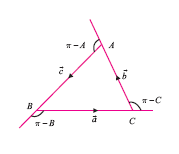
Similarly, since \(\vec { BC }+\vec { CA }+\vec { AB}=\vec 0\), we have
\(\vec {CA} \times (\vec { BC }+\vec { CA }+\vec { AB})=\vec 0\) .... (2)
On Simplification, we obtain \(\vec { BC }\times\vec { CA }=\vec {CA }\times\vec {AB }\)
From equations (1) and (2), we get
\(\vec { AB }\times\vec {BC }\) = \(\vec { CA }\times\vec {AB }\)=\(\vec { BC}\times\vec {CA}\)
So, \(\left| \overrightarrow { AB} \times \overrightarrow { BC } \right| =\left| \overrightarrow { CA } \times \overrightarrow { AB } \right| =\left| \overrightarrow { BC } \times \overrightarrow { CA } \right| \). Then, we get
ca sin(π − B) = bc sin(π - A) = ab sin (π - C)
That is, ca sin B = bc sin A = absinC . Dividing by abc, we get
\(\frac { sinA }{ A } =\frac { sinB }{ b } =\frac { sinC }{ c } \) or \(\frac { a }{ sinA }= \frac { b }{ sinB } =\frac { c }{ sinC } \)
47.
Given \(f(x)=\frac { { x }^{ 2 }-6x-1 }{ x+3 } \)
\(\underset { x\rightarrow -3^{ + } }{ lim } \frac { { x }^{ 2 }-6x-1 }{ x+3 } =\underset { h\rightarrow { 0 }^{ + } }{ lim } \frac { \left( -3+h \right) ^{ 2 }-6(-3+h)-1 }{ -3+h+3 } \)
= \(\underset { h\rightarrow 0^{ + } }{ lim } \frac { 9+{ h }^{ 2 }-6h+18-6h-1 }{ h } \)
= \(\underset { h\rightarrow 0^{ + } }{ lim } \frac { { h }^{ 2 }-12h+26 }{ h } =\infty \)
and \(\underset { x\rightarrow 3^{ - } }{ lim } \frac { { x }^{ 2 }-6x-1 }{ x+3 } =\underset { h\rightarrow { o }^{ + } }{ lim } \frac { \left( -3-h \right) ^{ 2 }-6(-3-h)-1 }{ -3-h+3 } \)
= -∞
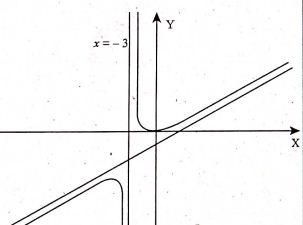
ஃx = -3 is the vertical asymptote,
Also
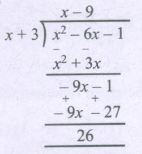
ஃ y = x - 9 is the slanting asymptote,

12th Standard Syllabus & Materials
12th Standard
TN 12th Computer Applications களப்பெயர் முறைமை (DNS) Sample Question Papers Study Material - QB365 Set A
NEW12th Standard
TN 12th Computer Applications வலையமைப்பு எடுத்துக்காட்டுகள் மற்றும் நெறிமுறைகள் Sample Question Papers Study Material - QB365 Set A
NEW12th Standard
TN 12th Computer Applications கணினி வலையமைப்பு ஓர் அறிமுகம் Sample Question Papers Study Material - QB365 Set A
NEW12th Standard
TN 12th Computer Applications PHP-உடன் MySQL-ஐ இணைத்தல் Sample Question Papers Study Material - QB365 Set A



Tamilnadu Stateboard 12th Standard Subjects
Maths

Chemistry

Physics

Biology

Computer Science

Business Maths and Statistics

Economics

Commerce

Accountancy

History

Computer Applications
Biology
Computer Technology
Computer Applications
Computer Science
Business Maths and Statistics
Commerce
Economics
Maths
Chemistry
Physics
Computer Technology
History
Accountancy

Tamil

English

French
Tamilnadu Stateboard Standards

