
 100% FREE ACCESS
12th Standard Syllabus & Materials
12th Standard
TN 12th Computer Applications மின்னணு தரவு பரிமாற்றம் Sample Question Papers Study Material - QB365 Set A
NEW12th Standard
TN 12th Computer Applications மின் - வணிக பாதுகாப்பு அமைப்புகள் Sample Question Papers Study Material - QB365 Set A
NEW12th Standard
TN 12th Computer Applications மின்னணு செலுத்தல் முறைகள் Sample Question Papers Study Material - QB365 Set A
NEW12th Standard
TN 12th Computer Applications மின் - வணிகம் Sample Question Papers Study Material - QB365 Set A
NEW12th Standard
TN 12th Computer Applications திறந்த மூல கருத்துருக்கள் Sample Question Papers Study Material - QB365 Set A
NEW12th Standard
TN 12th Computer Applications வலையமைப்பு வடமிடல் Sample Question Papers Study Material - QB365 Set A

Published on: 03/09/2020
12th Standard Maths English Medium Sample 5 Mark Creative Questions (New Syllabus) 2020
Download Tamil Nadu 12th Standard Maths question papers, model tests, one-mark questions, important questions, and public exam papers in PDF format. Free study materials and answer keys for TN State Board students.
Questions + Answers key
Take MCQ Maths Test1.
It is given that the rate at which some bacteria multiply is proportional to the instantaneous number present. If the original number of bacteria doubles in two hours, in how many hours will it be five times.
2.
Solve : (1+y2)(1 + log x)dx + x dy = 0, given that x = 1,y = 1.
3.
Show that the ratio of the area under the curve y=sinx and y=sin2x between x=0 and \(x=\frac { \pi }{ 3 } \) and x- axis are as 2 : 3.
4.
Find the area of the region common to the circle x2+y2=16 and the parabola y2=6x.
5.
A manufacturer can sell x items at a price of rupees \(\left( 5-\frac { x }{ 100 } \right) \) each. The cost price of x items is Rs.\(\left( \frac { x }{ 5 } +500 \right) \) .Find the numbers of items he should sell to earn maximum profit.
6.
A water tank has a shape of an inverted cone with its axis vertical and vertex lower most. Its semi vertical angle is tan−1(0.5). Water is poured into it at a constant rate of 5 cm3/hr. Find the rate at which the level of the water is rising at that instant when the depth of the water is 4 m.
7.
A population grows at the rate of 2% per year. How long does it take for the population to double?
8.
Construct the truth table for (p ∧ q) v r.
9.
Show that the area under the curve y = sin x and y = sin 2x between x = 0 and x = \(\frac { \pi }{ 3 } \) and x axis are as 2:3
10.
If V = log r and r2 = x2 +y2 + z2, then prove that \(\frac { { \partial }^{ 2 }V }{ \partial { x }^{ 2 } } +\frac { { \partial }^{ 2 }V }{ \partial { y }^{ 2 } } +\frac { { \partial }^{ 2 } }{ \partial { z }^{ 2 } } =\frac { 1 }{ { r }^{ 2 } } \)
11.
Show that the curves 4x = y2 and 4xy = k cut at right angles if k2 = 512.
12.
Find the shortest distance between the following pairs of lines \(\frac { x-3 }{ 3 } =\frac { y-8 }{ -1 } =\frac { z-3 }{ 1 } \)and \(\frac { x+3 }{ -3 } =\frac { y+7 }{ 2 } =\frac { z-6 }{ 4 } \)
13.
Verify that arg(1+i) + arg(1-i) = arg[(1+i) (1-i)]
14.
A kho-kho player In a practice session while running realises that the sum of tne distances from the two kho-kho poles from him is always 8m. Find the equation of the path traced by him of the distance between the poles is 6m.
15.
Simplify \({ sin }^{ -1 }\left( \frac { sinx+cosx }{ \sqrt { 2 } } \right) ,\frac { \pi }{ 4 }\)
16.
For what value of λ, the system of equations x + y + z = 1, x + 2y + 4z = λ, x + 4y + 10z = λ2 is consistent.
17.
If c ≠ 0 and \(\frac { p }{ 2x } =\frac { a }{ x+x } +\frac { b }{ x-c } \) has two equal roots, then find p.
1.
\(\frac { 2log5 }{ lof2 } hours\)
2.
\({ tan }^{ -1 }y=\frac { \pi }{ 4 } +\frac { 1 }{ 2 } -\frac { 1 }{ 2 } \left( 1+logx \right) ^{ 2 }\)
3.
prove.
4.
\(\frac { 4 }{ 2 } \left( 4\pi +\sqrt { 3 } \right) \)
5.
240
6.
\(\frac { 35 }{ 38 } m/h\)
7.
Let Po be the initial population and the population after t year be P.
Given \(\frac { dp }{ dt } =\frac { 2p }{ 100 } \Rightarrow \frac { dp }{ dt } =\frac { p }{ 50 } \)
⇒ \(\frac { dp }{ p } =\frac { dt }{ 50 } \Rightarrow \int { \frac { dp }{ p } } =\int { \frac { dt }{ 50 } } \)
⇒ log p =\(\frac { t }{ 50 } \) + c ...(1)
when t = 0, p = 0
⇒ log p0 = 0+c ⇒ log p0 ....(1)
∴ (1) becomes, log p =\(\frac { t }{ 50 } \)+log P0.
⇒ log\(\left( \frac { P }{ { p }_{ 0 } } \right) =\frac { t }{ 50 } \)
⇒ t = 50 log\(\left( \frac { P }{ { p }_{ 0 } } \right) \)
when p = 2p0, t = 50 log\(\left( \frac { 2P_{ 0 } }{ { p }_{ 0 } } \right) \) = 50 log 2
= 50(0.3) = 15 years.
Hence the population doubles in 15 years.
8.
| p | q | r | (p∧q) | (p∧q) v r |
| T | T | T | T | T |
| T | F | F | F | F |
| T | T | T | T | T |
| T | F | F | F | F |
| F | T | T | F | T |
| F | F | F | F | F |
| F | T | T | F | T |
| F | F | F | F | F |
9.
Area under the curve y = sin x between x = 0 and x = \(\frac { \pi }{ 3 } \) is
\({ A }_{ 1 }=\int _{ 0 }^{ \frac { \pi }{ 3 } }{ ydx } =\int _{ 0 }^{ \frac { \pi }{ 3 } }{ sinxdx } =-{ \left[ cosx \right] }_{ 0 }^{ \frac { \pi }{ 3 } }\)
\(=-(cos\frac { \pi }{ 3 } -cos0)=-\left( \frac { 1 }{ 2 } -1 \right) \)
\(=-\left( -\frac { 1 }{ 2 } \right) =\frac { 1 }{ 2 } \)
Area under the curve y = sin 2x between x = 0 and \(\frac { \pi }{ 3 } \) is
\({ A }_{ 2 }=\int _{ 0 }^{ \frac { \pi }{ 3 } }{ { sin2 \ x \ dx=-\left[ \frac { cos2 \ x }{ 2 } \right] }_{ 0 }^{ \frac { \pi }{ 3 } } } \)
\(=-\frac { 1 }{ 2 } [cos2\frac { \pi }{ 3 } -cos0]-\frac { 1 }{ 2 } \left[ -\frac { 1 }{ 2 } -1 \right] =-\frac { 1 }{ 2 } \left( -\frac { 3 }{ 2 } \right) =\frac { 3 }{ 4 } \)
\(\therefore \frac { { A }_{ 1 } }{ { A }_{ 2 } } =\frac { \frac { 1 }{ 2 } }{ \frac { 3 }{ 4 } } =\frac { 1 }{ 2 } \times \frac { 4 }{ 3 } =\frac { 2 }{ 3 } \)
∴ A1:A2 =2 : 3
10.
Given r2 = x2 +y2 + z2
log r2 = log (x2 + y2 + z2)
⇒ 2 log r = log (x2 + y2 + z2)
∴ 2V = log (x2 + y2 + z2) [∵ V = log r ]
⇒ V = \(\frac12\) log (x2 + y2 + z2)
\(\frac { \partial V }{ \partial x } =\frac { 1 }{ 2 } \frac { 2x }{ { x }^{ 2 }+{ y }^{ 2 }+{ z }^{ 2 } } =\frac { x }{ { x }^{ 2 }+{ y }^{ 2 }+{ z }^{ 2 } } \)
\(\frac { { \partial }^{ 2 }V }{ \partial { x }^{ 2 } } =\frac { ({ x }^{ 2 }+{ y }^{ 2 }+{ z }^{ 2 })(1)-x(2x) }{ { { (x }^{ 2 }+{ y }^{ 2 }+{ z }^{ 2 }) }^{ 2 } } \)
\(=\frac { { x }^{ 2 }+{ y }^{ 2 }-{ x }^{ 2 } }{ { { (x }^{ 2 }+{ y }^{ 2 }+{ z }^{ 2 }) }^{ 2 } } \)
IIIty \(\frac { { \partial }^{ 2 }V }{ \partial { y }^{ 2 } } =\frac { { x }^{ 2 }+{ y }^{ 2 }-{ y }^{ 2 } }{ { { (x }^{ 2 }+{ y }^{ 2 }+{ z }^{ 2 }) }^{ 2 } } \)
∴ \(\frac { { \partial }^{ 2 }V }{ \partial { z }^{ 2 } } =\frac { { x }^{ 2 }+{ y }^{ 2 }-{ z }^{ 2 } }{ { { (x }^{ 2 }+{ y }^{ 2 }+{ z }^{ 2 }) }^{ 2 } } \)
\(\therefore \frac { { \partial }^{ 2 }V }{ \partial { x }^{ 2 } } +\frac { { \partial }^{ 2 }V }{ \partial { y }^{ 2 } } +\frac { { \partial }^{ 2 }V }{ \partial { z }^{ 2 } } =\frac { { y }^{ 2 }+{ z }^{ 2 }-{ x }^{ 2 }+{ z }^{ 2 }+{ x }^{ 2 }-{ y }^{ 2 }+{ x }^{ 2 }+{ y }^{ 2 }-{ z }^{ 2 } }{ { ({ x }^{ 2 }+{ y }^{ 2 }{ +z }^{ 2 }) }^{ 2 } } \)
= \(\frac { { x }^{ 2 }+{ y }^{ 2 }{ +z }^{ 2 } }{ { ({ x }^{ 2 }+{ y }^{ 2 }{ +z }^{ 2 }) }^{ 2 } } =\frac { 1 }{ { x }^{ 2 }+{ y }^{ 2 }{ +z }^{ 2 } } \)
= \(\frac { 1 }{ { r }^{ 2 } } \)
Hence proved.
11.
Given curves are 4x = y2 ....(1)
⇒ 4xy = k....(2)
Substituting (1) in (2) we get
y3 = k ⇒ y = \(k^{ \frac { 1 }{ 3 } }\)
∴ (1) becomes, 4x = \(\left( { k }^{ \frac { 1 }{ 3 } } \right) ^{ 2 }=k^{ \frac { 2 }{ 3 } }\)
⇒ x = \(\frac { { k }^{ \frac { 2 }{ 3 } } }{ 4 } \)
∴ The point of intersection of the given curves is \(\left( \frac { k^{ \frac { 2 }{ 3 } } }{ 4 } ,{ k }^{ \frac { 1 }{ 3 } } \right) \)
Differentiating 4x = y2
4 = 2y\(\frac { dy }{ dx } \)
⇒ \(\frac { dy }{ dx } =\frac { 2 }{ y } \)
m1 = \(\frac { 2 }{ { k }^{ \frac { 1 }{ 3 } } } \)
Differentiating 4xy = k,
4x\(\frac { dy }{ dx } \)+4y = 0
⇒ \(\frac { dy }{ dx } =\frac { -y }{ x } \)
∴ m2 = \(\frac { { -k }^{ \frac { 1 }{ 3 } } }{ { k }^{ \frac { 2 }{ 3 } } } \)(4)
Since the given curves cut at right angles, m1m2 = -1.
∴ \(\left( \frac { 2 }{ { k }^{ \frac { 1 }{ 3 } } } \right) \left( \frac { -4.k^{ \frac { 1 }{ 3 } } }{ k^{ \frac { 2 }{ 3 } } } \right) \) = 1
⇒ \(\frac { 8 }{ { k }^{ \frac { 2 }{ 3 } } } \) = 1 ⇒ \({ k }^{ \frac { 2 }{ 3 } }\) = 8
⇒ \(\left( { k }^{ \frac { 2 }{ 3 } } \right) ^{ 3 }\) = 83
⇒ k2 = 512.
12.
From the line \(\frac { x-3 }{ 3 } =\frac { y-8 }{ -1 } =\frac { z-3 }{ 1 } \), we get
\(\overset { \rightarrow }{ a } =3\overset { \wedge }{ i } +8\overset { \wedge }{ j } +3\overset { \wedge }{ k } \), \(\overset { \rightarrow }{ b } =3\overset { \wedge }{ i } -\overset { \wedge }{ j } +\overset { \wedge }{ k } \)
From the line \(\frac { x+3 }{ -3 } =\frac { y+7 }{ 2 } =\frac { z-6 }{ 4 } \) we get
\(\overset { \rightarrow }{ c } =-3\overset { \wedge }{ i } -7\overset { \wedge }{ j } +6\overset { \wedge }{ k } \) and \(\overset { \rightarrow }{ d } =-3\overset { \wedge }{ i } +2\overset { \wedge }{ j } +4\overset { \wedge }{ k } \)
Since the given lines are not parallel, the shortest distance between the line is
\(d=\left| \frac { \left( \overset { \rightarrow }{ c } -\overset { \rightarrow }{ a } \right) .\left( \overset { \rightarrow }{ b } \times \overset { \rightarrow }{ d } \right) }{ \left| \overset { \rightarrow }{ b } \times \overset { \rightarrow }{ d } \right| } \right| \)
\(\overset { \rightarrow }{ c } -\overset { \rightarrow }{ a } =-6\overset { \wedge }{ i } -15\overset { \wedge }{ j } +3\overset { \wedge }{ k } \)
\(\overset { \rightarrow }{ b } \times \overset { \rightarrow }{ d } =\left| \begin{matrix} \overset { \wedge }{ i } \\ 3 \\ -3 \end{matrix}\begin{matrix} \overset { \wedge }{ j } \\ -1 \\ 2 \end{matrix}\begin{matrix} \overset { \wedge }{ k } \\ 1 \\ 4 \end{matrix} \right| \)
\(=\overset { \wedge }{ i } (-4-2)-\overset { \wedge }{ j } (12+3)+\overset { \wedge }{ k } (6-3)\\ \)
\(=-6\overset { \wedge }{ i } -15\overset { \wedge }{ j } +3\overset { \wedge }{ k } \)
\(\therefore \left| \overset { \rightarrow }{ b } \times \overset { \rightarrow }{ d } \right| =\sqrt { 36+225+9 } \)
\(=\sqrt { 270 } \)
\(\therefore \left( \overset { \rightarrow }{ c } -\overset { \rightarrow }{ a } \right) .\left( \overset { \rightarrow }{ b } \times \overset { \rightarrow }{ d } \right) =\left( -6\overset { \wedge }{ i } -15\overset { \wedge }{ j } +3\overset { \wedge }{ k } \right) .\left( -6\overset { \wedge }{ i } -15\overset { \wedge }{ j } +3\overset { \wedge }{ k } \right) \)
= -6 (-6) + 15 _(15) + 3(3)
= 270 ≠ 0
Since the given lines are neither intersecting, nor parallel they are skew lines
\(\therefore d=\frac { 270 }{ \sqrt { 270 } } =\sqrt { 270 } units\)
13.
arg(1+i) + arg(1-i) = arg[(1+i) (1-i)]
LHS = arg (1+i) + arg(1-i)
1+i = \(\sqrt { 2 } \left( \frac { 1 }{ \sqrt { 2 } } +\frac { i }{ \sqrt { 2 } } \right) \)
= \(\sqrt { 2 } \left( cos\frac { \pi }{ 4 } +isin\frac { \pi }{ 4 } \right) \)
∴ arg (1+i) = π/4
-1+i =\(\sqrt { 2 } \left( \frac { -1 }{ \sqrt { 2 } } +\frac { i }{ \sqrt { 2 } } \right) \)
= \(\sqrt { 2 } \left( cos3\frac { \pi }{ 4 } +isin3\frac { \pi }{ 4 } \right) \)
∴ (-1+i) = 3\(\frac { \pi }{ 4 } \)
∴ LHS = \(\frac { \pi }{ 4 } +\frac { 3\pi }{ 4 } =\frac { 4\pi }{ 4 } =\pi \)
RHS = arg[(1+i) (-1+i)]
= arg[-1-i + i + i2]
= (-1-i + i-1) = arg(-2)
= arg(2) - (1) = 2 arg(-1)
= 2 (cos π + isin π) = π
∴ LHS = RHS
14.
Given F1P + F2P = 8
By the focal property of ellipse
F1P + F2P = 2a
∴ 2a = 8 ⇒ a = 4
and distance between the foci = F1F2 = 6
2ae = 6 ⇒ ae = 3
∴ 4(e) = 3 ⇒ e \(\frac34\)
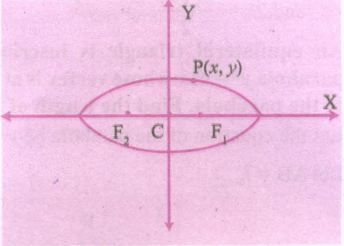
∴ b2 = a2(1- e2)
= \(16\left( { 1-\left( \frac { 3 }{ 4 } \right) }^{ 2 } \right) =16\left( 1-\frac { 9 }{ 10 } \right) =16\left( \frac { 7 }{ 16 } \right) =7\)
∴ The path traced by him is an ellipse and its equation is \(\frac { { x }^{ 2 } }{ { a }^{ 2 } } +\frac { { y }^{ 2 } }{ { b }^{ 2 } } =1\)
⇒ \(\frac { { x }^{ 2 } }{ 16 } -\frac { { y }^{ 2 } }{ 7 } \) = 1
15.
\({ sin }^{ -1 }\left( \frac { sinx+cosx }{ \sqrt { 2 } } \right)\)
\(\begin{aligned}
& =\sin ^{-1}\left(\frac{1}{\sqrt{2}} \sin x+\frac{1}{\sqrt{2}} \cos x\right) \\
& =\sin ^{-1}\left(\sin x \cos \frac{\pi}{4}+\cos x \sin \frac{\pi}{4}\right) \\
& =\sin ^{-1}\left(\sin \left(x+\frac{\pi}{4}\right)\right)=\pi+\frac{\pi}{4}
\end{aligned}\)
16.
Augmented matrix = [A|B] = \(\left[ \begin{matrix} 1 & 1 & 1 \\ 1 & 2 & 4 \\ 1 & 4 & 10 \end{matrix}|\begin{matrix} 1 \\ \lambda \\ { \lambda }^{ 2 } \end{matrix} \right] \)
[A|B] = \(\overset { { R }_{ 2 }\rightarrow { R }_{ 2 }-{ R }_{ 1 }\\ { R }_{ 3 }\rightarrow { R }_{ 3 }-{ R }_{ 1 } }{ \longrightarrow } \left[ \begin{matrix} 1 & 1 & 1 \\ 0 & 1 & 3 \\ 0 & 3 & 9 \end{matrix}|\begin{matrix} 1 \\ \lambda -1 \\ { \lambda }^{ 2 }-1 \end{matrix} \right] \)
\(\overset { { R }_{ 3 }\rightarrow { R }_{ 3 }-3{ R }_{ 2 } }{ \longrightarrow } \left[ \begin{matrix} 1 & 1 & 1 \\ 0 & 1 & 3 \\ 0 & 0 & 0 \end{matrix}|\begin{matrix} 1 \\ \lambda -1 \\ { \lambda }^{ 2 }-1-3\lambda +3 \end{matrix} \right] \)
⟶ \(\left[ \begin{matrix} 1 & 1 & 1 \\ 0 & 1 & 3 \\ 0 & 0 & 0 \end{matrix}|\begin{matrix} 1 \\ \lambda -1 \\ { \lambda }^{ 2 }-3\lambda +2 \end{matrix} \right] \)
Here \(\rho\)(A) = 2
The given system of equations is consistent only when \(\rho\)([AIB]) = 2
\(\rho\)([AIB]) = 2 only when λ2-3λ + 2 = 0
⇒ (λ-1) (λ-2) = 0 ⇒ λ = 1 or λ = 2
∴ The given system is consistent when the values of A are 1 and 2.
17.
Given \(\frac { p }{ 2x } =\frac { a }{ x+x } +\frac { b }{ x-c } \)
\(\frac { p }{ 2x } =\frac { (a+b)x+c(-a) }{ { x }^{ 2 }-{ c }^{ 2 } } \)
⇒ P (x2 - c2) = 2 (a + b) x2 - 2c(a-b)x
⇒ (2a + 2b - p)x2 - 2c (a - b)x +pc2 = 0
This equation has equal roots
if b2-4ac = 0
⇒ c2(a-b)2 - pc2 (2a + 2b - b) = 0
⇒ (a - b)2 - 2p (a + b) +p2 = 0 [∵ c2 ≠ 0]
⇒ [p - (a + b)]2 = (a + b)2 - (a - b)2 = 4ab
⇒ p-(a+b) = 土2\(\sqrt{ab}\)
⇒ p-(a+b)土2\(\sqrt{ab}\) = (\(\sqrt{a}\) 土\(\sqrt{b}\))2

12th Standard Syllabus & Materials
12th Standard
TN 12th Computer Applications களப்பெயர் முறைமை (DNS) Sample Question Papers Study Material - QB365 Set A
NEW12th Standard
TN 12th Computer Applications வலையமைப்பு எடுத்துக்காட்டுகள் மற்றும் நெறிமுறைகள் Sample Question Papers Study Material - QB365 Set A
NEW12th Standard
TN 12th Computer Applications கணினி வலையமைப்பு ஓர் அறிமுகம் Sample Question Papers Study Material - QB365 Set A
NEW12th Standard
TN 12th Computer Applications PHP-உடன் MySQL-ஐ இணைத்தல் Sample Question Papers Study Material - QB365 Set A



Tamilnadu Stateboard 12th Standard Subjects
Maths

Chemistry

Physics

Biology

Computer Science

Business Maths and Statistics

Economics

Commerce

Accountancy

History

Computer Applications
Biology
Computer Technology
Computer Applications
Computer Science
Business Maths and Statistics
Commerce
Economics
Maths
Chemistry
Physics
Computer Technology
History
Accountancy

Tamil

English

French
Tamilnadu Stateboard Standards

