
 100% FREE ACCESS
12th Standard Syllabus & Materials
12th Standard
TN 12th Maths Applications of Matrices and Determinants Sample Question Papers Study Material - QB365 Set A
NEW12th Standard
TN 12th Computer Applications மின்னணு தரவு பரிமாற்றம் Sample Question Papers Study Material - QB365 Set A
NEW12th Standard
TN 12th Computer Applications மின் - வணிக பாதுகாப்பு அமைப்புகள் Sample Question Papers Study Material - QB365 Set A
NEW12th Standard
TN 12th Computer Applications மின்னணு செலுத்தல் முறைகள் Sample Question Papers Study Material - QB365 Set A
NEW12th Standard
TN 12th Computer Applications மின் - வணிகம் Sample Question Papers Study Material - QB365 Set A
NEW12th Standard
TN 12th Computer Applications திறந்த மூல கருத்துருக்கள் Sample Question Papers Study Material - QB365 Set A

Published on: 01/09/2022
QB365 provides a detailed and simple solution for every Possible Book Back Questions in Class 12 Maths Subject - Theory of Equations, English Medium. It will help Students to get more practice questions, Students can Practice these question papers in addition to score best marks.
Download Tamil Nadu 12th Standard Maths question papers, model tests, one-mark questions, important questions, and public exam papers in PDF format. Free study materials and answer keys for TN State Board students.
Questions + Answers key
Take MCQ Maths Test1.
Solve the equations
x4+ 3x3- 3x - 1 = 0
2.
Solve: (x - 4)(x - 7)(x - 2)(x + 1) = 16
3.
4.
Solve the equations:
6x4- 35x3+ 62x2- 35x + 6 = 0
5.
Solve the following equation: x4-10x3+ 26x2-10x + 1 = 0
6.
Solve the equation : x4-14x2 + 45 = 0
7.
Find all zeros of the polynomial x6- 3x5- 5x4 + 22x3- 39x2- 39x + 135, if it is known that 1+2i and \(\sqrt{3}\) are two of its zeros.
8.
Solve the equation 3x3-26x2+52x - 24 = 0 if its roots form a geometric progression.
9.
Solve the equation 9x3- 36x2+ 44x -16 = 0 if the roots form an arithmetic progression.
10.
Solve: (2x-1) (x+3) (x-2) (2x+3)+20 = 0
11.
Solve : (x - 5) (x - 7) (x + 6) (x + 4) = 504
12.
Solve the equation (2x-3) (6x-1) (3x-2) (x-2)-5 = 0
13.
Solve the equation (x-2) (x-7) (x-3) (x+2)+19 = 0
14.
Find the condition that the roots of ax3+ bx2+ cx + d = 0 are in geometric progression. Assume a, b, c, d ≠ 0.
15.
If 2+i and 3-\(\sqrt{2}\) are roots of the equation x6-13x5+ 62x4-126x3+ 65x2+127x-140 = 0, find all roots.
16.
Prove that a straight line and parabola cannot intersect at more than two points.
17.
If the equations x2 + px + q = 0 and x2 + p'x + q' = 0 have a common root, show that it must be equal to \(\frac { pq'-p'q }{ q-q' } \) or \(\frac { q-q' }{ p'-p } \).
18.
If p and q are the roots of the equation I x2+ nx + n = 0, show that \(\sqrt{\frac{p}{q}}+\sqrt{\frac{q}{p}}+\sqrt{\frac{n}{i}}\) = 0
19.
Solve the equation x3− 9x2+14x + 24 = 0 if it is given that two of its roots are in the ratio 3:2.
20.
Show that the equation x9- 5x5+ 4x4+ 2x2+ 1 = 0 has atleast 6 imaginary solutions.
21.
Find a polynomial equation of minimum degree with rational coefficients, having \(\sqrt{5}\)−\(\sqrt{3}\) as a root.
22.
Find a polynomial equation of minimum degree with rational coefficients, having 2-\(\sqrt{3}\) as a root.
23.
A 12 metre tall tree was broken into two parts. It was found that the height of the part which was left standing was the cube root of the length of the part that was cut away. Formulate this into a mathematical problem to find the height of the part which was left standing.
24.
If α, β, and γ are the roots of the polynomial equation ax3+ bx2+ cx + d = 0, find the value of \(\Sigma \frac { \alpha }{ \beta \gamma } \) in terms of the coefficients.
1.
x4+ 3x3- 3x - 1 = 0
Sum of the co-efficients = 1 + 3 - 3.- 1 = 0
⇒x = 1 is a root ⇒(x - 1) is a factor
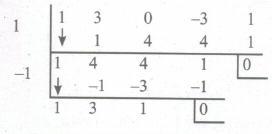
[Using synthetic division]
∴ x = 1, 1 are the roots and the remaining factor
\(\Rightarrow x=\frac { -3\pm \sqrt { 9-4(1)(1) } }{ 2 } \)
\(\Rightarrow x=\frac { -3\pm \sqrt { 5 } }{ 2 } \)
∴ The roots are 1, -1, \(\frac { -3+\sqrt { 5 } }{ 2 } ,\frac { -3-\sqrt { 5 } }{ 2 } \).
2.
(x-4)(x-7)(x-2)(x+1) = 16
Given (x - 4)(x -7)(x - 2)(x + 1) = 16
Rearrange the terms as
(x - 4)(x - 2)(x -7)(x + 1) = 16
⇒ (x2 - 6x + 8)(x2 - 6x -7) = 16
Put x2-6x = y
⇒ (y + 8) (y - 7) = 16
⇒ y2 +y - 56 - 16 = 0
⇒ (y+9)(y-8) = 0
⇒ y = -9, 8
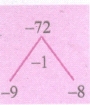
case (i)
When y = -9
⇒ x2-6x = -9
⇒ x2-6x+9 = 0
⇒ (x-3)2 = 0
⇒ x = 3, 3

case ii
When y = 8,
\(\Rightarrow x=\frac { 6\pm \sqrt { 36-4(1)(-8) } }{ 2 } \)
\(\Rightarrow x=\frac { 6\pm \sqrt { 36-32 } }{ 2 } \Rightarrow x=\frac { 6\pm \sqrt { 68 } }{ 2 } \)
\(\Rightarrow x=\frac { 6\pm 2\sqrt { 17 } }{ 2 } \Rightarrow x=\frac { 2(3\pm \sqrt { 17 } ) }{ 2 } \)
\(\Rightarrow x=3\pm \sqrt { 17 } \)
∴ The roots are 3, 3, 3 +\(\sqrt{17}\), and 3 -\(\sqrt{17}\)
3.
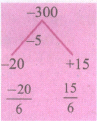
4.
6x4- 35x3+ 62x2- 35x + 6 = 0
This equation is type I even degree reciprocal equation.
Hence, it can be rewritten as
\(6\left( { x }^{ 2 }+\frac { 1 }{ x } \right) -35(x+\frac { 1 }{ x } )+62=0 ...(1)\)
putting \(x+\frac { 1 }{ x } =y\)
\(\Rightarrow { x }^{ 2 }+\frac { 1 }{ { x }^{ 2 } } +2={ y }^{ 2 }\)
\(\Rightarrow { x }^{ 2 }+\frac { 1 }{ { x }^{ 2 } } ={ y }^{ 2 }-2\)
∴ (1) becomes as,
\(\Rightarrow 6({ y }^{ 2 }-2)-35y+62=0\)
\(\Rightarrow { 6y }^{ 2 }-12-35y+62=0\)
\(\Rightarrow { 6y }^{ 2 }-35y+50=0\)
\(\Rightarrow (3y-10)(2y-5)=0\)
\(\Rightarrow y=\frac { 10 }{ 3 } ,\frac { 5 }{ 2 } \)
Case (i) when \(y=\frac { 10 }{ 3 } ,x+\frac { 1 }{ x } =\frac { 10 }{ 3 } \)
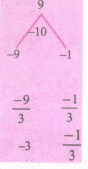
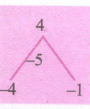
\(\Rightarrow \frac { { x }^{ 2 }+1 }{ x } =\frac { 10 }{ 3 } \)
\(\Rightarrow { 3x }^{ 2 }-10x+3=10x\)
\(\Rightarrow { 3x }^{ 2 }-10x+3=0\)
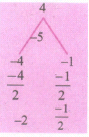
\(\Rightarrow (x-3)(3x-1)=0\)
\(\Rightarrow x=3,\frac { 1 }{ 3 } \)
Case (ii) when \(y=\frac { 5 }{ 2 } ,x+\frac { 1 }{ x } =\frac { 5 }{ 2 } \Rightarrow \frac { { x }^{ 2 }+1 }{ x } =\frac { 5 }{ 2 } \)
\(\Rightarrow { 2x }^{ 2 }+2=5x\Rightarrow { 2x }^{ 2 }-5x+2=0\)
\(\Rightarrow (x-2)(2x-1)=0\)
Hence the roots are \(2,\frac { 1 }{ 2 } ,3,\frac { 1 }{ 3 } \)
5.
This equation is Type I even degree reciprocal equation. Hence it can be rewritten as
x2\(\left[ \left( { x }^{ 2 }+\frac { 1 }{ { x }^{ 2 } } \right) -10 \left( x+\frac { 1 }{ x } \right) +26 \right] \)= 0 Since x \(\neq\) 0, we get \(\left(x^{2}+\frac{1}{x^{2}}\right)-10\left(x+\frac{1}{x}\right)+26=0\)
Let y = \(\left( x+\frac { 1 }{ x } \right) \)
[(y2-2)-10y+26] = 0 ⇒ (y2-10y+24) = 0 ⇒ (y-6)(y-4) = 0 ⇒ y = 6 or y = 4
Case (i)
y = 6 ⇒ x +\(\frac{1}{x}\) = 6 ⇒ x = 3+2\(\sqrt{2}\), x = 3 - 2\(\sqrt{2}\)
Case (ii)
y = 4 ⇒ x = 2+\(\sqrt{3}\), x = 2-\(\sqrt{3}\).
Hence, the roots are \(3 \pm 2 \sqrt{2}, 2 \pm \sqrt{3}\)
6.
Put x2 = y
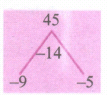
⇒ y2- 14y + 45 = 0
⇒ (y - 9) (y - 5) = 0
⇒ y = 9 or y = 5
⇒ x2 = 9 or x2 = 5
⇒ x = ±33 or x =±3√5
Hence the roots are 3, -3, √5 and -√5.
7.
Let f(x) x6-3x5-5x4+22x3-39x2-39x+135
Given (1+2i) is a root \(\Rightarrow\)(-2i) is also a root
Also \(\sqrt3\) is a root \(\Rightarrow\)-\(\sqrt3\) is also a root.
Hence, the factors of f(x) are [x - (1 + 2i)]
[x-(1-2i)] [x\(\sqrt3\)] [x+\(\sqrt3\)]
[(x-1)-2i] [(x-1)+2i] [x-\(\sqrt3\)][x+\(\sqrt3\)]
((x-1)2+22)(x2-3) = (x2-2x+1+4)(x2-3)
\(\Rightarrow\) factor of f(x) is (x2-2x+5)(x2-3)
\(\Rightarrow\)x4-3x2-2x3+6x+5x2-15
\(\Rightarrow\)(x4-3x2-2x3+6x-15) is a factor of f(x)
To find the other factor, let us divide f(x) by
x4 - 2x3 + 2x2 + 6x - 15
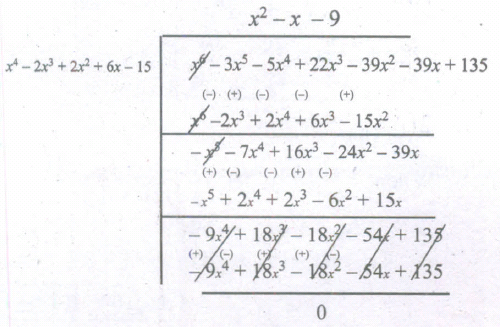
The other factor is x2 - x - 9
\(\Rightarrow x=\frac { 1\pm \sqrt { { (-1) }^{ 2 }-4(1)(-9) } }{ 2 } \left[ \because x=\frac { -b\pm \sqrt { { b }^{ 2 }-4ac } }{ 2a } \right] \)
\(\Rightarrow x=\frac { 1\pm \sqrt { 37 } }{ 2 } \)
Hence the roots are
1 - 2i, 1 + 2i, \(\sqrt { 3 }, -\sqrt { 3 }, \frac { 1+\sqrt { 37 } }{ 2 } ,\frac { 1-\sqrt { 37 } }{ 2 } \).
8.
Let the roots form a GP be \(\frac{a}{\lambda}\), a, a\(\lambda\)
Product of the roots \(\frac{a}{\lambda} \times a \times a \lambda=\frac{24}{3}=8\)
a3 = 8
a = 2
Sum of the roots, \(\frac{a}{\lambda}+a+a \lambda=\frac{26}{3}\)
\( a\left(\frac{1}{\lambda}+1+\lambda\right) =\frac{26}{3} \)
\(2\left(\frac{1+\lambda+\lambda^{2}}{\lambda}\right) =\frac{26}{3} \)
\( 3+3 \lambda+3 \lambda^{2} =13 \lambda \)
\(3 \lambda^{2}+3 \lambda-13 \lambda+3 =0 \)
\(3 \lambda^{2}-10 \lambda+3 =0\)
\( (\lambda-3)(3 \lambda-1)=0 \)
\( \lambda=3 \text { (or) } \lambda=\frac{1}{3}\)
\( \lambda=3, \quad \frac{a}{\lambda}=\frac{2}{3} , \)
\( a \lambda=2(3)=6 \)
If \( \lambda=\frac{1}{3}, \frac{a}{\lambda}=\frac{2}{\frac{1}{3}}=6 \)
If \( a \lambda=2\left(\frac{1}{3}\right)=\frac{2}{3} \)
Roots are \(\frac{a}{\lambda},\ a,\ a \lambda\)
If \(\lambda\) = 3 roots are \(\frac{2}{3}\), 2, 6
If \(\lambda=\frac{1}{3}\) roots are 6, 2, \(\frac{2}{3}\)
9.
Here, a = 9, b = - 36, c = 44, d = -16
Since the roots form an arithmetic progression,
Let the roots be a - d, a and a + d
Sum of the roots \(=\frac { -b }{ a } \)
\(\Rightarrow (a-d)+(a)+(a+d)=\frac { -(-36) }{ 9 } =4\)
\(\Rightarrow 3a=4\Rightarrow a=\frac { 4 }{ 3 } \)
and product of the roots \(=\frac { -d }{ a } \)
\(=\frac { -(-16) }{ 9 } =\frac { 16 }{ 9 } \)
\(\Rightarrow (a-d)(a)(a+d)=\frac { 16 }{ 9 } \)
\(\left( { a }^{ 2 }-{ d }^{ 2 } \right) (a)=\frac { 16 }{ 9 } \)
\(\left( \frac { 16 }{ 9 } -{ d }^{ 2 } \right) \left( \frac { 4 }{ 3 } \right) =\frac { 16 }{ 9 } \ [\because a=\frac { 4 }{ 3 } ]\)
\(\frac { 16 }{ 9 } -{ d }^{ 2 }=\frac { 16 }{ 9 } \times \frac { 3 }{ 4 } =\frac { 4 }{ 3 } \)
\(\frac { 16 }{ 9 } -\frac { 4 }{ 3 } ={ d }^{ 2 }=\frac { 16 }{ 9 } \times \frac { 3 }{ 4 } =\frac { 4 }{ 3 } \)
\(\frac { 16 }{ 9 } -\frac { 4 }{ 3 } ={ d }^{ 2 }\)
\(\Rightarrow { d }^{ 2 }=\frac { 16-12 }{ 9 } =\frac { 4 }{ 9 } \)
\(\Rightarrow d=\pm \sqrt { \frac { 4 }{ 9 } } =\frac { 2 }{ 3 } \)
∴ The roots are a-d, a, a+d
\(\Rightarrow \frac { 4 }{ 3 } -\frac { 2 }{ 3 } ,\frac { 4 }{ 3 } ,\frac { 4 }{ 3 } +\frac { 2 }{ 3 } \Rightarrow \frac { 2 }{ 3 } ,\frac { 4 }{ 3 } ,2\)
10.
Rearrange the terms as
(2x-1)(2x+ 3) (x + 3) (x - 2) + 20 = 0
⇒ (4x2 + 6x - 2x- 3)(x2 - 2x + 3x - 6) + 20 = 0
⇒ (4x2 + 4x - 3) (x2 + x - 6) + 20 = 0
put x2+ x = y
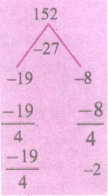
⇒ (4y - 3) (y - 6) + 20 = 0
⇒ 4y2 - 24y - 3y + 18 + 20 = 0
⇒ 4y2-27y +38 = 0
⇒ (y - 2)( 4y - 19) = 0
\(y=2,\frac { 19 }{ 4 } \)
Case (i)
When y = 2
x2+ x = 2
x2 + x - 2 = 0
⇒ (x + 2)(x - 1) = 0
⇒ x = -2, 1
Case (ii)
When \(y=\frac { 19 }{ 4 } ,{ x }^{ 2 }+x=\frac { 19 }{ 4 } \)
\(\Rightarrow { 4x }^{ 2 }+4x=19\)
\(\Rightarrow { 4x }^{ 2 }-4x-19=0\)
\(\Rightarrow x=\frac { -4\pm \sqrt { 16-4(4)(-19) } }{ 8 } \)
\(\Rightarrow x=\frac { -4\pm \sqrt { 16+304 } }{ 8 } \)
\(\Rightarrow x=\frac { -4\pm \sqrt { 320 } }{ 8 } \)
\(\Rightarrow x=\frac { 4\pm 8\sqrt { 5 } }{ 8 } \)
\(\Rightarrow x=\frac { -4(-1\pm 2\sqrt { 5 } ) }{ 8 } \)
\(\frac{-1 \pm 2 \sqrt{5}}{2}\)
Hence the roots are 1, -2, \(\frac{-1 \pm 2 \sqrt{5}}{2}\)
11.
(i) 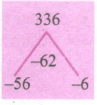
Rearrange the terms as,
(x-5) (x+4) (x-7) (x+6) = 504
{-2, 3, -7, 8}
⇒ (x2 -x - 20) (x2 -x - 42) = 504
Put x2- x = y
⇒ (y-20)(y-42) = 504
⇒ y2-62y+840-504 = 0
⇒ y2-62y+336 = 0
⇒ (y - 56) (y - 6) = 0
⇒ y = 56, 6
Case (i)
When y = 56, x2 - x = 56
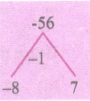
⇒ x2 - x - 56 = 0
⇒ (x - 8)(x + 7) = 0
⇒ x = 8, -7
Case (ii)
When y = 6,
x2- x = 6
x2- x - 6 = 0
⇒ (x - 3)(x + 2) = 0
⇒ x = 3, - 2

Hence the roots are -2, 3, 8, -7
12.
The given equation is same as
(2x-3)(3x-2)(6x-1)(x-2)-5 = 0
After a computation, the above equation becomes
(6x2-13x+6)(6x2-13x+12)-5 = 0
By taking y = 6x2-13x, the above equation becomes
(y+6)(y+12)-5 = 0
which is same as
y2+18y+7 = 0
Solving this equation, we get y = −1 and y = −7.
Substituting the values of y in y = −6x2-13x, we get
6x2-13x+1 = 0
6x2-13x+7 = 0
Solving these two equations, we get
x = 1, x = \(\frac { 7 }{ 6 } \), x = \(\frac { 13 + \sqrt { 145 } }{ 12 } \) and x = \(\frac { 13-\sqrt { 145 } }{ 12 } \)
as the roots of the given equation.
13.
We can solve this fourth degree equation by rewriting it suitably and adopting a technique of substitution. Rewriting the equation as
(x−2)(x−3)(x−7)(x+2)+19 = 0
the given equation becomes
(x2−5x+6)(x2−5x−14)+19 = 0 .
If we take x2 − 5x as y, then the equation becomes (y+6)(y−14)+19 = 0;
that is, y2-8y-65 = 0
Solving this we get solutions y = 13 and y = −5. Substituting this we get two quadratic equations
x2-5x-13 = 0 and x2-5x+5 = 0
which can be solved by usual techniques. The solutions obtained for these two equations together give solutions as \(\frac { 5\pm \sqrt { 77 } }{ 2 } ,\frac { 5\pm \sqrt { 5 } }{ 2 } \).
14.
Let the roots be in G.P.
Then, we can assume them in the form \(\frac { \alpha }{ \lambda } \), α, αλ.
Applying the Vieta’s formula, we get
Σ1 = \(\alpha \left( \frac { 1 }{ \lambda } +1+\lambda \right) =\frac { b }{ a } \) ....(1)
Σ2 = \(\alpha ^{ 2 }\left( \frac { 1 }{ \lambda } +1+\lambda \right) =\frac { c }{ a } \) ............(2)
Σ3 = α3 = -\(\frac { d }{ a } \) ..........(3)
Dividing (2) by (1), we get
α = -\(\frac { c }{ b } \) ...........(4)
Substituting (4) in (3), we get \(\left( -\frac { c }{ b } \right) ^{ 3 }=\frac { d }{ a } \) ⇒ ac3 = db3.
15.
Since the coefficients of the equation are all rational numbers, 2+i and 3-\(\sqrt{2}\) are roots, we get 2-i and 3+\(\sqrt{2}\) are also roots of the given equation. Thus (x-(2+i)), (x-(2-i)), (x-(3-\(\sqrt{2}\))) and (x-(3+\(\sqrt{2}\))) are factors. Thus their product.
((x-(2+i))(x-(2-i))(x-(3-\(\sqrt{2}\)))(x-(3+\(\sqrt{2}\))) is a factor of the given polynomial equation.
That is, (x2-4x+5)(x2-6x+7) is a factor. Dividing the given polynomial equation by this factor, we get the other factor as (x2-3x-4) which implies that 4 and −1 are the other two roots. Thus
2+i, 2-i, 3+\(\sqrt{2}\), 3-\(\sqrt{2}\), -1, and 4 are the roots of the given polynomial equation.
16.
By choosing the co-ordinate axes suitably, we take the equation of the straight line as
y = mx + c .........(1)
and equation of parabola as y2 = 4ax ............(2)
Substituting (1) in (2),we get
(mx + c)2 = 4ax
⇒ m2x2 + c2 + 2mcx = 4ax
⇒ m2x2+x(2mc - 4a) + c2 = 0
Which is a quadratic equation in x.
This equation cannot have more than two solution. Hence, a straight line and a parabola cannot intersect at more than two points.
17.
Given equation are \({ x }^{ 2 }px+q=0\) ............(1)
and \({ x }^{ 2 }+p'x+q'=0\) ..........(2)
Let ∝ be the common root for (1) and (2)
∴ ∝2 + p∝ + q = 0 .........(3)
and ∝2+ p'∝ + q' = 0 .............(4)
Solving (3) and (4) by cross multiplication method we get
p q 1 p
p' q' 1 p'
\(\Rightarrow \frac { { \alpha }^{ 2 } }{ pq'-p'q } =\frac { \alpha }{ q-q' } =\frac { 1 }{ p'-p } \)
consider \(\frac { { \alpha }^{ 2 } }{ pq'-p'q } =\frac { \alpha }{ q-q' } \)
\(\Rightarrow \frac { { \alpha }^{ 2 } }{ \alpha } =\frac { pq'-p'q }{ q-q' } \)
\(\alpha =\frac { pq'-p'q }{ q-q } \)
Consider \(\frac { \alpha }{ q-q' } =\frac { 1 }{ p'-p } \Rightarrow \alpha =\frac { q-q' }{ p'-p } \)
Hence its roots are \(\frac { pq'-p'q }{ q-q' } or\quad \frac { q-q' }{ p'-p } \)
18.
Given p, q are the roots of lx2 + nx + n = 0
\(p+q=\frac { -b }{ a } =\frac { -n }{ l } ...(1)\)
\(pq=\frac { c }{ a } =\frac { n }{ l } ...(2)\)
L.H.S
\( \sqrt{\frac{p}{q}}+\sqrt{\frac{q}{p}}+\sqrt{\frac{n}{l}} =\frac{\sqrt{p}}{\sqrt{q}}+\frac{\sqrt{q}}{\sqrt{p}}+\frac{\sqrt{n}}{\sqrt{l}}=\frac{p+q}{\sqrt{p} \sqrt{q}}+\frac{\sqrt{n}}{\sqrt{l}} \)
\( =\frac{-\frac{n}{l}}{\sqrt{p q}}+\frac{\sqrt{n}}{\sqrt{l}}=\frac{-\frac{n}{l}}{\frac{\sqrt{n}}{\sqrt{l}}}+\frac{\sqrt{n}}{\sqrt{l}} \)
\(=\frac{-\frac{n}{l}+\frac{n}{l}}{\sqrt{\frac{n}{l}}}=0\) R.H.S
19.
Let ∝, β, ૪ be the roots of the equation
Given \(\frac { \alpha }{ \beta } =\frac { 3 }{ 2 } \Rightarrow 2\alpha =3\beta \Rightarrow \alpha =\frac { 3 }{ 2 } \beta \)
\(\therefore \frac { 3 }{ 2 } \beta ,\beta ,\gamma \) are the roots of the given equation
Then by Vieta's formula,
\(\frac { 3 }{ 2 } \beta +\beta +\gamma =\frac { -b }{ a } =\frac { -(-9) }{ 1 } =9\)
\(\frac { 5 }{ 2 } \beta +\gamma =9\Rightarrow \gamma =9-\frac { 5 }{ 2 } \beta \)
\(\Rightarrow \gamma =\frac { 18-5\beta }{ 2 } ...(2)\)
Also \(\frac { 3 }{ 2 } \beta (\beta )+\beta \gamma +\left( \frac { 3 }{ 2 } \beta \right) \gamma =\frac { c }{ a } =\frac { 14 }{ 1 } =14\)
\(\Rightarrow \frac { 3 }{ 2 } { \beta }^{ 2 }+\frac { 5 }{ 2 } \beta \left( \frac { 18-5\beta }{ 2 } \right) =14\ [using\ (2)]\)
\(\Rightarrow \frac { 3 }{ 2 } { \beta }^{ 2 }+\frac { 90\beta }{ 4 } -\frac { 25{ \beta }^{ 2 } }{ 4 } =14\)
Multiplying by \(4,6{ \beta }^{ 2 }+90{ \beta }-25{ \beta }^{ 2 }=56\)
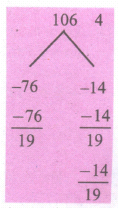
\(19{ \beta }^{ 2 }-90{ \beta }+56=0\)
\(\Rightarrow ({ \beta }-4)(19{ \beta }-14)=0\)
\(\Rightarrow { \beta }=4\)
\({ \beta }=\frac { 14 }{ 19 } \)
When \(\beta\) = 4, the other roots are \(\frac { 3 }{ 2 } (4),4,\frac { 18-5 }{ 2 } (4)\)
\(\Rightarrow 6,4,-1\)
When \(\\ \beta =\frac { 14 }{ 19 } ,\) the other roots are \(\frac { 3 }{ 2 } \beta ,\beta \frac { 18-5\beta }{ 2 } [by(2)]\)
\(\Rightarrow \frac { 3 }{ 2 } \left( \frac { 14 }{ 19 } \right) ,\frac { 14 }{ 19 } ,\frac { 18-5\left( \frac { 14 }{ 19 } \right) }{ 2 } \Rightarrow \frac { 21 }{ 19 } ,\frac { 14 }{ 19 } ,\frac { 136 }{ 19 } \)
20.
Let p(-x) = x9- 5x5 + 4x4 + 2x2 + 1 = 0
P(x) has only one sign change. It has atmost one positive roots.
Also p(-x) = (-x)9 - 5(-x)5 + 4(-x)4 +2(-x)2 +1 = 0
p(-x) = -x9+ 5x5+4x4+ 2x2+1 = 0
It has only one sign change.
It has atmost one negative roots.
Clearly 0 is not a root.
So maximum number of real roots is 3 and hence there are atleast six imaginary solutions.
21.
Given \((\sqrt { 5 } -\sqrt { 3 } )\) is a root
Another root \(\Rightarrow \sqrt { 5 } +\sqrt { 3 } \)
∴ Sum of the roots \(=\sqrt { 5 } -\sqrt { 3 } +\sqrt { 5 } +\sqrt { 3 } =2\sqrt { 5 } \)
Product of the roots
\(=(\sqrt { 5 } -\sqrt { 3 } )(\sqrt { 5 } +\sqrt { 3 } )\)
\(=(\sqrt { 5 } )^{ 2 }-{ (\sqrt { 3 } ) }^{ 2 }=5-3=2\)
∴ One of the factor is x2 -x (sum of the roots) + product of the roots
\(\Rightarrow { x }^{ 2 }-2x\sqrt { 5 } +2\)
The other factor also will be \({ x }^{ 2 }-2x\sqrt { 5 } +2\)
\(({ x }^{ 2 }-2x\sqrt { 5 } +2)({ x }^{ 2 }+2x\sqrt { 5 } +2)=0\)
\(\Rightarrow ({ x }^{ 2 }+2-2\sqrt { 5 } x)({ x }^{ 2 }+2+2\sqrt { 5 } x)=0\)
\(\Rightarrow \left( { x }^{ 2 }+2 \right) ^{ 2 }-{ (2\sqrt { 5 } x) }^{ 2 }=0\)
\([\because (a+b)(a-b)={ a }^{ 2 }-{ b }^{ 2 }]\)
\(\Rightarrow { x }^{ 4 }+{ 4x }^{ 2 }+4{ (5)x }^{ 2 }=0\)
\(\Rightarrow { x }^{ 4 }+{ 4x }^{ 2 }+4-{ 20x }^{ 2 }=0\)
\(\Rightarrow { x }^{ 4 }-{ 16x }^{ 2 }+4=0\) is a rational co-efficient polynomial equation.
22.
Since 2-\(\sqrt{3}\)i is a root and the coefficients are rational numbers, 2+\(\sqrt{3}\)i is also a root. A required polynomial equation is given by
x2 −(Sum of the roots) x + Product of the roots = 0
and hence
x2- 4x +1 = 0 is a required equation.
23.
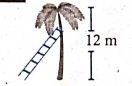
Given that the height of the tree is 12m.
Let x m be the standing part and (12 -x)m be the broken part.
Given \(x=\sqrt [ 3 ]{ 12-x } \)
\(\Rightarrow x=(12-x)^{ \frac { 1 }{ 3 } }\)
Taking power 3 both sides, we get
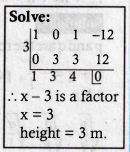
⇒ x3 = 12-x
⇒ x3+ x -12 = 0
which is the required mathematical problem.
24.
Given ∝, β and ૪ are the roots of ax3 + bx2 + cx + d = 0
\(\therefore \alpha +\beta +\gamma =\frac { -b }{ a } \)
\(\alpha \beta +\beta \gamma +\gamma \alpha =\frac { c }{ a } \)
\(\alpha \beta \gamma =\frac { -d }{ a } \)
Now, \(\sum { \frac { \alpha }{ \beta \gamma } } =\frac { \alpha }{ \beta \gamma } +\frac { \beta }{ \gamma \alpha } +\frac { \gamma }{ \alpha \beta } \)
\(=\frac { { \alpha }^{ 2 }+{ \beta }^{ 2 }+{ \gamma }^{ 2 } }{ \alpha \beta \gamma } \)
\(=\frac { { (\alpha +\beta +\gamma ) }^{ 2 }-2(\alpha \beta +\beta \gamma +\gamma \alpha ) }{ \alpha \beta \gamma } \)
\(=\frac { { \left( -\frac { b }{ a } \right) }^{ 2 }-2\left( \frac { c }{ a } \right) }{ -\frac { d }{ a } } \)
\(=\frac { \frac { { b }^{ 2 } }{ { a }^{ 2 } } -\frac { 2c }{ a } }{ -\frac { d }{ a } } \Rightarrow \frac { { b }^{ 2 }-2ac }{ { a }^{ 2 } } \times \frac { -a }{ d } \)
\(\therefore \frac { \sum { \alpha } }{ \beta \gamma } =-\frac { \left( { b }^{ 2 }-2ac \right) }{- ad } =\frac { 2ac-{ b }^{ 2 } }{ ad } \)

12th Standard Syllabus & Materials
12th Standard
TN 12th Computer Applications வலையமைப்பு வடமிடல் Sample Question Papers Study Material - QB365 Set A
NEW12th Standard
TN 12th Computer Applications களப்பெயர் முறைமை (DNS) Sample Question Papers Study Material - QB365 Set A
NEW12th Standard
TN 12th Computer Applications வலையமைப்பு எடுத்துக்காட்டுகள் மற்றும் நெறிமுறைகள் Sample Question Papers Study Material - QB365 Set A
NEW12th Standard
TN 12th Computer Applications கணினி வலையமைப்பு ஓர் அறிமுகம் Sample Question Papers Study Material - QB365 Set A



Tamilnadu Stateboard 12th Standard Subjects
Maths

Chemistry

Physics

Biology

Computer Science

Business Maths and Statistics

Economics

Commerce

Accountancy

History

Computer Applications
Biology
Computer Technology
Computer Applications
Computer Science
Business Maths and Statistics
Commerce
Economics
Maths
Chemistry
Physics
Computer Technology
History
Accountancy

Tamil

English

French
Tamilnadu Stateboard Standards

