
 100% FREE ACCESS
12th Standard Syllabus & Materials
12th Standard
TN 12th Maths Applications of Matrices and Determinants Sample Question Papers Study Material - QB365 Set A
NEW12th Standard
TN 12th Computer Applications மின்னணு தரவு பரிமாற்றம் Sample Question Papers Study Material - QB365 Set A
NEW12th Standard
TN 12th Computer Applications மின் - வணிக பாதுகாப்பு அமைப்புகள் Sample Question Papers Study Material - QB365 Set A
NEW12th Standard
TN 12th Computer Applications மின்னணு செலுத்தல் முறைகள் Sample Question Papers Study Material - QB365 Set A
NEW12th Standard
TN 12th Computer Applications மின் - வணிகம் Sample Question Papers Study Material - QB365 Set A
NEW12th Standard
TN 12th Computer Applications திறந்த மூல கருத்துருக்கள் Sample Question Papers Study Material - QB365 Set A

Published on: 02/02/2021
12th Standard Maths English Medium Theory of Equations Reduced Syllabus Important Questions 2021
Download Tamil Nadu 12th Standard Maths question papers, model tests, one-mark questions, important questions, and public exam papers in PDF format. Free study materials and answer keys for TN State Board students.
Questions + Answers key
Take MCQ Maths Test1.
Find x If \(x=\sqrt { 2+\sqrt { 2+\sqrt { 2+....+upto\infty } } } \)
2.
Find the Interval for a for which 3x2+2(a2+1) x+(a2-3a+2) possesses roots of opposite sign.
3.
Construct a cubic equation with roots 2, −2, and 4.
4.
If x2+2(k+2)x+9k = 0 has equal roots, find k.
5.
Show that the equation 2x2− 6x +7 = 0 cannot be satisfied by any real values of x.
6.
If α and β are the roots of the quadratic equation 2x2−7x+13 = 0 , construct a quadratic equation whose roots are α2 and β2.
7.
Construct a cubic equation with roots 1, 1 and −2
8.
Determine the number of positive and negative roots of the equation x9- 5x8-14x7= 0.
9.
If α, β, γ and \(\delta\) are the roots of the polynomial equation 2x4 + 5x3 − 7x2 + 8 = 0, find a quadratic equation with integer coefficients whose roots are α + β + γ + \(\delta\) and αβ૪\(\delta\).
10.
If α, β, and γ are the roots of the polynomial equation ax3+ bx2+ cx + d = 0, find the value of \(\Sigma \frac { \alpha }{ \beta \gamma } \) in terms of the coefficients.
11.
If α, β and γ are the roots of the cubic equation x3+2x2+3x+4 = 0, form a cubic equation whose roots are, 2α, 2β, 2γ
12.
If the sides of a cubic box are increased by 1, 2, 3 units respectively to form a cuboid, then the volume is increased by 52 cubic units. Find the volume of the cuboid.
13.
Solve: (2x2 - 3x + 1) (2x2 + 5x + 1) = 9x2.
14.
If c ≠ 0 and \(\frac { p }{ 2x } =\frac { a }{ x+x } +\frac { b }{ x-c } \) has two equal roots, then find p.
15.
If a, b, c, d and p are distinct non-zero real numbers such that (a2+b2+c2) p2-2 (ab+bc+cd) p+(b2+c2+d2)≤ 0 then prove that a, b, c, d are in G.P and ad = bc
16.
Discuss the nature of the roots of the following polynomials:
x5-19x4+ 2x3+ 5x2+11
17.
Solve the equations
x4+ 3x3- 3x - 1 = 0
18.
Solve the following equations,
12x3+ 8x = 29x2- 4
19.
Solve the equation
2x3 - 9x2 + 10x = 3
20.
Solve: (2x-1) (x+3) (x-2) (2x+3)+20 = 0
21.
Solve : (x - 5) (x - 7) (x + 6) (x + 4) = 504
22.
If 2+i and 3-\(\sqrt{2}\) are roots of the equation x6-13x5+ 62x4-126x3+ 65x2+127x-140 = 0, find all roots.
23.
Solve the equation x3− 9x2+14x + 24 = 0 if it is given that two of its roots are in the ratio 3:2.
24.
If p is real, discuss the nature of the roots of the equation 4x2+ 4px + p + 2 = 0 in terms of p.
25.
Form the equation whose roots are the squares of the roots of the cubic equation x3+ ax2+ bx + c = 0.
26.
Find the condition that the roots of cubic x3+ ax2+ bx + c = 0 are in the ratio p : q : r.
27.
Find the sum of squares of roots of the equation 2x4- 8x3+ 6x2-3 = 0.
28.
If p(x) = ax2 + bx + c and Q(x) = -ax2 + dx + c where ac ≠ 0 then p(x). Q(x) = 0 has at least _______ real roots.
no
1
2
infinite
29.
If ax2 + bx + c = 0, a, b, c \(\in\) R has no real zeros, and if a + b + c < 0, then __________
c>0
c<0
c=0
c≥0
30.
If x2 - hx - 21 = 0 and x2 - 3hx + 35 = 0 (h > 0) have a common root, then h = ___________
0
1
4
3
31.
If ∝, β, ૪ are the roots of 9x3-7x+6 = 0, then ∝ β ૪ is __________
\(\frac{-7}{9}\)
\(\frac{7}{9}\)
0
\(\frac{-2}{3}\)
32.
If \((2+\sqrt{3})^{x^{2}-2 x+1}+(2-\sqrt{3})^{x^{2}-2 x-1}=\frac{2}{2-\sqrt{3}}\) then x = _________
0, 2
0, 1
0, 3
0, √3
33.
If the equation ax2+ bx+c = 0(a > 0) has two roots ∝ and β such that ∝ <- 2 and β > 2, then __________
b2-4ac = 0
b2 - 4ac <0
b2 - 4ac >0
b2 - 4ac ≥ 0
34.
35.
lf the root of the equation x3 + bx2+ cx - 1 = 0 form an lncreasing G.P, then ___________
one of the roots is 2
one of the roots is 1
one of the roots is -1
one of the roots is -2
36.
37.
If a, b, c ∈ Q and p +√q (p, q ∈ Q) is an irrational root of ax2+bx+c = 0 then the other root is ___________
-p+√q
p-iq
p-√q
-p-√q
38.
39.
40.
41.
If f and g are polynomials of degrees m and n respectively, and if h(x) = (f o g)(x), then the degree of h is
mn
m+n
mn
nm
42.
A zero of x3 + 64 is
0
4
4i
-4
1.
We have \(x=\sqrt { 2+x } \)
\(\Rightarrow { x }^{ 2 }=2+x \Rightarrow { x }^{ 2 }-x-2=0\)
\(\Rightarrow x=\frac { 1\pm \sqrt { 1+8 } }{ 2 } \Rightarrow x=\frac { 1\pm 3 }{ 2 } \)
\(\Rightarrow x=\frac { 1+3 }{ 2 } ,\frac { 1-3 }{ 2 } \Rightarrow x=2,-1\)
Also x>0, we get x = 2
2.
The quadratic equation 3x2 + 2(a2 + 1)x + (a2 - 3a + 2)
Will have two roots of opposite sign if it has real roots and the product of the roots is negative.
⇒ 4(a2+1)2-12(a2-3a+2)\(\ge\) 0 and \(\frac { { a }^{ 2 }-3a+2 }{ 3 } <0\)
Both of these conditions are true if
⇒ a2-3a+2< 0
⇒ (a-1)(a-2)< 0
⇒ 1<a<2
3.
Here ∝ = 2, β = -2 and ૪ = 4
x3-(2-2+4)x2+(- 4 - 8 + 8x)x-(2)(-2)(4) = 0
⇒x3- 4x2- 4x+16 = 0
4.
Here Δ = b2−4ac = 0 for equal roots. This implies 4(k + 2)2 = 4(9)k. This implies k = 4 or 1.
5.
Δ = b2- 4ac = -20 < 0. The roots are imaginary numbers.
6.
Since α and β are the roots of the quadratic equation, we have α + β =\(\frac { 7 }{ 2 } \) and αβ = \(\frac { 13 }{ 2 } \).
Thus, to construct a new quadratic equation,
Sum of the roots = α2+β2 = (α+β)2-2αβ =\(\frac { -3 }{ 4 } \)
Product of the roots = α2β2 = (αβ)2 = \(\frac { 169 }{ 4 }\)
Thus a required quadratic equation is x2+\(\frac { 3 }{ 4 } x+\frac { 169 }{ 4 } \)= 0.
From this we see that 4x2+3x+169 = 0 is a quadratic equation with roots α2 and β2.
7.
Here ∝ = 1, β = 1 and ૪ = -2
∴ The required cubic equation is
x3-(1+1-2)x2(1-2-2)x-(1)(1)(-2) = 0
x3- 0x2-3x+2 = 0
x3-3x-2 = 0
8.
Let p(x) = x9 -5x2 - 14x7 = 0
p(x) has only one sign change
Also p(-x) = (-x)9 - 5 (-x)8 - 14(-x)7 = 0
⇒ p(-x) = -x9 -5x8 + 14x7 = 0
p(-x) has only one sign change
∴ p(-x) has at most one positive and one negative root.
9.
Given polynomial equation is
2x4+ 5x3−7x2 + 8 = 0
Here a = 2, b = 5, c = -7, d = 0, e = 8
By Vieta's formula,
\(\alpha +\beta +\gamma +\delta =\frac { -b }{ a } =\frac { -5 }{ 2 } \)
\(\alpha \beta +\alpha \gamma +\alpha \delta +\beta \gamma +\beta \delta +\gamma \delta =\frac { c }{ a } =\frac { -7 }{ 2 } \)
\(\alpha \beta \gamma +\alpha \beta \delta +\alpha \gamma \delta +\beta \gamma \delta =\frac { -d }{ a } =0\)
\(\alpha \beta \gamma \delta =\frac { e }{ a } =\frac { 8 }{ 2 } =4\)
Given roots of quadratic equation are
∝ + β + ૪ + \(\delta \) and ∝β૪\(\delta \)
∴ sum of the roots = (∝+β+૪+\(\delta \)) (∝β૪\(\delta \))
\(=\left( \frac { -5 }{ 2 } +4 \right) =\frac { -5+8 }{ 2 } =\frac { 3 }{ 2 } \)
\(=\left( \alpha +\beta +\gamma +\delta \right) (\alpha \beta \gamma \delta )\)
\(=\left( \frac { -5 }{ 2 } \right) (4)=\frac { -20 }{ 2 } =-10\)
∴ The required quadratic equation is x2-x
(sum of the roots) + product of the roots = 0
\(\Rightarrow { x }^{ 2 }-x\left( \frac { 3 }{ 2 } \right) -10=0\)
\(\Rightarrow { 2x }^{ 2 }-3x-20=0\)
10.
Given ∝, β and ૪ are the roots of ax3 + bx2 + cx + d = 0
\(\therefore \alpha +\beta +\gamma =\frac { -b }{ a } \)
\(\alpha \beta +\beta \gamma +\gamma \alpha =\frac { c }{ a } \)
\(\alpha \beta \gamma =\frac { -d }{ a } \)
Now, \(\sum { \frac { \alpha }{ \beta \gamma } } =\frac { \alpha }{ \beta \gamma } +\frac { \beta }{ \gamma \alpha } +\frac { \gamma }{ \alpha \beta } \)
\(=\frac { { \alpha }^{ 2 }+{ \beta }^{ 2 }+{ \gamma }^{ 2 } }{ \alpha \beta \gamma } \)
\(=\frac { { (\alpha +\beta +\gamma ) }^{ 2 }-2(\alpha \beta +\beta \gamma +\gamma \alpha ) }{ \alpha \beta \gamma } \)
\(=\frac { { \left( -\frac { b }{ a } \right) }^{ 2 }-2\left( \frac { c }{ a } \right) }{ -\frac { d }{ a } } \)
\(=\frac { \frac { { b }^{ 2 } }{ { a }^{ 2 } } -\frac { 2c }{ a } }{ -\frac { d }{ a } } \Rightarrow \frac { { b }^{ 2 }-2ac }{ { a }^{ 2 } } \times \frac { -a }{ d } \)
\(\therefore \frac { \sum { \alpha } }{ \beta \gamma } =-\frac { \left( { b }^{ 2 }-2ac \right) }{- ad } =\frac { 2ac-{ b }^{ 2 } }{ ad } \)
11.
The roots of x3+2x2+3x+4 = 0 are ∝, β, ૪
∴ ∝+β+૪ = -co-efficient of x2 = -2 ...(1)
∝β + β૪ + ૪∝ = co-effficient of x = 3 ....(2)
-∝β૪ = +4 ⇒ ∝β૪ = -4 ...(3)
Form a cubic equation whose roots are 2∝, 2β, 2૪
2∝+2β+2૪ = 2(∝+β+૪) = 2(-2) = -4 [from (1)]
4∝β+4β૪+4૪∝ = 4(∝β+β૪+୪∝) = 4(3) = 12 [from (2)]
(2∝)(2β)(2૪) = 8(∝β૪) = 8(-4) = -32 [from (3)]
∴ The required cubic equation is
x3-(2∝+2β+2૪)x2 + (2∝β+2β૪+2୪∝)x - (2∝)(2β)(2૪) = 0
⇒ x3+(-4)x2+12x+32 = 0
⇒ x3+4x2+12x+32 = 0
12.
The length and breadth of the cuboid are x + 1.
x + 2 and x + 3
[∵ they are increased by 1, 2, 3 units]
Also volume = V + 52 .
[since V is increased by 52]
∴ V + 52 = (x +1)(x + 2)(x + 3) .........(1)
⇒ V = (x + 1) (x + 2) (x + 3) - 52
Here a = -1, β = -2, ૪ = -3
⇒ V = x3-x2(α+β+૪)+x(αβ+β૪+૪α)-αβ૪ = 52
⇒ V = x3-x2(-1-2-3)+x(2+6+3)-(-1)(-2)(-3) = 52
⇒ V = x3-x2(-6)+x(11)+6-52
⇒ x3 = x2+6x2+11x+6-52
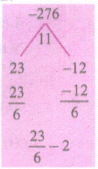
⇒ 6x2+11x-46 = 0
⇒ (6x+23)(x-2) = 0
⇒ (6x+23)(x-2) = 0
⇒ x = 2
∴ Volume of the cube = x3 = 23 = 8.
Volume of a cuboid = 52 + 8 = 60
[∵ x = \(\frac{-23}{6}\) is not possible as x represents the side of the cube]
13.
Given equation is
(2x2 - 3x + 1) (2x2 + 5x + 1) = 9x2 ....(1)
Clearly x = 0 does not satisfy (1),
∴ (1) can be rewritten as
\(\left( 2x+\frac { 1 }{ x } -3 \right) \left( 2x+\frac { 1 }{ x } +5 \right) =9...(2)\)
put \(2x+\frac { 1 }{ x } =y\)
∴ (2)⇒ (y - 3) (y + 5) = 9
⇒ y2+ 2y-15 = 9
or y2+ 2y - 24 = 0
⇒ (y + 6) (y - 4) = 0
⇒ y = -6, -4
Case (i)
When \(y=-6,2x+\frac { 1 }{ x } =-6\)
2x2+6x+1 = 0
\(\Rightarrow =\frac { -6\pm \sqrt { 36-8 } }{ 4 } \)
\(x=-3\pm \frac { \sqrt { 7 } }{ 2 } \)
Case(ii)
When \(y=4,2x+\frac { 1 }{ x } =4\)
⇒ 2x2- 4x+1 = 0
\(x=\frac{4 \pm \sqrt{16-8}}{4}\)
\(x=\frac { 2\pm \sqrt { 2 } }{ 2 } \)
This, the roots are
\(\\ \frac { -3+\sqrt { 7 } }{ 2 } ,\frac { -3-\sqrt { 7 } }{ 2 } ,\frac { 2+\sqrt { 2 } }{ 2 } ,\frac { 2-\sqrt { 2 } }{ 2 } \)
14.
Given \(\frac { p }{ 2x } =\frac { a }{ x+x } +\frac { b }{ x-c } \)
\(\frac { p }{ 2x } =\frac { (a+b)x+c(-a) }{ { x }^{ 2 }-{ c }^{ 2 } } \)
⇒ P (x2 - c2) = 2 (a + b) x2 - 2c(a-b)x
⇒ (2a + 2b - p)x2 - 2c (a - b)x +pc2 = 0
This equation has equal roots
if b2-4ac = 0
⇒ c2(a-b)2 - pc2 (2a + 2b - b) = 0
⇒ (a - b)2 - 2p (a + b) +p2 = 0 [∵ c2 ≠ 0]
⇒ [p - (a + b)]2 = (a + b)2 - (a - b)2 = 4ab
⇒ p-(a+b) = 土2\(\sqrt{ab}\)
⇒ p-(a+b)土2\(\sqrt{ab}\) = (\(\sqrt{a}\) 土\(\sqrt{b}\))2
15.
Given equation is (a2+b2+c2) p2-2
(ab+bc+cd) p+(b2+c2+d2) ≤ 0...(1)
(1) can be rewritten as
(a2p2 - 2abp + b2) + (b2p2 - 2bcp + c2) + (c2p2 - 2cdp + d2) ≤ 0
Since a, b, c, d, p∈ R
(ap-b)2 ≥ 0, (bp-c)2 ≥ 0 and (cp-d)2 ≥ 0
∴ (2) will be satisfied only if
ap - b = 0, bp - c = 0, cp - d = 0
\(\Rightarrow \frac { b }{ a } =\frac { c }{ b } =\frac { d }{ c } =p\)
⇒ a, b, c, d are in G.P and ad = bc
16.
Let P(x) be the polynomial under consideration.
The number of sign changes for P(x) and P(−x) are 2 and 1 respectively. Hence it has at most two positive roots and at most one negative root. Since the difference between number of sign changes in coefficients of P(−x) and the number of negative roots is even, we cannot have zero negative roots. So the number of negative roots is 1. Since the difference between number of sign changes in coefficient of P(x) and the number of positive roots must be even, we must have either zero or two positive roots. But as the sum of the coefficients is zero, 1 is a root. Thus we must have two and only two positive roots Obviously the other two roots are imaginary numbers.
17.
x4+ 3x3- 3x - 1 = 0
Sum of the co-efficients = 1 + 3 - 3.- 1 = 0
⇒x = 1 is a root ⇒(x - 1) is a factor
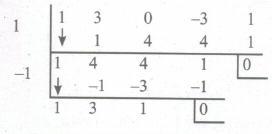
[Using synthetic division]
∴ x = 1, 1 are the roots and the remaining factor
\(\Rightarrow x=\frac { -3\pm \sqrt { 9-4(1)(1) } }{ 2 } \)
\(\Rightarrow x=\frac { -3\pm \sqrt { 5 } }{ 2 } \)
∴ The roots are 1, -1, \(\frac { -3+\sqrt { 5 } }{ 2 } ,\frac { -3-\sqrt { 5 } }{ 2 } \).
18.
12x + 8x = 29x2- 4
This equation can be re-written as
12x3 - 29x2 + 8x + 4 = 0

∴ x = 2 is a root and the remaining factor is
12x2- 5x - 2
⇒ (3x-2)(4x+1) = 0
⇒ 3x-2 = 0 or 4x+1 = 0

⇒ x = \(\frac{2}{3}\)
x = \(\frac{-1}{4}\)
∴ The roots are 2, \(\frac{2}{3}\), \(\frac{-1}{4}\)
19.
Since the sum of the co-efficients is
2 - 9 + 10 - 3 = 12 - 12 = 0
⇒ x = 1 is a root of (x)
∴ (x - 1) is a factor of (x)
To find the other factor, let us divide f(x) by x-1
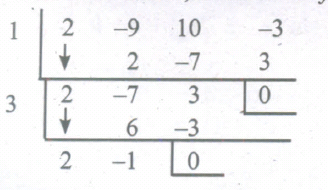
[Using synthetic division]
f(x) = (x-1)(x - 3)(2x - 1) = 0
⇒x - 1 = 0, x - 3 = 0 or 2x - 1 = 0
⇒ x = 1, x = 3x, x = \(\frac{1}{2}\)
Hence the roots are 1, 3, \(\frac{1}{2}\).
20.
Rearrange the terms as
(2x-1)(2x+ 3) (x + 3) (x - 2) + 20 = 0
⇒ (4x2 + 6x - 2x- 3)(x2 - 2x + 3x - 6) + 20 = 0
⇒ (4x2 + 4x - 3) (x2 + x - 6) + 20 = 0
put x2+ x = y
⇒ (4y - 3) (y - 6) + 20 = 0
⇒ 4y2 - 24y - 3y + 18 + 20 = 0
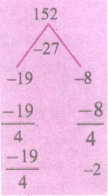
⇒ 4y2-27y +38 = 0
⇒ (y - 2)( 4y - 19) = 0
\(y=2,\frac { 19 }{ 4 } \)
Case (i)
When y = 2
x2+ x = 2
x2 + x - 2 = 0
⇒ (x + 2)(x - 1) = 0
⇒ x = -2, 1
Case (ii)
When \(y=\frac { 19 }{ 4 } ,{ x }^{ 2 }+x=\frac { 19 }{ 4 } \)
\(\Rightarrow { 4x }^{ 2 }+4x=19\)
\(\Rightarrow { 4x }^{ 2 }-4x-19=0\)
\(\Rightarrow x=\frac { -4\pm \sqrt { 16-4(4)(-19) } }{ 8 } \)
\(\Rightarrow x=\frac { -4\pm \sqrt { 16+304 } }{ 8 } \)
\(\Rightarrow x=\frac { -4\pm \sqrt { 320 } }{ 8 } \)
\(\Rightarrow x=\frac { 4\pm 8\sqrt { 5 } }{ 8 } \)
\(\Rightarrow x=\frac { -4(-1\pm 2\sqrt { 5 } ) }{ 8 } \)
\(\frac{-1 \pm 2 \sqrt{5}}{2}\)
Hence the roots are 1, -2, \(\frac{-1 \pm 2 \sqrt{5}}{2}\)
21.
(i) 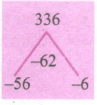
Rearrange the terms as,
(x-5) (x+4) (x-7) (x+6) = 504
{-2, 3, -7, 8}
⇒ (x2 -x - 20) (x2 -x - 42) = 504
Put x2- x = y
⇒ (y-20)(y-42) = 504
⇒ y2-62y+840-504 = 0
⇒ y2-62y+336 = 0
⇒ (y - 56) (y - 6) = 0
⇒ y = 56, 6
Case (i)
When y = 56, x2 - x = 56
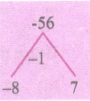
⇒ x2 - x - 56 = 0
⇒ (x - 8)(x + 7) = 0
⇒ x = 8, -7
Case (ii)
When y = 6,
x2- x = 6
x2- x - 6 = 0
⇒ (x - 3)(x + 2) = 0
⇒ x = 3, - 2

Hence the roots are -2, 3, 8, -7
22.
Since the coefficients of the equation are all rational numbers, 2+i and 3-\(\sqrt{2}\) are roots, we get 2-i and 3+\(\sqrt{2}\) are also roots of the given equation. Thus (x-(2+i)), (x-(2-i)), (x-(3-\(\sqrt{2}\))) and (x-(3+\(\sqrt{2}\))) are factors. Thus their product.
((x-(2+i))(x-(2-i))(x-(3-\(\sqrt{2}\)))(x-(3+\(\sqrt{2}\))) is a factor of the given polynomial equation.
That is, (x2-4x+5)(x2-6x+7) is a factor. Dividing the given polynomial equation by this factor, we get the other factor as (x2-3x-4) which implies that 4 and −1 are the other two roots. Thus
2+i, 2-i, 3+\(\sqrt{2}\), 3-\(\sqrt{2}\), -1, and 4 are the roots of the given polynomial equation.
23.
Let ∝, β, ૪ be the roots of the equation
Given \(\frac { \alpha }{ \beta } =\frac { 3 }{ 2 } \Rightarrow 2\alpha =3\beta \Rightarrow \alpha =\frac { 3 }{ 2 } \beta \)
\(\therefore \frac { 3 }{ 2 } \beta ,\beta ,\gamma \) are the roots of the given equation
Then by Vieta's formula,
\(\frac { 3 }{ 2 } \beta +\beta +\gamma =\frac { -b }{ a } =\frac { -(-9) }{ 1 } =9\)
\(\frac { 5 }{ 2 } \beta +\gamma =9\Rightarrow \gamma =9-\frac { 5 }{ 2 } \beta \)
\(\Rightarrow \gamma =\frac { 18-5\beta }{ 2 } ...(2)\)
Also \(\frac { 3 }{ 2 } \beta (\beta )+\beta \gamma +\left( \frac { 3 }{ 2 } \beta \right) \gamma =\frac { c }{ a } =\frac { 14 }{ 1 } =14\)
\(\Rightarrow \frac { 3 }{ 2 } { \beta }^{ 2 }+\frac { 5 }{ 2 } \beta \left( \frac { 18-5\beta }{ 2 } \right) =14\ [using\ (2)]\)
\(\Rightarrow \frac { 3 }{ 2 } { \beta }^{ 2 }+\frac { 90\beta }{ 4 } -\frac { 25{ \beta }^{ 2 } }{ 4 } =14\)
Multiplying by \(4,6{ \beta }^{ 2 }+90{ \beta }-25{ \beta }^{ 2 }=56\)
\(19{ \beta }^{ 2 }-90{ \beta }+56=0\)
\(\Rightarrow ({ \beta }-4)(19{ \beta }-14)=0\)
\(\Rightarrow { \beta }=4\)
\({ \beta }=\frac { 14 }{ 19 } \)
When \(\beta\) = 4, the other roots are \(\frac { 3 }{ 2 } (4),4,\frac { 18-5 }{ 2 } (4)\)
\(\Rightarrow 6,4,-1\)
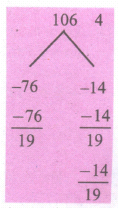
When \(\\ \beta =\frac { 14 }{ 19 } ,\) the other roots are \(\frac { 3 }{ 2 } \beta ,\beta \frac { 18-5\beta }{ 2 } [by(2)]\)
\(\Rightarrow \frac { 3 }{ 2 } \left( \frac { 14 }{ 19 } \right) ,\frac { 14 }{ 19 } ,\frac { 18-5\left( \frac { 14 }{ 19 } \right) }{ 2 } \Rightarrow \frac { 21 }{ 19 } ,\frac { 14 }{ 19 } ,\frac { 136 }{ 19 } \)
24.
The discriminant Δ =((4p)2 - 4(4)(p+2) = 16(p2-p-2) = 16(p+1)(p-2). So we get
Δ < 0 if -1
Δ = 0 if p = -1 or p = 2
Δ >0 if \(\infty\).
imaginary roots if -1 < p < 2
equal real roots if p = −1 or p = 2;
distinct real roots if -\(\infty\) < p < -1 or 2 < p < \(\infty\)
25.
Let α, β and γ be the roots of x3+ ax2+ bx + c = 0
Then, we get
Σ1 = α + β + γ = -a ....(1)
Σ2 = αβ + βγ + γα = b ...(2)
Σ3 = αβγ = -c ...(3)
We have to form the equation whose roots are α2, β2 and γ2.
Using (1), (2) and (3), we find the following
Σ1 = α2 + β2 + γ2 = (α + β + γ )2 - 2( αβ + βγ + γα) = (-a)2 -2(b) = a2-2b,
Σ2 = α2β2 + β2γ2 + γ2α2 = (αβ + βγ + γα)2 - 2((αβ)( βγ)(γα) + (γα)(αβ))
= (αβ + βγ + γα)2 - 2αβγ (β + γ + α) = (b)2 - 2(-c)(-a) = b2-2ca
Σ3 = α2β2γ2 = (αβγ)2 = (-c)2 = c2
Hence, the required equation is
x3-(α2 + β2 + γ2)x2 + (α2β2 + β2γ2 + γ2α2)x - α2β2γ2 = 0
That is, x3-(a2-2b)x2 + (b2-2ca)x-c2 = 0
26.
Since two roots are in the ratio p : q : r, we can assume the roots as pλ, qλ and rλ .
Then, we get
Σ1 = pλ + qλ + rλ = -a .....(1)
Σ2 = (pλ)(qλ)+(qλ)(rλ)+(rλ)(pλ) ..........(2)
Σ3 = (pλ)(qλ)(rλ) = -c .....(3)
Now, we get
(1) ⇒ λ = -\(\frac { a }{ p+q+r } \) ..........(4)
(3) ⇒ λ3 = \(\frac { c }{ pqr } \) ...........(5)
Substituting (4) in (5), we get
\(\left( \frac { a }{ p+q+r } \right) ^{ 3 }=-\frac { c }{ pqr } \) ⇒ pqra3 = c(p+q+ r)3.
27.
Given equation is 2x4- 8x + 6x2- 3 = 0
Here a = 2, b = -8, c = 6, d = 0, e = -3
Let ∝, β, ૪ and \(\delta \) be the roots of equation (1)
Then by Vieta's formula,
\(\sum { _{ 1 }= } \alpha +\beta +\gamma +\delta =\frac { -b }{ a } =\frac { -(-8) }{ 2 } =4\)
\(\sum { _{ 2 } } =\alpha \beta +\alpha \gamma +\alpha \delta +\beta \gamma +\beta \delta +\gamma \delta =\frac { c }{ a } =\frac { 6 }{ 2 } =3\)
\(\sum { _{ 3 } } =\alpha \beta \gamma +\alpha \beta \delta +\alpha \gamma \delta +\beta \gamma \delta =\frac { -d }{ a } =\frac { 0 }{ a } \)
\(\sum { _{ 4 } } =\alpha \beta \gamma \delta =\frac { e }{ a } =\frac { -3 }{ 2 } \)
Now, (a+b+c+d)2 = a2+b2+c2+d2+2(ab+ac+ad+bc+cd)
⇒ n∝2+β2+૪2+\(\delta\)2 = (∝ + β + ૪ + \(\delta\))2-2(\(\alpha \beta +\alpha \gamma +\alpha \delta +\beta \gamma +\beta \delta +\gamma \delta \))
∝2 + β2 + ૪2 = 42-2(3) = 16 - 6 = 10
28.
(c)
2
29.
(b)
c<0
30.
(c)
4
31.
(d)
\(\frac{-2}{3}\)
32.
(a)
0, 2
33.
(c)
b2 - 4ac >0
34.
(a)
35.
(b)
one of the roots is 1
36.
(a)
37.
(c)
p-√q
38.
(a)
39.
(d)
40.
(a)
41.
(a)
mn
42.
(d)
-4

12th Standard Syllabus & Materials
12th Standard
TN 12th Computer Applications வலையமைப்பு வடமிடல் Sample Question Papers Study Material - QB365 Set A
NEW12th Standard
TN 12th Computer Applications களப்பெயர் முறைமை (DNS) Sample Question Papers Study Material - QB365 Set A
NEW12th Standard
TN 12th Computer Applications வலையமைப்பு எடுத்துக்காட்டுகள் மற்றும் நெறிமுறைகள் Sample Question Papers Study Material - QB365 Set A
NEW12th Standard
TN 12th Computer Applications கணினி வலையமைப்பு ஓர் அறிமுகம் Sample Question Papers Study Material - QB365 Set A



Tamilnadu Stateboard 12th Standard Subjects
Maths

Chemistry

Physics

Biology

Computer Science

Business Maths and Statistics

Economics

Commerce

Accountancy

History

Computer Applications
Biology
Computer Technology
Computer Applications
Computer Science
Business Maths and Statistics
Commerce
Economics
Maths
Chemistry
Physics
Computer Technology
History
Accountancy

Tamil

English

French
Tamilnadu Stateboard Standards

