
 100% FREE ACCESS
12th Standard Syllabus & Materials
12th Standard
TN 12th Computer Applications மின்னணு தரவு பரிமாற்றம் Sample Question Papers Study Material - QB365 Set A
NEW12th Standard
TN 12th Computer Applications மின் - வணிக பாதுகாப்பு அமைப்புகள் Sample Question Papers Study Material - QB365 Set A
NEW12th Standard
TN 12th Computer Applications மின்னணு செலுத்தல் முறைகள் Sample Question Papers Study Material - QB365 Set A
NEW12th Standard
TN 12th Computer Applications மின் - வணிகம் Sample Question Papers Study Material - QB365 Set A
NEW12th Standard
TN 12th Computer Applications திறந்த மூல கருத்துருக்கள் Sample Question Papers Study Material - QB365 Set A
NEW12th Standard
TN 12th Computer Applications வலையமைப்பு வடமிடல் Sample Question Papers Study Material - QB365 Set A

Published on: 02/09/2022
QB365 provides a detailed and simple solution for every Possible Book Back Questions in Class 12 Maths Subject - Two Dimensional Analytical Geometry-II, English Medium. It will help Students to get more practice questions, Students can Practice these question papers in addition to score best marks.
Download Tamil Nadu 12th Standard Maths question papers, model tests, one-mark questions, important questions, and public exam papers in PDF format. Free study materials and answer keys for TN State Board students.
Questions + Answers key
Take MCQ Maths Test1.
Identify the type of conic and find centre, foci, vertices, and directrices of each of the following :
9x2−y2−36x−6y+18 = 0
2.
Identify the type of conic and find centre, foci, vertices, and directrices of each of the following :
18x2+12y2−144x+48y+120 = 0
3.
Identify the type of conic and find centre, foci, vertices, and directrices of each of the following :
\(\frac { { \left( y-2 \right) }^{ 2 } }{ 25 } \frac { { \left( x+1 \right) }^{ 2 } }{ 16 } =1\)
4.
Identify the type of conic and find centre, foci, vertices, and directrices of each of the following :
\(\frac { { \left( x+3 \right) }^{ 2 } }{ 225 } -\frac { { \left( y-4 \right) }^{ 2 } }{ 64 } =1\)
5.
Identify the type of conic and find centre, foci, vertices, and directrices of each of the following :
\(\frac { { \left( x+1 \right) }^{ 2 } }{ 100 } +\frac { { \left( y-2 \right) }^{ 2 } }{ 64 } =1\)
6.
Identify the type of conic and find centre, foci, vertices, and directrices of each of the following:
\(\frac { { y }^{ 2 } }{ 16 } -\frac { { x }^{ 2 } }{ 9 } =1\)
7.
Identify the type of conic and find centre, foci, vertices, and directrices of each of the following:
\(\frac { { x }^{ 2 } }{ 25 } -\frac { { y }^{ 2 } }{ 144 } =1\)
8.
Identify the type of conic and find centre, foci, vertices, and directrices of each of the following:
\(\frac { { x }^{ 2 } }{ 3 } +\frac { { y }^{ 2 } }{ 10 } =1\)
9.
Find the vertex, focus, equation of directrix and length of the latus rectum of the following: y2−4y−8x+12 = 0
10.
Find the vertex, focus, equation of directrix and length of the latus rectum of the following:
x2−2x+8y+17= 0
11.
Points A and B are 10 km apart and it is determined from the sound of an explosion heard at those points at different times that the location of the explosion is 6 km closer to A than B. Show that the location of the explosion is restricted to a particular curve and find an equation of it.
12.
On lighting a rocket cracker it gets projected in a parabolic path and reaches a maximum height of 4 m when it is 6 m away from the point of projection. Finally it reaches the ground 12 m away from the starting point. Find the angle of projection.
13.
14.
A rod of length 1.2 m moves with its ends always touching the coordinate axes. The locus of a point P on the rod, which is 0.3 m from the end in contact with x -axis is an ellipse. Find the eccentricity.
15.
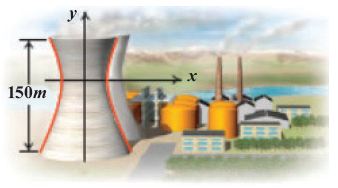
Cross section of a Nuclear cooling tower is in the shape of a hyperbola with equation\(\frac { { x }^{ 2 } }{ { 30 }^{ 2 } } -\frac { { y }^{ 2 } }{ { 44 }^{ 2 } } =1\). The tower is 150 m tall and the distance from the top of the tower to the centre of the hyperbola is half the distance from the base of the tower to the centre of the hyperbola. Find the diameter of the top and base of the tower.
16.
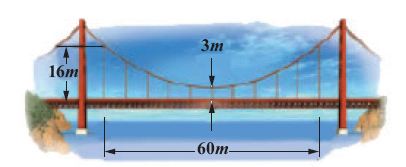
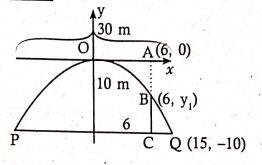
Parabolic cable of a 60m portion of the roadbed of a suspension bridge are positioned as shown below. Vertical Cables are to be spaced every 6m along this portion of the roadbed. Calculate the lengths of first two of these vertical cables from the vertex.
17.
An engineer designs a satellite dish with a parabolic cross section. The dish is 5 m wide at the opening, and the focus is placed 1.2 m from the vertex
(a) Position a coordinate system with the origin at the vertex and the x -axis on the parabola’s axis of symmetry and find an equation of the parabola.
(b) Find the depth of the satellite dish at the vertex.
18.
At a water fountain, water attains a maximum height of 4 m at horizontal distance of 0.5 m from its origin. If the path of water is a parabola, find the height of water at a horizontal distance of 0.75 m from the point of origin.
19.
A tunnel through a mountain for a four lane highway is to have a elliptical opening. The total width of the highway (not the opening) is to be 16 m, and the height at the edge of the road must be sufficient for a truck 4 m high to clear if the highest point of the opening is to be 5 m approximately. How wide must the opening be?
20.
21.
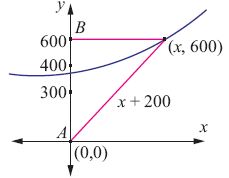
Two coast guard stations are located 600 km apart at points A(0, 0) and B(0, 600). A distress signal from a ship at P is received at slightly different times by two stations. It is determined that the ship is 200 km farther from station A than it is from station B. Determine the equation of hyperbola that passes through the location of the ship.
22.
A semielliptical archway over a one-way road has a height of 3m and a width of 12m. The truck has a width of 3m and a height of 2.7m. Will the truck clear the opening of the archway?
23.
If the normal at the point ‘t1’ on the parabola y2 = 4ax meets the parabola again at the point ‘t2’, then prove that t2 = -\(\left( { t }_{ 1 } + \frac { 2 }{ { t }_{ 1 } } \right) \)
24.
Prove that the point of intersection of the tangents at ‘t1’ and ‘t2’ on the parabola y2 = 4ax is \(\left[ at_{ 1 }t_{ 2 },a({ t }_{ 1 }+{ t }_{ 2 }) \right] .\)
25.
Find the equation of the tangent at t = 2 to the parabola y2 = 8x. (Hint: use parametric form)
26.
Find the equation of the tangent to the parabola y2 = 16x perpendicular to 2x + 2y + 3 = 0.
27.
Show that the line x−y+4 = 0 is a tangent to the ellipse x2+3y2 = 12 . Also find the coordinates of the point of contact.
28.
Find the equations of tangents to the hyperbola \(\frac { { x }^{ 2 } }{ 16 } -\frac { { y }^{ 2 } }{ 64 } \) = 1 which are parallel to10x − 3y + 9 = 0.
29.
Find the equations of the two tangents that can be drawn from (5, 2) to the ellipse 2x2+7y2 = 14 .
30.
Find the equations of tangent and normal to the ellipse x2+4y2 = 32 when \(\theta =\frac { \pi }{ 4 } \)
31.
32.
Identify the type of conic and find centre, foci, vertices, and directrices of each of the following :
\(\frac { { \left( x-3 \right) }^{ 2 } }{ 225 } +\frac { { \left( y-4 \right) }^{ 2 } }{ 289 } =1\)
33.
Identify the type of conic and find centre, foci, vertices, and directrices of each of the following:
\(\frac { { x }^{ 2 } }{ 25 } +\frac { { y }^{ 2 } }{ 9 } =1\)
34.
Find the centre, foci, and eccentricity of the hyperbola 11x2 − 25y2 −44x + 50y −256 = 0
35.
For the ellipse 4x2 + y2 + 24x − 2y + 21 = 0, find the centre, vertices and the foci. Also prove that the length of latus rectum is 2
36.
Find the foci, vertices and length of major and minor axis of the conic 4x2 + 36y2 + 40x − 288y + 532 = 0
37.
Find the equation of the ellipse whose eccentricity is \(\frac { 1 }{ 2 } \), one of the foci is(2, 3) and a directrix is x = 7. Also find the length of the major and minor axes of the ellipse.
38.
Find the equation of the circle through the points (1, 0),(-1, 0) , and (0, 1)
39.
Find the equation of the circle passing through the points (1, 1 ), (2, -1 ) and (3, 2) .
40.
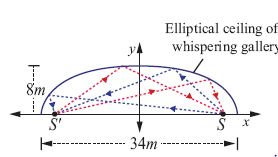
A room 34m long is constructed to be a whispering gallery. The room has an elliptical ceiling, as shown in Figure. If the maximum height of the ceiling is 8 m, determine where the foci are located.
41.
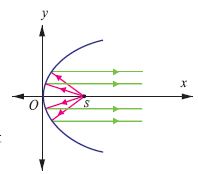
A search light has a parabolic reflector (has a cross-section that forms a ‘bowl’). The parabolic bowl is 40 cm wide from rim to rim and 30 cm deep. The bulb is located at the focus.
(1) What is the equation of the parabola used for reflector?
(2) How far from the vertex is the bulb to be placed so that the maximum distance covered?
42.
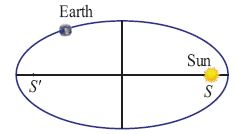
The maximum and minimum distances of the Earth from the Sun respectively are 152 × 106 km and 94.5 × 10⁶ km. The Sun is at one focus of the elliptical orbit. Find the distance from the Sun to the other focus.
43.
Show that the absolute value of difference of the focal distances of any point P on the hyperbola is the length of its transverse axis.
44.
Prove that the length of the latus rectum of the hyperbola \(\frac { { x }^{ 2 } }{ { a }^{ 2 } } -\frac { { y }^{ 2 } }{ { b }^{ 2 } } \) = 1 is \(\frac { { 2b }^{ 2 } }{ a } \).
45.
If the equation 3x2+(3−p)xy+qy2−2px = 8pq represents a circle, find p and q. Also determine the centre and radius of the circle.
46.
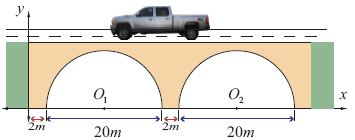
A road bridge over an irrigation canal has two semicircular vents each with a span of 20m and the supporting pillars of width 2m. Use Figure to write the equations that represent the semi-verticular vents
47.
Determine whether the points (-2, 1), (0, 0) and (-4, -3) lie outside, on or inside the circle x2+y2−5x+2y−5 = 0 .
1.
9x2- y2- 36x - 6y + 18 = 0
Given equation is 9x2- y2- 36x - 6y + 18 = 0
⇒ 9x2 - 36x - (y2 + 6y) = -18
⇒ 9(x2-4x)-(y2+6y) =-18
⇒ 9(x2 - 4x + 4 - 4) - (y2 + 6y + 9 - 9) = -18
⇒ 9(x-2)2-36-(y+3)2+9 =-18
⇒ 9(x-2)2 - (y+3)2 = -18+36-9
⇒ 9(x - 2)2 - (y + 3)2 = 9
Dividing by 9 we get, \(\frac { { (x-2) }^{ 2 } }{ 1 } -\frac { ({ y+3) }^{ 2 } }{ 9 } =1\)
This is an equation of the hyperbola whose transverse axis is parallel to x-axis.
a2 = 1, b2 = 9
∴ c2 = a2 + b2 = 1 + 9 = 10 ⇒ c = \(\sqrt { 10 } \)
\(e=\sqrt {1-\frac { { b }^{ 2 } }{ { a }^{ 2 } }} =\sqrt { 1-\frac { 9 }{ 1 } } =\sqrt { 10 } \)
a) Center is (2, -3)
⇒ h = 2, k = -3
(b) Foci are (h + c, k), (17 - c, k)
⇒ (2 +\(\sqrt { 10 } \), -3), (2 - \(\sqrt { 10 } \), -3)
(c) Vertic ar (h + a, k) (h - a, k)
⇒ (2+ 1,-3), (2-1,-3)
⇒ (3, -3) (1, -3)
(d) Equation of directrices are x - 2 = \(\pm \frac { a }{ e } \)
⇒ \(x-2=\pm \frac { 1 }{ \sqrt { 10 } } \)
\(x=2\pm \frac { 1 }{ \sqrt { 10 } } \)
⇒ \(x=2+\frac { 1 }{ \sqrt { 10 } } \) and \(x=2-\frac { 1 }{ \sqrt { 10 } } \)
2.
18x2+ 12y2 - 144x + 48y + 120 = 0
Given equation is
18x2 + 12y2 - 144x + 48y + 120 = 0
18x2 - 144x + 12y2 + 48y = -120
⇒ 18(x2 - 8x) + 12(y2 + 4y) = -120
⇒ 18(x2-8x+ 16-16)+ 12(y2 +4y+4-4) =-120
18(x - 4)2 - 288 + 12 (y + 2)2- 48 = -120
⇒ 18(x - 4)2+ 12(y + 2)2 = -120 + 288 + 48
⇒ 18(x - 4)2+ 12(y + 2)2 = 216
Dividing by 216 we get,
\(\frac { { 18(x-4) }^{ 2 } }{ 216 } +\frac { 12({ y+2) }^{ 2 } }{ 216 } =1\)
\(\Rightarrow \frac { { (x-4) }^{ 2 } }{ 12 } +\frac { ({ y+2) }^{ 2 } }{ 18 } =1\)
This is an equation of the ellipse with major axis parallel to y-axis,
∴ a2 = 18, b2 = 12
∴ c2 = a2 - b2 = 18 -12 = 6 ⇒ c = \(\sqrt { 6 } \)
e =\( \sqrt { 1-\frac { { b }^{ 2 } }{ { a }^{ 2 } } } =\sqrt { 1-\frac { 12 }{ 18 } } =\sqrt { \frac { 18-12 }{ 18 } } \)
\(=\sqrt{\frac{\not 6^1}{\not{18}}_{3}}=\sqrt{\frac{1}{3}}\)= \(\frac{1}{\sqrt 3}\)
(a) Center is (4, -2)
⇒ h = 4, k = -2
(b) Vertices are (h, k-a), (h, k + a)
⇒ (4, -2 - 3\(\sqrt { 2 } \)), (4, -2 + 3\(\sqrt { 2 } \))
[∴ a2 = 18 ⇒ a = \(\sqrt { 18 } \) = 3\(\sqrt { 2 } \)]
(c) Foci are (h, k - c), (h, k + c)
⇒ (4, -2 - \(\sqrt { 6 } \)), (4, -2 + \(\sqrt { 6 } \))
(d) Equation of directrices are y + 2 = \(\pm \frac { a }{ e } \)
⇒ y+ 2 = \(\pm \frac { a }{ e } \)
\(\Rightarrow y-2=\pm \frac { 3\sqrt { 2 } }{ \frac { 1 }{ \sqrt { 3 } } } =\pm 3\sqrt { 2 } \times \sqrt { 3 } =\pm 3\sqrt { 6 } \)
\(\Rightarrow y+2=\pm 3\sqrt { 6 } ,y+2=-3\sqrt { 6 } \)
\(\Rightarrow y=-2+3\sqrt { 6 } \) and \( y=-2-3\sqrt { 6 } \)
3.
\(\frac { { (y-2) }^{ 2 } }{ 25 } -\frac { ({ x+1) }^{ 2 } }{ 16 } =1\)
Given equatlon is \(\frac { { (y-2) }^{ 2 } }{ 25 } -\frac { ({ x+1) }^{ 2 } }{ 16 } =1\)
Thi is an equation of the hyperbola where transverse axis is parallel to y-axis.
∴ a2 = 25, b2 = 16
⇒ c2 - a2 + b2 = 25 +16 = 41
⇒ c = \(\sqrt { 41 } \)
\(e =\sqrt { 1-\frac { { b }^{ 2 } }{ { a }^{ 2 } } } =\sqrt { 1+\frac { 16 }{ 25 } } =\sqrt { \frac { 41 }{ 25 } } =\frac { \sqrt { 41 } }{ 5 } \)
(a) Center is (-1, 2) ⇒ h = -1, k = 2
(b) Foci are (h, k + c), (h, k- c)
⇒ (-1, 2 + \(\sqrt { 41 } \)), (-1, 2 - \(\sqrt { 41 } \))
(c) Vertices are (h, k + a), (h, k-a)
⇒ (-1, 2 + 5), (-1, 2 - 5)
= (-1, 7), (-1, -3)
(d) Equation of directrices are
\(y-2=\pm \frac { 5 }{ \frac { \sqrt { 41 } }{ 5 } } \)
\(\Rightarrow y-2=\pm \frac { 25 }{ \sqrt { 41 } } \)
\(\Rightarrow y=2+\frac { 25 }{ \sqrt { 41 } } \) and
\( y=2-\frac { 25 }{ \sqrt { 41 } } \)
4.
\(\frac { { \left( x+3 \right) }^{ 2 } }{ 225 } -\frac { { \left( y-4 \right) }^{ 2 } }{ 64 } =1\)
Given equation is \(\frac { { \left( x+3 \right) }^{ 2 } }{ 225 } -\frac { { \left( y-4 \right) }^{ 2 } }{ 64 } =1\)
This is an equation of the hyperbola
∴ a2 = 225, b2 = 64
⇒ c2 = a2 + b2 = 225 + 64 = 289
⇒ c = 17
\(e=\sqrt { 1-\frac { { b }^{ 2 } }{ { a }^{ 2 } } } =\sqrt { 1-\frac { 64 }{ 225 } } =\sqrt { \frac { 225+64 }{ 225 } } \)
= \(\sqrt { \frac { 289 }{ 225 } } =\frac { 17 }{ 15 } \)
(a) Center is (-3, 4)
⇒ h = -3, k = 4
(b) Foci are (h + c, k), (h - c, k)
⇒ (-3 + 17,4), (-3 -17, 4)
⇒ (14, 4) (-20, 4)
(c) Vertices are (h + a, k) and (h - a, k)
⇒ (-3 + 15,4), (-3 - 15,4)
⇒ (12, 4) (-18, 4)
(d) Equation of directrices are x + 3 = \(\pm \frac { a }{ e } \)
\(\Rightarrow x+3=\pm \frac { 15 }{ \frac { 17 }{ 15 } } \Rightarrow x+3=\pm \frac { -225 }{ 17 } \)
\(\Rightarrow x=\frac { 225 }{ 17 } \) and \(x=\frac { -225 }{ 17 } \)
\(\Rightarrow x=\frac { 225-51 }{ 17 } \) and \(x=\frac { -225-51 }{ 17 } \)
\(\Rightarrow x=\frac { 174 }{ 17 } \) and \(x=\frac { -276 }{ 17 } \)
5.
Given equation is \(\frac { { (x-1) }^{ 2 } }{ 100 } +\frac { ({ y-2) }^{ 2 } }{ 64 } =1\)
This is an equation of the ellipse
∴ a2 = 100,b2 = 64
⇒ c2 = a2 - b2
⇒ c2 = 100 - 64 = 36
∴ c = 6
\(\sqrt { 1-\frac { { b }^{ 2 } }{ { a }^{ 2 } } } =\sqrt { 1-\frac { 64 }{ 100 } } =\sqrt { \frac { 100-64 }{ 100 } } \)
\(=\sqrt{\frac{36}{100}}=\frac{\not 6} {\not {10}}\)
∴ c = \(\frac { 3 }{ 5 } \)
(a) Center is (-1, 2) ⇒ h = -1, k = 2
(b) Foci are (h - c, k), (h + c, k) ⇒ (-1 - 6, 2), (-1 + 6, -2) ⇒ (-7, 2), (5, 2)
(c) Vertices are (h - a, k) and (h + a, k) ⇒ (-1 -10,2), (-1 + 10,2) ⇒ (-11, 2), (9, 2)
(d) Equation of directrices are x + 1 = \(\pm \frac { a }{ e } \)
\(\Rightarrow x+1=\pm \frac { 10 }{ \frac { 3 }{ 5 } } \Rightarrow x+1=\pm \frac { 50 }{ 3 } \)
\(\therefore x+1=\frac { 50 }{ 3 } and x+1=-\frac { 50 }{ 3 } \)
\(\Rightarrow x=\frac { 50 }{ 3 } -1\) and \(x=-\frac { 50 }{ 3 } -1\)
\(\Rightarrow x=\frac { 47 }{ 3 } \) and \(x=\frac { -53 }{ 3 } \)
6.
\(\frac { { x }^{ 2 } }{ 16 } +\frac { { y }^{ 2 } }{ 9 } =1\)
Given equation is \(\frac { { x }^{ 2 } }{ 16 } +\frac { { y }^{ 2 } }{ 9 } =1\)
This is an equation of the hyperbola where the transverse axis is parallel to the y-axis.
∴ a2 = 16, b2 = 9, c2 = a2 + b2
⇒ c2 = 16 + 9 = 25 ⇒ c = 5
\(e=\sqrt { 1-\frac { { b }^{ 2 } }{ { a }^{ 2 } } } =\sqrt { 1+\frac { 9 }{ 16 } } =\sqrt { \frac { 16+9 }{ 16 } } =\sqrt { \frac { 25 }{ 16 } } =\frac { 5 }{ 4 } \)
(a) Center is (0, 0)
⇒ h = 0, k = 0
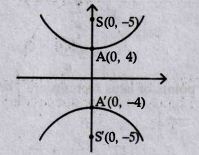
(b) Vertices are (h, k + a), (h, k-a)
⇒ (0, 0 + 4), (0, 0 - 4) ⇒ (0, 4) (0,-4)
(c) Foci are (h, k + c), (h, k- c)
⇒ (0, 0 + 5), (0, 0 - 5) ⇒ (0, 5) (0, -5)
(d) Equations of Directrices are y = \(x=\pm \frac { a }{ e } \)
\(\Rightarrow y=\pm \frac { 4 }{ \frac { 5 }{ 4 } } \Rightarrow y=\pm \frac { 16 }{ 5 } \)
7.
\(\frac { { x }^{ 2 } }{ 25 } +\frac { { y }^{ 2 } }{ 144 } =1\)
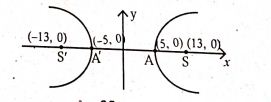
This is an equation of the hyperbola.
∴ a2 = 25 and b2 = 144
⇒ c2 =a2 + b2 =25 + 144 =169 ⇒ c = 13
\(e=\sqrt { 1-\frac { { b }^{ 2 } }{ { a }^{ 2 } } } =\sqrt { 1+\frac { 144 }{ 25 } } =\sqrt { \frac { 169 }{ 25 } } =\frac { 13 }{ 5 } \)
(a) Center is (0, 0) ⇒ h = 0, k = 0
(b) Foci are (h + c, k), (h - c, k)
⇒ (0 + 13,0), (0 - 13,0)
⇒ (13, 0), (-13, 0)
(c) Vertices are (h + a, k) and (h - a, k)
⇒ (0 + 5, 0), (0 - 5, 0) ⇒ (5, 0), (-5, 0)
(d) Equations of Directrices are x = \(x=\pm \frac { a }{ e } \)
\(\Rightarrow x=\frac { 5 }{ \frac { 13 }{ 5 } } \Rightarrow x=\pm \frac { 25 }{ 13 } \)
8.
\(\frac { { x }^{ 2 } }{ 3 } +\frac { { y }^{ 2 } }{ 10 } =1\)
Given equation \(\frac { { x }^{ 2 } }{ 3 } +\frac { { y }^{ 2 } }{ 10 } =1\)
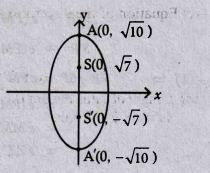
This is an equation of the ellipse with major axis parallel to the y-axis.
∴ b2 = 3, a2 = 10
⇒ c2 = a2 - b2 = 10 - 3
⇒ c = \(\sqrt { 7 } \)
\(
a e=\sqrt{7}
\)
\(\sqrt{10} =\sqrt{7}
\)
\(e =\sqrt{\frac{7}{10}}\)
(a) Center is (0, 0)
⇒ h = 0, k = 0
(b) vertic are (h, k - a), (h, k + a)
⇒ (0, 0 - \(\sqrt { 10 } \)), (0, 0 + \(\sqrt { 10 } \))
⇒ (0 - \(\sqrt { 10 } \)), (0 + \(\sqrt { 10 } \))
(c) Foci are (h, k-c)(h, k+c)
⇒ (0, 0 - \(\sqrt {7 } \)), (0, 0 + \(\sqrt {7 } \))
Directrices are y = \(\pm \frac { a }{ e } \)
\(y=\pm \frac { \sqrt { 10 } }{ \frac { \sqrt { 7 } }{ \sqrt { 10 } } } \)
\(y=\pm \frac{10}{\sqrt{7}}\)
9.
y2 - 4y - 8x + 12 = 0
y2-4y = 8x-12
Adding 4 both sides, we get,
y - 4y + 4 = 8x - 12 + 4 = 8x - 8
⇒ (y - 2)2 = 8(x - 1)
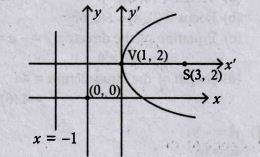
This is a right open parabola and latus
rectum is 4a = 8 ⇒ a = 2.
(a) Vertex is (1, 2) ⇒ h = 1, k = 2
(b) focus is (h + a, 0 + k)
⇒ (1 + 2, 0 + 2)
⇒ (3, 2)
(c) Equation of directrix is x = h - a
⇒ x = 1-2
⇒ x = -1
(d) Length of latus rectum is 4a = 8 units.
10.
x2-2x+ 8y+ 17 = 0
x2 - 2x = -8y - 17
Adding 1 both sides, we get
x2 - 2x + 1 = -8y - 17 + 1
⇒ (x - 1)2 = -8y - 16 = -8(y + 2)
⇒ (x - 1)2 = -8(y + 2)
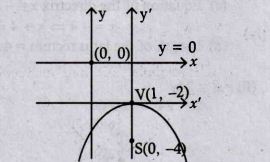
This is a open downward parabola, latus
rectum 4a = 8 ⇒ a = 2.
(a) Vertex is (1, -2)
⇒ h = 1, k = -2
(b) focus is (0 + h, - a + k)
⇒(0 + 1, -2-2)
⇒ (1, -4)
(c) Equation of directrix is y = k + a
⇒ y = -2 + 2 ⇒ y = 0
(d) Length of latus rectum is 4a = 8 units.
11.
Let P(x, y) be the location of explosion
Given PB - PA = 6
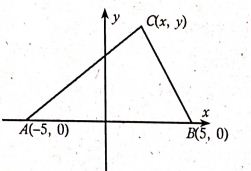
Using distance formula,
\(\sqrt { { (x-5) }^{ 2 }+({ y-0) }^{ 2 } } -\sqrt { ({ x+5 })^{ 2 }+({ y-0) }^{ 2 } } =6\)
\(\Rightarrow \sqrt { { (x-5) }^{ 2 }+({ y })^{ 2 } } -\sqrt { (x+{ 5) }^{ 2 }+({ y) }^{ 2 } } =6\)
Squaring both sides, we get,
(x - 5)2 + y2 + (x + 5)2 + y2
\(-2\sqrt { [(x-{ 5 })^{ 2 }+{ y }^{ 2 }][(x+{ 5 })^{ 2 }+{ y }^{ 2 }] } \) = 36
.JPG)
\(2\sqrt { [(x-{ 5 })^{ 2 }+{ y }^{ 2 }][(x+{ 5 })^{ 2 }+{ y }^{ 2 }] } \)
⇒ 2x2 + 2y2+14
= \(2\sqrt { ({ x }^{ 2 }-10x+25+{ y }^{ 2 })({ x }^{ 2 }+10x+25+{ y }^{ 2 }) } \)
⇒ x2 + y2 + 7
= \(2\sqrt { ({ x }^{ 2 }-10x+25+{ y }^{ 2 })({ x }^{ 2 }+10x+25+{ y }^{ 2 }) } \)
Squaring again,
x4+ y4 + 49 +2x2y2 + 14y2 + 14x2
= (x2 - 10x + 25 + y2) (x2 + 10x + 25 + y2)
.JPG)
⇒ 14y2 + 14x2 = -50x2 + 50y2 + 625 - 49
⇒ 64x2 - 36y2 = 576
\(\div \) 4 we get,
16x2 - 9y = 144
\(\frac { { x }^{ 2 } }{ 9 } -\frac { { y }^{ 2 } }{ 16 } =1\)
Hence the location of explo ion is restricted to a hyperbola whose equation is \(\frac { { x }^{ 2 } }{ 9 } -\frac { { y }^{ 2 } }{ 16 } =1\)
12.
By taking the vertex; at the origin, the parabola is open downward.
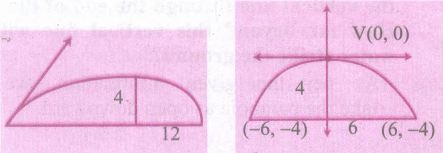
Its equation is x2 = -4ay
It passes through (6, -4)
∴ 36 = -4a(-4) ⇒ 4a = - \(\frac { 36 }{ 4 } \) = 9
∴ (1) becomes, x2 = -9y
To find the slope at (-6, -4)
Differentiating (1) with respect to 'x' we get,
2x = -9\(\frac { dy }{ dx } \)
⇒ \(\frac { dy }{ dx } =\frac { -2x }{ 9 } \)
At (-6, -4), \(\frac { dy }{ dx } =-2\frac { (-6) }{ 9 } =\frac { 12 }{ 9 } =\frac { 4 }{ 3 } \)
∴ \(tan\theta =\frac { 4 }{ 3 } \Rightarrow \theta ={ tan }^{ -1 }\left( \frac { 4 }{ 3 } \right) \)
∴ The angle of projection is tan-1 \(\left( \frac { 4 }{ 3 } \right) \)
13.
.JPG)
14.
Let AB be the rod and P(x1, y1) be a point on the rod such that AP = 0.3 m.
Draw PD ⊥ x-axis and PC ⊥ y - axis.
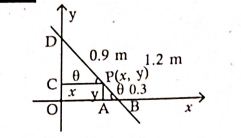
Δ ADP ≅ Δ PCB
∴ \(\frac { PC }{ DA } =\frac { PB }{ AP } =\frac { BC }{ PD } \)
⇒ \(\frac { x_{ 1 } }{ DA } =\frac { 0.9 }{ 0.3 } =\frac { BC }{ { y }_{ 1 } } \)
⇒ \(DA=\frac { 0.3{ x }_{ 1 } }{ 0.9 } =\frac { { x }_{ 1 } }{ 3 } \)
and BC = \(\frac { 0.9{ y }_{ 1 } }{ 0.3 } =\frac { 9 }{ 3 } { y }_{ 1 }=3{ y }_{ 1 }\)
Now OA = OD + DA
= \({ x }_{ 1 }+\frac { { x }_{ 1 } }{ 3 } =\frac { 4{ x }_{ 1 } }{ 3 } \)
OB = OC + BC = y1 + 3y1 = 4y1
But OA2 + OB2 = AB2
⇒ \({ \left( \frac { 4{ x }_{ 1 } }{ 3 } \right) }^{ 2 }+{ \left( 4{ y }_{ 1 } \right) }^{ 2 }={ \left( 1.2 \right) }^{ 2 }\)
⇒ \(\frac { { { x }_{ 1 } }^{ 2 } }{ 9 } +\frac { { { y }_{ 1 } }^{ 2 } }{ 9 } =\frac { 1.44 }{ 16 } =0.09\) ≅ 1
∴ Locus of (x1, y1) is \(\frac { { x }^{ 2 } }{ 9 } +\frac { { y }^{ 2 } }{ 1 } =1\)
Here a2 = 9, b2 = 1
∴ \(e=\sqrt { 1-\frac { { b }^{ 2 } }{ { a }^{ 2 } } } =\sqrt { 1-\frac { 1 }{ 9 } } =\sqrt { \frac { 9-1 }{ 9 } } \)
= \(\sqrt { \frac { 8 }{ 9 } } \)
e = \(\frac { 2\sqrt { 2 } }{ 3 } \)
15.
The cross section of a nuclear cooling tower is in the shape of a hyperbola.
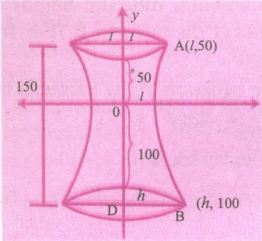
GIven OC = \(\frac12\) OD and CD = 150 m
Its equation is OC = 50 m & OD = 100 m
\(\frac { { x }^{ 2 } }{ { 30 }^{ 2 } } -\frac { { y }^{ 2 } }{ { 44 }^{ 2 } } =1\) ......(1)
Let I be the radius of the top of the tower
∴ A(l, 50) is a point on the hyperbola
∴ \(\frac { { l }^{ 2 } }{ { 30 }^{ 2 } } \frac { { 50 }^{ 2 } }{ { 44 }^{ 2 } } =1\)
⇒ \(\frac { { l }^{ 2 } }{ { 30 }^{ 2 } } =1+\frac { { 50 }^{ 2 } }{ { 44 }^{ 2 } } =\frac { { 44 }^{ 2 }+{ 50 }^{ 2 } }{ { 44 }^{ 2 } } \)
⇒ \({ l }^{ 2 }=\frac { { 30 }^{ 2 } }{ { 44 }^{ 2 } } \) (1936 + 2500)
⇒ l2 = \(\frac { 30 }{ 40 } \sqrt { 4436 } =\frac { 30 }{ 44 } \)(66.60)
⇒ \(\frac { 30 }{ 40 } \sqrt { 4436 } =\frac { 30 }{ 44 } \) = 45.41 m
Radius of the top of the tower is 45.41 m.
Let h be the radius of the base of the tower.
∴ B(h, 100) is a point on the hyperbola
∴ (1) becomes
\(\frac { { h }^{ 2 } }{ { 30 }^{ 2 } } -\frac { { 100 }^{ 2 } }{ { 44 }^{ 2 } } =1\Rightarrow \frac { h^{ 2 } }{ { 30 }^{ 2 } } =1+\frac { { 100 }^{ 2 } }{ { 44 }^{ 2 } } =\frac { { 44 }^{ 2 }+{ 100 }^{ 2 } }{ { 44 }^{ 2 } } \)
⇒ \({ h }^{ 2 }=\frac { { 30 }^{ 2 } }{ { 44 }^{ 2 } } \) (1936 + 10000)
⇒ \({ h }^{ 2 }=\frac { 30 }{ 44 } \sqrt { 11936 } =\frac { 30 }{ 44 } \)(109.25)
⇒ \(h=\frac { 3277.5 }{ 44 } \) = 74.48 m.
Radius of the base of the tower is 74.48 m.
Diameter of the base = 148.96 m
Diameter of the top and base of the tower are 90.82 m and 148.96 m.
16.
Let the of the parbola be x2 = 4ay (1)
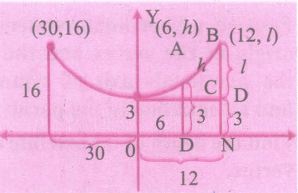
Since (30, 16) is a point on (1),
we get 302 = 4 \(\times\) a \(\times\) 16
⇒ a = \(\frac { 30\times 30 }{ 4\times 16 } =\frac { 225 }{ 16 } \)
∴ becomes, x2 = \({ x }^{ 2 }=\frac { 4\times 225 }{ 16 } y=\frac { 225 }{ 4 } y\)
Let AC = h m and BD = lm
∴ A(6, h) is a point on the parabola [∵ OD = 6]
∴ \({ 6 }^{ 2 }=\frac { 225 }{ 4 } \times h\)
⇒ \(h=\frac { 36\times 4 }{ 225 } \Rightarrow h=0.52\)
∴ AD = 3 + h = 3 + 0.52 = 3.52 m
Also (12, 1) is a point on the parabola
[∵ ON = 6 + 6 = 12]
∴ \({ 12 }^{ 2 }=\frac { 225 }{ 4 } \times l\)
⇒ l = \(\frac { 12\times 12\times 4 }{ 225 } =\frac { 576 }{ 225 } =2.08\) = 5.08 m
Hence the length of first two vertical cables are 3.52 m and 5.08 m.
17.
Let the cross section of the satellite dish be an right open parabola.
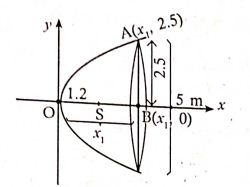
Its equation is y2 = 4ax
Since focus is placed 1.2 m from the vertex OA = 1.2 m and BC = 2.5 m since the width of the dish is 5 m.
From the diagram, a = 1.2 m
∴ y2 = 4(1.2)x
(a) ⇒ y2 = 4.8x ...(1)
(b) Since (x1, 2.5) lines on (1)(2.5)2 = 4.8(x1)
x1 = \(\frac { 2.5\times 2.5 }{ 4.8 } \)
x1 = 1.3 m
∴ Depth of the satellite dish at the vertex is 1.3 m.
18.

Let the equation of the parabola be
(x - h)2 = -4a(y - k).
Here the vertex is (0.5, 4)
Equation of the parabola is (x - 0.5)2
= -4a(y-4) ...(1)
O(0, 0) is a point on the parabola
(0 - 0.5)2 = -4a (0 - 4)
⇒ \({ \left( \frac { -1 }{ 2 } \right) }^{ 2 }=-4a(-4)\)
⇒ \(\frac { 1 }{ 4 } =16a\Rightarrow a=\frac { 1 }{ 64 } \)
∴ (1) becomes as (x - 0.5)2 = \(-4\times \frac { 1 }{ 64 } (y-4)\)
Also D(0.75, y1) is a point on the parabola
∴ (0.75 - 0.5)2 = \(\frac { -1 }{ 16 } ({ y }_{ 1 }-4)\)
⇒ \({ \left( \frac { 1 }{ 4 } \right) }^{ 2 }=\frac { -1 }{ 6 } ({ y }_{ 1 }-4)\)
\(\Rightarrow \frac{1}{\not 16}=\frac{1}{\not16}\left(y_{1}-4\right)\)
⇒ 1 = -y1 + 4
⇒ y1 = -1 + 4 = 3m
Height of the water at a horizontal distance of 0.75m is 3m
19.
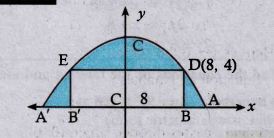
Let the equation of the ellipse be
\(\frac{x^{2}}{a^{2}}+\frac{y^{2}}{b^{2}}=1\)
Length of semi minor axis b = 5
\(\frac{x^{2}}{a^{2}}+\frac{y^{2}}{b^{2}}=1\)
Let BB' be the road width and AA' be the end points of the opening of the tunnel.
Let CB = 8, BD = 1,
D is (8, 4) lies on the ellipse
\(
\frac{8^{2}}{a^{2}}+\frac{4^{2}}{5^{2}}=1
\)
\( \Rightarrow a^{2}=\frac{25}{9} \times 64
\)
\( \Rightarrow a=\frac{40}{3}
\)
The width AA' = 2a
\(=\frac{80}{3}=26.66 \mathrm{~m}\)
The required width is 26.66 m.
20.
21.
Since the centre is located at (0, 300), midway between the two foci, which are the coast guard stations, the equation is \(\frac { { \left( y-300 \right) }^{ 2 } }{ { a }^{ 2 } } -\frac { { \left( x-0 \right) }^{ 2 } }{ { b }^{ 2 } } =1\).... (1)
To determine the values of a and b, select two points known to be on the hyperbola and substitute each point in the above equation.
The point(0, 400) lies on the hyperbola, since it is 200 km further from Station A than from station B.
\(\frac { { \left( 400-300 \right) }^{ 2 } }{ { a }^{ 2 } } -\frac { O }{ { b }^{ 2 } } =1\frac { { 100 }^{ 2 } }{ a^{ 2 } } =1,{ a }^{ 2 }=10000.\) There is also a point (x, 600) on the hyperbola such that 6002+ x2 = (x + 200)2
360000 + x2 = x2+400x+40000
x = 800
Substituting in (1), we have \(\frac { { \left( 600-300 \right) }^{ 2 } }{ 10000 } -\frac { { \left( 800-0 \right) }^{ 2 } }{ { b }^{ 2 } } =1\)
\(9-\frac { 640000 }{ { b }^{ 2 } } =1\)
b2 = 80000
Thus the required equation of the hyperbola is \(\frac { { \left( y-300 \right) }^{ 2 } }{ 10000 } -\frac { { x }^{ 2 } }{ 80000 } =1\)
The ship lies somewhere on this hyperbola. The exact location can be determined using data from a third station.
22.
Since the truck’s width is 3m, to determine the clearance, we must find the height of the archway 1.5 m from the centre. If this height is 2.7 m or less the truck will not clear the archway.
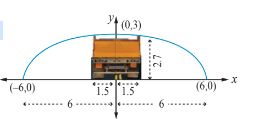
From the diagram a = 6 and b = 3 yielding the equation of ellipse as \(\frac { { x }^{ 2 } }{ { 6 }^{ 2 } } +\frac { { y }^{ 2 } }{ { 3 }^{ 2 } } =1\)
The edge of the 3m wide truck corresponds to x = 1.5 m. We will find the height of the
archway 1.5 m from the centre by substituting x =1.5 and solving for y
\(\frac { { \left( \frac { 3 }{ 2 } \right) }^{ 2 } }{ 36 } \frac { { y }^{ 2 } }{ 9 } =1\)
\({ y }^{ 2 }=9\left( 1-\frac { 9 }{ 144 } \right) \)
\(\frac { 9\left( 135 \right) }{ 144 } =\frac { 135 }{ 16 } \)
\(y=\frac { \sqrt { 135 } }{ 4 } \)
= 2.90
Thus the height of arch way 1.5m from the centre is approximately 2.90m. Since the truck’s height is 2.7 m, the truck will clear the archway.
23.
Equation of normal at 't1' to the parabola y2 = 4 axis is
y + xt1 = at13 + 2at1 ...(1)
(1) meets the-parabola y2 = 4ax at 't2'.
At 't2', the point on the parabola is x = at22, y = 2at2 (2) lies on (1)
∴ Substituting (2) in (1) we get,
2at2 + (at22)2t1 = at13 + 2at1
⇒ 2at2 + at1t22 = at13 + 2at1
⇒ 2a(t2 - t1) = -at1[t22 - t12]

⇒ 2 = -t1(t2+ t1)
⇒ \(\frac { -2 }{ { t }_{ 1 } } ={ t }_{ 2 }+{ t }_{ 1 }\Rightarrow { t }_{ 2 }=\frac { -2 }{ { t }_{ 1 } } { -t }_{ 1 }\)
⇒ t2 = -(t1 + \(\frac { -2 }{ { t }_{ 1 } } \))
Hence proved.
24.
The parametric equation of tangent at 't1' to the parabola y2 = 4ax is yt1 = x + at12 ...(1)
Also, the parametric equation of tangent at 't2' to the parabola y = 4ax is yt2 = x+ at22 ...(2)
(1) ➝ yt1 = x + at12
(2) ➝ yt2 = x + at22
(1) - (2) y(t1 -t2) = a(t12 - t22)
.JPG)
⇒ y = a(t1 + t2)
Substitutingy = a(t1 + t2) in (1) we get,
a(t1 + t2)t1 = x + at12
.JPG)
⇒ x = at1t2
Hence, the point of intersection of two lengths is
[at1t2, a(t1 + t2)]
25.
Equation of the parabola is y2 = 8x
∴ 4a = 8 ⇒ a = 2
Equation of tangent to the parabola in parametric form is yt = x + at2
When t = 2, the equation of tangent is
y(2) = x + 2(2)2 ⇒ 2y = x + 8
⇒ x - 2y + 8 = 0 is the required equation of tangent.
26.
Equation of theparabola is y2 = 16x
∴ 4a = 16 ⇒ a = 4
Let y = mx + c ... (1)
be a tangent to the parabola
Since the tangent is perpendicular to
2x + 2y+ 3 =0,
m = \(\frac{-1}{Slope \ of \ the \ line \ 2 x + 2y + 3 = 0}\)
∴ m = \(\frac { -1 }{ \frac { -2 }{ 2 } } =\frac { -1 }{ -1 } \) = 1
[∵ \(Slope=\frac{Co - efficient of \ x}{Co - efficient of \ y}=\frac{-2}{2}\) = -1]
The condition for the line y = mx + c to be a tangent to the parabola is c = \(\frac{a}{m}\)
∴ c = \(\frac14\)= 4
From (1), y = 1(x) + 4 ⇒ x - y + 4 = 0 is the required tangent.
27.
x2+3y2 = 12
\(\div 12\) we get, \(\frac { { x }^{ 2 } }{ 12 } +\frac { { y }^{ 2 } }{ 4 } =1\)
∴ a2 = 12, b2 = 4
The line x-y+ 4 = 0 can be rewritten as y = x+4.
∴ m = 1, c = 4
The condition for y = mx + 4 to be a tangent to the ellipse is c2 = a2m2 + b2
∴ (4)2 = 12(1)2 + 4
⇒ 16 = 12+4
⇒ 16 = 16
Since the condition is satisfied, the line x - y + 4 = 0 is a tangent to the ellipse x2 + 3y2 = 12.
Also, the point of contact is \(\left( -\frac { { a }^{ 2 }m }{ c } ,\frac { { b }^{ 2 } }{ c } \right) \)
\(\Rightarrow \left( -\frac { 12(1) }{ 4 } ,\frac { 4 }{ 4 } \right) \Rightarrow (-3,1)\)
∴The point of contact is (-3, 1).
28.
Given equation of hyperbola is \(\frac { { x }^{ 2 } }{ 16 } -\frac { { y }^{ 2 } }{ 64 } =1\)
Let y = mx + c be the required tangent
⇒ a2 = 16 and b2 = 64
The tangents are parallel to 10x - 3y + 9 = 0.
∴ Slope of tangent (m)
= Slope of the line 10x - 3y + 9 = 0.
∴ m = \(\frac{-co - efficient of \ x}{co - efficient of \ y}\)= \(\frac { -10 }{ -3 } =\frac { 10 }{ 3 } \)
The condition for y = mx + c to be a tangent to the hyperbola is c2 = a2m2 - b2
⇒ \({ c }^{ 2 }=16\left( \frac { 100 }{ 9 } \right) -64=\frac { 1600-64\times 9 }{ 9 } \)
⇒ \(\frac { 1024 }{ 9 } \Rightarrow c=\pm \frac { 32 }{ 3 } \)
∴ The required tangents are
y = \(\frac { 10 }{ 3 } x+\frac { 32 }{ 3 } \) or \(y=\frac { 10x }{ 3 } -\frac { 32 }{ 3 } \)
⇒ 3y = 10x + 32 or 3y = 10x - 32
⇒ 10x−3y+32 = 0, or 10x+3y−32 = 0
29.
Equation of the ellipse is 2x2 + 7y2 = 14
\(\div \) we get, \(\frac { { x }^{ 2 } }{ 7 } +\frac { { y }^{ 2 } }{ 2 } =1\)
∴ a2 = 7, b2 = 2
The condition for the line y = mx + c to be a tangent to the ellipse is
\(y=mx\pm \sqrt { { a }^{ 2 }{ m }^{ 2 }+{ b }^{ 2 } } \) ....(1)
(5, 2) lies on (1) and a2 = 7, b2 = 2
∴ 2 = \(m(5)\pm \sqrt { 7{ m }^{ 2 }+2 } \)
2 - 5m = \(\pm \sqrt { 7{ m }^{ 2 }+2 } \)
Squaring both sides we get,
(2, - 5m)2 = 7m2 + 2
4 + 25m2- 20m = 7m2 + 2
18m2-2m + 1 = 0 (\(\div \)2)
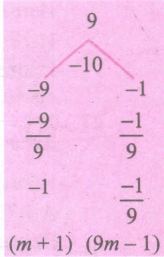
On factorising we get,
(m-1)(9m-1) = 0
∴ m -1 = 0 or
9m-1 = 0
⇒ m = 1 or \(\frac { 1 }{ 9 } \)
When m = 1, (1) becomes
y = \(1(x)\pm \sqrt { 7{ m }^{ 2 }+2 } \)
⇒ y = x \(x\pm \sqrt { 7+2 } \) ⇒ y = \(\pm \)3
y= x + 3 ⇒ x - y - 3 = 0
When m = \(\frac { 1 }{ 9 } \) (1) becomes
\(y=\frac { 1 }{ 9 } (x)\pm \sqrt { 7\left( \frac { 1 }{ 81 } \right) +2 } \)
⇒ \(y=\frac { x }{ 9 } +\sqrt { \frac { 7+162 }{ 81 } } \)
\(y=\frac { x }{ 9 } +\frac { 13 }{ 9 } \)
⇒ 9y = x + 13 ⇒ x -9y + 13 = 0
Hence the equation of tangents are x - y - 3 = 0 and x −9y + 13 = 0
30.
Equation of ellipse is
x2+ 4y2 = 32
\(\frac { { x }^{ 2 } }{ 32 } + \frac { { y }^{ 2 } }{ 8 } =1\)
a2 = 32, b2 = 8
\(a=4\sqrt { 2 } ,b=2\sqrt { 2 } \)
Equation of tangent at \(\theta =\frac { \pi }{ 4 } \) is \(\frac { xcos\frac { \pi }{ 4 } }{ 4\sqrt { 2 } } \frac { ysin\frac { \pi }{ 4 } }{ 2\sqrt { 2 } } =1\)
\(\frac { x }{ 8 } +\frac { y }{ 4 } =1\)
x+2y−8 = 0.
Equation of normal is \(\frac { 4\sqrt { 2X } }{ cos\frac { \pi }{ 4 } } -\frac { 2\sqrt { 2Y } }{ sin\frac { \pi }{ 4 } } =32-8\)
That is 8x-4y = 24
2x-y-6 = 0
Aliter:
At, \(\theta =\frac { \pi }{ 4 } \)
\((a\ cos \theta ,b\ sin \theta )=\left( 4\sqrt { 2 }\ cos\frac { \pi }{ 4 } ,2\sqrt { 2 }\ sin\frac { \pi }{ 4 } \right) \)
= (4, 2)
∴ Equation of tangent at \(\theta =\frac { \pi }{ 4 } \) is same at (4, 2)
Equation of tangent in cartesian form is \(\frac { { xx }_{ 1 } }{ { a }^{ 2 } } +\frac { { yy }_{ 1 } }{ { b }^{ 2 } } =1\)
x+2y−8 = 0
Slope of tangent is -\(\frac { 1 }{ 2 } \)
Slope of normal is 2 Equation of normal is y - 2 = 2(x -4)
y−2x+6 = 0
31.
32.
\(\frac { { (x-3) }^{ 2 } }{ 225 } +\frac { ({ y-4) }^{ 2 } }{ 289 } =1\)
Given equation is \(\frac { { (x-3) }^{ 2 } }{ 225 } +\frac { ({ y-4) }^{ 2 } }{ 289 } =1\)
This is an equation of the ellipse a2 = 289
b2 = 225 and
c2 = a2 - b2 ⇒ 289 - 225 = 64 ⇒ c = 8.
\(e=\sqrt { \frac { { b }^{ 2 } }{ { a }^{ 2 } } } =\sqrt { 1-\frac { 225 }{ 289 } } =\sqrt { \frac { 289-225 }{ 289 } } \)
\(=\sqrt { \frac { 64 }{ 289 } } =\frac { 8 }{ 17 } \)
(a) Center is (3, 4) ⇒ h = 3, k = 4
(b) foci are (h, k+c), (h, k-c)
⇒ (3, 4 + 8), (3, 4 - 8) ⇒ (3, 12), (3,-4)
(c) Vertices are (h, k - a), (h, k + a)
⇒ (3, 4 -17), (3, 4 + 17) ⇒ (3, -13), (3, 21)
(d) Equations of directrices are y - 4 = \(\pm \frac { a }{ e } \)
\(\Rightarrow y-4=\pm \frac { 17 }{ \frac { 8 }{ 17 } } +4\Rightarrow y-4=\pm \frac { -289 }{ 8 } +4\)
\(\Rightarrow y=\frac { 289 }{ 8 } +4\) and \(y=\frac { -289 }{ 8 } +4\)
\(\Rightarrow y=\frac { 289+32 }{ 2 } \) and \(y=\frac { -289+32 }{ 8 } \)
\(\Rightarrow y=\frac { 321 }{ 8 } \) and \(y=\frac { -257 }{ 8 } \)
33.
\(\frac { { x }^{ 2 } }{ 25 } +\frac { { y }^{ 2 } }{ 9 } =1\)
This is an equation of the ellipse.
a2 = 25 and b2 = 9 and c2 = a2 - b2
⇒ c2 = 25 - 9 = 16 ⇒ c = 4
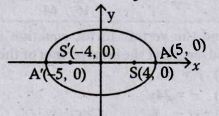
(a) Center is (0, 0) ⇒ h = 0, k = 0
(b) foci are (h - c, k), (h + c, k)
⇒ (0 - 4, 0), (0 + 4, 0)
⇒ (-4, 0) and (4, 0)
(c) Vertices are (h - a, k) and (h + a, k)
⇒ (0 - 5, 0) and (0 + 5, 0)
⇒ (-5, 0) and (5, 0)
(d) Directrices are x = \(\pm \frac { a }{ e } \)
⇒ x = \(\pm \frac { 5 }{ e } \)
\(e=\sqrt { 1-\frac { { b }^{ 2 } }{ { a }^{ 2 } } } =\sqrt { 1-\frac { 9 }{ 25 } } =\sqrt { \frac { 16 }{ 25 } } =\frac { 4 }{ 5 } \)
∴ Directrice are x = \(\pm \frac { 5 }{ \frac { 4 }{ 5 } } \Rightarrow x=\pm \frac { 25 }{ 4 } \)
34.
Rearranging terms in the equation of hyperbola to bring it to standard form,
we have, 11(x2-4x)-25(y2-2y)-256 = 0
11(x− 2)2−25(y−1)2 = 256−44+25
11(x−2 )2− 25 (y−1)2 = 275
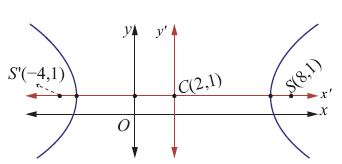
\(\frac { { \left( x-2 \right) }^{ 2 } }{ 25 } -\frac { { \left( y-1 \right) }^{ 2 } }{ 11 } =1\)
Centre (2, 1) a2 = 25, b2 = 11
c2 = a2 +b2
= 25 +11 = 36
Therefore, c = ±6
and e = \(\frac { c }{ a } =\frac { 6 }{ 5 } \)and the coordinates of foci are(8, 1) and(-4, 1) from figure.
35.
Rearranging the terms, the equation of ellipse is 4x2 + 24x + y2− 2y + 21 = 0
That is, 4(x2 + 6x + 9 − 9) + (y2 − 2y + 1 − 1) + 21 = 0,
4(x + 3)2 − 36 + (y−1)2 −1 + 21 = 0,
4(x + 3)2 + (y − 1)2 = 16,
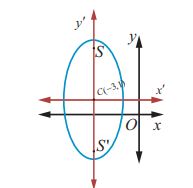
\(\frac { { \left( x+3 \right) }^{ 2 } }{ 4 } +\frac { { \left( y+1 \right) }^{ 2 } }{ 16 } =1\)
Centre is (-3, 1) a = 4, b = 2, and the major axis is parallel to y-axis c2 = 16−4 = 12
c = ±2\(\sqrt { 3 } \)
Therefore, the foci are (−3, 2\(\sqrt { 3 } \) +1) and (−3, −2\(\sqrt { 3 } \) +1).
Vertices are (3, ±4 +1).
That is the vertices are (3, 5) and (3, -3) and the length of Latus rectum = \(\frac { { 2b }^{ 2 } }{ a } \) = 2 units.
36.
Completing the square on x and y of 4x2+36y2+40x−288y+532 = 0,
4(x2 + 10x + 25 − 25) + 36(y2 − 8y + 16 − 16) + 532 = 0 , gives
4(x2 + 10x + 25) + 36(y2 − 8y + 16) = −532 + 100 + 576
4(x + 5)2 + 36(y − 4)2 = 144.
Dividing both sides by 144, the equation reduces to \(\frac { { \left( x+5 \right) }^{ 2 } }{ 36 } \frac { { \left( y-4 \right) }^{ 2 } }{ 4 } =1\)
This is an ellipse with centre (-5, 4), major axis is parallel to x-axis, length of major axis is 12 and length of minor axis is 4. Vertices are (1, 4) and (-11, 4).
Now, c2 = a2−b2 = 36 − 4 = 32
and c = ±4 \(\sqrt { 2 } \)
Then the foci are (−5 − 4\(\sqrt { 2 } \), 4) and (−5 + 4\(\sqrt { 2 } \) , 4).
Length of the major axis = 2a = 12 units and
the length of the minor axis = 2b = 4 units.
37.
By the definition of a conic \(\frac{SP}{PM}\)= e or SP2 = e2PM2
Then, (x−2)2 + (y−3)2 = \(\frac { 1 }{ 4 } \) (x-7)2
3x2+ 4y2−2x − 24y + 3 = 0
\({ 3\left( x-\frac { 1 }{ 3 } \right) }^{ 2 }+4(y-3)^{ 2 }=3\left( \frac { 1 }{ 9 } \right) +4\times 9-3=\frac { 100 }{ 3 } \)
\(\frac { { \left( x-\frac { 1 }{ 3 } \right) }^{ 2 } }{ \frac { 100 }{ 9 } } +\frac { (y-3{ ) }^{ 2 } }{ \frac { 100 }{ 12 } } \) = 1 which is in the standard form.
Therefore, the length of major axis = 2a = 2\(\sqrt { \frac { 100 }{ 9 } = } \frac { 20 }{ 3 } \) and
the length of minor axis = 2b = 2\(\sqrt { \frac { 100 }{ 12 } = } \frac { 10 }{ \sqrt { 3 } } \).
38.
Let the equation of the circle be
x2 + y2 + 2gx + 2fy + c = 0 ........... (1)
(1) passes through (1, 0)
⇒ 1 + 0 + 2g(1) + 2f(0) + c = 0
⇒ 2g + c = -1 ................(2)
(1) passes through (-1, 0)
⇒ (-1)2 + 0 + 2g(-1) + 2f(0)+ c = 0
⇒ -2g + c = -1 ..............(3)
Also (1) passes through (0, 1)
⇒ 0 + 12+ 2g(0) +2f(1) + c = 0
⇒ 2f + c = -1 .................(4)
(2) + (3) ⇒ 2c = -2
⇒ c = -1
Substituting c = -1 in (2), we get
2g-1 = -1
⇒ 2g = 0
⇒ g = 0
Substituting c = -1 in (4) we get,
2f -1 = -1
⇒ 2f = 0
⇒ f = 0
∴ The required equation of the circle
x2 + y2 - 1 = 0
39.
Let the general equation of the circle be
x2 +y2 +2gx + 2fy + c = 0 ........ (1)
It passes through points (1, 1), (2, -1) and(3, 2) .
Therefore,
2g+2f+c = -2 ........ (2)
4g−2f+c = -5 ........(3)
6g+4f+c = -13 ...... (4)
(2) – (3) gives −2g + 4f = 3 ... (5)
(4) – (3) gives 2g + 6f = -8 ....(6)
(5) + (6) gives f = \(-\frac { 1 }{ 2 } \)
Substituting f = \(-\frac { 1 }{ 2 } \) in (6), g = -\(\frac { 5 }{ 2 } \)
Substituting f = \(-\frac { 1 }{ 2 } \) and g = - \(\frac { 5 }{ 2 } \) in (2), c = 4 .
Therefore the required equation of the circle is
x2+ y2+ 2\(\left( -\frac { 5 }{ 2 } \right) x+2\left( -\frac { 1 }{ 2 } \right) \)y+4 = 0 and x2 + y2 − 5x − y + 4 = 0.
40.
The length a of the semi major axis of the elliptical ceiling is17 m. The height b of the semi minor axis is 8 m. Thus c2 = a2 -b2 = 172 - 82
then c =\(\sqrt { 289-64 } =\sqrt { 225 } =15\)
For the elliptical ceiling the foci are located on either side about 15 m from the centre, along its major axis.
41.
Let the vertex be (0, 0) .
The equation of the parabola is
y2 = 4ax
(1) Since the diameter is 40cm and the depth is 30 cm , the point (30, 20) lies on the parabola.
202 = 4a × 30
4a = \(\frac { 400 }{ 30 } \) = \(\frac { 40 }{ 3 } \)
Equation is y2 = \(\frac { 40 }{ 3 } \)x.
(2) The bulb is at focus (0, a).
Hence the bulb is at a distance of \(\frac { 10 }{ 3 } \)cm from the vertex.
42.
AS = 94.5 × 10⁶ km,
SA' = 152 × 106 km
a+c = 152 × 106
a-c = 94.5 × 10⁶
Subtracting 2c = 57.5 × 106 = 575 × 105 km
Distance of the Sun from the other focus is SS' = 575 × 105 km.
43.
Let P(x, y) be any point on the hyperbola
\(\frac { { x }^{ 2 } }{ { a }^{ 2 } } -\frac { { y }^{ 2 } }{ { b }^{ 2 } } =1\)
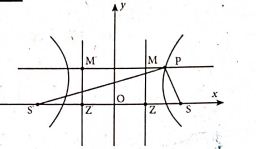
Then by definition, SP = ePM and S'P = ePM'
SP = ePM ⇒ SP = e(NK)
= e(CN - CK)
= \(e\left( x-\frac { a }{ e } \right) \) = ex - a
= and S'P = ePM' ⇒ S'P = e(NK')
⇒ e(CN + CK') = \(e\left( x+\frac { a }{ e } \right) \) = ex + a
∴ S'P -SP = (ex + a) - (ex - a)
ex + a - ex + a = 2a (constant)
= length of the transverse axis.
44.
The latus rectum LL' of the hyperbola passes through S(ae, 0)
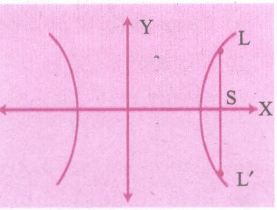
∴ L is (ae, y1)
Substituting L in \(\frac { { x }^{ 2 } }{ { a }^{ 2 } } -\frac { { y }^{ 2 } }{ { b }^{ 2 } } \) = 1 we get,
Substituting L in \(\frac { { x }^{ 2 } }{ { a }^{ 2 } } -\frac { { y }^{ 2 } }{ { b }^{ 2 } } =1\)
\(\frac { { a }^{ 2 }{ e }^{ 2 } }{ { a }^{ 2 } } -\frac { { { y }_{ 1 } }^{ 2 } }{ { b }^{ 2 } } =1\Rightarrow { e }^{ 2 }-\frac { { { y }_{ 1 } }^{ 2 } }{ { b }^{ 2 } } =1\)
\(\Rightarrow { e }^{ 2 }-1=\frac { { { y }_{ 1 } }^{ 2 } }{ { b }^{ 2 } } \) \([{ b }^{ 2 }={ a }^{ 2 }({ e }^{ 2 }-1)\)
\(\Rightarrow { { y }_{ 1 } }^{ 2 }={ b }^{ 2 }({ e }^{ 2 }-1)\) \(\Rightarrow \frac { { b }^{ 2 } }{ { a }^{ 2 } } ={ e }^{ 2 }-1]\)
\(\Rightarrow { { y }_{ 1 } }^{ 2 }={ b }^{ 2 }\left( \frac { { b }^{ 2 } }{ { a }^{ 2 } } \right) \) \(\Rightarrow { { y }_{ 1 } }^{ 2 }=\frac { { b }^{ 4 } }{ { a }^{ 2 } } \)
\(\Rightarrow { y }_{ 1 }=\pm \frac { { b }^{ 2 } }{ a } \)
∴ End points oflatus rectum Land L' are
\(\left( ae,\frac { { b }^{ 2 } }{ a } \right) \) and \(\left( ae,-\frac { { b }^{ 2 } }{ a } \right) \)
Hence, the length of latus rectum LL' = \(\frac { { b }^{ 2 } }{ a } +\frac { { b }^{ 2 } }{ a } =\frac { 2{ b }^{ 2 } }{ a } \) units.
Hence proved.
45.
Given equation of the circle is
3x2 + (3 - p)xy + qy2 - 2px = 8pq
For the circle, co-efficient of xy = 0
⇒ 3-p = 0 ⇒ p = 3
Also, co-efficient of x2 = co-efficient of y2
⇒ 3 = q
∴ Equation of the circle is
3x2 + 3y2 - 6x = 8(3)(3)
3x2 + 3y2 - 6x - 72 = 0
Dividing by 3, we get
x2 + y2 - 2x - 24 = 0
Here 2g = - 2⇒ g = - 1
f = 0 and c = - 24
Centre is (-g, -f) (1, 0)
and r = \(\sqrt { { g }^{ 2 }+{ f }^{ 2 }-c } \)
= \(\sqrt { { (-1 })^{ 2 }+0+24 } \)
= \(\sqrt { 25 } \) = 5 units.
46.
Let O1 O2 be the centres of the two semi circular vents.
First vent with centre O1 (12, 0) and radius r = 10 yields equation to first semicircle as
(x−12)2+(y− 0)2 = 102
\(\Rightarrow\) x2+y2−24x + 44 = 0, y > 0
Second vent with centre O2 (34, 0) and radius r = 10 yields equation to second vent as
(x−34)2+ y2 = 102
x2+y2− 68x + 1056 = 0, y > 0
47.
Given equation of the circle is
x2 + y2 - 5x + 2y - 5 = 0
(i) At (-2, 1), (1) becomes
(-2)2 + 12- 5(-2) + 2(1) - 5
= 4 + 1 + 10 + 2 - 5
= 17 - 5 = 12 > 0
∴ (-2, 1) lies outside the circle.
(ii) At (0, 0), (1) becomes -5 < 0
∴ (0, 0) lies inside the circle.
(iii) At (-4, -3), (1) becomes
(-4)2 + (-3)2 - 5(-4) + 2(-3) - 5
= 16 + 9 + 20 - 6 - 5
= 45 - 11 = 34 > 0
∴ (-4, -3) lies outside the circle.

12th Standard Syllabus & Materials
12th Standard
TN 12th Computer Applications களப்பெயர் முறைமை (DNS) Sample Question Papers Study Material - QB365 Set A
NEW12th Standard
TN 12th Computer Applications வலையமைப்பு எடுத்துக்காட்டுகள் மற்றும் நெறிமுறைகள் Sample Question Papers Study Material - QB365 Set A
NEW12th Standard
TN 12th Computer Applications கணினி வலையமைப்பு ஓர் அறிமுகம் Sample Question Papers Study Material - QB365 Set A
NEW12th Standard
TN 12th Computer Applications PHP-உடன் MySQL-ஐ இணைத்தல் Sample Question Papers Study Material - QB365 Set A



Tamilnadu Stateboard 12th Standard Subjects
Maths

Chemistry

Physics

Biology

Computer Science

Business Maths and Statistics

Economics

Commerce

Accountancy

History

Computer Applications
Biology
Computer Technology
Computer Applications
Computer Science
Business Maths and Statistics
Commerce
Economics
Maths
Chemistry
Physics
Computer Technology
History
Accountancy

Tamil

English

French
Tamilnadu Stateboard Standards

