
 100% FREE ACCESS
12th Standard Syllabus & Materials
12th Standard
TN 12th Computer Applications மின்னணு தரவு பரிமாற்றம் Sample Question Papers Study Material - QB365 Set A
NEW12th Standard
TN 12th Computer Applications மின் - வணிக பாதுகாப்பு அமைப்புகள் Sample Question Papers Study Material - QB365 Set A
NEW12th Standard
TN 12th Computer Applications மின்னணு செலுத்தல் முறைகள் Sample Question Papers Study Material - QB365 Set A
NEW12th Standard
TN 12th Computer Applications மின் - வணிகம் Sample Question Papers Study Material - QB365 Set A
NEW12th Standard
TN 12th Computer Applications திறந்த மூல கருத்துருக்கள் Sample Question Papers Study Material - QB365 Set A
NEW12th Standard
TN 12th Computer Applications வலையமைப்பு வடமிடல் Sample Question Papers Study Material - QB365 Set A

Published on: 02/09/2022
QB365 provides a detailed and simple solution for every Possible Creative Questions in Class 12 Maths Subject - Two Dimensional Analytical Geometry-II, English Medium. It will help Students to get more practice questions, Students can Practice these question papers in addition to score best marks.
Download Tamil Nadu 12th Standard Maths question papers, model tests, one-mark questions, important questions, and public exam papers in PDF format. Free study materials and answer keys for TN State Board students.
Questions + Answers key
Take MCQ Maths Test1.
A comet is moving in a parabolic orbit around the sun which is at the focus of a parabola. When the comet is 80 million kms from the sun, the line segment from the sun to the comet makes an angle of \(\frac{\pi}{3}\) radians with the axis of the orbit. Find
(i) the equation of the comet's orbit
(ii) how close does the comet come nearer to sun? (Take the orbit as open rightward).
2.
A reflecting telescope has a parabolic mirror for which the distance from the vertex to the focus in 9 mts. If the distance across (diameter) the top of the mirror is 160 cm, how deep is the mirror at the middle?
3.
The girder of a railway bridge is in the parabolic or with span 100 ft. and the highest point on the arch is 10 ft. above the bridge. Find the height of the bridge at 10 ft. to the left or right from the midpoint of the bridge.
4.
Find the equation of the hyperbola whose co- ordinates of the foci of a hyperbola are (±6, 0) and its latus rectum is of 10 units.
5.
The co-ordinates of the vertices of a hyperbola are (9, 2) and (1, 2) and the distance between its two foci is 10. Find its equation and also the length of its latus rectum.
6.
Determine the equation of the ellipse whose directrices along y = \(\pm\)9 and foci at (0, \(\pm\)4). Also find the length of its latus rectum.
7.
Find the equation of the ellipse whose eccentricity is \(\frac{4}{5}\) and axes are along the co-ordinate axes and with foci at \((0, \pm 4)\)
8.
Find the centre, foci and eccentricity of the hyperbola \(12 x^{2}-4 y^{2}-24 x+32 y-124=0\)
9.
Find the equations of directrices, latus rectum and length of latus rectums of the following ellipse \(4 x^{2}+3 y^{2}+8 x+12 y+4=0\)
10.
Find the equations of axes and length of axes of the ellipse \(6 x^{2}+9 y^{2}+12 x-36 y-12=0\)
11.
Find the equation of a point which moves so that the sum of its distances ftom (- 4, 0) and (4, 0) is 10.
12.
Find the equation of the ellipse given that the centre is (4, -1), focus is (1, -1) and passing through (8, 0).
13.
Find the vertex, focus, directrix, axis and latus rectum of the parabola \(y^{2}-4 x-4 y=0\)
14.
Find the equations of the two tangents that can be drawn from the point (5, 2) to the ellipse 2x2 +7y2 = 14.
15.
Find the equation of the tangent at t = 1 to the parabola y2 = 12x
1.
Take the parabolic orbit as open rightward and the vertex at the origin.
Let P be the position of the comet in which FP = 80 million kms.
Draw a perpendicular PQ from P to the axis of the parabola.
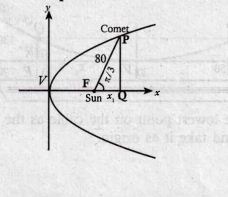
Let FQ = x1
From the triangle FQP,
\( \sin \frac{\pi}{3} =\frac{P Q}{F P} \)
\(\frac{\sqrt{3}}{2} =\frac{P Q}{80} \)
\(P Q =80 \times \frac{\sqrt{3}}{2}=40 \sqrt{3} \)
\(\cos \frac{\pi}{3} =\frac{F Q}{F P} \)
\(\frac{1}{2} =\frac{x_{1}}{80} \)
x1 = 40
VQ = a + 40 if VF = a;
P is (VQ, PQ) = (a + 40, 40√3)
Since P lies on the parabola y² = 4ax
(40-√3)2 = 4a(a + 40)
⇒ a = -60 or 20
a = -60 is not acceptable
a = 20
The equation of the orbit is
y2 = 4 \(\times\) 20 \(\times\) x
y = 80x
The shortest distance between the Sun and the Comet VF = a = 20 million kms
2.
Let the vertex be at the origin
VF = a = 900
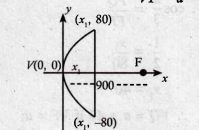
The equation of the parabola is y² = 4 \(\times\) 900 \(\times\) x
Let x, be the depth of the mirror at the middle
Since (x1, 80) lies on the parabola
\(80^{2}=4 \times 900 \times x_{1} \Rightarrow x_{1}=\frac{16}{9}\)
depth of the mirror = \(\frac{16}{9} \mathrm{~cm}\)
3.
Consider the parabolic girder as open downwards
ie., x2 = -4ay
it passes through (50, -10)
\( \therefore 50 \times 50 =-4 a(-10) \)
\(\Rightarrow a =\frac{250}{4} \)
\(\therefore x^{2} =-4\left(\frac{250}{4}\right) y \)
\(x^{2} =-250 y \)
Let B(10, y1) be a point on the parabola
100 = -250y,
\(y_{1}=-\frac{100}{250}=-\frac{2}{5}\)
Let B(10, y1) be apoint on the parubola
100 = -250y1
\(y_{1}=-\frac{100}{250}=-\frac{2}{5}\)
Let AB be the height of the bridge at 10 ft. To the right from the midpoint
AC = 10 and BC =
\(A B=10-\frac{2}{5}=9 \frac{3}{5} \mathrm{ft}\)
i.e. The height of the bridge at the required place \(=9 \frac{3}{5} \mathrm{ft}\)
4.
Given foci (± 6, 0)
Length of latus rectum = 10
The transverse axis is along the x axis
Equation of the hyperbola \(\frac{x^{2}}{a^{2}}-\frac{y^{2}}{b^{2}}=1\)
foci = (±c, 0) = (± 6,0)
c = 6
Length of Latus rectum = 10
\( \frac{2 b^{2}}{a} =10 \)
\(b^{2} =5 a \)
\( c^{2}-a^{2} =5 a \)
\(6^{2}-a^{2} =5 a \)
\(36-a^{2} =5 a \)
\(a^{2}+5 a-36 =0 \)
(a + 9)(a - 4) = 0
a = -9 a = 4
(not possible)
a = 4 then b2 = 5(4) = 20
The required equation of hyperbola
\(\frac{x^{2}}{16}-\frac{y^{2}}{20}=1\)
5.
Given vertices are (9, 2) & (1, 2)
A (9, 2), A' (1, 2)
Centre is midpoint of AA'
\(C(h, k)=\left(\frac{9+1}{2}, \frac{2+2}{2}\right)\)
=(5, 2)
AA' = 2a = 8
a = 4
FF' = 2c = 10
c = 5
\(b^{2}=c^{2}-a^{2}\)
= 25 - 16
b2 = 9
The transverse axis is parallel to x axis
Equation of hyperbola \( \frac{(x-h)^{2}}{a^{2}}-\frac{(y-k)^{2}}{b^{2}}=1 \)
\( \frac{(x-5)^{2}}{16}-\frac{(y-2)^{2}}{5}=1 \)
Length of Latus rectum \( =\frac{2 b^{2}}{a}=\frac{2(9)}{4} \)
\( =\frac{9}{2} \text { units } \)
6.
Given equation of directrix y = \(\pm\)9
foci = (0, \(\pm\)4)
The major axis is along the y axis Equation of the ellipse \(\frac{x^{2}}{b^{2}}+\frac{y^{2}}{a^{2}}=1\)
foci = c = 4 \(\Rightarrow\) ae = 4 ............. (1)
directrix \(\frac{a}{e}=9\) ......... (2)
\( (1) \times(2) \Rightarrow a \not e \times \frac{a}{\not e} =36 \)
\(a^{2} =36 \)
\(b^{2} =a^{2}-c^{2} \)
\( =36-16 \)
\(b^{2} =20 \)
\(\therefore\) The required Equation of ellipse
\(\frac{x^{2}}{20}+\frac{y^{2}}{36}=1\)
Length of Latus rectum \( =\frac{2 b^{2}}{a} \)
\( =\frac{\not 2(20)}{\not 6_3}=\frac{20}{3} \text { units } \)
7.
The major axis is along the y axis
Equation of ellipse : \(\frac{x^{2}}{b^{2}}+\frac{y^{2}}{a^{2}}=1\)
Foci \(
=(0, \pm 4)
\)
\(c =4 \ \
a e =4
\)
\(a\left(\frac{4}{5}\right) =4
\)
\(a = \not4 \times \frac{5}{\not4}
\)
a = 5
\(
b^{2} =a^{2}-c^{2}
\)
\(=25-16
b^{2} =9
\)
The required equation of ellipse \(\frac{x^{2}}{9}+\frac{y^{2}}{25}=1\)
8.
Rearranging terms in the equation of hyperbola to bring it to standard form,
We have,
\(
12\left(x^{2}-2 x\right)-4\left(y^{2}-8 y\right)-124 =0
\)
\(12(x-1)^{2}-4(y-4)^{2} =124+12-64
\)
\(12(x-1)^{2}-4(y-4)^{2} =72
\)
\(\frac{(x-1)^{2}}{6}-\frac{(y-4)^{2}}{18} =1\)
Centre (1, 4); a2 = 6;
\(
b^{2} =18
\)
\(c^{2} =a^{2}+b^{2}
\)
\( =6+18
\)
\(c^{2} =24
\)
\(c =\pm 2 \sqrt{6}
\)
\(e =\frac{c}{a}=\frac{2 \sqrt{6}}{6}\)
eccentricity, \(e=\frac{\sqrt{6}}{3}\)
centre (h, k) = (1, 4)
foci \(
=(h, \pm c+k)
\)
\(=(1, \pm 2 \sqrt{6}+4)
\)
\( =(1,2 \sqrt{6}+4) 8(1,-2 \sqrt{6}+4)\)
9.
\(
4 x^{2}+3 y^{2}+8 x+12 y+4 =0
\)
\(\left(4 x^{2}+8 x\right)+\left(3 y^{2}+12 y\right)+4 =0
\)
\(4\left(x^{2}+2 x\right)+3\left(y^{2}+4 y\right) =-4
\)
\(4\left\{(x+1)^{2}-1\right\}+3\left\{(y+2)^{2}-4\right\} =-4
\)
\(4(x+1)^{2}+3(y+2)^{2} =12 \)
\(\div \text { by } 12 \Rightarrow \quad \frac{(x+1)^{2}}{3}+\frac{(y+2)^{2}}{4} =1
\)
The major axis is parallel to y axis
\(
a^{2}=4\ \ b=3
\)
\(a=2 \ \ b=\sqrt{3}
\)
\(c^{2}=a^{2}-b^{2}
\)
= 4 - 3
\(c^{2}=1 \) c = 1
\(
a e =1 \Rightarrow 2(e)=1
\)
\(e =\frac{1}{2}
\)
Centre (h, k) = (-1 , -2)
Equation of directrix y \(
=\pm \frac{a}{e}+k
\)
\( =\pm \frac{2}{\frac{1}{2}}-2
\)
\( =\pm 4-2
\)
y = 4 - 2 & y = -4-2
y = 2 & y = -6
Equation of latus rectum
\(
\mathrm{y}=\pm \mathrm{ae}+\mathrm{k}
\)
\( =\pm(2)\left(\frac{1}{2}\right)-2=\pm 1-2
\)
\( y=1-2 \ \ \quad y=-1-2
\)
\( y=-1 \ \ \quad y=-3
\)
Length of latus rectum \(=\frac{2 b^{2}}{a}=\frac{2(3)}{2}=3\)
10.
\( 6 x^{2}+9 y^{2}+12 x-36 y-12 =0 \)
\(\left(6 x^{2}+12 x\right)+\left(9 y^{2}-36 y\right) =12 \)
\(6\left(x^{2}+2 x\right)+9\left(y^{2}-4 y\right) =12 \)
\(6\left\{(x+1)^{2}-1\right\}+9\left\{(y-2)^{2}-4\right\} =12 \)
\(6(x+1)^{2}+9(y-2)^{2}=12+6 +36 \)
\(6(x+1)^{2}+9(y-2)^{2} =54 \)
\(\frac{(x+1)^{2}}{9}+\frac{(y-2)^{2}}{6} =1 \)
\( X=x+1 ; Y =y-2 \)
The equation becomes \(\frac{X^{2}}{9}+\frac{Y^{2}}{6}=1\)
Clearly the major axis is along X-axis and the minor axis is along Y-axis.
The equation of the major axis Y = 0 and the equation of the minor axis is X = 0.
The equation of the major axis is y - 2 = 0 and of minor axis is x + 1 = 0.
i.e., the equation of the major axis is y - 2 = 0
Here \(a^{2}=9, b^{2}=6 \Rightarrow a=3 b=\sqrt{6}\)
\(\therefore\) The length of major axis (24) - 6
The length of minor axis (25) = 2\(\sqrt 6\)
11.
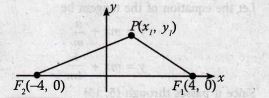
Let F and F be the fixed points (4,0) and (- 4,0) respectively and P(x, y) be the moving point.
It is given that \(F_{1} P+F_{2} P=10\)
\(\text { i.e., } \sqrt{\left(x_{1}-4\right)^{2}\left(y_{1}-0\right)^{2}}+\sqrt{\left(x_{1}+4\right)^{2}\left(y_{1}-0\right)^{2}}=10\)
Simplifying we get
\( 9 x_{1}^{2}+25 y_{1}^{2}=225 \)
The locus of (x1, y1) is \( \frac{x^{2}}{25}+\frac{y^{2}}{9}=1 \)
12.
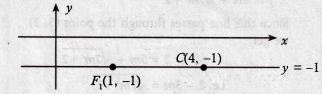
From the given data since the major axis is parallel to the x axis, the equation is of the form
\(\frac{(x-h)^{2}}{a^{2}}+\frac{(y-k)^{2}}{b^{2}}=1\)
The centre (h, k) is (4, -1)
\(\frac{(x-4)^{2}}{a^{2}}+\frac{(y+1)^{2}}{b^{2}}=1\)
It passes through (8, 0) \(\therefore \frac{16}{a^{2}}+\frac{1}{b^{2}}=1\) ....... (1)
But CF1 = ae = 3
\( b^{2} =a^{2}\left(1-e^{2}\right) \)
\( =a^{2}-a^{2} e^{2}=a^{2}-9 \)
\( (1) \Rightarrow \frac{16}{a^{2}}+\frac{1}{a^{2}-9} =1 \)
\(\Rightarrow 16 a^{2}-144+a^{2} =a^{4}-9 a^{2} \)
\(\Rightarrow a^{4}-26 a^{2}+144 =0 \)
\(\Rightarrow a^{2} =18 \text { or } 8\)
Case (1) : \( a^{2}=18 \)
\( b^{2}=a^{2}-9=18-9=9 \)
Case (2) :
\( a^{2}=8 \)
\(b^{2}=8-9=-1 \) which is not possible
\(\therefore a^{2}=18, b^{2}=9\)
Thus the equation is \(\frac{(x-4)^{2}}{18}+\frac{(y+1)^{2}}{9}=1\)
13.
The parabola is open rightwards
4a = 4 \(\Rightarrow\) d = 1
Vertex (h, k) = (-1, 2)
focus = (a + h, 0 + k)
= (1 -1, 0+2) = (0, 2)
Equation of directrix x = -a + h
= -1 -1
= -2
axis y - 2 = 0
y = 2
Length of latus rectum 4a = 4.
14.
Equation of the ellipse is
2x² + 7y² = 14
\(\text { i.e., } \frac{x^{2}}{7}+\frac{y^{2}}{2}=1\)
Here a² = 7, b² = 2
Let the equation of the tangent be
\( y=m x+\sqrt{a^{2} m^{2}+b^{2}} \)
\( \therefore y=m x+\sqrt{7 m^{2}+2} \)
Since this line passes through the point (5, 2)
we get
\( 2 =5 m+\sqrt{7 m^{2}+2} \)
i.e., \( 2-5 m =\sqrt{7 m^{2}+2} \)
(2-5m)² = 7m² + 2
4+25m² - 20m = 7m² +2
18m² - 20m + 2 = 0
9m² -10m + 1 = 0
(9m -1) (m-1) = 0
\(\therefore m=1 \text { or } m=\frac{1}{9}\)
To find the equations of the tangents, use slope-point from
(i) m = 1,
The equation is
y - y1 = m(x-x1).
y - 2 = 1(x - 5)
i.e., x - y - 3 = 0
(ii) \(m=1 / 9\)
The equation is \(y-2=\frac{1}{9}(x-5)\)
i.e., x - 9y + 13 = 0
Thus the equations of the tangents are
x - y - 3 = 0, x - 9y + 13 = 0
15.
Equation of the parabola is y2 = 12x
Here 4a = 12 = a = 3
Parametric points at t = \(\left(a t^{2}, 2 a t\right)\)
At t = 1 \(\Rightarrow\) (3(1), 2(3)(1)) = (3, 6)
Equation of tangent
\( y y_{1}=12 \frac{\left(x+x_{1}\right)}{2} \)
At (3, 6)
\( y(6)=\frac{12(x+3)}{2} \text { i.e., } x-y+3=0 \)
Alternative form :
The equation of the tangent at 't' is yt = \(=x+a t^{2}\)
Here 4a = 12 ⇒ a = 3
Also t = 1
The equation of the tangent is y = x + 3
x - y + 3 = 0

12th Standard Syllabus & Materials
12th Standard
TN 12th Computer Applications களப்பெயர் முறைமை (DNS) Sample Question Papers Study Material - QB365 Set A
NEW12th Standard
TN 12th Computer Applications வலையமைப்பு எடுத்துக்காட்டுகள் மற்றும் நெறிமுறைகள் Sample Question Papers Study Material - QB365 Set A
NEW12th Standard
TN 12th Computer Applications கணினி வலையமைப்பு ஓர் அறிமுகம் Sample Question Papers Study Material - QB365 Set A
NEW12th Standard
TN 12th Computer Applications PHP-உடன் MySQL-ஐ இணைத்தல் Sample Question Papers Study Material - QB365 Set A



Tamilnadu Stateboard 12th Standard Subjects
Maths

Chemistry

Physics

Biology

Computer Science

Business Maths and Statistics

Economics

Commerce

Accountancy

History

Computer Applications
Biology
Computer Technology
Computer Applications
Computer Science
Business Maths and Statistics
Commerce
Economics
Maths
Chemistry
Physics
Computer Technology
History
Accountancy

Tamil

English

French
Tamilnadu Stateboard Standards

