
 100% FREE ACCESS
12th Standard Syllabus & Materials
12th Standard
TN 12th Computer Applications மின்னணு தரவு பரிமாற்றம் Sample Question Papers Study Material - QB365 Set A
NEW12th Standard
TN 12th Computer Applications மின் - வணிக பாதுகாப்பு அமைப்புகள் Sample Question Papers Study Material - QB365 Set A
NEW12th Standard
TN 12th Computer Applications மின்னணு செலுத்தல் முறைகள் Sample Question Papers Study Material - QB365 Set A
NEW12th Standard
TN 12th Computer Applications மின் - வணிகம் Sample Question Papers Study Material - QB365 Set A
NEW12th Standard
TN 12th Computer Applications திறந்த மூல கருத்துருக்கள் Sample Question Papers Study Material - QB365 Set A
NEW12th Standard
TN 12th Computer Applications வலையமைப்பு வடமிடல் Sample Question Papers Study Material - QB365 Set A

Published on: 01/08/2019
Download Tamil Nadu 12th Standard Maths question papers, model tests, one-mark questions, important questions, and public exam papers in PDF format. Free study materials and answer keys for TN State Board students.
Questions + Answers key
Take MCQ Maths Test1.
Evaluate \(sin\left( { cos }^{ -1 }\left( \frac { 1 }{ 2 } \right) \right) \)
2.
If A is a square matrix such that A3 = I, then prove that A is non-singular.
3.
Find the adjoint of the following:
\(\left[ \begin{matrix} -3 & 4 \\ 6 & 2 \end{matrix} \right] \)
4.
Find z−1, if z = (2 + 3i) (1− i).
5.
Prove that \({ tan }^{ -1 }\left( \frac { 1-x }{ 1+x } \right) -{ tan }^{ -1 }\left( \frac { 1-y }{ 1+y } \right) ={ sin }^{ -1 }\left( \frac { y-x }{ \sqrt { 1+{ x }^{ 2 } } .\sqrt { 1+{ y }^{ 2 } } } \right)\)
6.
Find all real numbers satisfying 4x- 3(2x+2) + 25 = 0
7.
Solve the equations:
6x4- 35x3+ 62x2- 35x + 6 = 0
8.
Find the inverse of the non-singular matrix A = \(\left[ \begin{matrix} 0 & 5 \\ -1 & 6 \end{matrix} \right] \), by Gauss-Jordan method.
9.
If F(\(\alpha\)) = \(\left[ \begin{matrix} \cos { \alpha } & 0 & \sin { \alpha } \\ 0 & 1 & 0 \\ -\sin { \alpha } & 0 & \cos { \alpha } \end{matrix} \right] \), show that [F(\(\alpha\))]-1 = F(-\(\alpha\)).
10.
Show that the complex numbers 3 + 2i, 5i, -3 + 2i and -i form a square.
11.
Find the rank of the matrix math \(\left[ \begin{matrix} 4 \\ -2 \\ 1 \end{matrix}\begin{matrix} 4 \\ 3 \\ 4 \end{matrix}\begin{matrix} 0 \\ -1 \\ 8 \end{matrix}\begin{matrix} 3 \\ 5 \\ 7 \end{matrix} \right] \).
12.
Simplify: (1+i)18
13.
If A = \(\frac { 1 }{ 9 } \left[ \begin{matrix} -8 & 1 & 4 \\ 4 & 4 & 7 \\ 1 & -8 & 4 \end{matrix} \right] \), prove that A−1 = AT.
14.
The value of \(\frac { (cos{ 45 }^{ 0 }+isin{ 45 }^{ 0 })^{ 2 }(cos{ 30 }^{ 0 }-isin{ 30 }^{ 0 }) }{ cos{ 30 }^{ 0 }+isin{ 30 }^{ 0 } } \) is __________
\(\frac { 1 }{ 2 } +i\frac { \sqrt { 3 } }{ 2 } \)
\(\frac { 1 }{ 2 } -i\frac { \sqrt { 3 } }{ 2 } \)
\(-\frac { \sqrt { 3 } }{ 2 } +\frac { 1 }{ 2 } \)
\(\frac { \sqrt { 3 } }{ 2 } +\frac { 1 }{ 2 } \)
15.
The value of (1+i)4 + (1-i)4 is __________
8
4
-8
-4
16.
\({ tan }^{ -1 }\left( tan\cfrac { 9\pi }{ 8 } \right) \)
\(\cfrac { 9\pi }{ 8 } \)
\(\cfrac { -9\pi }{ 8 } \)
\(\cfrac { \pi }{ 8 } \)
\(\cfrac { -\pi }{ 8 } \)
17.
If p(x) = ax2 + bx + c and Q(x) = -ax2 + dx + c where ac ≠ 0 then p(x). Q(x) = 0 has at least _______ real roots.
no
1
2
infinite
18.
The quadratic equation whose roots are ∝ and β is ___________
(x - ∝)(x -β) = 0
(x - ∝)(x + β) = 0
∝ + β = \(\frac{b}{a}\)
∝ β = \(\frac{-c}{a}\)
19.
The system of linear equations x + y + z = 6, x + 2y + 3z =14 and 2x + 5y + λz =μ (λ, μ \(\in \) R) is consistent with unique solution if _________
λ = 8
λ = 8, μ ≠ 36
λ ≠ 8
none
20.
If A, B and C are invertible matrices of some order, then which one of the following is not true?
adj A = |A|A-1
adj(AB) = (adj A)(adj B)
det A-1 = (det A)-1
(ABC)-1 = C-1B-1A-1
21.
If A\(\left[ \begin{matrix} 1 & -2 \\ 1 & 4 \end{matrix} \right] =\left[ \begin{matrix} 6 & 0 \\ 0 & 6 \end{matrix} \right] \), then A =
\(\left[ \begin{matrix} 1 & -2 \\ 1 & 4 \end{matrix} \right] \)
\(\left[ \begin{matrix} 1 & 2 \\ -1 & 4 \end{matrix} \right] \)
\(\left[ \begin{matrix} 4 & 2 \\ -1 & 1 \end{matrix} \right] \)
\(\left[ \begin{matrix} 4 & -1 \\ 2 & 1 \end{matrix} \right] \)
22.
\(\tan ^{-1}\left(\frac{1}{4}\right)+\tan ^{-1}\left(\frac{2}{9}\right)\) is equal to
\(\frac { 1 }{ 2 } \ { cos }^{ -1 }\left( \frac { 3 }{ 5 } \right) \)
\(\frac { 1 }{ 2 } { sin }^{ -1 }\left( \frac { 3 }{ 5 } \right) \)
\(\frac { 1 }{ 2 } {tan }^{ -1 }\left( \frac { 3 }{ 5 } \right) \)
\({ tan}^{ -1 }\left( \frac { 1}{ 2 } \right) \)
23.
According to the rational root theorem, which number is not possible rational zero of 4x7 + 2x4 - 10x3 - 5?
-1
\(\frac { 5 }{ 4 } \)
\(\frac { 4 }{ 5 } \)
5
1.
Let \({ cos }^{ -1 }\left( \frac { 1 }{ 2 } \right) =\theta \Rightarrow cos\theta =\frac { 1 }{ 2 } \)
\(\Rightarrow sin\theta =\sqrt { 1-{ cos }^{ 2 }\theta } =\sqrt { 1-\frac { 1 }{ 4 } } =\sqrt { \frac { 3 }{ 4 } } =\frac { \sqrt { 3 } }{ 2 } \)
\(\therefore sin\left( { cos }^{ -1 }\left( \frac { 1 }{ 2 } \right) \right) =\frac { \sqrt { 3 } }{ 2 } \)
2.
Given A3 = I ⇒ IA3I = |I|
⇒ |A.A.A| = 1
⇒ |A|. |A|·|A| = 1
⇒ |A|3 = 1
∴ |A| ≠ 0
Hence, A is non-singular.
3.
\(\left[ \begin{matrix} -3 & 4 \\ 6 & 2 \end{matrix} \right] \)
Let A = \(\left( \begin{matrix} -3 & 4 \\ 6 & 2 \end{matrix} \right) \)
adj A = \(\left( \begin{matrix} 2 & -4 \\ -6 & -3 \end{matrix} \right) \)
[Interchange the elements in the leading diagonal and change the sign of the elements in off diagonal]
4.
We have z = (2+3i)(1−i) = (2+3)+(3−2)i = 5+i
\(\Rightarrow\) \({ z }^{ -1 }=\frac { 1 }{ z } =\frac { 1 }{ 5+i } \)
Multiplying the numerator and denominator by the conjugate of the denominator, we get
\({ z }^{ -1 }=\frac { \left( 5-i \right) }{ \left( 5+i \right) \left( 5-i \right) } =\frac { 5-i }{ { 5 }^{ 2 }+{ I }^{ 2 } } =\frac { 5 }{ 26 } -i\frac { 1 }{ 26 } \)
\(\Rightarrow\)\({ z }^{ -1 }=\frac { 5 }{ 26 } -i\frac { 1 }{ 26 } \)
5.
LHS =\({ tan }^{ -1 }\left( \frac { 1-x }{ 1+x } \right) -{ tan }^{ -1 }\left( \frac { 1-y }{ 1+y } \right) \)
= tan-1(1) - tan-1 (x) - (tan-1(1) - tan-1(y)
\(\left[ \because { tan }^{ -1 }(\frac { x-y }{ 1+xy } )={ tan }^{ -1 }x-{ tan }^{ -1 }y \right] \)
= tan-1(1) - tan-1 (x) - tan-1(1) + tan-1(y)
= tan-1(y) - tan-1(x)
= \({ tan }^{ -1 }\left( \frac { y-x }{ 1+xy } \right) \)
= \({ sin }^{ -1 }\left( \frac { y-x }{ \sqrt { 1+\left( yx \right) ^{ 2 }+\left( y-x \right) ^{ 2 } } } \right) \)
= \({ sin }^{ -1 }\left( \frac { y-x }{ \sqrt { (1+{ x }^{ 2 })(1+{ x }^{ 2 }) } } \right) \)
RHS
6.

4x- 3(2x + 2) + 25 = 0
\(\Rightarrow \left( { 2 }^{ 2 } \right) ^{ x }-3({ 2 }^{ x })({ 2 }^{ 2 })+{ 2 }^{ 5 }=0\)
\(\left( { 2 }^{ x } \right) ^{ 2 }-3\left( { 2 }^{ x } \right) ({ 2 }^{ 2 })=0\)
\(\left( { 2 }^{ x } \right) ^{ 2 }-12\left( { 2 }^{ x } \right) +32=0\)
Put \({ 2 }^{ x }=y\)
\({ y }^{ 2 }-12y+32=0\)
(y - 8)(y - 4) = 0
y = 8, 4
Case (i) when \(y=8,{ 2 }^{ x }=8\Rightarrow { 2 }^{ x }={ 2 }^{ 3 }\Rightarrow x=3\)
Case (ii) when \(y=4,{ 2 }^{ x }=4\Rightarrow { 2 }^{ x }={ 2 }^{ 2 }x=\pm 2\)
∴ The roots are 2, 3
7.
6x4- 35x3+ 62x2- 35x + 6 = 0
This equation is type I even degree reciprocal equation.
Hence, it can be rewritten as
\(6\left( { x }^{ 2 }+\frac { 1 }{ x } \right) -35(x+\frac { 1 }{ x } )+62=0 ...(1)\)
putting \(x+\frac { 1 }{ x } =y\)
\(\Rightarrow { x }^{ 2 }+\frac { 1 }{ { x }^{ 2 } } +2={ y }^{ 2 }\)
\(\Rightarrow { x }^{ 2 }+\frac { 1 }{ { x }^{ 2 } } ={ y }^{ 2 }-2\)
∴ (1) becomes as,
\(\Rightarrow 6({ y }^{ 2 }-2)-35y+62=0\)
\(\Rightarrow { 6y }^{ 2 }-12-35y+62=0\)
\(\Rightarrow { 6y }^{ 2 }-35y+50=0\)
\(\Rightarrow (3y-10)(2y-5)=0\)
\(\Rightarrow y=\frac { 10 }{ 3 } ,\frac { 5 }{ 2 } \)
Case (i) when \(y=\frac { 10 }{ 3 } ,x+\frac { 1 }{ x } =\frac { 10 }{ 3 } \)
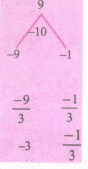
\(\Rightarrow \frac { { x }^{ 2 }+1 }{ x } =\frac { 10 }{ 3 } \)
\(\Rightarrow { 3x }^{ 2 }-10x+3=10x\)
\(\Rightarrow { 3x }^{ 2 }-10x+3=0\)
\(\Rightarrow (x-3)(3x-1)=0\)
\(\Rightarrow x=3,\frac { 1 }{ 3 } \)
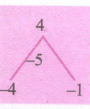
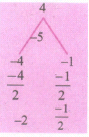
Case (ii) when \(y=\frac { 5 }{ 2 } ,x+\frac { 1 }{ x } =\frac { 5 }{ 2 } \Rightarrow \frac { { x }^{ 2 }+1 }{ x } =\frac { 5 }{ 2 } \)
\(\Rightarrow { 2x }^{ 2 }+2=5x\Rightarrow { 2x }^{ 2 }-5x+2=0\)
\(\Rightarrow (x-2)(2x-1)=0\)
Hence the roots are \(2,\frac { 1 }{ 2 } ,3,\frac { 1 }{ 3 } \)
8.
Applying Gauss-Jordan method, we get
[A | I2] = \(\left[ \begin{matrix} 0 & 5 \\ -1 & 6 \end{matrix}|\begin{matrix} 1 & 0 \\ 0 & 1 \end{matrix} \right] \overset { { R }_{ 1 }\leftrightarrow { R }_{ 2 } }{ \longrightarrow } \left[ \begin{matrix} -1 & 6 \\ 0 & 5 \end{matrix}|\begin{matrix} 0 & 1 \\ 1 & 0 \end{matrix} \right] \overset { { R }_{ 1 }\longrightarrow \left( -1 \right) { R }_{ 1 } }{ \longrightarrow } \left[ \begin{matrix} 1 & -6 \\ 0 & 5 \end{matrix}|\begin{matrix} 0 & -1 \\ 1 & 0 \end{matrix} \right] \)\(\overset { { R }_{ 1 }\longrightarrow \left( -1 \right) { R }_{ 1 } }{ \longrightarrow } \left[ \begin{matrix} 1 & -6 \\ 0 & 5 \end{matrix}|\begin{matrix} 0 & -1 \\ 1 & 0 \end{matrix} \right] \overset { { R }_{ 2 }\longrightarrow \frac { 1 }{ 5 } { R }_{ 2 } }{ \longrightarrow } \left[ \begin{matrix} 1 & -6 \\ 0 & 1 \end{matrix}|\begin{matrix} 0 & -1 \\ \left( 1/5 \right) & 0 \end{matrix} \right] \)\(\overset { { R }_{ 1 }\longrightarrow { R }_{ 1 }+6{ R }_{ 2 } }{ \longrightarrow } \left[ \begin{matrix} 1 & 0 \\ 0 & 1 \end{matrix}|\begin{matrix} \left( 6/5 \right) & -1 \\ \left( 1/5 \right) & 0 \end{matrix} \right] \).
So, we get A-1 = \(\left[ \begin{matrix} \left( 6/5 \right) & -1 \\ \left( 1/5 \right) & 0 \end{matrix} \right] =\frac { 1 }{ 5 } \left[ \begin{matrix} 6 & -5 \\ 1 & 0 \end{matrix} \right] \).
9.
Given F (\(\alpha\)) = \(\left[ \begin{matrix} \cos { \alpha } & 0 & \sin { \alpha } \\ 0 & 1 & 0 \\ -\sin { \alpha } & 0 & \cos { \alpha } \end{matrix} \right] \)
Expanding along R1 we get,
|F(\(\alpha\))| = cos \(\alpha\) \(\left| \begin{matrix} 1 & 0 \\ 0 & cos\alpha \end{matrix} \right| -0+sin\alpha \left| \begin{matrix} 0 & 1 \\ -sin\alpha & 0 \end{matrix} \right| \)
= cos \(\alpha\) (cos - 0) + sin \(\alpha\) (0 + sin \(\alpha\))
= cos2 + sin2 \(\alpha\) = 1 ≠ 0
Since F (\(\alpha\)) is a non-singular matrix, [F(\(\alpha\))]-1 exists
Now, adj (F(\(\alpha\))) = \(\left[ \begin{matrix} +\left| \begin{matrix} 1 & 0 \\ 0 & cos\alpha \end{matrix} \right| & -\left| \begin{matrix} 0 & 0 \\ sin\alpha & cos\alpha \end{matrix} \right| & +\left| \begin{matrix} 0 & 1 \\ -sin\alpha & 0 \end{matrix} \right| \\ -\left| \begin{matrix} 0 & sin\alpha \\ 0 & cos\alpha \end{matrix} \right| & +\left| \begin{matrix} cos\alpha & sin\alpha \\ -sin\alpha & cos\alpha \end{matrix} \right| & -\left| \begin{matrix} cos\alpha & 0 \\ sin\alpha & 0 \end{matrix} \right| \\ +\left| \begin{matrix} 0 & sin\alpha \\ 1 & 0 \end{matrix} \right| & -\left| \begin{matrix} cos\alpha & sin\alpha \\ 0 & 0 \end{matrix} \right| & +\left| \begin{matrix} cos\alpha & 0 \\ 0 & 1 \end{matrix} \right| \end{matrix} \right] ^{ T }\)
=\(\left[ \begin{matrix} +(cos\alpha -0) & -(0) & +(0+sin\alpha ) \\ -(0) & +(cos^{ 2 }\alpha +sin^{ 2 }\alpha & -(0) \\ +(0-sin\alpha ) & -(0) & +(cos-0) \end{matrix} \right] ^{ T }\)
\(\left[ \begin{matrix} cos\alpha & 0 & +sin\alpha \\ 0 & 1 & 0 \\ -sin\alpha & 0 & cos\alpha \end{matrix} \right] =\left[ \begin{matrix} cos\alpha & 0 & -sin\alpha \\ 0 & 1 & 0 \\ +sin\alpha & 0 & cos\alpha \end{matrix} \right] \)
∴ F(\(\alpha\))-1 = \(\frac { 1 }{ |F(\alpha )| } \) adj (F(\(\alpha\)))
[F(\(\alpha\))]-1 = \(\frac { 1 }{ 1 } \left[ \begin{matrix} cos\alpha & 0 & -sin\alpha \\ 0 & 1 & 0 \\ +sin\alpha & 0 & cos\alpha \end{matrix} \right] \)
= \(\left[ \begin{matrix} cos\alpha & 0 & -sin\alpha \\ 0 & 1 & 0 \\ +sin\alpha & 0 & cos\alpha \end{matrix} \right] \) ..............(1)
Now, F(-\(\alpha\))=\(\left[ \begin{matrix} cos(-\alpha ) & 0 & sin(-\alpha ) \\ 0 & 1 & 0 \\ -s9n(-\alpha ) & 0 & cos(-\alpha ) \end{matrix} \right] \)
=\(\left[ \begin{matrix} cos\alpha & 0 & -sin\alpha \\ 0 & 1 & 0 \\ sin\alpha & 0 & cos\alpha \end{matrix} \right] \) ..............(2)
[∵ cos \(\alpha\) is an even function, cos (-\(\alpha\)) = cos \(\alpha\) and sin \(\alpha\) is an odd function, sin (-\(\alpha\)) = -sin\(\alpha\)]
From (1) and (2)
[F(\(\alpha\))]-1 = F (-\(\alpha\))
10.
AB = |(3+2i) - (0+5i)| = |3-3i|
=\(\sqrt { 9+9 } =\sqrt { 18 } =3\sqrt { 2 } \)
BC = |(0+5i) - (-3+2i)| = |3+3i|
= \(\sqrt { 9+9 } =\sqrt { 18 } =3\sqrt { 2 } \)
CD = |(-3+2i) - (0-i) = |-3+i|
= \(\sqrt { 9+9 } =\sqrt { 18 } =3\sqrt { 2 } \)
DA = |(0-i) - (3+2i)| = |-3-3i|
=\(\sqrt { 9+9 } =\sqrt { 18 } =3\sqrt { 2 } \)
∴ AB = BC = CD = DA
Also AC = |(3+2i) - (-3+2i)|
= |6| = \(\sqrt { 36 } \) = 6
∴ AC = BD
Hence ABCD is a square
11.
Let A =\(\left[ \begin{matrix} 4 \\ -2 \\ 1 \end{matrix}\begin{matrix} 4 \\ 3 \\ 4 \end{matrix}\begin{matrix} 0 \\ -1 \\ 8 \end{matrix}\begin{matrix} 3 \\ 5 \\ 7 \end{matrix} \right] \)
A\(\overset { { R }_{ 1 }\leftrightarrow { R }_{ 3 } }{ \longrightarrow } \left[ \begin{matrix} 1 \\ -2 \\ 4 \end{matrix}\begin{matrix} 4 \\ 3 \\ 4 \end{matrix}\begin{matrix} 8 \\ -1 \\ 0 \end{matrix}\begin{matrix} 3 \\ 5 \\ 7 \end{matrix} \right] \)
\(\overset { { R }_{ 2 }\rightarrow { R }_{ 2 }+2{ R }_{ 1 }\\ { R }_{ 3 }\rightarrow { R }_{ 3 }-4{ R }_{ 1 } }{ \longrightarrow } \left[ \begin{matrix} 1 \\ 0 \\ 0 \end{matrix}\begin{matrix} 4 \\ 11 \\ -12 \end{matrix}\begin{matrix} 8 \\ 15 \\ -32 \end{matrix}\begin{matrix} 7 \\ 19 \\ -25 \end{matrix} \right] \)
A is in row - echelon form and it has 3 non-zero rows.
∴ \(\rho\) (A) = 3
12.
(1+i)18
Let 1+ i = \(r(cos\theta +isin\theta )\). Then , we get
\(r=\sqrt { { 1 }^{ 2 }+{ 1 }^{ 2 } } =\sqrt { 2 } ;\alpha ={ tan }^{ -1 }\left( \frac { 1 }{ 1 } \right) =\frac { \pi }{ 4 } \)
\(\theta =\alpha =\frac { \pi }{ 4 } \) (\(\because\) 1+i lies in the first Quadrant)
Therefore 1+ i = \(\sqrt { 2 } \left( cos\frac { \pi }{ 4 } +isin\frac { \pi }{ 4 } \right) \)
Raising the power 18 on both sides
\(\left( 1+i \right) ^{ 18 }=\left[ \sqrt { 2 } \left( cos\frac { \pi }{ 4 } +isin\frac { \pi }{ 4 } \right) \right] ^{ 18 }=\sqrt { 12 } ^{ 18 }\left( cos\frac { \pi }{ 4 } +isin\frac { \pi }{ 4 } \right) \)
By de Moivre’s theorem
\(\left( 1+i \right) ^{ 18 }={ 2 }^{ 9 }\left( cos\frac { 18\pi }{ 4 } +isin\frac { 18\pi }{ 4 } \right) \)
= \({ 2 }^{ 9 }\left( cos\left( 4\pi +\frac { \pi }{ 2 } \right) +isin\left( 4\pi +\frac { \pi }{ 2 } \right) \right) ={ 2 }^{ 9 }\left( cos\frac { \pi }{ 2 } +isin\frac { \pi }{ 2 } \right) \)
\(\left( 1+i \right) ^{ 18 }={ 2 }^{ 9 }\left( cos\frac { 18\pi }{ 4 } +isin\frac { 18\pi }{ 4 } \right) \)
= \(\left( 1+i \right) ^{ 18 }={ 2 }^{ 9 }(i)=512i\)
13.
Given A = \(\frac { 1 }{ 9 } \left[ \begin{matrix} -8 & 1 & 4 \\ 4 & 4 & 7 \\ 1 & -8 & 4 \end{matrix} \right] \)
AT = \(\frac { 1 }{ 9 } \left[ \begin{matrix} -8 & 4 & 1 \\ 1 & 4 & -8 \\ 4 & 7 & 4 \end{matrix} \right] \)...............(1)
We know that (\(\lambda\)A) -1 = \(\frac { 1 }{ \lambda } \)A-1
A-1 =\(\left\{ \frac { 1 }{ 9 } \left[ \begin{matrix} -8 & 1 & 4 \\ 4 & 4 & 7 \\ 1 & -8 & 4 \end{matrix} \right] \right\} ^{ -1 }=\frac { 1 }{ 9 } \left[ \begin{matrix} -8 & 1 & 4 \\ 4 & 4 & 7 \\ 1 & -8 & 4 \end{matrix} \right] ^{ T }\)
where \(\lambda\) = \(\frac{1}{9}\)
A-1= 9B-1 where B =\(\left[ \begin{matrix} -8 & 1 & 4 \\ 4 & 4 & 7 \\ 1 & -8 & 4 \end{matrix} \right] \) ............(2)
Now, |B|=\(-8\left| \begin{matrix} 4 & 7 \\ -8 & 4 \end{matrix} \right| -1\left| \begin{matrix} 4 & 7 \\ 1 & 4 \end{matrix} \right| +4\left| \begin{matrix} 4 & 4 \\ 1 & -8 \end{matrix} \right| \)
= -8(16+56)-1(16-7)+4(-32-4)
= -8(72)-1(9)+4(-36) = -576-9-144
= -729
adj B =\(\left[ \begin{matrix} +\left| \begin{matrix} 4 & 7 \\ -8 & 4 \end{matrix} \right| & -\left| \begin{matrix} 4 & 7 \\ 1 & 4 \end{matrix} \right| & +\left| \begin{matrix} 4 & 4 \\ 1 & -8 \end{matrix} \right| \\ -\left| \begin{matrix} 1 & 4 \\ -8 & 4 \end{matrix} \right| & +\left| \begin{matrix} -8 & 4 \\ 1 & 4 \end{matrix} \right| & -\left| \begin{matrix} -8 & 1 \\ 1 & -8 \end{matrix} \right| \\ +\left| \begin{matrix} 1 & 4 \\ 4 & 7 \end{matrix} \right| & -\left| \begin{matrix} -8 & 4 \\ 4 & 7 \end{matrix} \right| & +\left| \begin{matrix} -8 & 1 \\ 4 & 1 \end{matrix} \right| \end{matrix} \right] \)
=\(\left[ \begin{matrix} +(16+56)-(16-7)+(-32-3) \\ -(4+32)+(-32-4)+(64-1) \\ +(7-16)-(-56-16)+(-3-4) \end{matrix} \right] \)
=\(\left[ \begin{matrix} 72 & -9 & -36 \\ -36 & -36 & -63 \\ -9 & 72 & -36 \end{matrix} \right] ^{ T }=\left[ \begin{matrix} 72 & -36 & -9 \\ -9 & -36 & 72 \\ -36 & -63 & -36 \end{matrix} \right] \)
= \(9\left[ \begin{matrix} 8 & -4 & -1 \\ -1 & -4 & +8 \\ -4 & -7 & -4 \end{matrix} \right] \)
∴ B-1=\(\frac { 1 }{ |B| } adjB=\frac { -9 }{ 729 } \left[ \begin{matrix} 8 & -4 & -1 \\ -1 & -4 & +8 \\ -4 & -7 & -4 \end{matrix} \right] \)
= \(\frac { 1 }{ 81 } \left[ \begin{matrix} -8 & 4 & 1 \\ 1 & 4 & -8 \\ 4 & 7 & 4 \end{matrix} \right] \)
Substituting this in (2) we get,
A-1 = \(9.\frac { 1 }{ 81 } \left[ \begin{matrix} -8 & 4 & 1 \\ 1 & 4 & -8 \\ 4 & 7 & 4 \end{matrix} \right] =\frac { 1 }{ 9 } \left[ \begin{matrix} -8 & 4 & 1 \\ 1 & 4 & -8 \\ 4 & 7 & 4 \end{matrix} \right] \) ...............(3)
From (1) and (3)we get,
AT = A-1
14.
(d)
\(\frac { \sqrt { 3 } }{ 2 } +\frac { 1 }{ 2 } \)
15.
(c)
-8
16.
(c)
\(\cfrac { \pi }{ 8 } \)
17.
(c)
2
18.
(a)
(x - ∝)(x -β) = 0
19.
(c)
λ ≠ 8
20.
(b)
adj(AB) = (adj A)(adj B)
21.
(c)
\(\left[ \begin{matrix} 4 & 2 \\ -1 & 1 \end{matrix} \right] \)
22.
(d)
\({ tan}^{ -1 }\left( \frac { 1}{ 2 } \right) \)
23.
(c)
\(\frac { 4 }{ 5 } \)

12th Standard Syllabus & Materials
12th Standard
TN 12th Computer Applications களப்பெயர் முறைமை (DNS) Sample Question Papers Study Material - QB365 Set A
NEW12th Standard
TN 12th Computer Applications வலையமைப்பு எடுத்துக்காட்டுகள் மற்றும் நெறிமுறைகள் Sample Question Papers Study Material - QB365 Set A
NEW12th Standard
TN 12th Computer Applications கணினி வலையமைப்பு ஓர் அறிமுகம் Sample Question Papers Study Material - QB365 Set A
NEW12th Standard
TN 12th Computer Applications PHP-உடன் MySQL-ஐ இணைத்தல் Sample Question Papers Study Material - QB365 Set A



Tamilnadu Stateboard 12th Standard Subjects
Maths

Chemistry

Physics

Biology

Computer Science

Business Maths and Statistics

Economics

Commerce

Accountancy

History

Computer Applications
Biology
Computer Technology
Computer Applications
Computer Science
Business Maths and Statistics
Commerce
Economics
Maths
Chemistry
Physics
Computer Technology
History
Accountancy

Tamil

English

French
Tamilnadu Stateboard Standards

