
 100% FREE ACCESS
12th Standard Syllabus & Materials
12th Standard
TN 12th Computer Applications மின்னணு தரவு பரிமாற்றம் Sample Question Papers Study Material - QB365 Set A
NEW12th Standard
TN 12th Computer Applications மின் - வணிக பாதுகாப்பு அமைப்புகள் Sample Question Papers Study Material - QB365 Set A
NEW12th Standard
TN 12th Computer Applications மின்னணு செலுத்தல் முறைகள் Sample Question Papers Study Material - QB365 Set A
NEW12th Standard
TN 12th Computer Applications மின் - வணிகம் Sample Question Papers Study Material - QB365 Set A
NEW12th Standard
TN 12th Computer Applications திறந்த மூல கருத்துருக்கள் Sample Question Papers Study Material - QB365 Set A
NEW12th Standard
TN 12th Computer Applications வலையமைப்பு வடமிடல் Sample Question Papers Study Material - QB365 Set A

Published on: 31/12/2022
QB365 provides a detailed and simple solution for every Possible Questions in Class 12 Maths Subject - Revision Model Question Paper, English Medium. It will help Students to get more practice questions, Students can Practice these question papers in addition to score best marks.
Download Tamil Nadu 12th Standard Maths question papers, model tests, one-mark questions, important questions, and public exam papers in PDF format. Free study materials and answer keys for TN State Board students.
Questions + Answers key
Take MCQ Maths Test1.
Use the linear approximation to find approximate values of \({ (123) }^{ \frac { 2 }{ 3 } }\)
2.
Find the linear approximation for f(x) = \(\sqrt { 1+x } ,x\ge -1\) at x0 = 3. Use the linear approximation to estimate f(3.2)
3.
In a pack of 52 playing cards, two cards are drawn at random simultaneously. If the number of black cards drawn is a random variable, find the values of the random variable and number of points in its inverse images.
4.
Find the differential equation of the family of circles passing through the points (a, 0) and (−a, 0).
5.
Find the points of x the curve y = x3 − 3x2 + x − 2 at which the tangent is parallel to the line y = x
6.
Show that \(\left( \frac { 19-7i }{ 9+i } \right) ^{ 12 }+\left( \frac { 20-5i }{ 7-6i } \right) ^{ 12 }\) is real
7.
Prove by vector method that if a line is drawn from the centre of a circle to the midpoint of a chord, then the line is perpendicular to the chord.
8.
A particle acted upon by constant forces \(\hat { 2j } +\hat { 5j } +\hat { 6k } \) and \(-\hat { i } -\hat { 2j } -\hat { k } \) is displaced from the point (4, −3, −2) to the point (6, 1, −3). Find the total work done by the forces.
9.
If the equation 3x2+(3−p)xy+qy2−2px = 8pq represents a circle, find p and q. Also determine the centre and radius of the circle.
10.
Form a polynomial equation with integer coefficients with \(\sqrt { \frac { \sqrt { 2 } }{ \sqrt { 3 } } } \) as a root.
11.
Show that \(\left( \frac { 19+9i }{ 5-3i } \right) ^{ 15 }-\left( \frac { 8+i }{ 1+2i } \right) ^{ 15 }\) is purely imaginary.
12.
Verify (AB)-1 = B-1A-1 with A = \(\left[ \begin{matrix} 0 & -3 \\ 1 & 4 \end{matrix} \right] \), B = \(\left[ \begin{matrix} -2 & -3 \\ 0 & -1 \end{matrix} \right] \).
13.
A line 3x+4y+10 = 0 cuts a chord of length 6 units on a circle with centre of the circle (2,1). Find the equation of the circle in general form.
14.
Find the domain of sin−1(2−3x2)
15.
Find the value of the real numbers x and y, if the complex number (2+i)x+(1−i)y+2i −3 and x+(−1+2i)y+1+i are equal
16.
Verify the
(i) closure property,
(ii) commutative property,
(iii) associative property
(iv) existence of identity and
(v) existence of inverse for the arithmetic operation + on Z.
17.
Show that \(\int ^{1}_{0} (tan ^{-1} x + tan ^{-1}(1-x))\) dx = \(\frac {\pi}{2}\) - loge2
18.
A right circular cylinder has radius r =10 cm. and height h = 20 cm. Suppose that the radius of the cylinder is increased from 10 cm to 10. 1 cm and the height does not change. Estimate the change in the volume of the cylinder. Also, calculate the relative error and percentage error.
19.
Evaluate \(\int _{ 0 }^{ 1 }{ xdx } \), as the limit of a sum.
20.
Find an approximate value of \(\int _{ 1 }^{ 1.5 }{ xdx } \) by applying the left-end rule with the partition {1.1, 1.2, 1.3, 1.4, 1.5}.
21.
If we blow air into a balloon of spherical shape at a rate of 1000 cm3 per second. At what rate the radius of the baloon changes when the radius is 7cm? Also compute the rate at which the surface area changes.
22.
If tan-1 x + tan-1y + tan-1 z = \(\pi\), show that x + y + z = xyz
23.
(a) If A = \(\left[ \begin{matrix} -5 & 1 & 3 \\ 7 & 1 & -5 \\ 1 & -1 & 1 \end{matrix} \right] \) and B = \(\left[ \begin{matrix} 1 & 1 & 2 \\ 3 & 2 & 1 \\ 2 & 1 & 3 \end{matrix} \right] \), find the products AB and BA and hence solve the system of equations x + y + 2z = 1, 3x + 2y + z = 7, 2x + y + 3z = 2.
24.
If D is the midpoint of the side BC of a triangle ABC, then show by vector method that \({ \left| \vec { AB } \right| }^{ 2 }+{ \left| \vec { AC } \right| }^{ 2 }=2({ \left| \vec { AD} \right| }^{ 2 }+{ \left| \vec { BD } \right| }^{ 2 })\)
25.
If p and q are the roots of the equation I x2+ nx + n = 0, show that \(\sqrt{\frac{p}{q}}+\sqrt{\frac{q}{p}}+\sqrt{\frac{n}{i}}\) = 0
26.
If A = \(\left[ \begin{matrix} 8 & -6 & 2 \\ -6 & 7 & -4 \\ 2 & -4 & 3 \end{matrix} \right] \), verify that A(adj A) = (adj A)A = |A| I3.
27.
Construct a cubic equation with roots \(2, \frac{1}{2} \text { and } 1\)
28.
The temperature T in celsius in a long rod of length 10 m, insulated at both ends, is a function of length x given by T = x(10 − x). Prove that the rate of change of temperature at the midpoint of the rod is zero.
29.
Show that y = e−x + mx + n is a solution of the differential equation ex \(\left( \frac { { d }^{ 2 }y }{ { dx }^{ 2 } } \right) \) -1 = 0
30.
For each of the following differential equations, determine its order, degree (if exists)
\(\frac { dy }{ dx } +xy=cotx\)
31.
Prove the following properties z is real if and only if z = \(\bar { z } \)
32.
For what value of x does sinx = sin−1x?
33.
Determine whether x + y − 1 = 0 is the equation of a diameter of the circle x2 + y2 − 6x + 4y + c = 0 for all possible values of c .
34.
If A = \(\left[ \begin{matrix} a & b \\ c & d \end{matrix} \right] \) is non-singular, find A−1.
35.
A binary operation on a set S is a function from
S ⟶ S
(SxS) ⟶ S
S⟶ (SxS)
(SxS) ⟶ (SxS)
36.
The value of \(\int _{ -\frac { \pi }{ 4 } }^{ \frac { \pi }{ 4 } }{ \left( \frac { { 2x }^{ 7 }-{ 3x }^{ 5 }+{ 7x }^{ 3 }-x+1 }{ { cos }^{ 2 }x } \right) dx } \) is
4
3
2
0
37.
The value of \(\int _{ -4 }^{ 4 }{ \left[ { tan }^{ -1 }\left( \frac { { x }^{ 2 } }{ { x }^{ 4 }+1 } \right) +{ tan }^{ -1 }\left( \frac { { x }^{ 4 }+1 }{ { x }^{ 2 } } \right) \right] dx } \) is
\(\pi\)
\(2\pi\)
\(3\pi\)
\(4\pi\)
38.
The percentage error of fifth root of 31 is approximately how many times the percentage error in 31?
\(\frac{1}{31}\)
\(\frac15\)
5
31
39.
40.
The order and degree of the differential equation \(\frac { { d }^{ 2 }y }{ { dx }^{ 2 } } +{ \left( \frac { dy }{ dx } \right) }^{ 1/3 }+{ x }^{ 1/4 }=0\) are respectively
2, 3
3, 3
2, 6
2, 4
41.
A balloon rises straight up at 10 m/s. An observer is 40 m away from the spot where the balloon left the ground. The rate of change of the balloon's angle of elevation in radian per second when the balloon is 30 metres above the ground.
\(\frac{3}{25} \text { radians } / \mathrm{sec}\)
\(\frac{4}{25} \text { radians } / \mathrm{sec}\)
\(\frac{1}{5} \text { radians } / \mathrm{sec}\)
\(\frac{1}{3} \text { radians } / \mathrm{sec}\)
42.
The volume of a sphere is increasing in volume at the rate of 3 πcm3 / sec. The rate of change of its radius when radius is \(\frac { 1 }{ 2 } \) cm
3 cm/s
2 cm/s
1 cm/s
\(\cfrac { 1 }{ 2 } cm/s\)
43.
If A is a 3 \(\times\) 3 non-singular matrix such that AAT = ATA and B = A-1AT, then BBT =
A
B
I3
BT
44.
If a vector \(\vec { \alpha } \) lies in the plane of \(\vec { \beta } \) and \(\vec { \gamma } \), then
\([\vec { \alpha } ,\vec { \beta } ,\vec { \gamma } ]\) = 1
\([\vec { \alpha } ,\vec { \beta } ,\vec { \gamma } ]\) = -1
\([\vec { \alpha } ,\vec { \beta } ,\vec { \gamma } ]\) = 0
\([\vec { \alpha } ,\vec { \beta } ,\vec { \gamma } ]\) = 2
45.
If \(\vec{a}\) and \(\vec{b}\) are parallel vectors, then \([\vec { a } ,\vec { c } ,\vec { b } ]\) is equal to
2
-1
1
0
46.
The eccentricity of the hyperbola whose latus rectum is 8 and conjugate axis is equal to half the distance between the foci is
\(\frac { 4 }{ 3 } \)
\(\frac { 4 }{ \sqrt { 3 } } \)
\(\frac { 2 }{ \sqrt { 3 } } \)
\(\frac { 3 }{ 2 } \)
47.
The equation of the circle passing through (1, 5) and (4, 1) and touching y-axis is x2 + y2 − 5x − 6y + 9 + \(\lambda\)(4x + 3y − 19) = 0 where λ is equal to
\(0,-\frac { 40 }{ 9 } \)
0
\(\frac { 40 }{ 9 } \)
\(\frac { -40 }{ 9 } \)
48.
If \(\sin ^{-1} x+\sin ^{-1} y=\frac{2 \pi}{3}\); then cos-1 x + cos-1 y is equal to
\(\frac{2\pi}{3}\)
\(\frac{\pi}{3}\)
\(\frac{\pi}{6}\)
\(\pi\)
49.
The value of sin-1 (cos x), \(0\le x\le\pi\) is
\(\pi-x\)
\(x-\frac{\pi}{2}\)
\(\frac{\pi}{2}-x\)
\(x-\pi\)
50.
If f and g are polynomials of degrees m and n respectively, and if h(x) = (f o g)(x), then the degree of h is
mn
m+n
mn
nm
51.
A zero of x3 + 64 is
0
4
4i
-4
52.
The value of \(\sum_{n=1}^{13}\left(i^{n}+i^{n-1}\right)\) is
1+ i
i
1
0
53.
in+in+1+in+2+in+3 is
0
1
-1
i
1.
Let f(x) = \(f(x)={ x }^{ \frac { 2 }{ 3 } },{ x }_{ 0 }=125,\triangle x=-2\)
∴ (123)\(\frac23\) = f(125) +1'(125) (-2) ... (1)
\(f(125)={ (125) }^{ \frac { 2 }{ 3 } }={ { (5 }^{ 3 }) }^{ \frac { 2 }{ 3 } }\) = 52 = 25
\({ f }^{ ' }(x)={ \frac { 2 }{ 3 } x }^{ \frac { 2 }{ 3 } -1 }={ \frac { 2 }{ 3 } x }^{ \frac { 1 }{ 3 } }=\frac { 2 }{ { 3x }^{ \frac { 1 }{ 3 } } } \)
\({ f }^{ ' }(125)=\frac { 2 }{ { 3(125)x }^{ \frac { 1 }{ 3 } } } =\frac { 2 }{ { 3{ (5 }^{ 3 } })^{ \frac { 1 }{ 3 } } } =\frac { 2 }{ 3(5) } =\frac { 2 }{ 15 } \)
∴ \({ (123) }^{ \frac { 2 }{ 3 } }=25+\frac { 2 }{ 15 } (-2)\)
\(=25-\frac { 4 }{ 15 } =25-0.27\)
\({ (123) }^{ \frac { 2 }{ 3 } }=24.73\)
2.
We know from (4), that L(x) = f(x0) +f'(x0)(x-x0) We have x0 = 3, \(\Delta \)x = 0.2 and hence f(3) = \(\sqrt { 1+3 } \) = 2. Also,
f′(x) = \(\frac { 1 }{ 2\sqrt { 1+x } } \) and hence f'(3) = \(\frac { 1 }{ 2\sqrt { 1+3 } } \) = \(\frac { 1 }{ 4 } \)
Thus, L(x) = 2 +\(\frac { 1 }{ 4 } \)(x-3) = \(\frac { x }{ 4 } \)+\(\frac { 5 }{ 4 } \) gives the required linear approximation.
Now, f(3.2) = \(\sqrt { 4.2 } \) ≈ L(3.2) = \(\frac { 3.2 }{ 4 } \)+\(\frac { 5 }{ 4 } \) = 2.050
Actually, if we use a calculator to calculate we get \(\sqrt { 4.2 } \) = 2.04939
3.
Let X be the random variable of number of black cards occur.
X = {0,1,2}
Sample space 52C2 = 1326
Let X denote the number of black cards drawn.
X = 0, X (both are red cards) = 26C2 = 325
X = 1 (1 black card and 1 red card) = 26C1 \(\times\) 26C1 = 676
X = 2 (both are black cards) = 26C2 = 325
∴ X takes the values 0, 1, 2
| Values of random variable X | 0 | 1 | 2 | Total |
| Number of elements in inverse images | 325 | 676 | 325 | 1326 |
4.
A circle passing through the points (a, 0) and (−a, 0) has its centre on y - axis.
Let (0, b) be the centre of the circle. S o, the radius of the circle is \(\sqrt { { a }^{ 2 }+{ b }^{ 2 } } \) .
Therefore the equation of the family of circles passing through the points (a, 0) and (−a, 0) is x2 + ( y − b)2 = a2 + b2, b is an arbitrary constant. ...(1)
Differentiating both sides of (1) with respect to x, we get
\(2x+2(y-b)\frac { dy }{ dx } =0\Rightarrow y-b=\frac { x }{ \frac { dy }{ dx } } \Rightarrow b=\frac { x }{ \frac { dy }{ dx } } +y\)
Substituting the value of b in equation (1), we get
\(2x+2(y-b)\frac { dy }{ dx } =0\Rightarrow y-b=\frac { x }{ \frac { dy }{ dx } } \Rightarrow b=\frac { x }{ \frac { dy }{ dx } } +y\)
\({ x }^{ 2 }+\frac { { x }^{ 2 } }{ { \left( \frac { dy }{ dx } \right) }^{ 2 } } ={ a }^{ 2 }+{ \left[ \frac { x }{ \frac { dy }{ dx } } +y \right] }^{ 2 }\)
\(\Rightarrow { x }^{ 2 }{ \left( \frac { dy }{ dx } \right) }^{ 2 }+{ x }^{ 2 }={ a }^{ 2 }{ \left( \frac { dy }{ dx } \right) }^{ 2 }+{ \left[ x+y{ \left( \frac { dy }{ dx } \right) }^{ 2 } \right] }^{ 2 }\)
\(\Rightarrow ({ x }^{ 2 }-{ y }^{ 2 }-{ a }^{ 2 })\frac { dy }{ dx } -2xy=0\)
which is the required differential equation
5.
The slope of the line y = x is 1. The tangent to the given curve will be parallel to the line, if the slope of the tangent to the curve at a point is also 1. Hence,
\(\frac{dy}{dx}=3x^{2}-6x+1=1\)
which gives \( 3x^{2}-6x=0\)
Hence, x = 0 and x = 2.
Therefore, at (0, –2) and (2, –4) the tangent is parallel to the line y = x.
6.
Consider \(\frac { 19-7i }{ 9+i } =\frac { 19-7i }{ 9+i } \times \frac { 9-i }{ 9-i } \)
= \(\frac { 171-19i-63i+7i^{ 2 } }{ (9)^{ 2 }-{ i }^{ 2 } } =\frac { 171-82i-7 }{ 81+1 } \)
= \(\frac { 164-82i }{ 82 } =\frac { 82(2-i) }{ 82 } \) = 2- i
Also \(\frac { 20-5i }{ 7-6i } =\frac { 20-5i }{ 7-6i } \times \frac { 7+6i }{ 7+6i } \)
= \(\frac { 140+120i-35i-30^{ 2 } }{ { 7 }^{ 2 }-(6i)^{ 2 } } \)
\(=\frac{140+85 i+30}{49+36}=\frac{170+85 i}{85}=\frac{\not 85(2+i)}{\not 85}=2+i\)
∴ \(\left( \frac { 19-7i }{ 9+i } \right) ^{ 12 }+\left( \frac { 20-5i }{ 7-6i } \right) ^{ 12 }\) = (2-i)12+(2+i)12
Let z = (2-i)12+(2+i)12
∴ \(\overline { z } \) = \(\overline { (2-i)^{ 12 }+(2+i)^{ 12 } } =\overline { (2-i)^{ 12 } } +\overline { (2+i)^{ 12 } } \)
[∵ \(\overline { { z }_{ 1 }+{ z }_{ 2 } } =\overline { { z }_{ 1 } } +\overline { { z }_{ 2 } } \)]
= (2 + i)12+(2 - i)12= z
∴ \(\overline { z } \) = z ⇒ z is purely real
∴ \(\left( \frac { 19-7i }{ 9+i } \right) ^{ 12 }+\left( \frac { 20-5i }{ 7-6i } \right) ^{ 12 }\) is real.
7.
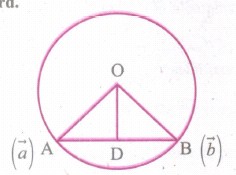
Let the position vectors of the parts A and B on the circle lie \(\vec { a } \) and \(\vec { b } \) respectively.
Since O is the centre of the circle
\(|\vec { OA } |=|\vec { OB } |\Rightarrow |\vec { a } |=|\vec { b } |\) ....(1)
Also D is the mid-point of AB,
⇒ \(\vec { OD } =\frac { \vec { a } +\vec { b } }{ 2 } \) (mid-point formula)
\(\left( \frac { \vec { a } +\vec { b } }{ 2 } \right) .(\vec { OB } -\vec { OA } )\)
=\(\left( \frac { \vec { a } +\vec { b } }{ 2 } \right) .(\vec { Ob } -\vec { Oa } )\)
= \(\frac { 1 }{ 2 } \left[ |\vec { b } |^{ 2 }-|\vec { a}| ^{ 2 } \right] \)
=\(\left[ \because (\vec { a } +\vec { b } ).(\vec { b } -\vec { a } )=|\vec { b } |^{ 2 }-|\vec { a } |^{ 2 } \right] \)
= \(\frac { 1 }{ 2 } \left[ |\vec { b } |^{ 2 }-|\vec { b| } ^{ 2 } \right] \) (using (1))
= \(\frac{1}{2}\)(0) = 0
⇒ \(\vec { OD } .\vec { AB } =0\Rightarrow \vec { OD } \bot \vec { AB } \)
Hence, if a line is drawn from the centre of a to the mid-point of a chord, then that line is perpendicular to the chord.
8.
Resultant of the given forces is \(\hat{F}\) = ( \(\hat { 2j } +\hat { 5j } +\hat { 6k } \) )+ (\(-\hat { i } -\hat { 2j } -\hat { k } \) ) = \(\hat { i } +\hat { 3j } +\hat {5 k } \)
Let A and B be the points (4, −3, −2) and (6, 1, −3) respectively.
Then the displacement vector of the particle is
\(\vec { d } =\vec { AB } =\vec { OB } -\vec { OA } =(\hat { 6i } +\hat { j } -\hat { 3k } )-(\hat { 4i } -\hat { 3j } -\hat { 2k } )=\hat { 2i } +\hat { 4j } -\hat { k } \)
Therefore the work done
w = \(\vec { f } .\vec { d } =(\hat { i } +\hat { 3j } +\hat { 5k } ).(\hat { 2j } +\hat { 4j } -\hat { k } )\) = 9 units.
9.
Given equation of the circle is
3x2 + (3 - p)xy + qy2 - 2px = 8pq
For the circle, co-efficient of xy = 0
⇒ 3-p = 0 ⇒ p = 3
Also, co-efficient of x2 = co-efficient of y2
⇒ 3 = q
∴ Equation of the circle is
3x2 + 3y2 - 6x = 8(3)(3)
3x2 + 3y2 - 6x - 72 = 0
Dividing by 3, we get
x2 + y2 - 2x - 24 = 0
Here 2g = - 2⇒ g = - 1
f = 0 and c = - 24
Centre is (-g, -f) (1, 0)
and r = \(\sqrt { { g }^{ 2 }+{ f }^{ 2 }-c } \)
= \(\sqrt { { (-1 })^{ 2 }+0+24 } \)
= \(\sqrt { 25 } \) = 5 units.
10.
Since \(\sqrt { \frac { \sqrt { 2 } }{ \sqrt { 3 } } } \) is a root, x-\(\sqrt { \frac { \sqrt { 2 } }{ \sqrt { 3 } } } \) is a factor. To remove the outermost square root, we take x +\(\sqrt { \frac { \sqrt { 2 } }{ \sqrt { 3 } } } \) as another factor and find their product.
\(\left( x+\sqrt { \frac { \sqrt { 2 } }{ \sqrt { 3 } } } \right) \left( x-\sqrt { \frac { \sqrt { 2 } }{ \sqrt { 3 } } } \right) ={ x }^{ 2 }-\frac { \sqrt { 2 } }{ \sqrt { 3 } } \)
Still we didn’t achieve our goal. So we include another factor x2+\(\sqrt { \frac { \sqrt { 2 } }{ \sqrt { 3 } } } \) and get the product.
\(\left( { x }^{ 2 }-\frac { \sqrt { 2 } }{ \sqrt { 3 } } \right) \left( { x }^{ 2 }+\frac { \sqrt { 2 } }{ \sqrt { 3 } } \right) ={ x }^{ 4 }-\frac { 2 }{ 3 } \)
So, 3x4- 2 = 0 is a required polynomial equation with the integer coefficients.
Now we identify the nature of roots of the given equation without solving the equation. The idea comes from the negativity, equality to 0, positivity of Δ = b2- 4ac.
11.
Let z =\(\left( \frac { 19+9i }{ 5-3i } \right) ^{ 15 }-\left( \frac { 8+i }{ I+2i } \right) ^{ 15 }\)
Here, \(\frac { 19+9i }{ 5-3i } =\frac { (19+9i)(5+3i) }{ (5-3i)(5+3i) } \)
= \(\frac { (95-27)+i(45+57) }{ { 5 }^{ 2 }+{ 3 }^{ 2 } } =\frac { 68+102i }{ 34 } \)
= 2 + 3i ................(1)
and \(\frac { 8+i }{ 1+2i } =\frac { (8+i)(1-2i) }{ (1+2i)(1-2i) } \)
= \(\frac { (8+2)+i(1-16) }{ { 1 }^{ 2 }+{ 2 }^{ 2 } } =\frac { 10-15i }{ 5 } \)
= 2 - 3i .............. (2)
Now z =\(\left( \frac { 19+9i }{ 5-3i } \right) ^{ 15 }-\left( \frac { 8+i }{ 1+2i } \right) ^{ 15 }\)
⇒ z = (2 + 3i)15 - (2 - 3i)15 (by (1) and (2))
Then by definition, \(\bar { z } =\left( \overline { (2+3i)^{ 15 }-(2-3i)^{ 15 } } \right) \)
= \(\left( \overline { 2+3i } \right) ^{ 15 }-\left( \overline { 2-3i } \right) ^{ 15 }\) (using properties of conjugates)
= (2 - 3i)15 - (2 + 3i)15 = -((2 + 3i)15 - (2-3i)15)
⇒ \(\\ \overline { z } \) = -z
Therefore, \(\left( \frac { 19+9i }{ 5-3i } \right) ^{ 15 }-\left( \frac { 8+i }{ 1+2i } \right) ^{ 15 }\) is purely imaginary.
12.
We get AB = \(\left[ \begin{matrix} 0 & -3 \\ 1 & 4 \end{matrix} \right] \left[ \begin{matrix} -2 & -3 \\ 0 & -1 \end{matrix} \right] =\left[ \begin{matrix} 0+0 & 0+3 \\ -2+0 & -3-4 \end{matrix} \right] =\left[ \begin{matrix} 0 & 3 \\ -2 & -7 \end{matrix} \right] \)
(AB)-1 = \(\frac { 1 }{ \left( 0+6 \right) } \left[ \begin{matrix} -7 & -3 \\ 2 & 0 \end{matrix} \right] =\frac { 1 }{ 6 } \left[ \begin{matrix} -7 & -3 \\ 2 & 0 \end{matrix} \right] \)...(1)
A-1 = \(\frac { 1 }{ \left( 0+3 \right) } \left[ \begin{matrix} 4 & 3 \\ -1 & 0 \end{matrix} \right] =\frac { 1 }{ 3 } \left[ \begin{matrix} 4 & 3 \\ -1 & 0 \end{matrix} \right] \)
B-1 = \(\frac { 1 }{ \left( 2-0 \right) } \left[ \begin{matrix} -1 & 3 \\ 0 & -2 \end{matrix} \right] =\frac { 1 }{ 2 } \left[ \begin{matrix} -1 & 3 \\ 0 & -2 \end{matrix} \right] \)
B-1A-1 = \(\frac { 1 }{ 2 } \left[ \begin{matrix} -1 & 3 \\ 0 & -2 \end{matrix} \right] \frac { 1 }{ 3 } \left[ \begin{matrix} 4 & 3 \\ -1 & 0 \end{matrix} \right] =\frac { 1 }{ 6 } \left[ \begin{matrix} -7 & -3 \\ 2 & 0 \end{matrix} \right] \) ...(2).
As the matrices in (1) and (2) are same, (AB)−1 = B−1A−1 is verified.
13.
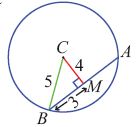
C(2, 1) is the centre and 3x + 4y + 10 = 0 cuts a chord AB on the circle. Let M be the midpoint of AB,
then AM = BM = 3. Now BMC is a right triangle.
So, we have CM = \(\frac { \left| 3\left( 2 \right) +4\left( 1 \right) +10 \right| }{ \sqrt { { 3 }^{ 2 }+{ 4 }^{ 2 } } } =4\)
By Pythagoras theorem BC2 = BM2 + MC2 = 32 + 42 = 25
BC = 5 = radius
Equation of the required circle is
(x−2)2+(y−1) = 52
x2+y2−4x−2y−20 = 0 .
14.
We know that the domain of sin−1(x) is [-1, 1].
This leads to −1\(\le\)2 - 3x2\(\le\)1, Which implies -3\(\le\) -3x2\(\le\)-1
Now, -3\(\le\) -3x2, gives x2\(\le\)1 and ............(1)
-3\(\le\)-3x2\(\le\)-1, gives x2\(\ge\)\(\frac{1}{2}\) .........(2)
Combining the equations (1) and (2), we get \(\frac{1}{3}\le x^2\le 1\). That is \(\frac{1}{\sqrt3}\le |x|\le1\), Which gives \(x\in[-1,-1\frac{1}{\sqrt3}]\cup[\frac{1}{\sqrt3},1]\)
since a\(\le|x|\le b\) implies x \(\in[-b,-a]\cup[a,b]\).
15.
Let z1 = (2+i)x + (1−i)y + 2i−3 = (2x+y−3) + i(x−y+ 2)and
z2 = x+(−1+2i)y+1+i = (x−y+1) + i(2y+1)
Given that z1 = z2
Therefore (2x+y−3) + i(x−y+2) = (x−y+1) + i(2y+1).
Equating real and imaginary parts separately, gives
2x+y−3 = x−y+1 \(\Rightarrow\) x+2y = 4
x−y+2 = 2y +1 \(\Rightarrow\) x−3y = −1
Solving the above equations, gives
x = 2 and y = 1.
16.
(i) m + n∈Z, ∀m, n∈Z. Hence + is a binary operation on Z.
(ii) Also m + n = n + m,∀m, n∈Z. So the commutative property is satisfied
(iii) ∀m, n, p∈Z, m+ (n + p) = (m+ n) + p. Hence the associative property is satisfied.
(iv) m + e = e + m = m ⇒ e = 0. Thus ヨ 0∈Z⋺(m+ 0) = (0 + m) = m. Hence the existence of identity is assured.
(v) m + m' = m'+ m = 0 ⇒ m' = −m. Thus ∀∈Z,ョ−m∈Z ⋺ m+ (−m) = (−m) + m = 0. Hence, the existence of inverse property is also assured. Thus we see that the usual addition + on Z satisfies all the above five properties.
17.
I =\(\int ^{1}_{0} (tan ^{-1} x + tan ^{-1}(1-x))\) dx
=\(\int ^{1}_{0} (tan ^{-1} x dx + \int ^{1}_{0} tan ^{-1}(1-x)) dx\)
= \(\int ^{1}_{0} (tan ^{-1} x dx + \int ^{1}_{0} tan ^{-1}(1-(1-x)) dx\), Since\(\int ^{a}_{0} f (x) dx = \int ^{a}_{0} f(a-x) dx \)
=\(\int ^{1}_{0} tan ^{-1} x dx + \int ^{1}_{0} tan ^{-1} x dx\)
= 2\(\int ^{1}_{0} tan^{-1} x dx\)
= \([2 \int udv]^1_0\) , Where u = tan-1 x and dν = dx
= 2\([uν - \int udv]^1_0,\) applying integration by parts
= 2\((x tan^{-1} x - \int x \frac{dx}{1+x^2})^{1}_{0}\)
= 2\((x tan^{-1} x - \frac {1}{2} log (1+x^2))^{1}_{0}\)
= \(\frac{\pi}{2} \)- log 2
18.
Recall that volume of a right circular cylinder is given by V = \(\pi \)r2h where r is the radius and h is the height. So we have V (r) = \(\pi \)r2h = 20\(\pi \)r2
V (10.1) −V (10)≈ \(\frac { dV }{ dr } { { | }_{ r=10 } }\) (10.1 10) = 20\(\pi \)2(10(0.1))
Thus the estimate for the change in the volume is 40 \(\pi \) cm3
Exact calculation of the volume change gives
V (10.1) −V (10) = 2040.2\(\pi \) -2000\(\pi \) = 40.2\(\pi \) cm3.
So relative error = \(\frac { 40.2\pi -40\pi }{ 40.2\pi } \) = \(\frac { 1 }{ 201 } \) = 0.00497 and hence
the percentage error = relative error x 100 = \(\frac { 1 }{ 201 } \)x100 = 0.497%
19.
Here f (x) = x, a = 0 and b = 1. Hence, we get
\(\int _{ a }^{ b }{ f(x)dx } =\underset { n\rightarrow \infty }{ lim } \frac { 1 }{ n } \sum _{ r=1 }^{ n }{ f } \left( \frac { r }{ n } \right) \Rightarrow \int _{ 0 }^{ 1 }{ xdx } =\underset { n\rightarrow \infty }{ lim } \frac { 1 }{ n } \sum _{ r=1 }^{ n }{ \frac { r }{ n } } \)
\(=\underset { n\rightarrow \infty }{ lim } \frac { 1 }{ { n }^{ 2 } } [1+2+...+n]\)
\(=\underset { n\rightarrow \infty }{ lim } \frac { 1 }{ { n }^{ 2 } } \frac { n(n+1) }{ 2 } =\underset { n\rightarrow \infty }{ lim } \frac { 1 }{ 2 } \left( 1+\frac { 1 }{ n } \right) =\frac { 1 }{ 2 } \)
20.
To find \(\int _{ 1 }^{ 1.5 }{ xdx } \) in {1.1, 1.2, 1.3, 1.4, 1.5}.
Here a = 1,
b = 1.5, n = 5, f(x) = x
\(\therefore h=\Delta x=\frac { b-a }{ n } =\frac { 1.5-1 }{ 5 } =\frac { 0.5 }{ 5 } =0.1\)
The partition of the interval is given by
x0 = 1
x1 = x0 + h = 1 + 0.1 = 1.1
x2 = x1 + h = 1.1 + 0.1 = 1.2
x3 = x2 + h = 1.2 + 0.1 = 1.3
x4 = x3 + h = 1.3 + 0.1 = 1.4
x5 = x4 + h = 1.4 + 0.1 = 1.5
The left end rule for Riemann sum with equal width \(\Delta\)x is
\(\int _{ a }^{ b }{ xdx } =[f({ x }_{ 0 })+f({ x }_{ 1 })+...+f({ x }_{ (n-1 })]\Delta x\)
S = [f(1) + f(1.1) + f(1.2) + f(1.3) + f(1.4)](0.1)
= (1 + 1.1 + 1.2 + 1.3 + 1.4) (0.1)
= 6 \(\times\) 0.1
S = 0.6
21.
The volume of the baloon of radius r is \(V =\frac{4}{3}\pi r ^{3} \)
We are given \(\frac{dV }{dt }=1000 \) and we need to find \(\frac{dr }{dt} \) when r = 7. Now,
\(\frac{dV}{dt}=3\times\frac{4}{3}\pi r^{2}\times \frac{dr}{dt}\)
Substituting r = 7 an \(\frac{dV}{dt}\) = 1000, we get 1000 \(= 4\pi \times 49 \times \frac{dr}{dt}\)
Hence, \(\frac{dr}{dt}=\frac{1000}{4\times49\times \pi}=\frac{250}{49\pi}\)
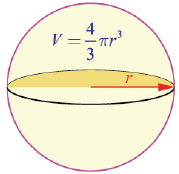
The surface area S of the baloon is S = 4ㅠr2. Therefore, \(\frac{dS}{dt}=8\pi \times r \times \frac{dr}{dt}\)
Substituting\(\frac{dr}{dt}=\frac{250}{49\pi}\) and r = 7, we get \(\frac{dS}{dt}=8\pi\times7\times \frac{250}{49\pi}=\frac{2000}{7}\)
Therefore, the rate of change of radius is \(\frac{250}{49 \pi}\) cm/sec and the change of surface area is \(\frac{2000}{7}\) cm2 / sec
22.
\({ tan }^{ -1 }x+{ tan }^{ -1 }y+{ tan }^{ -1 }z={ tan }^{ -1 }\left( \frac { x+y+z-xyz }{ 1-xy-yz-zx } \right) \)
Given \({ tan }^{ -1 }x+{ tan }^{ -1 }x+{ tan }^{ -o }y+{ tan }^{ -1 }z=\pi \)
\(\Rightarrow \pi ={ tan }^{ -1 }\left( \frac { x+y+zxyz }{ 1-xy-yz-zx } \right) \)
\(\Rightarrow tan\pi =\frac { x+y+z-xyz }{ 1-xy-yz-zx } \)
\(\Rightarrow 0=\frac { x+y+z-xyz }{ 1-xy-yz-zx } \quad [\therefore tan\pi =0]\)
\(\Rightarrow x+y+z-xyz=0\)
\(\Rightarrow x+y+z=xyz\)
23.
Given A =\(\left[ \begin{matrix} -5 & 1 & 3 \\ 7 & 1 & -5 \\ 1 & -1 & 1 \end{matrix} \right] \), B=\(\left[ \begin{matrix} 1 & 1 & 2 \\ 3 & 2 & 1 \\ 2 & 1 & 3 \end{matrix} \right] \)
AB =\(\left[ \begin{matrix} -5 & 1 & 3 \\ 7 & 1 & -5 \\ 1 & -1 & 1 \end{matrix} \right] \left[ \begin{matrix} 1 & 1 & 2 \\ 3 & 2 & 1 \\ 2 & 1 & 3 \end{matrix} \right] \)
=\(\left[ \begin{matrix} -5+3+6 & -5+2+3 & -10+1+9 \\ 7+3-10 & 7+2-3 & 14+1-15 \\ 1-3+2 & 1-2+1 & 2-1+3 \end{matrix} \right] \)
=\(\left[ \begin{matrix} 4 & 0 & 0 \\ 0 & 4 & 0 \\ 0 & 0 & 4 \end{matrix} \right] \)= 4. I3
BA =\(\left[ \begin{matrix} 1 & 1 & 2 \\ 3 & 2 & 1 \\ 2 & 1 & 3 \end{matrix} \right] \left[ \begin{matrix} -5 & 1 & 3 \\ 7 & 1 & -5 \\ 1 & -1 & 1 \end{matrix} \right] \)
=\(\left[ \begin{matrix} -5+7+2 & 1+1-2 & 3-5+2 \\ -15+14+1 & 3+2-1 & 9-10+1 \\ -10+7+3 & 2+1-3 & 6-5+3 \end{matrix} \right] \)
=\(\left[ \begin{matrix} 4 & 0 & 0 \\ 0 & 4 & 0 \\ 0 & 0 & 4 \end{matrix} \right] \)= 4. I3.
So, we get AB = BA = 4. I3
⇒ \(\left( \frac { 1 }{ 4 } A \right) B=B\left( \frac { 1 }{ 4 } A \right) =1\)
⇒ B-1 = \(\frac { 1 }{ 4 } \) = 1
Writing the given set of equations in matrix form we get,
\(\left[ \begin{matrix} 1 & 1 & 2 \\ 3 & 2 & 1 \\ 2 & 1 & 3 \end{matrix} \right] \left[ \begin{matrix} x \\ y \\ z \end{matrix} \right] =\left[ \begin{matrix} 1 \\ 7 \\ 2 \end{matrix} \right] \)
⇒ \(B=\left[ \begin{matrix} x \\ y \\ z \end{matrix} \right] =\left[ \begin{matrix} 1 \\ 7 \\ 2 \end{matrix} \right] \)
⇒ \(\left[ \begin{matrix} x \\ y \\ z \end{matrix} \right] ={ B }^{ -1 }\left[ \begin{matrix} 1 \\ 7 \\ 2 \end{matrix} \right] =\left[ \frac { 1 }{ 4 } A \right] \left[ \begin{matrix} 1 \\ 7 \\ 2 \end{matrix} \right] \)
= \(\frac { 1 }{ 4 } \left[ \begin{matrix} -5 & 1 & 3 \\ 7 & 1 & -5 \\ 1 & -1 & 1 \end{matrix} \right] \left[ \begin{matrix} 1 \\ 7 \\ 2 \end{matrix} \right] \)
= \(\frac { 1 }{ 4 } \left[ \begin{matrix} -5+7+6 \\ 7+7-10 \\ 1-7+2 \end{matrix} \right] =\frac { 1 }{ 4 } \left[ \begin{matrix} 8 \\ 4 \\ -4 \end{matrix} \right] =\left[ \begin{matrix} 2 \\ 1 \\ -1 \end{matrix} \right] \)
∴ x = 2, y = 1, z = -1
Hence, the solution set is {2, 1, - 1}.
24.
Let A be the origin, \(\vec { b } \) be the position vector of B and \(\vec {c } \) be the position vector of C .
Now D is the midpoint of BC , and so the position vector of D \(\frac{\vec{b}+\vec{c}}{2}\). There, we get
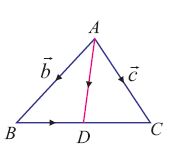
\({ \left| \vec { AD } \right| }^{ 2 }=\vec { AD } .\vec { AD } \)= \(\left( \frac { \vec { b } +\vec { c } }{ 2 } \right) .\left( \frac { \vec { b } +\vec { c } }{ 2 } \right) \)= \(\frac { 1 }{ 4 } ({ \left| \vec { b } \right| }^{ 2 }+{ \left| \vec { c } \right| }^{ 2 }+2\overrightarrow { b } .\vec { c } )\)....(1)
Now, \(\vec { BD } =\vec { AD } -\vec { AB } \) = \(\frac { \vec { b } +\vec { c } }{ 2 } -\vec { b }=\frac { \vec {c } -\vec { b} }{ 2 }\)
Then, we get, =\({ \left| \vec { BD } \right| }^{ 2 }=\vec { BD } .\vec {BD } \) = \(\left( \frac { \vec { c } -\vec { b} }{ 2 } \right) .\left( \frac { \vec { c } -\vec { b} }{ 2 } \right) \) = \(\frac { 1 }{ 4 } ({ \left| \vec { b } \right| }^{ 2 }+{ \left| \vec { c } \right| }^{ 2 }-2\overrightarrow { b } .\vec { c } )\)....(2)
Now, adding (1) and (2), we get
Therefore, \({ \left| \vec { AD } \right| }^{ 2 }+{ \left| \vec { BD } \right| }^{ 2 }=\frac { 1 }{ 4 } ({ \left| \vec { b } \right| }^{ 2 }+{ \left| \vec { c } \right| }^{ 2 }+2\overrightarrow { b } .\vec { c } )+\frac { 1 }{ 4 } ({ \left| \vec { b } \right| }^{ 2 }+{ \left| \vec { c } \right| }^{ 2 }-2\overrightarrow { b } .\vec { c } )=\frac { 1 }{ 2 } ({ \left| \vec { b } \right| }^{ 2 }+{ \left| \vec { c } \right| }^{ 2 })\)
⇒ \({ \left| \vec { AD } \right| }^{ 2 }+{ \left| \vec { BD } \right| }^{ 2 }=\frac { 1 }{ 2 } ({ \left| \vec { AB } \right| }^{ 2 }+{ \left| \vec { AC } \right| }^{ 2 })\)
Hence, \({ \left| \vec { AB } \right| }^{ 2 }+{ \left| \vec { AC } \right| }^{ 2 }=2({ \left| \vec { AD } \right| }^{ 2 }+{ \left| \vec { BD } \right| }^{ 2 })\)
25.
Given p, q are the roots of lx2 + nx + n = 0
\(p+q=\frac { -b }{ a } =\frac { -n }{ l } ...(1)\)
\(pq=\frac { c }{ a } =\frac { n }{ l } ...(2)\)
L.H.S
\( \sqrt{\frac{p}{q}}+\sqrt{\frac{q}{p}}+\sqrt{\frac{n}{l}} =\frac{\sqrt{p}}{\sqrt{q}}+\frac{\sqrt{q}}{\sqrt{p}}+\frac{\sqrt{n}}{\sqrt{l}}=\frac{p+q}{\sqrt{p} \sqrt{q}}+\frac{\sqrt{n}}{\sqrt{l}} \)
\( =\frac{-\frac{n}{l}}{\sqrt{p q}}+\frac{\sqrt{n}}{\sqrt{l}}=\frac{-\frac{n}{l}}{\frac{\sqrt{n}}{\sqrt{l}}}+\frac{\sqrt{n}}{\sqrt{l}} \)
\(=\frac{-\frac{n}{l}+\frac{n}{l}}{\sqrt{\frac{n}{l}}}=0\) R.H.S
26.
We find that |A| = \(\left| \begin{matrix} 8 & -6 & 2 \\ -6 & 7 & 4 \\ 2 & -4 & 3 \end{matrix} \right| \) = 8(21 - 16) + 6(-18 + 8) + 2(24 - 14) = 40 - 60 + 20 = 0
By the definition of adjoint, we get
adj A = \({ \left[ \begin{matrix} \left( 21-16 \right) & -\left( -18+8 \right) & \left( 24-14 \right) \\ -\left( -18+8 \right) & \left( 24-4 \right) & -\left( 32+12 \right) \\ \left( 24-14 \right) & -\left( -32+12 \right) & \left( 56-36 \right) \end{matrix} \right] }^{ T }=\left[ \begin{matrix} 5 & 10 & 10 \\ 10 & 20 & 20 \\ 10 & 20 & 20 \end{matrix} \right] \)
So, we get
A(adj A) = \(\left[ \begin{matrix} 8 & -6 & 2 \\ -6 & 7 & -4 \\ 2 & -4 & 3 \end{matrix} \right] \left[ \begin{matrix} 5 & 10 & 10 \\ 10 & 20 & 20 \\ 10 & 20 & 20 \end{matrix} \right] \)
= \(\left[ \begin{matrix} 40-60+20 & 80-120+40 & 80-120+40 \\ -30+70-40 & -60+140-80 & -60+140-80 \\ 10-40+30 & 20-80+60 & 20-80+60 \end{matrix} \right] =\left[ \begin{matrix} 0 & 0 & 0 \\ 0 & 0 & 0 \\ 0 & 0 & 0 \end{matrix} \right] \) = 0I3 = |A|I3,
Similarly, we get
(adj A)A = \(\left[ \begin{matrix} 5 & 10 & 10 \\ 10 & 20 & 20 \\ 10 & 20 & 20 \end{matrix} \right] \left[ \begin{matrix} 8 & -6 & 2 \\ -6 & 7 & -4 \\ 2 & -4 & 3 \end{matrix} \right] \)
= \(\left[ \begin{matrix} 40-60+20 & -30+70-40 & 10-40+30 \\ 80-120+40 & -60+140-80 & 20-80+60 \\ 80-120+40 & -60+140-80 & 20-80+60 \end{matrix} \right] =\left[ \begin{matrix} 0 & 0 & 0 \\ 0 & 0 & 0 \\ 0 & 0 & 0 \end{matrix} \right] \) = 0I3 = |A|I3.
Hence, A(adj A) = (adj A)A = |A|I3.
27.
The cubic equation is
x3 – x2 (α + β + γ) + x (αβ + βγ + γα) – αβγ = 0
\( x^{3}-x^{2}\left(2+\frac{1}{2}+1\right)+x\left(1+\frac{1}{2}+2\right)-(2)\left(\frac{1}{2}\right)(1)=0\)
\(x^{3}-x^{2}\left(\frac{4+1+2}{2}\right)+x\left(\frac{2+1+4}{2}\right)-1=0 \)
\(x^{3}-x^{2}\left(\frac{7}{2}\right)+x\left(\frac{7}{2}\right)-1=0\)
2x3 – 7x2 + 7x – 2 = 0
28.
We are given that, T = 10x − x2
Hence, the rate of change at any distance from one end is given by \(\frac{dT}{dx}=10-2x \)
The mid point of the rod is at x = 5
Substituting x = 5, we get \(\frac{dT}{dx}=0\)
29.
Given y = e−x + mx + n .... (1)
Derentiating cquation (1) wr.t 'x', we get
\(\frac { dx }{ dx } =-e^{ -x }(-1)+m\)
\(\frac { d^{ 2 }y }{ d{ x }^{ 2 } } =-e^{ -x }+m\)
Again differentiating, we get
\(\Rightarrow \frac { d^{ 2 }y }{ d{ x }^{ 2 } } ={ e^{ x } }+0\)
\(\Rightarrow \left( \frac { d^{ 2 }y }{ d{ x }^{ 2 } } \right) =e^x\)
Substituting the value of \(\frac{d^2y}{dx^2}\) in the given differential equation, we get
\(\Rightarrow e^{ x }\left( \frac { d^{ 2 }y }{ d{ x }^{ 2 } } \right) -1=e^x(e^x)-1\\= e^{x-x}-1\\
e^0-1= 1-1=0\)
Thus the solution of the given differential equation ex \(\left( \frac { { d }^{ 2 }y }{ { dx }^{ 2 } } \right) \) -1 = 0
30.
\(\frac { dy }{ dx } +xy=cotx\)
Given differential equation is
\(\frac { dy }{ dx } +xy=cotx\)
The highest derivative is 1 and its power is 1 order 1, degree 1.
31.
Prove the following properties
Z is real if and only if z =\(\bar { z } \)
Let z = x+iy
Then \(\bar { z } \) = x+iy
z = \(\bar { z } \)
⇔ x + iy = x-iy
⇔ x + iy - x + iy = 0
⇔ 2iy = 0
⇔ y = 0
[∴ 2 and i are constants]
when y = 0, z = x which is real
∴ z is purely ⇔ z = \(\bar { z } \)
32.
Let y = sin-1x
When y = 0, 0 = sin-1Ix
\(\Rightarrow\) sin(0) = sin (sin-1)(x))
\(\Rightarrow\)sin 0 = x
\(\Rightarrow\)x = 0
Hence, solution to (1) is x = 0. Also, graph of sin x and sin-1x intersect at origin (0, 0).
33.
Centre of the circle is (3,-2) which lies on x + y − 1 = 0. So the line x + y − 1 = 0 passes through the centre and therefore the line x + y −1 = 0 is a diameter of the circle for all possible values of c .
34.
We first find adj A. By definition, we get adj A = \({ \left[ \begin{matrix} +{ M }_{ 11 } & -{ M }_{ 12 } \\ -{ M }_{ 21 } & +{ M }_{ 22 } \end{matrix} \right] }^{ T }={ \left[ \begin{matrix} d & -c \\ -b & a \end{matrix} \right] }^{ T }=\left[ \begin{matrix} d & -c \\ -c & a \end{matrix} \right] \).
Since A is non-singular, |A| = ad - bc ≠ 0.
As \({ A }^{ -1 }=\frac { 1 }{ \left| A \right| } \) adj A, we get A-1 = \(\frac { 1 }{ ad-bc } \left[ \begin{matrix} d & -b \\ -c & a \end{matrix} \right] \).
35.
(b)
(SxS) ⟶ S
36.
(c)
2
37.
(d)
\(4\pi\)
38.
(b)
\(\frac15\)
39.
(d)
40.
(a)
2, 3
41.
(b)
\(\frac{4}{25} \text { radians } / \mathrm{sec}\)
42.
(a)
3 cm/s
43.
(c)
I3
44.
(c)
\([\vec { \alpha } ,\vec { \beta } ,\vec { \gamma } ]\) = 0
45.
(d)
0
46.
(c)
\(\frac { 2 }{ \sqrt { 3 } } \)
47.
(a)
\(0,-\frac { 40 }{ 9 } \)
48.
(b)
\(\frac{\pi}{3}\)
49.
(c)
\(\frac{\pi}{2}-x\)
50.
(a)
mn
51.
(d)
-4
52.
(a)
1+ i
53.
(a)
0

12th Standard Syllabus & Materials
12th Standard
TN 12th Computer Applications களப்பெயர் முறைமை (DNS) Sample Question Papers Study Material - QB365 Set A
NEW12th Standard
TN 12th Computer Applications வலையமைப்பு எடுத்துக்காட்டுகள் மற்றும் நெறிமுறைகள் Sample Question Papers Study Material - QB365 Set A
NEW12th Standard
TN 12th Computer Applications கணினி வலையமைப்பு ஓர் அறிமுகம் Sample Question Papers Study Material - QB365 Set A
NEW12th Standard
TN 12th Computer Applications PHP-உடன் MySQL-ஐ இணைத்தல் Sample Question Papers Study Material - QB365 Set A



Tamilnadu Stateboard 12th Standard Subjects
Maths

Chemistry

Physics

Biology

Computer Science

Business Maths and Statistics

Economics

Commerce

Accountancy

History

Computer Applications
Biology
Computer Technology
Computer Applications
Computer Science
Business Maths and Statistics
Commerce
Economics
Maths
Chemistry
Physics
Computer Technology
History
Accountancy

Tamil

English

French
Tamilnadu Stateboard Standards

