
 100% FREE ACCESS
12th Standard Syllabus & Materials
12th Standard
TN 12th Computer Applications மின்னணு தரவு பரிமாற்றம் Sample Question Papers Study Material - QB365 Set A
NEW12th Standard
TN 12th Computer Applications மின் - வணிக பாதுகாப்பு அமைப்புகள் Sample Question Papers Study Material - QB365 Set A
NEW12th Standard
TN 12th Computer Applications மின்னணு செலுத்தல் முறைகள் Sample Question Papers Study Material - QB365 Set A
NEW12th Standard
TN 12th Computer Applications மின் - வணிகம் Sample Question Papers Study Material - QB365 Set A
NEW12th Standard
TN 12th Computer Applications திறந்த மூல கருத்துருக்கள் Sample Question Papers Study Material - QB365 Set A
NEW12th Standard
TN 12th Computer Applications வலையமைப்பு வடமிடல் Sample Question Papers Study Material - QB365 Set A

Published on: 02/09/2019
Theory of Equations
Download Tamil Nadu 12th Standard Maths question papers, model tests, one-mark questions, important questions, and public exam papers in PDF format. Free study materials and answer keys for TN State Board students.
Questions + Answers key
Take MCQ Maths Test1.
If α, β, and γ are the roots of the equation x3 + px2 + qx + r = 0, find the value of \(\Sigma \frac { 1 }{ \beta \gamma } \) in terms of the coefficients.
2.
A 12 metre tall tree was broken into two parts. It was found that the height of the part which was left standing was the cube root of the length of the part that was cut away. Formulate this into a mathematical problem to find the height of the part which was left standing.
3.
Find the sum of the squares of the roots of ax4+ bx3+ cx2+ dx + e = 0. \(a \neq 0\)
4.
Solve the equations:
6x4- 35x3+ 62x2- 35x + 6 = 0
5.
Solve the equation
2x3 - 9x2 + 10x = 3
6.
Solve the equation (2x-3) (6x-1) (3x-2) (x-2)-5 = 0
7.
Solve the equation (x-2) (x-7) (x-3) (x+2)+19 = 0
8.
If the roots of x3+ px2+ qx + r = 0 are in H.P. prove that 9pqr = 27r2+2q3.
9.
10.
The polynomial x3 + 2x + 3 has
one negative and two imaginary zeros
one positive and two imaginary zeros
three real zeros
no zeros
11.
12.
According to the rational root theorem, which number is not possible rational zero of 4x7 + 2x4 - 10x3 - 5?
-1
\(\frac { 5 }{ 4 } \)
\(\frac { 4 }{ 5 } \)
5
13.
If α, β and γ are the zeros of x3 + px2 + qx + r, then \(\Sigma \frac { 1 }{ \alpha } \) is
\(-\frac { q }{ r } \)
\(-\frac { p }{ r } \)
\(\frac { q }{ r } \)
\(-\frac { q }{ p } \)
1.
Since α, β, and γ are the roots of the equation x3+ px2+ qx + r = 0, we have
Σ1 α + β + γ = -p and Σ3 αβγ = -r
\(\Sigma \frac { 1 }{ \beta \gamma } =\frac { 1 }{ \beta \gamma } +\frac { 1 }{ \gamma \alpha } +\frac { 1 }{ \alpha \beta } =\frac { \alpha +\beta +\gamma }{ \alpha \beta \gamma } =\frac { -p }{ -r } =\frac { p }{ r } \).
2.
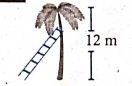
Given that the height of the tree is 12m.
Let x m be the standing part and (12 -x)m be the broken part.
Given \(x=\sqrt [ 3 ]{ 12-x } \)
\(\Rightarrow x=(12-x)^{ \frac { 1 }{ 3 } }\)
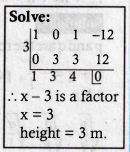
Taking power 3 both sides, we get
⇒ x3 = 12-x
⇒ x3+ x -12 = 0
which is the required mathematical problem.
3.
Let α, β, γ and δ be the roots of ax4+ bx3+ cx2+ dx + e = 0
Σ1 = α + β + γ + δ = -\(\frac { b }{ a } \),
Σ2 = αβ + αγ + αδ + βγ + βδ + γδ = \(\frac { c }{ a } \),
Σ3 = αβγ + αβδ + αγδ + βγδ = -\(\frac { d }{ a } \)
Σ4 = αβγδ =\(\frac { e }{ a } \)
We have to find α2 + β2 + γ2 + δ2
Applying the algebraic identity
(a+b+c+d)2 ≡ a2+b2+c2+d2+2(ab+ac+ad+bc+bd+cd),
we get
α2 + β2 + γ2 + δ2 = (α + β + γ + δ)2-2(αβ + αγ + αδ + βγ + βδ + γδ)
= \(\left( \frac { b }{ a } \right) ^{ 2 }-2\left( \frac { c }{ a } \right) \)
= \(\frac { { b }^{ 2 }-2ac }{ { a }^{ 2 } } \).
4.
6x4- 35x3+ 62x2- 35x + 6 = 0
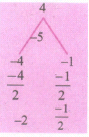
This equation is type I even degree reciprocal equation.
Hence, it can be rewritten as
\(6\left( { x }^{ 2 }+\frac { 1 }{ x } \right) -35(x+\frac { 1 }{ x } )+62=0 ...(1)\)
putting \(x+\frac { 1 }{ x } =y\)
\(\Rightarrow { x }^{ 2 }+\frac { 1 }{ { x }^{ 2 } } +2={ y }^{ 2 }\)
\(\Rightarrow { x }^{ 2 }+\frac { 1 }{ { x }^{ 2 } } ={ y }^{ 2 }-2\)
∴ (1) becomes as,
\(\Rightarrow 6({ y }^{ 2 }-2)-35y+62=0\)
\(\Rightarrow { 6y }^{ 2 }-12-35y+62=0\)
\(\Rightarrow { 6y }^{ 2 }-35y+50=0\)
\(\Rightarrow (3y-10)(2y-5)=0\)
\(\Rightarrow y=\frac { 10 }{ 3 } ,\frac { 5 }{ 2 } \)
Case (i) when \(y=\frac { 10 }{ 3 } ,x+\frac { 1 }{ x } =\frac { 10 }{ 3 } \)
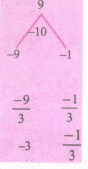
\(\Rightarrow \frac { { x }^{ 2 }+1 }{ x } =\frac { 10 }{ 3 } \)
\(\Rightarrow { 3x }^{ 2 }-10x+3=10x\)
\(\Rightarrow { 3x }^{ 2 }-10x+3=0\)
\(\Rightarrow (x-3)(3x-1)=0\)
\(\Rightarrow x=3,\frac { 1 }{ 3 } \)
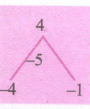
Case (ii) when \(y=\frac { 5 }{ 2 } ,x+\frac { 1 }{ x } =\frac { 5 }{ 2 } \Rightarrow \frac { { x }^{ 2 }+1 }{ x } =\frac { 5 }{ 2 } \)
\(\Rightarrow { 2x }^{ 2 }+2=5x\Rightarrow { 2x }^{ 2 }-5x+2=0\)
\(\Rightarrow (x-2)(2x-1)=0\)
Hence the roots are \(2,\frac { 1 }{ 2 } ,3,\frac { 1 }{ 3 } \)
5.
Since the sum of the co-efficients is
2 - 9 + 10 - 3 = 12 - 12 = 0
⇒ x = 1 is a root of (x)
∴ (x - 1) is a factor of (x)
To find the other factor, let us divide f(x) by x-1
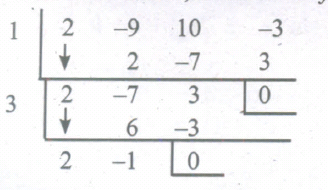
[Using synthetic division]
f(x) = (x-1)(x - 3)(2x - 1) = 0
⇒x - 1 = 0, x - 3 = 0 or 2x - 1 = 0
⇒ x = 1, x = 3x, x = \(\frac{1}{2}\)
Hence the roots are 1, 3, \(\frac{1}{2}\).
6.
The given equation is same as
(2x-3)(3x-2)(6x-1)(x-2)-5 = 0
After a computation, the above equation becomes
(6x2-13x+6)(6x2-13x+12)-5 = 0
By taking y = 6x2-13x, the above equation becomes
(y+6)(y+12)-5 = 0
which is same as
y2+18y+7 = 0
Solving this equation, we get y = −1 and y = −7.
Substituting the values of y in y = −6x2-13x, we get
6x2-13x+1 = 0
6x2-13x+7 = 0
Solving these two equations, we get
x = 1, x = \(\frac { 7 }{ 6 } \), x = \(\frac { 13 + \sqrt { 145 } }{ 12 } \) and x = \(\frac { 13-\sqrt { 145 } }{ 12 } \)
as the roots of the given equation.
7.
We can solve this fourth degree equation by rewriting it suitably and adopting a technique of substitution. Rewriting the equation as
(x−2)(x−3)(x−7)(x+2)+19 = 0
the given equation becomes
(x2−5x+6)(x2−5x−14)+19 = 0 .
If we take x2 − 5x as y, then the equation becomes (y+6)(y−14)+19 = 0;
that is, y2-8y-65 = 0
Solving this we get solutions y = 13 and y = −5. Substituting this we get two quadratic equations
x2-5x-13 = 0 and x2-5x+5 = 0
which can be solved by usual techniques. The solutions obtained for these two equations together give solutions as \(\frac { 5\pm \sqrt { 77 } }{ 2 } ,\frac { 5\pm \sqrt { 5 } }{ 2 } \).
8.
Let the roots be in H.P. Then, their reciprocals are in A.P. and roots of the equation
\(\left( \frac { 1 }{ x } \right) ^{ 3 }+p\left( \frac { 1 }{ x } \right) ^{ 2 }+q\left( \frac { 1 }{ x } \right) \)+ r = 0 ⇔ rx3 + qx2 + px + 1 = 0.....(1)
Since the roots of (1) are in A.P., we can assume them as α-d, α, α+d
Applying the Vieta’s formula, we get
Σ1 = (α-d)+α+(α+d) = -\(\frac { q }{ r } \) ⇒ 3α = -\(\frac { q }{ r } \) ⇒ α = -\(\frac { q }{ 3r } \)
But, we note that α is a root of (1). Therefore, we get
\(r\left( -\frac { q }{ 3r } \right) ^{ 2 }+q\left( -\frac { q }{ 3r } \right) ^{ 2 }+p\left( -\frac { q }{ 3r } \right) \) + 1 = 0 ⇒ q3 + 3q3 - 9pqr + 27r2 = 0 ⇒ 2q3 + 27r2.
9.
(a)
10.
(a)
one negative and two imaginary zeros
11.
(a)
12.
(c)
\(\frac { 4 }{ 5 } \)
13.
(a)
\(-\frac { q }{ r } \)

12th Standard Syllabus & Materials
12th Standard
TN 12th Computer Applications களப்பெயர் முறைமை (DNS) Sample Question Papers Study Material - QB365 Set A
NEW12th Standard
TN 12th Computer Applications வலையமைப்பு எடுத்துக்காட்டுகள் மற்றும் நெறிமுறைகள் Sample Question Papers Study Material - QB365 Set A
NEW12th Standard
TN 12th Computer Applications கணினி வலையமைப்பு ஓர் அறிமுகம் Sample Question Papers Study Material - QB365 Set A
NEW12th Standard
TN 12th Computer Applications PHP-உடன் MySQL-ஐ இணைத்தல் Sample Question Papers Study Material - QB365 Set A



Tamilnadu Stateboard 12th Standard Subjects
Maths

Chemistry

Physics

Biology

Computer Science

Business Maths and Statistics

Economics

Commerce

Accountancy

History

Computer Applications
Biology
Computer Technology
Computer Applications
Computer Science
Business Maths and Statistics
Commerce
Economics
Maths
Chemistry
Physics
Computer Technology
History
Accountancy

Tamil

English

French
Tamilnadu Stateboard Standards

