
 100% FREE ACCESS
12th Standard Syllabus & Materials
12th Standard
TN 12th Computer Applications மின்னணு தரவு பரிமாற்றம் Sample Question Papers Study Material - QB365 Set A
NEW12th Standard
TN 12th Computer Applications மின் - வணிக பாதுகாப்பு அமைப்புகள் Sample Question Papers Study Material - QB365 Set A
NEW12th Standard
TN 12th Computer Applications மின்னணு செலுத்தல் முறைகள் Sample Question Papers Study Material - QB365 Set A
NEW12th Standard
TN 12th Computer Applications மின் - வணிகம் Sample Question Papers Study Material - QB365 Set A
NEW12th Standard
TN 12th Computer Applications திறந்த மூல கருத்துருக்கள் Sample Question Papers Study Material - QB365 Set A
NEW12th Standard
TN 12th Computer Applications வலையமைப்பு வடமிடல் Sample Question Papers Study Material - QB365 Set A

Published on: 31/08/2019
Current Electricity
Download Tamil Nadu 12th Standard Physics question papers, model tests, one-mark questions, important questions, and public exam papers in PDF format. Free study materials and answer keys for TN State Board students.
Questions + Answers key
Take MCQ Physics Test1.
What is Peltier effect?
2.
What is Seebeck effect?
3.
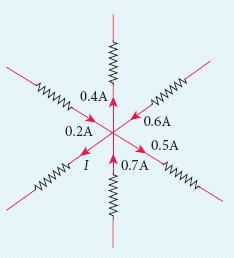
For the given circuit find the value of I.
4.
Distinguish between drift velocity and mobility.
5.
Compute the current in the wire if a charge of 120 C is flowing through a copper wire in 1 minute.
6.
Two electric bulbs marked 20 W – 220 V and 100 W – 220 V are connected in series to 440 V supply. Which bulb will get fused?
7.
Two resistors when connected in series and parallel, their equivalent resistances are 15 Ω and \(\frac{56}{15}\)Ω respectively. Find the individual resistances.
8.
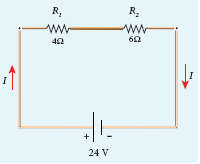
Calculate the equivalent resistance for the circuit which is connected to 24 V battery and also find the potential difference across each resistors in the circuit.
9.
A piece of copper and another of germanium are cooled from room temperature to 80 K. The resistance of ______.
each of them increases
each of them decreases
copper increases and germanium decreases
copper decreases and germanium increases
10.
The temperature coefficient of resistance of a wire is 0.00125 per °C. At 20°C, its resistance is 1 Ω. The resistance of the wire will be 2 Ω at ______.
800 °C
700 °C
850 °C
820 °C
11.
In India electricity is supplied for domestic use at 220 V. It is supplied at 110 V in USA. If the resistance of a 60 W bulb for use in India is R, the resistance of a 60 W bulb for use in USA will be ______.
R
2R
\(\frac{R}{4}\)
\(\frac{R}{2}\)
12.
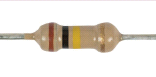
What is the value of resistance of the following resistor?
100 k Ω
10 k Ω
1 k Ω
1000 k Ω
13.
A toaster operating at 240 V has a resistance of 120 Ω. The power is ______.
400 W
2 W
480 W
240 W
1.
Peltier discovered that, when an electric current is passed through a circuit of a thermocouple heat is evolved at one junction and absorbed at the other junction. This is known as Peltier effect.
2.
Seebeck discovered that in a closed circuit consisting of two dissimilar metals, when the junctions are maintained at different temperature an emf is developed.
3.
Applying Kirchoff’s rule to the point P in the circuit,
The arrows pointing towards P are positive and away from P are negative.
Therefore, 0.2A - 0.4A + 0.6A - 0.5A + 0.7A - I = 0
0.7 A - I = 0
1.5A - 0.9A – I = 0
0.6A - I = 0
I = 0.6 A
4.
| S.No | Drift velocity | Mobility |
| (i) | Drift velocity is the average velocity acquired by the electrons inside the conductor when it is subjected to an electric field. | Mobility is defined as the magnitude of the drift velocity per unit electric field. |
| (ii) | Vd = a\(\tau\) (or) Vd = μE. | μ =e\(\tau\)/m (or) u = vd/E. |
| (iii) | Its unit is m / s. | Its unit is m2/ Vs. |
5.
The current (rate of flow of charge) in the wire is
\(I=\frac { Q }{ t } =\frac { 120 }{ 60 } =2A\)
6.
To check which bulb will be fused, the voltage drop across each bulb has to be calculated.
The resistance of a bulb,
\(R=\frac { V^{ 2 } }{ P } =\frac { { (Ratedvoltage) }^{ 2 } }{ Ratedpower } \)
For 20W - 220V bulb,
\({ R }_{ 1 }=\frac { { \left( 220 \right) }^{ 2 } }{ 20 } \Omega =2420\Omega \)
For 100W - 220V bulb,
\({ R }_{ 2 }=\frac { { \left( 220 \right) }^{ 2 } }{ 20 } \Omega =484\Omega \)
Both the bulbs are connected in series. So same current will pass through both the bulbs. The current that passes through the circuit, \(I=\frac { V }{ { R }_{ tot } } \)
Rtot (R1 + R2)
Rtot = (484 + 2420) \(\Omega\) = 2904 \(\Omega\)
\(I=\frac { 440V }{ 2904\Omega } \approx 0.151A\)
The voltage drop across the 20W bulb is
\(V_1=IR_1=\frac { 440V }{ 2904 }\times2420 \approx 366.6V\)
The voltage drop across the 100W bulb is
\({ V }_{ 2 }=I{ R }_{ 2 }=\frac { 440 }{ 2904 } 484\approx 73.3A\)
The 20 W bulb will get fused because the voltage across it is more than the voltage rating.
7.
Rs = R1 + R2 = 15 Ω (1)
\({ R }_{ p }=\frac { { R }_{ 1 }{ R }_{ 2 } }{ { R }_{ 1 }{ +R }_{ 2 } } =\frac { 56 }{ 15 } \Omega \quad \) (2)
From equation (1) substituting for R1 + R2 in equation (2)
\(\frac { { R }_{ 1 }{ R }_{ 2 } }{ 15 } =\frac { 56 }{ 15 } \Omega \)
∴ R1R2 = 56
\({ R }_{ 2 }=\frac { 56 }{ 15 } \Omega \) (3)
Substituting for R2 in equation (1) from equation (3)
\({ R }_{ 1 }+\frac { 56 }{ { R }_{ 1 } } =15\)
Then, \(\frac { { R }_{ 1 }^{ 2 }+56 }{ { R }_{ 1 } } =15\)
R12 + 56 = 15 R1
R12 - 15 R1 + 56 = 0
The above equation can be solved using factorisation.
R1 = 8 Ω (or) R1 = 7 Ω
If (R1 = 8 Ω)
Substituting in equation (1)
8 + R2 = 15
R2 = 15 – 8 = 7 Ω ,
R2 = 7 Ω i.e , (when R1 = 8 Ω ; R2 = 7 Ω)
If R1= 7 Ω
Substituting in equation (1)
7 + R2 = 15
R2 = 8 Ω , i.e , (when R1 = 7 Ω ; R2 = 8 Ω )
8.
Since the resistors are connected in series, the effective resistance in the circuit
= 4 Ω + 6 Ω = 10 Ω
The Current I in the circuit =\(\frac { V }{ { R }_{ eq } } =\frac { 24 }{ 10 } =2.4A\)
Voltage across 4Ω resistor
V1= IR1 = 2.4A x 4Ω = 9.6V
Voltage across 6 Ω resistor
V2 = IR2 = 2.4A x 6Ω = 14.4V
9.
Resistivity ∝ temperature for conductor. so, copper → decreases
Resistivity ∝\(\frac{1}{\text {temperature for semiconductor}}\)
so, germanium → increases.
10.
Rt = Ro [1 + α(T2 - T1)
2 = 1[1 + 0.00125(T2 - 293)
I = 5/4 x 10-3 (T2 - 293)
T2 = 1093 K
T2 = 820 oC
11.
\(\mathrm{V}_1 =220 \mathrm{~V}, \quad \mathrm{P}_1=60 \mathrm{~W} \)
\(\mathrm{~V}_{\mathrm{U}} =110 \mathrm{~V}, \mathrm{P}_{\mathrm{U}}=60 \mathrm{~W} \)
\(P =\frac{V^2}{R} \Rightarrow R=\frac{V^2}{P} \)
\(\therefore R_l =\frac{V_I^2}{P_l} \text { Similarly, } \quad \mathrm{R}_U=\frac{V_U^2}{P_U} \)
\(R_l =\frac{220 \times 220}{60} \quad \mathrm{R}_{\mathrm{U}}=\frac{110 \times 110}{60} \)
\(R_I =\frac{48400}{60} \quad R_U=\frac{12100}{60} \)
\(\frac{R_U}{R_l} =\frac{12100}{60} \times \frac{60}{48400}=\frac{1}{4} \)
\(R_U =\frac{R_l}{4}=\frac{R}{4}\)
12.
Brown - 1
Black - 0
Yellow - 104
(∴ R = 10 x 104 Ω = 100 kΩ)
13.
\(P=\frac{V^2}{R}=\frac{240 \times 240}{120}=480 \ W\)

12th Standard Syllabus & Materials
12th Standard
TN 12th Computer Applications களப்பெயர் முறைமை (DNS) Sample Question Papers Study Material - QB365 Set A
NEW12th Standard
TN 12th Computer Applications வலையமைப்பு எடுத்துக்காட்டுகள் மற்றும் நெறிமுறைகள் Sample Question Papers Study Material - QB365 Set A
NEW12th Standard
TN 12th Computer Applications கணினி வலையமைப்பு ஓர் அறிமுகம் Sample Question Papers Study Material - QB365 Set A
NEW12th Standard
TN 12th Computer Applications PHP-உடன் MySQL-ஐ இணைத்தல் Sample Question Papers Study Material - QB365 Set A



Tamilnadu Stateboard 12th Standard Subjects

Maths

Chemistry
Physics

Biology

Computer Science

Business Maths and Statistics

Economics

Commerce

Accountancy

History

Computer Applications
Biology
Computer Technology
Computer Applications
Computer Science
Business Maths and Statistics
Commerce
Economics
Maths
Chemistry
Physics
Computer Technology
History
Accountancy

Tamil

English

French
Tamilnadu Stateboard Standards

