
 100% FREE ACCESS
12th Standard Syllabus & Materials
12th Standard
TN 12th Computer Applications மின்னணு தரவு பரிமாற்றம் Sample Question Papers Study Material - QB365 Set A
NEW12th Standard
TN 12th Computer Applications மின் - வணிக பாதுகாப்பு அமைப்புகள் Sample Question Papers Study Material - QB365 Set A
NEW12th Standard
TN 12th Computer Applications மின்னணு செலுத்தல் முறைகள் Sample Question Papers Study Material - QB365 Set A
NEW12th Standard
TN 12th Computer Applications மின் - வணிகம் Sample Question Papers Study Material - QB365 Set A
NEW12th Standard
TN 12th Computer Applications திறந்த மூல கருத்துருக்கள் Sample Question Papers Study Material - QB365 Set A
NEW12th Standard
TN 12th Computer Applications வலையமைப்பு வடமிடல் Sample Question Papers Study Material - QB365 Set A

Published on: 26/07/2019
Magnetism and Magnetic Effects of Electric Current
Download Tamil Nadu 12th Standard Physics question papers, model tests, one-mark questions, important questions, and public exam papers in PDF format. Free study materials and answer keys for TN State Board students.
Questions + Answers key
Take MCQ Physics Test1.
What are the uses of studying hysteresis loops of various material?
2.
What is Geomagnetism?
3.
What are the causes for earth's magnetic field according to Gover?
4.
What is magnetic susceptibility?
5.
Define magnetic dipole moment.
6.
Let E be the electric field of magnitude 6.0 x 10⁶ N C–1 and B be the magnetic field magnitude 0.83 T. Suppose an electron is accelerated with a potential of 200 V, will it show zero deflection?. If not, at what potential will it show zero deflection.
7.
Two materials X and Y are magnetised whose values of intensity of magnetisation are 500 A m–1 and 2000 A m–1 respectively. If the magnetising field is 1000 A m–1, then which one among these materials can be easily magnetized?
8.
Let the magnetic moment of a bar magnet be \(\overset { \rightarrow }{ { p }_{ m } } \) whose magnetic length is d = 2l and pole strength is qm. Compute the magnetic moment of the bar magnet when it is cut into two pieces
(a) along its length
(b) perpendicular to its length.
9.
A short bar magnet 0 magnetic field. It experiences a torque of 0.051 J.
(i) Calculate the magnitude of the magnetic field.
(ii) In which orientation will the bar magnet the in stable equilibrium in the magnetic field.
10.
Explain the principle and working of a moving coil galvanometer.
11.
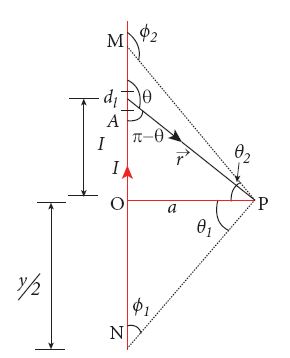
Show that for a straight conductor, the magnetic field
\(\overset { \rightarrow }{ B } =\frac { { \mu }_{ ° }I }{ 4\pi a } (cos\varphi _{ 1 }-cos\varphi _{ 2 })\hat { n } \)
\(=\frac { { \mu }_{ ° }I }{ 4\pi a } (sin{ \theta }_{ 1 }+sin{ \theta }_{ 2 })\hat { n } \)
12.
A current carrying conductor is associated with _______________.
electric field
magnetic field
electro magnetic
all these
13.
Four wires each of length 2m are bent into four loops P, Q, R, and S, and then suspended into a uniform magnetic field as shown in the figure same current is passed in each loop. On which loop the couple will be the highest?
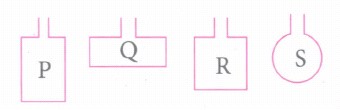
P
Q
R
S
14.
A thin insulated wire forms a plane spiral of N = 100 tight turns carrying a current I = 8 m A (milli ampere). The radii of inside and outside turns are a = 50 mm and b = 100 mm respectively. The magnetic induction at the centre of the spiral is ______.
\(5\mu T\)
\(7\mu T\)
\(8\mu T\)
\(10\mu T\)
15.
A circular coil of radius 5 cm and 50 turns carries a current of 3 ampere. The magnetic dipole moment of the coil is nearly ____.
1.0 A m2
1.2 A m2
0.5 A m2
0.8 A m2
16.
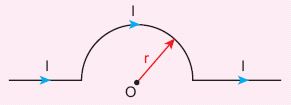
The magnetic field at the centre O of the following current loop is
\(\frac { { \mu }_{ ° }I }{ 4r } \bigotimes \)
\(\frac { { \mu }_{ ° }I }{ 4r } \bigodot \)
\(\frac { { \mu }_{ ° }I }{ 2r } \bigotimes \)
\(\frac { { \mu }_{ ° }I }{ 2r } \bigodot \)
17.
End rule
18.
Right hand thumb rule
19.
Permanent magnets
20.
Ferromagnetic materials
21.
Diamagnetic materials
22.
State the rule which is used to find the direction of field acting at a point near a current carrying street conductors?
23.
Obtain an expression for magnetic Lorentz force?
1.
The significance of hysteresis loop is that it provides information such as retentivity, coercivity, permeability, susceptibility and energy loss during one cycle of magnetisation for each ferromagnetic material. Therefore, the study of hysteresis loop will help us in selecting proper and suitable material for a given purpose.
2.
The branch of physics which deals with the Earth's magnetic field is called Geomagnetism or Terrestrial magnetism.
3.
Gover suggested that the Earth's magnetic field is due to hot rays coming out from the Sun. These rays will heat up the air near equatorial region. Once air becomes hotter, it rises above and will move towards northern and southern hemispheres and get electrified. This may be responsible to magnetize the ferromagnetic materials near the Earth's surface.
4.
Magnetic susceptibility is defined as the ratio of the intensity of magnetisation (\(\vec { M } \)) induced in the material due to the magnetising field |\(\vec H\)|.
\( \chi _{ m }=\frac { |\vec { M } | }{ |\vec { H } | } \).
5.
Magnetic dipote moment \(\vec { p }_{ m } \) is defined as the product of its pole strength and magnetic length. It is a vector quantity denoted by \(\vec { p }_{ m } \)
\(\vec { p }_{ m } ={ q }_{ m }\vec { d } \)
6.
Electric field, E = 6.0 x 10⁶ N C-1 and magnetic field, B = 0.83 T.
Then.
\(v=\frac { E }{ B } =\frac { { 6.0\times 10 }^{ 6 } }{ 0.83 } =7.23\times { 10 }^{ 6 }{ ms }^{ -1 }\)
When an electron goes with this velocity, it shows null deflection. Since the accelerating potential is 200 V, the electron acquires kinetic energy because of this accelerating potential. Hence,
\(\frac { 1 }{ 2 } mv^{ 2 }=eV \)
\(v=\sqrt { \frac { 2eV }{ m } }\)
Since the mass of the electron, m = 9.1 x 10⁻³¹kg and charge of an electron, \(\left| q \right| =e=1.6\times { 10 }^{ -19 }C.\) The velocity acquired by the electron due to accelerating potential 200 V is
\({ v }_{ 200 }=\sqrt { \frac { 2\left( 1.6\times { 10 }^{ -19 } \right) \left( 200 \right) }{ \left( 9.1\times { 10 }^{ -31 } \right) } } =8.39\times { 10 }^{ 6 }m{ s }^{ -1 }\)
Since the speed v200 > v, the electron is deflected towards direction of Lorentz force. So, in order to have null deflection, the potential, we have to supply is
\(v=\frac { { 1mv }^{ 2 } }{ 2\quad e } =\frac { \left( 9.1\times { 10 }^{ -31 } \right) \times \left( 7.23\times { 10 }^{ 6 } \right) ^{ 2 } }{ 2\times \left( 1.6\times { 10 }^{ -19 } \right) } \)
V = 148.65 V
7.
The susceptibility of material X is
Xm,x = \(\frac { \left| \overset { \rightarrow }{ M } \right| }{ \left| \overset { \rightarrow }{ H } \right| } =\frac { 500 }{ 1000 } =0.5\)
The susceptibility of material Y is
Xm,y = \(\frac { \left| \overset { \rightarrow }{ M } \right| }{ \left| \overset { \rightarrow }{ H } \right| } =\frac { 2000 }{ 1000 } =2\)
Since, susceptibility of material Y is greater than that of material X, material Y can be easily magnetized than X.
8.
(a) a bar magnet cut into two pieces along its length:
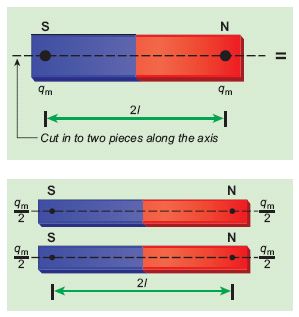
When the bar magnet is cut along the axis into two pieces, new magnetic pole strength is \({ q }_{ m }^{ ' }=\frac { { q }_{ m } }{ 2 } \) but magnetic length does not change. So, the magnetic moment is
\({ p }_{ m }^{ ' }={ q' }_{ m }2l\)
\({ p }_{ m }^{ ' }=\frac { { q }_{ m } }{ 2 } 2l=\frac { 1 }{ 2 } ({ q }_{ m }2l)=\frac { 1 }{ 2 }p_ m\)
In vector notation, \(\vec{p}'_m=\frac{1}{2}\vec{p}_m\)
(b) a bar magnet cut into two pieces perpendicular to the axis:
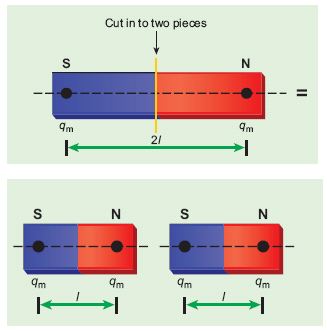
When the bar magnet is cut perpendicular to the axis into two pieces, magnetic pole strength will not change but magnetic length will be halved. So the magnetic moment is
\({ p }_{ m }^{ ' }={ q }_{ m }\times \frac { 1 }{ 2 } (2l)=\frac { 1 }{ 2 } ({ q }_{ m }.2l)=\frac { 1 }{ 2 } { p }_{ m }\)
In vector notation, \(\vec{p}'_m=\frac{1}{2}\vec{p}_m\)
9.
Magnetic moment μ = 0.6 J/T
Angle of inclination with magnetic field θ = 30°
Torque acts on bar magnet ፒ = 0.051 J
Magnitude of magnetic field B = ?
ፒ = \(\vec { \mu } \times \vec { B } \) = μB sinθ
B = \(\frac { \tau }{ \mu sin\theta } =\frac { 0.051 }{ 0.6\times sin{ 30 }^{ 0 } } \)
= \(\frac { 0.051 }{ 0.6\times \frac { 1 }{ 2 } } =\frac { 2\times 0.051 }{ 0.6 } =\frac { 0.102 }{ 0.6 } \)
B = 0.17T
(ii) The position of maximum energy corresponds to a position of stable equilibrium.
The energy (v) = -mB cosθ
when θ = 0°, v = -μB = minimum energy Hence when the bar magnet is placed parallel to the magnetic field, it is the state of stable equilibrium.
10.
Principle : When a current carrying loop is placed in a uniform magnetic field it experiences a torque.
Construction : A moving coil galvanometer consists of a rectangular coil PQRS of insulated thin copper wire. The coil contains a large number of turns wound over a light metallic frame. A cylindrical soft-iron core is placed symmetrically inside the coil as shown in Figure. The rectangular coil is suspended freely between two pole pieces of a horse-shoe magnet.
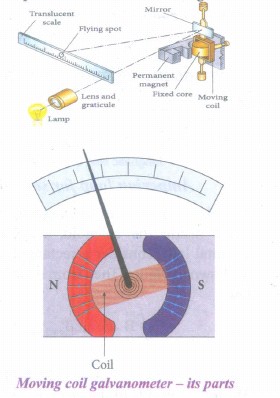
The upper end of the rectangular coil is attached to one end of fine strip of phosphor bronze and the lower end of the coil is connected to a hair spring which is also made up of phosphor bronze. In a fine suspension strip, a small plane mirror is attached in order to measure the deflection of the coil with the help of lamp and scale arrangement. The other end of the mirror is connected to a torsion head. In order to pass electric current through the galvanometer, the suspension strip and the spring S are connected to terminals.
Working : Consider a single turn of the rectangular coil PQRS whose length be l and breadth b. PQ = RS = l and QR = SP = b.
Let I be the electric current flowing through the rectangular coil PQRS as shown in Figure. The horse-shoe magnet has hemi - spherical magnetic poles which produces a radial magnetic field. Due to this radial field, the sides QR and SP are always parallel to the magnetic field B and experience no force. The sides PQ and RS are always parallel to the magnetic field and experience force in opposite directions. Due to this, torque is produced.
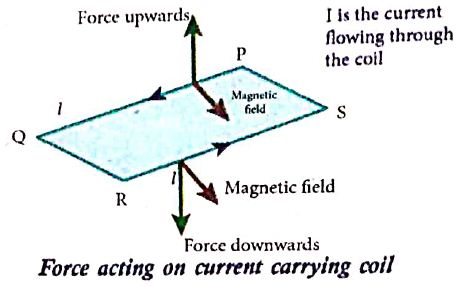
For single turn, the deflection torque is,
て = bF = bBIl = (lb)BI
て = ABI
since, area of the coil A = lb
For coil with N turns, we get
て = NABI ........(1)
Due to this deflecting torque, the coil gets twisted and restoring torque (also known as restoring couple) is developed. Hence the moment of restoring couple is proportional to the amount of twist θ. Thus
て = Kθ ............(2)
where K is the restoring couple per unit twist or torsional constant of the spring.
At equilibrium, the deflection couple is equal to the restoring couple. Therefore by comparing equations (1) and (2), we get,
NABI = Kθ
⇒ I =\(\frac { K }{ NAB } \) θ ...........(3)
(or) I = Gθ
where G = \(\frac { K }{ NAB } \) is called galvanometer constant or current reduction factor of the galvanometer.
Since, suspended moving coil galvanometer is very sensitive, we have to handle with high care while doing experiments. Most of the galvanometer we use are pointer type moving coil galvanometer.
11.
In a right angle triangle OPN let the angle \(\angle\)OPN = \(\theta \)1 which implies, \({ \varphi }_{ 1 }=\frac { \pi }{ 2 } -{ \theta }_{ 1 }\) and also in a right angle triangle OPM,
\(\angle\)OPN = \(\theta \)2 which implies, \({ \varphi }_{ 2 }=\frac { \pi }{ 2 } +{ \theta }_{ 2 }\)
Hence,
\(\overset { \rightarrow }{ B } =\frac { { \mu }_{ ° }I }{ 4\pi a } \left( cos\left( \frac { \pi }{ 2 } -{ \theta }_{ 1 } \right) -cos\left( \frac { \pi }{ 2 } +{ \theta }_{ 2 } \right) \right) \hat { n } \)
\(=\frac { { \mu }_{ ° }I }{ 4\pi a } (si{ n }_{ 1 }+{ sin }_{ 2 })\hat { n } \)
12.
(b)
magnetic field
13.
(d)
S
14.
(b)
\(7\mu T\)
15.
Dipole moment, \(\vec{p}_m=n\times I\times\vec{A}\)
\(\vec{p}_m\) = 50 x 3 x 3.14 x 25 x 10-4 ≈ 1.2 A m2
16.
Magnetic filed at the centre of a circular
loop, B = \(\frac{μ_oI}{2\pi R}\)
From the figure, R =\(\frac{2r}{\pi}\)
\(\therefore B'=\frac{μ_oI}{2\pi \times\frac{2r}{\pi}}=\frac{μ_oI}{4r}\)
\(B'=\frac { { \mu }_{ ° }I }{ 4r } \bigotimes \)
17.
To find the polarity of the solenoid
18.
Applied for circular coil carrying current
19.
Steel, Alnico
20.
Fe, Ni, Co etc.,
21.
Bi, Sb, Cu
22.
Right-hand thumb rule is used :
This rule is used to determine the direction of the magnetic field. If we rotate aright-handed screw using a screwdriver, then the direction of current is the same as the direction in which the screw advances and the direction of rotation of the screw gives the direction of the magnetic field.
23.
When an electric charge q is moving with velocity \(\vec { v } \) in the magnetic field \(\vec { B } \), it experiences a force, called magnetic force \(\vec { { F }_{ m } } \). After careful experiments, Lorentz deduced the force experienced by a moving charge in the magnetic field \(\vec { { F }_{ m } } \).
\(\vec { { F }_{ m } } =q(\vec { v } \times \vec { B } )\) ...........(1)
In magnitude, Fm = qvB sinθ .......(2)
The equations (1) and equation (2) imply
(i) \(\vec { { F }_{ m } } \) is directly proportional to the magnetic field \(\vec { B } \).
(ii) \(\vec { { F }_{ m } } \) is directly proportional to the velocity \(\vec { v } \).
(iii) \(\vec { { F }_{ m } } \) is directly proportional to sine of the angle between the velocity and magnetic field.
(iv) \(\vec { { F }_{ m } } \) is directly proportional to the magnitude of the charge q.
(v) The-direction of \(\vec { { F }_{ m } } \) is always perpendicular to \(\vec { v } \) and B as \(\vec { { F }_{ m } } \) in the cross product of \(\vec { v } \) and \(\vec { B } \).
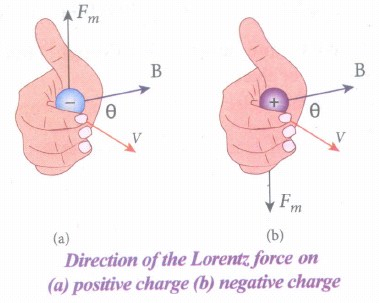
(vi) The direction of \(\vec { { F }_{ m } } \) on a negative charge is opposite to the direction of \(\vec { { F }_{ m } } \) on positive charge provided other factors are identified as shown in Figure.
(vii) If the velocity \(\vec { v } \) of the charge, q is along the magnetic field \(\vec { B } \) then, \(\vec { { F }_{ m } } \) is zero.

12th Standard Syllabus & Materials
12th Standard
TN 12th Computer Applications களப்பெயர் முறைமை (DNS) Sample Question Papers Study Material - QB365 Set A
NEW12th Standard
TN 12th Computer Applications வலையமைப்பு எடுத்துக்காட்டுகள் மற்றும் நெறிமுறைகள் Sample Question Papers Study Material - QB365 Set A
NEW12th Standard
TN 12th Computer Applications கணினி வலையமைப்பு ஓர் அறிமுகம் Sample Question Papers Study Material - QB365 Set A
NEW12th Standard
TN 12th Computer Applications PHP-உடன் MySQL-ஐ இணைத்தல் Sample Question Papers Study Material - QB365 Set A



Tamilnadu Stateboard 12th Standard Subjects

Maths

Chemistry
Physics

Biology

Computer Science

Business Maths and Statistics

Economics

Commerce

Accountancy

History

Computer Applications
Biology
Computer Technology
Computer Applications
Computer Science
Business Maths and Statistics
Commerce
Economics
Maths
Chemistry
Physics
Computer Technology
History
Accountancy

Tamil

English

French
Tamilnadu Stateboard Standards

