
 100% FREE ACCESS
12th Standard Syllabus & Materials
12th Standard
TN 12th Computer Applications மின்னணு தரவு பரிமாற்றம் Sample Question Papers Study Material - QB365 Set A
NEW12th Standard
TN 12th Computer Applications மின் - வணிக பாதுகாப்பு அமைப்புகள் Sample Question Papers Study Material - QB365 Set A
NEW12th Standard
TN 12th Computer Applications மின்னணு செலுத்தல் முறைகள் Sample Question Papers Study Material - QB365 Set A
NEW12th Standard
TN 12th Computer Applications மின் - வணிகம் Sample Question Papers Study Material - QB365 Set A
NEW12th Standard
TN 12th Computer Applications திறந்த மூல கருத்துருக்கள் Sample Question Papers Study Material - QB365 Set A
NEW12th Standard
TN 12th Computer Applications வலையமைப்பு வடமிடல் Sample Question Papers Study Material - QB365 Set A

Published on: 30/10/2019
Communication Systems
Download Tamil Nadu 12th Standard Physics question papers, model tests, one-mark questions, important questions, and public exam papers in PDF format. Free study materials and answer keys for TN State Board students.
Questions + Answers key
Take MCQ Physics Test1.
The frequency range of 3 MHz to 30 MHz is used for ______.
Ground wave propagation
Space wave propagation
Sky wave propagation
Satellite communication
2.
The internationally accepted frequency deviation for the purpose of FM broadcasts ____________.
75 kHz
68 kHz
80 kHz
70 kHz
3.
The variation of frequency of carrier wave with respect to the amplitude of the modulating signal is called ______.
Amplitude modulation
Frequency modulation
Phase modulation
Pulse width modulation
4.
The signal is aff ected by noise in a communication system _____________.
At the transmitter
At the modulator
In the channel
At the receiver
5.
The output transducer of the communication system converts the radio signal into ________.
Sound
Mechanical energy
Kinetic energy
None of the above
6.
What does RADAR stand for?
7.
Explain centre frequency or resting frequency in frequency modulation.
8.
Give the factors that are responsible for transmission impairments.
9.
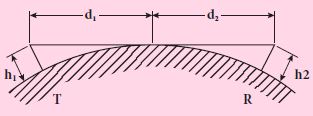
A transmitting antenna has a height of 40 m and the height of the receiving antenna is 30 m. What is the maximum distance between them for line-of-sight communication? The radius of the earth is 6.4 × 10⁶ m.
10.
What do you mean by Internet of Things?
11.
Distinguish between wireline and wireless communication? Specify the range of electromagnetic waves in which it is used.
12.
Fiber optic communication is gaining popularity among the various transmission media -justify.
13.
What do you know about GPS? Write a few applications of GPS.
14.
Explain the ground wave propagation and space wave propagation of electromagnetic waves through space.
15.
Explain the basic elements of communication system with the necessary block diagram.
1.
Ground wave propagation: frequency less than 2 MHz
Sky wave propagation: 3 to 30 MHz
Space wave propagation: Above 30 MHz to 400 GHz
Satellite communication: uplink communication 6 GHz band downlink communication 4 GHz band
2.
(a)
75 kHz
3.
(b)
Frequency modulation
4.
(c)
In the channel
5.
(a)
Sound
6.
RADAR stands for RAdio Detection And Ranging.
7.
When the frequency of the baseband signal is zero (no input signal), there is no change in the frequency of the carrier wave. It is at its normal frequency. This is called centre frequency or resting frequency.
8.
i) Noise : Interference of undesirable electrical signal with the transmitted signal.
ii) Attenuation: Loss of strength of a signal.
iii) Medium : It makes some distortion tothe signal.
9.
The total distance d between the transmitting and receiving antennas will be the sum of the individual distances of coverage.
d = d1 + d2
\(=\sqrt { 2R{ h }_{ 1 } } +\sqrt { 2{ Rh }_{ 2 } } \)
\(=\sqrt { 2R } \left( \sqrt { { h }_{ 1 } } +\sqrt { { h }_{ 2 } } \right) \)
\(=\sqrt { 2\times 6.4\times { 10 }^{ 6 } } \times (\sqrt { 40 } +\sqrt { 30 } )\)
\(=16\times { 10 }^{ 2 }\sqrt { 5 } \times (6.32+5.48)\)
= 42217 m = 42.217 km
10.
i) Internet is a fast-growing technology in the field of a communication system with multifaceted tools.
ii) It provides new ways and means to interact and connect with people.
iii) Internet is the largest computer network recognized globally that connects millions of people through computers.
iv) It finds extensive applications in all walks of life.
11.
| Wireline | Wireless |
|---|---|
| Wireline communication (point-point communication) uses mediums like wires, cables, and optical fibers. | Wireless communication uses free space as a communication medium. |
| These systems cannot be used for long-distance transmission they are connected physically. | The signals are transmitted in the form of electromagnetic waves with the help of a transmitting antenna Hence wireless communication is used for long-distance transmission |
| Examples are telephone, intercom, and cable TV. | Examples are mobile, radio or TV broadcasting, and satellite communication. |
| Wireline up to 100 meters | Wireless up to several thousand kilometers |
It is the maximum distance between the source and the destination up to which the signal is received with sufficient strength.
12.
Fiber optic communication:
(i) The method of transmitting information from one place to another in terms of light pulses through an optical fiber is called fiber optic communication. It works on the principle of total internal reflection.
Applications:
(ii) Optical fiber system has a number of applications namely, international communication, inter-city communication, data links, plant and traffic control and defense applications.
(iii) Fiber cables are very thin and weigh lesser than copper cables.
(iv) This system has much larger band width. This means that its information carrying capacity is larger.
(v) Fiber optic system is immune to electrical interferences.
(vi) Fiber optic cables are cheaper than copper cables.
13.
(i) GPS stands for Global Positioning System. It is a global navigation satellite system that offers geolocation and time information to a GPS receiver anywhere on or near the Earth.
(ii) GPS system works the assistance of a satellite network.
(iii) Each of these satellites broadcasts a precise, signal and these signals convey the location data are received by a low-cost aerial which is then translated by the GPS software.
(iv) The software is able to recognize the satellite, its location, and the time taken by the signals to travel from each satellite.
(v) The software then processes the data it accepts from each satellite to estimate the location of the receiver.
Applications:
Global positioning system is highly useful in many fields such as fleet vehicle management (for tracking cars trucks and buses), wildlife management (for counting of wild animals), and engineering (for making tunnels, brides, etc).
14.
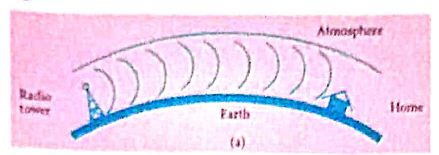
a) Ground wave propagation:
i) If the electromagnetic waves transmitted by the transmitter glide over the surface of the Earth to reach the receiver, then the propagation is called ground wave propagation.
ii) The corresponding waves are called ground waves or surface waves.
iii) Both transmitting and receiving antennas must be close to the Earth's surface.
iv) It is used in local broadcasting, radio navigation, for ship-to-ship, ship-to-shore communication and mobile communication.
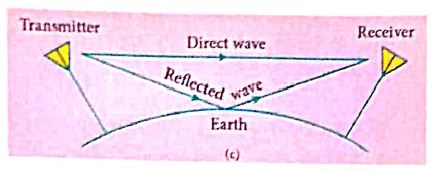
b) Space wave propagation:
i) The process of sending and receiving information signal through space is called space wave communication.
ii) The frequency range for this mode of propagation is above 30 MHz to 400 GHz.
iii) These waves travel in a straight line from the transmitter to the receiver. Hence, it is used for a line of sight (LOS) communication.
iv) Television telecast, satellite communication and RADAR type of communication are based on space wave propagation
v) Range or distance (d) of coverage of propagation depends on height (h) of the antenna given by the equation d = \(\sqrt{2hR}\) where R is radius of the earth, which is R = 6400 km.
15.
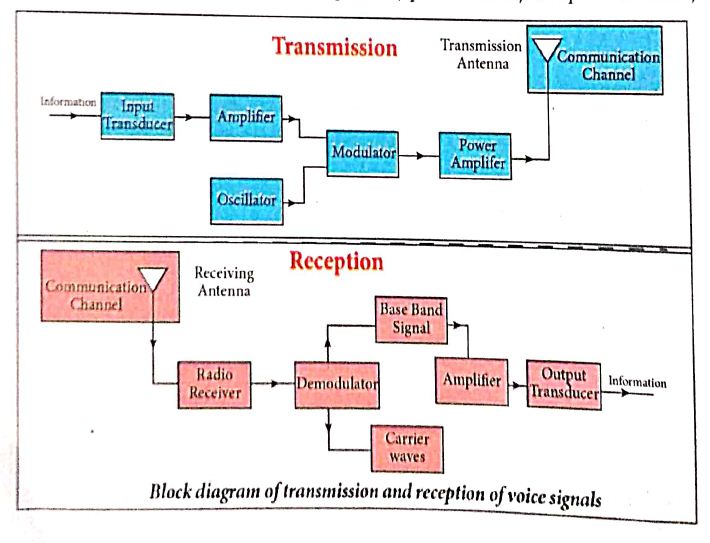
a) Information (Baseband or input signal):
i) Information can be in the form of a sound signal like speech, music, pictures, or computer data which is given as input to the input transducer.
b) Input transducer:
i) It converts the information which is in the form of sound, music, pictures or computer data into corresponding electrical signals.
ii) The electrical equivalent of the original information is called the baseband signal.
iii) The best example is the microphone that converts sound energy into electrical energy.
c) Transmitter
i) It feeds the electrical signal from the transducer to the communication channel
ii) It consists of circuits such as amplifier, oscillator, modulator, and power amplifier.
iii) Amplifier: The transducer output is very weak and is amplified by the amplifier.
iv) Oscillator: It generates high-frequency carrier wave (a sinusoidal wave) for long distance transmission into space. As the energy of a wave is proportional to its frequency, the carrier wave has very high energy.
v) Modulator: It superimposes the baseband signal onto the carrier signal and generates the modulated signal.
vi) Power amplifier: It increases the power level of the electrical signal in order to cover a large distance.
d) Transmitting antenna:
i) It radiates the radio signal into space in all directions.
ii) It travels in the form of electromagnetic waves with the speed of light.
e) Communication channel:
Communication channel is used to carry the electrical signal from transmitter to receiver with less noise or distortion.
Example: Wires, cables, optical fibres in wireline communication and free space in wireless communication.
f) Receiver:
i) The signals that are transmitted through the communication medium are received with the help of a receiving antenna and are fed into the receiver.
ii) The receiver consists of electronic circuits like demodulator, amplifier, detector etc. The demodulator extracts the baseband signal from the carrier signal.
iii) Then the baseband signal is detected and amplified using amplifiers.
iv) Finally, it is fed to the output transducer.
g) Repeaters:
i) Repeaters are used to increase the range or distance through which the signals are sent.
ii) It is a combination of transmitter and receiver.
iii) The signals are received, amplified, and retransmitted with a carrier signal of different frequency to the destination.
iv) The best example is the communication satellite in space
h) Output transducer:
i) It converts the electrical signal back to its original form such as sound, music, pictures or data.
ii) Examples of output transducers are loudspeakers, picture tubes, computer monitor, etc

12th Standard Syllabus & Materials
12th Standard
TN 12th Computer Applications களப்பெயர் முறைமை (DNS) Sample Question Papers Study Material - QB365 Set A
NEW12th Standard
TN 12th Computer Applications வலையமைப்பு எடுத்துக்காட்டுகள் மற்றும் நெறிமுறைகள் Sample Question Papers Study Material - QB365 Set A
NEW12th Standard
TN 12th Computer Applications கணினி வலையமைப்பு ஓர் அறிமுகம் Sample Question Papers Study Material - QB365 Set A
NEW12th Standard
TN 12th Computer Applications PHP-உடன் MySQL-ஐ இணைத்தல் Sample Question Papers Study Material - QB365 Set A



Tamilnadu Stateboard 12th Standard Subjects

Maths

Chemistry
Physics

Biology

Computer Science

Business Maths and Statistics

Economics

Commerce

Accountancy

History

Computer Applications
Biology
Computer Technology
Computer Applications
Computer Science
Business Maths and Statistics
Commerce
Economics
Maths
Chemistry
Physics
Computer Technology
History
Accountancy

Tamil

English

French
Tamilnadu Stateboard Standards

