
 100% FREE ACCESS
12th Standard Syllabus & Materials
12th Standard
TN 12th Computer Applications மின்னணு தரவு பரிமாற்றம் Sample Question Papers Study Material - QB365 Set A
NEW12th Standard
TN 12th Computer Applications மின் - வணிக பாதுகாப்பு அமைப்புகள் Sample Question Papers Study Material - QB365 Set A
NEW12th Standard
TN 12th Computer Applications மின்னணு செலுத்தல் முறைகள் Sample Question Papers Study Material - QB365 Set A
NEW12th Standard
TN 12th Computer Applications மின் - வணிகம் Sample Question Papers Study Material - QB365 Set A
NEW12th Standard
TN 12th Computer Applications திறந்த மூல கருத்துருக்கள் Sample Question Papers Study Material - QB365 Set A
NEW12th Standard
TN 12th Computer Applications வலையமைப்பு வடமிடல் Sample Question Papers Study Material - QB365 Set A

Published on: 30/09/2019
Electromagnetic Induction and Alternating Current
Download Tamil Nadu 12th Standard Physics question papers, model tests, one-mark questions, important questions, and public exam papers in PDF format. Free study materials and answer keys for TN State Board students.
Questions + Answers key
Take MCQ Physics Test1.
The current flowing in the first coil changes from 2 A to 10 A in 0.4 s. Find the mutual inductance between two coils if an emf of 60 mV is induced in the second coil. Also determine the magnitude of induced emf in the second coil if the current in the first coil is changed from 4 A to 16 A in 0.03 s. Consider only the magnitude of induced emf.
2.
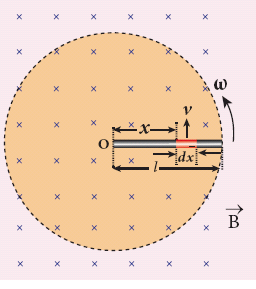
A copper rod of length l rotates about one of its ends with an angular velocity ω in a magnetic field B as shown in the figure. The plane of rotation is perpendicular to the field. Find the emf induced between the two ends of the rod.
3.
A straight conducting wire is dropped horizontally from a certain height with its length along east-west direction. Will an emf be induced in it? Justify your answer.
4.
A closed coil of 40 turns and of area 200 cm2, is rotated in a magnetic field of flux density 2 Wb m–2. It rotates from a position where its plane makes an angle of 30o with the field to a position perpendicular to the field in a time 0.2 s. Find the magnitude of the emf induced in the coil due to its rotation.
5.
A cylindrical bar magnet is kept along the axis of a circular solenoid. If the magnet is rotated about its axis, find out whether an electric current is induced in the coil.
6.
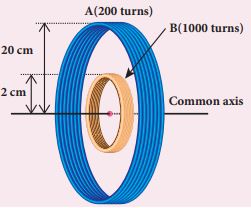
Consider two coplanar, co-axial circular coils A and B as shown in figure. The radius of coil A is 20 cm while that of coil B is 2 cm. The number of turns in coils A and B are 200 and 1000 respectively. Calculate the mutual inductance between the coils. If the current in coil A changes from 2 A to 6 A in 0.04 s, determine the induced emf in coil B and the rate of change of flux through the coil B at that instant.
7.
A conducting rod of length 0.5 m falls freely from the top of a building of height 7.2 m at a place in Chennai where the horizontal component of Earth’s magnetic field is 4.04 × 10⁻⁵ T. If the length of the rod is perpendicular to Earth’s horizontal magnetic field, find the emf induced across the conductor when the rod is about to touch the ground. (Assume that the rod falls down with constant acceleration of 10 m s–2)
8.
Elaborate the standard construction details of AC generator.
9.
Give the uses of Foucault current.
10.
Using Faraday’s law of electromagnetic induction, derive an equation for motional emf.
1.
Case (i):
di1 = 10 – 2 = 8 A; dt = 0.4 s;
ε2 = 60 x 10-3V
Case(ii):
di1 = 16 – 4 = 12 A; dt = 0.03 s
(i) Mutual inductance between the coils.
\({ M }=\frac { { \epsilon }_{ 2 } }{ \frac { { di }_{ 1 } }{ dt } } \)
\(=\frac { 60\times { 10 }^{ -3 }\times 0.4 }{ 8 } \)
\({ M }=3\times { 10 }^{ -3 }H\)
(ii) Induced emf in the second coil due to the rate of change of current in the first coil is
\({ \epsilon }_{ 2 }={ M }=\frac { { di }_{ 1 } }{ dt } \)
\(=\frac { 3\times { 10 }^{ -3 }\times 12 }{ 0.03 } \)
ε2 = 1.2V
2.
Consider a small element of length dx at a distance x from the centre of the circle described by the rod. As this element moves perpendicular to the field with a linear velocity v = xω, the emf developed in the element dx is dε = Bvdx = B(xω)dx
This rod is made up of many such elements, moving perpendicular to the field. The emf developed across two ends is
\(\epsilon =\int { d\epsilon } =\int _{ 0 }^{ l }{ B\omega xdx } =B\omega { { \left[ \frac { { x }^{ 2 } }{ 2 } \right] } }_{ 0 }^{ l }\)
\(\epsilon =\frac { 1 }{ 2 } B\omega { l }^{ 2 }\)
3.
Yes! An emf will be induced in the wire because it moves perpendicular to the horizontal component of Earth’s magnetic field and hence it cuts the magnetic lines of Earth's magnetic field.
4.
N = 40 turns; B = 2 Wb m-2
A = 200 cm2 = 200 x 10-4 m2;
Initial flux, \(\Phi_i\) = BA cos\(\theta\)
= 2 x 200 x 10-4 x cos60o
since θ = 90°− 30°= 60°
\(\Phi_i\)= 2 x 10⁻² Wb
Final flux, \(\Phi_f\) = BA cos\(\theta\)
= 2 x 200 x 10-4 x cos0o since \(\theta\) = 0o
\(\Phi_f\) = 4 x 10⁻²Wb
Magnitude of the induced emf is
\(ε =N\frac { d{ \Phi }_{ B } }{ dt } \)
\(=\frac { 40\times (4\times { 10 }^{ -2 }-2\times { 10 }^{ -2 }) }{ 0.2 } =4V\)
5.
The magnetic field of a cylindrical magnet is symmetrical about its axis. As the magnet is rotated along the axis of the solenoid, there is no induced current in the solenoid because the flux linked with the solenoid does not change due to the rotation of the magnet.
6.
NA = 200 turns; NB = 1000 turns;
rA = 20 x 10-2 m; rB = 2 x 10⁻² m;
dt = 0.04 s; diA = 6−2 = 4A
Let iA be the current flowing in coil A, then the magnetic field BA at the centre of the circular coil A is
\({ B }_{ A }=\frac { { \mu }_{ o }{ N }_{ A }{ i }_{ A } }{ { 2r }_{ A } } =\frac { 4\pi \times { 10 }^{ -7 }{ N }_{ A }{ i }_{ A } }{ { 2r }_{ A } } \)
\(=\frac { { 10 }^{ -7 }\times 2\times 3.14\times 200 }{ 20\times { 10 }^{ -2 } } \times { i }_{ A }\)
= 6.28 x 10⁻⁴iA Wbm-2
The magnetic flux linkage of coil B is
\({ N }_{ B }{ \Phi }_{ B }={ N }_{ B }{ B }_{ A }{ A }_{ B }\)
= 1000 x 6.28 x 10-4 x iA x 3.14 x (2 x 10-2)2
= 7.89 x 10⁻⁴iAWb turns
The mutual inductance between the coils
\(\\ { M }=\frac { { N }_{ B }{ \Phi }_{ B } }{ { i }_{ A } } =7.89\times { 10 }^{ -4 }H\)
Induced emf in coil B is
εB = - M\(\frac { { di }_{ A } }{ dt } \)
εB = \(\frac { 7.89\times { 10 }^{ -4 }\times (6-2) }{ 0.04 } \)(magnitude only)
εB = 78.9mV
The rate of change of magnetic flux of coil B is
\(\frac { d\left( { N }_{ B }{ \Phi }_{ B } \right) }{ dt } ={ \epsilon }_{ B }=78.9m{ Wbs }^{ -1 }\)
7.
l = 0.5 m; h = 7.2 m; u = 0 m s–1;
g = 10 m s–2; BH = 4.04 x 10⁻⁵ T
The final velocity of the rod is
V2 = u2 = + 2g h = 0 + (2 x 10 x 7.2) =144
v = 12 ms-1
The magnitude of the induced emf when the rod is about to touch the ground is
ε = BH lv = 4.04 × 10–5 × 0.5 × 12
= 242.4 µV
8.
Construction:
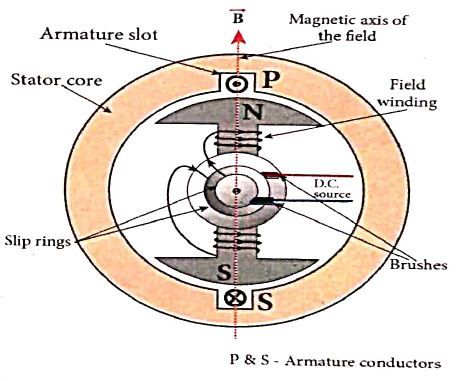
Alternator consists of two major parts, namely stator and rotor. As their names suggest, stator is stationary while rotor rotates inside the stator. In any standard construction of commercial alternators, the armature winding is mounted on stator and the field magnet on rotor.
The construction details of stator, rotor and various other components involved in them are given below.
(a) Stator:
The stationary part which has armature windings mounted in it is called stator. It has two components, namely stator frame, stator core and armature winding.
Stator core:
Stator core or armature core is made up of iron or steel alloy. It is a hollow cylinder and is laminated to minimize eddy current loss. The slots are cut on inner surface of the core to accommodate armature windings.
Armature winding:
Armature winding is the coil, wound on slots provided in the armature core.
(b) Rotor
Rotor contains magnetic field windings. The magnetic poles are magnetized by DC source. The ends of field windings are connected to a pair of slip rings, attached to a common shaft about which rotor rotates. Slip rings rotate along with rotor. To maintain connection between the DC source and field windings, two brushes are used which continuously slide over the slip rings.
9.
(a) Induction stove
(i) Induction stove is used to cook the food quickly and safely with less energy consumption. Below the cooking zone, there is a tightly wound coil of insulated wire.
(ii) The cooking pan made of suitable material, is placed over the cooking zone. When the stove is switched on, an alternating current flowing in the coil produces high frequency alternating magnetic field which induces very strong eddy currents in the cooking pan.
(iii) The eddy currents in the pan produce so much of heat due to Joule heating which is used to cook the food.
(b) Eddy current brake
(i) This eddy current braking system is generally used in high speed trains and roller coasters. Strong electromagnets are fixed just above the rails.
(ii) To stop the train, electromagnets are switched on. The magnetic field of these magnets induces eddy currents in the rails which oppose or resist the movement of the train. This is Eddy current linear brake.
(c) Eddy current testing
(i) It is one of the simple non-destructive testing methods to find defects like surface cracks, air bubbles present in a specimen.
(ii) A coil of insulated wire is given an alternating electric current, so that it produces an alternating magnetic field.
(iii) When this coil is brought near the test surface, eddy current is induced in the test surface.
(iv) The presence of defects causes the change in phase and amplitude of the eddy current that can be detected by some other means. In this way, the defects present in the specimen are identified.
(d) Electro magnetic damping:
(i) The armature of the galvanometer coil is wound on a soft iron cylinder.
(ii) Once the armature is deflected, the relative motion between the soft iron cylinder and the radial magnetic field induces eddy current in the cylinder.
(iii) The damping force due to the flow of eddy current brings the armature to rest immediately and then galvanometer shows a steady deflection. This is called electromagnetic damping.
10.
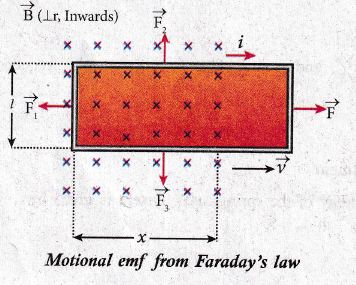
(i) Consider a rectangular conducting loop of width 1 in a uniform magnetic field \(\vec { B } \) which is perpendicular to the plane of the loop and is directed inwards.
(ii) A part of the loop is in the magnetic field while the remaining part is outside the loop as shown in Figure.
(iii) When the loop is pulled with a constant velocity \(\vec { v } \) to the right, the area of the portion of the loop within the magnetic field will decrease.
(iv) Thus, the flux linked with the loop will also decrease. According to Faraday's law, an electric current is induced in the loop which flows in a direction so as to oppose the pull of the loop.
(v) Let x be the length of the loop which is still within the magnetic field, then its area is lx. The magnetic flux linked with the loop is
\({ \phi }_{ B }=\int _{ A }^{ }{ B.d } \vec { A } =BAcos\theta \)
Here θ = 0o and cos 0o = 1
= BA
\({ \phi }_{ B }=Blx\)
(vi) As this magnetic flux decreases due to the movement of the loop, the magnitude of the induced emf is given by
\(\varepsilon =\frac { d{ \Phi }_{ B } }{ dt } =\frac { d }{ dt } (Blx)\)
(vii) Here, both B and 1 are constants. Therefore,
\(\varepsilon =Bl\frac { dx }{ dt } \)
ε = Blv
where \(v=\frac { dx }{ dt } \) is the velocity of the loop. This emf is known as motional emf since it is produced due to the movement of the loop in the magnetic field.

12th Standard Syllabus & Materials
12th Standard
TN 12th Computer Applications களப்பெயர் முறைமை (DNS) Sample Question Papers Study Material - QB365 Set A
NEW12th Standard
TN 12th Computer Applications வலையமைப்பு எடுத்துக்காட்டுகள் மற்றும் நெறிமுறைகள் Sample Question Papers Study Material - QB365 Set A
NEW12th Standard
TN 12th Computer Applications கணினி வலையமைப்பு ஓர் அறிமுகம் Sample Question Papers Study Material - QB365 Set A
NEW12th Standard
TN 12th Computer Applications PHP-உடன் MySQL-ஐ இணைத்தல் Sample Question Papers Study Material - QB365 Set A



Tamilnadu Stateboard 12th Standard Subjects

Maths

Chemistry
Physics

Biology

Computer Science

Business Maths and Statistics

Economics

Commerce

Accountancy

History

Computer Applications
Biology
Computer Technology
Computer Applications
Computer Science
Business Maths and Statistics
Commerce
Economics
Maths
Chemistry
Physics
Computer Technology
History
Accountancy

Tamil

English

French
Tamilnadu Stateboard Standards

