
 100% FREE ACCESS
12th Standard Syllabus & Materials
12th Standard
TN 12th Computer Applications மின்னணு தரவு பரிமாற்றம் Sample Question Papers Study Material - QB365 Set A
NEW12th Standard
TN 12th Computer Applications மின் - வணிக பாதுகாப்பு அமைப்புகள் Sample Question Papers Study Material - QB365 Set A
NEW12th Standard
TN 12th Computer Applications மின்னணு செலுத்தல் முறைகள் Sample Question Papers Study Material - QB365 Set A
NEW12th Standard
TN 12th Computer Applications மின் - வணிகம் Sample Question Papers Study Material - QB365 Set A
NEW12th Standard
TN 12th Computer Applications திறந்த மூல கருத்துருக்கள் Sample Question Papers Study Material - QB365 Set A
NEW12th Standard
TN 12th Computer Applications வலையமைப்பு வடமிடல் Sample Question Papers Study Material - QB365 Set A

Published on: 30/09/2019
Electromagnetic Waves
Download Tamil Nadu 12th Standard Physics question papers, model tests, one-mark questions, important questions, and public exam papers in PDF format. Free study materials and answer keys for TN State Board students.
Questions + Answers key
Take MCQ Physics Test1.
The relative magnetic permeability of the medium is 2.5 and the relative electrical permittivity of the medium is 2.25. Compute the refractive index of the medium.
2.
Explain the types of emission spectrum.
3.
Discuss the source of electromagnetic waves.
4.
5.
Write down Maxwell equations in integral form.
6.
Identify the following Electromagnetic radiations
(a) 109 Hz
(b) 1011 Hz. Give one application of each.
7.
Identify the Electromagnetic waves whose wavelength vary as
(a) 10-12 m to 10-8 m
(b) 10-4 m and write their uses.
8.
A variable frequency ac source is connected to capacitor. How will the displacement current change with decrease in frequency.
9.
Write the production of gamma rays and mention its properties and uses.
10.
Write the frequency source of production and uses of Ultraviolet radiation.
1.
Dielectric constant (relative permittivity of the medium) is εr = 2.25
Magnetic permeability is μr = 2.5
Refractive index of the medium,
n = \(\sqrt { { \varepsilon }_{ r }{ \mu }_{ r } } =\sqrt { 2.25\times 2.5 } \) = 2.37
2.
Emission spectra:
When the spectrum of self luminous source is taken, we get emission spectrum. Each source has its own characteristic emission spectrum. The emission spectrum can be divided into three types:
(i) Continuous emission spectra (or continuous spectra) :
(a) If the light from incandescent lamp (filament bulb) is allowed to pass through prism (simplest spectroscope), it splits into seven colours.
(b) Thus, it consists of wavelengths containing all the visible colours ranging from violet to red (in the figure). Examples: spectrum obtained from carbon arc, incandescent solids.
(ii) Line emission spectrum (or line spectrum) :
(a) Suppose light from hot gas is allowed to pass through a prism, line spectrum is observed. Line spectra are also known as discontinuous spectra. The line spectra consists of sharp lines of definite wavelengths or frequencies.
(b) Such spectra arise due to excited atoms of elements. These lines are the characteristics of the element and are different for different elements. Examples: spectra of atomic hydrogen, helium, etc.
(iii) Band emission spectrum (or band spectrum) :
(a) Band spectrum consists of several number of very closely spaced spectral lines which overlapped together forming specific bands which are separated by dark spaces.
(b) This spectrum has a sharp edge at one end and fades out at the other end. Such spectra arise when the molecules are excited.
(c) Band spectrum is the characteristic of the molecule hence, the structure of the molecules can be studied using their band spectra. Examples, spectra of hydrogen gas, ammonia gas in the discharge tube, etc.
3.
(i) Any stationary source charge produces only electric field. When the charge moves with uniform velocity, it produces steady current which gives rise to magnetic field (not time dependent, only space· dependent) around the conductor in which charge flows.
(ii) If the charged particle accelerates, it produces magnetic field in addition to electric field. Both electric and magnetic fields are time varying fields. Since the electromagnetic waves are transverse waves, the direction of propagation of electromagnetic waves is perpendicular to the plane containing electric and magnetic field vectors.
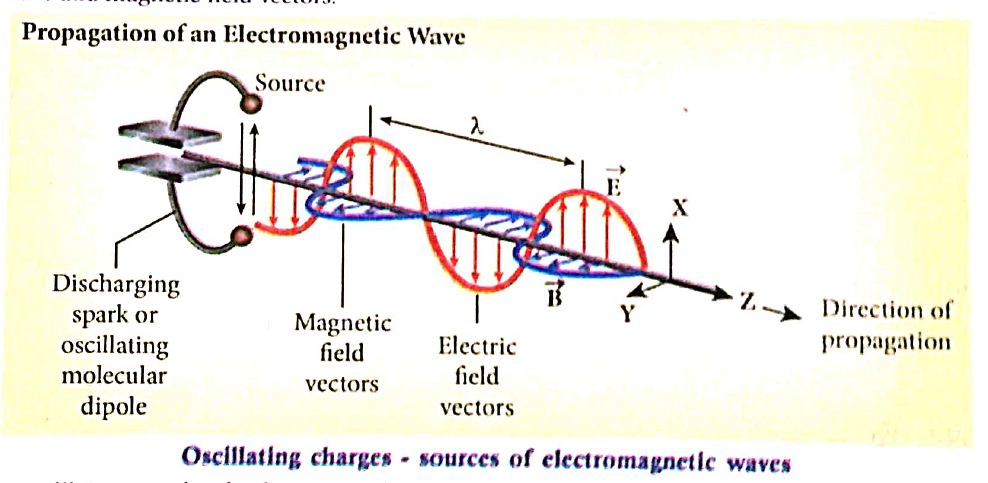
(iii) Any oscillatory motion is also an accelerating motion, so, when the charge oscillates (oscillating molecular dipole) about their mean position as shown in Figure, it produces electromagnetic waves.
(iv) Suppose the electromagnetic field in free space propagates along z-direction, and if the electric field vector points along x-axis then the magnetic field vector will be mutually perpendicular to both electric field and the direction of wave propogation. Thus,
Ex = Eo sin (kz - ωt)
By = Bo sin(Kz - ωt)
Where, Eo and Bo are amplitude of the oscillating electric and magnetic field, k is a wave number, ω is the angular frequency of the wave and \(\hat { k } \) (unit vector, here it is called propagation vector) denotes the direction of propagation of electromagnetic wave.
(vi) Note that both electric field and magnetic field oscillate with a frequency (frequency of electromagnetic wave) which is equal to the frequency of the source (here, oscillating charge is the source for the production of electromagnetic waves). In free space or in vacuum, the ratio between Eo and Bo is equal to the speed of electromagnetic wave, which is equal to speed of light c.
\(c=\frac { { E }_{ 0 } }{ { B }_{ 0 } } \)
In any medium, the ratio of Eo and Bo is equal to the speed of electromagnetic wave in that medium. Thus,
Further, the energy of electromagnetic waves comes from the energy of the oscillating charge.
4.
5.
MaxWell's equations in integral form
i) Gauss law in electricity, \(\oint _s\vec{E} \vec{d} A=\frac{Q_{\text {enclosed }}}{\varepsilon_{o}}\)
ii) Gauss law in magnetism \(\oint _s \vec{B} \cdot \vec{d} A=0\)
iii) Faraday's law \(\oint_l \vec E. \vec {d l}=-\frac{d \phi _B}{d t}\)
iv) Ampere-Maxwell's law \(\oint_l \vec {B}. \vec {d l}=\mu_{o} i_c+\mu_{o} \varepsilon_{o} \frac{d}{d t} \oint_s \vec{E} \cdot {d} \vec A\)
6.
(a) 109 Hz - Radiowaves
Application: For radio & television communication.
(b) 1011 Hz - microwaves
Application: used in Radar for aircraft navigation, (microwave oven for cooking).
7.
(a) X - rays are used as diagnostic tool in medicine. X-rays are used extensively in studying structures of inner atomic electron shells and crystal structures. It is used in detecting fractures, diseased organs, formation of bones and stones, observing the progress of healing bones. Further, in a finished metal product, it is used to detect faults, cracks, flaws and holes.
(b) Radio are produced by oscillators in electric circuits. It obeys reflection and diffraction. It is used in radio and communication system and cellphones.
8.
On decreasing the frequency, reactance \({ X }_{ c }=\frac { 1 }{ \omega C } \) will increase which will lead to decrease in condition current. In this case Id = Ic hence displacement current will decrease.
9.
(i) It is produced by transitions of atomic nuclei and decay of certain elementary particles. They produce chemical reactions on photographic plates, fluorescence, ionization, diffraction.
(ii) Gamma rays provide information about the structure of atomic nuclei. It is used in radiotherapy for the treatment of cancer and tumor, in the food industry to kill pathogenic microorganisms.
10.
It is produced by Sun, arc, and ionized gases. The wavelength range is 6 x 10⁻¹⁰m to 4 x 10⁻⁷m and the frequency range is 5 x 10¹⁷Hz to 7 x 10¹⁴Hz. It has less penetrating power. It can be absorbed by atmospheric ozone and harmful to human body. It is used to destroy bacteria, sterilizing the surgical instruments, burglar alarm, detect the invisible writing, finger prints and also in the study of molecular structure.

12th Standard Syllabus & Materials
12th Standard
TN 12th Computer Applications களப்பெயர் முறைமை (DNS) Sample Question Papers Study Material - QB365 Set A
NEW12th Standard
TN 12th Computer Applications வலையமைப்பு எடுத்துக்காட்டுகள் மற்றும் நெறிமுறைகள் Sample Question Papers Study Material - QB365 Set A
NEW12th Standard
TN 12th Computer Applications கணினி வலையமைப்பு ஓர் அறிமுகம் Sample Question Papers Study Material - QB365 Set A
NEW12th Standard
TN 12th Computer Applications PHP-உடன் MySQL-ஐ இணைத்தல் Sample Question Papers Study Material - QB365 Set A



Tamilnadu Stateboard 12th Standard Subjects

Maths

Chemistry
Physics

Biology

Computer Science

Business Maths and Statistics

Economics

Commerce

Accountancy

History

Computer Applications
Biology
Computer Technology
Computer Applications
Computer Science
Business Maths and Statistics
Commerce
Economics
Maths
Chemistry
Physics
Computer Technology
History
Accountancy

Tamil

English

French
Tamilnadu Stateboard Standards

