
 100% FREE ACCESS
12th Standard Syllabus & Materials
12th Standard
TN 12th Computer Applications மின்னணு தரவு பரிமாற்றம் Sample Question Papers Study Material - QB365 Set A
NEW12th Standard
TN 12th Computer Applications மின் - வணிக பாதுகாப்பு அமைப்புகள் Sample Question Papers Study Material - QB365 Set A
NEW12th Standard
TN 12th Computer Applications மின்னணு செலுத்தல் முறைகள் Sample Question Papers Study Material - QB365 Set A
NEW12th Standard
TN 12th Computer Applications மின் - வணிகம் Sample Question Papers Study Material - QB365 Set A
NEW12th Standard
TN 12th Computer Applications திறந்த மூல கருத்துருக்கள் Sample Question Papers Study Material - QB365 Set A
NEW12th Standard
TN 12th Computer Applications வலையமைப்பு வடமிடல் Sample Question Papers Study Material - QB365 Set A

Published on: 13/10/2020
12th Standard Physics Electrostatics English Medium Free Online Test One Mark questions with Answer Key 2020 - 2021
Download Tamil Nadu 12th Standard Physics question papers, model tests, one-mark questions, important questions, and public exam papers in PDF format. Free study materials and answer keys for TN State Board students.
Questions + Answers key
Take MCQ Physics Test1.
Van de Graaff generator produces an electrostatic potential difference of_______ volts.
108
109
107
1010
2.
A charge q1 exerts force on charge q2. If another charge q3 is brought near, the force of q1, exerted on q2, will be
decreased
increased
remains unchanged
increased if q3 is of same sign as q1 and decreased if q2 is of opposite sign.
3.
A charge q is placed at the centre of a cubical box of side with top open. The flux of electric field through the surface of the cubical box is
Zero
\(\frac { q }{ { \varepsilon }_{ 0 } } \)
\(\frac { q }{ 6{ \varepsilon }_{ 0 } } \)
\(\\ \frac { 5q }{ 6{ \varepsilon }_{ 0 } } \)
4.
During charging a capacitor variation of potential V of the capacitor with time t as shown a
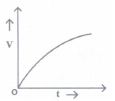
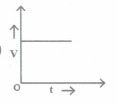
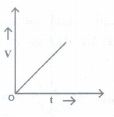
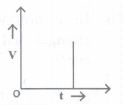
5.
Charge Q is divided into two parts which are then kept some distance apart. The force between them will be maximum if the two parts are
\(\frac{Q}{2} \) each
each \(\frac{Q}{5} \)
\(\frac{Q}{3} \)and\(\frac{2Q}{3} \)
\(\frac{Q}{4} \)and\(\frac{3Q}{4} \)
6.
Which of the following statement on equipotential surface is wrong?
The potential difference between any two points on the surface, is zero.
The electric field is always perpendicular to the surface
Equipotential surface is always spherical.
No work is done in moving a charge along the surface
7.
Dielectric constant for the metals is
Zero
>1
<1
Infinite
8.
The lower comb of van de graaff generator is maintained at a positive potential of
10 kV
107 V
100 V
103 V
9.
A non-conducting material which has no free electrons is called
capacitor
Dielectric
conductor
Inductor
10.
The magnitude of electric dipole moment of water molecule is
6 x 10-30 cm
6.2 x 10⁻³⁰ cm
6.1 x 10⁻³⁰
5.95 10-30 cm
11.
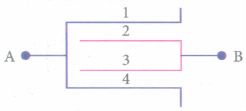
Four plates each of area N and inferplate separation 'd' are placed as shown in figure. The two inner plates are connected to the point 'B' and outer to point 'A'. What is equivalent capacitance?
\(\frac { { \varepsilon }_{ 0 }A }{ d } \\ \)
\(\frac { {2 \varepsilon }_{ 0 }A }{ d } \\ \)
\(\frac { {3 \varepsilon }_{ 0 }A }{ d } \\ \)
\(\frac { {4 \varepsilon }_{ 0 }A }{ d } \\ \)
12.
The electric potential V as a function of distance x (metres) is given by V = ( 5x2 + 10x -9) volt. The value of electric field at a point x = 1m is __________
20 Vm-1
6 Vm-1
11 Vm-1
-23 Vm-1
13.
The force experienced by a unit charge is called ____________
Electric potential
Electric flux
Electric field
Static electricity
14.
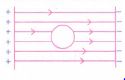
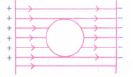
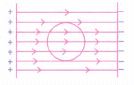
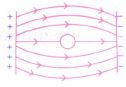
An uncharged metal sphere is placed between two equal and oppositely charged metal plates. The nature of lines of force will be ______________
15.
_______ and Coulomb's law form fundamental principles of electrostatics
Newton's law of gravitation
superposition principle
ohm's law
Kepler's law
16.
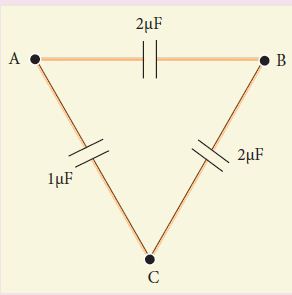
Three capacitors are connected in triangle as shown in the figure. The equivalent capacitance between the points A and C is
1μF
2μF
3μF
\(\frac{1}{4}\)μF
17.
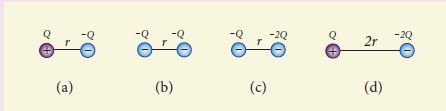
Rank the electrostatic potential energies for the given system of charges in increasing order
1 = 4 < 2 < 3
2 = 4 < 3 < 1
2 = 3 < 1 < 4
3 < 1 < 2 < 4
18.
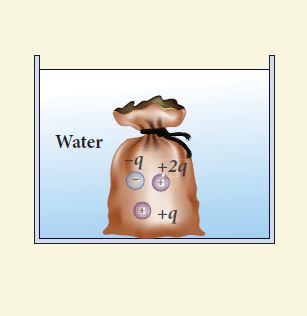
The total electric flux for the following closed surface which is kept inside water
\(\frac { 80q }{ { \varepsilon }_{ 0 } } \)
\(\frac { q }{ { 40\varepsilon }_{ 0 } } \)
\(\frac { q }{ { 80\varepsilon }_{ 0 } } \)
\(\frac { q }{ { 160\varepsilon }_{ 0 } } \)
19.
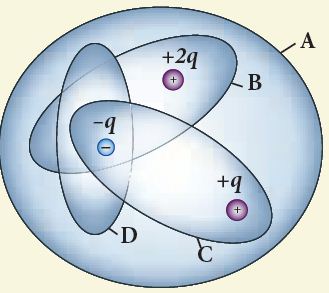
Four Gaussian surfaces are given below with charges inside each Gaussian surface. Rank the electric flux through each Gaussian surface in increasing order.
D < C < B < A
A < B = C < D
C < A = B < D
D > C > B > A
20.
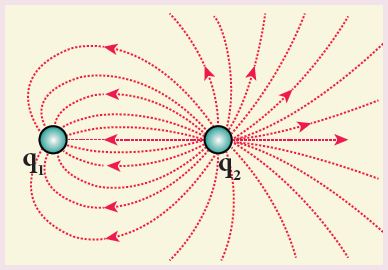
What is the ratio of the charges \(\left| \frac { { q }_{ 1 } }{ { q }_{ 2 } } \right| \) for the following electric field line pattern?
\(\frac { 1 }{ 5 } \)
\(\frac { 25 }{ 11 } \)
5
\(\frac { 11 }{ 25 } \)
1.
(c)
107
2.
(c)
remains unchanged
3.
(d)
\(\\ \frac { 5q }{ 6{ \varepsilon }_{ 0 } } \)
4.
(a)
5.
(a)
\(\frac{Q}{2} \) each
6.
(a)
The potential difference between any two points on the surface, is zero.
7.
(d)
Infinite
8.
(a)
10 kV
9.
(b)
Dielectric
10.
(c)
6.1 x 10⁻³⁰
11.
(b)
\(\frac { {2 \varepsilon }_{ 0 }A }{ d } \\ \)
12.
(a)
20 Vm-1
13.
(c)
Electric field
14.
(b)
15.
(b)
superposition principle
16.
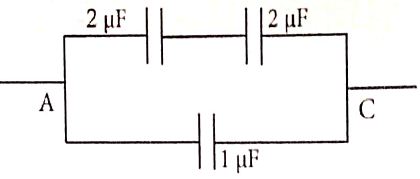
\(\frac{1}{C_s}=\frac{1}{2}+\frac{1}{2}=1 \ μF\)
Cp = 1 + 1 = 2 μF
17.
\(U=\frac{1}{4\piε_0}\frac{q_1q_2}{r_{12}}\)
\(i) U=\frac{1}{4\piε_0}\frac{Q(-Q)}{r}=\frac{1}{4\piε_0}[\frac{-Q^2}{r}]\)
\(ii) U=\frac{1}{4\piε_0}\frac{(-Q)(-Q)}{r}=\frac{1}{4\piε_0}[\frac{Q^2}{r}]\)
\(iii) U=\frac{1}{4\piε_0}\frac{Q(2Q)}{r}=\frac{1}{4\piε_0}[\frac{2Q^2}{r}]\)
\(iv) U=\frac{1}{4\piε_0}\frac{Q(-2Q)}{2r}=\frac{1}{4\piε_0}[\frac{-Q^2}{r}]\)
From the values, 1 = 4 < 2 < 3
18.
\(Φ=\frac { q_{net} }{ { \varepsilon }_{ 0 } } \)
qnet = - q + q + 2q = 2q
Relative permittivity of water = 80
\(\therefore Φ=\frac { q }{{ \varepsilon }_{ r } { \varepsilon }_{ 0 } } \)
\(=\frac{2q}{{ 80 \times \varepsilon }_{ 0 }}=\frac{q}{{ 40 \varepsilon }_{ 0 }}\)
19.
The electric flux of D is less than that of C
The electric flux of C is less than that of B
The electric flux of B is less than that of A
20.
q ∝ Φ
∴ \(\frac {q_1}{q_2} = \frac {Φ_1}{Φ_2}=\frac{11}{25}\)

12th Standard Syllabus & Materials
12th Standard
TN 12th Computer Applications களப்பெயர் முறைமை (DNS) Sample Question Papers Study Material - QB365 Set A
NEW12th Standard
TN 12th Computer Applications வலையமைப்பு எடுத்துக்காட்டுகள் மற்றும் நெறிமுறைகள் Sample Question Papers Study Material - QB365 Set A
NEW12th Standard
TN 12th Computer Applications கணினி வலையமைப்பு ஓர் அறிமுகம் Sample Question Papers Study Material - QB365 Set A
NEW12th Standard
TN 12th Computer Applications PHP-உடன் MySQL-ஐ இணைத்தல் Sample Question Papers Study Material - QB365 Set A



Tamilnadu Stateboard 12th Standard Subjects

Maths

Chemistry
Physics

Biology

Computer Science

Business Maths and Statistics

Economics

Commerce

Accountancy

History

Computer Applications
Biology
Computer Technology
Computer Applications
Computer Science
Business Maths and Statistics
Commerce
Economics
Maths
Chemistry
Physics
Computer Technology
History
Accountancy

Tamil

English

French
Tamilnadu Stateboard Standards

