
 100% FREE ACCESS
12th Standard Syllabus & Materials
12th Standard
TN 12th Maths Applications of Matrices and Determinants Sample Question Papers Study Material - QB365 Set A
NEW12th Standard
TN 12th Computer Applications மின்னணு தரவு பரிமாற்றம் Sample Question Papers Study Material - QB365 Set A
NEW12th Standard
TN 12th Computer Applications மின் - வணிக பாதுகாப்பு அமைப்புகள் Sample Question Papers Study Material - QB365 Set A
NEW12th Standard
TN 12th Computer Applications மின்னணு செலுத்தல் முறைகள் Sample Question Papers Study Material - QB365 Set A
NEW12th Standard
TN 12th Computer Applications மின் - வணிகம் Sample Question Papers Study Material - QB365 Set A
NEW12th Standard
TN 12th Computer Applications திறந்த மூல கருத்துருக்கள் Sample Question Papers Study Material - QB365 Set A

Published on: 18/07/2019
Download Tamil Nadu 12th Standard Physics question papers, model tests, one-mark questions, important questions, and public exam papers in PDF format. Free study materials and answer keys for TN State Board students.
Questions + Answers key
Take MCQ Physics Test1.
What is dielectrics or insulators.
2.
Suppose a charge +q on Earth’s surface and another +q charge is placed on the surface of the Moon.
(a) Calculate the value of q required to balance the gravitational attraction between Earth and Moon.
(b) Suppose the distance between the Moon and Earth is halved, would the charge q change?
(Take mE = 5.9 x 1024 kg, mM = 7.9 x 10²² kg)
3.
Obtain an expression for potential energy due to a collection of three point charges which are separated by finite distances.
4.
Derive an expression for the torque experienced by a dipole due to a uniform electric field.
5.
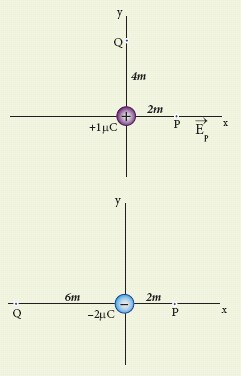
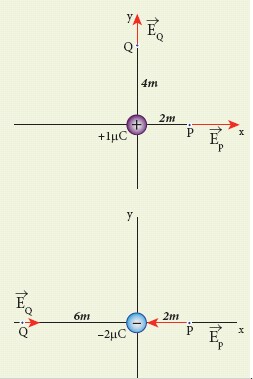
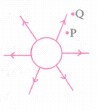
Calculate the electric field at points P, Q for the following two cases, as shown in the figure.
(a) A positive point charge +1 μC is placed at the origin.
(b) A negative point charge -2 μC is placed at the origin.
6.
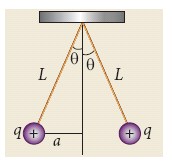
Two small-sized identical equally charged spheres, each having mass 1 g are hanging in equilibrium as shown in the figure. The length of each string is 10 cm and the angle θ is 30° with the vertical. Calculate the magnitude of the charge in each sphere. (Take g = 10 ms−2)
7.
What is the work zone by the field in moving a small positive charge from A to P? Given reason.
8.
(i) Electric field lines donot have sudden breaks why is it so?
(ii) Explain why two field lines never cross each other at any point.
9.
When does a dielectric said to be polarized?
10.
What is corona discharge?
11.
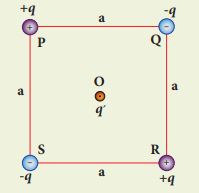
Four charges are arranged at the corners of the square PQRS of side an as shown in the figure.
(a) Find the work required to assemble these charges in the given configuration.
(b) Suppose a charge q is brought to the center of the square, by keeping the four charges fixed at the corners, how much extra work is required for this?
12.
An isolated metal sphere of radius 'r' is given a charge' q'. The potential energy of the sphere is ____________
\(\frac { { q }^{ 2 } }{ 4\pi { \varepsilon }_{ 0 }r } \)
\(\frac { { q }^{ } }{ 4\pi { \varepsilon }_{ 0 }r } \)
\(\frac { { q }^{ } }{ 8\pi { \varepsilon }_{ 0 }r } \)
\(\frac { { q }^{ 2 } }{ 8\pi { \varepsilon }_{ 0 }r } \)
13.
The relative permittivity of water is _______.
εr = 70
εr = 75
εr = 80
εr = 85
14.
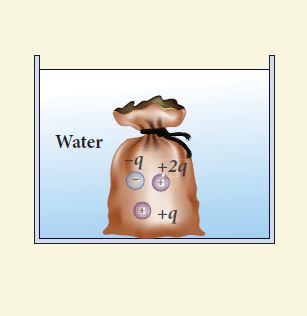
The total electric flux for the following closed surface which is kept inside water
\(\frac { 80q }{ { \varepsilon }_{ 0 } } \)
\(\frac { q }{ { 40\varepsilon }_{ 0 } } \)
\(\frac { q }{ { 80\varepsilon }_{ 0 } } \)
\(\frac { q }{ { 160\varepsilon }_{ 0 } } \)
15.
Two identical point charges of magnitude –q are fixed as shown in the figure below. A third charge +q is placed midway between the two charges at the point P. Suppose this charge +q is displaced a small distance from the point P in the directions indicated by the arrows, in which direction(s) will +q be stable with respect to the displacement?
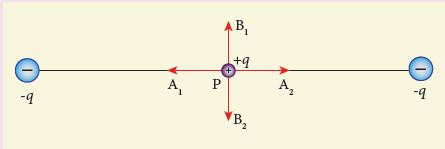
A1 and A2
B1 and B2
both directions
No stable
16.
The dielectric constant of water is 80. What is its permittivity?
17.
What charge would be required to electrify a sphere of radius 25 cm. So as to get a surface charge density of \(\frac{3}{\pi}\) cm-1?
1.
(i) A dielectric is a non-conducting material and has no free electrons. The electrons in a dielectric are bound within the atoms. Ebonite, glass and mica are some examples of dielectrics.
(ii) When an external electric field is applied, the electrons are not free to move anywhere but they are realigned in a specific way. A dielectric is made up of either polar molecules or non-polar molecules.
2.
G = 6.67 x 10⁻¹¹ Nm2kg-2
Mass of Earth mE = 5.9 x 1024 kg
Mass of Moon mm = 7.9 x 10²² kg
Gravitational force \(F_{g}=\frac{G m_{E} \times m_{M}}{r^{2}}\); Electro static force \(F_e=k\frac{q \times q}{r^2}\)
By equating the forces, \( k\frac{q \times q}{r^{2}}=G \cdot \frac{m_{E} \times m_{M}}{r^{2}} \)
\(\because k=\frac{1}{4 \pi \varepsilon_{0}}=9 \times 10^{9} \)
\( 4 \pi \varepsilon_{0} =0.11 \times 10^{-9} \)
\(q =\sqrt{4 \pi \varepsilon_{0} G m_{E} \cdot m_{M}} \) ....(1)
\(=\sqrt{0.11 \times 10^{-9} \times 6.67 \times 10^{-11} \times 5.9 \times 10^{24} \times 7.9 \times 10^{22}}\)
\( q =\sqrt{34.2 \times 10^{26}} \)
q ≈ 5.85 x 10¹³ C
b) Suppose the distance (r) between Moon and Earth is halved, there is no change in the value of charge (q). Because from equation (1), q is independent of distance (r).
3.
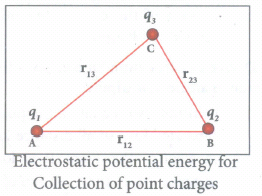
To calculate the total electrostatic potential energy, we use the following procedure. We bring all the charges one by one and arrange them according to the configuration as shown in Figure.
a) Bringing a charge q1 from infinity to the point A requires no work, because there are no other charges already present in the vicinity of charge q1.
b) To bring the second charge q2 to the point B, work must be done against the electric field created by the charge q1. So the work done on the charge q2 is W = q2 V1B. Here V1B is the electrostatic potential due to the charge q1 at point B.
\(U_I=\frac{1}{4\piε_o}\frac{q_1q_2}{r_{12}}\) .....(1)
Note that the expression is same when q2 is brought first and then q1 later.
c) Similarly to bring the charge q3 to the point C, work has to be done against the total electric field due to both the charges q1 and q2. So the work done to bring the charge q3 = q3 (V1C + V2C). Here V1C is the electrostatic potential due to charge q1 at point C and V2C is the electrostatic potential due to charge q2 at point C.
The electrostatic potential is
\(U_{II}=\frac{1}{4\piε_o}(\frac{q_1q_2}{r_{13}}+\frac{q_2q_3}{r_{23}})\) .....(2)
d) Adding equations (1) and (3), the total electrostatic potential energy for the system of three charges q1, q2 and q3 is
U = UI + UII
\(U=\frac{1}{4\piε_o}(\frac{q_1q_2}{r_{12}}+\frac{q_2q_3}{r_{13}}+\frac{q_2q_3}{r_{23}})\) ....(3)
4.
Torque experienced by an electric dipole in the uniform electric field:
Consider an electric dipole of dipole moment \(\vec { p } \) placed in a uniform electric field \(\vec { E } \) whose field lines are equally spaced and point in the same direction. The charge +q will experience a force \(q\vec { E } \) in the direction of the field and charge -q will experience a force \(-q\vec { E } \) in a direction opposite to the field. Since the external field \(\vec { E } \) is uniform, the total force acting on the dipole is zero. These two forces acting at different points will constitute a couple and the dipole experience a torque. This torque tends to rotate the dipole.
The total torque on the dipole about the point O
\(\vec{\tau}=\overrightarrow{O A} \times(-q \vec{E})+\overrightarrow{O B} \times q \vec{E}\) ......(1)
Using right-hand corkscrew rule, it is found that total torque is perpendicular to the plane of the paper and is directed into it.
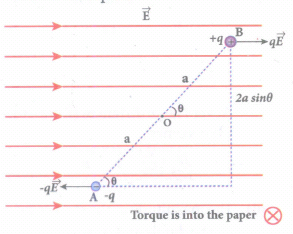
The magnitude of the total torque
\(\tau =|\vec { OA } |\left( -q\vec { E } \right) |sin\theta +|\vec { OB } ||\vec { E } |sin\theta \)
\(\tau =qE.2a\quad sin\theta \) ....(2)
where θ is the angle made by \(\vec { p } \) with \(\vec { E } \) since p = 2aq, the torque is written in terms of the vector product as
\(\vec { \tau } =\vec { p } \times \vec { E } \) ...(3)
The magnitude of this torque is \(\tau \) = pEsin \(\theta \) and is maximum when θ = 90o.
This torque tends to rotate the dipole and align it with the electric field \(\vec{E}\). Once \(\vec{p}\) is aligned with \(\vec{E}\), the total torque on the dipole becomes zero.
5.
Case (a)
The magnitude of the electric field at point P is
Ep = \(\frac { 1 }{ 4\pi \varepsilon _{ 0 } } \frac { q }{ { r }^{ 2 } } =\frac { 9\times { 10 }^{ 9 }\times 1\times 10^{ -6 } }{ 4 } \)
= 2.25 x 10³ NC-1
Since the source charge is positive, the electric field points away from the charge. So the electric field at the point P is given by
\(\bar { { E }_{ p } } \) = 2.25 x 10³ NC-1
For the point Q
\(|\vec { { E }_{ Q } } |=\frac { 9\times 10^{ 9 }\times 1\times { 10 }^{ -6 } }{ 16 } \) = 0.56 x 10³ NC-1
Hence \(\vec { { E }_{ Q } } \) = 0.56 x 10³\(\hat { j } \) NC-1
Case (b)
The magnitude of the electric field at point P
\(\bar { { E }_{ p } } =\frac { kq }{ r^{ 2 } } =\frac { 1 }{ 4\pi { \varepsilon }_{ 0 } } \frac { q }{ { r }^{ 2 } } =\frac { 9\times 10^{ 9 }\times 2\times 10^{ -6 } }{ 4 } \)
= 4.5 x 10³ NC-1
Since the source charge is negative, the electric field points towards the charge. So the electric field at the point P is given by
\(\vec { E_{ p } } \) = -4.5 x 10³\(\hat { i } \)NC-1
For the point Q, \(|\vec { { E }_{ Q } } |\frac { 9\times 10^{ 9 }\times 2\times { 10 }^{ -6 } }{ 36 } \)
= 0.5 x 10³ NC-1
\(\vec { E_{ Q } } \) = 0.5 x 10³\(\hat { i } \)NC-1
At the point Q the electric field is directed along the positive x-axis.
6.
If the two spheres are neutral, the angle between them will be 0o when hanged vertically. Since they are positively charged spheres, there will be a repulsive force between them and they will be at equilibrium with each other at an angle of 30° with the vertical. At equilibrium, each charge experiences zero net force in each direction. We can draw a free-body diagram for one of the charged spheres and apply Newton’s second law for both vertical and horizontal directions.
The free-body diagram is shown below
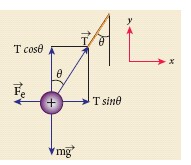
In the x-direction, the acceleration of the charged sphere is zero.
Using Newton’s second law \((\vec { { F }_{ tot }= } m\vec { a } )\), we have
T sinθ\(\hat { i } \) - Fe\(\hat { i } \) =0
T sinθ = Fe ......(1)
Here T is the tension acting on the charge due to the string and Fe is the electrostatic force between the two charges.
In the y-direction also, the net acceleration experienced by the charge is zero
Tcosθ\(\hat { j } \) - mg\(\hat { j } \) = 0
Tcosθ = mg ..(2)
By dividing equation (1) by equation (2),
tanθ = \(\frac { { F }_{ e } }{ mg } \) .....(3)
Since they are equally charged, the magnitude of the electrostatic force is
\({ F }_{ e }=k\frac { { q }^{ 2 } }{ { r }^{ 2 } } \) where k=\(\frac { 1 }{ 4\pi { \varepsilon }_{ 0 } } \)
Here r = 2a = 2Lsinθ. By substituting these values in equation (3),
tanθ = k\(\frac { { q }^{ 2 } }{ mg(2Lsin\theta )^{ 2 } } \) ..........(4)
Rearranging the equation (4) to get q
q = 2 Lsinθ\(\\ \sqrt { \frac { mgtan\theta }{ k } } \)
= 2 x 0.1 x sin 30o x \(\sqrt { \frac { 10^{ -3 }\times 10\times { tan30 }^{ 0 } }{ 9\times 10^{ 9 } } } \)
q = 8.01 x 10⁻⁸C = 80.1 nC
7.
The work done by the field is negative. This is since the charge is moved against the force exerted by the field.
8.
(i) In electric field line is the path of movement of a positive test charge (q0 ⇾ 0) A moving charge experiences a continuous force is an electric field, so field line is always continuous
(ii) The field lines nevel intersect since if they cross, there will be two directions of electric field at the point of intersection, which is impossible.
9.
When an external electric field is applied, the centers of positive and negative charges are separated by a small distance which induces dipole moment in the direction of the external electric field. Then the dielectric is said to be polarized by an external electric field.
10.
When an irregular shaped conductor is given positive charge, the electric field near the sharp end is very high and it ionizes the surrounding air. The positive ions are repelled at the sharp edge and negative ions are attracted towards the sharper edge. This reduces the total charge of the conductor near the sharp edge. This is called corona discharge.
11.
(a) The work done to arrange the charges in the corners of the square is independent of the way they are arranged. We can follow any order.
(i) First, the charge +q is brought to the corner P. This requires no work since no charge is already present, WP = 0
(ii) Work required to bring the charge –q to the corner Q = (-q) x potential at a point Q due to +q located at a point P
WQ = -q x \(\frac { 1 }{ 4\pi { \varepsilon }_{ 0 } } \frac { q }{ a } =-\frac { 1 }{ 4\pi { \varepsilon }_{ 0 } } \frac { q^{ 2 } }{ a } \)
(iii) Work required to bring the charge +q to the corner R = q x potential at the point R due to charges at the point P and Q.
WR = q x \(\frac { 1 }{ 4\pi { \varepsilon }_{ 0 } } \left( -\frac { q }{ a } +\frac { q }{ \sqrt { 2 } a } \right) \)
= \(\frac { 1 }{ 4\pi { \varepsilon }_{ 0 } } \frac { { q }^{ 2 } }{ a } \left( -1+\frac { 1 }{ \sqrt { 2 } } \right) \)
(iv) Work required to bring the fourth charge –q at the position S = q × potential at the point S due the all the three charges at the point P, Q and R.
Ws = - q x \(\frac { 1 }{ 4\pi { \varepsilon }_{ 0 } } \left( \frac { q }{ a } +\frac { q }{ a } -\frac { q }{ \sqrt { 2 } a } \right) \)
Ws = \(-\frac { 1 }{ 4\pi { \varepsilon }_{ 0 } } \frac { q^2 }{ a } \left( 2-\frac { 1 }{ \sqrt { 2 } } \right) \)
(b) Work required to bring the charge q′ to the center of the square = q′ x potential at the center point O due to all the four charges in the four corners.
The potential created by the two +q charges are canceled by the potential created by the -q charges which are located in the opposite corners. Therefore the net electric potential at the center O due to all the charges in the corners is zero.
Hence no work is required to bring any charge to the point O. Physically this implies that if any charge q′ when brought close to O, then it moves to the point O without any external force.
12.
(a)
\(\frac { { q }^{ 2 } }{ 4\pi { \varepsilon }_{ 0 }r } \)
13.
(c)
εr = 80
14.
\(Φ=\frac { q_{net} }{ { \varepsilon }_{ 0 } } \)
qnet = - q + q + 2q = 2q
Relative permittivity of water = 80
\(\therefore Φ=\frac { q }{{ \varepsilon }_{ r } { \varepsilon }_{ 0 } } \)
\(=\frac{2q}{{ 80 \times \varepsilon }_{ 0 }}=\frac{q}{{ 40 \varepsilon }_{ 0 }}\)
15.
The charge + q will be stable between B1 and B2 with respect to the displacement.
16.
\({ \varepsilon }_{ r }=\frac { \varepsilon }{ { \varepsilon }_{ 0 } } =80\)
ε = 80 x ε0
= 80 x 8.854 x 10-12
= 708 x 10-12
ε0 = 7.08 x 10⁻¹⁰ C2N-1m-2.
17.
r = 25cm = 25 x 10-2m
\(\sigma =\frac { 3 }{ \pi } { cm }^{ -2 }\)
\(AS,\quad \sigma =\frac { q }{ A } =\frac { q }{ 4\pi { r }^{ 2 } } \) [A - surface Area of the sphere]
\(q=(4\pi { r }^{ 2 })\sigma \)
\(=4\pi (0.25{ ) }^{ 2 }\times \frac { 3 }{ \pi } \)
= 0.75C.

12th Standard Syllabus & Materials
12th Standard
TN 12th Computer Applications வலையமைப்பு வடமிடல் Sample Question Papers Study Material - QB365 Set A
NEW12th Standard
TN 12th Computer Applications களப்பெயர் முறைமை (DNS) Sample Question Papers Study Material - QB365 Set A
NEW12th Standard
TN 12th Computer Applications வலையமைப்பு எடுத்துக்காட்டுகள் மற்றும் நெறிமுறைகள் Sample Question Papers Study Material - QB365 Set A
NEW12th Standard
TN 12th Computer Applications கணினி வலையமைப்பு ஓர் அறிமுகம் Sample Question Papers Study Material - QB365 Set A



Tamilnadu Stateboard 12th Standard Subjects

Maths

Chemistry
Physics

Biology

Computer Science

Business Maths and Statistics

Economics

Commerce

Accountancy

History

Computer Applications
Biology
Computer Technology
Computer Applications
Computer Science
Business Maths and Statistics
Commerce
Economics
Maths
Chemistry
Physics
Computer Technology
History
Accountancy

Tamil

English

French
Tamilnadu Stateboard Standards

