
 100% FREE ACCESS
12th Standard Syllabus & Materials
12th Standard
TN 12th Computer Applications மின்னணு தரவு பரிமாற்றம் Sample Question Papers Study Material - QB365 Set A
NEW12th Standard
TN 12th Computer Applications மின் - வணிக பாதுகாப்பு அமைப்புகள் Sample Question Papers Study Material - QB365 Set A
NEW12th Standard
TN 12th Computer Applications மின்னணு செலுத்தல் முறைகள் Sample Question Papers Study Material - QB365 Set A
NEW12th Standard
TN 12th Computer Applications மின் - வணிகம் Sample Question Papers Study Material - QB365 Set A
NEW12th Standard
TN 12th Computer Applications திறந்த மூல கருத்துருக்கள் Sample Question Papers Study Material - QB365 Set A
NEW12th Standard
TN 12th Computer Applications வலையமைப்பு வடமிடல் Sample Question Papers Study Material - QB365 Set A

Published on: 27/09/2019
Electrostatics
Download Tamil Nadu 12th Standard Physics question papers, model tests, one-mark questions, important questions, and public exam papers in PDF format. Free study materials and answer keys for TN State Board students.
Questions + Answers key
Take MCQ Physics Test1.
Derive an expression for electrostatic potential due to a point charge.
2.
Define ‘Electric field’ and discuss its various aspects.
3.
Discuss the basic properties of electric charges.
4.
Consider two point charges q1 and q2 at rest as shown in the figure.
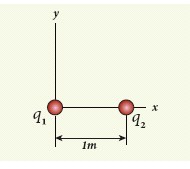
They are separated by a distance of 1m. Calculate the force experienced by the two charges for the following cases:
(a) q1 = +2μC and q2 = +3μC
(b) q1 = +2μC and q2 = -3μC
(c) q1= +2μC and q2 = -3μC kept in water (εr = 80)
5.
What are Polar molecules? Give examples.
6.
What is corona discharge?
7.
What is polarisation?
8.
Define ‘electric flux’.
9.
Define ‘electric dipole’. Give the expression for the magnitiude of its electric dipole moment and the direction.
10.
Define ‘electric field’
11.
12.
What is meant by quantisation of charges?
13.
Dielectric strength of air is 3 x 10⁶ V m-1. Suppose the radius of a hollow sphere in the Van de Graff generator is R = 0.5 m, calculate the maximum potential difference created by this Van de Graaff generator.
14.
A water molecule has an electric dipole moment of 6.3 x 10⁻³⁰ Cm. A sample contains 1022 water molecules, with all the dipole moments aligned parallel to the external electric field of magnitude 3 x 10⁵ NC-1. How much work is required to rotate all the water molecules from θ = 0° to 90°?
15.
Eight mercury droplets having a radius of 1 mm and charge of 0.066 PC each merge to form one droplet. Its potential is _____________
2.4 V
1.2 V
3.6 V
4.8 V
16.
The relative permittivity of water is _______.
εr = 70
εr = 75
εr = 80
εr = 85
17.
The electrostatic force obeys _______.
Newton's I law
Newton's II law
Newton's III law
none of the above
18.
Two metallic spheres of radii 1 cm and 3 cm are given charges of -1 \(\times\) 10-2 C and 5 \(\times\) 10-2 C respectively. If these are connected by a conducting wire, the final charge on the bigger sphere is
3 \(\times\) 10-2 C
4 \(\times\) 10-2 C
1 \(\times\) 10-2 C
2 \(\times\) 10-2 C
19.
An electric field \(\vec { E } =10x\hat { i } \) exists in a certain region of space. Then the potential difference V = Vo – VA, where Vo is the potential at the origin and VA is the potential at x = 2 m is _____.
10 V
-20 V
+20 V
-10 V
20.
21.
Which charge configuration produces a uniform electric field?
point charge
uniformly charged infinite line
uniformly charged infinite plane
uniformly charged spherical shell
22.
Explain in detail how charges are distributed in a conductor, and the principle behind the lightning conductor.
23.
Electric field
24.
permittivity of free space
25.
Air
26.
Thales
27.
Benjamin Franklin
28.
(a) ∝ - particle
(b) electron
(c) proton
(d) deutron
29.
(a) Mica
(b) Ebonite
(c) Aluminium
(d) Oil
30.
| a) | Volt | - | electric current |
| b) | C/m | - | electric dipole moment |
| c) | NC-1 | - | electric field intensity |
| d) | C2Nm2 | - | electric flux |
31.
| a) | NH3 | - | Non - polar molecule |
| b) | O2 | - | Polar molecule |
| c) | Mica | - | Conductor |
| d) | Ceramic | - | Capacitor |
1.
Electric potential due to a point charge:
Consider a positive charge q kept fixed at the origin. Let P be a point at distance r from the charge q. This is shown in Figure.
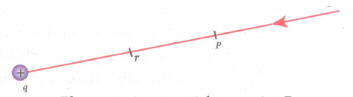
Electrostatic potential at a point P
The electric potential at the point P is
\(V=\int _{ \infty }^{ r }{ \left( -\vec { E } \right) d\vec { r } } =-\int _{ \infty }^{ r }{ \vec { E } } .d\vec { r } \) ...(1)
Electric field due to positive point charge q is
\(\vec { E } =\frac { 1 }{ 4\pi { \varepsilon }_{ 0 } } \frac { q }{ { r }^{ 2 } } \hat { r } \)
\(V=\frac { -1 }{ 4\pi { \varepsilon }_{ 0 } } \int _{ \infty }^{ r }{ \frac { q }{ { r }^{ 2 } } \hat { r } .d\vec { r } } \)
The infinitesimal displacement vector, \(d\vec { r } =dr\hat { r } \) and using \(\hat { r } \).\(\hat { r } \) = 1, we have
\(V=\frac { 1 }{ 4\pi { \varepsilon }_{ 0 } } \int _{ \infty }^{ r }{ \frac { q }{ { r }^{ 2 } } \hat { r } .dr\hat { r } =\frac { 1 }{ 4\pi { \varepsilon }_{ 0 } } \int _{ \infty }^{ r }{ \frac { q }{ { r }^{ 2 } } dr } } \)
After the integration,
\(V=-\frac { 1 }{ 4\pi { \varepsilon }_{ 0 } } q{ \left\{ -\frac { 1 }{ r } \right\} }_{ \infty }^{ r }=\frac { 1 }{ 4\pi { \varepsilon }_{ 0 } } \frac { q }{ r } \)
Hence, the electric potential due to a point charge q at a distance r is
\(V=\frac { 1 }{ 4\pi { \varepsilon }_{ 0 } } \frac { q }{ r } \) ....(2)
2.
The electric field at the point P at a distance r from the point charge q is defined as the force that would be experienced by a unit positive charge placed at that point and is given by,
\(\vec{E}=\frac{\vec{F}}{q_{0}}=\frac{k q}{r^{2}} \hat{r}=\frac{1}{4 \pi \varepsilon_{0}} \frac{q}{r^{2}} \hat{r}\) ....(1)
where \(\hat{r}\) is the unit vector pointing from q to the point of interest P.
Important aspect of the Electric field:
(i) If the charge q is positive then the electric field points away from the source charge and if q is negative, the electric field points towards the source charge q. This is shown in the Figure
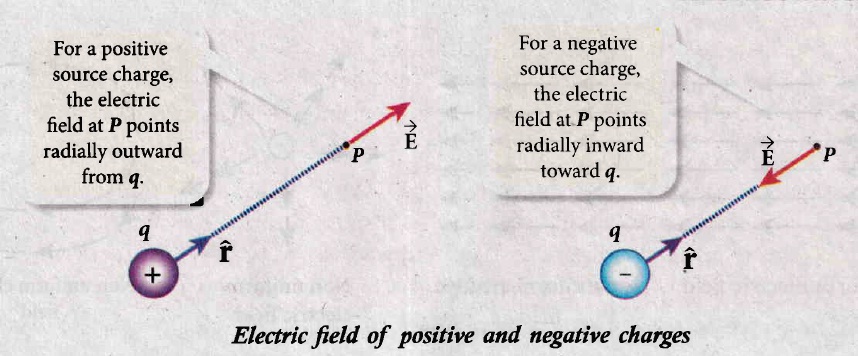
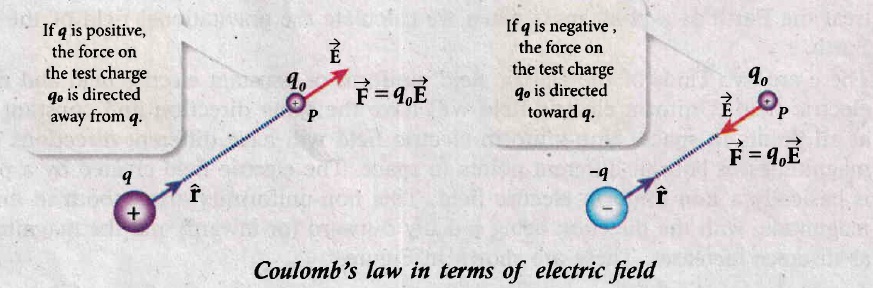
(ii) If the electric field at a point P is \(\vec{E},\) then the force experienced by the test charge qo placed at the point P is \(\vec { F } ={ q }_{ 0 }\vec { E } \)
This is Coulomb's law in terms of electric field. This is shown in Figure
(iii) The equation (1) implies that the electric field is independent of the test charge qo and it depends only on the source charge q.
(iv) Since the electric field is a vector quantity, at every point in space, this field has unique direction and magnitude, as shown in Figures (a) and (b). From equation (1), we can infer that as distance increases, the electric field decreases in magnitude. Note that in Figures (a) and (b) the length of the electric field vector is shown for three different points. The strength or magnitude of the electric field at point P is stronger than at the points Q and R because the point P is closer to the source charge.
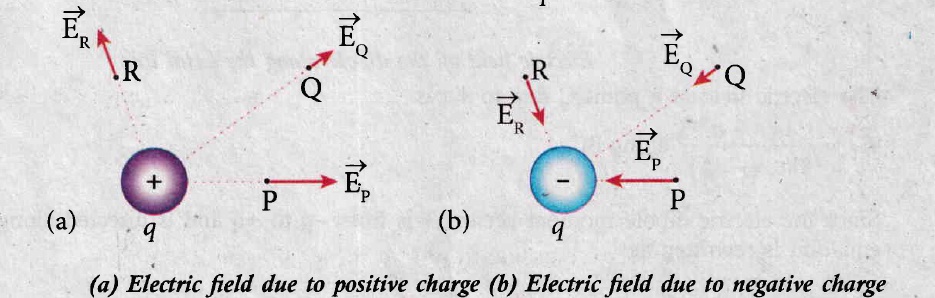
(v) In the definition of electric field, it is assumed that the test charge (q0) is taken sufficiently small, so that bringing this test charge will not move the source charge. In other words, the test charge is made sufficiently small such that it will not modify the electric field of the source charge.
(vi) The expression (1) is valid only for point charges. For continuous and finite size charge distributions, integration techniques must be used. These will be explained later in the same section. However, this expression can be used as an approximation for a finite-sized charge if the test point is very far away from the finite sized source charge. Note that we similarly treat the Earth as a point mass when we calculate the gravitational field of the Sun on the Earth.
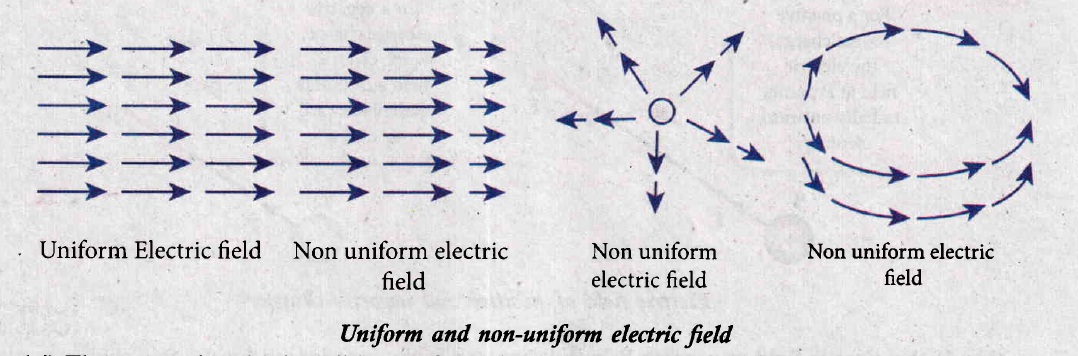
(vii) There are two kinds of the electric field : uniform or constant electric field and non-uniform electric field. Uniform electric field will have the same direction and constant magnitude at all points in space. Non-uniform electric field will have different directions or different magnitudes or both at different points in space. The electric field created by a point charge is basically a non uniform electric field. This non-uniformity arises, both in direction and magnitude, with the direction being radially outward (or inward) and the magnitude changes as distance increases. These are shown in Figure.
3.
Basic properties of charges:
(i) Electric charge:
(a) Most objects in the universe are made up of atoms, which in turn are made up of protons, neutrons and electrons.
(b) These particles have mass, an inherent property of particles. Similarly, the electric charge is another intrinsic and fundamental property of particles.
(ii) Conservation of charges:
Total electric charge is conserved. Charge can neither be created nor be destroyed. In any physical process, the net change in charge will be zero.
(iii) Quantisation of charges:
(a) The charge q on any object is equal to an integral multiple of this fundamental unit of charge.
(b) q = ne
(c) Here, n is any integer \((0, \pm 1, \pm 2, \pm 3, \pm 4 \ldots)\) This is called Quantisation of electric charge.
4.
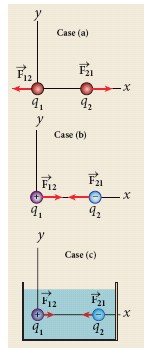
(a) q1 = +2 μC, q2 = +3 μC, and r = 1m. Both are positive charges. so the force will be repulsive.
Force experienced by the charge q2 due to q1 is given by
\(\vec { { F }_{ 21 } } =\frac { 1 }{ 4\pi { \varepsilon }_{ 0 } } \frac { { q }_{ 1 }{ q }_{ 2 } }{ { r }^{ 2 } } \hat { r_{ 12 } } \)
Here \(\hat { r_{ 12 } } \) is the unit vector from q1 to q2. Since q2 is located on the right of q1, we have
\(\hat { r_{ 12 } } =\hat { i } \), and \(\frac { 1 }{ 4\pi { \varepsilon }_{ 0 } }=9 \times10^9\) so that
\(\vec { { F }_{ 21 } } =\frac { 9\times 10^{ 9 }\times 2\times 10^{ -6 }\times 3\times 10^{ -6 } }{ 1^{ 2 } } \hat { i } \)
= 54 x 10-3 N\(\hat { i } \)
According to Newton’s third law, the force experienced by the charge q1 due to q2 is \(\vec { { F }_{ 12 } } =-\vec { { F }_{ 21 } } \) Therefore,
\(\vec { F_{ 12 } } \)= 54 x 10-3 N\(\hat { i } \)
The directions of \(\vec { { F }_{ 21 } } \) and \(\vec { { F }_{ 12 } } \) are shown in the figure (case (b)).
(b) q1 = +2 μC, q2 = –3 μC, and r = 1m. They are unlike charges. So the force will be attractive.
Force experienced by the charge q2 due to q1 is given by
\( \vec{F}_{21} =\frac{9 \times 10^{9} \times\left(2 \times 10^{-6}\right) \times\left(-3 \times 10^{-6}\right)}{1^{2}} \hat{r}_{12} \)
\(=-54 \times 10^{-3} \mathrm{~N} \hat{i}\left(\mathrm{Using} \hat{r}_{12}=\hat{i}\right)\)
The charge q2 will experience an attractive force towards q1 which is in the negative x direction.
According to Newton’s third law, the force experienced by the charge q1 due to q2 is \(\vec{F}_{12}=-\vec{F}_{21}\) Therefore,
\(\vec{F}_{12}=54 \times 10^{-3} \widehat{i} \mathrm{~N}\)
The directions of \(\vec{F}_{21} \text { and } \vec{F}_{12}\) are shown in the figure (case (b)).
(c) If these two charges are kept inside the water, then the force experienced by q2 due to q1
\(\vec { { F }_{ 21 }^{ W } } =\frac { 1 }{ 4\pi { \varepsilon }_{ 0 } } \frac { { q }_{ 1 }{ q }_{ 2 } }{ { r }^{ 2 } } \hat { r_{ 12 } } \)
since ε = εrε0,
we have \(\vec { { F }_{ 21 }^{ W } } =\frac { 1 }{ 4\pi { { \varepsilon }_{ r }\varepsilon }_{ 0 } } \frac { { q }_{ 1 }{ q }_{ 2 } }{ { r }^{ 2 } } \hat { r_{ 12 } } =\frac { \vec { F_{ 21 } } }{ { \varepsilon }_{ r } } \)
Therefore,
\(\vec { { F }_{ 21 }^{ W } } =\frac { 54\times { 10 }^{ -3 }N }{ 80 } \hat { i } \) = -0.675 x 10⁻³ N\(\hat { i } \)
5.
(i) In polar molecules, the centers of the positive and negative charges are separated even in the absence of an external electric field.
(ii) They have a permanent dipole moment.
(iii) Examples : H2O, N2O, HCI and NH3.
6.
When an irregular shaped conductor is given positive charge, the electric field near the sharp end is very high and it ionizes the surrounding air. The positive ions are repelled at the sharp edge and negative ions are attracted towards the sharper edge. This reduces the total charge of the conductor near the sharp edge. This is called corona discharge.
7.
The alignment of the dipole moments of the permanent or induced dipoles in the direction of applied electric field is called polarisation.
8.
The number of electric field lines crossing a given area kept normal to the electric field lines is called electric flux.
9.
(i) Two equal and opposite charges separated by a small distance constitute an electric dipole.
(ii) The magnitude of the electric dipole moment is equal to the product of the magnitude of one of the charges and the distance between them, \(|\vec{p}|=2 q a\).
(iii) The electric dipole moment vector lies along the line joining two charges and is directed from -q to +q.
10.
Electric field at the point P at a distance r from the point charge q is the force experienced by a unit positive placed at that point P and is given by
\(\vec { E } =\frac { \vec { F } }{ q_{ 0 } } =\frac { kq }{ { r }^{ 2 } } \hat { r } =\frac { 1 }{ 4\pi { \varepsilon }_{ 0 } } \frac { q }{ { r }^{ 2 } } \hat { r } \)
where \(\hat{r}\) is the unit vector pointing from q to the point of interest P.
11.
12.
The charge of an electron is the elementary charge in nature. Therefore, charge on any body is the integral multiple of an electron. The charge on any body can be expressed by the formula,
q = ne; where, n is the number of electrons, e is the charge on one electron.
n = 0, ±1, ±2, ±3, ±4, ...
This is called quantization of charge.
13.
The electric field on the surface of the sphere(by Gauss law) is given by
E = \(\frac { 1 }{ 4\pi { \varepsilon }_{ 0 } } \frac { Q }{ { R }^{ 2 } } \)
The potential on the surface of the hollow metallic sphere is given by
V = \(\frac { 1 }{ 4\pi { \varepsilon }_{ 0 } } \frac { Q }{ { R } } \) = ER
Since Vmax = EmaxR
Here Emax = 3 x 10⁶ Vm-1. So the maximum potential difference created is given by
Vmax = 3 x 106 x 0.5
= 1.5 x 10⁶V (or) 1.5 million volt.
14.
When the water molecules are aligned in the direction of the electric field, it has minimum potential energy. The work done to rotate the dipole from θ = 0° to 90° is equal to the potential energy difference between these two configurations.
W = ΔU = U(90°) - U(0°)
From the equation U =−pE cosθ = −\(\hat p.\hat E\) ,
we write U = − pE cosθ, Next, we calculate the work done to rotate one water molecule from θ = 0° to 90°.
For one water molecule
W = - pE cos90o + pE cos0o = pE
W= 6.3 x 10-30 x 3 x 105 = 18.9 x 10⁻²⁵J
For 1022 water molecules, the total work done is
Wtot = 18.9 x 10-25 x 1022 = 18.9 x 10⁻³J
15.
(a)
2.4 V
16.
(c)
εr = 80
17.
(b)
Newton's II law
18.
Q = q1 + q2 = 4 x 10⁻²C
\(q_{2f}=Q[\frac{r_2}{r_1+r_2}]\)
= 4 x 10⁻² \([\frac{3}{4}]\)
q2f = 3 x 10⁻² C
19.
\(\vec {E}\) = 10x\(\hat{i},\) when x = 2 m
\(\vec {E}\) = 10 x 2 x \(\hat{i}\) = 20\(\hat{i}\)
Since, \(E=\frac{-dV}{dx}\therefore V=+20 V\)
20.
(b)
21.
(c)
uniformly charged infinite plane
22.
Distribution of charges in a conductor:
(i) Consider two conducting spheres A and B of radii r1 and r2 respectively connected to each other by a thin conducting wire as shown in the Figure. The distance between the spheres is much greater than the radii of either spheres.
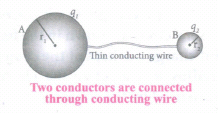
(ii) If a charge Q is introduced into any one of the spheres, this charge Q is redistributed into both the spheres such that the electrostatic potential is same in both the spheres. They are now uniformly charged and attain electrostatic equilibrium. Let q1 be the charge residing on the surface of sphere A and q2 is the charge residing on the surface of sphere B such that Q = q1 + q2, The charges are distributed only on the surface and there is no net charge inside the conductor.
The electrostatic potential at the surface of the sphere A is given by
\({ V }_{ A }=\frac { 1 }{ 4\pi { \varepsilon }_{ 0 } } \frac { { q }_{ 1 } }{ { r }_{ 1} } \quad \quad ...(1)\)
(iii) The electrostatic potential at the surface of the sphere B is given by ,
\({ V }_{ B }=\frac { 1 }{ 4\pi { \varepsilon }_{ 0 } } \frac { { q }_{ 2 } }{ { r }_{ 2 } } \) ...(2)
iv) The surface of the conductor is an equipotential. Since the spheres are connected by the conducting wire, the surfaces of both the spheres together form an equipotential surface.
This implies that
VA= VB
or \(\frac { { q }_{ 1 } }{ { r }_{ 1 } } =\frac { { q }_{ 2 } }{ { r }_{ 2 } } \) ...(3)
v) Let us take the charge density on the surface of sphere A and charge density on the surface of sphere B is σ2.This implies that q1 = 4πr12σ1 and 4πr22σ2 substituting these values into equation (3), we get
σ1r1 = σ2r2 ...(4)
from which we conclude that σr = constant ...(5)
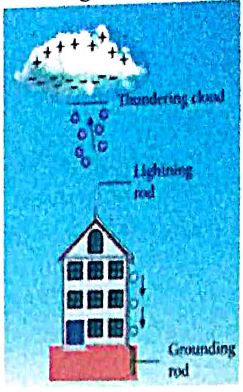
Lightning conductor:
It is used to protect tall buildings from lightning strikes.
Principle:
(i) Action at points (or) corona discharge.
(ii) This device consists of a long thick copper rod passing from top of the building to the ground.
(iii) The upper end of the rod has a sharp spike or a sharp needle as shown in Figure.
(iv) The lower end of the rod is connected to copper plate which is buried deep into the ground.
(v) When a negatively charged cloud is passing above the building, it causes a positive charge on the spike. Since the induced charge density on thin sharp spike is large, it results in a corona discharge. This positive Charge ionizes the surrounding air which in turn neutralizes the negative charge in the cloud.
(vi) The negative charge pushed to the spikes passes through the copper rod and is safely diverted to the Earth. The lightning arrester does not stop the lightning; rather it diverts the lightning to the ground safely.
23.
Vector quantity
24.
8.854 x 10⁻¹² C2N-1m-2
25.
εr = 1
26.
Frictional electricity
27.
Lightning Arrestor
28.
(b) electron
29.
(c) Aluminium
30.
c) NC-1 - electric field intensity
31.
d) Ceramic - Capacitor

12th Standard Syllabus & Materials
12th Standard
TN 12th Computer Applications களப்பெயர் முறைமை (DNS) Sample Question Papers Study Material - QB365 Set A
NEW12th Standard
TN 12th Computer Applications வலையமைப்பு எடுத்துக்காட்டுகள் மற்றும் நெறிமுறைகள் Sample Question Papers Study Material - QB365 Set A
NEW12th Standard
TN 12th Computer Applications கணினி வலையமைப்பு ஓர் அறிமுகம் Sample Question Papers Study Material - QB365 Set A
NEW12th Standard
TN 12th Computer Applications PHP-உடன் MySQL-ஐ இணைத்தல் Sample Question Papers Study Material - QB365 Set A



Tamilnadu Stateboard 12th Standard Subjects

Maths

Chemistry
Physics

Biology

Computer Science

Business Maths and Statistics

Economics

Commerce

Accountancy

History

Computer Applications
Biology
Computer Technology
Computer Applications
Computer Science
Business Maths and Statistics
Commerce
Economics
Maths
Chemistry
Physics
Computer Technology
History
Accountancy

Tamil

English

French
Tamilnadu Stateboard Standards

