
 100% FREE ACCESS
12th Standard Syllabus & Materials
12th Standard
TN 12th Maths Applications of Matrices and Determinants Sample Question Papers Study Material - QB365 Set A
NEW12th Standard
TN 12th Computer Applications மின்னணு தரவு பரிமாற்றம் Sample Question Papers Study Material - QB365 Set A
NEW12th Standard
TN 12th Computer Applications மின் - வணிக பாதுகாப்பு அமைப்புகள் Sample Question Papers Study Material - QB365 Set A
NEW12th Standard
TN 12th Computer Applications மின்னணு செலுத்தல் முறைகள் Sample Question Papers Study Material - QB365 Set A
NEW12th Standard
TN 12th Computer Applications மின் - வணிகம் Sample Question Papers Study Material - QB365 Set A
NEW12th Standard
TN 12th Computer Applications திறந்த மூல கருத்துருக்கள் Sample Question Papers Study Material - QB365 Set A

Published on: 02/09/2022
QB365 provides a detailed and simple solution for every Possible Book Back Questions in Class 12 Physics Subject - Retirement and Death of a Partner, English Medium. It will help Students to get more practice questions, Students can Practice these question papers in addition to score best marks.
Download Tamil Nadu 12th Standard Physics question papers, model tests, one-mark questions, important questions, and public exam papers in PDF format. Free study materials and answer keys for TN State Board students.
Questions + Answers key
Take MCQ Physics Test1.
Describe the working of nuclear reactor with a block diagram.
2.
Discuss the process of nuclear fusion and how energy is generated in stars?
3.
Discuss the process of nuclear fission and its properties.
4.
Obtain the law of radioactivity.
5.
Discuss the spectral series of hydrogen atom.
6.
Discuss the Millikan’s oil drop experiment to determine the charge of an electron.
7.
Explain the J.J. Thomson experiment to determine the specific charge of electron.
8.
Briefly explain the elementary particles present in nature.
9.
Explain in detail the four fundamental forces in nature.
10.
Explain the idea of carbon dating.
11.
Discuss the properties of neutrino and its role in beta decay.
12.
Discuss the gamma emission process with example.
13.
Discuss the beta decay process with examples.
14.
Discuss the alpha decay process with example.
15.
Explain in detail the nuclear force.
16.
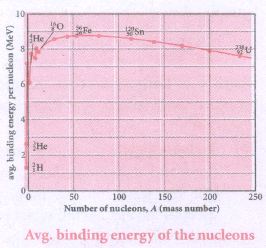
Explain the variation of average binding energy with the mass number using graph and discuss about its features.
17.
Derive the energy expression for an electron is the hydrogen atom using Bohr atom model.
1.
Nuclear reactor is a system in which the nuclear fission takes place in a self-sustained controlled manner.
The main parts of a nuclear reactor :
(a) Fuel (b) Neutron source (c) moderator (d) control rods (e) shielding (f) cooling system
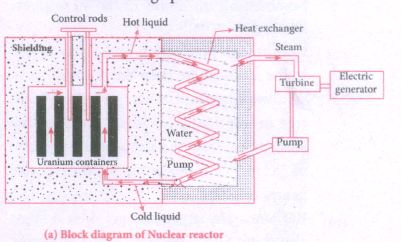
(a) Fuel:
(i) The fuel is fissionable material, usually uranium or plutonium.
(ii) Naturally occurring uranium contains only 0.7% of \(_{ 92 }^{ 235 }{ U }\) and 99.3% \(_{ 92 }^{ 238 }{ U }\).
(iii) So the fuel must be enriched such that it contains at least 2 to 4% of \(_{ 92 }^{ 235 }{ U }\).
b) Neutron Source :
(i) A neutron source is required to initiate the chain reaction for the first time.
(ii) A mixture of beryllium with plutonium or polonium is used as the neutron source.
(iii) During fission only fast neutrons are emitted. But slow neutrons are preferred for sustained nuclear reactions.
(c) Moderators :
(i) The moderator is a material used to convert fast neutrons into slow neutrons. Usually the moderators are chosen in such a way that it must be very light nucleus having mass comparable to that of neutrons.
(ii) Hence, these light nuclei undergo collision with fast neutrons and the speed of the neutron is reduced.
(iii) Most of the reactors use water, heavy water (D2O) and graphite as moderators.
(d) Control rods :
(i) The control rods are used to adjust the reaction rate.
(ii) An average of 2.5 neutrons are emitted in each fission reaction.
(iii) For the controlled chain reactions, only one effort is allowed to produce another fission and the remaining neutrons are absorbed by the control rod.
(iv) Usually cadmium or boron acts as control rod material.
(v) These rods are inserted into the uranium blocks.
(vi) Depending on the insertion depth of control rod into the uranium, the average number of the neutrons produced per fission is set to be equal to one or greater than one.
(vii) If the average number of neutrons produced per fission is equal to one, then reactor is said to be in critical state.
(viii) If it is greater than one, then reactor is said to be in super-critical and it may explode sooner of may cause massive destruction.
(e) Shielding :
For a protection against harmful radiation, the nuclear reactor is surrounded by a concrete wall of thickness of about 2 to 2.5 m.
(f) Cooling system :
(i) The cooling system removes the heat generated in the reactor core.
(ii) Ordinary water, heavy water and liquid sodium are used as coolant.
(iii) They have very high specific heat capacity and have large boiling point under high pressure.
(iv) This coolant passes through the fuel block and carries away the heat to the steam generator through heat exchanger.
(v) The steam runs the turbines which produces electricity in power reactors.
2.
(i) Nuclear fusion is the reaction in which two or more light nuclei (A < 20) combine to form a heavier nucleus.
(ii) In the nuclear fusion, the mass of the resultant nucleus is less than the sum of the masses of original light nuclei. This mass difference appears as energy.
(iii) At room temperature if two light nuclei come closer, is strongly repelled by the coulomb repulsive force.
(iv) If the temperature is increased in order of 107 K, the light nuclei have enough kinetic energy to move closer such that the nuclear force becomes effective.
(v) Then lighter nuclei start fusing to form heavier nuclei.
(vi) So it is called thermonuclear fusion reaction.
Energy generation in stars:
(i) Then natural place where nuclear fusion occurs is the core of the stars.
(ii) The energy of star is due to thermonuclear fusion.
(iii) Most of the stars including our Sun fuse hydrogen into helium and some stars even fuse helium into heavier elements.
(iv) The early stage of a star is in the form of cloud and dust.
(v) Due to their own gravitational pull, these clouds fall inward.
(vi) As a result, its gravitational potential energy is converted to kinetic energy and finally into heat.
(vii) When the temperature is high enough to initiate the thermonuclear fusion, they start to release enormous energy which tends to stabilize the star and prevents it from further collapse.
(viii) The sun's interior temperature is around 1.5 x 10⁷ K.
(ix) The sun is converting 6 x 10¹¹kg hydrogen into helium every second
(x) When the hydrogen is burnt out, the sun will enter into new phase called red giant where helium will fuse to become carbon.
(xi) During this stage, sun will expand greatly in size and all its planets will be engulfed in it.
(xii) The energy source of sun is proton-proton cycle of fusion reaction.
This cycle consists of three steps and the first two steps are as follows:
\(_{ 1 }^{ 1 }{ H+ }_{ 1 }^{ 1 }{ H }\rightarrow _{ 1 }^{ 2 }{ H }+{ e }^{ + }+v\)
\(_{ 1 }^{ 1 }{ H+ }_{ 1 }^{ 2 }{ H }\rightarrow _{ 2 }^{ 3 }{ He }+\gamma \)
A number of reactions are possible in the third step. But the dominant one is
\(_{ 2 }^{ 3 }{ He+ }_{ 2 }^{ 3 }{ He }\rightarrow _{ 2 }^{ 4 }{ He }+_{ 1 }^{ 1 }{ H+ }_{ 1 }^{ 1 }{ H }\)
(xiii) The overall energy production in the above reactions is about 27 MeV. The radiation energy we received from the sun is due to these fusion reactions.
3.
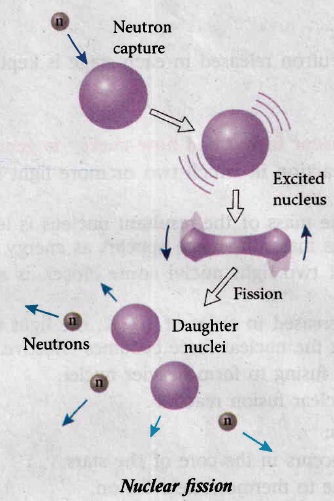
(i) The process of breaking up of the nucleus of a heavier atom into two smaller nuclei with the release of a large amount of energy is called nuclear fission.
Examples :
\(_{ 92 }^{ 235 }{ U+ }_{ 0 }^{ 1 }{ n }\rightarrow _{ 92 }^{ 236 }{ { U }^{ * } }\rightarrow _{ 56 }^{ 141 }{ Ba }+_{ 36 }^{ 92 }{ Kr }+3_{ 0 }^{ 1 }{ n }+Q\)
\(_{ 92 }^{ 235 }{ U+ }_{ 0 }^{ 1 }{ n }\rightarrow _{ 92 }^{ 236 }{ { U }^{ * } }\rightarrow _{ 54 }^{ 140 }Xe+_{ 38 }^{ 94 }{ Sr }+2_{ 0 }^{ 1 }{ n }+Q\)
(ii) When the slow neutron is absorbed by the uranium nuclei, the mass number increases by one and goes to an excited state \(_{ 92 }^{ 235 }{ U }\).
(iii) But this excited state does not last longer than 10-12s and decay into two daughter nuclei along with 2 or 3 neutrons.
Energy released in fission :
(i) We can calculate the energy (Q) released in each uranium fission reaction. We choose the most observed fission reaction which is given in the equation.
\(_{ 92 }^{ 235 }{ U+ }_{ 0 }^{ 1 }{ n }\rightarrow _{ 92 }^{ 236 }{ { U }^{ * } }\rightarrow _{ 56 }^{ 141 }{ Ba }+_{ 36 }^{ 92 }{ Kr }+3_{ 0 }^{ 1 }{ n }+Q\)
Mass of \({ }_{92}^{235} \mathrm{U}\) = 235.045733 u
Mass of \(_{ 0 }^{ 1 }{ n }\) = 1.008665 u
Total mass of reactants = 236.054398 u
Mass of \(_{ 56 }^{ 141 }{ Ba }\) = 140.9177 u
Mass of \(_{ 92 }^{ 36 }{ Kr }\) = 91.8854u
Mass of 3 neutrons = 3.025995 u
The total mass of products = 235.829095 u
Mass detect m =236.054398 u - 235.829095 u
= 0.225303u
So the energy released in each fission
= 0.225303 x 931 MeV = 200.MeV
(ii) This energy first appears as kinetic energy of daughter nuclei and neutrons. But later, this kinetic appears in the form of heat given to the surrounding.
Properties :
(i) The fission is accompanied by the release of neutrons. From each reaction, on an average, 2.5 neutrons are emitted.
(ii) The energy released in the nuclear fission is many times greater than the energy released in chemical reactions.
(iii) Energy released per fission is 200 MeV.
4.
(i) At any instant t, the number of decays per unit time, called rate of decay \(\left( \frac { dN }{ dt } \right) \) is proportional to the number of nuclei (N) at the same instant.
\(\left( \frac { dN }{ dt } \right) \propto N\)
\(\frac { dN }{ dt } =-\lambda N\) ...(1)
(ii) Here, proportionality constant \( \lambda\) is called decay constant which is different for different radioactive sample and the negative sign in the equation implies that the N is decreasing with time. From (1)
\(\frac{\mathrm{dN}}{\mathrm{N}}=-\lambda \mathrm{dt}\) ...(2)
(iii) Here, dN represents number of nuclei decaying in the time interval dt.
(iv) Let us assume that at time t = 0 s, the number of nuclei present in the radioactive sample is No.
(v) By integrating the equation (2), we can calculate the number of undecayed nuclei N at any time t.
\(\int_{N_{0}}^{N} \frac{d N}{N}=-\int_{0}^{t} \lambda d t \)
\({[\ln N]_{N_{0}}^{N}=-\lambda t} \)
\(\ln \left[\frac{N}{N_{0}}\right]=-\lambda t \)
Taking exponential on both sides, we get
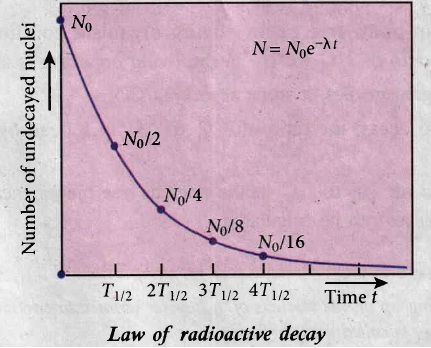
\(\mathrm{N}=\mathrm{N}_{0} \mathrm{e}^{-\lambda t}\) .....(3)
(vi) Equation (3) is called the law of radioactive decay.
(vii) Here N denotes the number of undecayed nuclei present at any time t and No denotes the number of nuclei present initially time t = 0.
(viii) From equation (3) the number of atoms is decreasing exponentially over the time. This implies that the time taken for all the radioactive nuclei to decay will be infinite.
5.
When electron jumps from higher energy stationary orbit (m) to lower energy stationary orbit (n), emit radiation.
Wave number (or) Wave length of the emitted radiation is given by,
\(\frac{1}{\lambda}=R\left[\frac{1}{n^{2}}-\frac{1}{m^{2}}\right]=\bar{v}\)
V - Ware number; R- Rydberg constant = 1.09737 x 10⁷ m-1
m > n (where m, n are integers)
(a) Lyman series:
When electron jumps from any outer orbit to first orbit, (n = 1 and m = 2,3,4.......) the wave number or wavelength of spectral lines lies in ultra-violet region is
\(\bar{v}=\frac{1}{\lambda}=\mathrm{R}\left[\frac{1}{1^{2}}-\frac{1}{\mathrm{~m}^{2}}\right]\)
(b) Balmer series:
Wher electron jumps from any outer orbit to second orbit, (n = 2 and m = 3, 4, 5.......) the wave number or wavelength of spectral lines lies in visible region is,
\(\bar{v}=\frac{1}{\lambda}=R\left[\frac{1}{2^{2}}-\frac{1}{m^{2}}\right]\)
(c) Paschen series:
When electron jumps from any outer orbit to third orbit, (n = 3 and m = 4, 5, 6.......) the wave number or wavelength of spectral lines lies in infra red (Near IR) region is
\(\bar{v}=\frac{1}{\lambda}=R\left[\frac{1}{3^{2}}-\frac{1}{m^{2}}\right]\)
(d) Bracket series:
When electron jumps from any outer orbit to fourth orbit, (n = 4 and m = 5, 6, 7.......) the wave number or wavelength of spectral lines lies in infra red (Middle IR) region is
\(\bar{v}=\frac{1}{\lambda}=R\left[\frac{1}{4^{2}}-\frac{1}{m^{2}}\right]\)
(e) Pfund series:
When electron jumps from any outer orbit to fifth orbit, (n - 5 and m = 6, 7, 8.......) the wave number or wavelength of spectral lines lies in infra red (far IR) region is
\(\bar{v}=\frac{1}{\lambda}=R\left[\frac{1}{5^{2}}-\frac{1}{m^{2}}\right]\)
6.
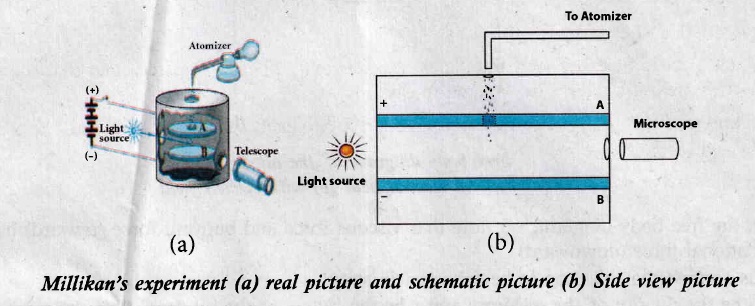
The motion of oil drop inside the chamber can be controlled by adjusting electric field. The oil drop can be moved up or down or even kept balanced in the field of view for sufficiently long time.
Construction:
(i) The apparatus consists of two horizontal circular metal plates A and B each with diameter around 20 cm and are separated by a small distance 1.5 cm.
(ii) These two parallel plates are enclosed in a chamber with glass walls.
(iii) Plates A and B are given a high potential difference around 10 kV such that electric field acts vertically downward
(iv) A small hole is made at the center of the upper plate A.
(v) Atomizer is kept above the hole to spray the liquid.
Working:
(i) When a fine droplet of highly viscous liquid (like glycerine) is sprayed using atomizer, it falls freely downward through the hole under the influence of gravity alone.
(ii) Few oil drops in the chamber can acquire electric charge (negative charge) because of friction with air or passage of x-rays in between the parallel plates.
(iii) The chamber is illuminated by light and oil drops can be seen clearly using microscope.
(iv) These drops can move either upwards or downward.
(v) Let m be the mass of the oil drop and q be its charge. Then the forces acting on the droplet are
(a) gravitational force Fg = mg
(b) electric force Fe = qE
(c) buoyant force Fb
(d) viscous force Fv
(a) Determination of radius of the droplet:
(i) When the electric field is switched off, the oil drop accelerates downwards. Due to presence of air drag forces, the oil drops attain its terminal velocity and moves with constant velocity.
(ii) This velocity can be measured by finding the time taken by the oil drop to fall through a predetermined distance.
.jpg)
(iii) From the free body diagram, we note that viscous force and buoyant force (upward) balance the gravitational force (downward).
(iv) Let us assume that oil drop to be spherical in shape.
(v) Let p be the density of the oil drop, and r be the radius of the oil drop, then the mass of the oil drop, the oil drop can be expressed in terms of its density as, \( \rho=m/v \Rightarrow m=\left(\frac{4}{3} \pi r^{3}\right) \rho\)
∵ (Volume of the sphere, V = \(\frac{4}{3} \pi r^{3})\)
Then gravitational force \(\mathrm{F}_{\mathrm{g}}=\mathrm{mg}=\left(\frac{4}{3} \pi \mathrm{r}^{3}\right) \rho g\)
(vi) Let σ be the density of air, the upthrust force experienced by the oil drop due to displaced air is \(F_{b}=\left(\frac{4}{3} \pi r^{3}\right) σ g\)
(vii) Once the oil drop attains a terminal velocity v, the net downward force acting on the oil drop is equal to the viscous force acting opposite to the direction of motion of the oil drop. From Stokes law, the viscous force on the oil drop is
\(\mathrm{F}_{\mathrm{v}}=6 \pi \eta \mathrm{rv}\)
(ix) From free body diagram, the force balancing equation is,
\(F_{g}=F_{b}+F_{v} \)
\(\left(\frac{4}{3} \pi r^{3}\right) \rho g=\left(\frac{4}{3} \pi r^{3}\right) \sigma g+6 \pi \eta r v \)
\(\frac{4}{3} \pi r^{3}(\rho-\sigma) g=6 \pi \eta r v \)
\(\frac{2}{3} r^{2}(\rho-\sigma) g=3 \eta v \)
Hence radius of the oil drop is \(r=\left[\frac{9 \eta v}{2(\rho-\sigma) g}\right]^{\frac{1}{2}} \ldots\) ........(1)
(b) Determination of electric charge:
(i) Now switch on the electric field.
(ii) Upward electric force on charged oil drops is qE.
(iii) Choose any one drop in the field of view of microscope.
(iv) Strength of the electric field is adjusted to make that particular drop to be stationary.
(v) Being oil drop is at rest, the viscous force acting on the oil drop is zero.
(vi) Then, from the free body diagram.
\(F_{g}=F_{b}+F_{v} \)
\(\left(\frac{4}{3} \pi r^{3}\right) \rho g=\left(\frac{4}{3} \pi r^{3}\right) \sigma g+q E \)
\(\frac{4}{3} \pi r^{3}(\rho-\sigma) g=q E \)
\(q=\frac{4}{3 E} \pi r^{3}(\rho-\sigma) g \ldots \ldots \ldots \ldots \ldots \) (2)
Substituting (1) in (2)
\(q=\frac{18 \pi}{E}\left(\frac{\eta^{3} v^{3}}{2(\rho-\sigma) g}\right)^{\frac{1}{2}}\)
(vii) Millikan repeated this experiment several times and computed the charges on oil drops. He found that the charge of any oil drop can be written as integral multiple of a basic value, -1.6 x 10⁻¹⁹ C which is nothing but the charge of an electron.
7.
Principle:
Cathode rays are deflected in electric and magnetic fields.
By the variation of electric and magnetic fields, mass normalized charge or the specific charge (charge per unit mass) of the cathode rays is measured.
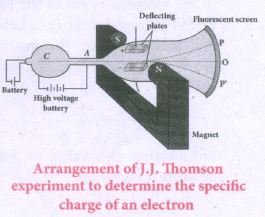
Construction and Working:
(i) Cathode rays (electron beam) produced at cathode of a highly evacuated discharge tube. Cathode rays are attracted towards anode disc A.
(ii) Pin hole in the anode disc allows only a narrow beam of cathode rays.
(iii) These cathode rays are now allowed to pass through the parallel metal plates, maintained at high voltage.
(iv) Further, discharge tube is kept in between pole pieces of magnet.
(v) Electric and magnetic fields are perpendicular to each other.
(vi) When the cathode rays strike the zinc sulphide coated screen (O), produces scintillation and hence bright spot is observed.
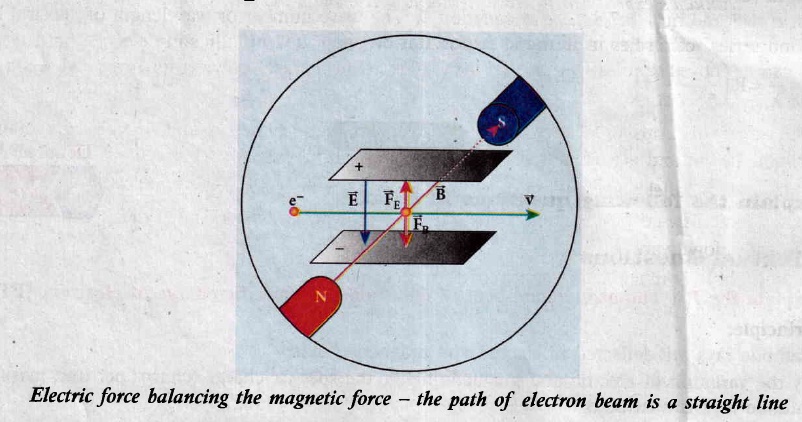
(i) Determination of velocity of cathode rays:
(a) For a fixed electric field between the plates, the magnetic field is adjusted such that the cathode rays (electron beam) strike at the original position O.
(b) This means that the magnitude of electric force is balanced by the magnitude of force due to magnetic field.
(ie) Ee = Bev
\(\Rightarrow v=\frac { E }{ B } \) ...(1)
(ii) Determination of specific charge:
(a) Since accelerated from cathode to anode, the potential energy of the electron beam at the cathode is converted into kinetic energy of the electron beam at the anode.
(b) Let V be the potential difference between anode and cathode, then the potential energy is eV.
Then from law of conservation of energy,
\(eV=\frac { 1 }{ 2 } { mv }^{ 2 } \)
\(\frac { e }{ m } =\frac { { v }^{ 2 } }{ 2V } \) ....(2)
Substituting (1) in (2),
\(\frac { e }{ m } =\frac { 1 }{ 2V } \frac { { E }^{ 2 } }{ { B }^{ 2 } } \)
By substituting known values, we get
\(\frac { e }{ m } =1.7\times { 10 }^{ 11 }{ CKg }^{ -1 }\)
The specific charge \(\frac{\mathrm{e}}{\mathrm{m}}\) is independent of (a) gas used (b) nature of the electrodes
8.
(i) An atom has a nucleus surrounded by electrons
(ii) Nucleus is made up of protons and neutrons.
(iii) Till 1960s, it was thought that protons, neutrons and electrons are fundamental building blocks of matter.
(iv) In 1964, physicists Murray Gellman and George Zweig theoretically proposed that protons and neutrons are not fundamental particles in fact they are made up of quarks.
(v) These quarks are now considered elementary particles of nature.
(vi) Electrons are fundamental or elementary particles because they are not made up of anything.
(vii) In the year 1968, the quarks were discovered experimentally by Stanford Linear Accelerator Center (SLAC), USA.
(viii) There are six quarks namely, up, down, charm, strange, top and bottom and their antiparticles.
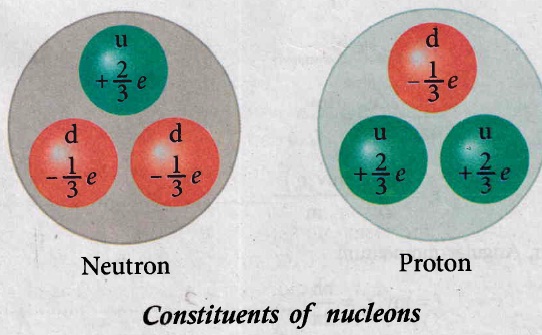
(ix) All these quarks have fractional charges. For example, charge of up quark is + \(\frac23\) e and that of down quark is \(\frac13\) e.
(x) According to quark model, proton is made up of two up quarks and one down quark and neutron is made up of one up quark and two down quarks.
9.
Fundamental forces of nature:
(i) It is known that there exists gravitational force between two masses and it is universal in nature. Our planets are bound to the Sun through gravitational force of the Sun.
(ii) ''Force is the external agency applied on a body to change its state of rest and motion"
There are four basic forces in nature.
(a) Gravitational force
(b) Electromagnetic force
(c) Strong nuclear force
(d) Weak nuclear force.
(a) Gravitational force :
(i) It is the force between any two objects in the universe.
(ii) It is an attractive force by virtue of their masses
(iii) By Newton's law of gravitation, the gravitational force is directly proportional to the product of the masses and inversely proportional to the square of the distance between them.
(iv) Gravitational force is the weakest force among the fundamental forces of nature but has the greatest large-scale impact on the universe.
(v) Unlike the other forces, gravity works universally on all matter and energy, and is universally attractive.
(b) Electromagnetic force :
(i) It is the force between charged particles or the force between two current carrying wires.
(ii) It is attractive for unlike charges and repulsive for like charges.
(iii) The electromagnetic force obeys inverse square law.
(iv) It is very strong compared to the gravitational force.
(v) It is the combination of electrostatic and magnetic forces.
(c) Strong nuclear force :
(i) It is the strongest of all the basic forces of nature.
(ii) It, however, has the shortest range, of the order of 10-15 m.
(iii) This force holds the protons and neutrons together in the nucleus of an atom.
(d) Weak nuclear force :
(i) Weak nuclear force is even shorter in range than nuclear force.
(ii) This force plays an important role in beta decay and energy production of stars
(iii) During the fusion of hydrogen into helium in sun, neutrinos and enormous radiations are produced through weak force.
(iv) In our day to - day life, we require these four fundamental forces.
To put it in simple words :
(a) we are in the Earth because of Earth's gravitational attraction on our body.
(b) We are standing on the surface of the earth because of the electromagnetic force between atoms of the surface of the earth with atoms in our foot.
(c) The atoms in our body are stable because of strong nuclear force.
(d) Finally, the lives of species in the earth depend on the solar energy from the sun and it is due to weak force which plays vital role during nuclear fusion reactions going on in the core of the sun.
10.
(i) The application of beta decay is radioactive dating or carbon dating.
(ii) Using this technique, the age of an ancient object can be calculated.
(iii) All living organisms absorb carbon dioxide (CO2) from air to synthesize organic molecules.
(iv) In this absorbed CO2, the major part is \(_{ 6 }^{ 12 }{ C }\) and very small fraction (1.3 x 10⁻¹²) is radioactive \(_{ 6 }^{ 14 }{ C }\)whose half-life is 5730 years
(v) Carbon-14 in the atmosphere is always decaying but at the same time, cosmic rays from outer space are continuously bombarding the atoms in the atmosphere which produces \(_{ 6 }^{ 14 }{ C }\)
(v) So the Continuous production and decay of \(_{ 6 }^{ 14 }{ C }\) in the atmosphere keep the ratio of \(_{ 6 }^{ 14 }{ C }\) always constant.
(vi) Since our human body, tree or any living organism continuously absorbs CO2 from the atmosphere, the ratio of \(_{ 6 }^{ 14 }{ C }\) to \(_{ 6 }^{ 12 }{ C }\) in the living organism is also nearly constant.
(vii) But when the organism get dies, it stops absorbing CO2
(viii) Now \(_{ 6 }^{ 14 }{ C }\) starts to decay, the ratio of \(_{ 6 }^{ 14 }{ C }\) to \(_{ 6 }^{ 12 }{ C }\) in a dead organism or specimen decreases over the years.
(ix) Suppose the ratio of \(_{ 6 }^{ 14 }{ C }\) to \(_{ 6 }^{ 12 }{ C }\) in the ancient tree pieces excavated is known, then the age of the tree pieces can be calculated.
11.
The neutrino has the following properties:
(i) It has zero charge
(ii) It has an antiparticle called anti-neutrino
(iii) Recent experiments showed that the nutrino has very small mass.
(iv) It interacts very weakly with the matter therefore, it is very difficult to detect it.
(v) In every second trillion of neutrino coming from the sun are passing through our body without any interaction.
Initially, it was thought that during beta decay, a neutron in the parent nucleus is converted to the daughter nuclei by emitting only electron as given by
\({ }_{\mathrm{Z}}^{\mathrm{A}} \mathbf{X} \rightarrow \underset{\mathrm{Z}+1}{\mathrm{~A}} \mathbf{Y}+\mathrm{e}^{-}\)
(i) But the kinetic energy of electron coming out of the nucleus did not match with the experimental results.
(ii) In beta decay, the beta particle (i.e, electron) have a continuous range of energies. But the conservation of energy and momentum gives specific single values for electron energy and the recoiling nucleus Y It seems that the conservation of energy, momentum is violated and could not be explained. So beta decay remained as a puzzle for several years.
(iii) But later w. Pauli proposed a third particle which must be present in beta decay to carry away missing energy and momentum.
(iv) Fermi later named this particle the neutrino.
(v) Finally, the neutrino was detected experimentally in 1956 by Fredrick Reines and Clyde Cowan.
12.
(i) In \(\alpha \text { and } \beta \) decay, most of the daughter nucleus is in the excited state.
(ii) The life time of excited state is approximately 10-11 s.
(iii) This excited state nucleus immediately returns to the ground state or lower energy state by emitting highly energetic photons called rays of energy in order of MeV.
The gamma decay is given by,
\({ }_{\mathrm{Z}}^{\mathrm{A}} \mathrm{X}^{*} \rightarrow{ }_{\mathrm{Z}}^{\mathrm{A}} \mathrm{X}+\gamma-\text { ray }\)
(iv) Here the asterisk(*) means excited state nucleus.
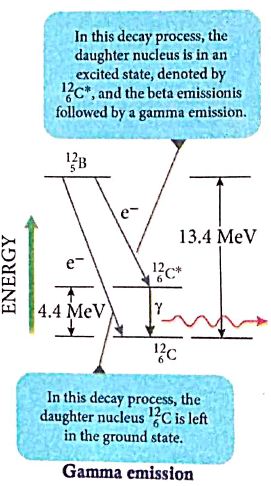
(a) In gamma decay, there is no change in the mass number or atomic number of the nucleus. when \({ }_{5}^{12} \mathrm{~B}\) undergoes beta decay directly into ground state carbon (\(_{ 6 }^{ 12 }{ C})\) by emitting an electron of maximum of energy 13.4 MeV.
(b) If \({ }_{5}^{12} \mathrm{~B}\) undergoes beta decay to an excited state of carbon \(({ _{ 6 }^{ 12 }{ C } }^{ * })\) by emitting an electron of maximum energy 9.0 MeV followed by gamma decay to ground state by emitting a photon of energy 4.4 MeV. It is represented by,
\(_{ 5 }^{ 12 }{ B }\rightarrow _{ 6 }^{ 12 }{ C+ }{ e }^{ - }+\overline { v } \)
\(_{ 6 }^{ 12 }{ C^* }\rightarrow _{ 6 }^{ 12 }{ C }+\gamma -rays\)
13.
(i) In beta decay, a radioactive nucleus emits either electron or positron. If electron (e-) is emitted, it is called β- decay and if positron (e+) is emitted, it is called β- decay
(ii) The positron is an anti-particle of an electron whose mass is same as that of electron and charge is opposite to that of electron - that is, +e. Both positron and electron are referred to as beta particles.
β- decay:
(iii) β- decay: In β- decay, the atomic number of the nucleus increases by one but mass number remains the same. This decay is represented by
\(_{ Z }^{ A }{ X }\rightarrow _{ Z+1 }^{ A }{ Y+ }{ e }^{ - }+\bar { v } \) ...(1)
(iv) It implies that the element X becomes Y by giving out an electron and antineutrino (⊽).
(v) In other words, In each β- decay, one neutron (n) in the nucleus of X is converted into a proton(p) by emitting an electron (e-) and antineutrino(⊽). It is given by
\(n\rightarrow p+{ e }^{ - }+\bar { v } \)
Example :
\(_{ 6 }^{ 14 }{ C }\rightarrow _{ 7 }^{ 14 }{ N+ }{ e }^{ - }+\overline { v } \)
β+ decay:
(vi) In β+ decay, the atomic number is decreased by one and the mass number remains the same. This decay is represented by
\(_{ Z }^{ A }{ X }\rightarrow _{ Z-1 }^{ A }{ Y+ }{ e }^{ + }+v\)
(vii) It implies that the element X becomes Y by giving out an positron (e+) and neutrino (v),
In otherwords, in each β+ decay, one proton(p) in the nucleus of X is converted into a neutron by emitting a positron (e+) and a neutrino. It is given by
\(p\rightarrow n+{ e }^{ +}+{ v } \)
Example:
\(_{ 11 }^{ 22 }{ Na }\rightarrow _{ 10 }^{ 22 }{ Ne }+{ e }^{ + }+v\)
(viii) However a single proton (not inside any nucleus) cannot have β+ decay due to energy conservation, because neutron mass is larger than proton mass.
(ix) But a single neutron (not inside any nucleus) can have β- decay.
(x) It is important to note that the electron or positron which comes out from nuclei during beta decay never present inside the nuclei rather they are produced during the conversion of neutron into proton or proton into neutron inside the nucleus.
14.
(i) When unstable nuclei decay by emitting an \(\alpha\) - particle (\(_{ 4 }^{ 2 }{ He }\) nucleus), it loses two protons and two neutrons. As a result, its atomic number Z decreases by 2, the mass number decreases by 4.
\(_{ Z }^{ A }{ X }\rightarrow _{ Z-2 }^{ A-4 }{ Y+ }_{ 2 }^{ 4 }{ He }\)
(ii) X is called the parent nucleus and Y is called the daughter nucleus.
Example : when uranium \(_{ 92 }^{ 238 }U\) emit (α - particle) it is converted into thorium \(_{ 90 }^{ 234 }{ Th }\) .
\(_{ 92 }^{ 238 }{ U\rightarrow }_{ 90 }^{ 234 }{ Th }+_{ 2 }^{ 4 }{ He }\)
(iii) Total mass of the daughter nucleus and \({ }_{2}^{4} \mathrm{He}\) nucleus is always less than that of parent nucleus.
(iv) The difference in mass \(\left(\Delta m=m_{X}-m_{Y}-m_{\alpha}\right)\) is released as energy called disintegration energy Q
\(\mathrm{Q}=\Delta \mathrm{m} \times \mathrm{c}^{2}=\left(\mathrm{m}_{\mathrm{X}}-\mathrm{m}_{\mathrm{Y}}-\mathrm{m}_{\alpha}\right) \mathrm{c}^{2}\)
(v) For spontaneous decay (natural radioactivity) Q > 0. In alpha decay process.
(a) The disintegration energy is positive (Q > 0).
(i) if the parent nucleus is not at rest, Q is equal to the net kinetic energy gained in the decay process.
(ii) if the parent nucleus is at rest, Q is equal to the total kinetic energy of daughter nucleus and the \({ }_{2}^{4} \mathrm{He}\) nucleus.
(b) The disintegration energy is negative (Q < 0).
The decay process cannot occur spontaneously and energy must be supplied to induce the decay.
15.
(i) The strong nuclear force is of very short range, acting only up to a distance of a few Fermi. But inside the nucleus, the repulsive Coulomb force or attractive gravitational forces between two protons are much weaker than the strong nuclear force .between two protons. Similarly, the gravitational force between two neurons is. also much weaker than strong nuclear force between the neutrons. So nuclear force is the strongest force in nature.
(ii) The strong nuclear force is attractive and acts with an equal strength between proton-proton, proton-neutron, and neutron-neutron.
(iii) Nuclear force does not act on the electrons. So it does not alter the chemical properties of the atom.
16.
The average binding energy per nucleon is the energy required to separate single nucleon from the particular nucleus.
\(\overline{\mathrm{BE}}=\frac{\left[\mathrm{Zm}_{\mathrm{H}}+\mathrm{Nm} _{\mathrm{n}}-\mathrm{M}_{\mathrm{A}}\right] \mathrm{c}^{2}}{\mathrm{~A}}\)
\(\overline { BE } \) is plotted against A of all known nuclei.
Important inferences from the average binding energy curve:
(i) The value of \(\overline { BE } \) rises as the mass number increases until it reaches a maximum value of 8.8 MeV for A = 56 (iron) and then it slowly decreases.
(ii) The average binding energy per nucleon is about 8.5 MeV for nuclei having mass number between A = 40 and 120. These elements are comparatively more stable and not radioactive.
(iii) For higher mass numbers, the curve reduces slowly and \(\overline { BE } \) for uranium is about 7.6 MeV. They are unstable and radioactive.
(iv) From Figure, If two light nuclei with A<28 combine with a nucleus with A<56, the binding energy per nucleon is more for final nucleus than initial nuclei. Thus, if the lighter elements combine to produce a nucleus of medium value A, a large amount of energy will be released. This is the basis of nuclear fusion and is the principle of the hydrogen bomb.
(v) If a nucleus of heavy element is split (fission) into two or more nuclei of medium value A, the energy released would again be large. The atom bomb is based on this principle and huge energy of atom bombs comes from this fission when it is uncontrolled.
17.
The electrostatic force is a conservative force, the potential energy for the electron in nth orbit is
\(U_{n} =\frac{1}{4 \pi \varepsilon_{0}} \frac{(+Z e)(-e)}{r_{n}}=-\frac{1}{4 \pi \varepsilon_{0}} \frac{Z^{2}}{r_{n}} \) \(\left[ \because r_n=\frac{\varepsilon_{0} h^{2} n^{2}}{\pi m Z e^{2}}\right]\)
\(U_{n} =-\frac{1}{4\varepsilon_{0}} -\frac{Z^{2} \mathrm{me}^{4}}{h^{2} n^{2}} \)
The kinetic energy of electron in nth orbit is
\(\mathrm{KE}_{\mathrm{n}}=\frac{1}{2} \mathrm{mv}_{\mathrm{n}}^{2}=\frac{\mathrm{Z}^{2} m \mathrm{e}^{4}}{8 \varepsilon_{0}^{2} \mathrm{~h}^{2} \mathrm{n}^{2}}\)
This implies that Un = -2KEn
Total energy of electron in the nth orbit is
\(E_{n}=K E_{n}+U_{n}=K E_{n}-2 K E_{n}=-K E_{n} \)
\(E_{n}=-\frac{Z^{2} m e^{4}}{8 \varepsilon_{0}^{2} h^{2} n^{2}} \)
For Hydrogen atom Z = 1
\(E_{n}=-\frac{m e^{4}}{8 \varepsilon_{0}^{2} h^{2} n^{2}} \text { joule }\)
n - principal quantum number
The negative sign indicates that the electron is bound to the nucleus.
Substituting the values of mass and charge of an electron (m and e), permittivity of free space \(\varepsilon^{0}\) and Planck's constant h and expressing in terms of (+(eV)), we get
\(E_{n}=-13.6\left(\frac{1}{n^{2}}\right) e V\)
(i) For the first orbit (ground state), the total energy of electron is E1 = - 13.6 eV.
(ii) For the second orbit (first excited state), the total energy of electron is E2 = -3.4 eV.
(iii) For the third orbit (second excited state), the total energy of electron is E3 = -1.51 eV and so on.

12th Standard Syllabus & Materials
12th Standard
TN 12th Computer Applications வலையமைப்பு வடமிடல் Sample Question Papers Study Material - QB365 Set A
NEW12th Standard
TN 12th Computer Applications களப்பெயர் முறைமை (DNS) Sample Question Papers Study Material - QB365 Set A
NEW12th Standard
TN 12th Computer Applications வலையமைப்பு எடுத்துக்காட்டுகள் மற்றும் நெறிமுறைகள் Sample Question Papers Study Material - QB365 Set A
NEW12th Standard
TN 12th Computer Applications கணினி வலையமைப்பு ஓர் அறிமுகம் Sample Question Papers Study Material - QB365 Set A



Tamilnadu Stateboard 12th Standard Subjects

Maths

Chemistry
Physics

Biology

Computer Science

Business Maths and Statistics

Economics

Commerce

Accountancy

History

Computer Applications
Biology
Computer Technology
Computer Applications
Computer Science
Business Maths and Statistics
Commerce
Economics
Maths
Chemistry
Physics
Computer Technology
History
Accountancy

Tamil

English

French
Tamilnadu Stateboard Standards

