
 100% FREE ACCESS
12th Standard Syllabus & Materials
12th Standard
TN 12th Computer Applications மின்னணு தரவு பரிமாற்றம் Sample Question Papers Study Material - QB365 Set A
NEW12th Standard
TN 12th Computer Applications மின் - வணிக பாதுகாப்பு அமைப்புகள் Sample Question Papers Study Material - QB365 Set A
NEW12th Standard
TN 12th Computer Applications மின்னணு செலுத்தல் முறைகள் Sample Question Papers Study Material - QB365 Set A
NEW12th Standard
TN 12th Computer Applications மின் - வணிகம் Sample Question Papers Study Material - QB365 Set A
NEW12th Standard
TN 12th Computer Applications திறந்த மூல கருத்துருக்கள் Sample Question Papers Study Material - QB365 Set A
NEW12th Standard
TN 12th Computer Applications வலையமைப்பு வடமிடல் Sample Question Papers Study Material - QB365 Set A

Published on: 27/01/2021
12th Standard Physics English Medium Atomic and nuclear Physics Reduced Syllabus Important Questions With Answer Key 2021
Download Tamil Nadu 12th Standard Physics question papers, model tests, one-mark questions, important questions, and public exam papers in PDF format. Free study materials and answer keys for TN State Board students.
Questions + Answers key
Take MCQ Physics Test1.
The explosion of hydrogen bomb is based on the principle of _________________.
uncontrolled fission reaction
nuclear fusion reaction
controlled fission
photo electric effect
2.
The moderator used in nuclear reactor is ________________.
Cadmium
Boron oxide
Heavy water
Uranium
3.
Pressurised heavy-water reactors in our country generally use _____ as fuel.
natural uranium oxide
radioactive phosphorous
titanium dioxide
plutonium
4.
β - rays are nothing but _______
protons
neutrons
electrons
helium
5.
α - rays consist of α - particles which are ______ nuclei.
hydrogen
helium
heavy water
boron
6.
In gamma ray emission from nucli _____________.
both the neutron number and the proton number change
there is no change in neutron number and the proton number change
only the neutron number changes
only the proton number changes
7.
Curie is a unit of _________________.
half life
intensity of nuclear radiation
energy of nuclear radiation
radioactivity
8.
The charge of an alpha-particle is _______________
same as that of a proton
twice as that of an electron
thrice as that of an proton
twice as that of a neutron
9.
J.J. Thomson discovered ________
protons
neutrons
electrons
quarks
10.
In a discharge tube, the source of positive rays is ________________.
cathode
anode
gas atoms present in the discharge tube
fluorescent screen
11.
The energy of a photon of characteristic X-ray from a Coolidge tubes comes from ___________.
the KE of the electron of the target
the K.E of ions of the target
the K.E of the striking electron
an atomic transition in the target
12.
A beam of electron posses undeflected through mutually perpendicular electric and magnetic fields. If the electric field is switched off and the same magnetic field is maintained, the electrons move ______________.
in a circular orbit
along a parabolic path
along a straight line
in an elliptical orbit
13.
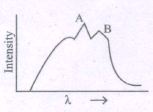
The fig. represents the observed intensity of X-rays emitted by an X-ray tube as a function of wavelength. The sharp peaks A and B denote ____________.
continuous spectrum
band spectrum
characteristic spectrum
white radiations
14.
The electric potential of an electron is given by \(V={ V }_{ 0 } \ In\left( \frac { r }{ { r }_{ 0 } } \right) \), where r0 is a constant. If Bohr atom model is valid, then variation of radius of nth orbit rn with the principal quantum number n is _____.
\({ r }_{ n }∝ \frac { 1 }{ n } \)
\({ r }_{ n }∝ n\)
\({ r }_{ n }∝\frac { 1 }{ { n }^{ 2 } } \)
\({ r }_{ n }∝ { n }^{ 2 }\)
15.
In a hydrogen atom, the electron revolving in the fourth orbit, has angular momentum equal to _____.
h
\(\frac{h}{\pi}\)
\(\frac{4h}{\pi}\)
\(\frac{2h}{\pi}\)
16.
What is a reactor core?
17.
Comment on the statement - "A nucleus contains to electrons and can eject them"
18.
The ground state energy of hydrogen atom is -13.6 eV. What are k.E & P.E of the electron in this state?
19.
What causes the sun to expand?
20.
What is the reason for using lighter nuclei as moderators?
21.
What is nuclear chain reaction?
22.
What is meant by radioactivity?
23.
What is isobar? Give an example.
24.
What is meant by excitation energy?
25.
Give the results of Rutherford alpha scattering experiment.
26.
A power reactor develops energy at the rate of 30,000 kW. How many gram of 235U would be consumed daily? Assuming that on an average 200 MeV energy is released per fission.
27.
In a fusion reactor, the reaction occurs in two stages.
(i) Two deuterium \((_{ 1 }^{ 2 }{ D) }\) nuclei fuse to form \((_{ 1 }^{ 3 }{ T) }\) a nucleus with a proton as a product.
(ii) A tritium nucleus fuses with another deuterium nucleus to form a helium (\(_{ 2 }^{ 4 }{ He }\)) nucleus with a neutron as another product.
Find (a) the energy released in each stage.
(b) the energy released in the combined reaction per deuterium and
(c) what percentage of the mass-energy of the initial deuterium is released?
Given :
\(_1^{ 2 }{ D}\) = 2.014102 u, \(_{ 1 }^{ 3 }{ T }\) = 3.016049 u; \(_{ 2 }^{ 4 }{ He }\) = 4.002603 u, \(_{ 1 }^{ 1 }{ H }\) = 1.007825; \(_0^{ 1 }{ n }\) = 1.008665 u, Take 1u = 931 MeV
28.
Two nuclei P, Q have equal number of atoms at t = 0. Their half-lives are 3 hours and 9 hours respectively. Compare their rates of disintegration, after 18 hours from the start.
29.
The half-life of radium is 1600 years. After how many years will one gram of the pure radium be reduced to one centigram?
30.
For a radioactive material, half-life period is 600s. If initially there are 600 number of molecules, find the time taken for disintegration of 450 molecules and the rate of disintegration.
31.
Write the application of alpha decay in smoke detectors.
32.
Explain the results of Rutherford α-particle scattering experiment.
33.
Discuss the spectral series of hydrogen atom.
34.
Explain the J.J. Thomson experiment to determine the specific charge of electron.
35.
With respect to power generation, what are the relative advantages and disadvantages of fusion type and Fission type reactors?
36.
Show that the decay rate 'R' of a sample of a radionuclide is related to the number of radioactive nuclei 'N' at the same instant by the expression R = λN.
37.
Write the properties of neutrino?
38.
Suppose the energy of an electron in hydrogen–like atom is given as En = \(-\frac { 54.4 }{ { n }^{ 2 } } eV\) where \(n \in \mathbb{N}\) . Calculate the following:
(a) Sketch the energy levels for this atom and compute its atomic number.
(b) If the atom is in ground state, compute its first excitation potential and also its ionization potential.
(c) When a photon with energy 42 eV and another photon with energy 51 eV are made to collide with this atom, does this atom absorb these photons?
(d) Determine the radius of its first Bohr orbit.
(e) Calculate the kinetic and potential energies of electron in the ground state.
39.
(a) Show that the ratio of velocity of an electron in the first Bohr orbit to the speed of light c is a dimensionless number.
(b) Compute the velocity of electrons in ground state, first excited state and second excited state in Bohr atom model for hydrogen atom.
40.
(a) A hydrogen atom is excited by radiation of wavelength 97.5 nm. Find the principal quantum number of the excited state
(b) Show that the total number of lines in emission spectrum is \(\frac { n(n-1) }{ 2 } \) Compute the total number of possible lines in emission spectrum as given in(a).
41.
Explain in detail the four fundamental forces in nature.
42.
Explain the idea of carbon dating.
43.
Discuss the alpha decay process with example.
1.
(b)
nuclear fusion reaction
2.
(c)
Heavy water
3.
(a)
natural uranium oxide
4.
(c)
electrons
5.
(b)
helium
6.
(a)
both the neutron number and the proton number change
7.
(d)
radioactivity
8.
(b)
twice as that of an electron
9.
(c)
electrons
10.
(c)
gas atoms present in the discharge tube
11.
(d)
an atomic transition in the target
12.
(a)
in a circular orbit
13.
(c)
characteristic spectrum
14.
Electric potential in nth orbit
\(\mathrm{V} =\mathrm{V}_0 \ln \left(\frac{\mathrm{r}_{\mathrm{n}}}{\mathrm{r}_0}\right) \)
\(=\mathrm{V}_0\left(\ln \mathrm{r}_{\mathrm{n}}-\ln \mathrm{r}_0\right) \)
\(=\mathrm{V}_0 \ln \mathrm{r}_{\mathrm{n}}-\mathrm{V}_0 \ln \mathrm{r}_0\)
\(\left|\mathrm{F}_\epsilon\right|=\mathrm{e} \frac{\mathrm{dv}}{\mathrm{dr}} =\mathrm{e} \frac{\mathrm{d}}{\mathrm{dr}}\left(\mathrm{V}_b / n \mathrm{r}_B-\mathrm{V}_0 / m \mathrm{r}_0\right) \)
\(=\mathrm{c}\left(\frac{\mathrm{V}_0}{\mathrm{r}_n}-0\right)=\frac{\mathrm{eV}}{\mathrm{r}_{\mathrm{n}}} \)
Centripetal force = coulomb force
\(\frac{m v^2}{r_n}=\mathrm{c} \frac{V_0}{r_n} \Rightarrow v=\sqrt{\frac{e V_0}{m}}=\text { constant }\)
Angular momentum,
\(\mathrm{mvr}_n=\frac{\mathrm{nh}}{2 \pi}\)
\(\mathrm{m}, \mathrm{v}, \mathrm{h}, 2 \pi\) are constants
hence, rn ∝ n
15.
\(L=\frac{nh}{2\pi}=\frac{4h}{2\pi}=\frac{2h}{\pi}\)
16.
The fuel bundles which consist of tiny pellets of uranium oxide are placed in calandria reactor vessel. The part of the reactor vessel which contains the fuel rod is known as reactor core.
17.
It is true that a nucleus contains no electrons as such. However, in the process of -decay, a neutron breaks up as follows.
\(_{ 0 }^{ 1 }{ n\rightarrow }_{ 1 }^{ 1 }{ H+ }_{ -1 }^{ 0 }{ e }+\overline { v } \)
18.
K.E of the electron = 13.6 eV
P.E is equal to twice its K.E
P.E of the electron = -13.6 x 2 = -27.2 eV
19.
When the hydrogen is burnt out, the sun will enter into a new phase called the red giant where helium will fuse to become carbon. During this stage, the sun will expand greatly in size and all its planets will be engulfed in it
20.
The moderator is a material used to convert fast neutrons into slow neutrons
(i) A billiard ball striking a stationary billiard ball of equal mass would itself be stopped but the same billiard ball bounces off almost with same speed when it strikes a heavier mass.
(ii) This is the reason for using lighter nuclei as moderators.
21.
A nuclear reaction in which the neutron used to carry out the nuclear fission reaction gets multiplied as more and more such fission reaction take place is called a nuclear chain reaction.
22.
The phenomenon of spontaneous emission of highly penetrating radiations such as α, β and ⋎ rays by an element is called radioactivity and the substances which emit these radiations are called radioactive elements.
23.
Isobars are the atoms of different elements having the same mass number A, but different atomic number Z.
Example: \({ }_{16}^{40} \mathrm{~S},{ }_{17}^{40} \mathrm{Cl},{ }_{18}^{40} \mathrm{Ar}\)
24.
The energy required to excite an electron from lower energy state to any higher energy state is known as excitation energy.
25.
(i) Most of the alpha particles are un-deflected through the gold foil and went straight.
(ii) Some of the alpha particles are deflected through a small angle.
(iii) A few alpha particles (one in thousand) are deflected through the angle more than 90o.
(iv) Very few alpha particles returned back (ie) deflected back by 180o.
26.
Number of atoms undergoing fission per second
\(\frac { 3\times { 10 }^{ 7 } }{ 200\times L6\times { 10 }^{ -13 } } =0.9375\times { 10 }^{ 18 }\)
= Number of atoms undergoing fission in 24 hours = 0.9375 x 1018X 24 x 3600 = 0.81 x 10²³.
∴ Mass of uranium undergoing fission
= \(\frac { 235 }{ 6.023\times { 10 }^{ 23 } } \times 0.81\times { 10 }^{ 23 }=31.6g\)
27.
a) \(_{ 1 }^{ 2 }{ D+ }_{ 1 }^{ 2 }{ D }\rightarrow _{ 1 }^{ 3 }{ T+ }_{ 1 }^{ 1 }{ H }+Q\)
∴ Q1 = 0.00433 x 931 MeV
= 4.031 MeV.
\(_{ 1 }^{ 3 }{ T }+_{ 1 }^{ 2 }{ D }\rightarrow _{ 2 }^{ 4 }{ He+ }_{ 0 }^{ 1 }{ n }+{ Q }_{ 2 }\)
∴ Q2 = 0.01888 x 931 MeV
= 17.577 MeV.
(b) Energy released per deuterium nucleus
\(=\frac { 2161 }{ 3 } =7.203MeV\)
(c) Percentage of the rest mass of deuterium released
\(=\frac { 7.203 }{ (2.014102\times 931)MeV } =0.384 \%\)
28.
Number of half-lives of P in 18 \(h=\frac { 18 }{ 3 } =6\)
Number of nuclei of P left undecayed after 6 half-lives
\({ N }_{ 1 }=N{ \left( \frac { 1 }{ 2 } \right) }^{ 6 }\)
Number of half-lives of Q in 18 \(h=\frac { 18 }{ 3 } =6\)
Number of nuclei of Q left undecayed after 2 half-lives
\({ N }_{ 2 }=N{ \left( \frac { 1 }{ 2 } \right) }^{ 2 }\)
\(\frac { { R }_{ 1 } }{ { R }_{ 2 } } =\frac { { \lambda }_{ 1 }{ N }_{ 1 } }{ { \lambda }_{ 2 }{ N }_{ 2 } } =\frac { { T }_{ 2 }{ N }_{ 1 } }{ { T }_{ 1 }{ N }_{ 2 } } \left[ \therefore T=\frac { 0.693 }{ \lambda } \right] \)
\(=\frac { 9 }{ 3 } \times \frac { N{ \left( \frac { 1 }{ 2 } \right) }^{ 6 } }{ { N\left( \frac { 1 }{ 2 } \right) }^{ 2 } } =\frac { 3 }{ 16 } =3.16\)
29.
\(\frac { { N }_{ 0 } }{ N } ={ 2 }^{ t/T }\)
(or) 102 = 2t/1600
\(\frac { 1 }{ { 10 }^{ -2 } } ={ 2 }^{ t/1600 }\)
(or) \(2{ log }_{ 10 }10=\frac { t }{ 1600 } { log }_{ 10 }2\)
(or) \(t=\frac { 2\times 1600 }{ { log }_{ 10 }2 } =\frac { 3200 }{ 0.3010 } =10631.2\) = years
30.
The initial number of molecules, No = 150
The final number of molecules, N = 150
\(\frac { N }{ { N }_{ 0 } } ={ \left( \frac { 1 }{ 2 } \right) }^{ n } \ or \ \frac { 150 }{ 600 } ={ \left( \frac { 1 }{ 2 } \right) }^{ n }\)
\({ \left( \frac { 1 }{ 2 } \right) }^{ 2 }={ \left( \frac { 1 }{ 2 } \right) }^{ n } \ or \ n=2=\frac { t }{ { T }_{ 1/2 } } \)
t = 2 x 600 s = 1200 s
Best of disintegration,
\(R=\frac { dN }{ dt } =-\lambda N\)
\(=\frac { 0.693 }{ { T }_{ 1/2 } } \times 150\)
\(=\frac { 0.693 }{ { 600} } \times 150\) = 0.173
disintegration/second at the instant when 150 molecules were remaining.
31.
(i) The smoke detector uses around 0.2 mg of a man-made weak radioactive isotope called americium \((_{ 95 }^{ 241 }{ Am })\)
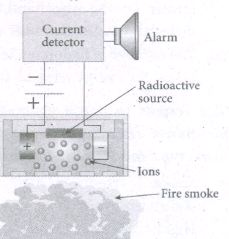
(ii) This radioactive source is placed between two oppositely charged metal plates and α radiations from \(_{ 95 }^{ 241 }{ Am }\) continuously ionize the nitrogen, oxygen molecules in the air space between the plates
(iii) As a result, there will be a continuous flow of small steady currents in the circuit.
(iv) If smoke enters, the radiation is being absorbed by the smoke particles rather than air molecules.
(v) As a result, the ionization and along with it the current is reduced. This drop-in current is detected by the circuit and the alarm starts.
(vi) The radiation dosage emitted by americium is very much less than the safe level, so it can be considered harmless.
32.
(i) In 1911, Geiger and Marsden did a remarkable experiment based on the advice of their teacher Rutherford, which is known as the scattering of alpha particles by gold foil.
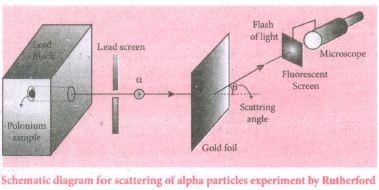
(ii) The experimental arrangement. A source of alpha particles (radioactive material, for example, polonium) is kept inside a thick lead box, with a fine hole.
(iii) The alpha particles coming through the fine hole of the lead box pass through another fine hole made on the lead screen. These particles are now allowed to fall on a thin gold foil and it is observed that the alpha particles passing through gold foil are scattered through different angles.
(iv) A movable screen (from 0° to 180°) which is made up of zinc sulphide (ZnS) is kept on the other side of the gold foil to collect the alpha particles. Whenever alpha particles strike the screen, a flash of light is observed which can be seen through a microscope.
(v) Rutherford proposed an atom model based on the results of alpha scattering. experiment.
(vi) In this experiment, alpha particles (positively charged particles) are allowed to fall on the atoms of a metallic gold foil. The results of this experiment. Rutherford expected the nuclear model, but the experiment showed the model.
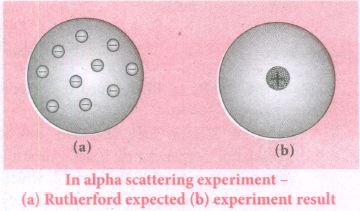
(a) Most of the alpha particles were un-deflected through the gold and went straight.
(b) Some of the alpha particles are deflected through a small angle.
(c) A few alpha particles (one in a thousand) are deflected through an angle more than 90°.
(d) Very few alpha particles returned back (backscattered) that is, deflected back by 180°.
33.
When electron jumps from higher energy stationary orbit (m) to lower energy stationary orbit (n), emit radiation.
Wave number (or) Wave length of the emitted radiation is given by,
\(\frac{1}{\lambda}=R\left[\frac{1}{n^{2}}-\frac{1}{m^{2}}\right]=\bar{v}\)
V - Ware number; R- Rydberg constant = 1.09737 x 10⁷ m-1
m > n (where m, n are integers)
(a) Lyman series:
When electron jumps from any outer orbit to first orbit, (n = 1 and m = 2,3,4.......) the wave number or wavelength of spectral lines lies in ultra-violet region is
\(\bar{v}=\frac{1}{\lambda}=\mathrm{R}\left[\frac{1}{1^{2}}-\frac{1}{\mathrm{~m}^{2}}\right]\)
(b) Balmer series:
Wher electron jumps from any outer orbit to second orbit, (n = 2 and m = 3, 4, 5.......) the wave number or wavelength of spectral lines lies in visible region is,
\(\bar{v}=\frac{1}{\lambda}=R\left[\frac{1}{2^{2}}-\frac{1}{m^{2}}\right]\)
(c) Paschen series:
When electron jumps from any outer orbit to third orbit, (n = 3 and m = 4, 5, 6.......) the wave number or wavelength of spectral lines lies in infra red (Near IR) region is
\(\bar{v}=\frac{1}{\lambda}=R\left[\frac{1}{3^{2}}-\frac{1}{m^{2}}\right]\)
(d) Bracket series:
When electron jumps from any outer orbit to fourth orbit, (n = 4 and m = 5, 6, 7.......) the wave number or wavelength of spectral lines lies in infra red (Middle IR) region is
\(\bar{v}=\frac{1}{\lambda}=R\left[\frac{1}{4^{2}}-\frac{1}{m^{2}}\right]\)
(e) Pfund series:
When electron jumps from any outer orbit to fifth orbit, (n - 5 and m = 6, 7, 8.......) the wave number or wavelength of spectral lines lies in infra red (far IR) region is
\(\bar{v}=\frac{1}{\lambda}=R\left[\frac{1}{5^{2}}-\frac{1}{m^{2}}\right]\)
34.
Principle:
Cathode rays are deflected in electric and magnetic fields.
By the variation of electric and magnetic fields, mass normalized charge or the specific charge (charge per unit mass) of the cathode rays is measured.
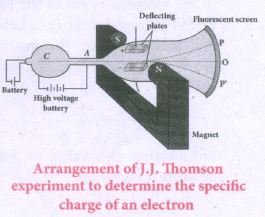
Construction and Working:
(i) Cathode rays (electron beam) produced at cathode of a highly evacuated discharge tube. Cathode rays are attracted towards anode disc A.
(ii) Pin hole in the anode disc allows only a narrow beam of cathode rays.
(iii) These cathode rays are now allowed to pass through the parallel metal plates, maintained at high voltage.
(iv) Further, discharge tube is kept in between pole pieces of magnet.
(v) Electric and magnetic fields are perpendicular to each other.
(vi) When the cathode rays strike the zinc sulphide coated screen (O), produces scintillation and hence bright spot is observed.
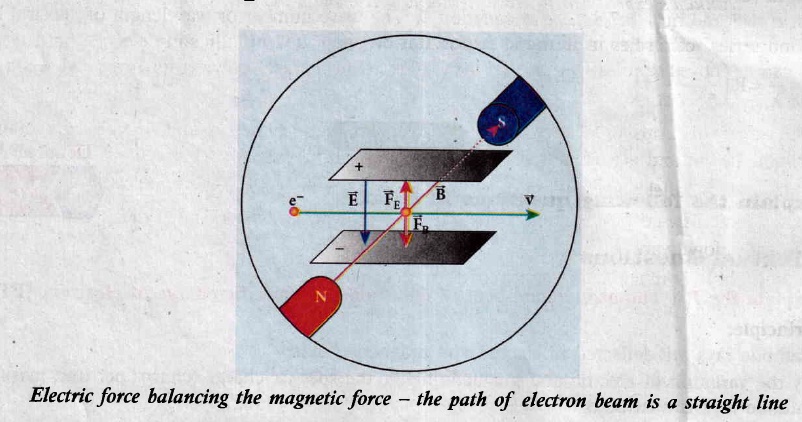
(i) Determination of velocity of cathode rays:
(a) For a fixed electric field between the plates, the magnetic field is adjusted such that the cathode rays (electron beam) strike at the original position O.
(b) This means that the magnitude of electric force is balanced by the magnitude of force due to magnetic field.
(ie) Ee = Bev
\(\Rightarrow v=\frac { E }{ B } \) ...(1)
(ii) Determination of specific charge:
(a) Since accelerated from cathode to anode, the potential energy of the electron beam at the cathode is converted into kinetic energy of the electron beam at the anode.
(b) Let V be the potential difference between anode and cathode, then the potential energy is eV.
Then from law of conservation of energy,
\(eV=\frac { 1 }{ 2 } { mv }^{ 2 } \)
\(\frac { e }{ m } =\frac { { v }^{ 2 } }{ 2V } \) ....(2)
Substituting (1) in (2),
\(\frac { e }{ m } =\frac { 1 }{ 2V } \frac { { E }^{ 2 } }{ { B }^{ 2 } } \)
By substituting known values, we get
\(\frac { e }{ m } =1.7\times { 10 }^{ 11 }{ CKg }^{ -1 }\)
The specific charge \(\frac{\mathrm{e}}{\mathrm{m}}\) is independent of (a) gas used (b) nature of the electrodes
35.
(i) Fusion requires high temperature controlled reaction is not yet obtained. Highly sophisticated technology will be required.
(ii) However, the fuel is easily available, cheap and causes very less pollution.
(iii) There is no problem of waste management.
(iv) Fission controlled chain reaction is possible. The technology is well developed and established.
(v) There also exists the problem of waste management.
36.
Rate of disintegration of a radioactive sample,
R = \(\frac{dN}{dt}\)
According to radioactive decay law
- \(\frac{dN}{dt}\) ∝ N
- \(\frac{dN}{dt}\) = λN or R = λN
37.
The neutrino has the following properties
(i) It has zero charge
(ii) It has an antiparticle called anti-neutrino.
(iii) Recent experiments showed that the neutrino has very tiny mass
(iv) It interacts very weakly with the matter. Therefore, it is very difficult to detect In fact, in every second, trillions of neutrinos coming from the sun are passing through our body without any interaction.
38.
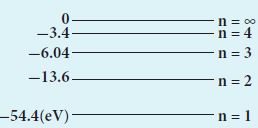
(a) Given that En = \(\frac { 54.4 }{ { n }^{ 2 } } eV\)
For n = 1, the ground state energy E1 = –54.4 eV and for n = 2, E2 = –13.6 eV. Similarly, E3 = –6.04 eV, E4 = –3.4 eV and so on.
For large value of principal quantum number – that is, n = ∞, we get E∞ = 0 eV.
(b) For a hydrogen-like atom, ground state energy is
E1 =\(\frac { 13.6 }{ { n }^{ 2 } } { Z }^{ 2 }eV\)
where Z is the atomic number. Hence, comparing this energy with given energy, we get, – 13.6 Z2 = – 54.4 ⇒ Z = ±2. Since, atomic number cannot be negative number, Z = 2.
(c) The first excitation energy is
E1 = E2 - E1 = -13.6 eV - (-54.4eV)
= 40.8 eV
Hence, the first excitation potential is
\({ V }_{ 1 }=\frac { 1 }{ e } { E }_{ 1 }=\frac { (40.8eV) }{ e } \)
= 40.8 volt
The first ionization energy is
Eionization = E∞ - E1 = 0 -(-54.4eV)
= 54.4 eV
Hence, the first ionization potential is
\({ V }_{ ionization }=\frac { 1 }{ e } { E }_{ ionization }=\frac { (54.4eV) }{ e } \)
= 54.4 volt
(d) Consider two photons to be A and B.
Given that photon A with energy 42 eV and photon B with energy 51 eV
From Bohr assumption, difference in energy levels is equal to photon energy, then atom will absorb energy, otherwise, not.
E2 - E1 = -13.6eV - (-54.4eV)
= 40.8eV ≈ 41 eV
Similarly,
E3 - E1 = -6.04 eV - (-54.4eV)
= 48.36 eV
E4 - E1 = -3.4eV - (-54.4eV)
= 51 eV
E3 - E2 = -6.04eV - (-13.6eV)
= 7.56 eV
and so on.
But note that E2 – E1 ≠ 42 eV, E3 – E1 ≠ 42 eV, E4 – E1 ≠ 42 eV and E3 – E2 ≠ 42 eV
For all possibilities, no difference in energy is an integer multiple of photon energy. Hence, photon A is not absorbed by this atom. But for Photon B, E4 – E1 = 51 eV, which means, Photon B can be absorbed by this atom
(d) The radius of Bohr orbit is \(r_n=\frac { a_o\times n^2 }{ z }\)
For n = 1, z = 2
\(r_1=\frac { a_o }{ 2 }\)
\(=\frac { 0.529 }{ 2 }\)
= 0.265 Å
(e) Since total energy is equal to negative of kinetic energy in Bohr atom model, we get
\(K{ E }_{ n }=-{ E }_{ n }=-\left( -\frac { 54.4 }{ { n }^{ 2 } } eV \right) \)
\(=-\frac { 54.4 }{ { n }^{ 2 } } eV\)
Since, potential energy is negative of twice the kinetic energy,
\( U_{ n }=-2K{ E }_{ n }=-2\left( -\frac { 54.4 }{ { n }^{ 2 } } eV \right) \)
\(=-\frac { 108.8 }{ { n }^{ 2 } } eV\)
For a ground state, put n = 1
Kinetic energy is KE1 = 54.4 eV and Potential energy is U1 = –108.8 eV
39.
(a) The velocity of an electron in nth orbit is
\(\upsilon _{ n }=\frac { h }{ 2\pi m{ a }_{ 0 } } \frac { Z }{ n } \)
Where \({ a }_{ 0 }=\frac { { \epsilon }_{ 0 }{ h }^{ 2 } }{ \pi { me }^{ 2 } } \) = Bohr radius. Substituting for a0 in ሀn,
\({ \upsilon }_{ n }=\frac { { e }^{ 2 } }{ 2{ \epsilon }_{ 0 }h } \frac { Z }{ n } =c\left( \frac { { e }^{ 2 } }{ 2{ \epsilon }_{ 0 }hc } \right) \frac { Z }{ n } =\frac { \alpha cZ }{ n } \)
where c is the speed of light in free space or vacuum and its value is c = 3 x 10⁸ m s–1 and α is called fine structure constant.
For a hydrogen atom, Z = 1 and for the first orbit, n = 1, the ratio of velocity of electron in first orbit to the speed of light in vacuum or free space is
\(\frac { { \upsilon }_{ 1 } }{ c } =\alpha =\frac { { e }^{ 2 } }{ 2{ \epsilon }_{ 0 }hc } \)
\(\alpha =\frac { { (1.6\times { 10 }^{ -19 }C })^{ 2 } }{ 2\times (8.854\times { 10 }^{ -12 }{ C }^{ 2 }{ N }^{ -1 }{ m }^{ -2 }) } \) x \(\frac { 1 }{ (6.6\times { 10 }^{ -34 }{ Nms)\times (3\times { 10 }^{ 8 } }{ ms }^{ -1 }) } \)
≈ \(\frac{1}{136.9}=\frac{1}{137}\) which is a dimensionless number
⇒ α = \(\frac{1}{137}\)
(b) Using fine structure constant, the velocity of electron can be written as vn = \(\frac{αcZ}{n}\)
For hydrogen atom (Z = 1) the velocity of electron in nth orbit is vn = \(\frac{c}{137}\frac{1}{n}=(2.19\times10^6)\frac{1}{n}ms^{-1}\)
For the first orbit (ground state), the velocity of electron is v1 = 2.19 x 10⁶ms−1
For the second orbit (first excited state), the velocity of electron is v2 = 1.095 x 10⁶ms−1
For the third orbit (second excited state), the velocity of electron is v3 = 0.73 x 10⁶ms−1
Here, v1 > v2 > v3
40.
Wavelength of incident radiation = 97.5 nm = 97.5 x 10⁻⁹ m
Energy of hydrogen atom in its ground state = -13.6 eV
(a) Principal quantum number n = ?
(b) (i) Number of possible transitions = ?
(ii) Total number possible lines = ?
(a) Energy absorbed by Hydrogen atom
\(E=\frac{h c}{\lambda}=\frac{6.6 \times 10^{-34} \times 3 \times 10^{8}}{97.5 \times 10^{-9}} \mathrm{~J} \)
\(E=\frac{h c}{\lambda}=\frac{6.6 \times 10^{-34} \times 3 \times 10^{8}}{97.5 \times 10^{-9} \times 1.6 \times 10^{-19}} \mathrm{eV} \)
E = 12.74 eV
Energy of the electron in first orbit of Hydrogen is -13.6 ev
En = -13.6 + 12.74 = -0.86 eV
We know that
\(\mathrm{E}_{\mathrm{n}} =-\frac{13.6}{\mathrm{n}^{2}} \)
\(-0.86 =-\frac{13.6}{\mathrm{n}^{2}} \)
\(\mathrm{n}^{2} =15.88 \)
\(\mathrm{n} \cong 4 \)
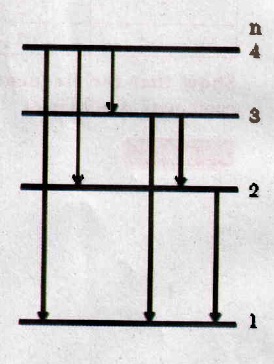
(b) (i) By using arithmetic progression, For the principle quantum number "n",
Total number of possible transition form level n is \(\frac{\mathrm{n}(\mathrm{n}-1)}{2}\)
(ii) Total number of possible transitions form level 4 is 3
Total number of possible transitions form level 3 is 2
Total number of possible transition form level 2 is 1
Hence total number of possible transitions is 3 + 2 + 1 = 6
41.
Fundamental forces of nature:
(i) It is known that there exists gravitational force between two masses and it is universal in nature. Our planets are bound to the Sun through gravitational force of the Sun.
(ii) ''Force is the external agency applied on a body to change its state of rest and motion"
There are four basic forces in nature.
(a) Gravitational force
(b) Electromagnetic force
(c) Strong nuclear force
(d) Weak nuclear force.
(a) Gravitational force :
(i) It is the force between any two objects in the universe.
(ii) It is an attractive force by virtue of their masses
(iii) By Newton's law of gravitation, the gravitational force is directly proportional to the product of the masses and inversely proportional to the square of the distance between them.
(iv) Gravitational force is the weakest force among the fundamental forces of nature but has the greatest large-scale impact on the universe.
(v) Unlike the other forces, gravity works universally on all matter and energy, and is universally attractive.
(b) Electromagnetic force :
(i) It is the force between charged particles or the force between two current carrying wires.
(ii) It is attractive for unlike charges and repulsive for like charges.
(iii) The electromagnetic force obeys inverse square law.
(iv) It is very strong compared to the gravitational force.
(v) It is the combination of electrostatic and magnetic forces.
(c) Strong nuclear force :
(i) It is the strongest of all the basic forces of nature.
(ii) It, however, has the shortest range, of the order of 10-15 m.
(iii) This force holds the protons and neutrons together in the nucleus of an atom.
(d) Weak nuclear force :
(i) Weak nuclear force is even shorter in range than nuclear force.
(ii) This force plays an important role in beta decay and energy production of stars
(iii) During the fusion of hydrogen into helium in sun, neutrinos and enormous radiations are produced through weak force.
(iv) In our day to - day life, we require these four fundamental forces.
To put it in simple words :
(a) we are in the Earth because of Earth's gravitational attraction on our body.
(b) We are standing on the surface of the earth because of the electromagnetic force between atoms of the surface of the earth with atoms in our foot.
(c) The atoms in our body are stable because of strong nuclear force.
(d) Finally, the lives of species in the earth depend on the solar energy from the sun and it is due to weak force which plays vital role during nuclear fusion reactions going on in the core of the sun.
42.
(i) The application of beta decay is radioactive dating or carbon dating.
(ii) Using this technique, the age of an ancient object can be calculated.
(iii) All living organisms absorb carbon dioxide (CO2) from air to synthesize organic molecules.
(iv) In this absorbed CO2, the major part is \(_{ 6 }^{ 12 }{ C }\) and very small fraction (1.3 x 10⁻¹²) is radioactive \(_{ 6 }^{ 14 }{ C }\)whose half-life is 5730 years
(v) Carbon-14 in the atmosphere is always decaying but at the same time, cosmic rays from outer space are continuously bombarding the atoms in the atmosphere which produces \(_{ 6 }^{ 14 }{ C }\)
(v) So the Continuous production and decay of \(_{ 6 }^{ 14 }{ C }\) in the atmosphere keep the ratio of \(_{ 6 }^{ 14 }{ C }\) always constant.
(vi) Since our human body, tree or any living organism continuously absorbs CO2 from the atmosphere, the ratio of \(_{ 6 }^{ 14 }{ C }\) to \(_{ 6 }^{ 12 }{ C }\) in the living organism is also nearly constant.
(vii) But when the organism get dies, it stops absorbing CO2
(viii) Now \(_{ 6 }^{ 14 }{ C }\) starts to decay, the ratio of \(_{ 6 }^{ 14 }{ C }\) to \(_{ 6 }^{ 12 }{ C }\) in a dead organism or specimen decreases over the years.
(ix) Suppose the ratio of \(_{ 6 }^{ 14 }{ C }\) to \(_{ 6 }^{ 12 }{ C }\) in the ancient tree pieces excavated is known, then the age of the tree pieces can be calculated.
43.
(i) When unstable nuclei decay by emitting an \(\alpha\) - particle (\(_{ 4 }^{ 2 }{ He }\) nucleus), it loses two protons and two neutrons. As a result, its atomic number Z decreases by 2, the mass number decreases by 4.
\(_{ Z }^{ A }{ X }\rightarrow _{ Z-2 }^{ A-4 }{ Y+ }_{ 2 }^{ 4 }{ He }\)
(ii) X is called the parent nucleus and Y is called the daughter nucleus.
Example : when uranium \(_{ 92 }^{ 238 }U\) emit (α - particle) it is converted into thorium \(_{ 90 }^{ 234 }{ Th }\) .
\(_{ 92 }^{ 238 }{ U\rightarrow }_{ 90 }^{ 234 }{ Th }+_{ 2 }^{ 4 }{ He }\)
(iii) Total mass of the daughter nucleus and \({ }_{2}^{4} \mathrm{He}\) nucleus is always less than that of parent nucleus.
(iv) The difference in mass \(\left(\Delta m=m_{X}-m_{Y}-m_{\alpha}\right)\) is released as energy called disintegration energy Q
\(\mathrm{Q}=\Delta \mathrm{m} \times \mathrm{c}^{2}=\left(\mathrm{m}_{\mathrm{X}}-\mathrm{m}_{\mathrm{Y}}-\mathrm{m}_{\alpha}\right) \mathrm{c}^{2}\)
(v) For spontaneous decay (natural radioactivity) Q > 0. In alpha decay process.
(a) The disintegration energy is positive (Q > 0).
(i) if the parent nucleus is not at rest, Q is equal to the net kinetic energy gained in the decay process.
(ii) if the parent nucleus is at rest, Q is equal to the total kinetic energy of daughter nucleus and the \({ }_{2}^{4} \mathrm{He}\) nucleus.
(b) The disintegration energy is negative (Q < 0).
The decay process cannot occur spontaneously and energy must be supplied to induce the decay.

12th Standard Syllabus & Materials
12th Standard
TN 12th Computer Applications களப்பெயர் முறைமை (DNS) Sample Question Papers Study Material - QB365 Set A
NEW12th Standard
TN 12th Computer Applications வலையமைப்பு எடுத்துக்காட்டுகள் மற்றும் நெறிமுறைகள் Sample Question Papers Study Material - QB365 Set A
NEW12th Standard
TN 12th Computer Applications கணினி வலையமைப்பு ஓர் அறிமுகம் Sample Question Papers Study Material - QB365 Set A
NEW12th Standard
TN 12th Computer Applications PHP-உடன் MySQL-ஐ இணைத்தல் Sample Question Papers Study Material - QB365 Set A



Tamilnadu Stateboard 12th Standard Subjects

Maths

Chemistry
Physics

Biology

Computer Science

Business Maths and Statistics

Economics

Commerce

Accountancy

History

Computer Applications
Biology
Computer Technology
Computer Applications
Computer Science
Business Maths and Statistics
Commerce
Economics
Maths
Chemistry
Physics
Computer Technology
History
Accountancy

Tamil

English

French
Tamilnadu Stateboard Standards

