
 100% FREE ACCESS
12th Standard Syllabus & Materials
12th Standard
TN 12th Maths Applications of Matrices and Determinants Sample Question Papers Study Material - QB365 Set A
NEW12th Standard
TN 12th Computer Applications மின்னணு தரவு பரிமாற்றம் Sample Question Papers Study Material - QB365 Set A
NEW12th Standard
TN 12th Computer Applications மின் - வணிக பாதுகாப்பு அமைப்புகள் Sample Question Papers Study Material - QB365 Set A
NEW12th Standard
TN 12th Computer Applications மின்னணு செலுத்தல் முறைகள் Sample Question Papers Study Material - QB365 Set A
NEW12th Standard
TN 12th Computer Applications மின் - வணிகம் Sample Question Papers Study Material - QB365 Set A
NEW12th Standard
TN 12th Computer Applications திறந்த மூல கருத்துருக்கள் Sample Question Papers Study Material - QB365 Set A

Published on: 01/09/2022
QB365 provides a detailed and simple solution for every Possible Book Back Questions in Class 12 Physics Subject - Current Electricity, English Medium. It will help Students to get more practice questions, Students can Practice these question papers in addition to score best marks.
Download Tamil Nadu 12th Standard Physics question papers, model tests, one-mark questions, important questions, and public exam papers in PDF format. Free study materials and answer keys for TN State Board students.
Questions + Answers key
Take MCQ Physics Test1.
In a potentiometer arrangement, a cell of emf 1.25 V gives a balance point at 35 cm length of the wire. If the cell is replaced by another cell and the balance point shifts to 63 cm, what is the emf of the second cell?
2.
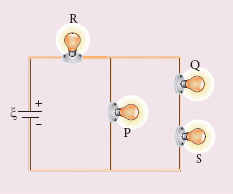
Four bulbs P, Q, R, S are connected in a circuit of unknown arrangement. When each bulb is removed one at a time and replaced, the following behavior is observed.
| P | Q | R | S | |
| P removed | * | on | on | on |
| Q removed | on | * | on | off |
| R removed | off | off | * | off |
| S removed | on | off | on | * |
Draw the circuit diagram for these bulbs.
3.
Two cells each of 5V are connected in series with a 8 Ω resistor and three parallel resistors of 4 Ω, 6 Ω, and 12 Ω. Draw a circuit diagram for the above arrangement. Calculate
(i) the current drawn from the cells
(ii) current through each resistor
4.
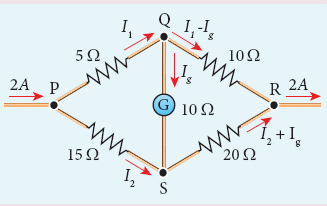
Determine the current flowing through the galvanometer (G) as shown in the figure.
5.
A potentiometer wire has a length of 4 m and resistance of 20 Ω. It is connected in series with resistance of 2980 Ω and a cell of emf 4 V. Calculate the potential gradient along the wire.
6.
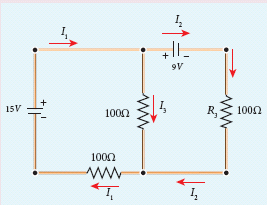
Calculate the currents in the following circuit.
7.
8.
An electronics hobbyist is building a radio which requires 150 Ω in her circuit. But she has only 220 Ω, 79 Ω and 92 Ω resistors available. How can she connect the available resistors to get desired value of resistance?
9.
The rod given in the figure is made up of two different materials.
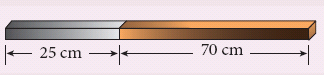
Both have square cross sections of 3 mm side. The resistivity of the first material is 4 x 10⁻³ Ωm and that of second material has resistivity of 5 x 10⁻³ Ωm. What is the resistance of rod between its ends?
10.
The resistance of a nichrome wire at 20oC is 10 Ω. If its temperature coefficient of resistanc is 0.004oC, find its resistance of the wire at boiling point of water. Comment on the result.
11.
A copper wire of 10-6 m2 area of cross section, carries a current of 2 A. If the number of free electrons per cubic meter in the wire is 8\(\times\)1028, Calculate the current density and average drift velocity of electrons.
12.
Lightning is very good example of natural current. In typical lightning, there is 109 J energy transfer across the potential difference of 5 x 10⁷ V during a time interval of 0.2 s.
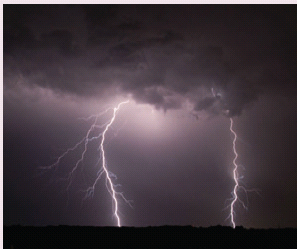
Using this information, estimate the following quantities.
(a) total amount of charge transferred between cloud and ground
(b) the current in the lightning bolt
(c) the power delivered in 0.2 s.
13.
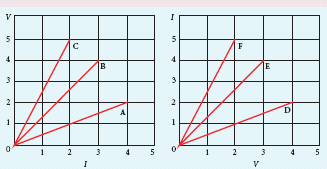
The following graphs represent the current versus voltage and voltage versus current for the six conductors A, B, C, D, E, and F. Which conductor has least resistance and which has maximum resistance?
14.
What is Peltier effect?
15.
What is Thomson effect?
16.
What is Seebeck effect?
17.
State Joule’s law of heating.
18.
What do you mean by internal resistance of a cell?
19.
State the principle of potentiometer.
20.
State Kirchhoff ’s voltage rule.
21.
State Kirchhoff ’s current rule.
22.
Derive the expression for power P=VI in electrical circuit.
23.
Find the heat energy produced in a resistance of 10 Ω when 5 A current flows through it for 5 minutes.
24.
In a meter bridge experiment, the value of resistance in the resistance box connected in the right gap is 10 Ω. The balancing length is l1 = 55 cm. Find the value of unknown resistance.
25.
In a meter bridge experiment with a standard resistance of 15 Ω in the right gap, the ratio of balancing length is 3:2. Find the value of the other resistance.
26.
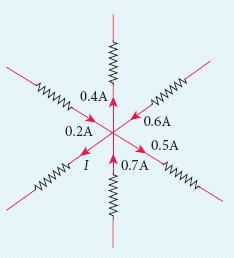
For the given circuit find the value of I.
27.
A battery has an emf of 12 V and connected to a resistor of 3 Ω. The current in the circuit is 3.93 A. Calculate
(a) terminal voltage and the internal resistance of the battery
(b) power delivered by the battery and power delivered to the resistor
28.
Resistance of a material at 20oC and 40oC are 45 Ω and 85 Ω respectively. Find its temperature coefficient of resistivity.
29.
If the resistance of coil is 3 Ω at 20oC and α = 0.004/oC then determine its resistance at 100oC.
30.
A potential difference across 24 Ω resistor is 12 V. What is the current through the resistor?
31.
Determine the number of electrons flowing per second through a conductor, when a current of 32 A flows through it.
32.
A copper wire of cross-sectional area 0.5 mm2 carries a current of 0.2 A. If the free electron density of copper is 8.4 x 1028 m-3 then compute the drift velocity of free electrons.
33.
If an electric field of magnitude 570 N C–1, is applied in the copper wire, find the acceleration experienced by the electron.
34.
Define current density.
35.
What is electric power and electric energy?
36.
Write a short note on superconductors?
37.
Define temperature coefficient of resistance.
38.
Define electrical resistivity.
39.
State macroscopic form of Ohm’s law.
40.
State microscopic form of Ohm’s law.
41.
Why current is a scalar?
42.
Compute the current in the wire if a charge of 120 C is flowing through a copper wire in 1 minute.
1.
Balancing lengths are
11 = 35 cm, l2 = 63 cm
E1 = 1.25v E2 = ?
At the following point \(E \propto 1\)
\(\frac{E_{1}}{E_{2}}=\frac{l_{1}}{l_{2}} \)
\(\therefore \frac{1.25}{E_{2}}=\frac{35}{63} \quad \therefore E_{2}=\frac{1.25 \times 63}{35}=2.25 \mathrm{v} \)
∴ EMF of the second cell = 2.25 V
Vd = 0.03 x 10⁻³ m s-1
2.
3.
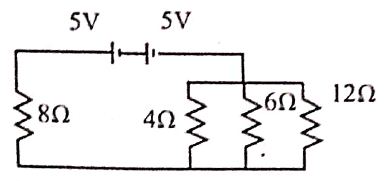
Circuit Diagram:
Here, 2 cells are in series,
\(\therefore \varepsilon_{\mathrm{tot}} =\varepsilon+\varepsilon=2 \varepsilon \)
\(\varepsilon_{\mathrm{tot}} =10 \mathrm{~V}\)
Here 4, 6 and 12 are in parallel
\(\therefore \frac{1}{\mathrm{R}_{\mathrm{p}}} =\frac{1}{\mathrm{R}_1}+\frac{1}{\mathrm{R}_1}+\frac{1}{\mathrm{R}_1}=\frac{1}{4}+\frac{1}{6}+\frac{1}{12} \)
\(\mathrm{R}_{\mathrm{p}} =2 \Omega\)
Now, the circuit becomes,
(i) current drawn from the cell (through the circuit) is,
\(\mathrm{I}=\frac{\mathrm{V}}{\mathrm{R}_{\mathrm{s}}}=\frac{10}{8+2}=1 \mathrm{~A}\)
Potential drop across the parallel combination of 3 resistors is \(\mathrm{V}^{\prime}=1 R_P=1 \times 2=2 \mathrm{~V}\)
(ii) Current through 8 resistor is I =1 A
\((\because 8 \Omega, 2 \Omega \text { in series) }\)
Current through \(\mathrm{R}=4 \Omega \ is, \mathrm{I}=\frac{\mathrm{V}^{\prime}}{\mathrm{R}}=\frac{2}{4}=0.5 \mathrm{~A}\)
Current through \(\mathrm{R}=6 \Omega \ is, \mathrm{I}=\frac{\mathrm{V}^1}{\mathrm{R}}=\frac{2}{6}=0.33 \mathrm{~A}\)
Current through \(\mathrm{R}=12 \Omega \ is, \mathrm{I}=\frac{\mathrm{V}^1}{\mathrm{R}}=\frac{2}{12}=0.17 \mathrm{~A}\)
4.
Applying Kirchhoff's current rule at P we get I1 + I2 = 2 ....(1)
Applying Kirchhoff's voltage rule for the closed loop PQSA we get,
5I1 + 10Ig - 15I2 = 0
Dividing the equation by 5 we get,
I1 + 2Ig - 3I2 = 0 ...(2)
Applying Kirchhoff's voltage rule for the closed loop QRSQ, we get,
\(\left(I_{1}-I_{g}\right) 10-\left(I_{2}+I_{g}\right) 20-10 I_{g}=0 \)
\(\therefore 10 I_{1}-10 I_{g}-20 I_{2}-20 I_{g}-10 I_{g}=0 \)
\(10 I_{1}-20 I_{2}-40 I_{g}=0 \) ....(3)
Dividing Eqn 3 by 10, we get,
\(I_1-2 I_2-4 I_s=0\) ....(4)
Solving equtions (4) and (2)
\(\begin{array}{l} I_1-4 I_g-2 I_2=0 \\ I_1+2 I_g-3 I_2=0 \\ (-)(-)(+) \\ \hline-6 I_g+I_2=0 \end{array}\) .......(5)
From ∴ I2 = 6Ig ....(6)
From equation (1), I2 = 2 - I1 ....(7)
From equation 6 & 7, we get,
2 - I1 = 6Ig
∴ -I1 = 6Ig - 2
∴ I1 = 2 - 6Ig .....(8)
Substituting equations (6) and (8) in equation (2), we get
\(2-6 I_{g}+2 I_{g}-3\left(6 I_{g}\right)=0 \)
\(2-6 I_{g}+2 I_{g}-18 I_{g}=0 \)
\(2-22 I_{g}=0\)
\(\therefore-22 I_{g}=-2 \)
\(\therefore I_{g}=\frac{-2}{-22} \)
\(I_{g}=\frac{1}{11} \mathbf{A} \)
5.
Length of the potentiometer wire = 4 m,
External resistance R = 2980 \(\Omega\), EMF(E) = 4V
Potentiometer resistance Rp = 20 \(\Omega\)
∴ Resistance per unit length \(=\frac{20}{4}=5 \Omega\)
∴ Total resistance of potentiometer wire R = R + Rp = 2980 + 20 = 3000 \(\Omega\)
Current, \(I=\frac{E}{R+R_{p}}=\frac{E}{R_T}=\frac{4}{3000}\)
\(I=\frac{4}{3} \times 10^{-3} A\)
Potential along the wire, V = IR
\(=\frac{4}{3} \times 10^{-3} \times 5 =\frac{20}{3} \times 10^{-3} \)
\(V=6.66 \times 10^{-3} \mathrm{~V} \mathrm{m}^{-1}=0.666 \times 10^{-2} \mathrm{~V}/M \)
∴ Potential gradient along the wire = 0.666 x 10⁻² V/m
6.
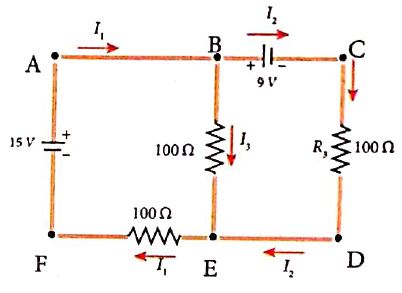
Apply Kirchoff's 1st law at junction B
II - I2 - I3 = 0
I3 = I1 - I2 ....(1)
Applying Kirchoff's IInd law at path ABEFA,
100I3 + 100 I1 = 15 ....(2)
Substitute equation (1) in equation (2),
100 (I1 - I2) + 100 I1 = 15
100 I1 - 100 I2 + 100 I1 = 15
200 I1 - 100 I2 = 15 ....(3)
Apply Kirchhoffs 2nd law ar path BCDEB,
100 I2 - 100 I3 = -9 ....(4)
Substitute equation (1) in above equation (4),
100 I2 - 100(I1 - I2) 100 = -9
100 I2 - 100 I1 + 100 I2 = -9
200 I2 - 100 I1 = - 9 ....(5)
Solve equation (3) and (5), we get
Eqn (3) ⇒ 200 I1 - 100 I2 = 15
2 x Eqn (5) ⇒ -200 I1 + 400I2 = -18
________________
300 I2 = -3
I2 = -3 /300 = -0.01 A
I2 = -0.01 A
Substitute I2 value in equation (5)
200 I2 -100 I1 = - 9
200 x (- 0.01) - 100 I1 = - 9
- 2 - 100 I1 = -9
-100 I1 = -9 + 2
-100 I1 = -7
I1 = 7/100
I1 = 0.07A
Substitute I1, I2 value in equation (1)
I3 = I1 - I2
= 0.07 + 0.01
I3 = 0.08 A
I1 = 0.07 A, I2 = - 0.01 A and I3 = 0.08 A
7.
8.
Requirement of resistors = \(150\Omega \)
Available resistances are \(R_{ 1 }=220\Omega \quad { R }_{ 2 }=79\Omega \ and \ { R }_{ 3 }=92\Omega \)
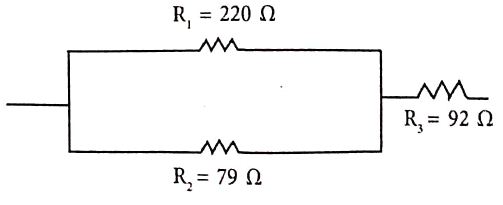
\(\frac{1}{R_{p}} =\frac{1}{R_{1}}+\frac{1}{R_{2}} \)
\(\therefore \frac{1}{R_{p}} =\frac{1}{220}+\frac{1}{79} \)
\(\frac{1}{R_p}=\frac{79+220}{17380}=\frac{299}{17380} \)
\(\therefore R_{p} =\frac{17380}{299}=58.12709 \simeq 58 \Omega \)
RAvailable Resistance = Rr+ R3
= 58 + 92 \(=150\Omega \)
Parallel combination of 220 \(\Omega \) and 79 \(\Omega \) in series with 92\(\Omega \).
9.
Resistivity of the first material \({ \rho }_{ 1 }=4\times { 10 }^{ -3 }\Omega m\)
Length of the first material, l1 = 25 x 102 m 
Area of cross section of the first material, A1 = 3 x 3 x 10-6
= 9 x 10⁻⁶ m2
Resistivity of second material, \({ \rho }_{ 2}=5\times { 10 }^{ -3 }\Omega m\)
Length of second material, \(l_{ 2 }=70\times { 10 }^{ -2 } m\)
Area of cross section second material, A2 = 3 x 3 x 10-6
= 9 x 10⁻⁶ m2
Resistivity of first material, \(\rho_{1}= R_{1} \times \frac {A_{1}}{l_{1}}\)
Resistance first material, \(R_{1} = \frac {\rho_{1}l_1}{A_{1}}\)
\(\therefore R_1=\frac{4 \times 10^{-3} \times 25\times 10^{-2}}{9 \times10^{-6}}\)
\(R_1=\frac{100}{9}\times10^{-5+6}=\frac{1000}{9}\Omega\)
Resistivity of second material, \(\rho_{2}=\frac{R_{2} A_{2}}{l_{2}} \)
∴ Resistance of second material, \(R_{2}=\frac{\rho_{2} l_{2}}{A_{2}} \)
\(\therefore R_{2} =\frac{5 \times 10^{-3} \times 70 \times 10^{-2}}{9 \times 10^{-6}} \)
\(R_2=\frac{350 \times 10^{-5}}{9 \times 10^{-6}}=\frac{350}{9} \times 10 \)
\(R_2=\frac{3500}{9} \Omega \)
Total resistance \(R_{t} =\frac{1000}{9}+\frac{3500}{9} \)
\(=\frac{4500}{9}=500 \Omega \)
\(\therefore\) Total resistance = 500 \(\Omega\)
10.
At To = 20oC, resistance R0 = 10 \(\Omega \)
\(\alpha\) = 0.004/oC, At To = 100oC R100 = ? (at boiling point of water)
RT = R0[1 + \(\left.(\alpha( T-T_{0}\right))\)]
R100 = 10 [1 + (0.004 x (100 - 20))]
= 10 [1 + 0.32] = 10 x 1.32 = 13.2 \(\Omega \)
∴ Resistance at boiling point of water R100 = 13.2 \(\Omega \)
(i.e) Rr = 13.2 \(\Omega \)
Comment : As the temperature increases, the resistance of the wire also increases.
11.
Area of cross section A = 10-6 m2 Current I = 2A
Number of electrons per cubic metre, n = 8 \(\times\)1028
Current I = nAevd
∴ Drift Velocity \(v_{d}=\frac{I}{n A e}\)
\(v_{d} =\frac{2}{8 \times 10^{28} \times 10^{-6} \times 1.6 \times 10^{-19}} \)
\(=\frac{2}{8 \times 10^{3} \times 1.6} \)
\(=\frac{20}{128} \times 10^{-3}=15.6 \times 10^{-5} \mathrm{~ms}^{-1} \)
Current density J = l / A.
\(J=\frac{2}{10^{-6}}\)
J = 2 x 10⁶ Am-2
12.
Emergency transferred, E = 109 J
Potential difference, V = 5\(\times\)107V
Time t = 0.2s.
(c) Power \(=\frac{\text { Energy }}{\text { Time }}=\frac{1 \times 10^{9}}{0.2}\) = 5 x 10⁹ W
P = 5 GW
(b) Current \(I =\frac{\text { Power }}{\text { Potiential difference }} \) \(=\frac{5 \times 10^{9}}{5 \times 10^{7}} \)
I = 102 = 100 A
∴ Q = 20C
(a) Charge Q = It (Here, I = 100 A)
Q = 100 x 0.2 = 20 C
(a) Q = 20 C, (b) I = 100 A, (c) P = 5 GW
13.
Resistance of the conductor, \(\mathrm{R}=\frac{\mathrm{V}}{\mathrm{I}}\)
From Graph - I,
Resistance of the conductor A is, \(\mathrm{R}_{\mathrm{A}}=\frac{\mathrm{V}}{\mathrm{I}}=\frac{2}{4}=0.5 \Omega\)
Resistance of the conductor B is, \(\mathrm{R}_{\mathrm{B}}=\frac{\mathrm{V}}{\mathrm{I}}=\frac{4}{3}=1.33 \Omega\)
Resistance of the conductor C is, \(\mathrm{R}_{\mathrm{c}}=\frac{\mathrm{V}}{\mathrm{I}}=\frac{5}{2}=2.5 \Omega\)
From Graph - II,
Resistance of the conductor D is, \(\mathrm{R}_{\mathrm{D}}=\frac{\mathrm{V}}{\mathrm{I}}=\frac{4}{2}=2 \Omega\)
Resistance of the conductor E is, \(\mathrm{R}_{\mathrm{E}}=\frac{\mathrm{V}}{\mathrm{I}}=\frac{3}{4}=0.75 \Omega\)
Resistance of the conductor F is, \(\mathrm{R}_{\mathrm{F}}=\frac{\mathrm{V}}{\mathrm{I}}=\frac{2}{5}=0.4 \Omega\)
The conductor F has least resistance, \(R_F=\mathbf{0. 4} \Omega\)
The conductor C has maximum resistance, \(\mathbf{R}_{\mathrm{c}}=2.5 \Omega\)
14.
Peltier discovered that, when an electric current is passed through a circuit of a thermocouple heat is evolved at one junction and absorbed at the other junction. This is known as Peltier effect.
15.
Thomson showed that, if two points in a conductor are at different temperatures, the density of electrons at these points will differ and as a result the potential difference is created between these points.
16.
Seebeck discovered that in a closed circuit consisting of two dissimilar metals, when the junctions are maintained at different temperature an emf is developed.
17.
It states that the heat developed in an electrical circuit due to the flow of current varies directly as
(i) the square of the current
(ii) the resistance of the circuit and
(iii) the time of flow.
18.
The internal resistance of a cell is the resistance offered to the flow of current (by the electrolyte) inside the cell.
19.
The emf of the cell is directly proportional to the balancing length.
20.
It states that in a closed circuit the algebraic sum of the products of the current and resistance of each part of the circuit is equal to the total emf included in the circuit.
21.
It states that the algebraic sum of the currents at any junction of a circuit is zero.
22.
Electric power is the rate at which the electrical potential energy is delivered
\(P =\frac{d U}{d t} \)
\(P =\frac{VdQ}{d t}=\mathrm{V} \frac{d Q}{d t} \)
Since \(\frac{d Q}{d t}=I\), where I - electric current
∴ P = VI
23.
R = 10 Ω, I = 5 A, t = 5 minutes = 5 x 60 s
H = I2 R t
= 52 x 10 x 5 x 60
= 25 x 10 x 300
= 25 x 3000
= 75000 J (or) 75 kJ
24.
Q = 10 Ω
\(\frac { P }{ Q } =\frac { { l }_{ 1 } }{ 100-{ l }_{ 1 } } =\frac { { l }_{ 1 } }{ { l }_{ 2 } } \)
\(P=Q \times \frac{l_1}{100-l_1}\)
\(P=\frac { 10\times 55 }{ 100-55 } \)
\(P=\frac { 550 }{ 45 } =12.2\Omega \)
25.
Q = 15 Ω, l1: l2 = 3 : 2
\(\frac { { l }_{ 1 } }{ { l }_{ 2 } } =\frac { 3 }{ 2 } \)
\(\frac { P }{ Q } =\frac { { l }_{ 1 } }{ { l }_{ 2 } } \)
\(P=Q\frac { { l }_{ 1 } }{ { l }_{ 2 } } \)
\(P=15 \times \frac { 3 }{ 2 } =22.5\Omega \)
26.
Applying Kirchoff’s rule to the point P in the circuit,
The arrows pointing towards P are positive and away from P are negative.
Therefore, 0.2A - 0.4A + 0.6A - 0.5A + 0.7A - I = 0
0.7 A - I = 0
1.5A - 0.9A – I = 0
0.6A - I = 0
I = 0.6 A
27.
The given values I = 3.93 A, ξ = 12 V,
R = 3 Ω
(a) The terminal voltage of the battery is equal to voltage drop across the resistor
V = IR = 3.93 x 3 = 11.79 V
The internal resistance of the battery,
\(r=\left[ \frac { \xi -V }{ V } \right] R=\left[ \frac { 12-11.79 }{ 11.79 } \right] \times 3=0.05\Omega \)
(b) The power delivered by the battery P = Iξ = 3.93 x 12 = 47.1 W
The power delivered to the resistor = I2 R = 46.3 W
The remaining power = (47.1 – 46.3) = 0.8 W is delivered to the internal resistance and cannot be used to do useful work. (it is equal to I2 r).
28.
T0 = 20oC, T = 40oC, Ro = 45 Ω , R = 85 Ω
\(\alpha =\frac { 1 }{ { R }_{ 0 } } \frac { \Delta R }{ \Delta T } \)
\(\alpha=\frac{1}{45}\left(\frac{85-45}{40-20}\right)=\frac{1}{45}(2)\)
\(\alpha=0.044 \text { per }^{\circ} C\)
29.
R0 = 3 Ω, T = 100oC, T0 = 20oC
α = 0.004/oC, RT = ?
RT = R0(1 + α(T - T0))
R100 = 3(1 + 0.004 x 80)
R100 = 3.96 Ω
30.
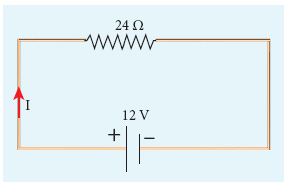
V = 12 V and R = 24 Ω
Current, I = ?
From Ohm’s law, \(I=\frac{V}{R}=\frac{12}{24}=0.5A\)
31.
I = 32 A , t = 1 s
Charge of an electron, e = 1.6 x 10⁻¹⁹ C
The number of electrons flowing per second, n = ?
\(I=\frac { q }{ t } =\frac { ne }{ t } \)
\(n=\frac { It }{ e } \)
\(n=\frac { 32\times 1 }{ 1.6\times { 10 }^{ -19 }C } \)
n = 20 x 1019 = 2 x 10²⁰ electrons
32.
The relation between drift velocity of electrons and current in a wire of cross- sectional area A is
\({ v }_{ d }=\frac { I }{ neA } =\frac { 0.2 }{ 8.4\times { 10 }^{ 28 }\times 1.6\times { 10 }^{ -19 }\times 0.5\times { 10 }^{ -6 } }\)
vd = 0.03 x 10⁻³ m s-1
33.
E = 570 N C-1, e = 1.6 x 10⁻¹⁹ C,
m = 9.11 x 10⁻³¹ kg and a = ?
F = ma = eE
\(a=\frac { eE }{ m } =\frac { 570\times 1.6 \times { 10 }^{ -19 } }{ 9.11\times { 10 }^{ -31 } } \)
\(=\frac { 912\times { 10 }^{- 19 }\times { 10 }^{ 31 } }{ 9.11 } \)
= 1.001 x 10¹⁴ ms-2
34.
Current density is J in a conductor is defined as the current flowing per unit area of cross-section of the conductor
\(\therefore J=\cfrac { I }{ A } \)
Where I - current
A - area of cross section
35.
Electric power:
(i) The electric power P is the rate at which the electrical potential energy is delivered.
(ii) The electric power P is the rate at which the work is done.
\( P= \frac{d U}{d t} (or)= \frac{d W}{d t} (or)=VI(or)\frac{V^2}{R}\)
Unit: watt (W)
Electric energy:
(i) The electric energy is the product of power (P) and duration of the time (t) when electric energy is delivered.
(ii) E = Pt
Unit: watt-hour (Wh)
36.
A superconductor is any material that can conduct electricity with no resistance. In most cases, materials such as metallic elements or compounds offer some resistance at room temperature, but offer less resistance at a temperature known as its critical temperature.
37.
Temperature coefficient of resistance is defined as the ratio of increase in resistivity per degree rise in temperature to its resistivity at To.
\(\alpha=\frac{\rho_{T}-\rho_{0}}{\rho_{0}\left(T-T_{0}\right)}\)
38.
Electrical resistivity of a material is defined as the resistance offered to current flow by a conductor of unit length having unit area of cross section.
39.
Macroscopic form of Ohm's law is V = IR
Where V - Potential difference
I - current
R - resistance of a conductor.
40.
Microscopic form of ohm's law is
\(\vec{J}=\sigma\vec {E}\)
\(J=\frac{ne^2\tau}{m}\vec{E}\)
\(\frac{e \tau}{m} \rightarrow Drift \ velocity \ v_d\)
where \(\vec{J} \) - current density
\(\sigma \) - conductivity
\(\vec{E} \) - Electric field
41.
Current is defined as the ratio of the net (i.e. amount of) charge (Q) passing through any cross section of a conductor to time.
\(I=\frac{Q}{t}\)
Since current is the ratio of two scalar quantities, it is a scalar. In addition current I is defined as the scalar product of the current density and area vector at which the charges cross.
I = \(\vec{J}.\vec{A}\)
42.
The current (rate of flow of charge) in the wire is
\(I=\frac { Q }{ t } =\frac { 120 }{ 60 } =2A\)

12th Standard Syllabus & Materials
12th Standard
TN 12th Computer Applications வலையமைப்பு வடமிடல் Sample Question Papers Study Material - QB365 Set A
NEW12th Standard
TN 12th Computer Applications களப்பெயர் முறைமை (DNS) Sample Question Papers Study Material - QB365 Set A
NEW12th Standard
TN 12th Computer Applications வலையமைப்பு எடுத்துக்காட்டுகள் மற்றும் நெறிமுறைகள் Sample Question Papers Study Material - QB365 Set A
NEW12th Standard
TN 12th Computer Applications கணினி வலையமைப்பு ஓர் அறிமுகம் Sample Question Papers Study Material - QB365 Set A



Tamilnadu Stateboard 12th Standard Subjects

Maths

Chemistry
Physics

Biology

Computer Science

Business Maths and Statistics

Economics

Commerce

Accountancy

History

Computer Applications
Biology
Computer Technology
Computer Applications
Computer Science
Business Maths and Statistics
Commerce
Economics
Maths
Chemistry
Physics
Computer Technology
History
Accountancy

Tamil

English

French
Tamilnadu Stateboard Standards

