
 100% FREE ACCESS
12th Standard Syllabus & Materials
12th Standard
TN 12th Computer Applications மின்னணு தரவு பரிமாற்றம் Sample Question Papers Study Material - QB365 Set A
NEW12th Standard
TN 12th Computer Applications மின் - வணிக பாதுகாப்பு அமைப்புகள் Sample Question Papers Study Material - QB365 Set A
NEW12th Standard
TN 12th Computer Applications மின்னணு செலுத்தல் முறைகள் Sample Question Papers Study Material - QB365 Set A
NEW12th Standard
TN 12th Computer Applications மின் - வணிகம் Sample Question Papers Study Material - QB365 Set A
NEW12th Standard
TN 12th Computer Applications திறந்த மூல கருத்துருக்கள் Sample Question Papers Study Material - QB365 Set A
NEW12th Standard
TN 12th Computer Applications வலையமைப்பு வடமிடல் Sample Question Papers Study Material - QB365 Set A

Published on: 01/09/2022
QB365 provides a detailed and simple solution for every Possible Creative Questions in Class 12 Physics Subject - Current Electricity, English Medium. It will help Students to get more practice questions, Students can Practice these question papers in addition to score best marks.
Download Tamil Nadu 12th Standard Physics question papers, model tests, one-mark questions, important questions, and public exam papers in PDF format. Free study materials and answer keys for TN State Board students.
Questions + Answers key
Take MCQ Physics Test1.
Distinguish electromotive force from potential difference.
2.
What do you know from coloured rings found on the resistor?
3.
Repairing the electrical connection with the wet skin is always dangerous. Give reason.
4.
Draw the variation between voltage and current for
(a) an Ohmic conductor and
(b) a Non - Ohmic conductor
5.
What is superconductivity?
6.
Explain Peltier effect.
7.
State Joule's law.
8.
Find the expression for the equivalent emf & internal resistance of the series combination of cells.
9.
In a circuit containing internal resistance r. Find the power delivered.
10.
Derive a relation between internal resisance and emf of a cell.
11.
What is meant by electromotive force?
12.
(a) Distinguish between electric cells and batteries.
(b) Explain its function.
13.
How does one can understand the temperature dependence of resistivity of a conductor?
14.
Derive an expression of drift velocity and write the relation between drift velocity and mobility.
15.
What are carbon resistors? What does the colour indicates?
1.
| Electromotive force | Potential difference |
| (i) It is independent of external resistance of the circuit. | It is proportional to the resistance between any two points. |
| (ii) It is the difference of potentials between two terminals of a cell in an open circuit. | It is the difference of potentials between any two points in a closed circuit. |
2.
(i) The coloured rings are used to indicate the values of a resistor.
(ii) The first two rings are significant figures of resistances.
(iii) The third ring indicates the decimal multiplies after.
(iv) Then, the fourth ring indicates the tolerance of the resistor.
3.
The dry skin of a human body has high resistance around \(500 \Omega\) But, when the skin is wet, the resistance is reduced to \(1000 \Omega\) Hence more current can flow through the human body. So, it is dangerous.
4.
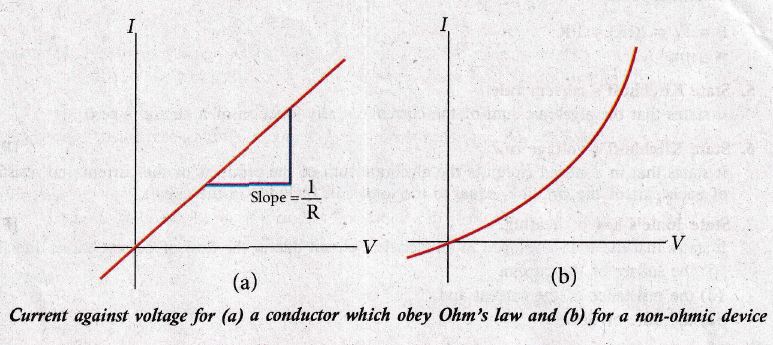
5.
The resistance of certain materials becomes zero below a certain temperature Tc, called transition temperature. This phenomenon is called superconductivity.
6.
(i) When an electric current is passed through a circuit of a thermocouple, heat is evolved at one junction and absorbed at the other junction. This is known as the Peltier effect.
(ii) In the Cu-Fe thermocouple the junctions A and B are maintained at the same temperature.
(iii) Let a current from a battery flow through the thermocouple. At junction A, where the current flows from Cu to Fe, heat is absorbed and junction A becomes cold.
(iv) At junction B, where the current flows from Fe to Cu heat is liberated and it becomes hot.
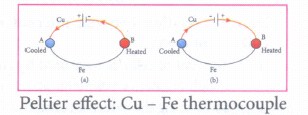
Peltier effect: Cu - Fe thermocouple
(v) When the direction of current is reversed, junction A gets heated and junction B gets cooled as shown in Figure (b).
Hence Peltier effect is reversible.
7.
If a current I flows through a conductor kept across a potential difference V for a time t, the work done or the electric potential energy spent is W = VIt
In the absence of any other external effect, this energy is spent on heating the conductor. The amount of heat(H) produced is H = VIt
For a resistance R,
H = I2 Rt
This relation was experimentally verified by Joule and is known as Joule's law of heating. It states that the heat developed in an electrical circuit due to the flow of current varies directly as
(i) the square of the current
(ii) the resistance of the circuit and
(iii) the time of flow.
8.
(i) Suppose n cells, each of emf \(\xi \) volts and internal resistance r ohms are connected in series with an external resistance R.
(ii) The total emf of the battery = \(n\xi \) The total resistance in the circuit = nr + R By Ohm's law, the current in the circuit is
\(I=\cfrac { totalemf }{ taoal\ resistance } =\cfrac { n\xi }{ nr+R } \)
\(I=\cfrac { n\xi }{ R } =n{ l }_{ 1 }\)
(iii) where II is the current due to a single cell
\(\left( { I }_{ 1 }=\cfrac { \xi }{ R } \right) \)
Thus, if r is negligible when compared to R the current supplied by the battery is n times that supplied by a single cell.
Case (b) If r >> R,\(I=\cfrac { n\xi }{ nr } =\cfrac { \xi }{ r } \)
(iv) It is the current due to a single cell. That is, current due to the whole battery is the same as that due to a single cell and hence there is no advantage in connecting several cells.
(v) Thus series connection of cells is advantageous only when the effective internal resistance of the cells is negligibly small compared with R.
9.
(i) Due to this internal resistance, the power delivered to the circuit is not equal to power rating mentioned in the battery.
(ii) For a battery of emf \({ \xi }_{ 1 }\) with an internal resistance r, the power delivered to the circuit of resistance R is given by
\(P=I\xi =I(V+Ir)\)
Here V is the voltage drop across the resistance R and it is equal to IR.
Therefore, P = I (IR +Ir)
P = I2 R + I2 r
(iii) Here Pr is the power delivered to the internal resistance and PR is the power delivered to the electrical device (here it is the resistance R). For a good battery, the internal resistance r is very small, then for P < r < P
10.
(i) The emf of cell \(\xi \) is measured by connecting a high resistance voltmeter across it without connecting the external resistance R.
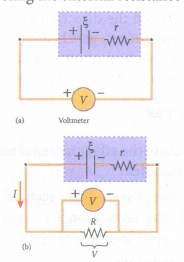
(ii) Since the voltmeter draws very little current for deflection, the circuit may be considered as open. Hence the voltmeter reading gives the emf of the cell.
(iii) Then, external resistance R is included in the circuit, and current I is established in the circuit. The potential difference across R is equal to the potential difference across the cell (V).
(iv) The potential drop across the resistor R is V + IR
(v) Due to internal resistance r of the cell, the voltmeter reads a value V, which is less than the emf of cell . It is because a certain amount of voltage (Ir) has dropped across the internal resistance r.
Then \(V=\xi -Ir\)
\(Ir=\xi -V\)
(vi) Dividing equation (2) by equation (1) we get
\(\cfrac { Ir }{ IR } =\cfrac { \xi -V }{ V } \)
\(r=\left| \cfrac { \xi -V }{ V } \right| R\)
Since \(\xi \) V and R are known, internal resistance r can be determined.
11.
A battery or cell is called a source of electromotive force (emf).
(i) The emf of a battery or cell is the voltage provided by the battery when no current flows in the external circuit.
(ii) Electromotive force determines the amount of work a battery or cell does to move a certain amount of charge around the circuit. It is denoted by the symbol and to be pronounced as 'xi'. An ideal battery has zero internal resistance and the potential difference (terminal voltage) across the battery equals to its emf.
(iii) A real battery is made of electrodes and electrolyte, there is resistance to the flow of charges within the battery. This resistance is called internal resistance r. For a real battery, the terminal voltage is not equal to the emf of the battery. A freshly prepared cell has low internal resistance and it increases with ageing.
12.
(a) An electric cell converts chemical energy into electrical energy to produce electricity. It contains two electrodes immersed in an electrolyte as shown Several electric cells connected together form a battery.
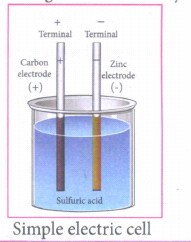
(b) When a cell or battery is connected to a circuit, electrons flow from the negative terminal to the positive terminal through the circuit. By using chemical reactions, a battery produces potential differences across its terminals. This potential difference provides the energy to move the electrons through the circuit.
13.
(i) For conductors a is positive. If the temperature of a conductor increases, the average kinetic energy of electrons in the conductor increases. This results in more frequent collisions and hence the resistivity increases.
(ii) The graph of the Even though, the resistivity of conductors like metals varies linearly for a wide range of temperatures, there also exists a nonlinear region at very low temperatures.
(iii) The resistivity approaches some finite value as the temperature approaches absolute zero.
(iv) As the resistance is directly proportional to the resistivity of the material, we can also write the resistance of a conductor at temperature T °C as
\({ R }_{ T }=R\left[ 1+\alpha \left( T-{ T }_{ 0 } \right) \right] \)
\(\alpha =\cfrac { { R }_{ T }-{ R }_{ 0 } }{ { R }_{ 0 }\left( T-{ T }_{ 0 } \right) } =\cfrac { 1\Delta R }{ { R }_{ 0 }\Delta T } \)
\(\alpha =\cfrac { 1 }{ { R }_{ 0 } } \cfrac { \Delta R }{ \Delta T } \)
where \(\Delta R={ R }_{ 1 }-{ R }_{ 0 }\) is a change in resistance during the changing temperature \(\Delta T=T-{ T }_{ 0 }\)
14.
The drift velocity is the average velocity acquired by the electrons inside the conductor when it is subjected to an electric field. The average time between successive collisions is called the mean free time denoted by \(\tau \). The acceleration \(\vec { a } \) experienced by the electron in an electric field \(\vec { E } \) is given by
\(\vec { a } =\cfrac { -e\vec { E } }{ m } \left( since\vec { F } =-e\vec { E } \right) \)
The drift velocity is given by
\({ \vec { V } }_{ d }=\vec { a } \tau \)
\({ \vec { V } }_{ d }=\cfrac { e\tau }{ m } \vec { E } \)
\({ \vec { V } }_{ d }=-\mu \vec { E } \)
Here \(\mu =\cfrac { e\tau }{ m } \) is the mobility of the electron and it is defined as the magnitude of the drift velocity per unit electric field \(\mu =\cfrac { \left| { \vec { v } }_{ d } \right| }{ \left| \vec { E } \right| } \)
15.
(i) Carbon resistors consists of a ceramic core, on which a thin layer of crystalline Carbon is deposited. These resistors are inexpensive, stable and compact in size. Color rings are used to indicate the value of the resistance.
(ii) Three coloured rings are used to indicate the values of a resistor: the first two rings are significant figures of resistances, the third ring indicates the decimal multiplier after them. The fourth color, silver or gold shows the tolerance of the resistor.
| Color | Number | Multiplier | Tolerance |
|---|---|---|---|
| Black | 0 | 1 | - |
| Brown | 1 | 101 | - |
| Red | 2 | 102 | - |
| Orange | 3 | 103 | - |
| Yellow | 4 | 104 | - |
| Green | 5 | 105 | - |
| Blue | 6 | 105 | - |
| Violet | 7 | 107 | - |
| Gray | 8 | 107 | - |
| White | 9 | 109 | - |
| Gold | - | 10-1 | 5% |
| Slive | - | 10-2 | 10% |
| Colorless | - | - | 20% |

12th Standard Syllabus & Materials
12th Standard
TN 12th Computer Applications களப்பெயர் முறைமை (DNS) Sample Question Papers Study Material - QB365 Set A
NEW12th Standard
TN 12th Computer Applications வலையமைப்பு எடுத்துக்காட்டுகள் மற்றும் நெறிமுறைகள் Sample Question Papers Study Material - QB365 Set A
NEW12th Standard
TN 12th Computer Applications கணினி வலையமைப்பு ஓர் அறிமுகம் Sample Question Papers Study Material - QB365 Set A
NEW12th Standard
TN 12th Computer Applications PHP-உடன் MySQL-ஐ இணைத்தல் Sample Question Papers Study Material - QB365 Set A



Tamilnadu Stateboard 12th Standard Subjects

Maths

Chemistry
Physics

Biology

Computer Science

Business Maths and Statistics

Economics

Commerce

Accountancy

History

Computer Applications
Biology
Computer Technology
Computer Applications
Computer Science
Business Maths and Statistics
Commerce
Economics
Maths
Chemistry
Physics
Computer Technology
History
Accountancy

Tamil

English

French
Tamilnadu Stateboard Standards

