
 100% FREE ACCESS
12th Standard Syllabus & Materials
12th Standard
TN 12th Maths Applications of Matrices and Determinants Sample Question Papers Study Material - QB365 Set A
NEW12th Standard
TN 12th Computer Applications மின்னணு தரவு பரிமாற்றம் Sample Question Papers Study Material - QB365 Set A
NEW12th Standard
TN 12th Computer Applications மின் - வணிக பாதுகாப்பு அமைப்புகள் Sample Question Papers Study Material - QB365 Set A
NEW12th Standard
TN 12th Computer Applications மின்னணு செலுத்தல் முறைகள் Sample Question Papers Study Material - QB365 Set A
NEW12th Standard
TN 12th Computer Applications மின் - வணிகம் Sample Question Papers Study Material - QB365 Set A
NEW12th Standard
TN 12th Computer Applications திறந்த மூல கருத்துருக்கள் Sample Question Papers Study Material - QB365 Set A

Published on: 01/09/2022
QB365 provides a detailed and simple solution for every Possible Creative Questions in Class 12 Physics Subject - Current Electricity, English Medium. It will help Students to get more practice questions, Students can Practice these question papers in addition to score best marks.
Download Tamil Nadu 12th Standard Physics question papers, model tests, one-mark questions, important questions, and public exam papers in PDF format. Free study materials and answer keys for TN State Board students.
Questions + Answers key
Take MCQ Physics Test1.
Two metallic wires P1 & P2 of the same material & same length but different cross sectional areas A1 & A2 are joined together & connected to a source of emf. Find the ratio of the drift velocities of free electrons in the two wires when they are connected
(i) in series &
(ii) in parallel.
2.
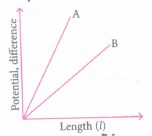
The variation of potential difference V with length l in the case of two potentiometer A & B is shown. Which of these two will you prefer for finding the emf of a cell or for comparing emfs of two primary cells?
3.
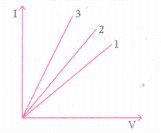
The V - I graphs of two resistors and their series combination are shown in the figure. Which one of these graph represents the series combination of the other two? Given reason.
4.
Using the concept of drift velocity of charge carries in a conductor, deduce the relationship between circuit density and resistivity of the conductor?
5.
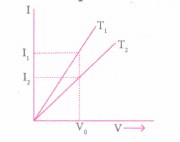
I - V graph for a metallic wire at two different temperatures T1 & T2 as shown in figure. Which of the two temperature is lower. Why?
6.
Write mathematical relation between
(i) mobility & drift velocity of charge carriers in a conductor
(ii) mobility & relaxation time (or) mean free time.
7.
A conductor of length I is connected to d.c. source of potential V. If the length of the conductor is doubled by treating it, keeping V constant, explain how do the following factors vary in the conductor
(i) Drift velocity.
(ii) Resistor
(iii) Resistivity.
8.
Two students A & B were asked to pick a resistor of 25 k from a collection of carbon resistors. A picked a resistors with bands of colours of red, green, orange, white. B picked a resistor with bands of colours: black, green, red who picked the correct resistor?
9.
How will you represent a resistor of 3700\(\Omega \) ± 10 by colour code?
10.
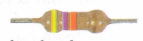
A carbon resistor has coloured strips. What is its resistors?
11.
Explain what is
(i) Thomson effect,
(ii) Positive Thomson effect,
(iii) Negative effect.
12.
What is potentiometer? Give its constant and 5 principles.
13.
Explain the variation of resistivity of conductor and semiconductor with change in temperature.
14.
Calculate the effect internal resistance in series and parallel.
15.
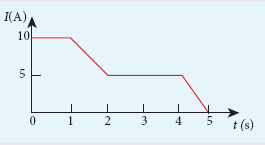
The current through an element is shown in the figure. Determine the total charge that pass through the element at a) t = 0 s, b) t = 2 s, c) t = 5s
1.
(i) In series the circuit remains the same
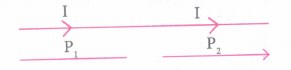
\(\therefore I=neA_{ 1 }{ V }_{ d_{ 1 } }=n{ A }_{ 2 }{ ev }_{ { d }_{ 2 } }\)or \(\cfrac { { vd }_{ 1 } }{ { vd }_{ 2 } } =\cfrac { { A }_{ 2 } }{ { A }_{ 1 } } \)
(ii) In parallel the potential difference is the same but the circuits are different
\(V={ I }_{ 1 }{ R }_{ 1 }=n{ A }_{ 1 }{ ev }_{ d_{ 1 } }\times \cfrac { \rho l }{ { A }_{ 1 } } ={ n }_{ 1 }e\rho v_{ d_{ 1 } }l\)
\(V={ I }_{ 2 }{ R }_{ 2 }={ n }_{ 1 }e\rho { v }_{ { d }_{ 1 } }l\) \(\left[ \because { R }_{ 1 }=\cfrac { \rho l }{ { A }_{ 1 } } \right] \)
Now I1R1 = I2R2 \(\therefore \cfrac { { V }_{ d_{ 1 } } }{ { V }_{ d_{ 2 } } } =1\)
2.
Potential gradient = \(\cfrac { dV }{ dl } \) = slope of the graph (V - l) to 'measure emf of a cell or to compare EMFs potentiometer B is preferred over A because it has a smaller potential gradient and hence it is more sensitive.
3.
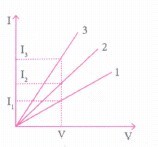
Various resistor is
\({ R }_{ 1 }=\cfrac { V }{ { I }_{ 1 } } ;{ R }_{ 2 }=\cfrac { V }{ { I }_{ 2 } } ;{ R }_{ 2 }=\cfrac { V }{ { I }_{ 3 } } \)
But \({ I }_{ 1 }<{ I }_{ 2 }<{ { I }_{ 3 } }\) \(\therefore { R }_{ 1 }>{ R }_{ 2 }>{ R }_{ 3 }\)
Hence graph I represent the series combination of the other two resistors.
4.
By the concept of Drift velocity \(I=nAeu_{ d }\)
\({ \mu }_{ d }=\cfrac { eE }{ m } \tau \)
\(\rho =\cfrac { m }{ { ne }^{ 2 }\tau } \)
\(\therefore\) Current density
\(J=\cfrac { I }{ A } ={ \cfrac { nA{ ev }_{ d } }{ A } =ne.\cfrac { em\tau }{ m } }=\left( \cfrac { { ne }^{ 2 }\tau }{ A } \right) E\)
\(J=\cfrac { 1 }{ \rho } .E\)
5.
For the same potential V0
The resistor at T1,\({ R }_{ 1 }=\cfrac { { V }_{ 0 } }{ { I }_{ 1 } } \)
The resistor at T2, \({ R }_{ 2 }=\cfrac { { V }_{ 0 } }{ { I }_{ 2 } } \)
I1>I2 (from the graph) \(\therefore { R }_{ 1 }<{ R }_{ 2 }\) Since the resistor of a metal increases with temperature \(\therefore { T }_{ 1 }<{ T }_{ 2 }\)
6.
(i) \(mobility=\cfrac { Drift\ velocity }{ electric\ field } \) (or) \(\mu =\cfrac { { V }_{ d } }{ E } \)
(ii) \({ \mu }_{ d }=\cfrac { eE }{ mL } .\tau \) (or) \(\cfrac { { v }_{ d } }{ E } =\left( \cfrac { e }{ mL } \right) .\tau \)
\(\mu =\cfrac { e }{ mL } .\tau \)
7.
(i) Drift velocity \({ u }_{ d }=\cfrac { ev }{ ml } .\tau \)
When I am doubled, drift velocity, become \(\cfrac { 1 }{ 2 } \) times the original vd
(ii) Resistor \(R=\rho .\cfrac { l }{ A } \)
Resistor becomes doubled i.e. 2 times the original resistors.
(iii) Resistivity is not affected.
8.
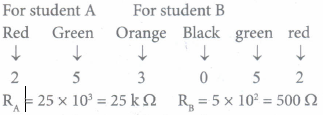
\(\therefore\) Student A picked up the correct resistor of 25 k\(\Omega \) .
9.
R = 37 X 102 ± 10 %
The colour of bands corresponding to
3 - orange
7 - violet
102 - red
10% - silver.
10.
The first two colour bands
for yellow = 4
for Violet = 7
for Brown = 101
The value of carbon resistor = 47 x 10 = 470\(\Omega \)
The gold ring showing tolerance of ± 5%
R = (470 ± 5%)\(\Omega \)
11.
(i) If two points in a conductor are at different temperatures, the density of electrons at these points will differ and as a result the potential difference is created between these points. Thomson effect is also reversible.
(ii) Heat is transferred due to the current flow in the direction of the current. It is called positive Thomson effect. Similar effect is observed in metals like silver, zinc, and cadmium.
(iii) Heat is transferred due to the current flow in the direction opposite to the direction of current. It is called negative Thomson effect. Similar effect is observed in metals like platinum, nickel, cobalt, and mercury.
12.
(i) Potentiometer is used for the accurate measurement of potential differences, current and resistances. It consists of ten meter long uniform wire of manganin or constantan stretched in parallel rows each of 1 meter length, on a wooden board.
(ii) The two free ends A and B are brought to the same side and fixed to copper strips with binding screws. A meter scale is fixed parallel to the wire. A jockey is provided for making contact.
(iii) The principle of the potentiometer is illustrated. A steady current is maintained across the wire CD by a battery Bt. The battery, key and potentiometer wire are connected in series forms the primary circuit.
(iv) The positive terminal of a primary cell of emf \(\xi \) is connected to the point C and negative terminal is connected to the jockey through a galvanometer G and a high resistance HR. This forms the secondary circuit.
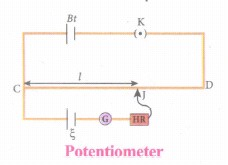
(v) Let contact be made at any point J on the wire by a jockey. If the potential difference across CJ is equal to the emf of the cell \(\xi \) then no current will flow through the galvanometer and it will show zero deflection.
(vi) CJ is the balancing length l. The potential difference across CJ is equal to Irl where I am the current flowing through the wire and r is the resistance per unit length of the wire
Hence \(\xi =Irl\)
(vii) Since I and r are constants \(\xi \propto l\). The emf of the cell is directly proportional to the balancing length.
13.
(i) The resistivity of a material is dependent on temperature. The resistivity of a conductor increases with increase in temperature according to the expression
\({ \rho }_{ r }={ \rho }_{ 0 }[I+\alpha (T-{ T }_{ 0 })\)
(ii) Where PT is the resistivity of a conductor at ToC, is the resistivity of the conductor at some reference temperature To (usually at 20°C), and a is the temperature coefficient of resistivity.
(iii) It is defined as the ratio of increase in resistivity per degree rise in temperature to its resistivity at To
From equation (1), we can write
\({ \rho }_{ r }-{ \rho }_{ 0 }=\alpha { \rho }_{ 0 }(T-{ T }_{ 0 })\)
\(\therefore \alpha =\cfrac { { \rho }_{ r }-{ \rho }_{ 0 } }{ { \rho }_{ 0 }(T-{ T }_{ 0 }) } =\cfrac { \Delta \rho }{ { \rho }_{ 0 }\Delta T } \)
where \(\Delta \rho ={ \rho }_{ r }-{ \rho }_{ 0 }\) is change in resistivity for a change in temperature \(\Delta T=T-{ T }_{ 0 }\) Its unit is per oC \(\alpha \) of conductor:
(iv) For conductors a is positive. If the temperature of a conductor increases, the average kinetic energy of electrons in the conductor increases. This results in more frequent collisions and hence the resistivity increases.
(v) The graph of the Even though, the resistivity of conductors like metals varies linearly for wide range of temperatures, there also exists a nonlinear region at very low temperatures.
(vi) The resistivity approaches some finite values the temperature approaches absolute zero
(vii) As the resistance is directly proportional to the resistivity of the material, we can also write the resistance of a conductor at temperature T °C as
\({ R }_{ T }={ R }_{ 0 }\left[ 1+\left( T-{ T }_{ 0 } \right) \right] \)
\(\alpha =\cfrac { { R }_{ T }-{ R }_{ 0 } }{ { R }_{ 0 }\left( T-{ T }_{ 0 } \right) } =\cfrac { I }{ { R }_{ 0 } } \cfrac { \Delta R }{ \Delta T } \)
\(\alpha =\cfrac { I }{ { R }_{ 0 } } \cfrac { \Delta R }{ \Delta T } \)
where \(\Delta R={ R }_{ r }-{ R }_{ 0 }\) is the change in resistance during the change in temperature \(\Delta T=T-{ T }_{ 0 }\)
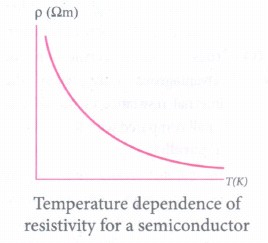
(viii) An of semiconductors For semiconductors, the resistivity decreases with increase in temperature. As the temperature increases, more electrons will be liberated from their atoms. Hence the current increases and therefore the resistivity decreases. A semiconductor with a negative temperature coefficient of resistance is called a thermistor.
14.
(i) Suppose n cells, each of emf volts and internal resistance r ohms are connected in series with an external resistance R as shown in Figure
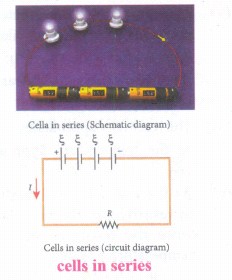
(ii) The total emf of the battery = nr
The total resistance in the circuit = nr + R
By Ohm's law, the current in the circuit is
\(I=\cfrac { total\ emf }{ total\ resistance } =\cfrac { n\xi }{ nr+5 } \)
Case (a) If r << R, then
\(I=\cfrac { n\xi }{ R } ={ nl }_{ 1 }\)
where II is the current due to a single cell
\(\left( { I }_{ 1 }=\cfrac { \xi }{ R } \right) \)
(iii) Thus, if r is negligible when compared to R the current supplied by the battery is n times that supplied by a single cell
Case (b) If >> R, \(I=\cfrac { n\xi }{ nr } =\cfrac { \xi }{ r } \)
(iv) It is the current due to a single cell. That is, current due to the whole battery is the same as that due to a single cell and hence there is no advantage in connecting several cells.
(v) Thus series connection of cells is advantageous only when the effective internal resistance of the cells is negligibly small compared with R. Cells in parallel
(i) In parallel connection all the positive terminals of the cells are connected to one point and all the negative terminals to a second point. These two points form the positive and negative terminals of the battery.
(ii) Let n cells be connected in parallel between the points A and B and a resistance R is connected between the points A and B as shown in Figure. Let be the emf and r the internal resistance of each cell.
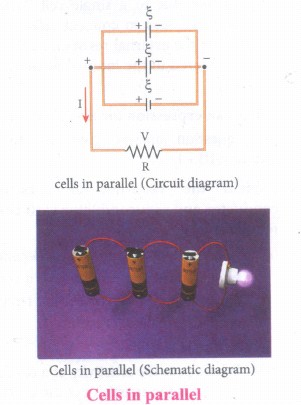
(iii) The equivalent internal resistance of the battery is \(\cfrac { 1 }{ { { r }_{ eq } } } =\cfrac { 1 }{ r } +\cfrac { 1 }{ r } +...\cfrac { 1 }{ r } (netrms)=\cfrac { n }{ r } \)
So \(\cfrac { 1 }{ { r }_{ eq } } =\cfrac { r }{ n } \) and the total resistance in the circuit = \(R+\cfrac { r }{ n } \) The total emf is the potential difference between the points A and B, which is equal to \(\xi \) The current in the circuit is given by
\(I=\cfrac { \xi }{ \frac { r }{ n } +R } \)
\(I=\cfrac { n\xi }{ r+nR } \)
Case (a) If >> R,\(I=\cfrac { n\xi }{ r } ={ nl }_{ 1 }\)
Case (b) If < \(I=\cfrac { \xi }{ R } \)
where II is the current due to a single cell and is equal to \(\cfrac { \xi }{ r } \) when R is negligible. Thus, the current through the external resistance due to the whole battery is n times the current due to a single cell.
15.
Charge Q = Current x Time interval
= I x t
At t = 0 s,
dq = dI x t
= 5 x 0
dq = 0 C
At t = 2 s,
dg = dI x t
=5 x 2
dq = 10 C
At t = 5 s,
dg = dl x t
=0 x 5
dq = 0 C
At t= 0 s, dg = 0 C; At t = 2 s, dg = 10 C; At t= 5 s, dg = 0 C.

12th Standard Syllabus & Materials
12th Standard
TN 12th Computer Applications வலையமைப்பு வடமிடல் Sample Question Papers Study Material - QB365 Set A
NEW12th Standard
TN 12th Computer Applications களப்பெயர் முறைமை (DNS) Sample Question Papers Study Material - QB365 Set A
NEW12th Standard
TN 12th Computer Applications வலையமைப்பு எடுத்துக்காட்டுகள் மற்றும் நெறிமுறைகள் Sample Question Papers Study Material - QB365 Set A
NEW12th Standard
TN 12th Computer Applications கணினி வலையமைப்பு ஓர் அறிமுகம் Sample Question Papers Study Material - QB365 Set A



Tamilnadu Stateboard 12th Standard Subjects

Maths

Chemistry
Physics

Biology

Computer Science

Business Maths and Statistics

Economics

Commerce

Accountancy

History

Computer Applications
Biology
Computer Technology
Computer Applications
Computer Science
Business Maths and Statistics
Commerce
Economics
Maths
Chemistry
Physics
Computer Technology
History
Accountancy

Tamil

English

French
Tamilnadu Stateboard Standards

