
 100% FREE ACCESS
12th Standard Syllabus & Materials
12th Standard
TN 12th Computer Applications மின்னணு தரவு பரிமாற்றம் Sample Question Papers Study Material - QB365 Set A
NEW12th Standard
TN 12th Computer Applications மின் - வணிக பாதுகாப்பு அமைப்புகள் Sample Question Papers Study Material - QB365 Set A
NEW12th Standard
TN 12th Computer Applications மின்னணு செலுத்தல் முறைகள் Sample Question Papers Study Material - QB365 Set A
NEW12th Standard
TN 12th Computer Applications மின் - வணிகம் Sample Question Papers Study Material - QB365 Set A
NEW12th Standard
TN 12th Computer Applications திறந்த மூல கருத்துருக்கள் Sample Question Papers Study Material - QB365 Set A
NEW12th Standard
TN 12th Computer Applications வலையமைப்பு வடமிடல் Sample Question Papers Study Material - QB365 Set A

Published on: 27/01/2021
12th Standard Physics English Medium Current Electricity Reduced Syllabus Important Questions with Answer key 2021
Download Tamil Nadu 12th Standard Physics question papers, model tests, one-mark questions, important questions, and public exam papers in PDF format. Free study materials and answer keys for TN State Board students.
Questions + Answers key
Take MCQ Physics Test1.
Nichrome and copper wire of same length and same radius are connected in series circuit I is passed through them. Which wire gets heated up more? Give reason.
2.
What happens to the drift velocity of electron and to the resistance if length of conductor and to the resistance if length of conductor unchanged?
3.
How heating effect is used in electrical lamps? Name other lamps which use the heating effected.
4.
What is electric fuse?
5.
What is thermoelectric effect?
6.
Distinguish between ohmic & non-ohmic device.
7.
Define instantaneous current.
8.
A battery has an emf of 12 V and connected to a resistor of 3 Ω. The current in the circuit is 3.93 A. Calculate
(a) terminal voltage and the internal resistance of the battery
(b) power delivered by the battery and power delivered to the resistor
9.
A copper wire of cross-sectional area 0.5 mm2 carries a current of 0.2 A. If the free electron density of copper is 8.4 x 1028 m-3 then compute the drift velocity of free electrons.
10.
If an electric field of magnitude 570 N C–1, is applied in the copper wire, find the acceleration experienced by the electron.
11.
Define current density.
12.
State microscopic form of Ohm’s law.
13.
Compute the current in the wire if a charge of 120 C is flowing through a copper wire in 1 minute.
14.
Find the expression for the equivalent emf & internal resistance of the series combination of cells.
15.
(a) Distinguish between electric cells and batteries.
(b) Explain its function.
16.
Derive an expression of drift velocity and write the relation between drift velocity and mobility.
17.
Two electric bulbs marked 20 W – 220 V and 100 W – 220 V are connected in series to 440 V supply. Which bulb will get fused?
18.
Two resistors when connected in series and parallel, their equivalent resistances are 15 Ω and \(\frac{56}{15}\)Ω respectively. Find the individual resistances.
19.
Kirchhoff's II law is named as_______
voltage law
resistance in series
resistance in parallel
current law
20.
Kirchhoff's I law is named as_____________
ohm's law
voltage law
resistance law
current law
21.
When three resistors are connected in parallel then the value of the effective resistance is________
less than or equal to individual resistance
greater than or equal to individual resistance
less than the individual resistance
greater than the individual resistance
22.
The unit of conductivity is________
mho
ohm
ohm-rn
mho-m-I
23.
A potential of 1 kV is applied between the ends of conductor of length 20 cm. The drift velocity of electron in this field is 3.52 x 10⁶ m/s. The relaxation time for the free electrons is
2 nano sec
4 nano sec.
6 nano sec
8 nano sec.
24.
A metal wire of current density is 3.2 x 10⁷ Am-2 has 1028 electron/m3. The average drift velocity is________
0.02 m.s -1
200 m s-1
1.6 x 10⁻² m s-1
3 x 10⁻² m s -1
25.
Calculate the mobility of a free electron in an electric field of 10+2N/C.
10-4m2V-1s-1
10-5m2V-1s-1
10-3m2V-1s-1
105m2V-1s-1
26.
The drift velocity is equal to mobility when__________
the electric field is parallel to the motion of electrons
the electric field is unity
the absence of electric field
either (a) or (b)
27.
Two identical resistors are connected in parallel then connected in series. The effective resistance are in the ratio ________________.
1:2
2:1
1:4
4:1
28.
In an electric circuit fuse wire is connected in ________________.
parallel
star connection
delta connection
series
29.
A bird sitting on an insulated wire carrying a current feels quite safe because ____________.
the bird is a non-conductor of electricity
resistance of the bird is very large
there is a large potential difference between bird and wire
there is no potential difference between bird and wire
30.
A potential difference is applied an the ends of a metallic wire. If the potential difference is doubled, the drift velocity ________________.
will be doubled
will be halved
will be quadrupled
will remain unchanged
31.
When 'n' resistors of equal resistance (R) are connected in series and in parallel respectively, then the ratio of their effective resistance is ______________
1: n2
n2: 1
n: 1
1: n
32.
In India electricity is supplied for domestic use at 220 V. It is supplied at 110 V in USA. If the resistance of a 60 W bulb for use in India is R, the resistance of a 60 W bulb for use in USA will be ______.
R
2R
\(\frac{R}{4}\)
\(\frac{R}{2}\)
33.
A wire connected to a power supply of 230 V has power dissipation P1. Suppose the wire is cut into two equal pieces and connected parallel to the same power supply. In this case power dissipation is P2. The ratio \(\frac{P_2}{P_1}\) is ______.
1
2
3
4
34.
A cell of emf E and internal resistance 'r' gives a current of 0.5 A with an external resistance of 12 \(\Omega \) and a current of 0.25 A with an external resistance of 25. Calculate
(i) internal resistance of the cell
(ii) emf of the cell.
35.
A potential difference of 3 V is applied across a conductor through which the 5 A of current is flowing. Determine the resistance of the conductor.
36.
Write mathematical relation between
(i) mobility & drift velocity of charge carriers in a conductor
(ii) mobility & relaxation time (or) mean free time.
37.
A conductor of length I is connected to d.c. source of potential V. If the length of the conductor is doubled by treating it, keeping V constant, explain how do the following factors vary in the conductor
(i) Drift velocity.
(ii) Resistor
(iii) Resistivity.
38.
Calculate the effect internal resistance in series and parallel.
39.
Obtain the condition for bridge balance in Wheatstone’s bridge.
40.
Explain the equivalent resistance of a series and parallel resistor network.
41.
Obtain the macroscopic form of Ohm’s law from its microscopic form and discuss its limitation.
1.
In series the current, I is same through both wires Rate of production of heat \(P={ I }^{ 2 }R\Rightarrow P\alpha R\) or \(H={ I }^{ 2 }Rt\Rightarrow H\alpha R\)
H - amount of heat produced; R - resistance of the wire.
Nichrome wire is heated up more since resistivity is more and hence resistance of nichrome wire is much more than that of copper wire of same length & radius.
2.
\({ V }_{ d }=\cfrac { eE }{ m } \tau =\cfrac { eV }{ ml } .\tau \left[ E=\cfrac { V }{ l } \right] \)
Keeping V constant, if 1 is doubled, vd is halved. Again keeping area constant if length is doubled, if R will be doubled [R \(\alpha\) 1,if a is constant].
3.
It consists of a tungsten filament (melting point 3380oC) kept inside a glass bulb with inert gas maintained at low pressure and heated to incandescence by the current. Electric discharge lamps, electric welding and electric arc also utilize the heating effect of current.
4.
It is a safety device and connected in series in a circuit to protect the electric devices from the heat developed by the passage of excessive current. It is a short length of a wire made of a low melting point material. It melts and breaks the circuit if current exceeds a certain value.
5.
Current produces thermal energy, thermal energy may also be suitably used to produce an electromotive force. This is known as thermoelectric effect.
6.
| Ohmic | non-ohmic |
|---|---|
| Materials for which the current against voltage graph is a straight line through the origin, are said to obey Ohm's law and their behavior is said to be ohmic. | Materials or devices that do not follow Ohm's law are said to be non-ohmic These materials have more complex relationships between voltage and current. A plot of I against V for a non-ohmic material is non-linear and they do not have a constant resistance. |
| e.g. metals. | e.g. Diode. |
7.
The instantaneous current I is defined as the limit of the average current \(\Delta t\rightarrow 0\)
\(I=\underset { \Delta t-0 }{ lim } \cfrac { \Delta Q }{ \Delta t } =\cfrac { dQ }{ dt } \)
8.
The given values I = 3.93 A, ξ = 12 V,
R = 3 Ω
(a) The terminal voltage of the battery is equal to voltage drop across the resistor
V = IR = 3.93 x 3 = 11.79 V
The internal resistance of the battery,
\(r=\left[ \frac { \xi -V }{ V } \right] R=\left[ \frac { 12-11.79 }{ 11.79 } \right] \times 3=0.05\Omega \)
(b) The power delivered by the battery P = Iξ = 3.93 x 12 = 47.1 W
The power delivered to the resistor = I2 R = 46.3 W
The remaining power = (47.1 – 46.3) = 0.8 W is delivered to the internal resistance and cannot be used to do useful work. (it is equal to I2 r).
9.
The relation between drift velocity of electrons and current in a wire of cross- sectional area A is
\({ v }_{ d }=\frac { I }{ neA } =\frac { 0.2 }{ 8.4\times { 10 }^{ 28 }\times 1.6\times { 10 }^{ -19 }\times 0.5\times { 10 }^{ -6 } }\)
vd = 0.03 x 10⁻³ m s-1
10.
E = 570 N C-1, e = 1.6 x 10⁻¹⁹ C,
m = 9.11 x 10⁻³¹ kg and a = ?
F = ma = eE
\(a=\frac { eE }{ m } =\frac { 570\times 1.6 \times { 10 }^{ -19 } }{ 9.11\times { 10 }^{ -31 } } \)
\(=\frac { 912\times { 10 }^{- 19 }\times { 10 }^{ 31 } }{ 9.11 } \)
= 1.001 x 10¹⁴ ms-2
11.
Current density is J in a conductor is defined as the current flowing per unit area of cross-section of the conductor
\(\therefore J=\cfrac { I }{ A } \)
Where I - current
A - area of cross section
12.
Microscopic form of ohm's law is
\(\vec{J}=\sigma\vec {E}\)
\(J=\frac{ne^2\tau}{m}\vec{E}\)
\(\frac{e \tau}{m} \rightarrow Drift \ velocity \ v_d\)
where \(\vec{J} \) - current density
\(\sigma \) - conductivity
\(\vec{E} \) - Electric field
13.
The current (rate of flow of charge) in the wire is
\(I=\frac { Q }{ t } =\frac { 120 }{ 60 } =2A\)
14.
(i) Suppose n cells, each of emf \(\xi \) volts and internal resistance r ohms are connected in series with an external resistance R.
(ii) The total emf of the battery = \(n\xi \) The total resistance in the circuit = nr + R By Ohm's law, the current in the circuit is
\(I=\cfrac { totalemf }{ taoal\ resistance } =\cfrac { n\xi }{ nr+R } \)
\(I=\cfrac { n\xi }{ R } =n{ l }_{ 1 }\)
(iii) where II is the current due to a single cell
\(\left( { I }_{ 1 }=\cfrac { \xi }{ R } \right) \)
Thus, if r is negligible when compared to R the current supplied by the battery is n times that supplied by a single cell.
Case (b) If r >> R,\(I=\cfrac { n\xi }{ nr } =\cfrac { \xi }{ r } \)
(iv) It is the current due to a single cell. That is, current due to the whole battery is the same as that due to a single cell and hence there is no advantage in connecting several cells.
(v) Thus series connection of cells is advantageous only when the effective internal resistance of the cells is negligibly small compared with R.
15.
(a) An electric cell converts chemical energy into electrical energy to produce electricity. It contains two electrodes immersed in an electrolyte as shown Several electric cells connected together form a battery.
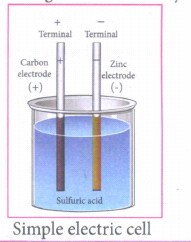
(b) When a cell or battery is connected to a circuit, electrons flow from the negative terminal to the positive terminal through the circuit. By using chemical reactions, a battery produces potential differences across its terminals. This potential difference provides the energy to move the electrons through the circuit.
16.
The drift velocity is the average velocity acquired by the electrons inside the conductor when it is subjected to an electric field. The average time between successive collisions is called the mean free time denoted by \(\tau \). The acceleration \(\vec { a } \) experienced by the electron in an electric field \(\vec { E } \) is given by
\(\vec { a } =\cfrac { -e\vec { E } }{ m } \left( since\vec { F } =-e\vec { E } \right) \)
The drift velocity is given by
\({ \vec { V } }_{ d }=\vec { a } \tau \)
\({ \vec { V } }_{ d }=\cfrac { e\tau }{ m } \vec { E } \)
\({ \vec { V } }_{ d }=-\mu \vec { E } \)
Here \(\mu =\cfrac { e\tau }{ m } \) is the mobility of the electron and it is defined as the magnitude of the drift velocity per unit electric field \(\mu =\cfrac { \left| { \vec { v } }_{ d } \right| }{ \left| \vec { E } \right| } \)
17.
To check which bulb will be fused, the voltage drop across each bulb has to be calculated.
The resistance of a bulb,
\(R=\frac { V^{ 2 } }{ P } =\frac { { (Ratedvoltage) }^{ 2 } }{ Ratedpower } \)
For 20W - 220V bulb,
\({ R }_{ 1 }=\frac { { \left( 220 \right) }^{ 2 } }{ 20 } \Omega =2420\Omega \)
For 100W - 220V bulb,
\({ R }_{ 2 }=\frac { { \left( 220 \right) }^{ 2 } }{ 20 } \Omega =484\Omega \)
Both the bulbs are connected in series. So same current will pass through both the bulbs. The current that passes through the circuit, \(I=\frac { V }{ { R }_{ tot } } \)
Rtot (R1 + R2)
Rtot = (484 + 2420) \(\Omega\) = 2904 \(\Omega\)
\(I=\frac { 440V }{ 2904\Omega } \approx 0.151A\)
The voltage drop across the 20W bulb is
\(V_1=IR_1=\frac { 440V }{ 2904 }\times2420 \approx 366.6V\)
The voltage drop across the 100W bulb is
\({ V }_{ 2 }=I{ R }_{ 2 }=\frac { 440 }{ 2904 } 484\approx 73.3A\)
The 20 W bulb will get fused because the voltage across it is more than the voltage rating.
18.
Rs = R1 + R2 = 15 Ω (1)
\({ R }_{ p }=\frac { { R }_{ 1 }{ R }_{ 2 } }{ { R }_{ 1 }{ +R }_{ 2 } } =\frac { 56 }{ 15 } \Omega \quad \) (2)
From equation (1) substituting for R1 + R2 in equation (2)
\(\frac { { R }_{ 1 }{ R }_{ 2 } }{ 15 } =\frac { 56 }{ 15 } \Omega \)
∴ R1R2 = 56
\({ R }_{ 2 }=\frac { 56 }{ 15 } \Omega \) (3)
Substituting for R2 in equation (1) from equation (3)
\({ R }_{ 1 }+\frac { 56 }{ { R }_{ 1 } } =15\)
Then, \(\frac { { R }_{ 1 }^{ 2 }+56 }{ { R }_{ 1 } } =15\)
R12 + 56 = 15 R1
R12 - 15 R1 + 56 = 0
The above equation can be solved using factorisation.
R1 = 8 Ω (or) R1 = 7 Ω
If (R1 = 8 Ω)
Substituting in equation (1)
8 + R2 = 15
R2 = 15 – 8 = 7 Ω ,
R2 = 7 Ω i.e , (when R1 = 8 Ω ; R2 = 7 Ω)
If R1= 7 Ω
Substituting in equation (1)
7 + R2 = 15
R2 = 8 Ω , i.e , (when R1 = 7 Ω ; R2 = 8 Ω )
19.
(a)
voltage law
20.
(d)
current law
21.
(c)
less than the individual resistance
22.
(b)
ohm
23.
(b)
4 nano sec.
24.
(a)
0.02 m.s -1
25.
(b)
10-5m2V-1s-1
26.
(b)
the electric field is unity
27.
(a)
1:2
28.
(d)
series
29.
(d)
there is no potential difference between bird and wire
30.
(a)
will be doubled
31.
(b)
n2: 1
32.
\(\mathrm{V}_1 =220 \mathrm{~V}, \quad \mathrm{P}_1=60 \mathrm{~W} \)
\(\mathrm{~V}_{\mathrm{U}} =110 \mathrm{~V}, \mathrm{P}_{\mathrm{U}}=60 \mathrm{~W} \)
\(P =\frac{V^2}{R} \Rightarrow R=\frac{V^2}{P} \)
\(\therefore R_l =\frac{V_I^2}{P_l} \text { Similarly, } \quad \mathrm{R}_U=\frac{V_U^2}{P_U} \)
\(R_l =\frac{220 \times 220}{60} \quad \mathrm{R}_{\mathrm{U}}=\frac{110 \times 110}{60} \)
\(R_I =\frac{48400}{60} \quad R_U=\frac{12100}{60} \)
\(\frac{R_U}{R_l} =\frac{12100}{60} \times \frac{60}{48400}=\frac{1}{4} \)
\(R_U =\frac{R_l}{4}=\frac{R}{4}\)
33.
\(\mathrm{V}=230 \mathrm{~V} \)
\(P=\frac{V^2}{R} \text { since } \mathrm{V} \text { is same } \mathrm{P} \propto \frac{1}{R} \)
\(\frac{1}{R_2}=\frac{1}{\frac{R_1}{2}}+\frac{1}{\frac{R_1}{2}}=\frac{2}{R_1}+\frac{2}{R_1}=\frac{2+2}{R_1} \)
\(\frac{1}{R_2}=\frac{4}{R_1} \)
\(\therefore R_2=\frac{R_1}{4} \)
\(R_1=4 R_2 \)
\(\therefore \frac{P_2}{P_1}=\frac{R_1}{R_2}=\frac{4 R_2}{R_2}=4\)
34.
Let R be the external resistance in series with the cell of emf E and external resistance 'r',
The current in the circuit is \(I=\cfrac { E }{ R+r } \)
Case I: 1 = 0.5 A, R = 12\(\Omega \) then
\(0.5=\cfrac { E }{ 12r } \)
E = 0.5 (12 + r)
E = 6.0 + 0.5 r
Case II: I = 0.25 A. R = 25 then
\(0.25=\cfrac { E }{ 25+r } \)
E = (0.25) (25 + r)
E = 6.25 + 0.25 r
From (1) (2), we get
6.0 + 0.5 r = 6.25 + 0.25 r
\(r=1\Omega \)
in equation (1) E = 6.0 + 0.5 x (1)
E = 6.5 v
35.
Potential difference V = 3 V
Current, I = 5 A
By Ohms law, \(R=\cfrac { V }{ I } =\cfrac { 3 }{ 5 } =0.6\Omega \)
36.
(i) \(mobility=\cfrac { Drift\ velocity }{ electric\ field } \) (or) \(\mu =\cfrac { { V }_{ d } }{ E } \)
(ii) \({ \mu }_{ d }=\cfrac { eE }{ mL } .\tau \) (or) \(\cfrac { { v }_{ d } }{ E } =\left( \cfrac { e }{ mL } \right) .\tau \)
\(\mu =\cfrac { e }{ mL } .\tau \)
37.
(i) Drift velocity \({ u }_{ d }=\cfrac { ev }{ ml } .\tau \)
When I am doubled, drift velocity, become \(\cfrac { 1 }{ 2 } \) times the original vd
(ii) Resistor \(R=\rho .\cfrac { l }{ A } \)
Resistor becomes doubled i.e. 2 times the original resistors.
(iii) Resistivity is not affected.
38.
(i) Suppose n cells, each of emf volts and internal resistance r ohms are connected in series with an external resistance R as shown in Figure
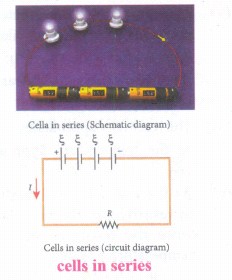
(ii) The total emf of the battery = nr
The total resistance in the circuit = nr + R
By Ohm's law, the current in the circuit is
\(I=\cfrac { total\ emf }{ total\ resistance } =\cfrac { n\xi }{ nr+5 } \)
Case (a) If r << R, then
\(I=\cfrac { n\xi }{ R } ={ nl }_{ 1 }\)
where II is the current due to a single cell
\(\left( { I }_{ 1 }=\cfrac { \xi }{ R } \right) \)
(iii) Thus, if r is negligible when compared to R the current supplied by the battery is n times that supplied by a single cell
Case (b) If >> R, \(I=\cfrac { n\xi }{ nr } =\cfrac { \xi }{ r } \)
(iv) It is the current due to a single cell. That is, current due to the whole battery is the same as that due to a single cell and hence there is no advantage in connecting several cells.
(v) Thus series connection of cells is advantageous only when the effective internal resistance of the cells is negligibly small compared with R. Cells in parallel
(i) In parallel connection all the positive terminals of the cells are connected to one point and all the negative terminals to a second point. These two points form the positive and negative terminals of the battery.
(ii) Let n cells be connected in parallel between the points A and B and a resistance R is connected between the points A and B as shown in Figure. Let be the emf and r the internal resistance of each cell.
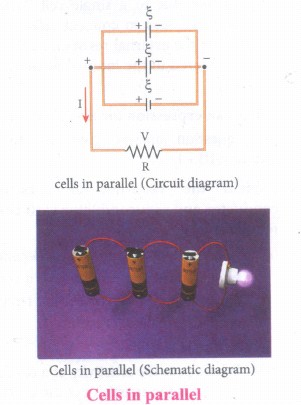
(iii) The equivalent internal resistance of the battery is \(\cfrac { 1 }{ { { r }_{ eq } } } =\cfrac { 1 }{ r } +\cfrac { 1 }{ r } +...\cfrac { 1 }{ r } (netrms)=\cfrac { n }{ r } \)
So \(\cfrac { 1 }{ { r }_{ eq } } =\cfrac { r }{ n } \) and the total resistance in the circuit = \(R+\cfrac { r }{ n } \) The total emf is the potential difference between the points A and B, which is equal to \(\xi \) The current in the circuit is given by
\(I=\cfrac { \xi }{ \frac { r }{ n } +R } \)
\(I=\cfrac { n\xi }{ r+nR } \)
Case (a) If >> R,\(I=\cfrac { n\xi }{ r } ={ nl }_{ 1 }\)
Case (b) If < \(I=\cfrac { \xi }{ R } \)
where II is the current due to a single cell and is equal to \(\cfrac { \xi }{ r } \) when R is negligible. Thus, the current through the external resistance due to the whole battery is n times the current due to a single cell.
39.
Wheatstone's bridge:
i) An important application of Kirchhoff's rule is Wheatstone's bridge. It is used to compare Resistances and also helps in determining the unknown resistance in electrical network. The bridge consists of four resistances P, Q, R and S connected as shown in Figure.
ii) A galvanometer G is connected between the points B and D. The battery is connected between the points A and C. The current through the galvanometer is IG and its resistance is G.
Applying Kirchhoff's current rule to junction B
I1 - IG - I3 = 0 ..(1)
Applying Kirchhoff's current rule to junction D,
I2 + IG - I4 = 0 ...(2)
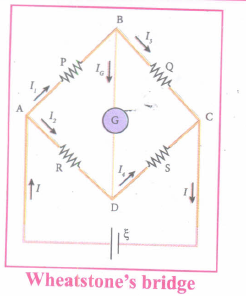
Applying Kirchhoff's voltage rule to loop ABDA,
I1P + IGG - I2R = 0 ...(3)
Applying Kirchhoff's voltage rule to loop ABCDA,
I1P + I3Q - I4S - I2R = 0 ...(4)
(iii) When the points B and D are at the same potential, the bridge is said to be balanced. As there is no potential difference between B and D, no current flows through galvanometer (IG = 0). Substituting IG = 0 in equation (1), (2) and (3), we get
I1 = I3 ..(5)
I2 = I4 ..(6)
I1P = I2R ..(7)
Substituting the equation (7) in equation (4),
I3Q = I4S .....(8)
Dividing equation (7) by equation (8), we get
\(\cfrac { P }{ Q } =\cfrac { R }{ S } \) .....(9)
(iv) This is the bridge balance condition. Only under this condition, galvanometer shows null deflection.
40.
Resistors in series:
(i) When two or more resistors are connected end to end, they are said to be in series. The resistors could be simple resistors or bulbs or heating elements or other devices. Figure (a) shows three resistors R1, R2 and R3 connected in series.
(ii) The amount of charge passing through resistor R1 must also pass through resistors R2 and R3 since the charges cannot accumulate anywhere in the circuit. Due to this reason, the current I passing through all the three resistors are the same.
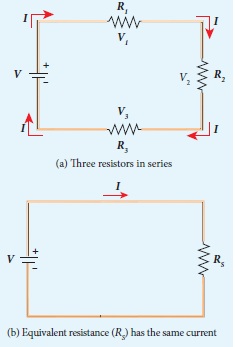
(iii) According to Ohm's law, if same current pass through different resistors of different values, then the potential difference across each resistor must be different. Let V1, V2 and V3 be the potential difference (voltage)across each of the resistors R1, R2 and R3 respectively, then we can write V1 = IR1, V2= RI2 and V3 = IR3. But the total voltage V is equal to the sum of voltages across each resistor.
V = V1 + V2 + V3 = IR1+ IR2 + IR3
V = I (R1 + R2 + R3)
V = IRS
where Rs is the equivalent resistance,
RS = R1 + R2 + R3
(iv) When several resistances are connected in series, the total or equivalent resistance is the sum of the individual resistances.
Note: The value of equivalent resistance in series connection will be greater than each individual resistance.
Resistors in parallel:
(i) Resistors are in parallel when they are connected across the same potential difference as shown in figure (a).
(ii) In this case, the total current I that leave the battery split into three separate components.
Let I1, I2 and I3 be the current through the resistors R1, R2, and R3 respectively. Due to the conservation of charge, total current in the circuit I is equal to sum of the currents through each of the three resistors.
I = I1 + I2 + I3 .....(1)
(iii) Since the voltage across each resistor is the same, applying Ohm's law to each resistor, we have
\({ I }_{ 1 }=\cfrac { V }{ { R }_{ 1 } } ,{ I }_{ 2 }=\cfrac { V }{ { R }_{ 2 } } ,{ I }_{ 3 }=\cfrac { V }{ { R }_{ 3 } } \)
Substituting these values in equation (1), we get,
\({ I }_{ 1 }=\cfrac { V }{ { R }_{ 1 } } +\cfrac { V }{ { R }_{ 2 } } +\cfrac { V }{ { R }_{ 3 } } =V\left[ \cfrac { 1 }{ { R }_{ 1 } } +\cfrac { 1 }{ { R }_{ 2 } } +\cfrac { 1 }{ { R }_{ 3 } } \right] \)
\(I=\cfrac { V }{ { R }_{ p } } \)
\(\cfrac { 1 }{ R_{ P } } =\cfrac { 1 }{ { R }_{ 1 } } +\cfrac { 1 }{ { R_{ 2 } } } +\cfrac { 1 }{ R_{ 3 } } \)
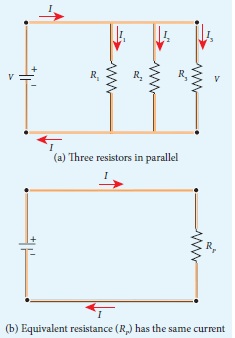
Here RP is the equivalent resistance of the parallel combination of the resistors. Thus, when a number of resistors are connected in parallel, the sum of the reciprocal of the values of resistance of the individual resistor is equal to the reciprocal of the effective resistance of the combination.
Note: The value of equivalent resistance in parallel connection will be lesser than each individual resistance.
41.
(i) The ohm's law can be derived from the equation \(J=\sigma E\) Consider a segment of wire of length I and cross-sectional area A as shown in Figure.
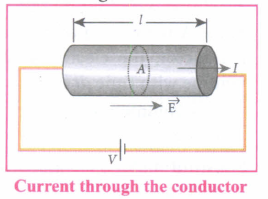
(ii) When a potential difference V is applied across the wire, a net electric field is created in the wire which constitutes the current in the wire.
(iii) For simplicity, we assumed that the electric field is uniform in the entire length of the wire, the potential difference (voltage V) can be written as V = EI
(iv) As we know, the magnitude of current density
\(J=\sigma E=\sigma \cfrac { V }{ l } \)
(v) But \(J=\cfrac { I }{ A } \), so we write the equation as,
\(\cfrac { I }{ A } =\sigma \cfrac { V }{ l } \)
(vi) By rearranging the above equation we get,
\(V=I\left( \cfrac { I }{ \sigma A } \right) \)
(vii) The quantity \(\cfrac { l }{ \sigma A } \)is called resistance of the conductor and it is denoted as R. Note that the resistance is directly proportional to the length of the conductor and inversely proportional to area of cross-section.
(viii) Therefore, the macroscopic form of ohm's law can be stated as V = IR.

12th Standard Syllabus & Materials
12th Standard
TN 12th Computer Applications களப்பெயர் முறைமை (DNS) Sample Question Papers Study Material - QB365 Set A
NEW12th Standard
TN 12th Computer Applications வலையமைப்பு எடுத்துக்காட்டுகள் மற்றும் நெறிமுறைகள் Sample Question Papers Study Material - QB365 Set A
NEW12th Standard
TN 12th Computer Applications கணினி வலையமைப்பு ஓர் அறிமுகம் Sample Question Papers Study Material - QB365 Set A
NEW12th Standard
TN 12th Computer Applications PHP-உடன் MySQL-ஐ இணைத்தல் Sample Question Papers Study Material - QB365 Set A



Tamilnadu Stateboard 12th Standard Subjects

Maths

Chemistry
Physics

Biology

Computer Science

Business Maths and Statistics

Economics

Commerce

Accountancy

History

Computer Applications
Biology
Computer Technology
Computer Applications
Computer Science
Business Maths and Statistics
Commerce
Economics
Maths
Chemistry
Physics
Computer Technology
History
Accountancy

Tamil

English

French
Tamilnadu Stateboard Standards

