
 100% FREE ACCESS
12th Standard Syllabus & Materials
12th Standard
TN 12th Computer Applications மின்னணு தரவு பரிமாற்றம் Sample Question Papers Study Material - QB365 Set A
NEW12th Standard
TN 12th Computer Applications மின் - வணிக பாதுகாப்பு அமைப்புகள் Sample Question Papers Study Material - QB365 Set A
NEW12th Standard
TN 12th Computer Applications மின்னணு செலுத்தல் முறைகள் Sample Question Papers Study Material - QB365 Set A
NEW12th Standard
TN 12th Computer Applications மின் - வணிகம் Sample Question Papers Study Material - QB365 Set A
NEW12th Standard
TN 12th Computer Applications திறந்த மூல கருத்துருக்கள் Sample Question Papers Study Material - QB365 Set A
NEW12th Standard
TN 12th Computer Applications வலையமைப்பு வடமிடல் Sample Question Papers Study Material - QB365 Set A

Published on: 02/09/2022
QB365 provides a detailed and simple solution for every Possible Creative Questions in Class 12 Physics Subject - Retirement and Death of a Partner, English Medium. It will help Students to get more practice questions, Students can Practice these question papers in addition to score best marks.
Download Tamil Nadu 12th Standard Physics question papers, model tests, one-mark questions, important questions, and public exam papers in PDF format. Free study materials and answer keys for TN State Board students.
Questions + Answers key
Take MCQ Physics Test1.
The stopping potential in an experiment on photoelectric effect is 1.5V. What is the maximum kinetic energy of the photoelectrons emitted?
2.
Write briefly the underlying principle used in Davison-Germer experiment to verify wave nature of electrons experimentally. What is the de-Broglie wavelength of an electron with kinetic energy (KE) 120 eV?
3.
An electron and a proton, each have the de Brogile wavelength of 1.00 nm.
(i) Find the ratio of their momenta.
(ii) Compare the kinetic energy of the proton with that of the electron.
4.
Determine the value of the de Broglie wavelength associated with the electron orbiting in the ground state of hydrogen atom (Given En = -(13.6 n2) eV and Bohr radius r0 = 0.53 Å). How will the de Broglie wavelength change when it is in the first excited state?
5.
A monochromatic light source of power SmW emits 8 x 10¹⁵ photons per second. This light ejects photo electrons from a metal surface. The stopping potential for this set up is 2V. Calculate the work function of the metal.
6.
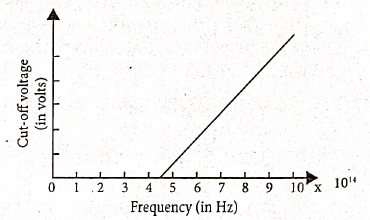
For photo electronic effect in sodium, the figure shows the plot of cut-off voltage versus frequency of incident radiation. Calculate
(i) threshold frequency
(ii) work function for sodium.
7.
When an electron in hydrogen atom jumps from the third excited state to the grand state, how would the de Broglie wavelength associated with the electron change? Justify your answer.
8.
Write the application of x-rays.
9.
Write a note on characteristic x - ray spectra:
10.
The ground state energy of the hydrogen atom is -13.6 eV. If an electron makes a transition from an energy level -1.51 eV to -3.4 eV, calculate the wavelength of the spectral line emitted and name the series of hydrogen spectrum to which it belongs.
11.
A 12.3 eV electron beam is used to bombard gaseous hydrogen at room temperature. Upto which energy level the hydrogen atoms would be excited? Calculate the wavelengths of the second member of Lyman series and second member of Balmer series.
12.
Determine the distance of closed approach when an alpha particle of kinetic energy 4.5 MeV strikes a nucleus of Z = 80, stops and reverses its direction.
13.
Write a note on continuous x-ray spectra.
14.
Explain the production of x-rays.
1.
Kmax = eVs = e(1.5V) = 1.5eV
= 1.5 x 1.6 x 10-19J
= 2.4 x 10⁻¹⁹J
2.
Principle: Diffraction effects are observed for beams of electrons scattered by the crystals.
λ = \(\frac { h }{ p } =\frac { h }{ \sqrt { 2mE_{ k } } } =\frac { h }{ \sqrt { 2meV } } \)
= \(\frac { 6.63\times { 10 }^{ -34 } }{ \sqrt { 2\times 9.1\times 10^{ -31 }\times 1.6\times 10^{ -19 }\times 120 } } \)
λ = 0.112 nm.
3.
(i) λe = \(\frac { h }{ { p }_{ e } } \) and λp = \(\frac { h }{ { p }_{ e } } \) , λe-λp = 1.00 nm
So, \(\frac { \lambda _{ e } }{ { \lambda }_{ p } } =\frac { { p }_{ e } }{ { p }_{ e } } =\frac { 1 }{ 1 } \Rightarrow \frac { { p }_{ p } }{ { p }_{ e } } =\frac { 1 }{ 1 } \) = 1:1
(ii) From relation K = \(\frac { 1 }{ 2 } { mv }^{ 2 }=\frac { { p }^{ 2 } }{ 2m } \)
Ke = \(\frac { { p }_{ e }^{ 2 } }{ 2m_{ e } } \) and Kp = \(\frac { { p }_{ p }^{ 2 } }{ 2m_{ p } } \)
\(\frac { { K }_{ p } }{ { K }_{ e } } =\frac { { p }_{ p }^{ 2 } }{ { 2m }_{ p } } \times \frac { { 2m }_{ e } }{ { p }_{ e }^{ 2 } } =\frac { m_{ e } }{ { m }_{ p } } \)
Since me <<< mp. So Kp <<< Ke
\(\frac { { K }_{ p } }{ { K }_{ e } } =\frac { 9.1\times 10^{ -31 } }{ 1.67\times 10^{ -27 } } \) = 5.4 x 10⁻⁴.
4.
In ground state, the kinetic energy of the electron is
K = -E = \(\frac { +13.6eV }{ 1^{ 2 } } \) =13.6 x 1.6 x 10-19 J
de Broglie wavelength,
λ = \(\frac { h }{ p } =\frac { h }{ \sqrt { 2mK } } \)
λ1 = -\(\frac { 6.63\times { 10 }^{ -34 } }{ \sqrt { 2\times 9.1\times 10^{ -31 }\times 2.18\times 10^{ -18 } } } \)
= 9.33 x 10-9 = 0.33 nm
Kinetic energy in the first excited state (n = 2)
K = -E = + \(\frac { 13.6 }{ 2^{ 2 } } \) eV = +3.4 eV
= 3.4 x 1.6 x 10-19 J
= 0.54 x 10⁻¹⁸ J
de Broglie wavelength,
λ2 = \(\frac { h }{ \sqrt { 2mK } } \)
= \(\frac { 6.63\times { 10 }^{ -34 } }{ \sqrt { 2\times 9.1\times { 10 }^{ -31 }\times 0.544\times { 10 }^{ -15 } } } \)
= 2 x 0.33 nm = 0.66 mm.
5.
Given data: P = 5 x 10⁻³ W,
n = 8 x 10¹⁵ photons per second
Energy of each photon,
E = \(\frac { p }{ n } =\frac { 5\times { 10 }^{ -3 } }{ 8\times { 10 }^{ 15 } } \)
= 6.25 x 10⁻¹⁹ J
= \(\frac { 6.25\times 10^{ -19 }J }{ 1.6\times { 10 }^{ -19 } } \)
E = 3.9 eV
Work function, Wo = E-Vo
= (3.9-2)eV = 1.9 eV
6.
(i) The threshold frequency is the frequency of incident light at which kinetic energy of ejected photoelectron is zero.
∴ From fig. threshold frequency,
v0 = 4.5 x 10¹⁴ Hz
(ii) Work function, W = hv0
= 6.6 x 10-34 x 4.5 x 1014 joule
= \(\frac { 6.6\times { 10 }^{ -34 }\times 4.5\times 10^{ 14 } }{ 1.6\times { 10 }^{ -19 } } \) eV
= 1.85 eV
7.
(i) de Broglie wavelength associated with a moving charge particle having a KE 'K' can be given as
λ = \(\frac { h }{ p } =\frac { h }{ \sqrt { 2mK } } \) ......(1) \(\left[ K=\frac { 1 }{ 2 } mv^{ 2 }=\frac { { p }^{ 2 } }{ 2m } \right] \)
(ii) The kinetic energy of the electron in any orbit of the hydrogen atom can be given as
K = -E = -\(\left( \frac { 13.6 }{ { n }^{ 2 } } eV \right) =\frac { 13.6 }{ { n }^{ 2 } } \) ........(2)
(iii) Let K and K4 be the KE of the electron in the ground state and third excited state, where n1 = 1 shows the ground state and n2 = 4 shows the third excited state.
Using the concept of equations (1) & (2), we have
\(\frac { { \lambda }_{ 1 } }{ { \lambda }_{ 4 } } =\sqrt { \frac { { K }_{ 4 } }{ { K }_{ 1 } } } =\sqrt { \frac { { n }_{ 1 }^{ 2 } }{ { n }_{ 2 }^{ 2 } } } \)
\(\frac { { \lambda }_{ 1 } }{ { \lambda }_{ 4 } } =\sqrt { \frac { { 1 }^{ 2 } }{ { 4 }^{ 2 } } } =\frac { 1 }{ 4 } \)
λ = \(\frac { { \lambda }_{ 4 } }{ 4 } \)
i.e., the wavelength in the ground state will decrease.
8.
X-rays are being used in many fields. Let us list a few of them.
(i) Medical diagnosis X-rays can pass through flesh more easily than through bones. Thus an x-ray radiograph containing a deep shadow of the bones and a light shadow of the flesh may be obtained. X-ray radiographs are used to detect fractures, foreign bodies, diseased organs, etc.
(ii) Medical therapy Since x-rays can kill diseased tissues, they are employed to cure skin diseases, malignant tumors, etc.
(iii) Industry X-rays are used to check for flaws in welded joints, motor tires, tennis balls, and wood. At the customs post, they are used for the detection of contraband goods.
(iv) Scientific research X-ray diffraction is an important tool to study the structure of the crystalline materials - that is, the arrangement of atoms and molecules in crystals.
9.
(i) X-ray spectra show some narrow peaks at some well-defined wavelengths when the target is hit by fast electrons.
(ii) The line spectrum showing these peaks is called the characteristic x-ray spectrum. This x-ray spectrum is due to the electronic transitions within the atoms.
(iii) When an energetic electron penetrates into the target atom and removes some of the K-shell electrons.
(iv) Then the electrons from outer orbits jump to fill up the vacancy so created in the K-shell.
(v) During the downward transition, the energy difference between the levels is given out in the form of an x-ray photon of a definite wavelength.
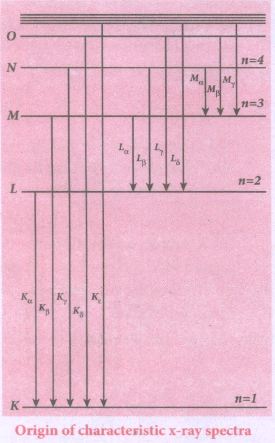
(vi) Such wavelengths, characteristic of the target, constitute the line spectrum.
(vii) It is evident that K-series of lines in the x-ray spectrum of an element arises due to the electronic transitions from L, M, N, levels to the K-level. Similarly, the longer wavelength L-series originates when an L-electron is knocked out of the atom and the corresponding vacancy is filled by the electronic transitions from M, N, 0, ..., and so on.
(viii) The K\(\alpha\) and K\(\beta\) of the K-series of molybdenum are shown by the two peaks in its x-ray spectrum.
10.
Energy differnce = Energy of emitted photon
= E2 - E1
= -1.51 - (-3.4) = 1.89 eV
= 1.89 x 1.6 x 10-19 J
λ = \(\\ \frac { hc }{ { E }_{ 2 }-{ E }_{ 1 } } \)
= \(\frac { 6.6\times { 10 }^{ -34 }\times 3\times { 10 }^{ 8 } }{ 1.89\times 1.6\times 10^{ -19 } } =\frac { 19.8 }{ 3.024 } \) x 10-7
= 6.548 x 10⁻⁷ m = 6548 Å
The wavelength belongs to the Balmer series of the hydrogen spectrum.
11.
The energy of electrons in the nth orbit of a hydrogen atom is
En = -\(\frac { 13.6 }{ { n }^{ 2 } } \)
when the incident beam of energy 12.3 eV is absorbed by a hydrogen atom. Let the electron jump from n = 1 to n = n level.
E = En - E1
12.3 = \(\frac { 13.6 }{ { n }^{ 2 } } -\left( -\frac { 13.6 }{ { I }^{ 2 } } \right) \)
⇒ 12.3 = 13.6 \(\left| 1-\frac { 1 }{ n^{ 2 } } \right| \Rightarrow \frac { 12.3 }{ 13.6 } =1-\frac { 1 }{ { n }^{ 2 } } \)
⇒ 0.9 = \(1-\frac { 1 }{ { n }^{ 2 } } \) ⇒ n2 = 10 ⇒ n = 3
That is the hydrogen atom would be excited up to the second excited state.
For Lyman Series
\(\frac { 1 }{ \lambda } =R\left[ \frac { 1 }{ { n }_{ f }^{ 2 } } -\frac { 1 }{ { n }_{ i }^{ 2 } } \right] \)
⇒ \(\frac { 1 }{ \lambda } \) =0.097 x 10⁷ \(\left[ \frac { 1 }{ 1 } -\frac { 1 }{ 9 } \right] \)
⇒ \(\frac { 1 }{ \lambda } \) =1.097 x 10⁷ x \(\frac { 8 }{ 9 } \)
λ =\(\frac { 9 }{ 8\times 1.097\times { 10 }^{ 7 } } \)
=1.025 x 107 =102.5 mm
For Balmer Series
\(\frac { 1 }{ \lambda } \) = 1.097 x 10⁷ \(\left[ \frac { 1 }{ 4 } -\frac { 1 }{ 16 } \right] \)
⇒ \(\frac { 1 }{ \lambda } \) = 1.097 x 10⁷ x \(\frac { 3 }{ 16 } \)
⇒ λ = 4.86 x 10⁻⁷ m ⇒ λ = 486 nm
12.
Let r be the center to center distance between the alpha particle and the nucleus (Z = 80). When the alpha particle is at the stopping point, then
K = \(\frac { 1 }{ 4\pi { \varepsilon }_{ 0 } } \frac { (Ze)(2e) }{ r } \)
(or) r = \(\frac { 1 }{ 4\pi { \epsilon }_{ 0 } } .\frac { 2Ze^{ 2 } }{ K } \)
= \(\frac { 9\times { 10 }^{ 9 }\times 2\times 80{ e }^{ 2 } }{ 4.5MeV } \)
= \(\frac { 9\times { 10 }^{ 9 }\times 2\times 80\times (1.6\times { 10 }^{ -19 })^{ 2 } }{ 4.5\times { 10 }^{ 6 }\times 1.6\times { 10 }^{ -19 }J } \)
= \(\frac { 9\times 160\times 16 }{ 4.5 } \) x 10-16 = 512 x 10-16 m
= 5.12 x 10⁻¹⁴ m
13.
i) When a fast-moving electron penetrates and approaches a target nucleus, the interaction between the electron and the nucleus either accelerates or decelerates it which results in a change of path of the electron.
ii) The radiation produced from such decelerating electrons is called Bremsstrahlung or braking radiation.
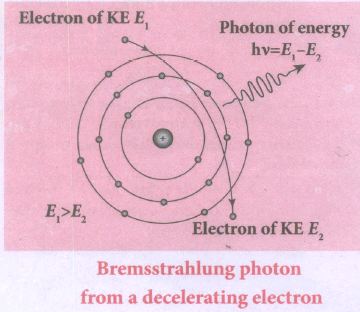
iii) The energy of the photon emitted is equal to the loss of kinetic energy of the electron
iv) Since an electron may lose part or all of its energy to the photon, the photons are emitted with all possible energies (or frequencies).
v) The continuous x-ray spectrum is due to such radiations
vi) When an electron gives up all its energy, then the photon is emitted with the highest frequency vo (or lowest wavelength \(\lambda\)o).
vii) The initial kinetic energy of an electron is given by eV where V is the accelerating voltage. Therefore, we have
\({ hv }_{ 0 }=eV(or)\frac { hc }{ { \lambda }_{ 0 } } =eV\)
\(\\ { \lambda }_{ 0 }=\frac { hc }{ eV } \)
viii) Where \({ \lambda }_{ 0 }\) is the cut-off wavelength. Substituting the known values in the above equation, we get
\({ \lambda }_{ 0 }=\frac { 12400 }{ V } \)Å ...(1)
The relation given by equation (1) is known as the Duane - Hunt formula.
ix) The value \({ \lambda }_{ 0 }\)depends only on the accelerating potential and is the same for all targets.
x) This is in good agreement with the experimental results.
xi) Thus, the production of continuous x-ray spectrum and the origin of cut-off wavelength can be explained on the basis of the photon theory of radiation.
14.
i) X-rays are produced in x-ray tube which is essentially a discharge tube.
ii) A tungsten filament F is heated to incandescence by a battery. As a result, electrons are emitted from it by thermionic emission.
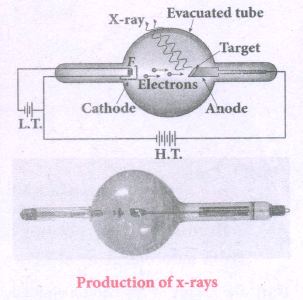
iii) The electrons are accelerated to high speeds by the voltage applied between the filament F and the anode.
iv) The target materials like tungsten, molybdenum are embedded in the face of the solid copper anode.
v) The face of the target is inclined at an angle with respect to the electron beam so that x-rays can leave the tube through its side.
vi) When high-speed electrons strike the target, they are decelerated suddenly and lose their kinetic energy.
vii) As a result, x-ray photons are produced. Since most of the kinetic energy of the bombarding electrons gets converted into heat, targets' made of high-melting-point metals and a cooling system are usually employed.

12th Standard Syllabus & Materials
12th Standard
TN 12th Computer Applications களப்பெயர் முறைமை (DNS) Sample Question Papers Study Material - QB365 Set A
NEW12th Standard
TN 12th Computer Applications வலையமைப்பு எடுத்துக்காட்டுகள் மற்றும் நெறிமுறைகள் Sample Question Papers Study Material - QB365 Set A
NEW12th Standard
TN 12th Computer Applications கணினி வலையமைப்பு ஓர் அறிமுகம் Sample Question Papers Study Material - QB365 Set A
NEW12th Standard
TN 12th Computer Applications PHP-உடன் MySQL-ஐ இணைத்தல் Sample Question Papers Study Material - QB365 Set A



Tamilnadu Stateboard 12th Standard Subjects

Maths

Chemistry
Physics

Biology

Computer Science

Business Maths and Statistics

Economics

Commerce

Accountancy

History

Computer Applications
Biology
Computer Technology
Computer Applications
Computer Science
Business Maths and Statistics
Commerce
Economics
Maths
Chemistry
Physics
Computer Technology
History
Accountancy

Tamil

English

French
Tamilnadu Stateboard Standards

