
 100% FREE ACCESS
12th Standard Syllabus & Materials
12th Standard
TN 12th Computer Applications மின்னணு தரவு பரிமாற்றம் Sample Question Papers Study Material - QB365 Set A
NEW12th Standard
TN 12th Computer Applications மின் - வணிக பாதுகாப்பு அமைப்புகள் Sample Question Papers Study Material - QB365 Set A
NEW12th Standard
TN 12th Computer Applications மின்னணு செலுத்தல் முறைகள் Sample Question Papers Study Material - QB365 Set A
NEW12th Standard
TN 12th Computer Applications மின் - வணிகம் Sample Question Papers Study Material - QB365 Set A
NEW12th Standard
TN 12th Computer Applications திறந்த மூல கருத்துருக்கள் Sample Question Papers Study Material - QB365 Set A
NEW12th Standard
TN 12th Computer Applications வலையமைப்பு வடமிடல் Sample Question Papers Study Material - QB365 Set A

Published on: 27/01/2021
12th Standard Physics English Medium Dual Nature of Radiation and Matter Reduced Syllabus Important Questions With Answer Key 20211
Download Tamil Nadu 12th Standard Physics question papers, model tests, one-mark questions, important questions, and public exam papers in PDF format. Free study materials and answer keys for TN State Board students.
Questions + Answers key
Take MCQ Physics Test1.
For a given photo sensitive surface the ratio of stopping potential for three different incident frequencies is ______________.
1: 2 : 3
1: 4: 9
1: 1 : 1
\(\sqrt { 1 } :\sqrt { 2 } :\sqrt { 3 } \)
2.
In an electron microscope, the electron beam is associated through a large potential difference in a device called _______
accelerator
electron gun
CRO
vibrator
3.
The phenomena by which metals emit electrons under the influence of radiation is called ________
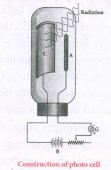
interference
polarization
ionization
photoelectric effect
4.
The particle which has zero mass but has energy is _____________.
electron
photon
proton
neutron
5.
Light of wavelength 5000Å falls on a sensitive plate with photoelectric work function of 1.9 eV. The K.E of the photo electron emitted will be ________________.
0.58 eV
2.48 eV
1.24 eV
1.16 eV
6.
A photocell employs photoelectric effect to convert into ______________.
Change in the frequency of light into a change in electric voltage
Change in the intensity of light into a change in photoelectric current
Change in the intensity of light into a change in work function of photocathode
Change in the frequency of light into a change in electric current
7.
Stopping potential of emitted photo electrons is given by (where ф = hv0) _____________.
\(\frac { hv-{ \phi }_{ 0 } }{ e } \)
hv-ф
\(\frac { hv }{ e } \)
\(\frac { hv+{ \phi }_{ 0 } }{ e } \)
8.
As the intensity of incident light increases ______________.
K.E of emitted photo electrons increases
photoelectric current decreases
photoelectric current increases
K.E of emitted photo electrons decreases
9.
A photon of energy hv is absorbed by a free electrons of a metal having work function ф < hv _____________.
The electron is sure to come out
The electron is sure to come out with a kinetic energy ф < hv
Either the electron does not come out or it comes out with kinetic energy hv - ф
It may come out with a kinetic energy less than hv - ф
10.
If the frequency of light in a photo electron experiment is doubled the stopping potential will ______________.
be doubled
be halved
become more than double
become less than double.
11.
Emission of electrons by the absorption of heat energy is called ______ emission.
photoelectric
field
thermionic
secondary
12.
The threshold wavelength for a metal surface whose photoelectric work function is 3.313 eV is _____.
4125 \(\mathring { A } \)
3750\(\mathring { A } \)
6000\(\mathring { A } \)
2062.5\(\mathring { A } \)
13.
A photoelectric surface is illuminated successively by monochromatic light of wavelength λ and λ /2. If the maximum kinetic energy of the emitted photoelectrons in the second case is 3 times that in the first case, the work function of the material is _____.
\(\frac{hc}{\lambda}\)
\(\frac{2hc}{\lambda}\)
\(\frac{hc}{3\lambda}\)
\(\frac{hc}{2\lambda}\)
14.
15.
The wavelength λe of an electron and λp of a photon of same energy E are related by _____.
λp ∝ λe
\({ \lambda }_{ p }∝ \sqrt { { \lambda }_{ e } } \)
\({ \lambda }_{ p }∝ \frac { 1 }{ \sqrt { { \lambda }_{ e } } } \)
\({ \lambda }_{ p }∝ { \lambda }_{ e }^{ 2 }\)
16.
A proton and a deuteron have the same velocity, what is the ratio of their de Broglie wavelengths?
17.
If the intensity of radiation in a photocell is increased how does the stopping potential vary?
18.
What is meant by de Broglie waves?
19.
What is photo emissive cell?
20.
A 3310 Å photon liberates an electron from a material with energy 3 x10-19 J while another 5000 Å photon ejects an electron with energy 0.972 x 10⁻¹⁹ J from the same material. Determine the value of Planck’s constant and the threshold wavelength of the material.
21.
Calculate the maximum kinetic energy and maximum velocity of the photoelectrons emitted when the stopping potential is 81 V for the photoelectric emission experiment.
22.
Write the relationship of de Broglie wavelength λ associated with a particle of mass m in terms of its kinetic energy K.
23.
How will you define threshold frequency?
24.
Give the definition of intensity of light according to quantum concept and its unit.
25.
Define work function of a metal. Give its unit.
26.
Why do metals have a large number of free electrons?
27.
An electron and a proton, each have de Broglie wavelength of 1.00 nm.
(a) Find the ratio of their momenta.
(b) Compare the kinetic energy of the proton with that of the electron.
28.
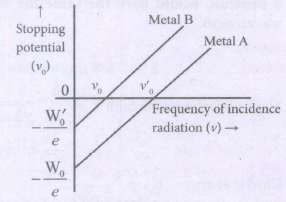
What is the stopping potential of a photocell, in which electrons with a maximum kinetic energy of 6 eV are emitted?
29.
An ∝ - particle and a proton are accelerated from rest through the same potential difference V. Find the ratio of de Broglie wavelength associated with them.
30.
The ground state energy of the hydrogen atom is -13.6 eV. If an electron makes a transition from an energy level -1.51 eV to -3.4 eV, calculate the wavelength of the spectral line emitted and name the series of hydrogen spectrum to which it belongs.
31.
Describe briefly Davisson – Germer experiment which demonstrated the wave nature of electrons.
32.
33.
Briefly discuss the observations of Hertz, Hallwachs and Lenard.
34.
Red light however bright it is, cannot produce the emission of electrons from a clean zinc surface, but even weak ultraviolet radiation can do so; why?
35.
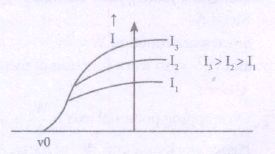
(i) Draw a graph showing variation of photoelectric current (I) with anode potential (V) for different intensities of incident radiation. Name the characteristic of the incident radiation that is kept constant in this experiment.
(ii) If the potential difference used to accelerate electrons is doubled, by what factor does the de-Broglie wavelength associated with the electrons change?
36.
An electron and a proton have the same kinetic energy. Which one of the two has the larger de Broglie wavelength and why?
37.
List out the laws of photoelectric effect. (or) Write any three Laws of Photoelectric Effect
38.
(a) Define the term 'intensity of radiation' in terms of photon picture of light.
(b) Two monochromatic beams, one red and the other blue; have the same intensity. In which case
(i) the number of photons per unit area per second is larger,
(ii) the maximum kinetic energy of the photoelectrons is more? Justify you answer.
39.
Light of wavelength 390 nm is directed at a metal electrode. To find the energy of electrons ejected, an opposing potential difference is established between it and another electrode. The current of photoelectrons from one to the other is stopped completely when the potential difference is 1.10 V. Determine i) the work function of the metal and ii) the maximum wavelength of light that can eject electrons from this metal.
40.
A deuteron and an alpha particle are accelerated with the same potential. Which one of the two has i) greater value of de Broglie wavelength associated with it and ii) less kinetic energy? Explain.
41.
Calculate the de Broglie wavelength of a proton whose kinetic energy is equal to 81.9 x 10⁻¹⁵ J. (Given: mass of proton is 1836 times that of electron).
42.
When a 6000Å light falls on the cathode of a photo cell, photoemission takes place. If a potential of 0.8 V is required to stop emission of electron, then determine the
(i) frequency of the light
(ii) energy of the incident photon
(iii) work function of the cathode material
(iv) threshold frequency and
(v) net energy of the electron after it leaves the surface.
43.
Derive an expression for de Broglie wavelength of electrons.
1.
(d)
\(\sqrt { 1 } :\sqrt { 2 } :\sqrt { 3 } \)
2.
(b)
electron gun
3.
(d)
photoelectric effect
4.
(b)
photon
5.
(a)
0.58 eV
6.
(b)
Change in the intensity of light into a change in photoelectric current
7.
(a)
\(\frac { hv-{ \phi }_{ 0 } }{ e } \)
8.
(c)
photoelectric current increases
9.
(d)
It may come out with a kinetic energy less than hv - ф
10.
(c)
become more than double
11.
(c)
thermionic
12.
\(\lambda_0 =\frac{h c}{\phi} \)
\(=\frac{6.626 \times 10^{-34} \times 3 \times 10^8}{3.313 \times 1.6 \times 10^{-19}} \)
\( =\frac{19.8782400}{5.3} \times 10^{-7} \)
\(\lambda_0 =3.750 \times 10^{-7} \simeq 3750 \stackrel{o}A\)
13.
\(\frac{\mathrm{hc}}{\lambda} =\phi+\mathrm{K} . \mathrm{E} .....(1) \)
\(\frac{2 \mathrm{hc}}{\lambda} =\phi+3 \mathrm{~K} . \mathrm{E}......(2)\)
multiply eqn. (1) by 3, we get
\(\frac{3 \mathrm{hc}}{\lambda} =3\phi+3 \mathrm{~K} . \mathrm{E} .....(3)\)
Subtract eqn. (2) from (3), we get
\(\frac{\mathrm{hc}}{\lambda} =2\phi \)
\(\phi=\frac{ \mathrm{hc}}{2\lambda} \)
14.
(b)
15.
\(\mathrm{E}_{\mathrm{p}} =\frac{\mathrm{hc}}{\lambda_{\mathrm{p}}} \)
\(\mathrm{E}_{\mathrm{e}} =\frac{\mathrm{h}^2}{2 \mathrm{~m} \lambda_{\mathrm{e}}^2} \)
\(\frac{\mathrm{hc}}{\lambda_{\mathrm{p}}} =\frac{\mathrm{h}^2}{2 \mathrm{~m} \lambda_{\mathrm{e}}^2} \)
\(\lambda_{\mathrm{p}} \propto \lambda_{\mathrm{e}}^{{ }^2}\)
16.
de Broglie wavelength \(\lambda =\frac { P }{ m } \propto \frac { 1 }{ m } \) for the same velocity v.
\(\frac { { \lambda }_{ p } }{ { \lambda }_{ d } } =\frac { { m }_{ d } }{ { m }_{ p } } =\frac { 2{ m }_{ p } }{ { m }_{ p } } =\frac { 2 }{ 1 } \) = 2.1
17.
The stopping potential does not depend on the intensity of incident radiation; so stopping potential will remain unchanged.
18.
According to de Broglie's hypothesis, all matter particles like electrons, protons, neutrons in motion are associated with waves. These waves are called de Broglie waves or matter waves.
19.
Its working depends on the electron emission from a metal cathode due to irradiation of light or other radiations.
20.
\(\lambda_{1}=3310 Å=3310 \times 10^{-10} \mathrm{~m} ; \mathrm{E}_{1}=3 \times 10^{-19} \mathrm{~J} \)
\(\lambda_{2}=5000 Å=5000 \times 10^{-10} \mathrm{~m} ; \mathrm{E}_{2}=0.972 \times 10^{-19} \mathrm{~J} \)
\(\mathrm{E}=\mathrm{E}_{1}-\mathrm{E}_{2}=2.028 \times 10^{-19} J\)
\(\mathrm{hc}\left(\frac{1}{\lambda_{1}}-\frac{1}{\lambda_{2}}\right)=\mathrm{E}_{1}-\mathrm{E}_{2} \)
\(\frac{\mathrm{h} \times 3 \times 10^{8}}{10^{-10}}\left(\frac{1}{3310}-\frac{1}{5000}\right)=2.028 \times 10^{-19} \)
\(\mathrm{~h}=\frac{2.028 \times 10^{-19} \times 10^{-10} \times 3310 \times 5000}{3 \times 10^{8} \times 1690}=6.62 \times 10^{-34} \mathrm{Js} \)
\(\phi_{0} =\frac{\mathrm{hc}}{\lambda}-\mathrm{E}=\frac{6.62 \times 10^{-34} \times 3 \times 10^{8}}{3310 \times 10^{-10}}-3 \times 10^{-19} \)
\(=(6-3) \times 10^{-19}=3 \times 10^{-19} \mathrm{~J} \)
\(\phi_{0} =3 \times 10^{-19} \mathrm{~J} \)
Threshold Wavelength,
\(\lambda_{0}=\frac{\mathrm{hc}}{\phi_{0}}=\frac{6.626 \times 10^{-34} \times 3 \times 10^{8}}{3 \times 10^{-19}}=6.62 \times 10^{-7} \mathrm{~m} \)
\(\lambda_{0}=6620 \stackrel {o}{A}\)
21.
V = 81 V
∴ K = eV = 1.6 x 10-19 x 81 = 1.296 x 10-17 = 1.3 x 10⁻¹⁷ J
\({ V }=\sqrt \frac {2K}{m}\sqrt { \cfrac { 2\times 1.3\times { 10 }^{ -17 } }{ 9.1\times { 10 }^{ -31 } } } =5.345 \times 10^6 ms^{-1} \)
v = 5.345 x 10⁶ m s-1, K = 1.3 x 10⁻¹⁷ J
22.
de Broglie wavelength \(\lambda=\frac{\mathrm{h}}{\mathrm{mv}}\)
Kinetic energy of electron K \(=\frac{1}{2} m v^{2} \text { (or) } v=\sqrt{\frac{2 K}{m}}\)
Now de Broglie wavelength is \(\lambda=\frac{h}{m v}=\frac{h}{m \sqrt{2 K / m}} \)
\(\lambda=\frac{h}{\sqrt{2 m K}} \)
23.
For a given metallic Surface, the emission of photo electrons takes place only if the frequency of incident light is greater than a certain minimum frequency called the threshold frequency.
24.
According to quantum concept, intensity of light of given wavelength is defined as the number of energy quanta or photons incident per unit area per unit time, with each photon having same energy. Its unit is Wm-2.
25.
The minimum energy needed for an electron to escape from the metal surface is called work function of that metal.
Unit: electron volt (eV).
26.
In metals, the electrons in the outer most shells are loosely bound to the nucleus. Even at room temperature, these large number of electrons which are moving inside the metal in random manner and they cannot leave the surface of metal. So that metals have a large number of free electrons.
27.
(a) λe =\(\frac { h }{ { p }_{ e } } \) and λp=\(\frac { h }{ { p }_{ p } } \), λe = λp =1.00 nm.
So, \(\frac { { \lambda }_{ e } }{ { \lambda }_{ p } } =\frac { { p }_{ p } }{ { p }_{ e } } =\frac { 1 }{ 1 } \Rightarrow \frac { { p }_{ p } }{ { p }_{ e } } =\frac { 1 }{ 1 } \) = 1:1
(b) From relation K=\(\frac { 1 }{ 2 } mv^{ 2 }=\frac { { p }^{ 2 } }{ 2m } \)
Ke = \(\\ \frac { { p }_{ e }^{ 2 } }{ 2me } \) and Kp = \(\frac { { p }_{ e }^{ 2 } }{ 2m_{ p } } \)
\(\frac { { K }_{ p } }{ { K }_{ e } } =\frac { { p }_{ p }^{ 2 } }{ 2{ m }_{ p } } \times \frac { 2{ m }_{ e } }{ { p }_{ e }^{ 2 } } =\frac { { m }_{ e } }{ { m }_{ p } } \)
Since me <<< mp, So Kp <<< Ke
\(\frac { { K }_{ p } }{ { K }_{ e } } =\frac { 9.1\times { 10 }^{ -31 } }{ 1.67\times 10^{ -27 } } \)
= 5.4 x 10⁻⁴
28.
Ek = eV0 ⇒ 6 eV = eV0 ⇒ V0 = 6 V
The stopping potential V0 = 6 volt (Negative).
29.
K.E.= \(\frac{1}{2}mv^2=qV or\)
\(v=\sqrt { \frac { 2qV }{ m } } \)
de Broglie wavelength, \(\lambda =\frac { h }{ mv } \)
\(=\frac { h }{ m\sqrt { \frac { 2qV }{ m } } } =\frac { h }{ \sqrt { 2mqV } } \)
For the same potential difference
\(\frac { { \lambda }_{ \alpha } }{ { \lambda }_{ p } } =\sqrt { \frac { { m }_{ p }{ q }_{ p } }{ { m }_{ \alpha }{ q }_{ \alpha } } } =\sqrt { \frac { { m }_{ p }e }{ { 4m }_{ p }2e } } \)
\(=\frac { 1 }{ 2\sqrt { 2 } } \)
30.
Energy differnce = Energy of emitted photon
= E2 - E1
= -1.51 - (-3.4) = 1.89 eV
= 1.89 x 1.6 x 10-19 J
λ = \(\\ \frac { hc }{ { E }_{ 2 }-{ E }_{ 1 } } \)
= \(\frac { 6.6\times { 10 }^{ -34 }\times 3\times { 10 }^{ 8 } }{ 1.89\times 1.6\times 10^{ -19 } } =\frac { 19.8 }{ 3.024 } \) x 10-7
= 6.548 x 10⁻⁷ m = 6548 Å
The wavelength belongs to the Balmer series of the hydrogen spectrum.
31.
Davisson - Germer experiment
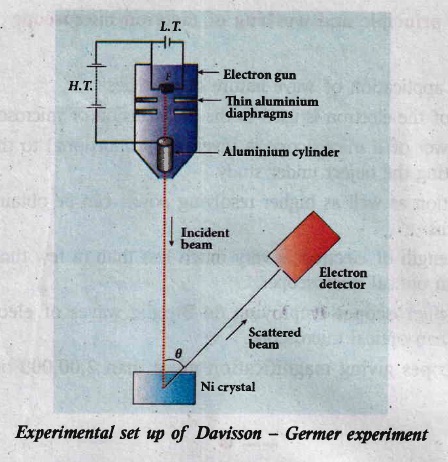
(i) The filament F is heated by a low tension (L . T) battery. Electrons are emitted from the hot filament by thermionic emission.
(ii) They are then accelerated due to the potential diference between the filament and the anode aluminum cylinder by a high tension (H.T) battery.
(iii) Electron beam is collimated by using two thin aluminum diaphragms and is allowed to strike a single crystal of Nickel.
(iv) The electrons scattered by Niatoms in diflerent directions are received by the electron detector which measures the intensity of scattered electron beam.
(v) The detector is capable of rotation in the plane of the paper, so that the angle (\(\theta\)) between the incident beam and the scattered beam can be changed at our will.
(vi) The intensity of the scattered electron beam is measured as a function of the angle \(\theta\).
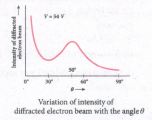
(i) Figure shows the variation of intensity of the scattered electrons with the angle \(\theta\) for the accelerating voltage of 54 V.
(ii) For a given accelerating voltage V, the scattered wave shows a peak or maximum at an angle of 50o to the incident electron beam.
(iii) This peak in intensity is attributed to the constructive interference of electrons diffracted from various atomic layers of the target material.
(iv) From the known value of interplanar spacing of Nickel, the wavelength of the electron wave has been experimentally calculated as 1.65\(\overset { o }{ A }\).
(v) The wavelength can also be calculated from de Broglie relation for V = 54 V from equation as
\(\lambda =\cfrac { 12.27 }{ \sqrt { V } } \overset { o }{ A } =\cfrac { 12.27 }{ \sqrt { 54 } } \)
\(\lambda =1.67\overset { o }{ A } \)
(vi) This value agrees very well with the experimentally observed wavelength of 1.65 \(\overset { o }{ A }\). Thus this experiment directly verifies de Broglie's hypothesis of the wave nature of moving particles.
32.
33.
Hertz observation:
(i) Maxwell's theory of electromagnetism predicted the existence of electromagnetic waves and concluded that light itself is just an electromagnetic wave. Then, the experimentalists tried to generate and detect electromagnetic waves through various experiments.
(ii) In 1887, Heinrich Hertz first became successful in generating and detecting electromagnetic wave with his high voltage spark discharge between two metallic spheres.
(iii) When a spark is formed, the charges will oscillate back and forth rapidly and the electromagnetic waves are produced.
(iv) The electromagnetic waves thus produced were detected by a detector that has a copper wire bent in the shape of a circle.
(v) Although the detection of waves is successful, there is a problem in observing the tiny spark produced in the detector.
(vi) In order to improve the visibility of the spark, Hertz made many attempts and finally noticed an important thing that small detector spark became more vigorous when it was exposed to ultraviolet light.
(vii) The reason for this behavior of the spark was not known at that time. Later it was found that it is due to the photoelectric emission. whenever ultraviolet light is incident on the metallic sphere, the electrons on the outer surface are emitted which caused the spark to be more vigorous.
Hallwachs' observation:
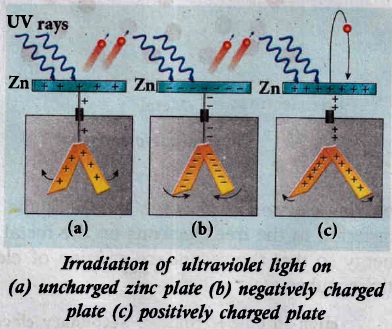
(i) In 1888, Wilhelm Hallwachs, a German physicist, confirmed that the strange behaviour of the spark is due to the action of ultraviolet light with his simple experiment.
(ii) A clean circular plate of zinc is mounted on an insulating stand and is attached to a gold leaf electroscope by a wire.
(iii) When the uncharged zinc plate is irradiated by ultraviolet light from an arc lamp, it becomes positively charged and the leaves will open.
(iv) Further, if the negatively charged zinc plate is exposed to ultraviolet light, the leaves will close as the charges leaked away quickly.
(v) If the plate is positively charged, it becomes more positive upon UV rays irradiation and the leaves will open further.
(vi) From these observations, it was concluded that negatively charged electrons were emitted from the zinc plate under the action of ultraviolet light.
Lenard's observation:
(i) ln 1902, Lenard studied this electron emission phenomenon in detail. His simple experimental setup is as shown in Figure.
(ii) The apparatus consists of two metallic plates A and C placed in an evacuated quartz bulb. The galvanometer G and battery B are connected in the circuit.
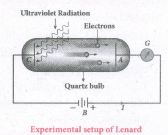
(iii) When ultraviolet light is incident on the negative plate C, an electric current flows in the circuit that is indicated by the deflection in the galvanometer.
(iv) On other hand, if the positive plate is irradiated by the ultraviolet light, no current is observed in the circuit.
(v) From these observations, it is concluded that when ultraviolet light falls on the negative plate, electrons are ejected from it which are attracted by the positive plate A.
(vi) On reaching the positive plate through the evacuated bulb, the circuit is completed and the current flows in it.
(vii) Thus, the ultraviolet light falling on the negative plate causes the electron emission from the surface of the plate.
34.
(i) The photoemission of electrons does not depend on the intensity but it depends on the frequency and hence on the energy of a photon of incident light.
(ii) If the energy of a photon is greater than the work function, the photoemission of electrons results however weak the incident radiation may be.
(iii) The energy of a photon of red light is less than the work function of zinc, so red light cannot emit photoelectrons.
(iv) The energy of a photon of ultraviolet light is greater than the work function of zinc, so ultraviolet light can emit photoelectrons.
35.
1) The frequency of incident radiation was kept constant.
2) de Broglie wavelength,
\(\lambda =\frac { h }{ \sqrt { 2mqV } } \alpha \frac { 1 }{ V } \)
If potential difference V is doubled, the de-Broglie wavelength is decreased to \(\frac { 1 }{ \sqrt { 2 } } \) time.
36.
An electron has a larger wavelength.
Reason: de- Broglie wavelength in terms of kinetic energy \(\lambda =\frac { h }{ \sqrt { 2m{ E }_{ K } } } \alpha \frac { 1 }{ \sqrt { m } } \) is for the same kinetic energy.
As an electron has a smaller mass than a proton, an electron has a larger de Broglie wavelength than a proton for the same kinetic energy.
37.
Laws of photoelectric effect:
(i) For a given surface, the emission of photoelectrons takes place only if the frequency of incident light is greater than a certain minimum frequency called the threshold frequency.
(ii) For a given frequency of incident light, the number of photoelectrons emitted is directly proportional to the intensity of the incident light. The saturation current is also directly proportional to the intensity of incident light.
(iii) Maximum kinetic energy of the photoelectrons is independent of the intensity of the incident light.
(iv) Maximum kinetic energy of the photoelectrons from a given metal is directly proportional to the frequency of incident light.
(v) There is no time lag between the incidence of light and the ejection of photoelectrons.
38.
a) The number of photons incident normally per unit area per unit time is determined by the intensity of radiations.
b) (i) Red light, because the energy of red light is less than that of blue light
(hv)R < (hv)B
(ii) Blue light, because the energy of blue light is greater than that of red light
(hv)B > (hv)R
39.
i) The work function is given by
ϕ0 = hv - Kmax = \(\frac { hc }{ \lambda } \) - eV0
since Kmax = eV0
\(=\left[ \frac { 6.626\times { 10 }^{ -34 }\times 3\times { 10 }^{ 8 } }{ 390\times 10^{ -9 } } \right] \) - [1.6 x 10-19 x 1.10]
= 5.10 x 10⁻¹⁹ - 1.76 x 10-19 = 3.34 x 10⁻¹⁹ J
= 2.09 eV
ii) The threshold wavelength is
\(\lambda_{0}=\frac{h c}{\phi_o}=\frac{6.626 \times 10^{-34} \times 3 \times 10^{8}}{3.34 \times 10^{-19}}\)
= 5.951 x 10⁻⁷ m = 5951 \(\mathring { A }\).
40.
\(\text { (i) } \lambda_{\mathrm{d}}=\frac{\mathrm{h}}{\sqrt{2 \mathrm{meV_1}}} ; \lambda_{\alpha}=\frac{\mathrm{h}}{\sqrt{\mathrm{me}}}\)
\(\frac{\lambda_{\mathrm{d}}}{\lambda_{\alpha}}=\frac{\frac{1}{\sqrt{2 m e}}}{\frac{1}{\sqrt{4 m 2 e}}} \Rightarrow \lambda_{\mathrm{d}}=2 \lambda_{\alpha}\)
\(\text { (ii) } =\frac{K.E_d}{K.E_a}=\frac{eV}{2eV} =\frac{1}{2}\Rightarrow K.E_d=\frac{1}{2}K.E_a\)
∴ K.E of deuteron is half of K.E of α-particle.
41.
\(\text { K.E }=81.9 \times 10^{-15} \mathrm{~J} \)
\(\lambda =\frac{\mathrm{h}}{\sqrt{2 \mathrm{mk}}}=\frac{6.626 \times 10^{-34}}{\sqrt{2 \times 9.1 \times 10^{-3} \times 1836 \times 81.9 \times 10^{-15}}} \)
\(\lambda =\mathbf{4 . 0 0} \times 10^{-14} \mathrm{~m} \)
42.
\(\lambda=6000Å=6000 \times 10^{-10} \mathrm{~m} ; \mathrm{V}=0.8 \mathrm{v} \)
\(\mathrm{k} \cdot \mathrm{E}=\mathrm{hv}-\phi \)
\(\mathrm{eV}_o=\mathrm{hv}-\phi=\frac{\mathrm{hc}}{\lambda}-\phi \)
\((i) v=\frac{c}{\lambda}=\frac{3 \times 10^{8}}{6000 \times 10^{-10}}=5 \times 10^{14} \mathrm{~Hz} \)
\((ii)\ \mathrm{E}=\frac{\mathrm{hc}}{\lambda}=\frac{6.626 \times 10^{-34} \times 3 \times 10^{8}}{6000 \times 10^{-10}}=3.313 \times 10^{-19} J\)
\(\mathrm{E}=\frac{3.313 \times 10^{-19}}{1.6 \times 10^{-19}}=2.07 \mathrm{eV} \)
\((iii) \ \mathrm{E}=\mathrm{hv}-\mathrm{W}\Rightarrow\mathrm{W}=\mathrm{h} v-\mathrm{E} \)
\(\mathrm{E}=\mathrm{eV_o}=1.6 \times 10^{-19} \times 0.8=1.2 8 \times10^{-19}J\)
\(\mathrm{hv}=6.626 \times 10^{-34} \times 5 \times 10^{14}=3.313 \times 10^{-19}J \)
\(\mathrm{~W}=\frac{(3.313-1.28) \times 10^{-19}}{1.6 \times 10^{-19}}=1.270 \mathrm{eV} \)
W = 1.27 eV
\((iv) \ \mathrm{W}=\mathrm{h} \mathrm{v}_{0} \)
\(v_{0}=\frac{W}{h}=\frac{2.033 \times 10^{-19}}{6.626 \times 10^{-34}}=3.07 \times 10^{14} \mathrm{~Hz} \)
\((v)\ \mathrm{E}=\mathrm{eV}_o=\frac{0.8 \times 1.6 \times 10^{-19}}{1.6 \times 10^{-19}}=\mathbf{0 . 8} \mathrm{eV}\)
43.
(i) An electron of mass m is accelerated through a potential difference of V volt. The kinetic energy acquired by the electron is given by
\(\cfrac { 1 }{ 2 } { mv }^{ 2 }=ev\)
(ii) Therefore, the speed v of the electron is
\(v=\sqrt { \cfrac { 2ev }{ m } } \)
Hence, the de Broglie wavelength of the matter waves associated with electron is
\(\lambda =\cfrac { h }{ mv } =\cfrac { h }{ \sqrt { 2mev } } \)
(iii) Substituting the known values in the above equation, we get
\(\lambda =\cfrac { 6.26\times { 10 }^{ -34 } }{ \sqrt { 2V\times 1.6\times { 10 }^{ -19 }\times 9.11\times { 10 }^{ -31 } } } \)
= \(\cfrac { 12.27\times { 10 }^{ -10 } }{ \sqrt { V } } m\)
\(\lambda =\cfrac { 12.27 }{ \sqrt { V } } \overset { o }{ A } \)
(iv) Since the kinetic energy of the electron, K = eV, then the de Broglie wavelength associated with electron can be also written as
\(\lambda =\cfrac { h }{ \sqrt { 2mK } } \)

12th Standard Syllabus & Materials
12th Standard
TN 12th Computer Applications களப்பெயர் முறைமை (DNS) Sample Question Papers Study Material - QB365 Set A
NEW12th Standard
TN 12th Computer Applications வலையமைப்பு எடுத்துக்காட்டுகள் மற்றும் நெறிமுறைகள் Sample Question Papers Study Material - QB365 Set A
NEW12th Standard
TN 12th Computer Applications கணினி வலையமைப்பு ஓர் அறிமுகம் Sample Question Papers Study Material - QB365 Set A
NEW12th Standard
TN 12th Computer Applications PHP-உடன் MySQL-ஐ இணைத்தல் Sample Question Papers Study Material - QB365 Set A



Tamilnadu Stateboard 12th Standard Subjects

Maths

Chemistry
Physics

Biology

Computer Science

Business Maths and Statistics

Economics

Commerce

Accountancy

History

Computer Applications
Biology
Computer Technology
Computer Applications
Computer Science
Business Maths and Statistics
Commerce
Economics
Maths
Chemistry
Physics
Computer Technology
History
Accountancy

Tamil

English

French
Tamilnadu Stateboard Standards

