
 100% FREE ACCESS
12th Standard Syllabus & Materials
12th Standard
TN 12th Computer Applications மின்னணு தரவு பரிமாற்றம் Sample Question Papers Study Material - QB365 Set A
NEW12th Standard
TN 12th Computer Applications மின் - வணிக பாதுகாப்பு அமைப்புகள் Sample Question Papers Study Material - QB365 Set A
NEW12th Standard
TN 12th Computer Applications மின்னணு செலுத்தல் முறைகள் Sample Question Papers Study Material - QB365 Set A
NEW12th Standard
TN 12th Computer Applications மின் - வணிகம் Sample Question Papers Study Material - QB365 Set A
NEW12th Standard
TN 12th Computer Applications திறந்த மூல கருத்துருக்கள் Sample Question Papers Study Material - QB365 Set A
NEW12th Standard
TN 12th Computer Applications வலையமைப்பு வடமிடல் Sample Question Papers Study Material - QB365 Set A

Published on: 02/09/2022
QB365 provides a detailed and simple solution for every Possible Book Back Questions in Class 12 Physics Subject - Retirement and Death of a Partner, English Medium. It will help Students to get more practice questions, Students can Practice these question papers in addition to score best marks.
Download Tamil Nadu 12th Standard Physics question papers, model tests, one-mark questions, important questions, and public exam papers in PDF format. Free study materials and answer keys for TN State Board students.
Questions + Answers key
Take MCQ Physics Test1.
\(\frac{20}{\pi^2}H\) inductor is connected to a capacitor of capacitance C. The value of C in order to impart maximum power at 50 Hz is
50 μF
0.5 μF
500 μF
5 μF
2.
In an oscillating LC circuit, the maximum charge on the capacitor is Q. The charge on the capacitor when the energy is stored equally between the electric and magnetic fields is
\(\frac{Q}{2}\)
\(\frac{Q}{\sqrt3}\)
\(\frac{Q}{\sqrt2}\)
Q
3.
The instantaneous values of alternating current and voltage in a circuit are \(i=\frac { 1 }{ \sqrt { 2 } } \sin\left( 100\pi t \right) \) A and v \(=\frac { 1 }{ \sqrt { 2 } } \sin\left( 100\pi t+\frac { \pi }{ 3 } \right) V.\)The average power in watts consumed in the circuit is
\(\frac{1}{4}\)
\(\frac{\sqrt3}{4}\)
\(\frac{1}{2}\)
\(\frac{1}{8}\)
4.
An inductor 20 mH, a capacitor 50 μF and a resistor 40Ω are connected in series across a source of emf V = 10 sin 340 t. The power loss in AC circuit is
0.76 W
0.89 W
0.46 W
0.67 W
5.
In a series resonant RLC circuit, the voltage across 100 Ω resistor is 40 V. The resonant frequency ω is 250 rad/s. If the value of C is 4 µF, then the voltage across L is
600 V
4000 V
400 V
1 V
6.
In a series RL circuit, the resistance and inductive reactance are the same. Then the phase difference between the voltage and current in the circuit is
\(\frac{\pi}{4}\)
\(\frac{\pi}{2}\)
\(\frac{\pi}{6}\)
zero
7.
In an electrical circuit, R, L, C, and AC voltage source are all connected in series. When L is removed from the circuit, the phase difference between the voltage and current in the circuit is \(\frac{\pi}{3}\). Instead, if C is removed from the circuit, the phase difference is again \(\frac{\pi}{3}\). The power factor of the circuit is
1/2
1/\(\sqrt2\)
1
\(\sqrt3\)/2
8.
A step-down transformer reduces the supply voltage from 220 V to 11 V and increase the current from 6 A to 100 A. Then its efficiency is
1.2
0.83
0.12
0.9
9.
10.
A circular coil with a cross-sectional area of 4 cm2 has 10 turns. It is placed at the centre of a long solenoid that has 15 turns/cm and a cross-sectional area of 10 cm2. The axis of the coil coincides with the axis of the solenoid. What is their mutual inductance?
7.54 μH
8.54 μH
9.54 μH
10.54 μH
11.
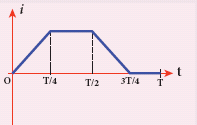
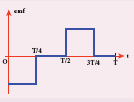
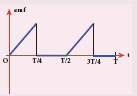
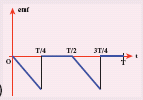
The current i flowing in a coil varies with time as shown in the figure. The variation of induced emf with time would be
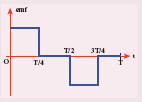
12.
When the current changes from +2A to −2A in 0.05 s, an emf of 8 V is induced in a coil. The co-efficient of self-induction of the coil is
0.2H
0.4H
0.8H
0.1H
13.
The flux linked with a coil at any instant t is given by \(\Phi\)B = 10t2 − 50t + 250. The induced emf at t = 3s is
−190 V
−10 V
10 V
190 V
14.
A thin semi-circular conducting ring (PQR) of radius r is falling with its plane vertical in a horizontal magnetic field B, as shown in the figure.
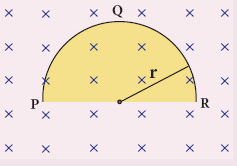
The potential difference developed across the ring when its speed v, is
Zero
\(\frac { { Bv\pi { r }^{ 2 } } }{ 2 } \) and P is at higher potential
πrBv and R is at higher potential
2rBv and R is at higher potential
15.
An electron moves on a straight line path XY as shown in the figure. The coil abcd is adjacent to the path of the electron. What will be the direction of current, if any, induced in the coil?
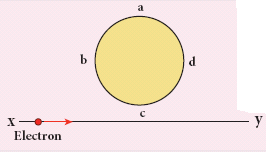
The current will reverse its direction as the electron goes past the coil
No current will be induced
abcd
adcb
1.
\(L=\frac{20}{\pi^2} \mathrm{H}, \mathrm{f}=50 \mathrm{~Hz} \)
\(f=\frac{1}{2 \pi \sqrt{L C}} \)
\(50=\frac{1}{2 \pi \sqrt{\frac{20}{\pi^2} \times C}} \)
\(50=\frac{1}{2 \times \sqrt{20 C}} \)
\(\therefore(50)^2=\frac{1}{4 \times 20 C} \)
\(\therefore C=\frac{1}{2500 \times 4 \times 20}=5 \times 10^{-6}=5 \mu \mathrm{F}\)
2.
\(Q_{midpoint}=\frac{Q}{\sqrt{1^2+1^2}}=\frac{Q}{\sqrt2}\)
3.
Pav = \(\frac{1}{2}\)V0I0cosΦ
\(= \frac{1}{2}\times\frac{1}{\sqrt{2}}\times\frac{1}{\sqrt{2}}cos\times\frac{\pi}{3}\times \frac{1}{2}\times\frac{1}{2}\times\frac{1}{2}=\frac{1}{8}\)
4.
L = 20 x 10-3H. C = 50 x 10-6 F, R= 40Ω
enf V = 10 sin 340 t
\(\therefore V_0=10 \mathrm{~V}, \omega=340 \)
\(X_1=1 \omega^{\prime}=20 \times 10^3 \times 340 \)
\(=6800 \times 10^{-1}=6.8 \Omega \)
\(X_C=\frac{1}{C .} \)
\(=\frac{1}{50 \times 10^{-\alpha} \times 340}=\frac{10^{\circ}}{17000}=\frac{10^{\prime}}{17}=58.823 \Omega \)
\(Z=\sqrt{R^2+\left(X_6-X_1\right)^2} \)
\(=\sqrt{(40)^2+(58.82-6.8)^2} \)
\(=\sqrt{(40)^2+(52.02)^2} \)
\(=65.62 \Omega\)
The peak current in the circuit is,
\(I_0=\frac{V_0}{Z}=\frac{10}{65.62} \)
\(\cos 0=\frac{R}{Z}=\frac{40}{65.62} \)
\(\text{Power loss in A.C. circuit }=V_{r m} 1_{r \rightarrow \infty} \cos \phi \)
\(=\frac{1}{2} V_{\mathrm{o}} I_{\mathrm{c}} \cos \phi \)
\(=\frac{1}{2} \times 10 \times \frac{10}{65.62} \times \frac{40}{65.62}\)
\(\frac{2000}{4305.98}\)
= 0.46 W
5.
\(\omega=250 \mathrm{rad} / \mathrm{s}, C=4 \times 10^{-} \mathrm{F} \)
\(R=100 \Omega, \quad \mathrm{V}_{\mathrm{R}}=40 \mathrm{~V} \)
\(\therefore I_{\mathrm{R}}=\frac{V_R}{100}=\frac{40}{100}=0.4 \mathrm{~A} \)
\(\omega=\frac{1}{\sqrt{L C}} \)
\(\omega^2=\frac{1}{L C} \)
\((250)^2=\frac{1}{L \times 4 \times 10^{-6}} \)
\(L=\frac{1}{4 \times(250)^2 \times 10^{-6}} \)
\(=\frac{1}{4 \times 250 \times 250 \times 10^{-6}} \)
\(=\frac{1}{1000 \times 10^{-6} \times 250} \)
\(=\frac{10^3}{250}=\frac{1000}{250}=4 \mathrm{H}\)
Voltage acnoss L, Vt = IXL
VL = l x L x ω
= 0.4 x 4 x 250
0.4 x 1000 = 400 V
6.
In RL circuit, tanΦ = \(\frac{X_l}{R}\)
If R = X1, then tanΦ = \(\frac{X_l}{X_l}=1\)
∴ Φ = tan-1(1)=\(\frac{\pi}{4}\)
∴ Phase difference \(=\frac{\pi}{4}\)
7.
\(\Phi = \frac{\pi}{3}-\frac{\pi}{3}=0 \)
Power factor = cosФ = cos 0 = 1
8.
\(\mathrm{V}_{\mathrm{P}}=220 \mathrm{~V}, \mathrm{~V}_{\mathrm{s}}=11 \mathrm{~V} \)
\(\mathrm{I}_{\mathrm{P}}=6 \mathrm{~A}, \mathrm{I}_{\mathrm{s}}=100 \mathrm{~A} . \)
\(\text {Efficiency }=\frac{\mathrm{V}_{\mathrm{s}} \mathrm{I}_{\mathrm{s}}}{\mathrm{V}_{\mathrm{P}} \mathrm{I}_{\mathrm{P}}} \)
\(=\frac{11 \times 100}{220 \times 6}=\frac{1100}{220 \times 6}=\frac{5}{6}=0.83\)
9.
(a)
10.
\(A_1 =4 \times 10^{-4} \mathrm{~m}^2 \)
\(N_1 =10 \text { turns } \)
\(A_2 =4 \times 10^{-4} \mathrm{~m}^2 \)
\(N_2 =15 \times 10^{-}=1500 \mathrm{turn} / \mathrm{m} \)
\(\phi =B_2 A_2=\left(\mu_0 \mathrm{n}_2 I_2\right) \mathrm{A}_1 \)
\(Where, \mathrm{n}_2=\frac{\mathrm{N}_2}{l}=1500 \mathrm{turn} / \mathrm{m}\)
The mutual Inductance is,
\(M =\frac{N_1 o_{12}}{I_2}=\mu_0 n_2 N_1 A_1 \)
\(=4 \pi \times 10^{-7} \times 1500 \times 10 \times 4 \times 10^{-4} \)
\(=7.54 \times 10^{-6} \mathrm{H}=7.54 \mu \mathrm{H}\)
11.
Solution
e = -L\(\frac{dl}{dt}\)
12.
\(\text {emf } e=8 \mathrm{~V} \)
\(d I=I_1-I_0=2-(-2)=4 \mathrm{~A} \)
\(\text {dt }=0.05 \mathrm{~s} \)
\(L=\frac{-e}{d I / d t}=\frac{-8}{4 / 0.05} \)
\(=\frac{-8 \times 0.05}{4}=\frac{-0.40}{4} \)
=-0.1 H
-ve sign indicates that self-induced emf always opposes the current w.r.t. time.
13.
\(\phi_B =10 t^2-50 t+250 \)
\(e =\frac{-d \phi_B}{d t} \)
\(=\frac{-d}{d t}\left(10 t^2-50 t+250\right) \)
=-(20 t - 50)
=-20 t + 50
When, t = 3 s, e =-20(3) + 50 = -60 + 50
e = -10V
14.
(d)
2rBv and R is at higher potential
15.
The direction of conventional current is always opposite to the direction of flow of electrons.

12th Standard Syllabus & Materials
12th Standard
TN 12th Computer Applications களப்பெயர் முறைமை (DNS) Sample Question Papers Study Material - QB365 Set A
NEW12th Standard
TN 12th Computer Applications வலையமைப்பு எடுத்துக்காட்டுகள் மற்றும் நெறிமுறைகள் Sample Question Papers Study Material - QB365 Set A
NEW12th Standard
TN 12th Computer Applications கணினி வலையமைப்பு ஓர் அறிமுகம் Sample Question Papers Study Material - QB365 Set A
NEW12th Standard
TN 12th Computer Applications PHP-உடன் MySQL-ஐ இணைத்தல் Sample Question Papers Study Material - QB365 Set A



Tamilnadu Stateboard 12th Standard Subjects

Maths

Chemistry
Physics

Biology

Computer Science

Business Maths and Statistics

Economics

Commerce

Accountancy

History

Computer Applications
Biology
Computer Technology
Computer Applications
Computer Science
Business Maths and Statistics
Commerce
Economics
Maths
Chemistry
Physics
Computer Technology
History
Accountancy

Tamil

English

French
Tamilnadu Stateboard Standards

