
 100% FREE ACCESS
12th Standard Syllabus & Materials
12th Standard
TN 12th Computer Applications மின்னணு தரவு பரிமாற்றம் Sample Question Papers Study Material - QB365 Set A
NEW12th Standard
TN 12th Computer Applications மின் - வணிக பாதுகாப்பு அமைப்புகள் Sample Question Papers Study Material - QB365 Set A
NEW12th Standard
TN 12th Computer Applications மின்னணு செலுத்தல் முறைகள் Sample Question Papers Study Material - QB365 Set A
NEW12th Standard
TN 12th Computer Applications மின் - வணிகம் Sample Question Papers Study Material - QB365 Set A
NEW12th Standard
TN 12th Computer Applications திறந்த மூல கருத்துருக்கள் Sample Question Papers Study Material - QB365 Set A
NEW12th Standard
TN 12th Computer Applications வலையமைப்பு வடமிடல் Sample Question Papers Study Material - QB365 Set A

Published on: 02/09/2022
QB365 provides a detailed and simple solution for every Possible Creative Questions in Class 12 Physics Subject - Retirement and Death of a Partner, English Medium. It will help Students to get more practice questions, Students can Practice these question papers in addition to score best marks.
Download Tamil Nadu 12th Standard Physics question papers, model tests, one-mark questions, important questions, and public exam papers in PDF format. Free study materials and answer keys for TN State Board students.
Questions + Answers key
Take MCQ Physics Test1.
Explain briefly. a) Ultra violet radiation b) Infra red radiation c) Gamma rays.
2.
Explain the method of generation of magnetic field by changing electric field.
3.
Use the formula E = h૪ (for energy of a quantum of radiation photon) and obtain the photon energy in units of ev for different parts of the Electromagnetic spectrum. In what ways are the different scales of photon energies that you obtain related to the sources of Electromagnetic radiation?
4.
About 5 % of the power of a 100 W light bulb is connected to visible radiation. What is the average intensity of visible radiation at the distance of 1m from the bulb?
5.
A plane Electromagnetic wave travels in vacuum along z - direction. What can you say about the directions of electric and magnetic field vectors? If the frequency of the wave is 30 MHz. What is its wavelength?
6.
An electromagnetic wave is traveling in vacuum with a speed 3 x 10⁸ m/s. find its velocity in a medium having relative electric and magnetic permeability 2 and 1 respectively.
7.
In which way you can establish an instantaneous displacement current of 1.0 A in the space between the parallel plates of 1μf capacitor?
8.
In an electric circuit, there is a capacitor of reactance 100 Ω connected across the source of 220 V, find the displacement current.
9.
The magnetic field amplitude of an Electromagnetic wave is 1.6 x 10⁻⁷ T. If the frequency is 30 MHz. determine electric field, any velocity K and λ.
10.
In a plane Electromagnetic wave, the electric field oscillates sinusoidally at a frequency of 1.5 x 10¹⁰Hz with & an amplitude of 36 Vm-1.
(i) What is the wavelength of a wave?
(ii) What the amplitude of the oscillating magnetic field?
(iii) Straight the average energy density of the electric field \(\left( \overrightarrow { E } \right) \), is equal to average energy density of the magnetic field \(\left( \overrightarrow { B } \right) \)
11.
The oscillating magnetic field in a plane Electromagnetic wave is given by
B = (8 x 10⁻⁶) sin (2 x 10¹¹ t + 300 πx) T
(i) Calculate the λ of Electromagnetic wave.
(ii) Find the amplitude of electric field.
12.
In an Electromagnetic wave propagating along the X - direction, the magnetic field oscillates at a frequency. 5 x 10⁸ Hz and has an amplitude of 10-7 tesla, acting along the Y-direction.
(i) What is the wavelength of the wave?
(ii) Write the expression representing the corresponding oscillating electric field.
13.
A parallel plate capacitor is charged by an external ac source straight the displacement current inside the capacitor is the same as the current charging the capacitor.
14.
Show how to generalize Ampere's circuital law to include the term due to displacement current?
1.
(a) Ultra violet radiation
i) It is produced by Sun, arc and ionized gases. Its frequency range is 8 x 10¹⁴ HZ to 1017 HZ. It has less penetrating power.
ii) It can be absorbed by atmospheric ozone and is harmful to human body. It is used to destroy bacteria in sterilizing the surgical instruments, burglar alarm, to detect the invisible writing, finger prints and also in the study of atomic structure.
(b) Infrared radiation
i) It is produced by hot bodies (also known as heat waves) and also by when the molecules undergoing rotational and vibrational transitions.
ii) The frequency range is 1011Hz to 4 X 10¹⁴ Hz. It provides electrical energy to satellites by means of solar cells.
iii) It is used to produce dehydrated fruits, in green houses to keep the plants warm, heat therapy for muscular pain or sprain, TV remote as a signal carrier, to look through haze fog or mist and used in night vision or infrared photography.
(c) Gamma rays
i) It is produced by transitions of radioactive nuclei and decay of certain elementary particles. They produce chemical reactions on photographic plates, fluorescence, ionisation, diffraction. The frequency range is 1018 Hz and above.
ii) Gamma rays have higher penetrating power than X-rays and ultraviolet radiations, it has no charge but harmful to human body.
iii) Gamma rays provide information about the structure of atomic nuclei. It is used in radio therapy for the, treatment of cancer and tumour, in food industry to kill pathogenic micro-organism.
2.
(i) In order to understand how the changing electric field induces magnetic field, let us consider a situation of charging a parallel plate capacitor which contains non-conducting medium, between the plates.
(ii) Let a time-dependent current ic called conduction current be passed through the wire to charge the capacitor.
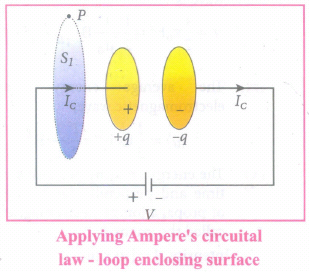
(iii) Ampere's circuital law can be used to find the magnetic field produced around the current carrying wire.
(iv) To calculate the magnetic field at a point P near the wire and outside the capacitor, let us draw a circular Amperian loop which encloses the circular surface S1 . Using Ampere's circuital law for this loop, we get
\(\oint_{\text {enclosing } S_1} \vec{B} \cdot \mathrm{d} \vec{l}=\mu_0 i_c\) ... (1)
Where, \(\mu_0\) is the permeability of free space.
3.
Given : Frequency of ૪ - rays = 3 x 10²⁰ Hz
Formula:
Energy of gamma rays,
E = h૪
= 6.63 x 10-34 x 3 x 1020
E = 19.8 x 10⁻¹⁴ J
∵ [ 1 eV = 1.6 x 10 - 19J; 1 T = \(\frac{1}{1.6\times 10^{-19}}\) eV]
Solution:
\(E=\frac { 19.8\times { 10 }^{ -14 } }{ 1.6\times { 10 }^{ -19 } } \)
E = 1.24 x 10⁶ eV
4.
Formula:
Intensity, I = \(\frac{Power\ of\ visible\ light}{Area}\)
\(I=\frac { \frac { 5 }{ 100 } \times 100 }{ 4\pi { (1) }^{ 2 } } =0.4{ W/m }^{ 2 }\)
5.
E and B vectors must be in x and y directions.
Formula: We know \(\lambda =\frac { v }{ \gamma } =\frac { 3\times { 10 }^{ 8 } }{ 30\times { 10 }^{ 6 } } \)
λ = 10m.
6.
Given: Velocity of electromagnetic wave is
c = 3 x 10⁸ m/s.
Relative electric permittivity εr = 2
Relative magnetic permeability μr = 1
To find:
Velocity of Electromagnetic in a medium is
\(v=\frac { 1 }{ \sqrt { { \varepsilon }_{ 0 }{ \varepsilon }_{ r }.{ \mu }_{ 0 }{ \mu }_{ r } } } =\frac { 1 }{ \sqrt { { \varepsilon }_{ 0 }{ \mu }_{ 0 } } \times \sqrt { { \varepsilon }_{ r }{ \varepsilon }_{ r } } } \)
Solution:
\(\therefore v=\frac { 1 }{ \sqrt { { \varepsilon }_{ 0 }{ \mu }_{ 0 } } } ,v=\frac { 1 }{ \sqrt { { \varepsilon }_{ r }{ \mu }_{ R } } } \)
\(\therefore v=\frac { 3\times { 10 }^{ 8 } }{ \sqrt { 2\times 1 } } =\frac { 3 }{ \sqrt { 2 } } \times 10^{ 8 }m/s\)
7.
Given: Displacement current,
\({ I }_{ d }={ \varepsilon }_{ 0 }\frac { d{ \phi }_{ E } }{ dt } \)
\(={ \varepsilon }_{ 0 }\frac { d(EA) }{ dt } \quad (\therefore { \phi }_{ E }=EA)\)
\({ I }_{ d }={ \varepsilon }_{ 0 }A\frac { d }{ dt } \left( \frac { V }{ d } \right) \left( \because E=\left( \frac { V }{ d } \right) \right) \)
\({ I }_{ d }=\frac { { \varepsilon }_{ 0 }A }{ d } \left( \frac { dV }{ dt } \right) (\because C=\frac { { \varepsilon }_{ 0 }A }{ d } )\)
Formula:
\({ I }_{ d }=C.\frac { dV }{ dt } \)
Solution:
\(\frac { dV }{ dt } =\frac { { I }_{ d } }{ C } =\frac { 1.0 }{ 1\times { 10 }^{ -6 } } ={ 10 }^{ 6 }\)
8.
Since displacement current = conduction current
\({ I }_{ d }=\frac { V }{ { X }_{ C } } =\frac { 220 }{ 100 } =2.2A\)
9.
Given: The amplitude of magnetic field of an Electromagnetic wave B = 1.6 x 10⁻⁷ T
To find:
The amplitude of electric field of an Electromagnetic wave E = ?
frequency ૪ = 30 Mhz = 30 x 106 Hz.
To find: Angle velocity ω =?
Wavelength of Electromagnetic wave λ = ?
(i) Ampere of electric field E = ?
\(\frac { E }{ B } =C\Rightarrow E=C.B\Rightarrow 3\times { 10 }^{ 8 }\times 1.6\times { 10 }^{ -7 }\)
E = 48Vm-1.
(ii) Angle velocity, ω = 2π૪
ω = 2 x 3.14 x 30 x 106
ω = 1.885 x 10⁸ rad /s.
(iii) Wavelength of Electromagnetic wave, λ = \(\frac{C}{\gamma}\)
\(\gamma=\frac{3\times 10^8}{30\times 10^6}\) = 10m
λ = 10m
10.
(i) Wavelength \(\lambda =\frac { c }{ \gamma } =\frac { 3\times { 10 }^{ 8 } }{ 1.5\times { 10 }^{ 10 } } =2\times { 10 }^{ -2 }m\)
(ii) \(B=\frac { E }{ c } =\frac { 36 }{ 3\times { 1 }0^{ 8 } } =12\times { 10 }^{ -8 }T\)
Formula: (or) 1.2 x 10⁻⁷T
Average energy of magnetic field \(\overrightarrow { E } \) \({ U }_{ E }=\frac { 1 }{ 2 } .{ \varepsilon }_{ 0 }{ E }^{ 2 }\)
The average energy density of electric field \(\overrightarrow { B } \) \({ U }_{ E }=\frac { 1 }{ 2{ \mu }_{ 0 } } .{ B }^{ 2 }\)
But E = CB & C2 = \(\frac { 1 }{ { \mu }_{ 0 }{ \varepsilon }_{ 0 } } \)
\({ U }_{ E }=\frac { 1 }{ 2 } .{ \varepsilon }_{ 0 }{ E }^{ 2 }=\frac { 1 }{ 2 } .{ \varepsilon }_{ 0 }{ (CB) }^{ 2 }\)
\({ U }_{ E }=\frac { 1 }{ 2 } .{ \varepsilon }_{ 0 }.\frac { 1 }{ { \mu }_{ 0 }{ \varepsilon }_{ 0 } } { B }^{ 2 }=\frac { 1 }{ { \mu }_{ 0 }{ \varepsilon }_{ 0 } } { B }^{ 2 }={ U }_{ B }\)
\(\therefore { U }_{ E }={ U }_{ B }\)
11.
(i) \(\lambda =\frac { 2\pi }{ 300\pi } =\frac { 1 }{ 150 } m\)
\([{ B }_{ y }={ B }_{ o }sin2\pi \left( \frac { x }{ \lambda } +\frac { t }{ r } \right) ]\)
(ii) \(\\ { E }_{ o }=c,{ B }_{ o }=3\times { 10 }^{ 8 }\times 8\times { 10 }^{ -6 }=2400{ Vm }^{ -1 }\)
12.
Given:
The frequency of Electromagnetic wave
૪ = 5 x 10⁸Hz
λ = 0.6m
\(\lambda =\frac { c }{ \gamma } =\frac { 3\times { 10 }^{ 8 } }{ 5\times { 10 }^{ 8 } } =0.6\)
(ii) The amplitude of magnetic field Bo = 107 T
To find:
Tile amplitude of electric field Eo = ?
Eo = c Bo = 3 x 108 x 10-7 = 30 V m-1
The expression for oscillating electric field
Ez =?
\(E={ E }_{ 0 }sin2\pi (vt+\frac { 1 }{ \lambda } .x)\)
E = 30 sin 2π (3 x 10⁸ t + 1.66 x) Vm-1.
13.
Electric field between the capacitor plates
\(E=\frac { \sigma }{ \varepsilon _{ 0 } } =\frac { q }{ \varepsilon _{ 0 }A } \)
Where q is the charge accumulated on the positive plate.
The electric flux through this plate
\({ \phi }_{ E }=EA=\frac { q }{ \varepsilon _{ 0 }A } .A=\frac { q }{ \varepsilon _{ 0 } } \)
∴ Displacement current
\(\\ { I }_{ d }=\varepsilon _{ 0 }.\frac { d\phi }{ dt } =\varepsilon _{ 0 }\frac { d }{ dt } \left[ \frac { q }{ \varepsilon _{ 0 } } \right] =\frac { dq }{ dt } \)
\(\frac { dq }{ dt } \) is the rate at which charge flows to a positive plate through the conducting wire.
Id = Ic
i.e. displacement current between the capacitor plates = conduction current through the wire.
14.
According to Ampere's circuital law,
\(\oint _{ s }^{ }{ \overrightarrow { B } .\overrightarrow { dl } } ={ \mu }_{ 0 }I\quad ...(1)\)
As the current flows across the area bounded by loop S1, so
\(\oint _{ { s }_{ 1 },s }^{ }{ \overrightarrow { B } .\overrightarrow { dl } } ={ \mu }_{ 0 }I\quad ...(2)\)
But the area bounded by S2 lies in the region between the plates capacitor where no current flows across it.
\(\therefore \oint _{ { s }_{ 1 } }^{ }{ \overrightarrow { B } .\overrightarrow { dl } } =0\)
Consider that loops enclosing S1 & S2 are infinitesimally close to each other. Then
\(\oint _{ { s }_{ 1 } }^{ }{ \overrightarrow { B } .\overrightarrow { dl } } =\oint _{ { s }_{ 2 } }^{ }{ \overrightarrow { B } .\overrightarrow { dl } } \)
This equation is inconsistent with equations (2) & (3). To remove this maxwell said that a changing electric field (during charging) between the capacitor plates must induce a magnetic field which in turn must be associated with current Id.
\({ I }_{ d }={ \varepsilon }_{ 0 }\left( \frac { d{ \phi }_{ E } }{ dt } \right) \) [\(\frac { d{ \phi }_{ E } }{ dt } \) change in electric flux]
The total current must be
I = Iconduction + Idisplacement
\({ I }_{ c }={ \varepsilon }_{ 0 }\frac { d{ \phi }_{ E } }{ dt } \)
Hence the generalized from of Ampere's circuital law is
\(\oint _{ s }^{ }{ \overrightarrow { B } .\overrightarrow { dl } } ={ \mu }_{ 0 }\left[ { I }_{ c }+{ \varepsilon }_{ 0 }\frac { d{ \phi }_{ E } }{ dt } \right] \)

12th Standard Syllabus & Materials
12th Standard
TN 12th Computer Applications களப்பெயர் முறைமை (DNS) Sample Question Papers Study Material - QB365 Set A
NEW12th Standard
TN 12th Computer Applications வலையமைப்பு எடுத்துக்காட்டுகள் மற்றும் நெறிமுறைகள் Sample Question Papers Study Material - QB365 Set A
NEW12th Standard
TN 12th Computer Applications கணினி வலையமைப்பு ஓர் அறிமுகம் Sample Question Papers Study Material - QB365 Set A
NEW12th Standard
TN 12th Computer Applications PHP-உடன் MySQL-ஐ இணைத்தல் Sample Question Papers Study Material - QB365 Set A



Tamilnadu Stateboard 12th Standard Subjects

Maths

Chemistry
Physics

Biology

Computer Science

Business Maths and Statistics

Economics

Commerce

Accountancy

History

Computer Applications
Biology
Computer Technology
Computer Applications
Computer Science
Business Maths and Statistics
Commerce
Economics
Maths
Chemistry
Physics
Computer Technology
History
Accountancy

Tamil

English

French
Tamilnadu Stateboard Standards

