
 100% FREE ACCESS
12th Standard Syllabus & Materials
12th Standard
TN 12th Computer Applications மின்னணு தரவு பரிமாற்றம் Sample Question Papers Study Material - QB365 Set A
NEW12th Standard
TN 12th Computer Applications மின் - வணிக பாதுகாப்பு அமைப்புகள் Sample Question Papers Study Material - QB365 Set A
NEW12th Standard
TN 12th Computer Applications மின்னணு செலுத்தல் முறைகள் Sample Question Papers Study Material - QB365 Set A
NEW12th Standard
TN 12th Computer Applications மின் - வணிகம் Sample Question Papers Study Material - QB365 Set A
NEW12th Standard
TN 12th Computer Applications திறந்த மூல கருத்துருக்கள் Sample Question Papers Study Material - QB365 Set A
NEW12th Standard
TN 12th Computer Applications வலையமைப்பு வடமிடல் Sample Question Papers Study Material - QB365 Set A

Published on: 27/01/2021
12th Standard Physics English Medium Electromagnetic Waves Reduced Syllabus Important Questions With Answer Key 2021
Download Tamil Nadu 12th Standard Physics question papers, model tests, one-mark questions, important questions, and public exam papers in PDF format. Free study materials and answer keys for TN State Board students.
Questions + Answers key
Take MCQ Physics Test1.
Name the parts of Electromagnetic spectrum which is
(i) used to destroy becteria.
(ii) produced by where is a sudden deceleration of high speed electrons.
(iii) used in food industry.
2.
Identify the Electromagnetic waves whose wavelength vary as
(a) 10-12 m to 10-8 m
(b) 10-4 m and write their uses.
3.
Write the generalized expression for Ampere's circuital law in terms of Ic & Id. Mention the situation when there is
(i) only conduction current &no displacement current (Id).
(ii) only Id & no Ic.
4.
How does Ampere - Maxwell law expalain the flux of current trough a capacitor when it is being charged by a battery? write the expression for the displacement current in terms of the rate of change of electric flux.
5.
Discuss briefly the experiment conducted by Hertz to produce and detect electromagnetic spectrum.
6.
Write short notes on
(a) microwaves
(b) X - rays
(c) Radio waves
(d) Visible spectrum
7.
Consider a parallel plate capacitor which is connected to an 230 V RMS value and 50 Hz frequency. If the separation distance between the plates of the capacitor and area of the plates are 1 mm and 20 cm2 respectively. Calculate the displacement current at t = 1 s.
8.
The dark lines in the solar spectrum are called _______ lines.
Fresnel
Newton
Compton
Fraunhofer
9.
We can make long distance photographs using _________.
radio waves
visible light
X-rays
IR rays
10.
________ radiations are used to study atomic structure.
UV
IR
X-rays
Gamma
11.
Microwaves ovens are the domestic application of ________ wave.
UV
visible
radio
micro
12.
The frequency of electromagnetic radiation Hertz produced was _________ Hz.
108
5x10⁷
3x10⁸
6x10⁵
13.
The electromagnetic waves are __________ by electric and magnetic fields
deflected
not deflected
oscillated
scanned
14.
In E.M. waves, the variations in electric and magnetic fields are at an angle of________.
0°
60°
90°
270°
15.
In Hertz experiment, the formula for the frequency is _____
\(\frac { 1 }{ 2\pi \sqrt { \frac { L }{ C } } } \)
\(\frac { \sqrt { LC } }{ 2\pi } \)
\(\frac { 1 }{ 2\pi \sqrt { LC } }\)
\(\frac { 2\pi }{ \sqrt { LC } } \)
16.
Which one of the following groups of electromagnetic waves is in order of increasing frequency?
Microwaves U-V rays, X-rays
Radio waves, visible light and 1-R rays
gamma rays U-V rays radio waves
gamma rays, U-V rays radio waves
17.
Which of the following can be used to take photograph over long distance of ____________.
White light
U- V radiation
I-R radiation
Microwaves
18.
Cellular phones use radio frequencies in ______________.
AM band
UHF band
FM band
upto 54 MHz
19.
Electromagnetic waves are discovered by _______________.
Hertz
Maxwell
Lenz
Huygens
20.
The existence of E.M. waves was confirmed experimentally by __________________.
Hertz
Maxwell
Huygens
Planck
21.
Who produced the electromagnetic waves first?
J.C.Bose
Marconi
Maxwell
Hertz
22.
If the magnetic monopole exists, then which of the Maxwell’s equation to be modified?
\(\oint { \vec { E } .d\vec { A } } =\frac { { Q }_{ enclosed } }{ { \in }_{ 0 } } \)
\(\oint { \vec { B } .d\vec { A } } \) = 0
\(\oint { \vec { B } .d\vec { l } } ={ \mu }_{ 0 }{ i }_{ c}+{ \mu }_{ 0 }{ \in }_{ 0 }\frac { d }{ dt } \oint_s { \vec { E } .d\vec { A } } \)
\(\oint { \vec { E } .d\vec { l } } =-\frac { d }{ dt } { \Phi }_{ B }\)
23.
What is the orgin of displacement currtent?
24.
Which part of Electromagnetic is absorbed from sunlight by ozone layer?
(i) Write its source and
(ii) mention its uses.
25.
Which part of the Electromagnetic spetrum spectrum is used in operating a RADAR and why?
26.
Arrange the Electromagnetic waves in order of
(i) increasing frequency
(ii) decreasing wavelength.
27.
(i) In which situation is there a displacement current but no conduction current?
(ii) Find the displacement current across the plate of the capacitor whose charging current is 0.25 A.
28.
Write the uses of Micro waves.
29.
A transmitter consists of LC circuit with an inductance of 1 µH and a capacitance of 1 µF. What is the wavelength of the electromagnetic waves it emits?
30.
Consider a parallel plate capacitor whose plates are closely spaced. Let R be the radius of the plates and the current in the wire connected to the plates is 5 A, calculate the displacement current through the surface passing between the plates by directly calculating the rate of change of flux of electric field through the surface.
31.
What is meant by Fraunhofer lines?
32.
Explain the concept of intensity of electromagnetic waves.
33.
Write down the integral form of modified Ampere’s circuital law.
34.
What is displacement current?
35.
A plane Electromagnetic wave travels in vacuum along z - direction. What can you say about the directions of electric and magnetic field vectors? If the frequency of the wave is 30 MHz. What is its wavelength?
36.
In an electric circuit, there is a capacitor of reactance 100 Ω connected across the source of 220 V, find the displacement current.
37.
The magnetic field amplitude of an Electromagnetic wave is 1.6 x 10⁻⁷ T. If the frequency is 30 MHz. determine electric field, any velocity K and λ.
38.
In a plane Electromagnetic wave, the electric field oscillates sinusoidally at a frequency of 1.5 x 10¹⁰Hz with & an amplitude of 36 Vm-1.
(i) What is the wavelength of a wave?
(ii) What the amplitude of the oscillating magnetic field?
(iii) Straight the average energy density of the electric field \(\left( \overrightarrow { E } \right) \), is equal to average energy density of the magnetic field \(\left( \overrightarrow { B } \right) \)
39.
In an Electromagnetic wave propagating along the X - direction, the magnetic field oscillates at a frequency. 5 x 10⁸ Hz and has an amplitude of 10-7 tesla, acting along the Y-direction.
(i) What is the wavelength of the wave?
(ii) Write the expression representing the corresponding oscillating electric field.
40.
Show how to generalize Ampere's circuital law to include the term due to displacement current?
41.
Explain the types of emission spectrum.
42.
Explain the Maxwell’s modification of Ampere’s circuital law.
43.
Write down Maxwell equations in integral form.
1.
(i) u - v rays
(ii) X - rays
(iii) ૪ - rays.
2.
(a) X - rays are used as diagnostic tool in medicine. X-rays are used extensively in studying structures of inner atomic electron shells and crystal structures. It is used in detecting fractures, diseased organs, formation of bones and stones, observing the progress of healing bones. Further, in a finished metal product, it is used to detect faults, cracks, flaws and holes.
(b) Radio are produced by oscillators in electric circuits. It obeys reflection and diffraction. It is used in radio and communication system and cellphones.
3.
Expression for Ampere circuital law
\(\oint { \overrightarrow { B } .\overrightarrow { dl } } ={ \mu }_{ 0 }{ I }_{ c }+{ \mu }_{ 0 }\varepsilon _{ 0 }\frac { d{ \phi }_{ E } }{ dt } \)
\(\oint { \overrightarrow { B } .\overrightarrow { dl } } ={ \mu }_{ 0 }{ (I }_{ c }+{ I }_{ d })\)
(i) In case of steady current in a conducting wire, the electric field does not change with time, condition current Ic exists but Id may be zero
so \(\oint { \overrightarrow { B } .\overrightarrow { dl } } ={ \mu }_{ 0 }.{ I }_{ c }.\)
(ii) In the large region of space, no condition current (Ic) but there is only displacement current (Id) to time-varying electric field (i.e. flux).
so \(\oint { \overrightarrow { B } .\overrightarrow { dl } } ={ \mu }_{ 0 }\varepsilon _{ 0 }\frac { d{ \phi }_{ E } }{ dt } \)
4.
During charging, the electric flux between the plates capacitor keeps on changing. This results in the production of displacement current between the plates.
\({ I }_{ d }=\varepsilon _{ 0 }\left( \frac { d{ \phi }_{ E } }{ dt } \right) \)
5.
i) Maxwell's prediction was experimentally confirmed by Heinrich Rudolf Hertz in 1888. The experimental set up used is shown in Figure.
ii) It consists of two metal electrodes which are made of small spherical metals. These are connected to larger spheres and the ends of them are connected to induction coil with very large number of turns. This is to produce very high electromotive force (emf).
iii) Since the coil is maintained at very high potential, air between the electrodes gets ionized and spark (spark means discharge of electricity) is produced.
iv) The gap between electrode (ring type - not completely closed and has a small gap in between) kept at a distance also gets spark. This implies that the energy is transmitted from electrode to the receiver (ring electrode) as a wave, known as electromagnetic waves.
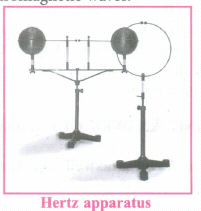
v) If the receiver is rotated by 90° - then no spark is observed by the receiver. This confirms that electromagnetic waves are transverse waves as predicted by Maxwell.
vi) Hertz detected radio waves and also computed the speed of radio waves which is equal to the speed of light (3 x 10⁸m S-1).
6.
(a) Microwaves:
It is produced by special vacuum tubes such as klystron, magnetron and gunn diode. The frequency range of microwaves is 109 Hz to 1011 Hz. These waves undergo reflection and can be polarised.
Uses:
It is used in radar system for aircraft navigation, speed of the vehicle, microwave oven for cooking and very long distance wireless communication through satellites.
(b) X-rays:
lt is produced when there is sudden stopping of high speed electrons at high-atomic number target, and also by electronic transitions among the innermost orbits of atoms. The frequency range of X-rays is from 1017 Hz to 1019 Hz. X-rays have more penetrating power than ultraviolet radiation.
Uses:
X-rays are used extensively in studying structures of inner atomic electron shells and crystal structures. It is used in detecting fractures, diseased organs, formation of bones and stones, observing the progress of healing bones. Further, in a finished metal product, it is used to detect faults, cracks, flaws and holes.
(c) Radio waves:
It is produced by accelerated motion of charges in conducting wires. The frequency range is from few Hz to 109 Hz. It obeys reflection and diffraction.
Uses:
It is uses in radio and television communication systems and also in cellular phones to transmit voice communication in the ultra high frequency band.
(d) Visible light:
Visible light is produced by incandescent bodies and also it is radiated by excited atoms in gases. The frequency range is from 4 x 10¹⁴ Hz to 8 x 10¹⁴ Hz. It obeys the laws of interference, diffraction and can be polarised. It exhibits photo-electric effect also.
Uses:
It can be used to study the structure of molecules, arrangement of electrons in external shells of atoms and it causes sensation of vision.
7.
Potential difference between the plates of the capacitor,
\(V=V_{\max } \sin 2 \pi f t\)
\(=230 \sqrt{2} \sin (2 \pi \times 50 t)\)
\(\therefore V=325 \sin 100 \pi t\)
d = 1 mm = 1 x 10⁻³ m
A = 20 cm2 = 20 x 10–4 m2
Displacement current, \(i_{d}=\epsilon_{0} \frac{d \Phi_{E}}{d t}=\epsilon_{\circ} \frac{d(\mathrm{EA})}{d t}\)
\(\therefore i_{d}=\frac{\epsilon_{0} A}{d}\left[\frac{d V}{d t}\right] \quad\left[\because E=\frac{V}{d}\right]\)
\(=\frac{\epsilon_{0} A}{d}(325)(100 \pi) \cos 100 \pi t\)
\(=\left(\begin{array}{l} 8.85 \times 10^{-12} \times 20 \times 10^{-4} \times 325 \\ \times 100 \times 3.14 \times \cos (100 \pi \times 1) \end{array}\right) /\left(1 \times 10^{-3}\right)\)
\(\begin{aligned}=1.81 \times 10^{-6} \mathrm{~A}=1.81 \mu \mathrm{A}[\because \cos (100 \pi \times 1)=1] \end{aligned}\)
8.
(d)
Fraunhofer
9.
(d)
IR rays
10.
(a)
UV
11.
(d)
micro
12.
(b)
5x10⁷
13.
(b)
not deflected
14.
(c)
90°
15.
(c)
\(\frac { 1 }{ 2\pi \sqrt { LC } }\)
16.
(a)
Microwaves U-V rays, X-rays
17.
(c)
I-R radiation
18.
(b)
UHF band
19.
(b)
Maxwell
20.
(a)
Hertz
21.
(d)
Hertz
22.
(b)
\(\oint { \vec { B } .d\vec { A } } \) = 0
23.
Displacement of does not arise due to motion of charge carries but it arises due to time variation of electric flux.
24.
UV light is absorbed by the ozone layer
(i) Source: Sun, arc and ionized gases.
(ii) Uses: To destroy bacteria, sterilizing the surgical instruments, burglar alarm etc
25.
Microwaves are used. They are considered suitable for radar systems for aircraft navigation due to their short wavelength or high frequency. Its wavelength range 1 x 10⁻³ m to 3 x 10⁻¹ m and frequency range is 3 x 10¹¹Hz to 1 x 10⁹ Hz.
26.
૪ - rays, microwaves, IR, UV rays.
(i) Microwaves < IR < UV < ૪ - rays
(ii) Microwaves < IR > UV > ૪ - rays.
27.
(i) During charging or discharging there is a displacement current, but no conduction current between the plates of the capacitor.
(ii) The displacement current is equal to conduction current Id = Ic, so Id = 0.25 A.
28.
It is used in radar systems for aircraft navigation, speed of the vehicle, microwave oven for cooking, and very long-distance wireless communication through satellites.
29.
Inductance L = 1μH = 1\(\times\)10-6 H
Capacitance C = 1μF = 1 \(\times\)10-6 F
∴ Frequency \(f =\frac{1}{2 \pi \sqrt{L C}} \)
\(f =\frac{1}{2 \pi \sqrt{1 \times 10^{-6} \times 1 \times 10^{-6}}} \)
Frequency of electromagnetic wave, f \(=\frac{1}{2 \pi \times 10^{-6}} Hz\)
∴ Wavelength of electromagnetic wave (⋋) = \(\frac{C}{f}\)
\(⋋ = 3 \times 10^8 \times 2\pi \times10^{-6}\)
\(=6.28 \times 10^{-6} \times 3 \times 10^{8} \)
Wavelength, ⋋ = 18.84 x 10² m
30.
Area of the capacitor = A
Radius = R
Current in the wire connected to the plates I = 5 A
The electric field, between the plates of a parallel plate capacitor,
\(E=\frac{\sigma}{\varepsilon_0} \)
\(E=\frac{Q}{A \varepsilon_0}\)
Q is the charge accumulated at the positive plate.
The flux of this field, \(\phi_E=\frac{Q}{A \varepsilon_0} \times A=\frac{Q}{\varepsilon_0}\)
Displacement current \(i_d=\varepsilon_0 \frac{d \phi_E}{d t}\)
\(=\varepsilon_0 \frac{d}{d t}\left(\frac{Q}{\varepsilon_0}\right)=i_c\)
\(\therefore \mathrm{i}_{\mathrm{d}}=5 \mathrm{~A} \quad\left(\because\right.\) The current through the capacitor ic = 5 A)
Displacement current = 5 A
31.
When the spectrum obtained from the Sun is examined, it consists of large number of dark lines (line absorption spectrum). These dark lines in the solar spectrum are known as Fraunhofer lines.
32.
The energy crossing per unit area per unit time and perpendicular to the direction of propagation of the electromagnetic wave is called the intensity.
Intensity, I = [u] c or \(I=\frac { total\ electromagnetic\ energy(U) }{ Surface\ area(A)\times time(t) } \)
\(=\frac { Power(P) }{ Surfacearea(A) } \)
33.
\(\oint _l\vec{B} \cdot \overrightarrow{d l}=\mu_{o} i_{\text {c }}+\mu_{o} \varepsilon_{o} \frac{d}{d t} \oint _s \vec{E} \cdot \overrightarrow{d A}\)
34.
The displacement current can be defined as the current which comes into play in the region in which the electric field or the electric flux is changing with time.
35.
E and B vectors must be in x and y directions.
Formula: We know \(\lambda =\frac { v }{ \gamma } =\frac { 3\times { 10 }^{ 8 } }{ 30\times { 10 }^{ 6 } } \)
λ = 10m.
36.
Since displacement current = conduction current
\({ I }_{ d }=\frac { V }{ { X }_{ C } } =\frac { 220 }{ 100 } =2.2A\)
37.
Given: The amplitude of magnetic field of an Electromagnetic wave B = 1.6 x 10⁻⁷ T
To find:
The amplitude of electric field of an Electromagnetic wave E = ?
frequency ૪ = 30 Mhz = 30 x 106 Hz.
To find: Angle velocity ω =?
Wavelength of Electromagnetic wave λ = ?
(i) Ampere of electric field E = ?
\(\frac { E }{ B } =C\Rightarrow E=C.B\Rightarrow 3\times { 10 }^{ 8 }\times 1.6\times { 10 }^{ -7 }\)
E = 48Vm-1.
(ii) Angle velocity, ω = 2π૪
ω = 2 x 3.14 x 30 x 106
ω = 1.885 x 10⁸ rad /s.
(iii) Wavelength of Electromagnetic wave, λ = \(\frac{C}{\gamma}\)
\(\gamma=\frac{3\times 10^8}{30\times 10^6}\) = 10m
λ = 10m
38.
(i) Wavelength \(\lambda =\frac { c }{ \gamma } =\frac { 3\times { 10 }^{ 8 } }{ 1.5\times { 10 }^{ 10 } } =2\times { 10 }^{ -2 }m\)
(ii) \(B=\frac { E }{ c } =\frac { 36 }{ 3\times { 1 }0^{ 8 } } =12\times { 10 }^{ -8 }T\)
Formula: (or) 1.2 x 10⁻⁷T
Average energy of magnetic field \(\overrightarrow { E } \) \({ U }_{ E }=\frac { 1 }{ 2 } .{ \varepsilon }_{ 0 }{ E }^{ 2 }\)
The average energy density of electric field \(\overrightarrow { B } \) \({ U }_{ E }=\frac { 1 }{ 2{ \mu }_{ 0 } } .{ B }^{ 2 }\)
But E = CB & C2 = \(\frac { 1 }{ { \mu }_{ 0 }{ \varepsilon }_{ 0 } } \)
\({ U }_{ E }=\frac { 1 }{ 2 } .{ \varepsilon }_{ 0 }{ E }^{ 2 }=\frac { 1 }{ 2 } .{ \varepsilon }_{ 0 }{ (CB) }^{ 2 }\)
\({ U }_{ E }=\frac { 1 }{ 2 } .{ \varepsilon }_{ 0 }.\frac { 1 }{ { \mu }_{ 0 }{ \varepsilon }_{ 0 } } { B }^{ 2 }=\frac { 1 }{ { \mu }_{ 0 }{ \varepsilon }_{ 0 } } { B }^{ 2 }={ U }_{ B }\)
\(\therefore { U }_{ E }={ U }_{ B }\)
39.
Given:
The frequency of Electromagnetic wave
૪ = 5 x 10⁸Hz
λ = 0.6m
\(\lambda =\frac { c }{ \gamma } =\frac { 3\times { 10 }^{ 8 } }{ 5\times { 10 }^{ 8 } } =0.6\)
(ii) The amplitude of magnetic field Bo = 107 T
To find:
Tile amplitude of electric field Eo = ?
Eo = c Bo = 3 x 108 x 10-7 = 30 V m-1
The expression for oscillating electric field
Ez =?
\(E={ E }_{ 0 }sin2\pi (vt+\frac { 1 }{ \lambda } .x)\)
E = 30 sin 2π (3 x 10⁸ t + 1.66 x) Vm-1.
40.
According to Ampere's circuital law,
\(\oint _{ s }^{ }{ \overrightarrow { B } .\overrightarrow { dl } } ={ \mu }_{ 0 }I\quad ...(1)\)
As the current flows across the area bounded by loop S1, so
\(\oint _{ { s }_{ 1 },s }^{ }{ \overrightarrow { B } .\overrightarrow { dl } } ={ \mu }_{ 0 }I\quad ...(2)\)
But the area bounded by S2 lies in the region between the plates capacitor where no current flows across it.
\(\therefore \oint _{ { s }_{ 1 } }^{ }{ \overrightarrow { B } .\overrightarrow { dl } } =0\)
Consider that loops enclosing S1 & S2 are infinitesimally close to each other. Then
\(\oint _{ { s }_{ 1 } }^{ }{ \overrightarrow { B } .\overrightarrow { dl } } =\oint _{ { s }_{ 2 } }^{ }{ \overrightarrow { B } .\overrightarrow { dl } } \)
This equation is inconsistent with equations (2) & (3). To remove this maxwell said that a changing electric field (during charging) between the capacitor plates must induce a magnetic field which in turn must be associated with current Id.
\({ I }_{ d }={ \varepsilon }_{ 0 }\left( \frac { d{ \phi }_{ E } }{ dt } \right) \) [\(\frac { d{ \phi }_{ E } }{ dt } \) change in electric flux]
The total current must be
I = Iconduction + Idisplacement
\({ I }_{ c }={ \varepsilon }_{ 0 }\frac { d{ \phi }_{ E } }{ dt } \)
Hence the generalized from of Ampere's circuital law is
\(\oint _{ s }^{ }{ \overrightarrow { B } .\overrightarrow { dl } } ={ \mu }_{ 0 }\left[ { I }_{ c }+{ \varepsilon }_{ 0 }\frac { d{ \phi }_{ E } }{ dt } \right] \)
41.
Emission spectra:
When the spectrum of self luminous source is taken, we get emission spectrum. Each source has its own characteristic emission spectrum. The emission spectrum can be divided into three types:
(i) Continuous emission spectra (or continuous spectra) :
(a) If the light from incandescent lamp (filament bulb) is allowed to pass through prism (simplest spectroscope), it splits into seven colours.
(b) Thus, it consists of wavelengths containing all the visible colours ranging from violet to red (in the figure). Examples: spectrum obtained from carbon arc, incandescent solids.
(ii) Line emission spectrum (or line spectrum) :
(a) Suppose light from hot gas is allowed to pass through a prism, line spectrum is observed. Line spectra are also known as discontinuous spectra. The line spectra consists of sharp lines of definite wavelengths or frequencies.
(b) Such spectra arise due to excited atoms of elements. These lines are the characteristics of the element and are different for different elements. Examples: spectra of atomic hydrogen, helium, etc.
(iii) Band emission spectrum (or band spectrum) :
(a) Band spectrum consists of several number of very closely spaced spectral lines which overlapped together forming specific bands which are separated by dark spaces.
(b) This spectrum has a sharp edge at one end and fades out at the other end. Such spectra arise when the molecules are excited.
(c) Band spectrum is the characteristic of the molecule hence, the structure of the molecules can be studied using their band spectra. Examples, spectra of hydrogen gas, ammonia gas in the discharge tube, etc.
42.
(i) We have stated Ampere's law as \(\oint \vec{B} \cdot \overrightarrow{d l}=\mu_oi\)
(ii) Where, i is the electric current crossing a surface bounded by a closed curve and the line integral of \(\vec{B}\) is calculated along that closed curve. This equation is valid only when the electric field at the surface does not change with time.
(iii) Maxwell strongly believed that when the time varying magnetic field produces an electric field, the time varying electric field must produce a magnetic field.
(iv) To understand how a varying electric field produces magnetic field, let us consider a situation of charging a parallel plate capacitor.
.JPG)
(v) Let ic be the conduction current. To calculate the magnetic field at P (fig. 1 ) an amperian loop. S1 is drawn. Applying Ampere circuital law for the surface S1, we get
\(\oint \vec{B} \cdot \overrightarrow{d l}=\mu_0 i_c\) Where, \(\mu_0\) is permeability of free space.
(vi) Applying the same for the surface S2, we get \(\oint \vec{B} \cdot \overrightarrow{d l}=0.\)
Because the surface S2 nowhere touches the wire carrying conduction current. Therefore for the point P at one surface (S1) it has some value and at another surface (S2) it has zero value.
(vii) So, Maxwell believed that there must be a current associated with the changing electric field in between the capacitor and he called that current as displacement current.
(viii) Applying Gauss law to the electric flux between the plates of the capacitor \(\phi_E=\oint \vec{E} \cdot \overrightarrow{\mathrm{dA}}=E A=\frac{q}{\varepsilon_0}\) where, A is the area of the plate.
The change in electric flux is \(\frac{d \phi_F}{d t}=\frac{1}{\varepsilon_0} \frac{d q}{d t} (or) \frac{\mathrm{dq}}{\mathrm{dt}}=\mathrm{i}_{\mathrm{d}}=\varepsilon_0 \frac{\mathrm{d} \phi_{\mathrm{E}}}{\mathrm{dt}}\), where id is the displacement current.
(ix) The displacement current can be defined as the current which comes into play in the region in which the electric field and electric flux are changing with time.
(x) So, Maxwell modified Ampere's law \(\oint_{l} \vec{B} \cdot d \vec{l}=\mu_{0} i_c+\mu_{0}-i_d\) which means the total current enclosed by the surface is sum of conduction current and displacement current.
43.
MaxWell's equations in integral form
i) Gauss law in electricity, \(\oint _s\vec{E} \vec{d} A=\frac{Q_{\text {enclosed }}}{\varepsilon_{o}}\)
ii) Gauss law in magnetism \(\oint _s \vec{B} \cdot \vec{d} A=0\)
iii) Faraday's law \(\oint_l \vec E. \vec {d l}=-\frac{d \phi _B}{d t}\)
iv) Ampere-Maxwell's law \(\oint_l \vec {B}. \vec {d l}=\mu_{o} i_c+\mu_{o} \varepsilon_{o} \frac{d}{d t} \oint_s \vec{E} \cdot {d} \vec A\)

12th Standard Syllabus & Materials
12th Standard
TN 12th Computer Applications களப்பெயர் முறைமை (DNS) Sample Question Papers Study Material - QB365 Set A
NEW12th Standard
TN 12th Computer Applications வலையமைப்பு எடுத்துக்காட்டுகள் மற்றும் நெறிமுறைகள் Sample Question Papers Study Material - QB365 Set A
NEW12th Standard
TN 12th Computer Applications கணினி வலையமைப்பு ஓர் அறிமுகம் Sample Question Papers Study Material - QB365 Set A
NEW12th Standard
TN 12th Computer Applications PHP-உடன் MySQL-ஐ இணைத்தல் Sample Question Papers Study Material - QB365 Set A



Tamilnadu Stateboard 12th Standard Subjects

Maths

Chemistry
Physics

Biology

Computer Science

Business Maths and Statistics

Economics

Commerce

Accountancy

History

Computer Applications
Biology
Computer Technology
Computer Applications
Computer Science
Business Maths and Statistics
Commerce
Economics
Maths
Chemistry
Physics
Computer Technology
History
Accountancy

Tamil

English

French
Tamilnadu Stateboard Standards

