
 100% FREE ACCESS
12th Standard Syllabus & Materials
12th Standard
TN 12th Computer Applications மின்னணு தரவு பரிமாற்றம் Sample Question Papers Study Material - QB365 Set A
NEW12th Standard
TN 12th Computer Applications மின் - வணிக பாதுகாப்பு அமைப்புகள் Sample Question Papers Study Material - QB365 Set A
NEW12th Standard
TN 12th Computer Applications மின்னணு செலுத்தல் முறைகள் Sample Question Papers Study Material - QB365 Set A
NEW12th Standard
TN 12th Computer Applications மின் - வணிகம் Sample Question Papers Study Material - QB365 Set A
NEW12th Standard
TN 12th Computer Applications திறந்த மூல கருத்துருக்கள் Sample Question Papers Study Material - QB365 Set A
NEW12th Standard
TN 12th Computer Applications வலையமைப்பு வடமிடல் Sample Question Papers Study Material - QB365 Set A

Published on: 01/09/2022
QB365 provides a detailed and simple solution for every Possible Book Back Questions in Class 12 Physics Subject - Electrostatics, English Medium. It will help Students to get more practice questions, Students can Practice these question papers in addition to score best marks.
Download Tamil Nadu 12th Standard Physics question papers, model tests, one-mark questions, important questions, and public exam papers in PDF format. Free study materials and answer keys for TN State Board students.
Questions + Answers key
Take MCQ Physics Test1.
Define ‘electrostatic potential”.
2.
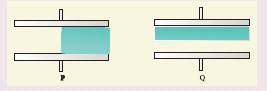
Capacitors P and Q have identical cross sectional areas A and separation d. The space between the capacitors is filled with a dielectric of dielectric constant εr as shown in the figure. Calculate the capacitance of capacitors P and Q.
3.
For the given capacitor configuration
(a) Find the charges on each capacitor
(b) potential difference across them
(c) energy stored in each capacitor
4.
During a thunder storm, the movement of water molecules within the clouds creates friction, partially causing the bottom part of the clouds to become negatively charged. This implies that the bottom of the cloud and the ground act as a parallel plate capacitor. If the electric field between the cloud and ground exceeds the dielectric breakdown of the air (3 x 10⁶ Vm-1 ), lightning will occur.
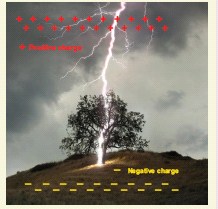
(a) If the bottom part of the cloud is 1000 m above the ground, determine the electric potential difference that exists between the cloud and ground.
(b) In a typical lightning phenomenon, around 25C of electrons are transferred from cloud to ground. How much electrostatic potential energy is transferred to the ground.
5.
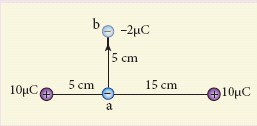
A point charge of +10 μC is placed at a distance of 20 cm from another identical point charge of +10 μC. A point charge of -2 μC is moved from point a to b as shown in the figure. Calculate the change in potential energy of the system? Interpret your result.
6.
A closed triangular box is kept in an electric field of magnitude E = 2 x 10³ NC-1 as shown in the figure.
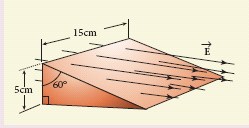
Calculate the electric flux through the
(a) vertical rectangular surface
(b) slanted surface and
(c) entire surface.
7.
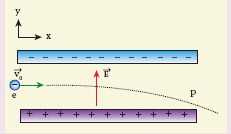
Consider an electron travelling with a speed vo and entering into a uniform electric field \(\vec{E}\) which is perpendicular to \(\vec { { v }_{ 0 } } \) as shown in the Figure. Ignoring gravity, obtain the electron’s acceleration, velocity and position as functions of time.
8.
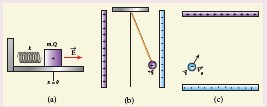
Draw the free body diagram for the following charges as shown in the figure (a), (b) and (c).
9.
The total number of electrons in the human body is typically in the order of 1028. Suppose, due to some reason, you and your friend lost 1% of this number of electrons. Calculate the electrostatic force between you and your friend separated at a distance of 1m. Compare this with your weight. Assume mass of each person is 60 kg and use point charge approximation.
10.
When two objects are rubbed with each other, approximately a charge of 50 nC can be produced in each object. Calculate the number of electrons that must be transferred to produce this charge.
11.
What is corona discharge?
12.
Define ‘capacitance’. Give its unit.
13.
What is dielectric strength?
14.
What is polarisation?
15.
Write a short note on ‘electrostatic shielding’.
16.
What is meant by electrostatic energy density?
17.
Define ‘electric flux’.
18.
Define ‘electrostatic potential energy’.
19.
Give the relation between electric field and electric potential.
20.
What are the properties of an equipotential surface?
21.
What is an equipotential surface?
22.
Write the general definition of electric dipole moment for a collection of point charge.
23.
Define ‘electric dipole’. Give the expression for the magnitiude of its electric dipole moment and the direction.
24.
The electric field lines never intersect. Justify.
25.
What is meant by ‘electric field lines’?
26.
Define ‘electric field’
27.
Write a short note on superposition principle.
28.
Write down Coulomb’s law in vector form and mention what each term represents.
29.
What is meant by quantisation of charges?
30.
Dielectric strength of air is 3 x 10⁶ V m-1. Suppose the radius of a hollow sphere in the Van de Graff generator is R = 0.5 m, calculate the maximum potential difference created by this Van de Graaff generator.
31.
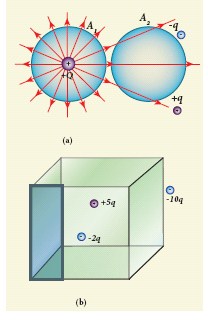
(i) In figure (a), calculate the electric flux through the closed areas A1 and A2.
(ii) In figure (b), calculate the electric flux through the cube.
32.
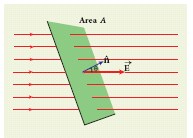
Calculate the electric flux through the rectangle of sides 5 cm and 10 cm kept in the region of a uniform electric field 100 NC-1. The angle θ is 60°. If θ becomes zero, what is the electric flux?
33.
A water molecule has an electric dipole moment of 6.3 x 10⁻³⁰ Cm. A sample contains 1022 water molecules, with all the dipole moments aligned parallel to the external electric field of magnitude 3 x 10⁵ NC-1. How much work is required to rotate all the water molecules from θ = 0° to 90°?
34.
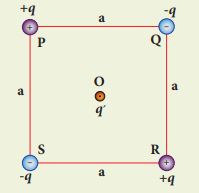
Four charges are arranged at the corners of the square PQRS of side an as shown in the figure.
(a) Find the work required to assemble these charges in the given configuration.
(b) Suppose a charge q is brought to the center of the square, by keeping the four charges fixed at the corners, how much extra work is required for this?
35.
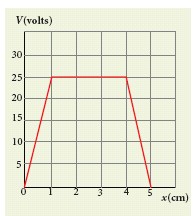
The following figure represents the electric potential as a function of x – coordinate. Plot the corresponding electric field as a function of x.
36.
A sample of HCl gas is placed in a uniform electric field of magnitude 3 x 10⁴ NC-1. The dipole moment of each HCl molecule is 3.4 x 10⁻³⁰ Cm. Calculate the maximum torque experienced by each HCl molecule.
37.
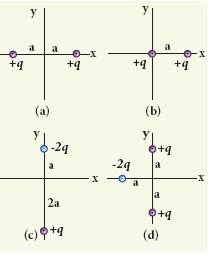
Calculate the electric dipole moment for the following charge configurations.
38.
The following pictures depict electric field lines for various charge configurations.
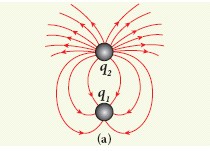
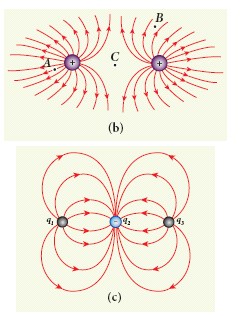
(i) In figure (a) identify the signs of two charges and find the ratio \(\left| \frac { { q }_{ 1 } }{ { q }_{ 2 } } \right| \)
(ii) In figure (b), calculate the ratio of two positive charges and identify the strength of the electric field at three points A, B, and C
(iii) Figure (c) represents the electric field lines for three charges. If q2 = -20 nC, then calculate the values of q1 and q3.
39.
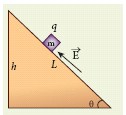
A block of mass m carrying a positive charge q is placed on an insulated frictionless inclined plane as shown in the figure. A uniform electric field E is applied parallel to the inclined surface such that the block is at rest. Calculate the magnitude of the electric field E.
40.
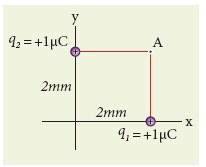
Consider the charge configuration as shown in the figure. Calculate the electric field at point A. If an electron is placed at points A, what is the acceleration experienced by this electron? (mass of the electron = 9.1 x 10⁻³¹ kg and charge of electron = −1.6 x 10⁻¹⁹ C)
41.
Calculate the number of electrons in one coulomb of negative charge.
1.
The electric potential at a point P is equal to the work done by an external force to bring a unit positive charge with constant velocity from infinity to the point P in the region of the external electric field \(\vec{E}.\)
\(V=\frac{1}{4\piε_0}\frac{q}{r}\)
2.
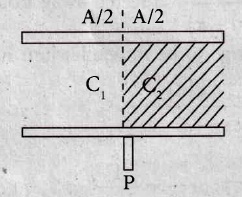
(a) \(C_{1}=\frac{\varepsilon_{0} A}{2d} (\because area=\frac{A}{2})\)
\(C_{2}=\frac{\varepsilon_{r} \varepsilon_{0} A}{d} \)
C1 and C2 are in parellel,
\(C_{P}=\left(C_{1}+C_{2}\right) \)
\(C_{P}=\frac{1}{2}\left(\frac{\varepsilon_{r} \varepsilon_{0} A}{d}+\frac{\varepsilon_{0} A}{d}\right) \)
\(=\frac{1}{2} \frac{\varepsilon_{0} A}{d}\left(\varepsilon_{r}+1\right) \)
\(C_{P}=\frac{\varepsilon_{0} A}{2 d}\left(\varepsilon_{r}+1\right) \)
.jpg)
(b) \(C_1=\frac{\varepsilon_0 \varepsilon_r A}{d / 2}=\frac{2 \varepsilon_0 \varepsilon_r A}{d}(\because \text { Separation }=d / 2)\)
\(C_2=\frac{2 \varepsilon_0 A}{d}\)
C1 and C2 are in series,
\(\frac{1}{C_1} =\frac{1}{C_1}+\frac{1}{C_2} \)
\(=\frac{d}{2 \varepsilon_0 \varepsilon_r A}+\frac{d}{2 \varepsilon_0 A} \)
\(=\frac{d}{2 \varepsilon_0 A}\left(\frac{1}{\varepsilon_r}+1\right) \)
\(\frac{1}{C_1} =\frac{d}{2 \varepsilon_0 A}\left(\frac{1+\varepsilon_r}{\varepsilon_r}\right) \)
\(\therefore C_s =\frac{2 e_0 A}{d}\left(\frac{e_r}{1+e_r}\right)\)
3.
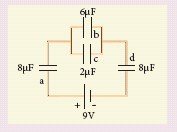
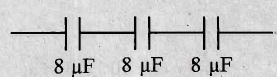
Cp = Cb + Cc
\(C_{P}=6+2=8 \mu \mathrm{F} \)
\(\frac{1}{C_{s}}=\frac{1}{C_a}+\frac{1}{C_p}=\frac{1}{C_d} \)
\(C_{s}=\frac{1}{8}+\frac{1}{8}+\frac{1}{8}=\frac{3}{8} \)
\(\therefore C_{s}=\frac{8}{3} \mu \mathrm{F} \)
Total capacitance \(C_{s}=\frac{8}{3} \times 10^{-6} \mathrm{~F} \)
Total Charge, \(Q=C_{s} V=\frac{8}{3} \times 10^{-6} \times 9 \)
\(Q_{a}=24 \mu C\)
(a) Charge on capacity \(Q_{a}=24 \mu C\) .....(1)
Charge on capacitor \(Q_{b}=24 \times \frac{6}{8}=18 \mu \mathrm{C} \) ..............(2)
Charge on capacitor \(Q_{c}=24 \times \frac{2}{8}=6 \mu \mathrm{C} \) ..............(3)
Charge on capacitor \(Q_{d}=24 \times \frac{8}{8}=24 \mu \mathrm{C} \) ..............(4)
(b) Potential difference across \(C_{a} \ is\ V_{a}=\frac{Q_{a}}{C_{a}} \)
\(=\frac{24}{8}=3 \mathrm{~V} \) ...(5)
Potential difference across \(C_{b}\ is \ V_{b}=\frac{Q_{b}}{C_{b}} \)
\(=\frac{18}{6}=3 \mathbf{V}\) ........(6)
Potential difference across \(C_{c}\ is \ V_{c}=\frac{Q_{c}}{C_{c}}=\frac{6}{2}=3 \mathrm{~V} \) ......(7)
Potential difference across \(C_{d}\ is \ V_{d}=\frac{Q_{d}}{C_{d}} \)
\(=\frac{24}{8}=3 \mathbf{V} \) ....(8)
(c) Energy stored in each capacitor \(U=\frac{1}{2} C V^{2}\)
Energy stored in \(\mathrm{C}_{\mathrm{a}} \text { is } U_{a}=\frac{1}{2} C_{a} V_{a}^{2}\)
\(U_{\mathrm{a}}=\frac{1}{2} \times 8 \times 10^{-6} \times 3 \times 3=36 \mu \mathrm{J}\) ....(9)
Energy stored in \(C_{b}\ is \ U_{b}=\frac{1}{2} C_{b} V_{b}^{2} \)
\(U=\frac{1}{2} \times 6 \times 10^{-6} \times 3 \times 3 \)
\(=27 \mu \mathrm{J} \) ........(10)
Energy stored in Ce is \(U_{c} =\frac{1}{2} C_{c} V_{c}^{2} \)
\(=\frac{1}{2} \times 2 \times 10^{-6} \times 3 \times 3=9 \mu \mathrm{J} \) ......(11)
Energy stored in Cd is \(U_{d} =\frac{1}{2} C_{d} V_{d}^{2} \)
\(U_d=\frac{1}{2} \times 8 \times 10^{-6} \times 3 \times 3 \)
\(=36 \times 10^{-6} \mathrm{~J}=36 \mu \mathrm{J} \) .........(12)
4.
(a) Electric Field E = \(\frac{Potential \ difference}{Distance}=\frac{V}{d}\)
Electric field E = 3 x 10⁶ Vm-1
Distance d = 1000 m
∴ Potential difference V = E x d =3 x 106 x 103 = 3 x 10⁹ V
(b) Potential Energy U = qV
U = 25 x 3 x 109 = 75 x 109 J
∴ Potential energy transferred to the ground = 75 x 109 J
5.
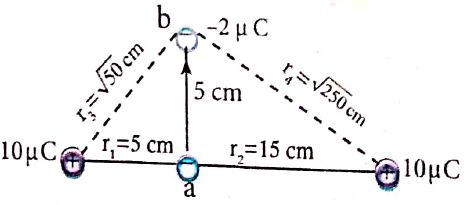
\(W =\left(V_{b}-V_{a}\right) q\left[where\ V=\frac{K Q}{r}\right] \)
To find Vb :
\(V_b=\frac{kQ}{r_3}+\frac{kQ}{r_4}\)
\(V_{b} =\frac{K \times 10 \times 10^{-6}}{\sqrt{50 \times 10^{-4}}}+\frac{K \times 10 \times 10^{-6}}{\sqrt{250 \times 10^{-4}}} \)
\(V_{b} =\frac{K \times 10^{-5}}{\sqrt{50} \times 10^{-2}}+\frac{K \times 10^{-5}}{\sqrt{250} \times 10^{-2}} \)
\(=K \times 10^{-3}\left[\frac{1}{\sqrt{50}}+\frac{1}{\sqrt{250}}\right] \)
\(=9 \times 10^{9} \times 10^{-3}\left[\frac{1}{\sqrt{50}}+\frac{1}{\sqrt{250}}\right] \)
Vb = 1842002 V
To find Va :
\(V_a=\frac{kQ}{r_1}+\frac{kQ}{r_2}\)
\(V_{a} =\frac{K \times 10 \times 10^{-6}}{\sqrt{5 \times 10^{-2}}}+\frac{K \times 10 \times 10^{-6}}{\sqrt{15 \times 10^{-2}}} \)
Va = 2400000 V
\(\therefore W_{D} =\left(V_{b}-V_{a}\right) q=(1842002-2400000)( -2 \times 10^{-6} )\)
W = +1.12J
Positive sign implies that to move the charge - 2 μC external work is required.
6.
E = 2 x 10³ N C-1
Φ = EA cos θ
a) Vertical rectangular surface :
\(\phi_{\text {vertical surface }}=E A \cos 180^ {o}\)
\( \phi_{v s}=\left(-2 \times 10^{3} \right) \times(0.05 \times 0.15)\)
\(\phi_{v s}=-15 \mathrm{Nm}^{2} / \mathrm{C} \)
b) Slanted Surface :
\( \phi_{\text {slanted surface }} =\mathrm{EA} \cos 60^{\circ} \)
Here, cos 60o = 1/2
\(\text { hyp } =\frac{5 \mathrm{~cm}}{\sin 30^{\circ}}=\frac{5}{1 / 2}=10 \mathrm{~cm}=0.1 \mathrm{~m} \)
\( \phi_{\text {slanted surface }}=\frac{1}{2}EA,\)
\(\phi_{s s} =\frac{1}{2}\left(2 \times 10^{3}\right) \times(0.1 \times 0.15) \)
\(\phi_{\mathrm{as}} =15 \mathrm{Nm}^{2} / \mathrm{C} \)
(c) Entire Surface :
\( \phi_{\text {entire surface }}=\phi_{v s}+\phi_{\text {slanted }}+\phi_{\text {ends }} \)
\(\phi_{\text {end sufface }}=\mathrm{EA} \cos 90^{\circ}0\)
\(\phi_{\text {entire surface }}=-15+15 +0 \)
\(\phi_{\text {entire surface }}=0 \)
7.
(a) Acceleration of the electron \(a=\frac{F}{m}\)
Electrostatic force F = - eE
\(a=\frac{F}{m}=\frac{-e E \hat{j}}{m}\) ... ( 1)
(b) Let velocity of the electron be \(\vec{v}\)
v = u + at ...(2)
Here, \( u=v_{0} \hat{i} \), \(a=\frac{-e \bar{E}}{m} \hat{j}\)
Substituting these values in the equation (2) we get
\(\therefore \vec{v}=\nu_{0} \hat{i}-\frac{e E}{m} t \hat{j}\)
(c) Displacement \(\vec{r}\) represents position,
\( s=u t+\frac{1}{2} a t^{2} \) ...(3)
Let, \(s=\hat{r} \) and Here, \(u=v_{0} \hat{i} \), \(a=\frac{-e E}{m} \hat{j}\)
Substituting these values in the equation (3), we get,
\(\hat{r}=v_{0} t \hat{i}-\frac{1}{2} \frac{e E}{m} t^{2} \hat{j}\)
8.
(a) In the figure
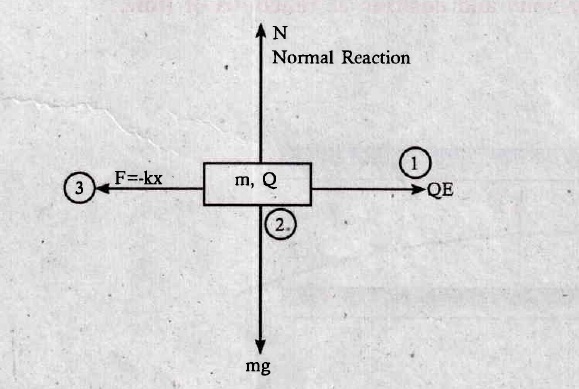
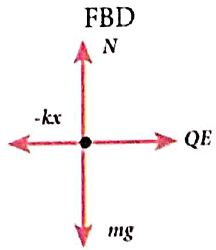
1 - Electrostatic force Fe = QE
2 - Weight W = mg
3 - Elastic force F = -kx
4 - Upward force = Normal reaction = N
b) In this figure
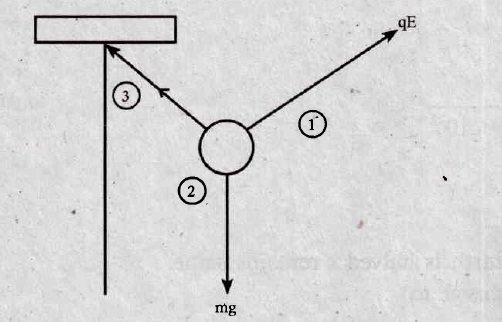
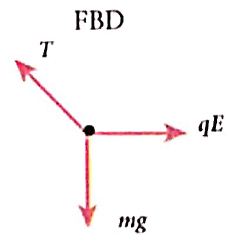
1- Electrostatic force F = qE
2 - Weight W = mg
3 - Tension acting along the string is T
(c) The charge is attracted towards the positively charged plate because it is a negative charge.
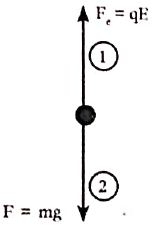
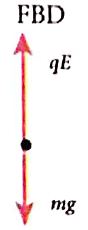
1 - Force = qE
2 - Downward force F = mg
9.
Distance of separation r = 1 m
Number of electron in human body = 1028
Charge appeared on my friend and me, q = 1% of charge on 1028 electrons
q \(=10^{28} \times 1 / 100 \)
q = 1.6 x 10⁷ C
Force between us \( \mathrm{F}_{\mathrm{e}} =\mathrm{Kq}^{2} / \mathrm{r}^{2} \)
\(\left.=\frac{9 \times 10^{9} \times\left(1.6 \times 10^{7}\right)^{2}}{(1)^{2}} \quad \text { (as } \mathrm{r}=1 \mathrm{~m}\right)\)
= 9 x 2.56 x 109 x 1014
Fe = 23.04 x 10²³ N
Mass of each person m1 = m2 = m = 60 kg
Weight of each person W = mg = 60 x 9.8
W = 588N
Fe / W = \(\frac{23.04\times10^{23}}{588} = 3.9 \times 10^{21}=(or)F_e= 3.9 \times 10^{21}W\)
10.
Charge q = 50 nC = 50 x 10-9 C , e = 1.6 x 10⁻¹⁹ C
No. of electrons \(n=\frac{q}{e}\)
\(\frac { q }{ e } =\frac { 50\times { 10 }^{ -9 } }{ 1.6\times { 10 }^{ -19 } } \)
= 31.25 x 10¹⁰ electrons
To produce 50 nC charge, number of electrons transferred = 31.25 x 10¹⁰ electrons
11.
When an irregular shaped conductor is given positive charge, the electric field near the sharp end is very high and it ionizes the surrounding air. The positive ions are repelled at the sharp edge and negative ions are attracted towards the sharper edge. This reduces the total charge of the conductor near the sharp edge. This is called corona discharge.
12.
The capacitance C of a capacitor is defined as the ratio of the magnitude of charge on either of the conductor plates to the potential difference existing between the conductors. \(C=\frac{Q}{V}\)
Its unit is Coulomb per volt or farad (F).
13.
i) When the external electric field applied to the dielectric is very large, the bound charges (electrons) become free charges. This is called dielectric breakdown.
ii) The maximum electric field the dielectric can withstand before it breaksdown is called dielectric strength.
14.
The alignment of the dipole moments of the permanent or induced dipoles in the direction of applied electric field is called polarisation.
15.
Electrostatic shielding is the process of isolating a certain region of space from external field. It is based on the fact that electric field inside a conductor is zero. This property is called elecrostatic shielding because anything placed inside the cavity of the conductor will be completely shielded from external fields.
16.
The electrostatic energy stored per unit volume of space is called electrostatic energy density.
\(u_E=\frac{1}{2}ε_0E^2\)
17.
The number of electric field lines crossing a given area kept normal to the electric field lines is called electric flux.
18.
Electrostatic potential energy is the work done to assemble the charges at the given locations brought from infinity. If q1 and q2 are the charges to be assembled with a separation of distance r, the electric potential energy is, \(U=\frac{1}{4\piε_o}\frac{q_1q_2}{r}\)
19.
i) The electric field is the negative gradient of the electric potential. \(E=\frac{-dV}{dx}\).
ii) In vector form, \(\vec{E}=-\left[\frac{\partial V}{\partial x} \hat{i}+\frac{\partial V}{\partial y} \hat{j}+\frac{\partial V}{\partial z} \hat{k}\right]\)
20.
(i) The work done to move a charge q between any two points A and B, W = q (VB - VA). If the points A and B lie on the same equipotential surface, work done is zero because VB = VA.
(ii) The electric field is normal to an equipotential surface.
21.
An equipotential surface is a surface on which all the points are at the same electric potential.
22.
For a collection of n point charges, the electric dipole moment is defined as follows, \(\vec{p}=\stackrel{i=n} \sum _{i=1}q_i\vec{r}_i\) where, \(\vec{r}_i\) is the position vector of charge qi from the origin.
23.
(i) Two equal and opposite charges separated by a small distance constitute an electric dipole.
(ii) The magnitude of the electric dipole moment is equal to the product of the magnitude of one of the charges and the distance between them, \(|\vec{p}|=2 q a\).
(iii) The electric dipole moment vector lies along the line joining two charges and is directed from -q to +q.
24.
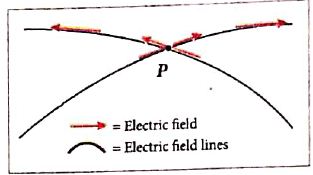
(i) No two electric field lines intersect each other. lf two lines cross at a point, then there will be two different electric field vectors at the same point.
(ii) As a consequence, if some charge is placed in the intersection point, then it has to move in two different directions at the same time, which is physically impossible. Hence electric field lines do not intersect.
25.
Electric field lines are a set of continuous lines which represent the electric field in some region of space visually.
26.
Electric field at the point P at a distance r from the point charge q is the force experienced by a unit positive placed at that point P and is given by
\(\vec { E } =\frac { \vec { F } }{ q_{ 0 } } =\frac { kq }{ { r }^{ 2 } } \hat { r } =\frac { 1 }{ 4\pi { \varepsilon }_{ 0 } } \frac { q }{ { r }^{ 2 } } \hat { r } \)
where \(\hat{r}\) is the unit vector pointing from q to the point of interest P.
27.
It there are more than two charges, the total force acting on a given charge is equal to the vector sum of forces exerted on it by all the other charges.
Consider a system of n charges namely q1, q2, q3 ...qn. The force on q1 exerted by the charge q2 is \(\overrightarrow{F_{12}}=k \frac{q_{1} q_{2}}{r_{21}^{2}} \hat{r}_{21}\) .
The force on q1 exerted by the charge q3 is \(\overrightarrow{F_{13}}=k \frac{q_{1} q_{3}}{r_{31}^{2}} \hat{r}_{31}\)
By continuing this, the total force acting on the charge q1 due to all other charges is given by
\( \vec{F}_{1}^{\text { tot }}=\overrightarrow{F_{12}}+\overrightarrow{F_{13}}+\overrightarrow{F_{14}}+\ldots+\vec{F}_{1 n} \)
\(\vec{F}_{1} ^{\text { tot }}=k\left\{\frac{q_{1} q_{2}}{r_{21}^{2}} \hat{r}_{21}+\frac{q_{1} q_{3}}{r_{31}^{2}} \hat{r}_{31}+\frac{q_{1} q_{4}}{r_{41}^{2}} \hat{r}_{41}+\ldots+\frac{q_{1} q_{n}}{r_{n 1}^{2}} \hat{r}_{n 1}\right\}\)
28.
Coulomb's law \(\overrightarrow{F_{21}}=\frac{k q_{1} q_{2}}{r^{2}} \hat{r}_{12}\)
where, q1 - charge; q2 - charge
r - distance between the charges
\(\hat{r}_{12}\)- the unit vector directed from charge q1 to charge q2
k = Proportionality constant
29.
The charge of an electron is the elementary charge in nature. Therefore, charge on any body is the integral multiple of an electron. The charge on any body can be expressed by the formula,
q = ne; where, n is the number of electrons, e is the charge on one electron.
n = 0, ±1, ±2, ±3, ±4, ...
This is called quantization of charge.
30.
The electric field on the surface of the sphere(by Gauss law) is given by
E = \(\frac { 1 }{ 4\pi { \varepsilon }_{ 0 } } \frac { Q }{ { R }^{ 2 } } \)
The potential on the surface of the hollow metallic sphere is given by
V = \(\frac { 1 }{ 4\pi { \varepsilon }_{ 0 } } \frac { Q }{ { R } } \) = ER
Since Vmax = EmaxR
Here Emax = 3 x 10⁶ Vm-1. So the maximum potential difference created is given by
Vmax = 3 x 106 x 0.5
= 1.5 x 10⁶V (or) 1.5 million volt.
31.
(i) In figure (a), area A1 encloses the charge Q. So electric flux through this closed surface A1 is \(\frac { Q }{ { \varepsilon }_{ 0 } } \). But the closed surface A2 contains no charges inside, so electric flux through A2 is zero.
(ii) In figure (b), the net charge inside the cube is 3q and the total electric flux in the cube is therefore \(\Phi _{ E }=\frac { 3q }{ { \varepsilon }_{ 0 } } \).
Note that the charge -10 q lies outside the cube and it will not contribute the total flux through the surface of the cube.
32.
The electric flux through the rectangular area
\({ \Phi }_{ E }=\vec { E } .\vec { A } \) = EA cosθ = 100 x 5 x 10 x 10-4 x cos60°
⇒ \({ \Phi }_{ E }\) = 0.25 Nm2C-1
For θ = 0°
\({ \Phi }_{ E }=\vec { E } .\vec { A } \)= EA
= 100 x 5 x 10 x 10-4 = 0.5 Nm2C-1
33.
When the water molecules are aligned in the direction of the electric field, it has minimum potential energy. The work done to rotate the dipole from θ = 0° to 90° is equal to the potential energy difference between these two configurations.
W = ΔU = U(90°) - U(0°)
From the equation U =−pE cosθ = −\(\hat p.\hat E\) ,
we write U = − pE cosθ, Next, we calculate the work done to rotate one water molecule from θ = 0° to 90°.
For one water molecule
W = - pE cos90o + pE cos0o = pE
W= 6.3 x 10-30 x 3 x 105 = 18.9 x 10⁻²⁵J
For 1022 water molecules, the total work done is
Wtot = 18.9 x 10-25 x 1022 = 18.9 x 10⁻³J
34.
(a) The work done to arrange the charges in the corners of the square is independent of the way they are arranged. We can follow any order.
(i) First, the charge +q is brought to the corner P. This requires no work since no charge is already present, WP = 0
(ii) Work required to bring the charge –q to the corner Q = (-q) x potential at a point Q due to +q located at a point P
WQ = -q x \(\frac { 1 }{ 4\pi { \varepsilon }_{ 0 } } \frac { q }{ a } =-\frac { 1 }{ 4\pi { \varepsilon }_{ 0 } } \frac { q^{ 2 } }{ a } \)
(iii) Work required to bring the charge +q to the corner R = q x potential at the point R due to charges at the point P and Q.
WR = q x \(\frac { 1 }{ 4\pi { \varepsilon }_{ 0 } } \left( -\frac { q }{ a } +\frac { q }{ \sqrt { 2 } a } \right) \)
= \(\frac { 1 }{ 4\pi { \varepsilon }_{ 0 } } \frac { { q }^{ 2 } }{ a } \left( -1+\frac { 1 }{ \sqrt { 2 } } \right) \)
(iv) Work required to bring the fourth charge –q at the position S = q × potential at the point S due the all the three charges at the point P, Q and R.
Ws = - q x \(\frac { 1 }{ 4\pi { \varepsilon }_{ 0 } } \left( \frac { q }{ a } +\frac { q }{ a } -\frac { q }{ \sqrt { 2 } a } \right) \)
Ws = \(-\frac { 1 }{ 4\pi { \varepsilon }_{ 0 } } \frac { q^2 }{ a } \left( 2-\frac { 1 }{ \sqrt { 2 } } \right) \)
(b) Work required to bring the charge q′ to the center of the square = q′ x potential at the center point O due to all the four charges in the four corners.
The potential created by the two +q charges are canceled by the potential created by the -q charges which are located in the opposite corners. Therefore the net electric potential at the center O due to all the charges in the corners is zero.
Hence no work is required to bring any charge to the point O. Physically this implies that if any charge q′ when brought close to O, then it moves to the point O without any external force.
35.
In the given problem, since the potential depends only on x, we can use \(\vec { E } =\frac { dV }{ dx } \hat { i } \) (the other two terms \(\frac { \eth V }{ \eth y } \) and \(\frac { \eth V }{ \eth z } \) are zero)
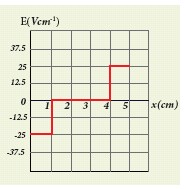
From 0 to 1 cm, the slope is constant and so \(\frac { dV }{ dx } \) = 25V cm-1, So \(\vec { E } \)= -25V cm-1\(\hat { i } \)
From 1 to 4 cm, the potential is constant
V = 25 V. It implies that \(\frac { dV }{ dx } \) = 0, So \(\vec { E } \) = 0
From 4 to 5 cm, the slope \(\frac { dV }{ dx } \) = -25 V cm-1
So \(\vec { E } \) = + 25Vcm-1\(\hat { i } \)
The plot of electric field for the various points along the x-axis is given below
36.
The maximum torque experienced by the dipole is when it is aligned perpendicular to the applied field.
ፒmax = pE sin 900 = 3.4 x 10-30 x 3 x 104 Nm
ፒmax = 10.2 x 10⁻²⁶ Nm.
37.
Case (a) The position vector for the +q on the positive x-axis is a\(\hat { i } \) and position vector for the +q charge the negative x-axis is - a\(\hat { i } \) So the dipole moment is,
\( \vec { p } =(+q)(a\hat { i } )+(+q)(-a\hat { i } )=0\)
Case (b) In this case one charge is placed at the origin, so its position vector is zero. Hence only the second charge +q with position vector a\(\hat { i } \) contributes to the dipole moment, which is \(\vec { p } =qa\hat { i } \).
From both cases (a) and (b), we can infer that in general the electric dipole moment depends on the choice of the origin and charge configuration. But for one special case, the electric dipole moment is independent of the origin. If the total charge is zero, then the electric dipole moment will be the same irrespective of the choice of the origin. It is because of this reason that the electric dipole moment of an electric dipole (total charge is zero) is always directed from –q to +q, independent of the choice of the origin.
Case (c) \(\vec { p } =(-2q)a\hat { j } +q(2a)(-\hat { j } )=-4qa\hat { j } \)
Note that in this case \(\vec { p } \) is directed from -2q to +q.
Case (d) \(\vec { p } =-2qa(-\hat { i } )+qa\hat { j } +qa(-\hat { j } )\)
= \(2qa\hat { i } \).
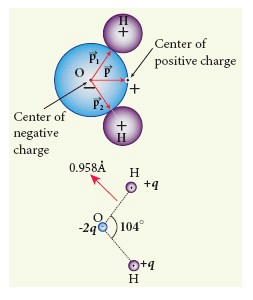
The water molecule (H2O) has this charge configuration. The water molecule has three atoms (two H atom and one O atom). The centers of positive (H) and negative (O) charges of a water molecule lie at different points, hence it possess permanent dipole moment. The electric dipole moment \(\vec { p } \) is directed from center of negative charge to the center of positive charge, as shown in the figure.
38.
(i) The electric field lines start at q2 and end at q1. In figure (a), q2 is positive and q1 is negative. The number of lines starting from q2 is 18 and number of the lines ending at q1 is 6. So q2 has greater magnitude. The ratio of \(\left| \frac { { q }_{ 1 } }{ { q }_{ 2 } } \right| =\frac { { N }_{ 1 } }{ { N }_{ 2 } } =\frac { 6 }{ 18 } =\frac { 1 }{ 3 } \). It implies that |q2| = 3|q1|.
(ii) In figure (b), the number of field lines emanating from both positive charges are equal (N = 18). So the charges are equal. At point A, the electric field lines are denser compared to the lines at point B. So the electric field at point A is greater in magnitude compared to the field at point B. Further, no electric field line passes through C, which implies that the resultant electric field at C due to these two charges is zero.
(iii) In the figure (c), the electric field lines start at q1 and q3 and end at q2. This implies that q1 and q3 are positive charges. The ratio of the number of field lines is \(\left| \frac { { q }_{ 1 } }{ { q }_{ 2 } } \right| =\frac { 8 }{ 16 } =\left| \frac { { q }_{ 3 } }{ { q }_{ 2 } } \right| =\frac { 1 }{ 2 } \), implying that q1 and q3 are half of the magnitude of q2. So q1 = q3 = +10 nc.
39.
Note: A similar problem is solved in XIth Physics volume I, unit 3 section 3.3.2. There are three forces that acts on the mass m:
(i) The downward gravitational force exerted by the Earth (mg)
(ii) The normal force exerted by the inclined surface (N)
(iii) The Coulomb force given by uniform electric field (qE) The free body diagram for the mass m is drawn below.
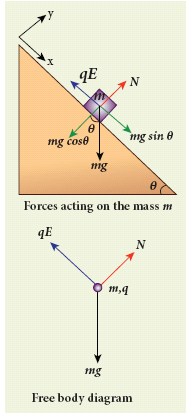
A convenient inertial coordinate system is located in the inclined surface as shown in the figure. The mass m has zero net acceleration both in x and y-direction.
Along x-direction, applying Newton’s second law, we have
mg sinθ\(\hat { i } \) - qE\(\hat { i } \) = 0
mg sinθ - q E = 0
or, E = \(\\ \frac { mgsin\theta }{ q } \)
Note that the magnitude of the electric field is directly proportional to the mass m and inversely proportional to the charge q. It implies that, if the mass is increased by keeping the charge constant, then a strong electric field is required to stop the object from sliding. If the charge is increased by keeping the mass constant, then a weak electric field is sufficient to stop the mass from sliding down the plane.
The electric field also can be expressed in terms of height and the length of the inclined surface of the plane.
E = \(\frac { mgh }{ qL } \).
40.
By using superposition principle, the net electric field at point A is
\(\vec { E_{ A } } =\frac { 1 }{ 4\pi { \varepsilon }_{ 0 } } \frac { { q }_{ 1 } }{ { r }_{ 1A }^{ 2 } } \hat { { r }_{ 1A } } +\frac { 1 }{ 4\pi { \varepsilon }_{ 0 } } \frac { { q }_{ 1 } }{ { r }_{ 2A }^{ 2 } } \hat { { r }_{ 2A } } \)
where r1A and r2A are the distances of point A from the two charges respectively
\(\vec { E_{ A } } =\frac { 9\times 10^{ 4 }\times 1\times { 10 }^{ -6 } }{ (2\times { 10 }^{ -3 })^{ 2 } } (\hat { j } )+\frac { 9\times 10^{ 9 }\times 1\times { 10 }^{ -6 } }{ (2\times 10^{ -3 })^{ 2 } } (\hat { i } )\)\(\)
= 2.25 x 10⁹\(\hat { j } \) + 2.25 x 10⁹\(\hat { i } \) = 2.25 x 10⁹ (\((\hat { i } +\hat { j } )\)
The magnitude of electric field
\(|\vec { { E }_{ A } } |=\sqrt { (2.25\times { 10 }^{ 9 })^{ 2 }+(2.25\times 10^{ 9 })^{ 2 } } \)
= 2.25 x \(\sqrt { 2 } \) x 109 NC-1
The direction of \(\vec { { E }_{ A } } \) is given by \(\frac { \vec { { E }_{ A } } }{ |\vec { { E }_{ A } } | } =\frac { 2.25\times 10^{ 9 }(\hat { i } +\hat { j } ) }{ 2.25\times \sqrt { 2 } \times { 10 }^{ 9 } } =\frac { (\hat { i } +\hat { j } ) }{ \sqrt { 2 } } \), which is the unit vector along OA as shown in the figure.
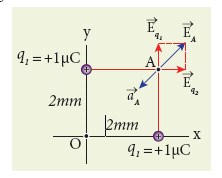
The acceleration experienced by an electron placed at point A is
\(\vec { a_{ A } } =\frac { \vec { F } }{ m } =\frac { q\vec { { E }_{ A } } }{ m } \)
=\(\frac { (-1.6\times 10^{ -19 })\times (2.25\times 10^{ 9 })(\hat { i } +\hat { j } ) }{ 9.1\times { 10 }^{ -31 } } \)
= -3.95 x 10²⁰ \((\hat { i } +\hat { j } )\)Nkg-1
The electron is accelerated in a direction exactly opposite to \(\vec { { E }_{ A } } \).
41.
According to the quantisation of charge
q = ne
Here q = 1C. So the number of electrons in 1 coulomb of charge is
n = \(\frac { q }{ e } =\frac { 1C }{ 1.6\times 10^{ -19 } } \) = 6.25 x 10¹⁸ electrons

12th Standard Syllabus & Materials
12th Standard
TN 12th Computer Applications களப்பெயர் முறைமை (DNS) Sample Question Papers Study Material - QB365 Set A
NEW12th Standard
TN 12th Computer Applications வலையமைப்பு எடுத்துக்காட்டுகள் மற்றும் நெறிமுறைகள் Sample Question Papers Study Material - QB365 Set A
NEW12th Standard
TN 12th Computer Applications கணினி வலையமைப்பு ஓர் அறிமுகம் Sample Question Papers Study Material - QB365 Set A
NEW12th Standard
TN 12th Computer Applications PHP-உடன் MySQL-ஐ இணைத்தல் Sample Question Papers Study Material - QB365 Set A



Tamilnadu Stateboard 12th Standard Subjects

Maths

Chemistry
Physics

Biology

Computer Science

Business Maths and Statistics

Economics

Commerce

Accountancy

History

Computer Applications
Biology
Computer Technology
Computer Applications
Computer Science
Business Maths and Statistics
Commerce
Economics
Maths
Chemistry
Physics
Computer Technology
History
Accountancy

Tamil

English

French
Tamilnadu Stateboard Standards

