
 100% FREE ACCESS
12th Standard Syllabus & Materials
12th Standard
TN 12th Maths Applications of Matrices and Determinants Sample Question Papers Study Material - QB365 Set A
NEW12th Standard
TN 12th Computer Applications மின்னணு தரவு பரிமாற்றம் Sample Question Papers Study Material - QB365 Set A
NEW12th Standard
TN 12th Computer Applications மின் - வணிக பாதுகாப்பு அமைப்புகள் Sample Question Papers Study Material - QB365 Set A
NEW12th Standard
TN 12th Computer Applications மின்னணு செலுத்தல் முறைகள் Sample Question Papers Study Material - QB365 Set A
NEW12th Standard
TN 12th Computer Applications மின் - வணிகம் Sample Question Papers Study Material - QB365 Set A
NEW12th Standard
TN 12th Computer Applications திறந்த மூல கருத்துருக்கள் Sample Question Papers Study Material - QB365 Set A

Published on: 01/09/2022
QB365 provides a detailed and simple solution for every Possible Creative Questions in Class 12 Physics Subject - Electrostatics, English Medium. It will help Students to get more practice questions, Students can Practice these question papers in addition to score best marks.
Download Tamil Nadu 12th Standard Physics question papers, model tests, one-mark questions, important questions, and public exam papers in PDF format. Free study materials and answer keys for TN State Board students.
Questions + Answers key
Take MCQ Physics Test1.
A sphere of charge +Q is fixed. A smaller sphere of charge +q is placed near the larger sphere and released from rest. The small sphere will move away from large sphere with
a. decreasing velocity & decreasing acceleration.
b. decreasing velocity & increasing acceleration.
c. decreasing velocity & constant acceleration
d. increasing velocity & decreasing acceleration
e. increasing velocity & increasing acceleration
Which of the above statement is correct? Explain.
2.
An electric dipole is held in a uniform electric field.
(i) Straight the net force acting on it is zero.
(ii) The dipole is alignment parallel to the field. find the work done in rotating it through the angle of 180o.
3.
(i) Electric field lines donot have sudden breaks why is it so?
(ii) Explain why two field lines never cross each other at any point.
4.
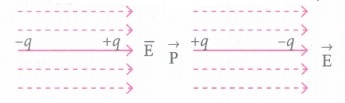
What orientation of an electric dipole in a uniform electric field corresponds to its
(i) stable and
(ii) unstable equilibrium? Depict the orientations.
5.
A charge Q μC is placed at the centre of a cube what would be the
(i) flux through one face?
(ii) flux passing through two opposite faces of the cube?
Electric flux through whole cube \(\frac { Q }{ { \varepsilon }_{ 0 } } \)
6.
What is the electric flux through a cube of side 1 cm which encloses on electric dipole?
7.
(i) Two insulated charged copper spheres A & B of identical size have charges qn and -3qA respectively. When they are brought in contact with each other and then separated. What are the new charges on them?
(ii) When third sphere of some size but uncharged is brought in contact with first and then second and finally removed? What are the new charges.
8.
When we rotate the blades, it starts to rotate as usual. Why it is so?
9.
What is a Capacitor?
10.
What is meant by dielectric breakdown?
11.
What are induced dipoles.
12.
What are Polar molecules? Give examples.
13.
When does a dielectric said to be polarized?
14.
What are Non-polar molecules? State examples.
15.
Give a comparison of electrical and gravitional forces?
1.
(i) At a distance r; the force on the small sphere due to large sphere
\(F=\frac { 1 }{ 4\pi { \varepsilon }_{ 0 } } .\frac { Qq }{ { mr }^{ 2 } } \)
(ii) If m is the mass of small sphere then its acceleration
\(a=\frac { F }{ m } =\frac { 1 }{ 4\pi { \varepsilon }_{ 0 } } .\frac { Qq }{ { mr }^{ 2 } } \)
(iii) As the small sphere is pushed away (i.e. r increased) 'a' decrease.
(iv) As 'a' is always +ve the speed of the small sphere goes on increasing.
(v) ∴ increasing velocity and decreasing acceleration.
(d) is correct
2.
(i) The dipole moment of dipole \(|\overset { \rightarrow }{ P } |=q\times 2a\)
Force on -q at A = -q \(\overset { \rightarrow }{ E } \)
Force on + q at B = +q\(\overset { \rightarrow }{ E } \)
Net force on the dipole = q\(\overset { \rightarrow }{ E } \)- q\(\overset { \rightarrow }{ E } \) = 0
(ii) Work done on dipole when it is rotated through 180°
W = ∆U = pE (cos θ1 - cos θ2)
= pE (cos 0° - cos180o)
= pE(1 - (-1)
W = 2pE
3.
(i) In electric field line is the path of movement of a positive test charge (q0 ⇾ 0) A moving charge experiences a continuous force is an electric field, so field line is always continuous
(ii) The field lines nevel intersect since if they cross, there will be two directions of electric field at the point of intersection, which is impossible.
4.
(i) In stable equilibrium the dipole moment is parallel to he direction of electric field. i.e. θ = 0.
θ = 0o \(\overset { \rightarrow }{ P } \) is parallel to stable \(\overset { \rightarrow }{ E } \) equilibrium
(ii) In unstable equilibrium, P.E. is max., so θ = π. i.e. dipole moment is antiparallel to electric field.
θ = 180°. \(\overset { \rightarrow }{ P } \) is antiparallel
5.
(i) Electric flux through one face \(=\frac { 1 }{ 6 } .\frac { Q }{ { \varepsilon }_{ 0 } } \mu { V }_{ m }\)
(ii) By symmetry the flux through each of the six faces of cube will be same when charge is placed at the centre.
\(\\ \therefore { \phi }_{ E }=\frac { 1 }{ 6 } .\frac { Q }{ { \varepsilon }_{ 0 } } \)
Thus electric flux passing through two opposite faces of the cube
\(=2\times \frac { 1 }{ 6 } .\frac { Q }{ { \varepsilon }_{ 0 } } \)
\(\phi =\frac { 1 }{ 3 } .\frac { Q }{ { \varepsilon }_{ 0 } } \)
6.
Net electric flux is zero because
(i) It is independent to the shape and size
(ii) Net charge of the electric dipole is zero.
7.
(i) Charge on each sphere \(=\frac { { q }_{ A }-{ 3q }_{ A } }{ 2 } =-{ q }_{ A }\)
(ii)New charge on A is \(\frac { { q }_{ A } }{ 2 } \)
New charge on B is \(\frac { { q }_{ A }(2{ q }_{ B }) }{ 4 } \)
\(\because \frac { \frac { { q }_{ A } }{ 2 } +{ q }_{ B } }{ 2 } =\frac { { q }_{ A } }{ 4 } +\frac { q_{ B } }{ 2 } =\frac { { q }_{ A }+2{ q }_{ B } }{ 4 } \)
qB = -3qA
∵ qB = -3qA
∴ New charge on B1 is \(\frac { { q }_{ A }-{ 6q }_{ A } }{ 4 } \)
New charge on B \(-\frac { 5 }{ 4 } { q }_{ A }\)
8.
To rotate any object, there must be a torque applied on the object. For the ceiling fan, the initial torque is given by the capacitor widely known as a condenser. If the condenser is faulty, it will not give sufficient initial torque to rotate the blades when the fan is switched on.
9.
Capacitor is a device used to store electric charge and electrical energy.
10.
When the external electric field applied to a dielectric is very large, it tears the atoms apart so that the bound charges become free charges. Then the dielectric starts to conduct electricity. This is called dielectric breakdown.
11.
When an external electric field is applied, the dipoles inside the polar molecule tend to align in the direction of the electric field. Hence a net dipole moment is induced in it. Then the dielectric is said to be polarized by an external electric field.
12.
(i) In polar molecules, the centers of the positive and negative charges are separated even in the absence of an external electric field.
(ii) They have a permanent dipole moment.
(iii) Examples : H2O, N2O, HCI and NH3.
13.
When an external electric field is applied, the centers of positive and negative charges are separated by a small distance which induces dipole moment in the direction of the external electric field. Then the dielectric is said to be polarized by an external electric field.
14.
(i) A non-polar molecule is one in which centers of positive and negative charges coincide. As a result, it has no permanent dipole moment.
(ii) Examples of non-polar molecules are hydrogen (H2), oxygen (O2), and carbon di oxide (CO2).
15.
(i) Both forces obey inverse square law, F∝\(\frac{1}{r^2}\)
(ii) Both forces are proportional to product of masses or charges.
(iii) Both forces are conservative forces.
(iv) Both forces can operate in vacuum.

12th Standard Syllabus & Materials
12th Standard
TN 12th Computer Applications வலையமைப்பு வடமிடல் Sample Question Papers Study Material - QB365 Set A
NEW12th Standard
TN 12th Computer Applications களப்பெயர் முறைமை (DNS) Sample Question Papers Study Material - QB365 Set A
NEW12th Standard
TN 12th Computer Applications வலையமைப்பு எடுத்துக்காட்டுகள் மற்றும் நெறிமுறைகள் Sample Question Papers Study Material - QB365 Set A
NEW12th Standard
TN 12th Computer Applications கணினி வலையமைப்பு ஓர் அறிமுகம் Sample Question Papers Study Material - QB365 Set A



Tamilnadu Stateboard 12th Standard Subjects

Maths

Chemistry
Physics

Biology

Computer Science

Business Maths and Statistics

Economics

Commerce

Accountancy

History

Computer Applications
Biology
Computer Technology
Computer Applications
Computer Science
Business Maths and Statistics
Commerce
Economics
Maths
Chemistry
Physics
Computer Technology
History
Accountancy

Tamil

English

French
Tamilnadu Stateboard Standards

