
 100% FREE ACCESS
12th Standard Syllabus & Materials
12th Standard
TN 12th Computer Applications மின்னணு தரவு பரிமாற்றம் Sample Question Papers Study Material - QB365 Set A
NEW12th Standard
TN 12th Computer Applications மின் - வணிக பாதுகாப்பு அமைப்புகள் Sample Question Papers Study Material - QB365 Set A
NEW12th Standard
TN 12th Computer Applications மின்னணு செலுத்தல் முறைகள் Sample Question Papers Study Material - QB365 Set A
NEW12th Standard
TN 12th Computer Applications மின் - வணிகம் Sample Question Papers Study Material - QB365 Set A
NEW12th Standard
TN 12th Computer Applications திறந்த மூல கருத்துருக்கள் Sample Question Papers Study Material - QB365 Set A
NEW12th Standard
TN 12th Computer Applications வலையமைப்பு வடமிடல் Sample Question Papers Study Material - QB365 Set A

Published on: 27/01/2021
12th Standard Physics English Medium Electrostatics Reduced Syllabus Important Questions 2021
Download Tamil Nadu 12th Standard Physics question papers, model tests, one-mark questions, important questions, and public exam papers in PDF format. Free study materials and answer keys for TN State Board students.
Questions + Answers key
Take MCQ Physics Test1.
How does the energy stored in a capacitor change it
(i) after disconnecting the battery, the plates of a charged capacitor are moved faster.
(ii) The battery remaining connected capacitance c ∝ \(\frac{1}{d}\), when plates of capacitor.
2.
Gauss law is true for any closed surface, no matter what its shape or size is. Justify.
3.
A point charge Q is placed at point O potential difference VA - VB is positive. Is the charge Q negative or positive?
4.
A sphere of charge +Q is fixed. A smaller sphere of charge +q is placed near the larger sphere and released from rest. The small sphere will move away from large sphere with
a. decreasing velocity & decreasing acceleration.
b. decreasing velocity & increasing acceleration.
c. decreasing velocity & constant acceleration
d. increasing velocity & decreasing acceleration
e. increasing velocity & increasing acceleration
Which of the above statement is correct? Explain.
5.
A charge Q μC is placed at the centre of a cube what would be the
(i) flux through one face?
(ii) flux passing through two opposite faces of the cube?
Electric flux through whole cube \(\frac { Q }{ { \varepsilon }_{ 0 } } \)
6.
What is the electric flux through a cube of side 1 cm which encloses on electric dipole?
7.
What is a Capacitor?
8.
Give a comparison of electrical and gravitional forces?
9.
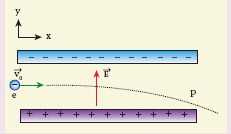
Consider an electron travelling with a speed vo and entering into a uniform electric field \(\vec{E}\) which is perpendicular to \(\vec { { v }_{ 0 } } \) as shown in the Figure. Ignoring gravity, obtain the electron’s acceleration, velocity and position as functions of time.
10.
Define ‘electric field’
11.
Write down Coulomb’s law in vector form and mention what each term represents.
12.
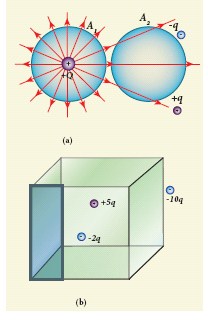
(i) In figure (a), calculate the electric flux through the closed areas A1 and A2.
(ii) In figure (b), calculate the electric flux through the cube.
13.
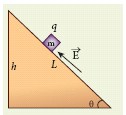
A block of mass m carrying a positive charge q is placed on an insulated frictionless inclined plane as shown in the figure. A uniform electric field E is applied parallel to the inclined surface such that the block is at rest. Calculate the magnitude of the electric field E.
14.
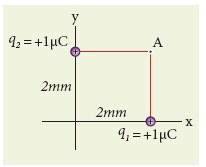
Consider the charge configuration as shown in the figure. Calculate the electric field at point A. If an electron is placed at points A, what is the acceleration experienced by this electron? (mass of the electron = 9.1 x 10⁻³¹ kg and charge of electron = −1.6 x 10⁻¹⁹ C)
15.
Calculate the number of electrons in one coulomb of negative charge.
16.
The unit of electric dipole moment is ________.
volt/metre \([\frac{V}{m}]\)
coulomb / metre\([\frac{C}{m}]\)
volt. metre [Vm]
Coulomb. metre (Cm)
17.
The intensity of the electric field that produces a force of 10-5 N on a charge of 5 μC is
5 x 10-11NC-1
50 NC-1
2 NC-1
0.5 NC-1
18.
Electric field intensity and electric potential are related by_________.
E = -\(\frac{dV}{dt}\)
E = -\(\frac{dV}{dx}\)
E = \(\frac{dV}{dt}\)
E = \(\frac{-dx}{dV}\)
19.
When a point charge of 6mC is moved between two points in an electric field, the work done is 1.8 x 10⁻⁵ J. The potential difference between the two points is
1.08 V
1.08 μV
3 V
30 V
20.
In two concentric hollow spheres of radii r and R (>r), the charge Q is distributed such that their surface densities are some. Then the potential at their common centre is
\(\frac { Q({ R }^{ 2 }+{ r }^{ 2 }) }{ 4\pi { \varepsilon }_{ 0 }(R+r) } \)
\(\frac { QR }{ R+r } \)
zero
\(\frac { Q({ R }+{ r }) }{ 4\pi { \varepsilon }_{ 0 }({ R }^{ 2 }+{ r }^{ 2 }) } \)
21.
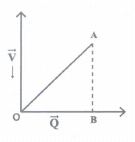
Charge Q on a capacitor varies with voltage V as shown in graph, where Q is along X-axis and V along Y-axis. The area of triangle OAB represents
capacitance
capacitive reactance
magnetic field between the plates
energy stored in the capacitor
22.
A charge Q μ C is placed at the center of a cube. The flux coming out from any surface will be
\(\frac { Q }{ { 24\varepsilon }_{ 0 } } \)
\(\\ \frac { Q }{ { 8\varepsilon }_{ 0 } } \)
\(\frac { Q }{ { 6\varepsilon }_{ 0 } } \times { 10 }^{ -6 }\)
\(\frac { Q }{ { 6\varepsilon }_{ 0 } } \times { 10 }^{ -3 }\)
23.
An uniformly charged conducting shell of 2cm diameter has a surface charge density of 80μC / m2. The charge on the shell is
100.48 nC
100.48 μC
100.48C
100.48 x 10⁻¹²C
24.
The expression for electric potential difference is
\(\int _{ R }^{ P }{ +\overset { \rightarrow }{ E } .\overset { \rightarrow }{ dr } } \)
\(\\ -\int _{ \infty }^{ P }{ +\overset { \rightarrow }{ E } .\overset { \rightarrow }{ dr } } \)
\(\\\int _{ \infty }^{ P }{ \overset { \rightarrow }{ E } .\overset { \rightarrow }{ dr } } \)
\(\int _{ R }^{ P }{ -\overset { \rightarrow }{ E } .\overset { \rightarrow }{ dr } } \)
25.
The electric field created by a _________ is basically a non-uniform electric field.
Test charge
Positive charge
Negative charge
Point charge
26.
The expression for electric field in vector form is
\(\frac { 1 }{ 4\pi { \varepsilon }_{ 0 } } \frac { q }{ r } \hat { r } \)
\(\frac { -1 }{ 4\pi { \varepsilon }_{ 0 } } \frac { q }{ r } \hat { r } \)
\(\frac { -1 }{ 4\pi { \varepsilon }_{ 0 } } \frac { q }{ r^2 } \hat { r } \)
\(\frac { 1 }{ 4\pi { \varepsilon }_{ 0 } } \frac { q }{ r^2 } \hat { r } \)
27.
A force of 40 N is acting between two charges in air if the space between then is filled with glass εr = 8. Then the force between then is __________
20 N
10 N
5 N
the same and does not change
28.
_______ and Coulomb's law form fundamental principles of electrostatics
Newton's law of gravitation
superposition principle
ohm's law
Kepler's law
29.
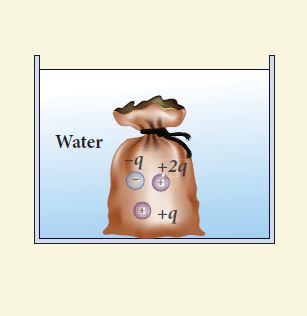
The total electric flux for the following closed surface which is kept inside water
\(\frac { 80q }{ { \varepsilon }_{ 0 } } \)
\(\frac { q }{ { 40\varepsilon }_{ 0 } } \)
\(\frac { q }{ { 80\varepsilon }_{ 0 } } \)
\(\frac { q }{ { 160\varepsilon }_{ 0 } } \)
30.
Which charge configuration produces a uniform electric field?
point charge
uniformly charged infinite line
uniformly charged infinite plane
uniformly charged spherical shell
31.
Define and derive an expression for the energy density in parallel plate capacitor.
32.
Write the special features of Gauss law.
33.
Obtain the expression for capacitance for a parallel plate capacitor.
34.
Obtain Gauss law from Coulomb’s law.
35.
Derive an expression for the torque experienced by a dipole due to a uniform electric field.
36.
Three capacitors each of capacitance 9pF are connected in series
(i) What is the total capacitance of the combination?
(ii) What is the potential difference across each capacitor, if the combination is connected to a 120 V supply.
37.
An electric dipole of length 4cm, when placed with its axis making an angle of 60° with a uniform electric field, experiences a torque of 4√3 Nm. Calculate the potential energy of the dipole, if it has charge ± 8nC.
38.
The electric potential in region is represented as V = 2x + 3y - z. Obtain an expression for electric field strength.
39.
A capacitor of capacity 10μF is subjected to charge by a battery of 10V. Calculate the energy stored in the capacitor.
40.
How many electrons are there in one coulomb of negative charge?
41.
A thin metallic spherical shell of radius R carries a charge Q on its surface. A point charge \(\frac{Q}{2}\) is placed at the centre C and another is placed at the centre C and another a distance x from the centre as shown in the figure.
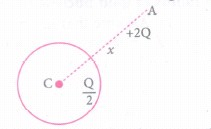
(i) Find the electric flux through the shell.
(ii) Find the force on the charges at C and A.
42.
Derive the expression for resultant capacitance, when capacitors are connected in series and in parallel.
43.
Explain in detail the effect of a dielectric placed in a parallel plate capacitor.
1.
(i) After disconnecting the battery, the charge on capacitor remains constant.
∴ energy stored capacitor \(\left( U=\frac { { q }^{ 2 } }{ 2C } \right) \)
(ii) As the battery remains connected, the potential difference remains constant.
Hence energy stored U = \(\frac{1}{2}\) CV2 decreases.
2.
This is due to the fact that
(i) electric field is radial
(ii) electric field E ∝ \(\frac{1}{R^2}\)
3.
The electric potential \(V=\frac { 1 }{ 4\pi { \varepsilon }_{ 0 } } .\frac { Q }{ r } \)
\(\\ V=\frac { 1 }{ r }\)
The potential due to a point charge decreases with increase of distance.
VA - VB > 0 ⇒ VA > VB
Hence the charge Q is positive.
4.
(i) At a distance r; the force on the small sphere due to large sphere
\(F=\frac { 1 }{ 4\pi { \varepsilon }_{ 0 } } .\frac { Qq }{ { mr }^{ 2 } } \)
(ii) If m is the mass of small sphere then its acceleration
\(a=\frac { F }{ m } =\frac { 1 }{ 4\pi { \varepsilon }_{ 0 } } .\frac { Qq }{ { mr }^{ 2 } } \)
(iii) As the small sphere is pushed away (i.e. r increased) 'a' decrease.
(iv) As 'a' is always +ve the speed of the small sphere goes on increasing.
(v) ∴ increasing velocity and decreasing acceleration.
(d) is correct
5.
(i) Electric flux through one face \(=\frac { 1 }{ 6 } .\frac { Q }{ { \varepsilon }_{ 0 } } \mu { V }_{ m }\)
(ii) By symmetry the flux through each of the six faces of cube will be same when charge is placed at the centre.
\(\\ \therefore { \phi }_{ E }=\frac { 1 }{ 6 } .\frac { Q }{ { \varepsilon }_{ 0 } } \)
Thus electric flux passing through two opposite faces of the cube
\(=2\times \frac { 1 }{ 6 } .\frac { Q }{ { \varepsilon }_{ 0 } } \)
\(\phi =\frac { 1 }{ 3 } .\frac { Q }{ { \varepsilon }_{ 0 } } \)
6.
Net electric flux is zero because
(i) It is independent to the shape and size
(ii) Net charge of the electric dipole is zero.
7.
Capacitor is a device used to store electric charge and electrical energy.
8.
(i) Both forces obey inverse square law, F∝\(\frac{1}{r^2}\)
(ii) Both forces are proportional to product of masses or charges.
(iii) Both forces are conservative forces.
(iv) Both forces can operate in vacuum.
9.
(a) Acceleration of the electron \(a=\frac{F}{m}\)
Electrostatic force F = - eE
\(a=\frac{F}{m}=\frac{-e E \hat{j}}{m}\) ... ( 1)
(b) Let velocity of the electron be \(\vec{v}\)
v = u + at ...(2)
Here, \( u=v_{0} \hat{i} \), \(a=\frac{-e \bar{E}}{m} \hat{j}\)
Substituting these values in the equation (2) we get
\(\therefore \vec{v}=\nu_{0} \hat{i}-\frac{e E}{m} t \hat{j}\)
(c) Displacement \(\vec{r}\) represents position,
\( s=u t+\frac{1}{2} a t^{2} \) ...(3)
Let, \(s=\hat{r} \) and Here, \(u=v_{0} \hat{i} \), \(a=\frac{-e E}{m} \hat{j}\)
Substituting these values in the equation (3), we get,
\(\hat{r}=v_{0} t \hat{i}-\frac{1}{2} \frac{e E}{m} t^{2} \hat{j}\)
10.
Electric field at the point P at a distance r from the point charge q is the force experienced by a unit positive placed at that point P and is given by
\(\vec { E } =\frac { \vec { F } }{ q_{ 0 } } =\frac { kq }{ { r }^{ 2 } } \hat { r } =\frac { 1 }{ 4\pi { \varepsilon }_{ 0 } } \frac { q }{ { r }^{ 2 } } \hat { r } \)
where \(\hat{r}\) is the unit vector pointing from q to the point of interest P.
11.
Coulomb's law \(\overrightarrow{F_{21}}=\frac{k q_{1} q_{2}}{r^{2}} \hat{r}_{12}\)
where, q1 - charge; q2 - charge
r - distance between the charges
\(\hat{r}_{12}\)- the unit vector directed from charge q1 to charge q2
k = Proportionality constant
12.
(i) In figure (a), area A1 encloses the charge Q. So electric flux through this closed surface A1 is \(\frac { Q }{ { \varepsilon }_{ 0 } } \). But the closed surface A2 contains no charges inside, so electric flux through A2 is zero.
(ii) In figure (b), the net charge inside the cube is 3q and the total electric flux in the cube is therefore \(\Phi _{ E }=\frac { 3q }{ { \varepsilon }_{ 0 } } \).
Note that the charge -10 q lies outside the cube and it will not contribute the total flux through the surface of the cube.
13.
Note: A similar problem is solved in XIth Physics volume I, unit 3 section 3.3.2. There are three forces that acts on the mass m:
(i) The downward gravitational force exerted by the Earth (mg)
(ii) The normal force exerted by the inclined surface (N)
(iii) The Coulomb force given by uniform electric field (qE) The free body diagram for the mass m is drawn below.
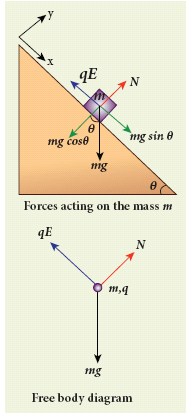
A convenient inertial coordinate system is located in the inclined surface as shown in the figure. The mass m has zero net acceleration both in x and y-direction.
Along x-direction, applying Newton’s second law, we have
mg sinθ\(\hat { i } \) - qE\(\hat { i } \) = 0
mg sinθ - q E = 0
or, E = \(\\ \frac { mgsin\theta }{ q } \)
Note that the magnitude of the electric field is directly proportional to the mass m and inversely proportional to the charge q. It implies that, if the mass is increased by keeping the charge constant, then a strong electric field is required to stop the object from sliding. If the charge is increased by keeping the mass constant, then a weak electric field is sufficient to stop the mass from sliding down the plane.
The electric field also can be expressed in terms of height and the length of the inclined surface of the plane.
E = \(\frac { mgh }{ qL } \).
14.
By using superposition principle, the net electric field at point A is
\(\vec { E_{ A } } =\frac { 1 }{ 4\pi { \varepsilon }_{ 0 } } \frac { { q }_{ 1 } }{ { r }_{ 1A }^{ 2 } } \hat { { r }_{ 1A } } +\frac { 1 }{ 4\pi { \varepsilon }_{ 0 } } \frac { { q }_{ 1 } }{ { r }_{ 2A }^{ 2 } } \hat { { r }_{ 2A } } \)
where r1A and r2A are the distances of point A from the two charges respectively
\(\vec { E_{ A } } =\frac { 9\times 10^{ 4 }\times 1\times { 10 }^{ -6 } }{ (2\times { 10 }^{ -3 })^{ 2 } } (\hat { j } )+\frac { 9\times 10^{ 9 }\times 1\times { 10 }^{ -6 } }{ (2\times 10^{ -3 })^{ 2 } } (\hat { i } )\)\(\)
= 2.25 x 10⁹\(\hat { j } \) + 2.25 x 10⁹\(\hat { i } \) = 2.25 x 10⁹ (\((\hat { i } +\hat { j } )\)
The magnitude of electric field
\(|\vec { { E }_{ A } } |=\sqrt { (2.25\times { 10 }^{ 9 })^{ 2 }+(2.25\times 10^{ 9 })^{ 2 } } \)
= 2.25 x \(\sqrt { 2 } \) x 109 NC-1
The direction of \(\vec { { E }_{ A } } \) is given by \(\frac { \vec { { E }_{ A } } }{ |\vec { { E }_{ A } } | } =\frac { 2.25\times 10^{ 9 }(\hat { i } +\hat { j } ) }{ 2.25\times \sqrt { 2 } \times { 10 }^{ 9 } } =\frac { (\hat { i } +\hat { j } ) }{ \sqrt { 2 } } \), which is the unit vector along OA as shown in the figure.
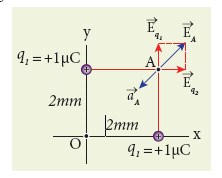
The acceleration experienced by an electron placed at point A is
\(\vec { a_{ A } } =\frac { \vec { F } }{ m } =\frac { q\vec { { E }_{ A } } }{ m } \)
=\(\frac { (-1.6\times 10^{ -19 })\times (2.25\times 10^{ 9 })(\hat { i } +\hat { j } ) }{ 9.1\times { 10 }^{ -31 } } \)
= -3.95 x 10²⁰ \((\hat { i } +\hat { j } )\)Nkg-1
The electron is accelerated in a direction exactly opposite to \(\vec { { E }_{ A } } \).
15.
According to the quantisation of charge
q = ne
Here q = 1C. So the number of electrons in 1 coulomb of charge is
n = \(\frac { q }{ e } =\frac { 1C }{ 1.6\times 10^{ -19 } } \) = 6.25 x 10¹⁸ electrons
16.
(d)
Coulomb. metre (Cm)
17.
(c)
2 NC-1
18.
(b)
E = -\(\frac{dV}{dx}\)
19.
(c)
3 V
20.
(d)
\(\frac { Q({ R }+{ r }) }{ 4\pi { \varepsilon }_{ 0 }({ R }^{ 2 }+{ r }^{ 2 }) } \)
21.
(d)
energy stored in the capacitor
22.
(c)
\(\frac { Q }{ { 6\varepsilon }_{ 0 } } \times { 10 }^{ -6 }\)
23.
(a)
100.48 nC
24.
(d)
\(\int _{ R }^{ P }{ -\overset { \rightarrow }{ E } .\overset { \rightarrow }{ dr } } \)
25.
(d)
Point charge
26.
(d)
\(\frac { 1 }{ 4\pi { \varepsilon }_{ 0 } } \frac { q }{ r^2 } \hat { r } \)
27.
(c)
5 N
28.
(b)
superposition principle
29.
\(Φ=\frac { q_{net} }{ { \varepsilon }_{ 0 } } \)
qnet = - q + q + 2q = 2q
Relative permittivity of water = 80
\(\therefore Φ=\frac { q }{{ \varepsilon }_{ r } { \varepsilon }_{ 0 } } \)
\(=\frac{2q}{{ 80 \times \varepsilon }_{ 0 }}=\frac{q}{{ 40 \varepsilon }_{ 0 }}\)
30.
(c)
uniformly charged infinite plane
31.
Energy stored in the capacitor
\(U=\frac { 1 }{ 2 } { Cv }^{ 2 }\quad \quad ...(1)\)
This is rewritten as using \(C=\frac { { \varepsilon }_{ 0 }A }{ d } \& Ed=V\)
\(U=\frac { 1 }{ 2 } \left( \frac { { \varepsilon }_{ 0 }A }{ d } \right) { (Ed })^{ 2 }=\frac { 1 }{ 2 } { \varepsilon }_{ 0 }(Ad)\quad { E }^{ 2 }...(2)\)
where Ad = volume of the space between the capacitor plates. The energy stored per unit volume of space is defined as energy density \({ U }_{ E }=\frac { U }{ Volume } \) From equation (4),
We get
\({ u }_{ E }=\frac { 1 }{ 2 } { \varepsilon }_{ 0 }{ E }^{ 2 }\quad \quad \quad \quad \quad ...(3)\)
(iv) The energy density depends only on the electric field and not on the size of the plates of the capacitor.
32.
(i) The total electric flux through the closed surface depends only on the charges enclosed by the surface and the charges present outside the surface will not contribute to the flux and the shape of the closed surface which can be chosen arbitrarily.
(ii) The total electric flux is independent of the location of the charges inside the closed surface.
(iii) To arnve at equation \(\Phi =\oint { \overset { \rightarrow }{ E } .d\overset { \rightarrow }{ A } } =\frac { { Q }_{ encl } }{ { \varepsilon }_{ 0 } } \) is chosen a spherical surface. This imaginary surface is called a Gaussian surface. The shape of the Gaussian surface to be chosen depends on the type of charge configuration and the kind of symmetry existing in that charge configuration. The electric field is spherically symmetric for a point charge, therefore spherical Gaussian surface is chosen. cylindrical and planar Gaussian surfaces can be chosen for other kinds of charge configurations.
(iv) In the L.H.S of equation \(\Phi =\oint { \overset { \rightarrow }{ E } .d\overset { \rightarrow }{ A } } =\frac { { Q }_{ encl } }{ { \varepsilon }_{ 0 } } \) the electric field \(\overset { \rightarrow }{ E } \) is due to charges present inside and outside the Gaussian surface but the charge Qencl denotes the charges which lie only inside the Gaussian surface.
(v) The Gaussian surface cannot pass through any discrete charge but it can pass through continuous charge distributions. It is because, very close to the discrete charges, the electric field is not well defined.
(vi) Gauss law is another form of Coulomb's law and it is also applicable to the charges in motion. Because of this reason, Gauss law is treated as much more general law than Coulomb's law.
33.
Capacitance of a parallel plate capacitor:
(i) Consider a capacitor with two parallel plates each of cross-sectional area A and separated by a distance d as shown in Figure.
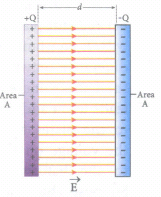
(ii) The electric field between two infinite parallel plates is uniform and is given by \(E=\frac { \sigma }{ { \varepsilon }_{ o} } \) where σ is the surface charge density on the plates \(\left( \sigma =\frac { Q }{ A } \right) \).
iii) If the separation distance d is very much smaller than the size of the plate (d2 < < A), then the above result is used even for finite-sized parallel plate capacitor.
The electric field between the plates is
\(E=\frac { Q }{ A{ \varepsilon }_{ 0 } } ...(1)\)
iv) Since the electric field is uniform, the electric potential between the plates having separation d is given by
\(V=Ed=\frac { Qd }{ A{ \varepsilon }_{ 0 } } \quad \quad \quad ...(2)\)
Therefore the capacitance of the capacitor is given by
\(C=\frac { Q }{ V } =\frac { Q }{ \left( \frac { Qd }{ A{ \varepsilon }_{ 0 } } \right) } =\frac { { \varepsilon }_{ 0 }A }{ d } \quad \quad ....(3)\)
(v) From equation (3), it is evident that capacitance is directly proportional to the area of cross section and is inversely proportional to the distance between the plates.
34.
Gauss law:
(i) A positive point charge Q is surrounded by an imaginary sphere of radius r as shown in Figure. then the total electric flux through the closed surface of the sphere is
\(\Phi_E =\oint { \vec { E } .d\vec { A } =\oint { Ed } Acos\theta } \) .....(1)
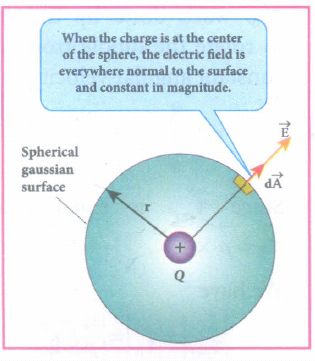
(ii) The electric field of the point charge is directed radially outward at all points on the surface of the sphere. Therefore, the direction of the area element \(d\vec { A } \) is along the electric field \(\vec { E } \) and θ = 0o.
\(\\ \Phi_E =\oint { EdA } \) Since cos0o = 1 ......(2)
iii) E is uniform on the surface of the sphere,
\(\\ \Phi_E=E\oint { dA } \) .......(3)
Substituting for \(\oint { dA=4{ \pi r }^{ 2 } } \) and \(E=\frac { 1 }{ 4\pi { \varepsilon }_{ 0 } } \frac { Q }{ { r }^{ 2 } } \) in eqn (3), we get
\(\therefore \phi E=4{ \pi r }^{ 2 }E\)
\({ \phi }_{ E }=\frac { 1 }{ 4\pi { \varepsilon }_{ 0 } } \frac { Q }{ { r }^{ 2 } } \times { 4\pi r }^{ 2 }=4\pi \frac { 1 }{ 4\pi { \varepsilon }_{ 0 } } Q\)
\({ \phi }_{ E }=\frac { Q }{ { \varepsilon }_{ 0 } } \) .....(4)
The equation (4) is called as Gauss's law.
35.
Torque experienced by an electric dipole in the uniform electric field:
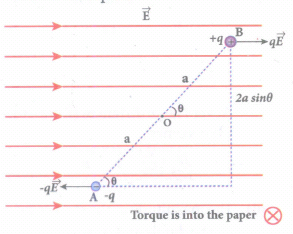
Consider an electric dipole of dipole moment \(\vec { p } \) placed in a uniform electric field \(\vec { E } \) whose field lines are equally spaced and point in the same direction. The charge +q will experience a force \(q\vec { E } \) in the direction of the field and charge -q will experience a force \(-q\vec { E } \) in a direction opposite to the field. Since the external field \(\vec { E } \) is uniform, the total force acting on the dipole is zero. These two forces acting at different points will constitute a couple and the dipole experience a torque. This torque tends to rotate the dipole.
The total torque on the dipole about the point O
\(\vec{\tau}=\overrightarrow{O A} \times(-q \vec{E})+\overrightarrow{O B} \times q \vec{E}\) ......(1)
Using right-hand corkscrew rule, it is found that total torque is perpendicular to the plane of the paper and is directed into it.
The magnitude of the total torque
\(\tau =|\vec { OA } |\left( -q\vec { E } \right) |sin\theta +|\vec { OB } ||\vec { E } |sin\theta \)
\(\tau =qE.2a\quad sin\theta \) ....(2)
where θ is the angle made by \(\vec { p } \) with \(\vec { E } \) since p = 2aq, the torque is written in terms of the vector product as
\(\vec { \tau } =\vec { p } \times \vec { E } \) ...(3)
The magnitude of this torque is \(\tau \) = pEsin \(\theta \) and is maximum when θ = 90o.
This torque tends to rotate the dipole and align it with the electric field \(\vec{E}\). Once \(\vec{p}\) is aligned with \(\vec{E}\), the total torque on the dipole becomes zero.
36.
Here, C1 = C2 = C3 = 9 pF
Voltage, V2 = 120V
(i) Total capacitance in series combination,
\(\frac { 1 }{ { C }_{ s } } =\frac { 1 }{ { C }_{ 1 } } +\frac { 1 }{ { C }_{ 2 } } +\frac { 1 }{ { C }_{ 3 } } =\frac { 1 }{ 9 } +\frac { 1 }{ 9 } +\frac { 1 }{ 9 } \)
\(\frac { 1 }{ { C }_{ s } } =\frac { 3 }{ 9 } \)
\(\Rightarrow { C }_{ s }=3pE\)
(ii) Total charge, q = v x Cs
where V = 120 V
q = 120 x 3 x 10-9
= 360 pC
∴ Potential difference across \({ C }_{ 1 },{ V }_{ 1 }=\frac { 9 }{ { C }_{ 1 } } \)
\(=\frac { 360\times 10^{ -12 } }{ 9\times { 10 }^{ -12 } } =10V\)
\({ V }_{ 2 }=\frac { q }{ { C }_{ 2 } } =\frac { 360 }{ 9 } =40V\)
\({ V }_{ 3 }=\frac { q }{ { C }_{ 3 } } =\frac { 360 }{ 9 } =40V\)
∴ Potential difference across each capacitor is 40V.
37.
Length, I = 2a = 4cm = 4 x 10⁻²m
Angle, θ = 60°
torque ፔ = 4√3 Nm
Charge, Q = 8 x 10⁻⁹C
We know that, ፔ = pE sine [where p = Q x 2a]
ፔ = (Q x 2a)E sinθ
\(\tau =\frac { \partial }{ Q\times (2a)sin\theta } \)
\(=\frac { 4\sqrt { 3 } }{ 8\times { 10 }^{ -9 }\times 4\times { 10 }^{ -2 }\times { sin\quad 60 }^{ 0 } } \)
∴ Potential energy, U = -pE cosθ
= -Q(2a) x E x cosθ
\(=-8\times { 10 }^{ -9 }\times 4\times { 10 }^{ -2 }\times \frac { 4\sqrt { 3 } \times cos{ 60 }^{ 0 } }{ 8\times { 10 }^{ -9 }\times 4\times { 10 }^{ -2 }sin{ 60 }^{ 0 } } \)
\(U=\frac { -4\sqrt { 3 } }{ \sqrt { 3 } } =-4J\)
38.
\(E=-\left[ \frac { \partial V }{ \partial x } \hat { i } +\frac { \partial V }{ \partial y } \hat { j } +\frac { \partial V }{ \partial z } \hat { k } \right] \)
\(\frac { \partial V }{ \partial x } =\frac { \partial }{ \partial x } (2x+3y-z)=2\)
\(\frac { \partial V }{ \partial y } =3;\frac { \partial V }{ \partial z } =-1\)
∴ Electric field, E \(\\ =-2\hat { i } -3\hat { j } +1\hat { k } \)
39.
Capacitance, C = 10μF = 10 x 10-6F
Voltage, V = 10V
Energy, E = ?
Energy stored in the capacitor, E = \(\frac{1}{23}CV^2\)
= \(\frac{1}{2}\) x 10 x 10-6 x 10 x 10
= 5 x 10⁻⁴ J
40.
Charge of an electron, e = 1.6 x 10⁻¹⁹C
q = 1C
∴ No of electrons, n = \(\frac{q}{e}\)
\(n=\frac { 1 }{ 1.6\times { 10 }^{ -19 } } \)
= 6.25 x 10¹⁸
n = 6.25 x 10¹⁸ electrons
41.
(i) Electric flux \(\phi =\frac { Total\ enclosed\ charge }{ { \varepsilon }_{ 0 } } \)
Net charge enclosed inside the shell q = 0
∴ electric flux through the shell \(\frac { q }{ { \varepsilon }_{ 0 } } =0\)
(ii) The electric field or net charge inside the spherical conducting shell is zero.
Hence the force on charge \(\frac{Q}{2}\)is zero.
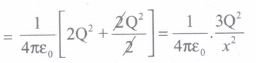
Force on charge at \(A,{ F }_{ A }=\frac { 1 }{ 4\pi { \varepsilon }_{ 0 } } .\frac { 2Q\left( Q+\frac { Q }{ 2 } \right) }{ { x }^{ 2 } } \)
42.
(a) Capacitor in series
(i) Consider three capacitors of capacitance C1, C2 and C3 connected in series with a battery of voltage V as shown in the Figure (a).
(ii) As soon as the battery is connected to the capacitors in series, the electrons of charge -Q are transferred from negative terminal to the right plate of C3 which pushes the electrons of same amount -Q from left plate of C3 to the right plate of C2 due to electrostatic induction.
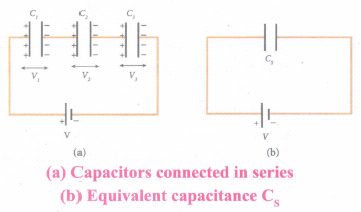
(iii) Similarly, the left plate of C2 pushes the charges of -Q to the right plate of C1 which induces the positive charge +Q on the left plate of C1.
(iv) At the same time, electrons of charge -Q are transferred from left plate of C1 to positive terminal of the battery.
(v) By these processes, each capacitor stores the same amount of charge Q.
(vi) The capacitances of the capacitors are in general different so that the voltage across each capacitor is also different and are denoted as V1, V2 and V3 respectively.
(vii) The sum voltage across capacitor must be equal to the voltage of the battery.
V = V1 + V2 + V3 ....(1)
Since, Q = CV
We have V = \(\frac { Q }{ { C }_{ 1 } } +\frac { Q }{ { C }_{ 2 } } +\frac { Q }{ { C }_{ 3 } } \)
\(=Q\left[ \frac { 1 }{ { C }_{ 1 } } +\frac { 1 }{ { C }_{ 2 } } +\frac { 1 }{ { C }_{ 3 } } \right] ...(2)\)
(viii) If three capacitors in series are considered to form an equivalent single capacitor Cs shown in Figure (b), then we have \(V=\frac { Q }{ { C }_{ s } } \). Substituting this expression into equation (2), we get
\(\frac { Q }{ { C }_{ s } } =Q\left( \frac { 1 }{ { C }_{ 1 } } +\frac { 1 }{ { C }_{ 2 } } +\frac { 1 }{ { C }_{ 3 } } \right) \)
\(\frac { 1 }{ { C }_{ s } } =\frac { 1 }{ { C }_{ 1 } } +\frac { 1 }{ { C }_{ 2 } } +\frac { 1 }{ { C }_{ 3 } } \) ...(3)
(ix) Thus, the inverse of the equivalent capacitance Cs of three capacitors connected in series is equal to the sum of the inverses of each capacitance. This equivalent capacitance Cs, is always less than the smallest individual capacitance in the series.
(b) Capacitor in parallel
i) Consider three capacitors of capacitance C1, C2 and C3 connected in parallel with a battery of voltage V as shown in Figure (a).
ii) Since corresponding sides of the capacitors are connected to the same positive and negative terminals of the battery, the voltage across each capacitor is equal to the battery's voltage.
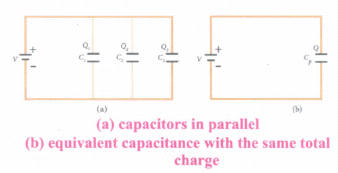
iii) Since capacitance of the capacitors is different, the charge stored in each capacitor is not the same. Let the charge stored in the three capacitors be Q1, Q2, and Q3 respectively.
iv) According to the law of conservation of total charge, the sum of these three charges is equal to the charge Q transferred by the battery,
Q = Q1 + Q2 + Q3 ...(4)
Now, since Q = CV, we have
Q = C1V + C2V + C3V ...(5)
(v) If these three capacitors are considered to form a single capacitance C, which stores the total charge Q as shown in the Figure (b), then we can write Q = CpV. Substituting this in equation (2), we get
CpV = C1V + C2V + C3V
Cp = C1+ C2 + C3 ...(6)
vi) Thus, the equivalent capacitance of capacitors connected in parallel is equal to the sum of the individual capacitances.
vii) The equivalent capacitance Cp, in a parallel connection is always greater than the largest individual capacitance. In a parallel connection, it is equivalent as area of each capacitance adds to give more effective area such that total capacitance increases.
43.
Effect of dielectrics in capacitors:
Suppose dielectrics like mica, glass or paper are introduced between the plates, then the capacitance of the capacitor is altered. The dielectric can be inserted into the plates in two different ways.
(i) when the capacitor is disconnected from the battery.
(ii) when the capacitor is connected to the battery.
(i) When the capacitor is disconnected from the battery
Consider a capacitor with two parallel plates each of cross-sectional area A and are separated by a distance d. The capacitor is charged by a battery of voltage Vo and the charge stored is Qo. The capacitance of the capacitor without the dielectric is,
\(C_{0}=\frac{Q_{0}}{V_{0}}\) ....(i)
The battery is then disconnected from the capacitor and the dielectric is inserted between the plates. This is shown in Figure.
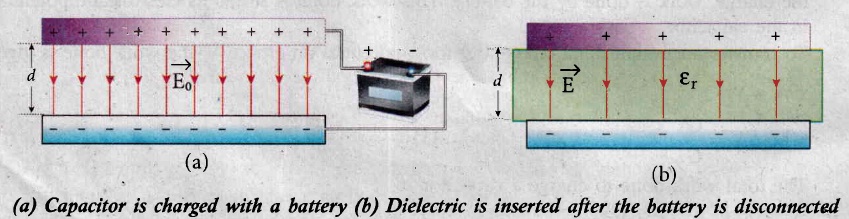
The introduction of dielectric between the plates will decrease the electric field. Experimentally it is found that the modified electric field is given by,
\(E=\frac{E_{0}}{\varepsilon_{r}}\) ....(2)
Here Eo is the electric field inside the capacitors when there is no dielectric and \(\varepsilon_{\mathrm{r}}\) is the relative permittivity of the dielectric or simply known as the dielectric constant. Since \(\varepsilon_{\mathrm{r}}\) > 1, the electric field E < Eo.
As a result, the electrostatic potential difference between the plates (V = Ed) is also reduced. But at the same time, the charge Qo will remain constant once the battery is disconnected.
Hence the new potential difference is
\(V=E d=\frac{E_{0}}{\varepsilon_{r}} d=\frac{V_{0}}{\varepsilon_{r}}\) .......(3)
We know that capacitance is inversely proportional to the potential difference. Therefore as V decreases, C increases.
Thus new capacitance in the presence of a dielectric is
\(C=\frac{Q_{0}}{V}=\varepsilon_{r} \frac{Q_{0}}{V_{0}}=\varepsilon_{r} C_{0}\) ......(4)
Since \(\varepsilon_{\mathrm{r}}\) > 1, we have C > Co. Thus insertion of the dielectric increases the capacitance.
We know that, Co =\(\frac{\varepsilon_{\mathrm{o}} A}{d}\) ...........(5)
Equation (4) ⇒ \(C=\frac{\varepsilon_{r} \varepsilon_{0} A}{d}=\frac{\varepsilon A}{d} \) ..........(6)
where \(\varepsilon=\varepsilon_{\mathrm{r}} \varepsilon_{\mathrm{o}}\) is the permittivity of the dielectric medium.
The energy stored in the capacitor before the insertion of a dielectric is given by,
\(U_{0}=\frac{1}{2} \frac{Q_{0}^{2}}{C_{0}}\) .......(7)
After the dielectric is inserted, the charge Qo remains constant but the capacitance is increased. As a result, the stored energy is decreased.
\(U=\frac{1}{2} \frac{Q_{0}^{2}}{C}=\frac{1}{2} \frac{Q_{0}^{2}}{\varepsilon_{r} C_{0}}=\frac{U_{0}}{\varepsilon_{r}}\) ..........(8)
Since \(\varepsilon_{\mathrm{r}}\) > 1we get U < Uo. There is a decrease in energy because, when the dielectric is inserted, the capacitor spends some energy in pulling the dielectric inside.
(ii) When the battery remains connected to the capacitor:
When the battery of voltage vo remains connected to the capacitor and the dielectric is inserted into the capacitor, then
(a) The potential difference vo across the plates remains constant.
(b) The charge stored in the capacitor is increased by a factor \(\varepsilon_{\mathrm{r}}\). (Experimentally found).
.jpg)
\({Q}=\varepsilon_{r} Q_{0}\) .......(1)
Due to this increased charge, the capacitance is also increased. The new capacitance is,
\(C=\frac{Q}{V_{0}}=\varepsilon_{r} \frac{Q_{0}}{V_{0}}=\varepsilon_{r} C_{0}\) ......(2)
However the reason for the increase in capacitance in this case where the battery remains connected is different from the case when the battery is disconnected before introducing the dielectric.
The energy stored in the capacitor before the insertion of a dielectric is given by,
\(U_{0}=\frac{1}{2} C_{0} V_{0}^{2}\) ....(4)
After the dielectric is inserted, the capacitance is increased; hence the stored energy is also increased.
\( U=\frac{1}{2} C V_{0}^{2}=\frac{1}{2} \varepsilon_{r} C_{0} V_{0}^{2}=\varepsilon_{r} U_{0} \) .....(5)
\(Since \ \varepsilon_{r}>1\ we \ have \ U>U_{o}.\)
Note: Here we have not used the expression \(U_o=\frac{1}{2}\frac{Q_0^2}{C_0}\)because here, both charge and capacitance are changed, whereas in equation (4), Vo remains constant.
Since voltage between the capacitor Vo is constant, the electric field between the plates also remains constant .The energy density is given by,
\(u=\frac{1}{2} \varepsilon E_{0}^{2}\) ..(6)
where ε is the permittivity of the given dielectric material.

12th Standard Syllabus & Materials
12th Standard
TN 12th Computer Applications களப்பெயர் முறைமை (DNS) Sample Question Papers Study Material - QB365 Set A
NEW12th Standard
TN 12th Computer Applications வலையமைப்பு எடுத்துக்காட்டுகள் மற்றும் நெறிமுறைகள் Sample Question Papers Study Material - QB365 Set A
NEW12th Standard
TN 12th Computer Applications கணினி வலையமைப்பு ஓர் அறிமுகம் Sample Question Papers Study Material - QB365 Set A
NEW12th Standard
TN 12th Computer Applications PHP-உடன் MySQL-ஐ இணைத்தல் Sample Question Papers Study Material - QB365 Set A



Tamilnadu Stateboard 12th Standard Subjects

Maths

Chemistry
Physics

Biology

Computer Science

Business Maths and Statistics

Economics

Commerce

Accountancy

History

Computer Applications
Biology
Computer Technology
Computer Applications
Computer Science
Business Maths and Statistics
Commerce
Economics
Maths
Chemistry
Physics
Computer Technology
History
Accountancy

Tamil

English

French
Tamilnadu Stateboard Standards

